-
Lucy and the Lost Star
S6;E22
~ February 26, 1968

Synopsis
Lucy
and Viv break down in the middle of nowhere and happen upon Joan
Crawford’s house to call for help. Because Crawford is remodeling
and has no furniture, they believe her to be broke and arrange to
star her in a show so that producers will offer her work.Regular
CastLucille
Ball (Lucy
Carmichael / “Rusty”),
Gale
Gordon
(Theodore J. Mooney / “Scarface”)Roy
Roberts
(Harrison Winfield Cheever) and Mary
Jane Croft (Mary
Jane Lewis) do not appear in this episode.Guest
Cast
Joan
Crawford (Herself
/ “Cynthia”) was
born Lucille Fay LeSueur on March 23, 1905. She made her film debut
in 1925.
Mildred
Pierce (1945)
gave her an opportunity to show her range as an actress, and her
performance garnered Crawford her first, and only, Oscar for Best
Actress. She earned two additional Oscar nominations; in 1947 for Possessed; and in 1952 for Sudden Fear. In 1962 she and Bette
Davis
co-starred
in What
Ever Happened to Baby Jane?
(1962). Their longstanding rivalry may have helped fuel their phenomenally
well-received performances.
Crawford made her final screen appearance in 1970. She
died in 1977 at age 72. She was the subject of a tell-all 1978
biography and biopic titled Mommie
Dearest
(1982).
Vivian
Vance
(Viv Bunson / “Cuddles”) makes
her final appearance in the role she created, Lucy’s best friend
and former housemate, Vivian Bagley (now Bunson). Vance was born
Vivian Roberta Jones in Cherryvale, Kansas in 1909, although her
family quickly moved to Albuquerque, New Mexico where she was
raised. She had extensive theatre experience, co-starring on Broadway
with Ethel Merman in Anything
Goes.
She was acting in a play in Southern California when she was spotted
by Desi Arnaz and hired to play Ethel Mertz, Lucy Ricardo’s
neighbor and best friend. The pairing is credited with much of the
success of “I Love Lucy.” She made half a dozen appearances on “Here’s
Lucy,” as well as joining Ball for a TV special “Lucy Calls the
President” in 1977. Vance died two years later.Viv Bunson is on a ten day vacation to California. Lucy are taking a Sunday drive to see the Pacific Ocean as the episode begins.

Lew
Parker
(Lew, Joan’s Agent) is
probably best remembered as the restaurateur father of Ann Marie,
Marlo Thomas’ character on TV’s “That Girl” (1966-71). This
is the last of his five appearances on “The Lucy Show” and he
will return for two episodes of “Here’s Lucy.”In the original script, the character was named Joel, but it was probably Lucy who suggested Parker use his real name, something she preferred.

Sid
Gould (“Speakeasy Waiter,”
uncredited) made more than 45 appearances on “The Lucy Show,” all
as background characters. He also did 40 episodes of “Here’s
Lucy.” Gould (born Sydney Greenfader) was Lucille Ball’s cousin
by marriage to Gary Morton.Tony Dante (Speakeasy Patron, uncredited) made more than 20 uncredited appearances on Desilu’s “The Untouchables.” This is one of his two episodes of “The Lucy Show.” He did one episode of “Here’s Lucy” in 1970.
Victor Romito (Speakeasy Patron, uncredited) was seen as the Bartender in “Lucy Meets John Wayne” (S5;E10). He also appeared in four episodes of “Here’s Lucy.” Romito was an extra in the 1960 Lucille Ball / Bob Hope film Critic’s Choice and in Mame (1974).
The
other speakeasy patrons, waiters, and band members are played by
uncredited background performers.

This episode was first aired on February 26, 1968, which would have been William Frawley’s 81st birthday. He had died on March 3, 1966. His final TV appearance was on “The Lucy Show”.
It was also the birthday of several of Lucille Ball’s favorite co-stars:
- Jackie Gleason (56)
- Robert Alda (54)
- Tony Randall (48)

The revised final script was dated January 15, 1968.

Lucille Ball later called this episode one of the worst installments of her series.

Although
Jack Donohue is credited with directing this episode, some sources
report that Crawford’s friend, Herbert Kenwith, who had directed Lucy previously,
actually directed the episode. Kenwith begged Lucy to give Joan a second chance after she discovered Crawford passed out in her dressing room.
The Name Game!
Like Ball, Crawford’s birth name was Lucille, meaning there were two Lucilles on set! Going by her stage name, Crawford joins Ball’s other TV Joans:
- Joan Blondell
- Joan Rivers
- Joan Collins
- Joan Caulfield
- Joan Crosby
- Joan Banks
- Joan Swift
- Joan Carey

While “I Love Lucy” was airing on CBS, its main competitor on NBC was a sitcom called “I Married Joan” starring Joan Davis, who had an uncredited role in the 1935 film Bunker Bean starring Lucille Ball. On screen, Ball played a character named Joan in The Marines Fly High (1940) while Crawford played a character named Lucy in Strait-Jacket (1964).

Sources
say that Lucille
Ball
was
not happy during the making of this episode, as guest star Joan
Crawford
was
often drunk during rehearsals and filming, which led to frequent
arguments between the stars.
Crawford
was reportedly late for rehearsals and couldn’t remember her lines.
Joan feared that Lucy wanted her to replace her with Gloria Swanson,
the “lost star” for whom the episode was originally intended.
Lucy
had Joan continually repeat a dance number and then, in front of an
audience, abruptly cut the number because of Crawford’s poor
performance. Ironically, Joan Crawford first gained attention as a
young dancer.
Crawford
was so upset that at one point, she wouldn’t leave her dressing room.
According to Ball’s friend Kaye
Ballard,
it was Vanda
Barra,
a featured actress frequently seen on “The Lucy Show,” who
finally persuaded Crawford to continue with the show.
After
the filming was over, Crawford was quoted as saying,
Baby Jane & Lucy

In
“No More Double Dates” (S1;E21), Viv wants to see What
Ever Happened to Baby Jane (1962),
but Lucy thinks it will be too scary.
Joan
Crawford’s arch rival and Baby
Jane
co-star Bette Davis was scheduled to appear on “The Lucy-Desi
Comedy Hour” in 1957 but backed out at the last minute and was
replaced by Tallulah Bankhead. Ironically, Davis had replaced
Bankhead for the film version of The
Little Foxes.
Like Crawford, Bankhead and Lucy did not get along. Lucy
disapproved of both stars’ unprofessional behavior and their drinking
on set.
Another Oscar-nominated actor from Whatever Happened To Baby Jane, Victor Buono, will guest star in “Lucy Gets Her Man” (HL S1;E21) in 1969.
Background players in Baby Jane include “Lucy” actors Ralph Volkie, Jack Tornek, Bobs Watson, and James Seay.

“LUCY AND _____{fill in the blank}_____”
This
is the second movie star named Joan that had a well publicized feud
with Lucille Ball on “The Lucy Show.” The first was Joan
Blondell, who played neighbor Joan Bennett for two episodes. The
title of her first episode was “Lucy and Joan” (S4;E4), which
might have been the title of Joan Crawford’s appearance here, had it not
been already used. The script was likely so vaguely titled when it was
originally written for Gloria Swanson, just as “The Celebrity Next Door” would be an appropriate title for whoever was cast.
In
the episode, Lucy and Viv think Joan Crawford is broke but actually
she’s not. However, later in her life, Crawford actually did struggle
financially.Crawford gets a ‘star reveal’ entrance, turning to face the camera after the scene has already started, greeted by a warm round of applause from the studio audience.

The
plot point that Crawford is a cleaning fanatic is taken right out of
her personal life. Several scenes in the biopic Mommie
Dearest
(1982, right) depict Joan’s fanatical devotion to cleaning. In this
episode, Joan doesn’t trust her maid to get things really
clean, just as in Mommie
Dearest.
Viv
calls Joan Mildred
Pierce.
This was the name of the title character of the 1945 film that won
Crawford her only acting Oscar.
Both
Viv and Mr. Mooney separately declare that Joan Crawford is their
all-time favorite.
Lucy has previously said that Ginger Rogers is her all-time favorite
star.
Lucy
says that
“Mr. Mooney wouldn’t lend a dime to Richard Burton even if he left
Elizabeth Taylor as collateral.” This is yet another mention of the married acting couple Richard
Burton and
Elizabeth Taylor.
The two will appear together (as themselves) on a 1970 episode of
“Here’s Lucy.”
When
Mr. Mooney sees Lucy and Viv together, he calls them the Smothers
Mothers. The
Smothers Brothers were
real-life brothers who had a TV variety show on CBS from 1967-70
called “The Smothers Brothers Comedy Hour.” It is true that
both Lucy and Viv are both mothers, but they do not mention their
children during this episode.
The
charity show is called “Speak Easy Daze”
written by Lucille Carmichael and presented by the Good Samaritan
Players. It is never clear if The Good Samaritan Players are an
actual group or something that Lucy and Viv made up to protect
Crawford’s pride.A “speak easy” (or speakeasy) is a business that illegally served alcohol during the prohibition era (1920 to 1933) in the United States.

The
show opens in a speakeasy with dancers performing to “I’m
Just Wild About Harry,”
a
song written in 1921 by Eubie
Blake for
the Broadway
show
Shuffle
Along.
The band briefly plays “Ain’t
We Got Fun” by
Richard
A. Whiting,
first
performed in the revue Satires
of 1920.
The last song is “The
Charleston”
by
James
P. Johnson,
which
originated in the Broadway
show
Runnin’
Wild (1923)
and
became one of the most popular hits of the decade.
When
Cuddles (Viv) first sees Cynthia (Crawford) she says “Well,
it ain’t the flying nun.”
“The Flying Nun”
was a popular sitcom starring Sally Field (1967-70) that aired on
Thursday nights on ABC TV. The joke likely relies on Joan’s unusually big hat resembling the nun’s bird-like cornette and her ladylike appearance. Lucy calls Cynthia’s hat an “umbrella.”
Hearing her Southern accent, Rusty (Lucy) calls Cynthia (Crawford) Honeysuckle Rose. The song “Honeysuckle Rose” was written by Fats Waller in 1929. Coincidentally, Lena Horne sung it in MGM’s 1943 film Thousands Cheer, which also featured Lucille Ball.

When
Scarface (Mr. Mooney) enters the speakeasy the soundtrack plays the
theme from “The
Untouchables” (1959-63) written by Nelson Riddle.
This was a Desilu-produced crime show that was satirized in “Lucy
the Gun Moll”
(S4;E25).Callbacks!

In October 1959, Lucille Ball and Joan Crawford were two of the many stars paying tribute to former first lady Eleanor Roosevelt on NBC’s “Sunday Showcase.”

Lucy
previously played a 1920s flapper named Rusty in “Lucy
the Gun Moll” (S4;E25),
a satire on the Desilu TV show “The Untouchables” (1959-63).
When
Lucy and Viv are stranded in the middle of nowhere and open the hood
to see what is wrong with the car, the scene is reminiscent of when
Lucy Ricardo and Ethel Mertz had a flat tire in the middle of nowhere
when they are “Off to Florida” (ILL S6;E6).(Lucy Carmichael is looking under the hood.)
VIV: “What are you looking for?”
LUCY: “Well, how do I know? This is what everybody else does!”
(Lucy Ricardo curses in Spanish and kicks the flat tire.)
ETHEL: “What are you doing that for?”
LUCY: “That’s what Ricky always does when he changes a tire.”
Although Joan Crawford never appeared on “I Love Lucy” her name was dropped in two episodes:
- On Lucy and Ethel’s bus tour of the Hollywood homes in “The Tour” (ILL S4;E30, above)
- and in the forecourt of the Chinese Theatre when “Lucy Visits Grauman’s” (ILL S5;E1)

Although
Lucy Carmichael was once a newspaper reporter, this is her first
brush with writing for the stage. On “I Love Lucy” Lucy Ricardo
wrote “The Pleasant Peasant” and “A Tree Grows in Havana / The
Perils of Pamela.”Fast Forward!

On a 1971 episode of “Here’s Lucy,” Lucy Carter is having a garage sale and models a fur-lined jacket she says was worn by Joan Crawford in Mildred Pierce. Her son Craig says that judging by the shoulder pads she could have worn it in The Spirit of Notre Dame, a 1931 football-themed movie NOT featuring Crawford.

In March 1974, both Lucille Ball and Joan Crawford took part in the CBS Radio broadcast “The American Movie”.

Herbert Kenwith, the assumed director of this episode, appeared in the TV documentary film, “Joan Crawford: The Ultimate Movie Star” in 2002 as well as the 2008 documentary short “Tough Girl: Torch Song” also about Crawford, which was released a month after Kenwith’s death.
Blooper
Alerts!
Lucy
says that Joan has “agreed to appear ON the show” which is
something one might say about a television show, but not a stage
appearance. She probably should have said “agreed to appear IN the
show”. Doubtless Lucille Ball is thinking about Crawford
agreeing to appear ON her show.
When
Joan is headed out of the room, a small white object is moving a bit
just off stage. This is a backstage assistant ready to hand the camp
stools to Joan Crawford for her next entrance.
When
Lucy, Viv and Joan toast with their lemonade and Lucy’s candy glass
goblet shatters, the stem of Joan’s cup also breaks off. She
momentarily has no way to set down the full cup! Luckily, the scene blacks
out.
“Lucy and the Lost Star” rates 4 Paper Hearts out of 51920s, 1968, Ain’t We Got Fun, Bette Davis, CBS, Charleston, Elizabeth Taylor, Feud, Gale Gordon, Herbert Kenwith, I’m Just Wild About Harry, Joan Blondell, Joan Crawford, Lew Parker, Lucille Ball, Lucy and the Lost Star, Mildred Pierce, Mommie Dearest, Richard Burton, Sid Gould, Speakeasy, Tallulah Bankhead, The Flying Nun, The Lucy Show, The Smothers Brothers, The Untouchables, tv, Vivian Vance, What Ever Happened to Baby Jane -
Lucy Helps Ken Berry
S6;E21 ~ February 19, 1968


Synopsis
A dance instructor (Ken Berry) is about
to default on his loan until Lucy arranges for him to be on a local
television show.Regular Cast
Lucille Ball (Lucy Carmichael), Gale
Gordon (Theodore J. Mooney), Roy Roberts (Harrison Winfield Cheever)Mary Jane Croft (Mary Jane Lewis) does
not appear in this episode.Guest Cast

Ken Berry (Ken Jones) was spotted by
Lucille Ball performing in The Billie Barnes Revue. Ball offered him
a job at Desilu for $50 a week in her Desilu Workshop. He made his TV
debut in a 1960 episode of “Harrigan and Son” filmed at Desilu
before being cast as Woody on “The Ann Sothern Show.” In 1965 he
was cast as Captain Parmenter in “F-Troop.” A month after this
“Lucy Show” episode first aired, Berry made his first appearance
on “The Andy Griffith Show.” In the fall of 1968 the show was
re-formatted to become “Mayberry R.F.D.” with Ken Berry as the
star. His final series before retiring was “Mama’s Family”
(1983-1990). He died on December 1, 2018 at age 85.
Sidney Miller (Sid Howard) was an actor
turned director who performed opposite Lucille Ball in Yours, Mine
and Ours (1968) and “Lucy Moves to NBC” (1980). He directed Ken
Berry in a 1961 episode of “Peter Loves Mary.”
Stanley
Adams (Union Leader) was also seen with Lucille Ball in Critic’s
Choice (1963). This is the last of his three appearances on “The
Lucy Show.”
Ralph Story (Himself) was well known in
the Los Angeles area as a local TV personality as host of “Ralph
Story’s Los Angeles” from 1963 until the late 1970s. He also
hosted “A.M. Los Angeles” on for several years during the
1970s and 80s.
Ralph Bernardi (Tony Reggio) was the
brother of actor Herschel Bernardi. Although this is his only
appearance with Lucille Ball, he acted opposite Ken Berry in a 1968
episode of “Mayberry R.F.D.”Tony is the proprietor of Tony’s Pizza
Parlor, which was the subject of one of Ralph Story’s programs. His
surname is never mentioned in the dialogue.
James J. Casino
(Teamster #1) went on to appear in a 1970 episode of “Here’s Lucy.”
He appeared in Rocky II (1979) and Paradise Alley (1978) with
Sylvester Stallone.Owen C. Harvey (Teamster #2) was an
actor and a stunt man who also appeared in six episodes of “Here’s
Lucy.”George Boyce (Teamster #3) was an actor
and dancer who makes his only appearance with Lucille Ball. His
final screen credit was as a dancer in Hello, Dolly (1969).Charles Cirillo (Teamster, uncredited)
was also an uncredited extra in Lucy’s 1968 film Yours, Mine and
Ours. He also did a 1971 episode of “Here’s Lucy.”
Seven other Teamsters, as well as the
bank employees and customers are played by uncredited background
performers.
There was no new episode on Monday,
February 12, 1968.Ken Jones teaches a course of tap and
soft shoe for $25. Lucy signs up and recruits a dozen truck drivers
to also participate.Ralph Story gets entrance applause from
the Los Angeles studio audience. The rest of America is likely not
as familiar with his face as he is a local celebrity.Lucy compliments Story on his programs
about the sex lives of dates and the steamer that goes to Catalina.
When Story asks if she’s made the trip she replies that she’s never
been abroad. Catalina Island, off the coast of Southern California,
has been mentioned three times previously on “The Lucy Show.”
Ken’s recital is featured on “Ralph
Story’s Los Angeles” and features:
Ken and the Teamsters perform “Steppin’
Out With My Baby” by Irving Berlin and introduced in the 1948
musical film Easter Parade.
To introduce Lucy, they sing “Lucy’s
Back In Town” (aka “Lulu’s Back in Town”) by Harry Warren
with special lyrics by Bob O’Brien. The original song was introduced
in the 1935 film Broadway Gondolier.
For the finale, everyone sings “Pick
Yourself Up” by Jerome Kern and Dorothy Fields written for the film
Swing Time (1936).Callbacks!

When “Lucy Meets Mickey Rooney”
(S4;E18) he is also looking to the bank for a loan to open his acting
school. Lucy takes lessons with him and they also perform a
‘showcase.’Blooper Alerts!

When Ralph Story enters the bank, Lucy,
Mr. Mooney’s secretary, is acting as a teller.
Lucy tells Ralph Story that she’s never
been abroad. She must have forgotten about her trip to England in
“Lucy in London.”
“Lucy Helps Ken Berry” rates 3 Paper Hearts out of 5
Charles Cirillo, dance classes, Gale Gordon, George Boyce, James J. Casino, Ken Berry, Lucille Ball, Lucy Helps Ken Berry, Lulu’s Back in Town, Owen C. Harvey, Pick Yourself Up, Ralph Bernardi, Ralph Story, Ralph Story’s Los Angeles, Roy Roberts, Sid Miller, Stanley Adams, Steppin Out With My Baby, Teamsters, The Lucy Show, truck drivers -
Lucy and Phil Harris
S6;E20 ~ February 5, 1968


Synopsis
When
Lucy and Mr. Mooney go to a piano bar for dinner, Lucy decides to
bring a drunken lounge singer (Phil Harris) home and encourage him to
finish a song she hopes will be a big hit.Regular
CastLucille
Ball (Lucy
Carmichael),
Gale
Gordon
(Theodore J. Mooney)Roy
Roberts
(Harrison Winfield Cheever) and Mary
Jane Croft (Mary
Jane Lewis) do not appear in this episode.Guest
Cast
Phil
Harris
(Phil Stanley) was
a bandleader who became a comic radio star as a Jack Benny sidekick
in the 1930s. Although his fondness for booze was largely a creation
of the Benny’s writers, Harris played the part to the hilt.
Harris was mentioned in “Lucy Gets Jack Benny’s Account” (S6;E6)
when Benny made a
reference to Harris’ persona as a lush. In “Lucy
and Joan” (S4;E4)
Joan
(Joan Blondell) says she’s been in pictures so long she saw Phil
Harris take his first drink. Harris plays himself again on a 1974
episode of “Here’s Lucy.”Phil
Stanley was a celebrated song writer of the 1940s.
Lew
Parker
(Jack Murray) is
probably best remembered as the restaurateur father of Ann Marie,
Marlo Thomas’ character on TV’s “That Girl” (1966-71). This
is the fourth of his five appearances on “The Lucy Show” and he
will return for two episodes of “Here’s Lucy.”Jack
Murray is a music publisher.
Kasey
Rogers
(Miss Carroll) is
best remembered for playing Louise Tate on “Bewitched” from 1966
to 1972. She previously played Miss Cavanaugh in “Lucy and Carol
Burnett: Part 1 (S6;E14) and “Lucy and Carol Burnett: Part 2”
(S6;E15). This is her last appearance on the series.Miss
Carroll works with Jack Murray. Phil Stanley affectionately nicknamed her ‘BB’ for
blue blood because she went to a fancy finishing school.
Gerald
Mohr
(Ruby) has played the Psychiatrist in “The Inferiority Complex”
(ILL S2;E18). This is his last appearance with Lucille Ball.Ruby
is the proprietor of Ruby’s Restaurant and Piano Bar.
Tim
Herbert
(Mario, Headwaiter) was
born Herbert Timberg in 1914. In 1944 he appeared on Broadway in the
Jackie Gleason revue Follow
the Girls.
This is the second of his three appearances on “The Lucy Show.”
He also did one episode of “Here’s Lucy” in 1968.
Vanda
Barra
(Agnes, Waitress) was
married to Sid Gould so is Lucille Ball’s cousin-in-law. She will
also make 23 appearances on “Here’s Lucy” as well as appearing
in Ball’s two 1975 TV movies “Lucy Gets Lucky” (with Dean
Martin) and “Three for Two” (with Jackie Gleason).
This is her final appearance on the series, which she began by also
playing a waitress.
Sid
Gould (Piano
Delivery Man, uncredited) made
more than 45 appearances on “The Lucy Show,” all as background
characters. He also did 40 episodes of “Here’s Lucy.” Gould
(born Sydney Greenfader) was Lucille Ball’s cousin by marriage to
Gary Morton. Gould and Vanda Barra were married in real life.The
Delivery Man has a partner who has no lines and leaves before Gould.
He is uncredited and unidentified.Ruby’s
Piano Bar Patrons (all uncredited) are played by:
Carole
Cook
played
Thelma Green on the series when it was set in Danfield. She was a
protege of Lucille Ball’s during the Desilu Playhouse years.
Although born as Mildred Cook, Ball suggested she take the name
Carole, in honor of Lucy’s great friend, Carole Lombard. Cook also
went on to appear in five episodes of “Here’s Lucy.”George
DeNormand (with Cook above) appeared
in three films with Lucille Ball from 1937 to 1963. This is the just
one of his many appearances on “The Lucy Show” and “Here’s
Lucy.”Perhaps
in deference to Cook’s history with the show, the camera cuts to a
reaction shot of Cook and DeNormand during Phil Stanley’s act.
Neither have any dialogue.James
Gonzales was
a popular Hollywood extra who first acted with Lucille Ball in the
1953 film The
Long, Long Trailer.
He was previously seen on the series as Stan Williams in “Lucy
Digs Up a Date” (S1;E2).
He was seen in more than 20 episodes of “The Lucy Show” and 3
episodes of “Here’s Lucy.”Robert
Hitchcock appeared
as a bar / club patron on many TV series’ including on “Bewitched”
with Kasey Rogers and ”That Girl” with Lew Parker. This is
his only “Lucy Show” appearance but he will do four episodes of
“Here’s Lucy.”
Jerry
Rush
makes
the last of his nine (mostly uncredited) appearances on the series.
He also did two episodes of “Here’s Lucy.”Jerry Rush’s date goes unnamed and uncredited.
Other
Piano Bar patrons and Mr. Murray’s receptionist go uncredited.

“Lucy
Show” script consultant Milt Josefsberg was a writer for “The
Jack Benny Program” and was probably the reason that Harris was
recruited as a guest star. The series had already featured guest
appearances by Benny and Dennis Day.
Lucy
revives her bad singing voice shtick, although she was able to sing
on key in several previous episodes.
At
the piano, Phil Stanley opens with “Cabaret”
written by John Kander and Fred Ebb, the title song of the 1966
Broadway musical of the same name.
The show won the 1967 Tony for Best Musical and it was also honored
for Best Score.
Phil Stanley next performs “But
Beautiful”
written by Johnny Burke and James Van Heusen for the film Road
to Rio
(1947).
He winds up with “Is
It True What They Say About Dixie?”
written
by Irving
Caesar,
Sammy
Lerner, and
Gerald
Marks in 1936.
Lucy
tries to get Phil Stanley to perform “Night
and Day”
written by Cole Porter for the 1932 Broadway musical Gay
Divorce.
Lucy mistakenly says the song is called “You Are the One.” She
then sings a bar of “In
Other Words”
(aka “Fly Me to the Moon”)
written
in 1954 by Bart
Howard for Kaye Ballard.
The
song that Phil Stanley is trying to write throughout the episode is
called “I
Loved Her,”
and was really written by Gordon Jenkins. After being introduced by
Harris in this episode, was recorded by Jack Jones and Frank Sinatra.
During the final performance of the song Phil Harris actually seems
to shed a tear.
After
hearing Lucy’s strained sing-along, Mr. Mooney longs for Kate Smith.
Kathryn
Elizabeth Smith
(1907–86),
was
a singer
best
known for her rendition of Irving
Berlin’s
“God
Bless America.”
She
had a radio,
television,
and recording career spanning five decades, which reached its
pinnacle in the 1940s.Callbacks!

Lucy
Carmichael also played talent agent for musicians like Wayne Newton (above),
Tommy Cheever (Frankie Avalon), and her neighbor Mel Tinker (Mel
Torme).Blooper
Alerts!Playback Problems! When
Phil Stanley finally sits down at the piano to perform “I Loved
Her” for Mr. Murray and Miss Carroll, the soundtrack swells with a
full orchestra and a lot of studio echo making the lip sync very
unconvincing.
“Lucy and Phil Harris” rates 3 Paper Hearts out of 5
1968, But Beautiful, Cabaret, Carole Cook, CBS, Fly Me to the Moon, Gale Gordon, George DeNormand, Gerald Mohr, I Loved Her, In Other Words, Is It True What They Say About Dixie?, Jack Benny Program, James Gonzales, Jerry Rush, Kasey Rogers, Kate Smith, Lew Parker, Lucille Ball, Lucy and Phil Harris, Night and Day, Phil Harris, Piano Bar, Robert Hitchcock, Sid Gould, The Lucy Show, Tim Herbert, tv, Vanda Barra -
Lucy and the Stolen Stole
S6;E19
~ January 29, 1968

Synopsis
Lucy
and Mr. Mooney go shopping for Mrs. Mooney’s birthday and wind up
being arrested for possession of a stolen fur stole. Trying to get
his money back from the scam artist (Buddy Hackett), Mooney and Lucy
are jailed twice more!Regular
CastLucille
Ball (Lucy
Carmichael),
Gale
Gordon
(Theodore J. Mooney), Roy
Roberts
(Harrison Winfield Cheever), Mary
Jane Croft (Mary
Jane Lewis)Guest
Cast
Buddy
Hackett (Harry
Barton) was born Leonard Hacker in 1923. He was a successful
nightclub comic who also had a film career. He appeared in The
Music Man
(1962) and It’s
a Mad Mad Mad Mad World (1963),
to name just two. Hackett was involved in two episodes of “What’s My Line?” with Lucille Ball as mystery guest. In February 1970, he sat next to Lucille Ball as Johnny Carson’s guest on “The Tonight Show.” Hackett died in 2003.Harry
Barton lives at the Valley Vista Arms, 500 Old Oak Drive in the San
Fernando Valley. A girlfriend of Mary Jane’s is dating Harry.
John
J. ‘Red’ Fox
(Officer Shapiro) was
best known for playing policemen, which is what he did on five of his
eight appearances on “The Lucy Show” as well as three of his five
episodes of “Here’s Lucy.”
Ray
Kellogg
(Police Officer) played
the barking Assistant Director (“Roll
‘em!”)
in “Ricky’s
Screen Test” (ILL S4;E6)
and later appeared in “Bullfight
Dance” (ILL S4;E22).
This is his final episode of “The Lucy Show.” He also did two
episodes of “Here’s Lucy.” He
was also seen in The
Music Man
(1962) with Buddy Hackett. Just
as he does here, most most time he played a policeman.
Roy
Engel
(Irish Police Officer) played a police officer in many films and TV
shows, including “My Favorite Martian” and It’s
a Mad Mad Mad Mad World (1963)
with Buddy Hackett. This is his only series appearance.
John
Harmon
(Frankie) previously appeared as a fur-stealing criminal in another crime-themed
episode “Lucy Makes a Pinch” (S3;E8). He will do one episode of
“Here’s Lucy.”
Sid
Gould (Doorman
at the Pink Pelican, uncredited) made
more than 45 appearances on “The Lucy Show,” all as background
characters. He also did 40 episodes of “Here’s Lucy.” Gould
(born Sydney Greenfader) was Lucille Ball’s cousin by marriage to
Gary Morton.Kathryn Janssen (Pink Pelican Patron, uncredited) began doing background work in 1966. This is the last of her “Lucy Show” appearances. She went on to be spotted in three episodes of “Here’s Lucy”.
Joe
the Police Officer and the patrons of the Pink Pelican are played by
uncredited background performers.
The
final draft of this script by Milt Josefsberg and Ray Singer is dated
November 16, 1967. It was filmed on December 7, 1967.
Lucy
has two goldfish – but she doesn’t know if they are male or female or
give them names. The fish are not tied into the plot and only there
for a few jokes about their gender.Although
Lucy at first thinks it is a bird sanctuary, the Pink Pelican Club is
a backroom gambling casino.
Harry
drives a small red convertible sports car. After some trouble
getting out of it, he grumbles that he should have gotten the next
larger size.The
Officer describes the person who paid Mr. Mooney’s bail as a big
brute, about 6’3”, about 250lbs, muscular and tough looking. He
assumes it was Mr. Mooney’s brother, but Mr. Mooney says it was his
wife!
By
the end of the episode Lucy and Mr. Mooney have been in jails in Downtown Los Angeles, in the San Fernando Valley, and in Beverley Hills (the nicest of the three). Mr.
Mooney says they’ve been in more jails than Bonnie and Clyde. Bonnie
Parker
(1910–34) and Clyde
Barrow
(1909–34) were
criminals who traveled with
their
gang
during
the Great
Depression,
robbing people and killing when cornered or confronted. A popular
film about their lives was released in August 1967 (above) winning two
Academy Awards. The film also starred Michael J. Pollard, who played Mr. Mooney’s son Ted in a 1964 episode of “The Lucy Show.”
When
Lucy says “all’s
well that ends well”
Mr. Mooney calls her a red-headed Pollyanna. Pollyanna
was
a best-selling 1913 novel by Eleanor
H. Porter
that
is now considered a classic of children’s
literature. The title character’s name has become synonymous with a person who
has an overly optimistic outlook.
A Disney film version (above) was released in 1960 with Hayley Mills as the cheerful title character. The film featured one of Lucille Ball’s favorite character actresses, Reta Shaw, who had been in three episodes of “The Lucy Show” and would go on to do three episodes of “Here’s Lucy.”Callbacks!

Lucy
ends up behind bars – again. The last time was in “Lucy Meets the
Law” (S5;E19, above) when she was suspected of being a jewel thief. Lucy
Ricardo was arrested and in jail in several episodes: “New
Neighbors” (ILL S1;E21) in
New York City, “Tennessee
Bound” (ILL S4;E14) in
Bent Fork, and “Lucy
Takes a Cruise To Havana” (1957) in
Cuba.
At
the end of the episode, Mr. Cheever is jailed for counterfeiting.
Lucy Ricardo was nearly jailed for the same thing after an encounter
with a forger in Paris.
On
“I Love Lucy” Little Ricky also kept goldfish, which Lucy was in
charge of feeding. Their names were Mildred and Charles, although
Fred Mertz later nicknames one of the Moby, after the whale in the book and film Moby Dick.Blooper
Alerts!
Familiar Fur! The
gray fur stole that gets Mr. Mooney and Lucy arrested is the same
costume piece that Mary Jane purchased with five others and loans to
Lucy in “Little Old Lucy” (S6;E7).
Mooney’s Memory Loss! Mr.
Mooney says he drives a 1955 Edsel. The last time we saw Mr.
Mooney’s car it was a red Volkswagen convertible in “Lucy and the
Ring-A-Ding Ring” (S5;E5).
Also, the Edsel was only in production from 1958 to 1960.
Lucy’s Memory Loss! At
the Pink Pelican Club Lucy says she’s never played a slot machine. In
“Lucy Goes to Vegas” (S3;E17) Lucy played the slot machines.
Lucy’s well-loved pink coat (worn in many episodes of “The Lucy Show”) turns up on the rack at a second hand store! [Thanks to The Lucy Lounge for this observation]

“Lucy in the Stolen Stole” rates 4 Paper Hearts out of 5
-
Mooney’s Other Wife
S6;E18
~ January 22, 1968

Synopsis
After
Mr. Mooney returns from a convention, he is pursued by a flirtatious
woman who is in love with him. To scare her off, Lucy pretends to be
Mr. Mooney’s wife and paints a very dire picture of him as a husband.Regular
CastLucille
Ball (Lucy
Carmichael),
Gale
Gordon
(Theodore J. Mooney), Roy
Roberts
(Harrison Winfield Cheever)Mary
Jane Croft (Mary
Jane Lewis) does not appear in this episode.Guest
Cast
Edie
Adams
(Nanette Johnson) was
born Edith Elizabeth Enke in Pennsylvania, although her family
settled in Tenafly, New Jersey. She earned a vocal degree from
Juilliard, then graduated from the Columbia School of Drama. She made
her television debut with her future husband on 1951’s “Ernie in
Kovacsland.” They were married in 1954. Adams Won Broadway’s 1957
Tony Award as Best Supporting Actress in a Musical as Daisy Mae in
Li’l
Abner.
That
same year she played the Fairy Godmother in Rodgers and Hammerstein’s
TV musical “Cinderella” starring Julie Andrews. In April 1960
Adams appeared with Kovacs on “Lucy Meets the Mustache,” the
final installment of “The Lucy-Desi Comedy Hour” and the very
last time we see the Ricardos and the Mertzes. Appropriately, Adams
sang the song “That’s All” on the show. She died at the age of
cancer at the age of 81.Nanette
is a member of the Atlantic City Chamber of Commerce.Bennett
Green (Man
with Telegram, uncredited) was
Desi Arnaz’s stand-in during “I Love Lucy.” He does frequent
background work on “The Lucy Show.”
The
date this episode first aired (January 22, 1968) NBC premiered “Rowan
and Martin’s Laugh-In.” Dick Martin played Lucy’s boyfriend Harry
Conners during seasons 1 and 2 of “The Lucy Show.” Dan Rowan was
in two season 5 episodes as different characters. The second half
hour of the show ran at the same time as “The Lucy Show” so the
two programs were vying for the same viewers. The show ran for six
seasons.
Mr.
Mooney and Mr. Cheever went to a convention in Atlantic City, New
Jersey. It was a well known TV trope that
conventions were excuses for grown men to indulge in all sorts of
juvenile shenanigans and – sometimes – extra marital flirtations.
The
name ‘Nanette’ was doubtless chosen in honor of the Broadway musical
No,
No Nanette,
first produced in 1925 and filmed in 1930 and 1940. It was revived
on Broadway in 1971. The second and third acts of the musical take
place in Atlantic City, New Jersey, the convention site that Mr.
Mooney and Mr. Cheever have just returned from at the start of the
episode. Curiously, the writers miss a golden opportunity to use the
line “no,
no, Nanette.”
Edie
Adams uses a high-pitched voice with a slight New York accent much
like the character of Adelaide in the musical Guys
and Dolls.
In 1964, Adams sang Adelaide’s song “Bushel and a Peck” from
Guys
and Dolls
on a compilation LP.
Mr.
Mooney says that Atlantic City has a world famous museum – but it
was closed – so they went to a discotheque and a pizza parlor.
Nanette and Mr. Mooney shared a kiss in the cab.
As
usual when scenes take place at the Mooney home, Mrs. Mooney is out
of town. The character has not and will never be seen on camera.Callbacks!

In
“Mertz and Kurtz” (ILL S4;E2) Fred’s old vaudeville partner
Barney joins the Ricardos and the Mertzs in a Gay 90s revue at the
Tropicana that is set in Atlantic City. They refer to the Dairymen’s
Convention.


Lucille
Ball acted like a dog in several episodes of “I Love Lucy” with
the Ricardo family pet Fred.
Lucy
Ricardo also made herself into a frumpy housewife to discourage the
amorous advances of Mr. Ritter in “Lucy Plays Cupid” (ILL
S1;E15). She tells Mr. Ritter she has 31 children, making Lucy
Carmichael’s claim of having just 12 seem pretty tame.Blooper
Alerts!Name Game! In
“Little Old Lucy” (S6;E7) we learned that Mr. Cheever’s first
name is Harrison. In “Lucy and the Starmaker” (S6;E4) Mr.
Cheever says his middle name is Winfield. Here, Mr. Mooney calls him
Winfield. Either the writers have forgotten about “Little Old
Lucy” or Mr. Cheever prefers to be referred to by his middle name.
Family Tree! In
order to scare her off, Lucy (as Mrs. Mooney) tells Nanette that Mr.
Mooney has twelve children. The Mooneys actually have four children:
Arnold, Ted Jr., Bob, and a daughter in Trenton, New Jersey. He is
also a grandfather. Mr. Mooney did not mention them to Nanette. It
is possible that, like Lucy’s two children, the writers would prefer
to ignore them.
Remember Me? During
their man and wife role play, Mr. Mooney and Lucy mention his dog
Duke. In previous episodes the Mooney’s dog was named Nelson (above). At
the end of the episode, Mr. Mooney says “We
don’t have a dog.”
Nelson’s last appearance was in “Lucy Discovers Wayne Newton”
(S4;E14) after the move to California. What happened to Nelson?Door is Ajar! Lucy
(as Mrs. Mooney) fails to close the front door completely after Mr.
Mooney comes home. It is ajar for the remainder of the scene.Butter Fingers! Just
as Nanette is about to grab the rolled up newspaper from Mr. Mooney,
Gale Gordon drops it. He manages to quickly scoop it up and the
scene continues.
“Mooney’s Other Wife” rates 3 Paper Hearts out of 5

-
Sandra Dickinson talks about playing a legend in Lee Tannen’s play I LOVED LUCY and praises Matthew Scott as her co-star!
-
Lucy Gets Involved
S6;E17
~ January 15, 1968

Synopsis
When
Lucy borrows Mr. Mooney’s television set and drops it, she must take
a night job as a carhop in a drive-in restaurant to make extra money
to replace it.Regular
Cast
Lucille
Ball (Lucy
Carmichael),
Gale
Gordon
(Theodore J. Mooney), Mary
Jane Croft (Mary
Jane Lewis), Roy
Roberts
(Harrison Winfield Cheever)Guest
Cast
Jackie
Coogan
(Mr. Burton) was
a child actor. In “Ricky’s
Screen Test” (ILL S4;E6)
Lucy
Ricardo hopes Little Ricky will be “the
next Jackie Coogan.”
Coogan
was once married to Flower Parry, who was a frequent extra on “I
Love Lucy.” He is, of course, best remembered as Uncle Fester on
TV’s “The Addams Family” (1964-66). He previously appeared on
“The Lucy Show” in “Lucy and the Military Academy” (S2;E10)
as well as a 1973 episode of “Here’s Lucy.” Their last collaboration was on the TV special “Lucy Gets Lucky” (1975).Mr.
Burton is the proprietor of Phil’s Fatboy Burgers. It is never
established if Burton is the Phil in the company’s name.
Phil
Vandervort (Tommy
Watkins) previously appeared in “Lucy Gets Her Diploma” (S6;E5).
He also did 3 episodes of “Here’s Lucy.”Tommy’s father Walter Watkins is an important depositor at the Westland Bank where Lucy works. During
this and his previous appearance, Vandervort appeared opposite Lucie
Arnaz. The two were married from 1971 to 1977.
Irwin
Charone
(Man in the Blue Triumph) makes
the fourth of his five appearances on “The Lucy Show.” The
expressive character actor also did an equal number of “Here’s
Lucy” episodes. He died in January 2016 in Maplewood, New Jersey,
at the age of 93.Vanda
Barra
(Woman in the Blue Triumph) makes
the fifth of her six appearances on the series. She was married to
Sid Gould so is Lucille Ball’s cousin-in-law. She will also make 23
appearances on “Here’s Lucy” as well as appearing in Ball’s
two 1975 TV movies “Lucy Gets Lucky” (with Dean Martin) and
“Three for Two” (with Jackie Gleason).Barra
has no dialogue in this episode.
John
J. ‘Red’ Fox
(Policeman) was
best known for playing policemen, which is what he did on five of his
eight appearances on “The Lucy Show” as well as three of his five
episodes of “Here’s Lucy.”
Lucie
Arnaz
(Dancer in Roadster, uncredited) was
the real life daughter of Lucille Ball and Desi Arnaz. She previously
appeared on “The Lucy Show” as Cynthia, a friend of Lucy’s
daughter Chris. She also did background appearances, most recently
with her brother Desi Jr. in “Lucy
at Marineland” (S5;E1).
She will do one more credited episode of “The Lucy Show” before
becoming a regular on “Here’s Lucy.”
Sid
Gould (Man
in Blue Ford Convertible, uncredited) made
more than 45 appearances on “The Lucy Show,” all as background
characters. He also did 40 episodes of “Here’s Lucy.” Gould
(born Sydney Greenfader) was Lucille Ball’s cousin by marriage to
Gary Morton.Shirley Anthony (Woman in Blue Ford Convertible, uncredited) made 13 appearances on “Here’s Lucy.” From 1994 to 1999 she played Sally on “The Rockford Files” TV movies.
Oddly, Gould is not paired with his real-life wife, Vanda Barra, in his short scene.
Two uncredited actors play diners inside the drive-in.

Although
the episode was written by Milt Josefsberg and Ray Singer, writer and
producer Ernest D. Glucksman and Martin Grupsmith are given a “story
by” credit line. This is their only collaboration with Lucille
Ball.
The title of this episode should probably have been “Lucy Moonlights as a Carhop” (or words to that effect) since that is the primary thrust of the plot. The sight gags rely primarily upon Lucy and Mr. Burton dropping dishes of food. The word “involved” is vague and gives no real clue what the episode is about.

The
episode features a Light Blue 1962 Triumph TR4 convertible. It was
previously seen in “Lucy, the Meter Maid” (S3;E7). Tommy Watkins
rides a white 1962 Honda Dream motorcycle. It was previously seen
parked inside Mel Tinker’s apartment in “Lucy in the Music World”
(S4;E3).
Other vehicles on screen include:
- Blue Ford Convertible
- Vintage
1920s Roadster - Blue Sports Car
- Red VW Beetle with Moon Roof
- Police Car
At the start of the episode, Mr. Mooney dictates a letter to Rylander Mosier and Tibbett. These names are frequently used by Mr. Mooney (and later Harry Carter) when asking Lucy to take dictation.
Later in the episode, he asks Lucy for the Jones file. Vivian Jones was the birth name of Vivian Vance. She also used it as her last name on “Here’s Lucy.”

Mr.
Burton calls Lucy Typhoid Mary. This is the third series reference to
Typhoid
Mary,
although this one is the first used in a food service
setting.In “Lucy the Stock Holder” (S3;E25) Mr. Mooney called Viv Typhoid Mary.
Mary
Mallon
(1869-1938)
was a cook known as Typhoid Mary because she was an asymptomatic
carrier of the typhoid virus. She is said to have infected 22 people,
three of whom died. Here
Mr. Burton merely means she is the source of trouble.
Later
Mr. Burton refers to Lucy as a redheaded Calamity Jane. Martha
Jane Canary
(1852–1903),
better known as Calamity
Jane,
was an American frontierswoman known for her claims of being an
acquaintance of Wild
Bill Hickok and
fighting against Indians.
Again, the writers are looking for a creative way to say that Lucy is
a trouble maker. On “Here’s Lucy,” Harry also calls Lucy Calamity Jane in “Lucy the Cement Worker” (HL S2;E10), something he previously did in “The Great Airport Chase” (HL S1;E18).
Lucy
calls Mr. Burton an ‘upholstered Simon Legree’. Simon
Legree
was
the evil slave owner featured in the Harriet Beecher Stowe story
“Uncle
Tom’s Cabin” (1852).
In
“Lucy the Philanthropist” (S6;E11) Lucy says that “When Mr. Mooney smells money he turns from Simon Legree to Rebecca of Sunnybrook farms.”
Lucy
says Mr. Mooney is no Diamond Jim Brady. James
Buchanan Brady (1856–1917)
aka Diamond
Jim Brady (inset photo) was an American businessman, financier and philanthropist of the
Gilded Age who had a particular affinity for precious stones and
jewelry. Brady’s name was first mentioned on “I Love Lucy” in “The Business Manager” (ILL S4;E1). In the late 1960s, Lucy was announced to play Jane Russell to Jackie Gleason’s Brady in a film project that never materialized.
Tommy
Watkins (Phil Vandervort) says Lucy reminds him of her mother.
Little did she know that by 1971 Lucille Ball would actually be his
mother-in-law!Roy
Roberts (Mr. Cheever) gets a smattering of exit applause from the
studio audience for his brief scene at the end of the episode.Callbacks!

When Lucy drops the TV, Mary Jane sets down the grocery bag and viewers can see a pink bakery box inside. These boxes frequently turned up when the show was set in Danfield.

Two
broken television sets were also a major plot catalyst in “The
Courtroom” (ILL S2;E7). The sets belonged to the Ricardos and the
Mertzes. Lucy has traditionally had trouble with faulty television
sets.Blooper
Alerts!
Gong Show! For
plot purposes, the table behind Mr. Mooney’s desk now holds a Chinese gong. It is gone by the next episode.Dialogue Error! Lucy
says “I’m sorry” and then she cuts off Gale Gordon’s line,
which sounds like it was supposed to be “You should be”
but only comes out “Yoush”.
Saving Glass! Mr.
Mooney slams the door to his office, shattering the pane of glass in
the wall next to it. In previous episodes, this was a full pane of
opaque glass but here, for the purposes of the gag, it is only a half
wall of glass. The curtains remain closed for the rest of the
episode.Auto Bingo! On
Lucy’s second night of work, the light blue Triumph has moved
positions in the car parking area and is occupied by new owners.
However, it still has a #3 service card in the window.Going Down! When
the Policeman tells Tommy he has to go downtown for questioning actor
John J. ‘Red’ Fox (Policeman) says “Now
let’s go down the car.”
He was probably be supposed to say “Let’s
go down to the station”
or “Let’s get in the car.”Tripping Hazard! When the Policeman is approaching Tommy, Mr. Burton is sweeping up the food that has spilled on the sidewalk. The broom handle momentarily dips into the Policeman’s path, nearly tripping him.

Name Game! When
Mr. Burton introduces himself to Mr. Mooney he calls his
establishment Phil’s Fatboy Barbecue. The neon sign on the drive-in
restaurant says Phil’s Fatboy Burgers. Lucy also calls it by that
name when reading about it in the want ads.All Redheads Look Alike! At
the bank, Mr. Burton doesn’t recognize Lucy from the back even when
Mr. Mooney calls her Mrs. Carmichael. It is only when she faces him
that Mr. Burton goes ballistic.
“Lucy Gets Involved” rates 3 Paper Hearts out of 5
Calamity Jane, Carhop, Diamond Jim Brady, Drive-In Restaurant, Ford, Gale Gordon, Honda Dream, Irwin Charone, Jackie Coogan, John J. Fox, Lucie Arnaz, Lucille Ball, Lucy Gets Involved, Mary Jane Croft, Phil Vandervort, Roy Roberts, Sid Gould, Simon Legree, Television Set, The Lucy Show, Triumph TR4, Typhoid Mary, Vanda Barra -
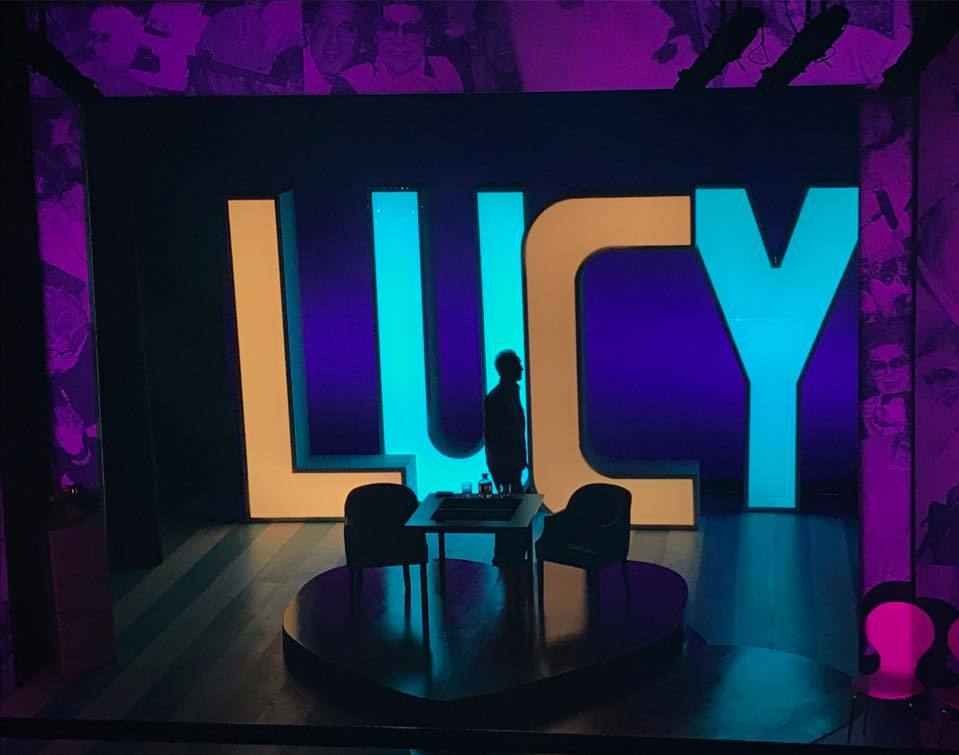
Stage set for “I LOVED LUCY” a play by Lee Tannen – silhouette of the author.
-
Lucy and Viv Reminisce
S6;E16
~ January 1, 1968

Synopsis
When
Lucy breaks her leg, Viv comes to nurse her and the two stroll down
memory lane by recalling their past misadventures.Regular
CastLucille
Ball (Lucy
Carmichael),
Gale
Gordon
(Theodore J. Mooney)Mary
Jane Croft (Mary
Jane Lewis) and Roy
Roberts
(Harrison Winfield Cheever) do not appear in this episode. Mary Jane
is mentioned as being on vacation.Guest
Cast
Vivian
Vance (Vivian
Bunson) makes her penultimate appearance in the role she created, Lucy’s
best friend and former roommate, Vivian Bagley (now Bunson). Vance
was born Vivian Roberta Jones in Cherryvale, Kansas, in 1909,
although her family quickly moved to Albuquerque, New Mexico, where
she was raised. She had extensive theatre experience, co-starring on
Broadway with Ethel Merman in Anything
Goes.
She was acting in a play in Southern California when she was spotted
by Desi Arnaz and hired to play Ethel Mertz, Lucy Ricardo’s
neighbor and best friend. The pairing is credited with much of the
success of “I Love Lucy.” Vance was convinced to join the cast
of “The Lucy Show” in 1962, but stayed with the series only
through season three. She made half a dozen appearances on “Here’s
Lucy,” as well as joining Ball for a TV special “Lucy Calls the
President” in 1977. Vance died two years later.

This
is the first new show of 1968. There were no new episodes on
December 18 and December 25, 1967. This is the first and only clips
show on “The Lucy Show.” Not including actors appearing in the
clips, this episode has the smallest cast of any “Lucy Show.” For this episode, the opening credits roll rather than fade in. This
marks the penultimate appearance of Vivian Vance as Viv Bunson.
As
of January 1, 1968 Desilu Studios is owned by Paramount, a subsidiary
of Gulf + Western. Desilu Productions, however, remains the producer.Lucille
Ball didn’t want to do a ‘final episode’, because the show was about
to be rerun on CBS on weekday mornings (replacing “I
Love Lucy,”
which was going into syndication). Ball felt a final episode would
hurt the show in reruns.In
lieu of an official final episode, Ball opted to do a clips show
during this second half of the final season. It
is then decided to involve Vivian Vance and to limit the clips to
those involving the two of them. Vance thought it would be a good
idea to do a retrospective of all their bits together going back to
1951. Ball immediately nixed the suggestion, in part because it is
still difficult for her to deal with the Desi years. In the end, all
but one of the clips are from Season 1 of “The Lucy Show” which
was filmed and aired in black and white.Wrap
around scenes were filmed to introduce and conclude the clips. These
were shot in one day, without a live studio audience. At one point,
when Lucy says, “I’ve
always had a sensible reason for everything I did,”
Viv jokes back, “Sensible?
Sensible my ass!”
Although
the take wasn’t used, it can be seen on bloopers reel on the DVD
extras. In the final cut Viv simply replies “Sensible?”The connecting scenes were written by series script supervisor Milt Josefsberg. Milt’s wife Hilda Josefsberg receives a “based on an idea by” credit line.
Lucy
confesses that she broke her leg falling out of bed during a romantic
dream. She says she will be out of work at least a month. Lucy has a
female doctor named Dorothy.Cheapskate
Mooney sends Viv a bus ticket to travel 3,000 miles to come and nurse
Lucy.
The
first flashback clip is from “Lucy,
the Coin Collector”
(S3;E13) where Lucy and Viv go down into the storm drain to retrieve
a rare penny worth $16.50. It features Tex
Brodus
as an ‘Ed Norton-like’ sewer worker. This is the only clip that is in
color. It was strategically placed just before the first commercial
break so that the audience was not put off by the disparity between
black and white and color before being hooked into the show’s
premise.
The
second flashback clip is from “Lucy
and Her Electric Mattress”
(S1;E12) where Lucy uses stilts to get into an upper bunk.
That
is followed by a clip from “Lucy
and Viv are Volunteer Fireman”
(S1;E16) in which Lucy and Viv hear an actual fire alarm and race to
put on their uniforms and head out the door. Once they arrive at the
firehouse, the scene includes Carole Cook (Thelma), Ruth Crews
(Dorothy), Bess Flowers, Hazel Pierce, and other members of the
Danfield Women’s Volunteer Fire Brigade.
Next
is a clip from “Lucy
Puts Up a TV Antenna”
(S1;E9) which places Lucy and Viv on the roof of their home
manipulating a giant TV aerial.
It
is followed by “Lucy
and Viv Put in a Shower” (S1;E18)
which finds the pair up to their necks in water in a sealed shower
stall.
The
final clip is from “Lucy
Buys a Boat”
(S1;E30), which shows Lucy and Viv trying to deal with a leaky,
pitching vessel.
Going
into the kitchen to prepare bedridden Lucy some lunch, Viv slips and
also breaks her leg. She says she feels just like a female version
of The
Man Who Came To Dinner.
This was the title of a 1939 play and a 1942 film where a pompous
radio star slips on the ice outside the home of a suburban Ohio
couple and becomes their unwilling house guest during his recovery.
Coincidentally, both the Broadway production and movie version starred Lucille Ball’s good friend Mary Wickes, who appeared on “The Lucy Show’ nine times! Hollywood’s ‘Queen of the Extras’ Bess Flowers was also in the film and is one of the Danfield Firewomen in the third clip. Patrick McVey was also in that episode, and briefly appears in the film. Jimmy Durante, who plays Banjo in the film, did a walk-on cameo as himself on a 1966 “Lucy Show.”
Callbacks!

The
“I Love Lucy” Christmas Show was also a clips show – the
only one in the series.
Mr. Mooney also broke his leg in “Lucy Plays Florence Nightingale” (S2;E14).
Flash Forward!

In real-life, Lucille Ball broke her leg in a skiing accident shortly
before the start of Season 5 of “Here’s Lucy.” Instead of ending
the show, Lucy had her broken leg written into the script and filmed
using a cast and wheelchair.
“Here’s Lucy” also chose to end with a retrospective clips show between the two main characters (Lucy and Harry): “Lucy and Harry’s Memoirs” (HL S5;E24). Like “Lucy and Viv Reminisce” it didn’t actually ‘end’ the series. Instead, Lucille Ball chose to extend “Here’s Lucy” for a sixth season to match her previous two series’. The last shot of the episode was re-done to show Lucy Carter adding the word “Temporarily” to the ‘Out of Business’ sign, and leaving with a knowing wink!
Blooper
Alerts!
The Shadow Knows! When
Viv walks into the kitchen there’s the crashing sound of her falling
but her shadow on the window sill reveals that Vance is still walking across the room.
“Lucy and Viv Reminisce” rates 4 Paper Hearts out of 5
-
Lucy and Carol Burnett: Part 2
S6;E15
~ December 11, 1967

Synopsis
Lucy
and Carol get their wings as flight attendants and perform a
graduation revue about the history of aviation with the stars of the
motion picture Wings, Buddy Rodgers and Richard Arlen.Regular
CastLucille
Ball (Lucy
Carmichael),
Gale
Gordon
(Theodore J. Mooney)Mary
Jane Croft (Mary
Jane Lewis) and Roy
Roberts
(Harrison Winfield Cheever) do not appear in this episode, although
Mr. Cheever is mentioned.Guest
Cast
Carol
Burnett (Carol
Tilford) got
her first big break on “The Paul Winchell Show” in 1955.
A
years later she was a regular on “The Garry Moore Show.” In 1959
she made her Broadway debut in Once
Upon a Mattress,
which she also appeared in on television three times. From 1960 to
1965 she did a number of TV specials, and often appeared with Julie
Andrews. Her second Broadway musical was Fade
Out – Fade In
which
ran for more than 270 performances. From 1967 to 1978 she hosted her
own highly successful variety show, “The Carol Burnett Show.”
Burnett had previously appeared in two episodes as Lucy’s roommate
Carol Bradford. In return, Lucille Ball made five appearances on
“The Carol Burnett Show.” Burnett also returned to star in three
episodes of “Here’s Lucy,” once playing herself. After Lucille
Ball’s passing, Burnett was hailed as the natural heir to Lucy’s
title of ‘The Queen of TV Comedy.’Carol
has an Uncle Charlie who is a drinker. His intoxication prevents him
from playing the role of the Captain in the revue.
Kasey
Rogers
(Miss Cavanaugh) is probably best remembered for playing Louise Tate
on “Bewitched” from 1966 to 1972, including an episode five days
before this installment of “The Lucy Show.” She will appear in
one more episode of the series.Rogers is never addressed as Miss Cavanaugh in the dialogue, but she was in the previous episode.

Buddy
Rodgers
(Himself) was the star of the first Academy Award-winning Best
Picture, Wings
(1929). He was married to silent film star Mary Pickford from 1937
until her death in 1979. This appearance on “The Lucy Show” was
his penultimate screen credit. His last appearance was also with
Richard Arlen, on a 1968 episode of “Petticoat Junction” titled
“Wings.” He died in 1999 at the age of 94.
Richard
Arlen (Himself)
was also featured in Wings
in 1929. He appeared in more than 175 movies and TV shows. He was
born in 1899 and died in 1976.
Characters
named Terry Harper and Joan Boston also receive their wings. The
episode features male and female singers / dancers who all are
uncredited.
This
is the second of a two part episode. The first episode is rather
uncreatively titled “Lucy and Carol Burnett: Part 1” and also
features Kasey Rogers. After
this, the flight attendant plot thread is dropped without
explanation, and Lucy is back at the bank as Mr. Mooney’s secretary.
Carol
Burnett first appeared on the series before the premiere of her own
TV variety show. This time she returns as a celebrity guest star,
with her name in the title.
Coincidentally,
on the same day this airline-themed episode premieres, the supersonic
Concorde was unveiled in France. Also on this date, newspapers
announced the crash of a twin-engine plane in Madison, Wisconsin that
killed recording star Otis Redding and six others.
The
same night this episode first aired, Gale Gordon appeared on NBC’s
“The Danny Thomas Hour” in a salute to 1930s musicals. Gordon
and Thomas had appeared together on “Lucy Makes Room for Danny,”
a 1958 episode of “The Lucy-Desi Comedy Hour.”
After
receiving their ‘wings,’ graduates Lucy and Carol join Rodgers, Arlen, Mr. Mooney and an ensemble of flight attendants in a revue
titled…“A Salute To Aviation”

Lucy,
Carol and the female Flight Attendants sing “Over
There” (1917)
written by George
M. Cohan.
Rodgers
and Arlen sing “My
Buddy”
(1922) with music
by Walter
Donaldson and
lyrics by Gus
Kahn.
Lucy,
Carol, Mr. Mooney, Arlen, and Rodgers sing “How
‘Ya Gonna Keep ’em Down on the Farm (After They’ve Seen Paree?)”
(1919) with music by Walter
Donaldson and lyrics
by Sam
Lewis and
Joe
Young.
Lucy,
Carol and the Flight Attendants (as flappers) dance to “Thoroughly
Modern Millie”
(1967) with music by Jimmy
Van Heusen. The film of the same title (set in 1922) was released
earlier in 1967 starring Julie Andrews. Andrews and Burnett would do
many TV variety specials together.Lucy,
Carol, and an uncredited male soloist sing “Chattanooga
Choo Choo” (1941)
with music by Harry
Warren and lyrics
by Mack
Gordon.
Three
uncredited male tap dancers sing “Alabamy
Bound”
(1924) with music by Ray
Henderson and lyrics
by Buddy
G. DeSylva and
Bud
Green.
A
bride and groom (uncredited singer and dancer) performer “Shuffle
Off to Buffalo”
(1933) from the film 42nd Street
with music by Harry
Warren and lyrics
by Al
Dubin.
Six
uncredited boys and girls sing “Toot,
Toot, Tootsie”
(1921) which was written by written by Dan
Russo,
Ernie
Erdman and
Gus
Kahn for the Al Jolson musical Bombo.
Lucy,
Carol and the ensemble perform “Hey,
Look Me Over”
(1960) from the musical Wildcat with music by Cy Coleman and lyrics
by Carolyn Leigh. Lucille Ball introduced the song to America on
Broadway. This version has specially written lyrics to suit the
setting.
The
ensemble performs “The
Army Air Corps Song”
(1917) written by Robert Crawford.Blooper
Alerts!
History Lesson! It
is stated that Mr. Mooney was given a citation during World War II
for extreme valor under fire, yet in “Lucy and the Submarine”
(S5;E2) it was stated that during the war Mr. Mooney was a housing
officer in Wichita, Kansas who never saw combat.

“Lucy and Carol Burnett: Part 2″ rates 3 Paper Hearts out of 5
1967, Air Travel, Airlines, Alabamy Bound, Army Air Corps Song, Buddy Rodgers, Carol Burnett, CBS, Chatanooga Choo Choo, Concorde, Flight Attendants, Gale Gordon, Hey Look Me Over, How Ya Gonna Keep ‘Em Down on the Farm, Kasey Rogers, Lucille Ball, Lucy and Carol Burnett: Part 2, Musical Revue, My Buddy, Otis Redding, Over There, Richard Arlen, Shuffle Off to Buffalo, Stewardess, The Lucy Show, Thoroughly Modern Millie, Toot Toot Tootsie, tv, Wings
-
Subscribe
Subscribed
Already have a WordPress.com account? Log in now.
 Papermoon Loves Lucy