-
LUCY SELLS CRAIG TO WAYNE NEWTON
S1;E9
~ November 25, 1968

Directed
by Jack Donohue ~ Written by Robert O’BrienSynopsis
Lucy
gets Craig a gig filling in for Wayne Newton’s drummer. Naturally,
Lucy and Kim also manage to get into the act.Regular
CastLucille
Ball (Lucy
Carter), Gale
Gordon (Harrison
Otis Carter), Lucie
Arnaz (Kim
Carter), Desi
Arnaz Jr. (Craig
Carter)Guest
Cast
Wayne
Newton (Himself)
also played himself in “Lucy Discovers Wayne Newton” (TLS
S4;E14).
He is one of the best-known entertainers in Las Vegas, known by the
nicknames the ‘Midnight Idol,’ ‘Mr. Las Vegas’ and ‘Mr.
Entertainment.’ His well-known songs include 1972’s “Daddy,
Don’t You Walk So Fast” (#4 on the Billboard chart), “Years”
(1980), and his signature song “Danke Schoen” (1963), which he
performs in this episode. He will also play himself in a 1970 episode
of “Here’s Lucy.”Wayne Newton introduces this episode on the “Here’s Lucy” DVD. He credits Lucille Ball with helping discover him and fostering his talent.
Jerry
Newton
(Himself) is
the older brother of Wayne Newton.
He
plays the guitar for Wayne Newton. He will also appear in 1970’s
“Lucy and Wayne Newton” (S2;E22).Jerry’s
catch phrase is “Oh, gosh yes.”Tommy
Amato (Himself)
was a bandleader and Wayne Newton’s bass player. He will also appear
in 1970’s “Lucy and Wayne Newton” (S2;E22).Amato
has one line of dialogue but is not identified by name.Don
Vincent
(Himself) was a composer, conductor, and actor. Here he plays piano
for Wayne Newton. He played himself on a 1981 episode of “Vega$”
guest starring Wayne Newton.Vincent
is not identified by name and has no dialogue.Harvey
Lang
(Himself) was Wayne Newton’s drummer. This is his only screen
credit.Lang
has no dialogue.Uncredited Concert Specatators
Include:- Jack
Berle
was the older brother of Milton Berle, a frequent guest star of
Lucille Ball’s sitcoms. Jack makes the first of his eleven uncredited
appearances on the series. - George
DeNormand
appeared
in three films with Lucille Ball from 1937 to 1963. This is the just
one of his many appearances on “The Lucy Show” and “Here’s
Lucy.” - James
Gonzales was
a popular Hollywood extra who first acted with Lucille Ball in the
1953 The
Long, Long Trailer.
He was previously seen on “The Lucy Show” as Stan Williams
in “Lucy
Digs Up a Date” (TLS S1;E2).
He was seen in more than 20 episodes of “The Lucy Show” and 3
episodes of “Here’s Lucy.” - Tony
Regan
had nearly 150 screen credits, most uncredited, including the Lucille
Ball film Critic’s
Choice
(1963). - Clark
Ross
makes the first of his three appearances on “Here’s Lucy.” He is
also in the 1974 Lucille Ball film Mame.
Other
uncredited extras make up the rest of the concert audience.
Wayne
Newton is one of ten celebrities to also have appeared on “The Lucy
Show.” The others are Carol Burnett, Wally Cox, Jack Benny, Milton
Berle, Danny Thomas, Art Linkletter, Tennessee Ernie Ford, Frankie
Avalon, and Phil Harris. Of these stars, only Milton Berle and
Tennessee Ernie Ford also appeared on “I Love Lucy” or “The
Lucy-Desi Comedy Hour.” Carol Burnett takes top honors with 7
half-hour episodes (including one two-parter).Craig
says that Wayne Newton improvises a lot “and
if you’re not with it, you’ll still be in the bus station by the time
he gets to Phoenix.”
“By
the Time I Get to Phoenix”
is a song written by Jimmy
Webb.
Originally recorded by Johnny
Rivers in
1965, it was a big hit for country singer Glen Campbell in 1967.
Wayne Newton and Campbell performed the song as a duet live in London
in 1975. Coincidentally, Wayne Newton’s family moved to Phoenix when
he was ten to help with his asthma.Lucy
brags to Wayne Newton that Craig was in one of the 100 bands that
played during halftime at the Rose Bowl football game in front of a
hundred thousand fans.
During
the opening concert, Wayne Newton sings “Danke
Schoen”
by Bert Kaempfert, Kurt Schwabach, and Milton
Gabler. Newton first recorded it in 1963 and it quickly became his
signature song. Newton’s rendition was prominently featured in the
1986 film Ferris
Buehler’s Day Off.Wayne
Newton then launches into “You’re
Nobody till Somebody Loves You”
written
by Russ
Morgan, Larry
Stock,
and James Cavanaugh and published in 1944.
It’s most famous cover was by Dean Martin in 1964. Wayne Newton
also sang it on “Lucy Discovers Wayne Newton” (TLS S4;E14).
The
next day, Lucie and Lucy do a soft shoe to “Tea
for Two”
to show off Kim’s dancing skills. The song is by
Vincent Youmans and was introduced in the 1925 Broadway musical, No,
No, Nanette. The
lyrics are not used here.
Wayne
Newton’s rehearsal starts with “Rock-a-Bye
Your Baby with a Dixie Melody”
a popular song written
by Jean
Schwartz,
with lyrics by Sam
M. Lewis and Joe
Young.
The song was introduced by Al
Jolson in
the 1918 Broadway musical Sinbad.Newton’s
second performance at the club begins with “Swanee”
another associated with Al Jolson written in 1919 by George
Gershwin
with lyrics by Irving
Caesar.Next,
Wayne Newton and Kim sing
“Waiting for the Robert E. Lee”
while
Lucy plays the guitar. The three of them then play the banjo
together. Harry joins in for the final chorus, but does not bother
to strum his banjo. The song was yet another hit for Al Jolson and
was written
in 1912 by Lewis F. Muir and
L. Wolfe Gilbert.
All three of the above songs were from shows the premiered at New
York’s Winter Garden Theatre.
The
studio audience applauds Lucie’s enthusiastic lip synch to “Danke
Shoen” several times while Craig practices his drum part and Lucy
mimes playing the guitar. While Desi Jr. actually played the drums,
Lucy and her daughter were miming playing the guitar and banjo.On
stage at the club, Harry does a cartwheel. This was a skill Gale
Gordon showed off several times on “The Lucy Show.”The
title of this episode is unusually worded. The word “sells” means “convinces” not a monetary transaction! The episode is the first
“Here’s Lucy” episode to feature a musical guest. Most times,
Lucy and her kids will find away to get into the act!

Wayne
Newton also played (a version of) himself in “Lucy Discovers Wayne
Newton” (TLS
S4;E14) in which Newton also crooned “You’re Nobody till Somebody
Loves You.”
Oops! While
listening to Wayne Newton sing in the opening scene, Craig reaches
for his drink and the rose centerpiece falls out of its glass. Desi
Arnaz Jr. and Gale Gordon spend a few moments fiddling with it to get
it to stand up again.
Check the Gate! When
Kim runs to answer the front door to let Uncle Harry in, the camera
swings right to follow her to the door. When it stops, there is a
crew member standing on the right side of the screen.
Drum Beat! Lucy
makes a small banner that says “Wayne Newton” to put on the front
of his drums. On his drum set at home (presumably the same one) the
brand name is taped over. Here, until Lucy applies her banner, it
has no tape or brand name.
Product Displacement! Lucy’s
can of hairspray has no label.Casting Thrift! Wayne
Newton must have a loyal following because the same background
performers are in the audience for the first and second performance,
albeit in slightly different seats.
“Lucy Sells Craig to Wayne Newton” rates 3 Paper Hearts out of 5
For some reason, Lucille Ball loved Wayne Newton. He kept turning up as Wayne Newton – and they all were pretty similar, danke schoen very much.
1968, By the Time I Get To Phoenix, CBS, Clark Ross, Danke Schoen, Desi Arnaz Jr., Dixie Melody, Don Vincent, Gale Gordon, George DeNormand, Harvey Lang, Here’s Lucy, Jack Berle, Jack Newton, James Gonzales, Lucie Arnaz, Lucille Ball, Swanee, Tea for Two, Tommy Amato, Tony Regan, tv, Waiting on the Robert E. Lee, Wayne Newton, You’re Nobody Till Somebody Loves You - Jack
-
LUCY’S BIRTHDAY
S1;E8
~ November 18, 1968

Directed
by Jack Donohue ~ Written by Milt Josefsberg and Ray SingerSynopsis
Kim
and Craig take Lucy out to a Chinese restaurant to celebrate her
birthday. But when Craig forgets his wallet, Lucy must fake illness
to get out of paying the bill.Regular
CastLucille
Ball (Lucy
Carter), Gale
Gordon (Harrison
Otis Carter), Lucie
Arnaz (Kim
Carter), Desi
Arnaz Jr. (Craig
Carter)Guest
Cast
Victor
Sen Yung
(Waiter) is probably best remembered as ranch cook Hop-Sing on
“Bonanza” from 1959 to 1973. This is the first of his two
appearances on “Here’s Lucy.” He appeared in two dozen films and
TV shows with uncredited extra Spencer Chan. He died in 1980 at age
65 of natural gas poisoning in his own home a month after his final
film was released.Spencer
Chan (Restaurant
Employee, uncredited) was a Los Angeles-born actor with more than 100
TV and film projects on his resume, most all uncredited, many with
Victor Sen Yung. This is his only appearance with Lucille Ball.Murray
Pollack
(Restaurant Patron, uncredited) was
seen as one of the party guest in “Country
Club Dance” (ILL S6;E25),
the episode that introduced Barbara Eden. Coincidentally, he later
appeared on half a dozen episodes of “I Dream of Jeannie.” He was at the airport when “The
Ricardos Go to Japan”
(1959).
He was seen in the 1963 movie Critic’s
Choice with
Lucille Ball. He made two appearances on “The Lucy Show.” This is
the first of his three episodes of “Here’s Lucy.”Other
restaurant patrons and staff are played by uncredited background
performers.
At
the time this episode first aired, Lucille Ball was 57 years old.
Ball’s birthday is August 6th.Victor
Sen Yung, Spencer Chan, and Murray Pollack all appeared in the 1961
film musical Flower
Drum Song,
based on the 1958 Broadway musical by Rodgers and Hammerstein.This
is the first time we have seen Lucy’s bedroom or any of the rooms on
the second floor of the house.
Kim
sings “Happy Birthday” to her mother. The song is also used in
the underscoring. In the final moments, it is sung in Chinese by the
waiters and Harry. “Happy
Birthday To You”
has
traditionally
been attributed to sisters Patty
and
Mildred
J. Hill
in
1893 and was under copyright. In 2015 a court decision ruled the
song was no longer covered under copyright protection.
When
trying to think of a possible date for Lucy, Craig asks Kim who she
would like to date. Kim replies “I
don’t think mother would be happy with Ringo Starr.” Craig
then suggests Lawrence Welk. Ringo
Starr (born
Richard Starkey in 1940) was the singer, songwriter, and drummer for
the phenomenally successful Beatles. Lawrence
Welk
(1903-1992) was a musician,
accordionist,
bandleader,
and television impresario,
who hosted TV’s The
Lawrence Welk Show
from
1951 to 1982. Welk was mentioned several times on “The Lucy Show” and starred as himself on a 1970 episode of “Here’s Lucy.” These two musical artists also represent the spectrum of popular
music – from rock and roll (Kim’s generation) to big band (Lucy’s
generation).Harry
says that he promised to give Lucy a raise on her 40th birthday. In an earlier episode Lucy says that she’s only worked for
Harry for two years. Lucy is about to try to calculate her back pay
but realizes that would mean disclosing her real age, so…she takes
an early lunch instead!
Alone
in the office, Harry is nearly caught by his niece and nephew looking
at a magazine centerfold. Although the cover of the magazine has
been removed, the fold-out centerfold was a device used by Playboy
Magazine,
a publication that was famous for its photographs of nude or nearly
nude women.Harry
says he wishes his niece and nephew had been named after his
grandparents: Bonnie
and Clyde.
This is the second series reference to the Oscar-winning biopic
Bonnie
and Clyde.
The
Chinese restaurant is called Yang Sing Ching. The (unseen)
proprietor is named Irving. They have matzoh ball soup on the menu.
The
waiter calls Harry “Hot Shot Harry.” Apparently, he has a
reputation around Yang Sing Ching.Lucy
plans to fake illness because she has no money to pay the bill. She
brags her performance will make “the
dying scene of ‘Camille’ look like a love-in.”
Camille
was a 1936 film starring Greta Garbo based on the 1848 novel La
Dame aux Camélias
(The
Lady with the Camellias)
by Alexandre
Dumas fils,
in which a young courtesan is dying of consumption. Camille is
mentioned several times on “I Love Lucy” and “The Lucy Show.” During the 1960s a ‘love-in’
was is a peaceful public gathering focused
on meditation, love, music, sex and
sometimes the use of psychedelic
drugs.
The term was coined by Los Angeles radio comedian Peter
Bergman,
who may also have hosted the first one in early 1967.
Although
this episode has a happy, sentimental ending, it is considered
politically incorrect today to depict stereotypical Asians speaking
English by changing the letter ‘L’ to ‘R’ (’Rucy’ instead of
‘Lucy’). Clever dialogue is displayed in the scene depicting the
selection of the menu items and Lucille Ball gets to show of her
skill at physical comedy through the use of chopsticks.

A
lonely Lucy Ricardo sought the company of the Friends of the
Friendless in “Lucy’s Last Birthday” (ILL S2;E25).
When
they have no money to pay the check, Kim and Craig worry that they
may have to wash dishes! In “Equal Rights” (ILL S3;E4) the boys
teach Lucy and Ethel a lesson by not paying for their dinner, forcing
them to work-off their bill by washing dishes.
Lucy also had trouble with chopsticks in a 1962 “Danny Kaye Special” that looked at the international dining craze.

Props! It’s
pretty obvious there’s no water in the sink when Kim is washing the
breakfast dishes at home.
“Lucy’s Birthday” rates 3 Paper Hearts out of 5
This episode manages to have some charm while walking the fine line of stereotypes of Asian characters. There were worse and things get better.
1968, Birthday Cake, Bonanza, Camille, CBS, Centerfold, Chines Restaurant, chopsticks, Desi Arnaz Jr., Flower Drum Song, Gale Gordon, Happy Birthday To You, Here’s Lucy, Jack Donohue, Lawrence Welk, Love-In, Lucie Arnaz, Lucille Ball, Lucy’s Birthday, Milt Josefsberg, Murray Pollack, Playboy Magazine, Ray Singer, Ringo Starr, Spencer Chan, tv, Victor Sen Yung -
LUCY AND EVA GABOR
S1;E7
~ November 11, 1968

Directed
by Jack Donohue ~ Written by Milt Josefsberg and Ray SingerSynopsis
The
author of a controversial novel (Eva Gabor) is in town and needs a
quiet place to work so Harry volunteers Lucy’s home. Naturally, it is
anything but peaceful and far from quiet.Regular
CastLucille
Ball (Lucy
Carter), Gale
Gordon (Harrison
Otis Carter), Lucie
Arnaz (Kim
Carter), Desi
Arnaz Jr. (Craig
Carter)Guest
Cast
Eva
Gabor
(Eva Von Graunitz) was born in Hungary in 1919. She came to America
with her sisters, Magda and Zsa Zsa. She began her screen career in
1941. She also appeared on Broadway five times between 1950 and
1983. Her signature role was glamorous socialite turned farm wife
Lisa Douglas on “Green Acres” (1965-71), also aired on CBS.
Gabor was married five times. She
was also a successful businesswoman, marketing wigs, clothing and
beauty products.
Gabor returned to “Here’s Lucy” to play herself in 1972. She
died in 1995.Eva
Gabor also used Graunitz as her maiden name on “Green Acres”
which ran concurrently with “Here’s Lucy.”
Robert
Carson
(Martin Phillips) was
a busy Canadian-born character actor who appeared on six episodes of
“The Lucy Show.” This is the first of his five appearances on
“Here’s Lucy.”
Peggy
Rea
(Maude, above center) was seen on four episodes of “I Love Lucy,” mostly as one
of the members of the Wednesday Afternoon Fine Arts League, but also
as the Nurse that wheeled enceinte Lucy into the hospital. Rea was a
regular on “The Waltons” and “Grace Under Fire,” her last
series before her death in 2011. This is her only appearance on
“Here’s Lucy.”Maude
is in Lucy’s bridge club.Kay
Elliot (Nelly, second from right)
was the fifth of six actors to play Aunt Hagatha on “Bewitched.”
This is her only appearance with Lucille Ball.Nelly
is in Lucy’s bridge club.Gail
Bonney
(Dolores, above right) appeared
with Lucille Ball in the 1950 films A
Woman of Distinction and
The
Fuller Brush Girl.
She played Mrs. Hudson, mother of unruly twins, on “The
Amateur Hour” (ILL S1;E14)
as well as in “Lucy and the Ceramic Cat” (TLS S3;E16).
She had also appeared with Eva Gabor on a 1965 episode of “Green
Acres.” This is her only appearance on “Here’s Lucy.”Dolores
is in Lucy’s bridge club. She is the president of the PTA.
Mickey
Martin
(Photographer) appeared with Lucille Ball in the 1934 film Kid
Millions
starring Eddie Cantor. He did one more episode of “Here’s Lucy”
in 1970, which was his final screen credit.Sid
Gould
(Expressman) made
more than 45 appearances on “The Lucy Show,” all as background
characters. This is the third of his 40 episodes of “Here’s
Lucy.” Gould (born Sydney Greenfader) was Lucille Ball’s cousin
by marriage to Gary Morton.
Earl
Parker
(Newspaper Reporter) was seen mostly in TV westerns. He was a stunt
double for Vic Morrow. This is his only appearance with Lucille
Ball.
There
was no new “Here’s Lucy” episode on Monday, November 6, 1968
because it was the eve of a US Presidential election. Instead, CBS
sold the time slot to the George Wallace campaign, while Richard
Nixon bought time on another network. Regular programming resumed
later in the evening and Lucille Ball made a guest appearance (her
second) on “The Carol Burnett Show.” So Lucy was still on Monday
night!This
episode of “Here’s Lucy” was aired on Veterans Day 1968.
Peggy Rea (Maude) introduced this episode on the “Here’s Lucy” DVD collection. Rea passed away shortly afterwards.
Two
days after this “Here’s Lucy” episode originally aired, “Green
Acres” broadcast the seventh episode of their fourth season, “A
Husband for Eleanor” (their cow).
Eva
Von Graunitz is the author of Valley
of the Puppets, a
title that parodies the 1966 Jacqueline Susann novel Valley
of the Dolls,
which was filmed in 1967. In the film, Peggy Rea (Maude) played
Neely’s (Patty Duke) vocal coach. Harry
says that Valley
of the Puppets
was banned in Boston. Lucy adds that it was even barred in Tijuana!
Harry
says he hasn’t read anything like it since Captain
Billy’s Whiz Bang.
Captain
Billy’s Whiz Bang
was
one of the most popular and notorious humor magazines of the 1920s.
It was created by Wilford Hamilton Fawcett, who had been a captain in
the US Army during World War I and gained the nickname Captain Billy.
The books were immortalized in the lyrics of the song “Trouble”
in Meredith Willson’s 1957 Broadway musical The
Music Man
which was filmed in 1962. The reference, however, is anachronistic
as the musical is set in 1912 and the first issue did not hit the
newsstands until 1919, seven years later! The humor magazine was
eventually sold to CBS Publications, a division of CBS, the network
that distributed “Here’s Lucy” and Lucille Ball’s other sitcoms.
Harry
compares his wise-cracking nephew Craig to Milton Berle. Berle guest
starred on episodes of “The Lucy-Desi Comedy Hour” and “The Lucy Show.” Desi Arnaz Jr. would co-stars with Berle on “Lucy and the Used Car Dealer” (S2;E9) above.Craig
is dating the most popular girl in the class, Lori Wilson. Despite
this he seems smitten with Eva Von Graunitz. Eva Gabor was 48
years old at the time and Desi Arnaz Jr. was 15. In
her thick Hungarian accent Eva calls Lucy ‘Loosel’! The screenplay
Eva is writing concerns a love affair between William and Veronica
(or, as Eva says, Villiam and Weronica).
Dolores
asks Eva for her autograph – on a copy of The
Caine Mutiny,
the 1951
Pulitzer
Prize–winning
novel by Herman
Wouk.
It was turned into a stage play in 1953 and also a film in 1954. The
play is mentioned in “Lucy Meets Orson Welles” (ILL S6;E3).Lucy
gets a phone call from Millie, who is in her bowling league.
When
a reporter pretends to be Eva’s brother, she tells Lucy she has no
brothers! Lucy asks about sisters. Eva rolls her eyes and says
“Boy,
oh, boy, oh, boy! Do I have sisters!”
This is an inside reference to Gabor’s famous siblings Zsa-Zsa and
Magda.
Where
there’s water, Gale Gordon is sure to end up wet. Here he is on the
receiving end of a flowing garden hose. This running gag began on
“The Lucy Show.”
When
Eva’s agent Martin Phillips is at the door, Lucy says “I
don’t care if you’re Tiny Tim!”
This is the third reference to “Rowan
and Martin’s Laugh-In” where
singer and ukulele player Tiny Tim was a regular performer. The
variety comedy show aired opposite “Here’s Lucy” on NBC.
The
name of Eva’s next book, Life
with Lucille (or,
as Eva says, ‘Loosel’),
is
eerily close to the title of Lucille Ball’s final television series
Life
with Lucy (1987).The
episode ends with role reversal, Lucy dictating to Eva, invoking the
names of Cary Grant and John Vane (Wayne). John
Wayne
had guest starred as himself on both “I Love Lucy” and “The
Lucy Show.” While Cary
Grant
never appeared with Lucille Ball, his name was mentioned three times
on “I Love Lucy.”

Booby-trapping
the front door with buckets designed to tip over was first done in
“The Ballet” (ILL S1;E19) where Lucy Ricardo ended up drenched in
water.
Sitcom
logic alert! Mr. Phillips is looking for a ‘normal family’ where
successful writer Eva Von Graunitz can live while she writes a
screenplay. He is paying $500 a week. For that price he not might
rent her a private home, apartment, or hotel room. If she desired
privacy, why would she want a family environment?Allergy Attack! Eva
Gabor gives a little ladylike sneeze while hosing down the shrubbery.Consistency! Eva
says that Lucy (Loosel) will be the subject of her next book,
yet as the episode fades to black Lucy is dictating a screenplay,
not a book.
“Lucy and Eva Gabor” rates 4 Paper Hearts out of 5
Eva Gabor and Lucy are a lot of fun together. So much so that they re-paired in season 5, although by then Eva just played Eva, which is not so far from the Eva she’s playing here! Darling I love you, but give me Park Avenue!
1968, Caine Mutiny, Captain Billy’s Whiz Bang, CBS, Desi Arnaz Jr., Earl Parker, Eva Gabor, Gabor Sisters, Gail Bonney, Gale Gordon, Green Acres, Here’s Lucy, Herman Wouk, Jack Donohue, Kay Elliot, Life With Lucy, Lucie Arnaz, Lucille Ball, Mickey Martin, Milt Josefsberg, Milton Berle, Peggy Rea, Ray Singer, Robert Carson, Rowan and Martin’s Laugh-In, Sid Gould, The Music Man, tv, Valley of the Dolls -
LUCY’S IMPOSSIBLE MISSION
S1;E6 ~ October 28, 1968


Directed by Jack Donohue ~ Written by Robert O’Brien
Synopsis
Lucy mistakenly enters a phone booth meant for a secret agent and becomes embroiled in a mission impossible: to impersonate Middle Eastern royalty!
Regular Cast
Lucille Ball (Lucy Carter), Gale Gordon (Harrison Otis Carter), Lucie Arnaz (Kim Carter), Desi Arnaz Jr. (Craig Carter)
Guest Cast

Richard Derr (Agent Commander Geller, right) appeared in 8 Broadway shows between 1949 and 1960. His screen career began in 1941, often appearing on televised adaptations of stage plays. This is his only appearance opposite Lucille Ball.
The character is named after the creator of “Mission: Impossible” Bruce Geller.
Jack Collins (Agent Johnson, left) appeared on the final two episodes of “The Lucy Show” episode earlier in 1968. He played Russel Slater on “Dallas” from 1982 to 1987. This is the first of his six appearances on “Here’s Lucy.”
The character is named in honor of the voice on the self-destruct tape recording heard on nearly every episode of “Mission: Impossible” Bob Johnson, who also is heard in this episode.
Raymond Kark (Newsstand Proprietor) was a character actor with a baker’s dozen of TV and film credits. This is his only one with Lucille Ball.
Kark’s one line of dialogue is spoken off-screen.
John J. “Red” Fox (Policeman) was best known for playing policemen, which is what he did on five of his eight appearances on “The Lucy Show” as well as three of his five episodes of “Here’s Lucy.”
The policeman has no lines, but is kicked by Lucy to get his attention and says “Ouch!”

Ken Drake (Butler) had 66 film and TV credits, but rarely appeared on sitcoms. This is his only appearance with Lucille Ball.
Maxine Gates (Dowager, above right with red sash) was nicknamed “250 pounds of pep and personality.” She had a pet alligator named Oscar. This is her penultimate screen credit.
The Dowager has no dialogue and is not identified. When the harem-hunting Sultan is about to dance with Kim, Lucy pulls her away and substitutes the Dowager.
Tim Herbert (Mahuli Omar, below left) was born Herbert Timberg in 1914. In 1944 he appeared on Broadway in the Jackie Gleason revue Follow the Girls. He made three appearances on “The Lucy Show.” This is his only time on “Here’s Lucy.” He appeared with Lucille Ball in A Guide for the Married Man in 1967.
The character’s name is never spoken on screen. Lucy calls him (and others) Sahib.

Joseph Ruskin (Ambassador Korlik of the Slobtoni Embassy, above right) made his screen debut as an uncredited extra on Jackie Gleason’s “The Honeymooners” in 1955. He appeared in four of the “Star Trek” series, the first shot at Desilu. He played John Wayne’s director Joe on “The Lucy Show.” Ruskin appeared as foreign operatives in six episodes of “Mission: Impossible” (two of which were two-parters). This is his only episode of “Here’s Lucy.”
Robert Buckingham
(Party Guest, uncredited)
had been seen with Lucille Ball in Critic’s Choice (1963). This is his first of three appearances on the series.
George DeNormand (Party Guest, uncredited) appeared in three films with Lucille Ball from 1937 to 1963. This is the just one of his many appearances on “The Lucy Show” and “Here’s Lucy.” He also appeared in seven episodes of “Mission: Impossible” the final one as an uncredited party guest.
Monty O’Grady (Party Guest, uncredited) was first seen with Lucille Ball in The Long, Long Trailer (1953) and played a passenger on the S.S. Constitution in “Second Honeymoon” (ILL S5;E14). He was a traveler at the airport when “The Ricardos Go to Japan” (1959). He made more than a dozen appearances on “The Lucy Show” and a half dozen more on “Here’s Lucy.” O’Grady appeared in eleven episodes of “Mission: Impossible” (often also as an uncredited party guest) including one a month before this episode first aired, and one a month after.
Bob Johnson (Voice of Self-Destruct Tape, uncredited) reprises his voice-over role from “Mission: Impossible” on which he was heard in 156 episodes. He also returned for the 1988 reboot of the show, but by this time his voice was on a disc, not a tape! Johnson was also a voice-over heard on Desilu’s “Star Trek.”
Uncredited background performers play the other embassy party guests, dancers, and the Sultan of Alzukar.

The evening before this episode originally aired (October 27, 1968) “Mission: Impossible” aired an episode titled “The Mercenaries” guest starring Pernell Roberts (“Trapper John, M.D.”) and Vic Tayback (“Alice”). Like “Here’s Lucy,” the show was seen on CBS TV and was produced and filmed at Paramount. It was episode number 57, the third of season four.

This episode is a spoof of the TV series “Mission: Impossible” (1966-73) which was a Desilu / Paramount series. Had Lucille Ball not given the nod to the series in 1966, there would be no Mission: Impossible movies today! What would Tom Cruise do?

The episode uses the “Mission: Impossible” theme and original underscoring by Lalo Schifrin. The theme won a Grammy Award earlier in 1968. The instantly recognizable theme song is saved for the final chase sequence.
Episode scribe Bob O’Brien co-wrote the screenplay for the Lucille Ball / Bob Hope film Fancy Pants (1950). He was responsible for 54 episodes of “The Lucy Show.” This was the first of his 24 episodes of “Here’s Lucy.” He would also write the Lucy specials “Lucy Gets Lucky” (1975) and “Lucy Moves to NBC” (1980), his last screen writing credit. He died in 2005.

Actor Joseph Ruskin (Korlik) introduces this episode on the “Here’s Lucy” DVD. He passed away shortly afterward.
On October 28, 1968 this episode was originally followed on CBS by an episode of “Mayberry R.F.D.” that also featured George DeNormand and Monty O’Grady as uncredited extras.
Trying to remember the recorded message, Lucy mistakes the word ‘embassy’ for ‘NBC’. Although Lucille Ball was a long-time CBS TV star, she briefly ‘moved’ to NBC in 1980. Although her final series “Life With Lucy” was produced and distributed by CBS, it actually aired on ABC, meaning Lucille Ball was seen on all three of the major networks!

At the episode’s start, Lucille Ball wears the same light blue tweed suit she wore in the previous episode, “Lucy, the Conclusion Jumper” (S1;E5).

Kim compares Agent Geller to James Bond, except taller and more handsome. Craig later say the idea of going in disguise is “kinda 007.” The sixth James Bond film On Her Majesty’s Secret Service was released in mid-December 1967 and starred George Lazenby as 007. The film would have been recently in cinemas when this episode was filmed.

During the Embassy party the small band plays the Beatles song “Yesterday.” Released in September 1965, the song reached number one on the Billboard charts. Later in the party, the band plays “The Sunny Side of the Street,” a 1930 song by Jimmy McHugh. It was introduced in the Broadway musical Lew Leslie’s International Revue.

Lucy, Harry, Craig and Kim impersonate the Royal Family of Capazonia. As an Indian Prince, Craig says that in America he sees many more Nehru jackets. The Nehru jacket is a hip-length tailored coat with a mandarin collar modeled on the Indian garment worn by Jawaharlal Nehru, the Prime Minister of India from 1947 to 1964. The jackets were popularized in Europe and North America by the Beatles and the mods, a fashion movement. Several villains in the James Bond film series appear wearing a Nehru jacket.
As the Maharani, Lucy must improvise a dance routine. Although it starts off with Middle Eastern moves, Lucy turns it into a square dance. It then turns into an (American) Indian War Dance and a Charleston. It culminates with Lucy walking across hot coals and sticking her feet in a tub of champagne bottles for relief.

Although a treat for Lucy fans, the episode would be considered politically incorrect today for the use of dark make-up for Asian characters.


As the Maharani, Lucy makes her entrance on a litter, just as Lucy Carmichael did when she played Cleopatra for the Danfield Community Players.

Lucy’s impersonation of a Middle Eastern Maharani is a direct homage to "The Publicity Agent” (ILL S1;E32) where she created the character of the Scheherazade of Franistan. Even the voice is similar! In that episode, Lucy Ricardo initially suggests calling the character a Maharani, but Ethel informs her that a Maharani is a Maharaja’s wife, so they settle on Maharincess, combining Maharani with Princess. Lucy later says she’s not a Maharincess but a Henna Rinses, a joke about her hair dye.

This is not the first time Lucy went undercover! After seeing a James Bond film, Lucy and Mr. Mooney get embroiled in a spy caper that finds her disguised as Broadway star Carol Channing in “Lucy and the Undercover Agent” (TLS S4;E10).

Another show that was produced by Desilu, “The Untouchables,” was similarly parodied by “The Lucy Show.” Like this episode of “Here’s Lucy,” it disguised the character’s names, used the original program’s theme music, and employed the show’s iconic voice-over artist, Walter Winchell, who, like tape voice Bob Johnson, was heard on every episode, but never seen. In that episode, Lucy was also forced to go undercover.

Lucy’s improvised dance routine feels similar to when Lucy Ricardo had to blend in to a chorus line in “Lucy is Jealous of Girl Singer” (ILL S1;E10) in 1951. Despite every move being scripted and rigorously rehearsed, Lucille Ball was able to make it look convincingly improvised.

Product Displacement! At the party, the drummer in the band has the brand name taped over. The drummer for the specialty dance plays the bongos, but it is not timed well with the music playback. In an earlier episode, Craig’s drums also had the brand name taped over.

Props! When Lucy is perusing photographs of the Royal Family, Lucille Ball is actually holding a black and white photo of herself and her children used to promote “Here’s Lucy.”

Props II! The magazine rack holds the November 10, 1967 issue of Time Magazine, published a full year before this episode aired. There is another issue of Time on the rack. News agents typically only sell the issue dated that week.

“Lucy’s Impossible Mission” rates 4 Paper Hearts out of 5
Lucy blends her own back catalog with Desilu’s and comes up with some very funny (if improbable) stuff. The very involved dance routine is a stand alone classic.
 007, 1968, Bob Johnson, CBS, Desi Arnaz Jr., Gale Gordon, George DeNormand, Here’s Lucy, Jack Collins, Jack Donohue, James Bond, John J. Fox, Joseph Ruskin, Ken Drake, Lalo Schiffrin, Lucie Arnaz, Lucille Ball, Maxine Gates, Mission Impossible, Monty O’Grady, Nehru Jackets, Raymond Kark, Richard Derr, spy, The Sunny Side of the Street, The Untouchables, Tim Herbert, Time Magazine, tv, Yesterday
 -
LUCY, THE CONCLUSION JUMPER
S1;E5 ~ October 21, 1968

Directed
by Jack Donohue ~ Written by George Balzer and Phil LeslieSynopsis
When
Kim and her classmate Don are talking about a household budget and
visiting a city hall judge for a school project, Lucy jumps to the conclusion
they are going to get married.Regular
CastLucille
Ball (Lucy
Carter), Gale
Gordon (Harrison
Otis Carter), Lucie
Arnaz (Kim
Carter), Desi
Arnaz Jr. (Craig
Carter)Guest
Cast
Don
Crichton (Don)
makes
the second of his three appearances on “Here’s Lucy.” He was
an Emmy nominated choreographer who worked on “The Carol Burnett
Show” and “The Love Boat,” among others.
Sid
Gould (Marriage
License Office Clerk) made
more than 45 appearances on “The Lucy Show,” all as background
characters. This is the second of his 40 episodes of “Here’s
Lucy.” Gould (born Sydney Greenfader) was Lucille Ball’s cousin
by marriage to Gary Morton.
Ben
Stone (Clerk
#2) was primarily a voice actor who worked on “Underdog”
(1960-1964). He acted
in the musical The
Zula and The Zayda
at the Paper Mill Playhouse in Millburn, New Jersey. This is his
final screen appearance.Booker
Bradshaw (First
Groom in Line) was a voice actor and writer making his only
appearance opposite Lucille Ball. He played Dr. M’Benga on the
original “Star Trek,” a Desilu series.Bruce
Mars (Fourth
Groom in Line) makes
his only appearance on the series but had previously played boxer
Sonny Shaw in “Lucy the Fight Manager” (TLS S5;E20) on “The
Lucy Show.”Laurie
Mock (Fourth
Bride) makes her only appearance with Lucille Ball. As
of 2006, she and her husband were running an urban real estate
development company in Culver City, California.
Jack
Donohue
(Nasty Groom in Line, above left)
was
the director of this episode and 34 others. He also directed 107
episodes of “The Lucy Show” where he was seen on screen as Man in
the Bank in “Lucy
and the Bank Scandal” (TLS S2;E7)
and “Lucy Conducts the Symphony” (TLS S2;E13). He will be seen
on camera in two future episodes, both of which he also directed.Jack Bannon (Last Groom in Line, above center) was the son of Bea Benadaret, who had played Iris Atterbury on Lucy’s radio show “My Favorite Husband” and elderly neighbor Miss Lewis on “I Love Lucy.” Bannon was also a dialogue coach on his mother’s series “Petticoat Junction” in which he also appeared, as well as on “The Beverly Hillbillies.” This is his only appearance opposite Lucille Ball.
Kevin Edwards (Draftee who cuts the Line) was an uncredited ballet dancer in Streisand’s Funny Girl (1968) and will return for a 1970 episode of “Here’s Lucy.” These are his only screen credits.
Other
prospective brides and grooms are played by uncredited extras.
Kim wants to budget $25 to $30 a month for a one bedroom apartment, which gets a laugh from the 1968 studio audience. In the mid-1950’s Lucy and Ricky Ricardo were paying $200 a month for their apartment.
Lucy tells her daughter the real household budget includes $30 a month for the telephone bill and $29.40 for 3 bags of groceries. In 1968 these were comically supposed to be high prices, but today seem ridiculously cheap.

For
the second week in a row, Lucy uses a catch-phrase from “Rowan and
Martin’s Laugh-In”: “Here
comes the judge! Here comes the judge!” The
lines were first spoken on “Laugh-In” by Pigmeat Markham and later by Sammy Davis
Jr. The
show’s second half hour aired opposite “Here’s Lucy” on NBC.Don
gets a job as a supermarket box boy. This is a job that does not
exist in today’s world. A box boy stood at the end of the
supermarket check-out line and put the groceries in bags (or boxes,
originally). Today this position has been relegated to the cashier
or (in self check-out) the shoppers themselves.Kim
has a friend named Susie Meyers who just married the Clayton boy.
The
magazine rack behind Craig’s drum set holds the November 3, 1967
issue of Time,
which was almost a year old by the time this episode aired. A
cartoon drawing of conservative journalist William Buckley is on the
cover. There is also a copy of The
New Yorker
next to Time.
When a phone call tells Harry that he deals in antique carriages, Harry says “You mean surreys with the fringe on top”? This is a reference to a song from the 1943 musical (and 1955 film) Oklahoma! “The Surrey with the Fringe on Top.” The caller is looking for a dozen authentic buggy whips. Why an employment agency would deal in antiques – let alone carriages and buggy whips – is unclear.
Harry
gets some distressing personal news during a phone call from someone
named Bill. His distraction gives Lucy time to do comic business of
getting the cup of coffee (made with carpet sweeping compound kept in
a coffee can) away from him without him noticing.
The
Nasty Man(Jack Donohue)
calls Lucy a “kooky redhead” and Harry “fatso”.
After some name
calling, Harry and the Nasty Man have a show down in
the style Laurel and Hardy,
alternately ripping each other’s clothes to shreds, all underscored
with the Laurel and Hardy Theme “Dance of the Cuckoos” by Marvin
Hatley. Not to be upstaged, Lucy also gets in on the action. The showdown soon erupts into a full-scale brawl at the
marriage bureau.

On a 1964 episode of “The Lucy Show” Lucy also mistakenly thought her teenage daughter was going to get married – to Mr. Mooney’s son! Both go out of their way to assure they don’t elope!

Wet
suits are inherently funny! Jack Benny wore one in the second episode of
“Here’s Lucy.” Before that Lucy wore one on a trip to the beach
with her daughter Chris on “The Lucy Show” and on “I Love Lucy”
when meeting Orson Welles in Macy’s.

Product Displacement! The
brand name on Craig’s drums is taped over to avoid open promotion of
the maker’s product without financial compensation.Say What? A phone caller tells Harry that he deals in antique carriages and he is looking for a dozen authentic buggy whips. Why an employment agency would deal in antiques – let alone carriages and buggy whips in 1968 – is unclear.

“Lucy, the Conclusion Jumper” rates 4 Paper Hearts out of 5
The episode is sometimes as awkward as its title, although the scene at the license bureau is very funny physical comedy.
-
LUCY AND MISS SHELLEY WINTERS
S1;E4 ~ October 14, 1968

Directed by Jack Donohue ~ Written by Milt Josefsberg and Ray Singer
Synopsis
Shelley Winters needs to slim down before filming her new picture, so Lucy is employed as her private secretary and diet coach.
Regular Cast
Lucille Ball (Lucy Carter), Gale Gordon (Harrison Otis Carter)
Lucie Arnaz (Kim Carter) and Desi Arnaz Jr. (Craig Carter) do not appear in this episode.
Guest Cast
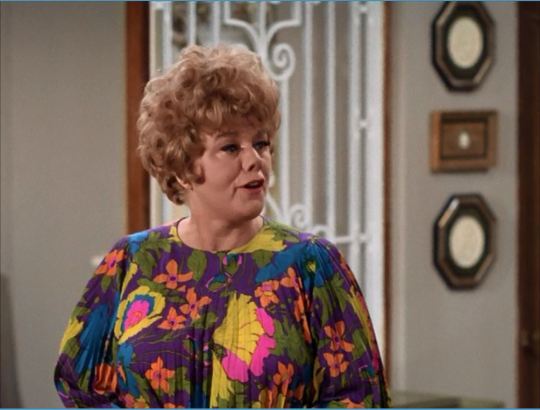
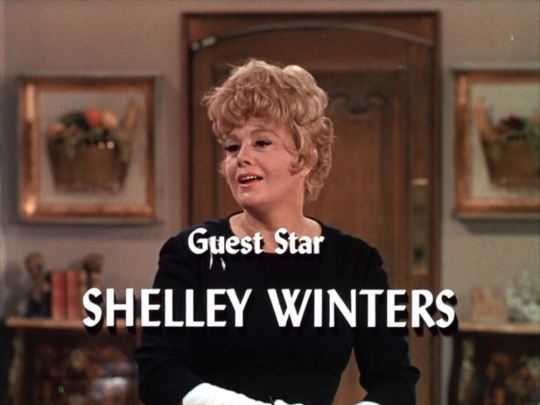
Shelley Winters (Shelley Summers) was born Shirley Schrift in 1920 (some sources list 1922) in Illinois. Her screen acting career began in 1943 under the name Shelley Winter (no ‘s’). It culminated in two Oscars for Best Supporting Actress in the films The Diary of Anne Frank in 1960 and A Patch of Blue in 1966.
She also won a 1964 Emmy. One of her final roles was as Nana Mary on TV’s “Roseanne.” Winters was married four times and known for her brash sexuality. She had an uncredited role in the 1946 Lucille Ball film Two Smart People. She died in 2006.
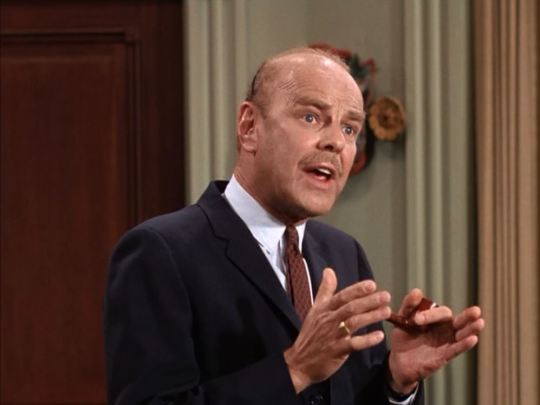
Bartlett Robinson (C.B.Wellborn) had played Mr. Wilkins in “Lucy Gets Trapped” (TLS S6;E2). This is his only appearance on “Here’s Lucy.” He died in 1986.
The title refers to her as “Miss Shelley Winters” just as she was billed in the 1955 film The Big Knife when she was between husbands having divorced Vittorio Gassman in 1954 and not married Anthony Franciosa until 1957. During “Here’s Lucy” she was also single, having divorced Franciosa in 1960 and not remarrying until the day before her death in 2006. The original title of the episode was “Lucy and Chubby.”

This was the first time Shelley Winters guest starred on a sitcom. She is the first guest-star on “Here’s Lucy” to have won a competitive acting Oscar at the time of her appearance (The Diary of Ann Frank in 1959). She was followed by:
- Elizabeth Taylor – who earned an Oscar in 1960 and appeared on the show in 1970
- Ginger Rogers – who earned an Oscar in 1940 and appeared on the show in 1971
- Helen Hayes – who earned Oscars in 1931 and 1970 and appeared on the show in 1972. Hayes has the distinction of being the only multiple Oscar winner on the series as well as the only actor playing a distinctly different character than herself without her name in the title. [Winters plays Shelley Summers, and essentially is different from Winters in name only!]
William Holden holds this same distinction on “I Love Lucy” and Ed Begley Sr. on “The Lucy Show.”

As the episode opens, Lucy is listening to Harry on the dicta-phone and decides to try out the newfangled recording machine for herself, first quoting a bit of Lincoln’s Gettysburg Address, then singing “The Man I Love,” a torch song by George and Ira Gershwin. The song was written for, but deleted from, the 1924 Broadway musical Lady Be Good.
Overhearing Lucy sing into the dicta-phone, Harry quips “Thank you, Tiny Tim!” Tiny Tim (born Herbert Buckingham Khaury in 1932) was a singer and ukulele player known for his cover of “Tiptoe Through the Tulips.” He was a regular cast member on “Rowan and Martin’s Laugh-In” which aired opposite “Here’s Lucy” on NBC.
Harryreminds Lucy that “This is a business office, not Tin Pan Alley!” Tin Pan Alley is the name given an area of New York City where music publishers and songwriters who dominated the popular music of the late 19th century and early 20th century had their businesses. The origins of the name Tin Pan Alley are unclear but one account claims that it was a derogatory reference to the sound of many pianos playing (comparing them to the banging of tin pans).

Once Lucy leaves the office to get Harry’s lunch, Harry also uses the dicta-phone to record himself. He sings “Shortnin’ Bread” by James Whitcomb Riley in 1900. The song was famously sung by Vivian Vance as Ethel Mertz in “Ethel’s Home Town” (ILL S4;E15) in 1955.
Satisfied with the sound of his voice on the playback, he remarks “Wayne Newton eat your heart out!” Wayne Newton (born 1942) is a singer and entertainer who played a version of himself on “Lucy Discovers Wayne Newton” (TLS S4;E14). He will make two appearances as himself on “Here’s Lucy.”

Lucy is looking forward to meeting movie producer C.B. Wellborn (no doubt named after Cecil B. DeMille), because she says hopes to break into show business, something Lucy Carter has in common with the otherLucy characters. “After all, lots of people are discovered in drug stores and elevators…” This is a reference to the legendary but apocryphal story that actress Lana Turner was discovered at Schwab’s Drugstore in Hollywood. In “Lucy Gets Into Pictures” (ILL S4;E18) Lucy went down to Schwab’s to be discovered but all she discovered was a stomach ache from too many ice cream sodas. Dorothy Lamour was an elevator operator in Chicago when she was discovered.
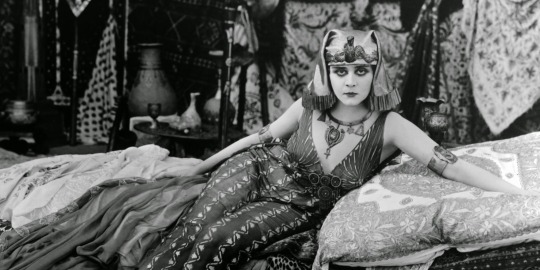
When Lucy theatrically plays up to Mr. Wellborn, Harry says to her “That will be all, Theda Bara.” Theodosia Burr Goodman (aka Theda Bara, 1885–1955) was a silent film and stage actress. She was the first to play Cleopatra on film in 1917 (now lost). Lucy played Cleopatra on the very first color filmed “The Lucy Show” in 1963, in which Lucy was also compared to Theda Bara.

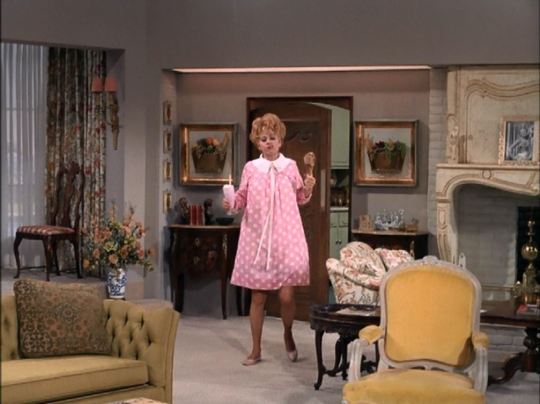
On the mantle of Summers’ apartment is a photo of Shelley Winters from the 1950 film Frenchie. She glances guiltily at the photo when she is about to overeat.
Summers brags about having two Oscars, just like Shelley Winters. Wild in the Street starring Shelley Winters had opened in late May 1968. In December 1968 Winters opened in the film Buona Sera, Mrs. Campbell starring Gina Lollobrigida.

Shelly Winters’ dresses were padded to make her appear bigger then she really was. This is done so that in the final scene she appears thinner in her new black dress.
Shelley hides food all over her apartment:
- A box of candy in the chandelier
- A banana in a framed fruit basket
- A bowl of spaghetti from the TV (which is actually a mini-fridge)
- A whole pizza pie on the turntable of the stereo
The scene is underscored with Theremin music, which is an electronic instrument mainly used during dream sequences and in sci-fi and horror movies. It was first used to underscore Lucy Ricardo’s dream of Ricky’s infidelity in “Lucy and the Dummy” (ILL S5;E3). It was also used in “Lucy Gets Mooney Fired” (TLS S6;E9) when Lucy Carmichael and Mr. Mooney are ‘gaslighting’ Mr. Cheever into rehiring him!
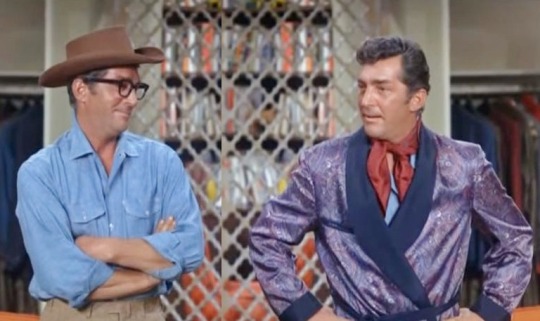
When Lucy catches her with the pizza, she claims it is a Dean Martin record and sings “When the moon hits your eye like a big pizza pie, that’s amore!” “That’s Amore” was written by Harry Martin and Jack Brooks and recorded by Dean Martin in 1953. “Amore” means “love” in Italian. Dean Martin guest starred on “The Lucy Show” in 1966 playing himself and his stunt double, Eddie Feldman.

Lucy discovers a rope of sausages hidden in the sofa cushion that Shelley claims are her love beads! Love beads were a necklaces worn by hippies in the 1960s as a symbol of peace and goodwill.

Shelley humorously remarks “Honey, they invented CinemaScope to get my hips in the screen!“ CinemaScope is an anamorphic lens used from 1953 to 1967 for shooting widescreen movies. Its creation in 1953 by 20thCentury Fox, marked the beginning of the modern anamorphic format in both principal photography and movie projection. The anamorphic lens allowed the process to create an image almost twice as wide as the previously common format. Winters’ first CinemaScope film was I Died A Thousand Times in 1955.
When Lucy bumps into Shelley and says she didn’t see her, Shelley replies “Baby,on a clear day you can see me from Catalina!” The Island of Catalina off the California coast has been used as a punchline in “Lucy and Tennessee Ernie Ford” (TLS S5;E21) when the bell captain smugly says of a swanky hotel penthouse “On a clear day you can see Catalina.” This same claim was made about the Cugamonga high rise apartment in “Lucy Helps the Countess” (TLS S4;E8). In reality, it is highly unlikely (even on a rare smog-free day) to be able to see Catalina from Los Angeles, which is nearly sixty miles away.

The episode allows Winters to stretch her comic abilities. The script assigns her all the physical comedy that would normally be done by Lucy. Like Ball, Winters is game for anything and pulls it off.
Other Hollywood stars have had their surnames slightly altered for their appearances, such as Joan Blondell (Joan Brennan) and Mel Torme (Mel Tinker).
Callbacks

Preparing to make a home cooked meal for a hot date behind roommate Viv’s back, Lucy hides food all over the house in “Lucy Builds a Rumpus Room” (TLS S1;E11) just like Lucy Ricardo did when she faked a hunger strike in “Lucy Gets a Paris Gown” (ILL S5;E20).

Lucy Carmichael dieted and exercised at a fat farm in “Lucy and the Countess Lose Weight” (TLS S3;E21) in 1965. They wear pink sweat suits just like Shelley Winters!

Lucy Ricardo tried to lose weight to get into Ricky’s act (and a tight costume) in “The Diet” (ILL S1;E3) in 1951. I wonder if Lucy Ricardo’s workout clothes are also pink?
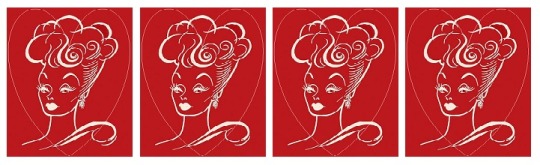
“Lucy and Miss Shelley Winters” rates 4 Paper Hearts out of 5
Oddly, Shelley Winters is basically playing herself, so it is unclear why she had to be re-named Shelley Summers. Many “Lucy” guest stars have used their own names and played very different versions of themselves on screen (Wayne Newton and Joan Crawford, for example). This episode may be considered politically incorrect in today’s society, which seeks to celebrate the fuller figured woman and not measure acceptance by body size.
 1968, Bartlett Robinson, Catalina, CBS, CinemaScope, Dean Martin, dictaphone, Dieting, Fat, Frenchie, Gale Gordon, Gettysburg Address, Here’s Lucy, Love Beads, Lucille Ball, Lucy and Miss Shelley Winters, Shelley Winters, Shortnin Bread, That’s Amore, The Man I Love, Theda Bara, Tin Pan Alley, Tiny Tim, tv, Wayne Newton
 -
LUCY THE PROCESS SERVER
S1;E3 ~ October 7, 1968


Directed
by Jack Donohue ~ Written
by George Balzer and Phil LeslieSynopsis
Lucy
plans a picnic on the beach with Kim and Craig but is called in to
work by Harry, who asks her to deliver a summons and make a bank
deposit. Lucy gets the two mixed-up and loses the envelope of cash in a
department store trash bin.Regular
Cast
Lucille
Ball (Lucy Carter), Gale Gordon (Harrison Otis Carter), Lucie
Arnaz (Kim Carter), Desi Arnaz Jr. (Craig Carter)Guest
Cast
Reta
Shaw (Mabel
Ryker) started
her career on the stage in such hits as Picnic
(1953)
and The
Pajama Game (1954),
for which she also did the film versions. She is best known for
playing maids, such as in Disney’s Mary
Poppins (1964)
and TV’s “The Ghost and Mrs. Muir” (1968-1970), which she
filmed concurrently with “Here’s Lucy.” She made three
appearances on “The Lucy Show” and she will make two more on
“Here’s Lucy.”
Jonathan
Hole (Floorwalker)
was
seen in eight Broadway plays between 1924 and 1934. His screen career
began in 1951. This is the first of his two appearances on the
series. He also played a department store employee in “Lucy
Bags a Bargain” (TLS S4;E17) in addition to one other role on
“The Lucy Show.”
Joan
Swift (Salesgirl
#1)
made
six appearances on “The Lucy Show.” This is the first of her two
episodes of “Here’s Lucy.” Her final screen credit was 1975’s
“Lucy Gets Lucky” with Lucille Ball and Dean Martin.
Vanda
Barra (Salesgirl
#2) was
married to Sid Gould so is Lucille Ball’s cousin-in-law. She makes
the first of her 23 appearances on “Here’s Lucy” as well as
appearing in Ball’s two 1975 TV movies “Lucy Gets Lucky” (with
Dean Martin) and “Three for Two” (with Jackie Gleason). She was
seen in half a dozen episodes of “The Lucy Show.”Frank
Radcliffe (Stockboy
#1) was known as as a specialty dancer in Hollywood musicals like My
Fair Lady
(1964), Sweet
Charity
(1969), and Li’l
Abner
(1959), among others. This is his only television appearance and the
only time he received screen credit for his work.Maurice
Kelly (Stockboy
#2) was an English-born actor who played a student in “Lucy and Viv
Take Up Chemistry” (TLS S1;E26). This is the first of his three
appearances on “Here’s Lucy.” He died at the young age of 46 in
1974.Kathryn Janssen (Customer, uncredited) began doing background work in 1966. She was often seen on both “The Lucy Show” and “Here’s Lucy.”

Writer
Phil Leslie had written one episode of “The Lucy Show.” This is
the first of his four episodes of “Here’s Lucy.” George Balzer
was a longtime writer for Jack Benny making his debut writing for
Lucille Ball. With Leslie, he will write three more episodes of
“Here’s Lucy.”
The
date this episode first aired the Motion
Picture Association of America (MPAA) adopted their film rating
system. The only new Lucille Ball feature film to be rated by the
MPAA after this date was Mame
(1974,
which was also Ball’s last feature film) which received a PG rating:
Parental
Guidance Suggested – Some material may not be suitable for
children.
This
PG rating was not added to the system until 1972 to replace M (Mature
Audiences) and then GP (All
Ages Admitted – Parental Guidance Suggested).
Regarding
the episode’s title: Process servers are employed to notify
individuals of their constitutional right to due process of law by
“serving” them with a notification that states the legal issue
that involves them. Originally, legal papers were typically served by
a sheriff. As cities expanded in the United States this duty become a
burden on law enforcement creating the need for lay individuals to
deliver these papers legally and in a timely manner.
As
the episode opens and closes, Lucy is singing “By the Beautiful
Sea” in anticipation of their beach picnic. “By
the Beautiful Sea” was
written by Harry Carroll and Harold R. Atteridge in 1914 for the
Broadway musical For
Me and My Gal.It was sung by Lucy and the “I Love Lucy” cast in “Mertz and
Kurtz” (ILL S4;E2).The
client that wants the summons delivered is named Mr. Draper. Harry
speaks to him on the telephone.Lucy
is sent to find Mrs. Ryker at the (fictional) Empire Department
Store.Craig’s
mentions a friend named Danny.
When
Craig says he has some bad news Lucy wearily sits down and says “I
have a feeling this is going to be sock-it-to-me time!” “Sock it
to me!” was the catch phrase of
“Rowan and Martin’s Laugh-In,”
which aired opposite “Here’s Lucy” on NBC. Dan Rowan and Dick
Martin were both seen on “The Lucy Show” before landing their hit
comedy variety show.

This
is not the first time Lucy has been employed to serve a summons.
Lucy Carmichael was assigned the task in “Lucy is a Process Server”
(TLS S2;E27) where she had to serve Mr. Mooney (Gale Gordon)!
Lucille
Ball has had a history of troubles in department stores, first at
Macy’s in “Lucy and Orson Welles” (ILL S6;E3), then at Stacey’s
in “Lucy Bags a Bargain” (TLS S4;E17, above) also starring Jonathan
Hole and “Lucy Gets Trapped” (TLS S6;E2), as well as at Bigelow’s in “Lucy and the Ceramic Cat” (TLS S3;E16).
Lucille
Ball also had an encounter with a department store mannequin
in the 1974 film Mame that involved dismemberment of the
dummy!
“Lucy is a Process Server” rates 4 Paper Hearts out of 5
Although it feels a bit familiar at times, the script of this episode has a very clever (if a bit contrived) ending that ends with all the loose ends being tied up: justice is served AND Lucy and the kids get their picnic – albeit in the living room!
 1968, By the Beautiful Sea, CBS, Department Store, Desi Arnaz Jr., Frank Radcliffe, Gale Gordon, George Balzer, Here’s Lucy, Jack Donohue, Joan Swift, Jonathan Hole, Laugh-In, Lucie Arnaz, Lucille Ball, Lucy Carter, Lucy the Process Server, Mame, Maurice Kelly, MPAA, Phil Leslie, Reta Shaw, tv, Vanda Barra
 -
LUCY VISITS JACK BENNY
S1;E2 ~ September 30, 1968

Synopsis
Lucy
sees an ad for a bargain vacation in Palm Springs and decides to take
the kids away for the weekend. Not able to resist a bargain, Harry
tags along. When they get there, they discover that the place is run
by Hollywood’s most notorious cheapskate, Jack Benny, who nickles and
dimes the foursome for the duration of their stay.
Directed by Jack Donohue ~ Written by Milt Josefsberg and Ray Singer
Regular
Cast
Lucille
Ball (Lucy Carter)l, Gale Gordon (Harrison Otis Carter), Lucie
Arnaz (Kim Carter), Desi Arnaz Jr. (Craig Carter)Guest
Cast
Jack
Benny (Himself)
was born on Valentine’s day 1894. He had a successful vaudeville
career, and an even greater career on radio with “The Jack Benny
Program” which also became a successful television show. His screen
persona was known for being a penny-pincher and playing the violin.
Benny was a Beverly Hills neighbor of Lucille Ball’s and the two
were off-screen friends. Benny previously appeared on “The Lucy
Show” as Harry Tuttle (a Jack Benny doppelganger) in “Lucy
and the Plumber” (TLS S3;E2), did
a voice over cameo as himself in “Lucy
With George Burns” (TLS S5;E1),
and played himself in “Lucy Gets Jack Benny’s Account” (TLS
S6;E6).
This is the first of his
three episodes of “Here’s Lucy.” Benny and Ball appeared on
many TV variety and award shows together. He died in 1974.Sid
Gould
(Sam, Tour Guide) made more than 45 appearances on “The Lucy Show,”
all as background characters. This is the first of his 40 episodes of
“Here’s Lucy.” Gould (born Sydney Greenfader) was Lucille
Ball’s cousin by marriage to Gary Morton.
Jackie
Gleason (Ralph Kramden, Tour Bus Driver, uncredited) was born in
1916. He became one of America’s most recognized all-around
entertainers but is perhaps best remembered for his iconic character
of bus driver Ralph Kramden on “The Honeymooners” which was seen
on CBS just like “I Love Lucy.” On “The Lucy Show” Lucy
Carmichael frequently referred to Gleason even borrowing his “Away
we go” exit in a couple of episodes. In 1975 Gleason teamed with
Lucille Ball for the CBS TV film “Three for Two.” He died in
1987.Don
Anderson
(Man on Tour, uncredited) was seen in the last two episodes of “The
Lucy Show” as well as making three appearances on “Here’s
Lucy.”James
Gonzales
(Man on Tour, uncredited) was a popular Hollywood extra who first
acted with Lucille Ball in the 1953 The
Long, Long Trailer.
He was previously seen on “The Lucy Show” as Stan Williams in
“Lucy
Digs Up a Date” (TLS S1;E2).
He was seen in more than 20 episodes of “The Lucy Show” and 3
episodes of “Here’s Lucy.”Monty
O’Grady (Man on Tour, uncredited) was first seen with Lucille
Ball in The Long, Long Trailer (1953) and played a passenger
on the S.S. Constitution in “Second
Honeymoon” (ILL S5;E14). He was a traveler at the airport
when “The
Ricardos Go to Japan” (1959). He made more than a dozen
appearances on “The Lucy Show” and a half dozen more on “Here’s
Lucy.”Uncredited
background performers play the other tourists.
“Here’s
Lucy” head writer Milt Josefsberg had been one of Jack Benny’s
writers, accounting for the sharp dialogue and frequency of Benny’s
guest appearances.
When
Harry questions how Lucy can afford a weekend in Palm Springs, Lucy
says “On
what you pay me I can’t afford ten minutes in Cucamonga.”
Cucamonga
is
a suburban city situated at the foothills of the San Gabriel
Mountains 37 miles east of Downtown Los Angeles. Cucamonga became
well known to fans of Jack Benny’s radio program, in which
announcer Mel Blanc would call out: “Train
leaving on track five for Anaheim, Azusa and Cu-camonga!”
Blanc also said the city’s name as Bugs Bunny in the Warner Brothers
cartoons. Cucamonga was mentioned in “Lucy Helps the Countess”
(TLS S4;E8) and “Lucy and the Soap Opera” (TLS S4;E19).
Benny’s
guest register lists past guest Mr. and Mrs. Gregory Peck, Howard
Hughes, Mr. and Mrs. Jack Lemmon, Mr. and Mrs. Steve McQueen, and Mr.
and Mrs. Kirk Douglas, and Sheikh Bin Abdulla Fouad and wife and wife
and wife and wife and wife. Kirk Douglas made a cameo
appearance in “Lucy Goes to a Hollywood Premiere” (TLS S4;E20, above photo)
and was a long-time resident of Palm Springs. Gregory Peck
was mentioned (but never seen) on two episodes of “I Love Lucy.”
Sheikh Bin Abdulla Fouad
(1925-2015) was a real-life businessman, although his name is clearly
being used for comic effect based on the Arab tradition of having
multiple wives.
Benny
tells Harry that his room is more expensive but that it overlooks
Raquel Welch’s patio. When he learns that she sunbathes every day,
miserly Harry eagerly agrees to the extra expense. Voluptuous sex
symbol Raquel Welch
had three films in release in 1968. Welch was also a real-life
resident of Palm Springs. [Above photo is not from the episode. Welch does not actually appear on the show!]
The
desert city of Palm Springs was a favorite get-away spot for the
Arnaz family. Lucy, Desi, and their children had a home there and it
was in Palm Springs that Desi chose to open a golf course and hotel,
the Indian Wells Resort, which is still in business today. A statue
to Lucille Ball is located in downtown Palm Springs. Lucie Arnaz and
her husband Laurence Luckinbill recently relocated from Connecticut
to Palm Springs.
Jack
Benny only charges $3
a night for rooms, but adds on ‘extra charges’:- $1
an hour for binoculars - 50
cents for golf ball retrieval - 10
cents for picking an orange from his tree - Swimming
is free, but 11 cents for towels (10 cents for the towel, one cent
for tax)

When
Lucy balks at paying a penny tax, Benny replies “Go
fight with Ronald Reagan!” Former
Hollywood actor Ronald Reagan
had been elected Governor of California in 1967, a position he held
until 1975. He was later elected 40th President of the United States and served until 1989. Jack Benny did
three episodes of “General Electric Theatre” (1953-1964) which
was an anthology series hosted by Ronald Reagan. Ball met President Reagan when she was honored by The Kennedy Center Honors in 1986 (above). No word whether they discussed taxes!
Nearly
sitting on Jack Benny’s famous violin, Lucy says that as a little
girl she took five or six lessons. Naturally she plays like a
virtuoso but her performance is obviously mimed to pre-recorded
music. Lucille Ball had a rudimentary knowledge of the violin, which
she learned for “The Lucy Show” (above photo) but the “Here’s Lucy” gag relied upon extremely
difficult and technical playing that was well beyond her
capabilities.
When
Kim and Craig are playing table tennis, Lucie Arnaz seems to ad lib
the line “He
plays like Lawrence Welk.”
The scene required Desi to hit the ball over the fence. Because the
gag needed several volleys to get the timing right, it is possible
Lucie felt the scene was getting dull and needed some vocal interest.
Lawrence
Welk
was a popular bandleader and television personality who was
frequently mentioned on “The Lucy Show.” He will play himself on
a 1970 episode of “Here’s Lucy.”
Jack
Benny tells Lucy that he is going on tour with Clyde McCoy, trumpet
player and they will be billed as “Benny and Clyde.” The line is
an obvious pun on the title of the Oscar-winning 1967 film Bonnie
and Clyde.
Clyde
McCoy (1903-1990)
was jazz
trumpeter
whose
popularity spanned seven decades. He is best remembered for his theme
song, “Sugar
Blues”
written by Clarence
Williams and
Lucy Fletcher, as well as being the co-founder of Down
Beat
magazine
in 1935.
In
1951,
Down Beat was
parodied on “I Love Lucy” as Half
Beat
magazine in “Men are Messy” (ILL S1;E8).While
preparing dinner Benny hums a bit of his
theme song “Love in Bloom” by Ralph Rainger and Leo Robin.
The
Tour Guide (Sid Gould, in his first of many series appearances) says
they are late because “Bob
Hope did more jokes than usual.” Bob
Hope
was a long-time comedy partner of Lucille Ball’s doing four films
with the redhead as well as appearing on “I Love Lucy” and “The
Lucy Show” (also with Jack Benny). Hope was also a resident of Palm Springs.
Benny
charges each of the tourists one dollar for a hot dog or hamburger, a
tour of the house, and an autographed photo. When
bus driver Ralph Kramden (Jackie Gleason) enters, the underscoring
plays the theme from “The Honeymooners” by Sammy
Spear. As
the episode fades out Gleason utters his iconic catch phrase: “How
sweet it is!”

Palm
Springs, California, was featured in 1955′s “In Palm Springs” (ILL
S4;E26) starring Rock Hudson and 1966′s “Lucy and Carol in Palm Springs”
(TLS S5;E8) starring Carol Burnett.

Golf
is what attracted Desi Arnaz to Palm Springs. The game, always good
for a few laughs when Lucy is playing, was featured in 1954′s “The Golf
Game” (ILL S3;E30) and 1964′s “Lucy Takes Up Golf” (TLS S2;E17) both
of which starred Jimmy Demaret and Vivian Vance.
When
Harry rings the doorbell at Lucy’s home, Lucy squints and peers at the opaque glass
and solid wood door as if she could see through it and tell who is on
the other side. Sure enough, she is right!
After
hearing Lucy read the alluring newspaper ad for the Palm Springs
accommodations, Harry remarks on what a bargain it is – despite
that fact that Lucy never mentioned the actual price. He doesn’t
learn the rate until he arrives there, after driving more than 100
miles!
When
Jackie Gleason comes out onto the patio, a few of the tourist extras
look shocked and delighted to see him. If he was their tour bus driver, they
should not be all that surprised at his presence. Gleason probably
did not rehearse with the extras, who may have been kept in the dark
about “the great one’s” cameo and been taken aback at his last
minute walk-on role. This has been hailed as one of the greatest
cameos in television history.
“Lucy Visits Jack Benny” rates 5 Paper Hearts out of 5
The payoff for this very funny star-driven episode is the cameo by Jackie Gleason.
abdulla fouad, Bob Hope, CBS, Clyde McCoy, Cucamonga, Desi Arnaz Jr., Don Anderson, Gale Gordon, golf, Gregory Peck, Here’s Lucy, Indian Wells, Jack Benny, Jack Lemmon, Jackie Gleason, James Gonzales, Kirk Douglas, Lawrence Welk, Lucie Arnaz, Lucille Ball, Lucy Carter, Monty O’Grady, Palm Springs, ping pong, Raquel Welch, Ronald Reagan, Sid Gould, Steve McQueen, tv, violin - $1
-
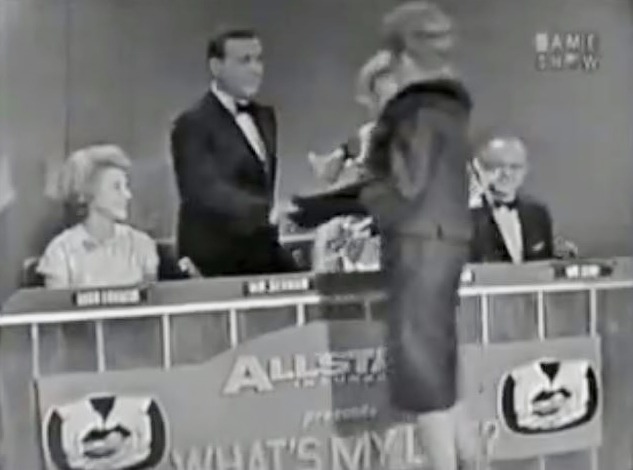
RIP comedy legend SHELLEY BERMAN (1925-2017). Seen here shaking hands with Lucille Ball after her appearance on “What’s My Line” in 1961, the only time the two appeared together.
-
MOD, MOD LUCY
S1;E1 ~ September 23, 1968
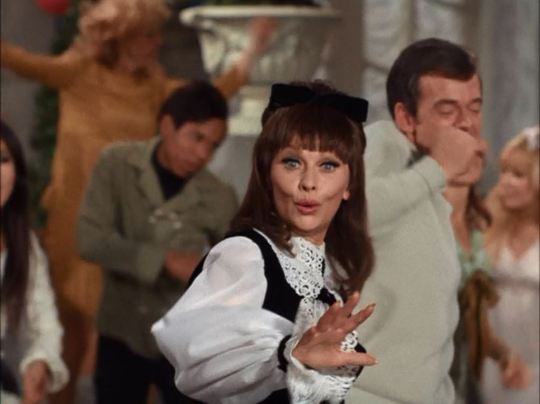
“Here’s
Lucy” BackgroundIn
December 1967 Lucille Ball sold Desilu Studios to Paramount. “The
Lucy Show” was in its sixth season and still at the top of the
ratings for CBS. Ball was not interested in working for Paramount and
“The Lucy Show” now had enough episodes to qualify for
syndication, so she decided to form her own production company named
Lucille Ball Productions (LBP) and produce a new show for CBS.
First, she asked her own children Lucie Arnaz and Desi Arnaz Jr. if
they would be interested in starring alongside her. Gale Gordon would
co-star. Eventually, Mary Jane Croft would also join the cast.
Ball’s husband Gary Morton would act as co-Producer and his actor
cousins Sid Gould and Vanda Barra would round out the ensemble
players. Jack Donohue, who had directed 107 or the 156 episodes of
“The Lucy Show,” would direct season one. With the main cast in
place and former “Lucy Show” writers Milt Josefsberg and Joe
Singer in charge of scripts, “Here’s Lucy” premiered in September
1968 in the same time-slot and evening formerly held by “The Lucy
Show” and “I Love Lucy.” For the first season, Paramount would
co-produce the show with LBP.
The
premise of the show was similar to that of the first seasons of “The
Lucy Show.” Ball played widow raising two children on her own –
in this case free-spirited teenagers played by Lucie and Desi. Using
her own first name as usual, Lucy chose the surname CARter in order
to repeat the AR combination of letters so successful in her marriage
to Desi ARnaz and the characters Lucy RicARdo, and Lucy CARmichael.
One story (possibly apocryphal) says that Carole Lombard’s mother was
very superstitious and told Lucy these letters would be key to her
future success. Lucie and Desi were given freedom to chose their
character names and selected Kim and Craig, respectively. The show’s
scripts would showcase their offscreen talents; Lucie’s singing and
dancing, and Desi’s drumming.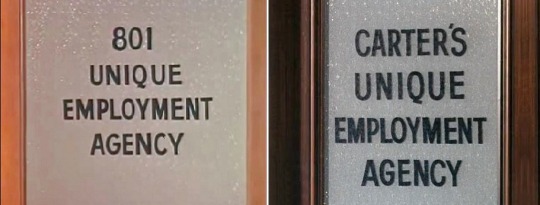
Once
again, Gale Gordon, who had appeared on all of Lucille Ball’s
successful radio and television programs, would play her employer,
Harrison Otis Carter, proprietor of the Unique Employment Agency.
This business’s name was taken from a 1967 episode of “The Lucy
Show”. Their motto was “Odd Positions for Odd people.” On
“Here’s Lucy” it would be “Unusual Jobs for Unusual People”
and was sewn on a sampler that hung in their office. Just as in the
final seasons of “The Lucy Show,” Lucy and Harry would share an
office. Here, Harry would also be related to the Lucy character, as
the brother of her deceased (but never mentioned) husband, Kim and
Craig’s father. Just like the latter seasons of “The Lucy Show,”
the show would be set in Los Angeles.
“Here’s
Lucy” debuted on September 23, 1968 at 8:30 Eastern time on CBS.
Its lead-in was the massively popular “Gunsmoke,” entering its
14th season. “Here’s Lucy” was followed by the first
season of “Mayberry R.F.D.,” a reformatted version of “The Andy
Griffith Show,” just as “Here’s Lucy” was a reformatted version
of “The Lucy Show.”
“Here’s Lucy” was aired opposite the
second half hour of season two of “Rowan and Martin’s Laugh-In”
on NBC. Both Dan Rowan and Dick Martin were frequently seen on “The
Lucy Show.” On ABC “Here’s Lucy” was up against the third (and
final) season of “Felony Squad,” a half-hour crime drama starring
Howard Duff. Duff and his wife played themselves on a 1959 episode
of “The Lucy-Desi Comedy Hour.”
The
“Here’s Lucy” opening credit sequence featured a puppet created
by Oscar-nominated Jim Danforth. The figure hearkens back to the
original stick-figure drawings that opened “I Love Lucy” and the
first seasons of “The Lucy Show.” During the opening sequence,
the Lucy puppet blows a kiss toward the name Gary Morton, Ball’s
husband. The theme song was composed by Wilbur Hatch, who had been
involved with Lucy and Desi since “I Love Lucy.”
Directed
by Jack Donohue ~ Written
by Milt Josefsberg and Ray SingerSynopsis
When Kim and Craig get a job performing at a birthday party for one of Uncle Harry’s clients, Kim gets laryngitis and Lucy must take her daughter’s place.
Regular
Cast
Lucille
Ball (Lucy
Carter) was born on August 6, 1911 in Jamestown, New York. She began
her screen career in 1933 and was known in Hollywood as ‘Queen of
the B’s’ due to her many appearances in ‘B’ movies. With
Richard Denning, she starred in a radio program titled “My Favorite
Husband” which eventually led to the creation of “I Love Lucy,”
a television situation comedy in which she co-starred with her
real-life husband, Latin bandleader Desi Arnaz. The program was
phenomenally successful, allowing the couple to purchase what was
once RKO Studios, re-naming it Desilu. When the show ended in 1960
(in an hour-long format known as “The Lucy-Desi Comedy Hour”) so
did Lucy and Desi’s marriage. In 1962, hoping to keep Desilu
financially solvent, Lucy returned to the sitcom format with “The
Lucy Show,” which lasted six seasons. She followed that with a
similar sitcom “Here’s Lucy” co-starring with her real-life
children, Lucie and Desi Jr., as well as Gale Gordon, who had joined
the cast of “The Lucy Show” during season two. Before her death
in 1989, Lucy made one more attempt at a sitcom with “Life With
Lucy,” also with Gordon, which was not a success and was canceled
after just 13 episodes.Lucie
Arnaz (Kim Carter) is the real-life daughter of Lucille Ball and Desi Arnaz. She
was born in 1951 just before the premiere of “I Love Lucy.”
Lucille Ball was actually pregnant during the filming of the show’s
pilot. Despite rumors to the contrary, Lucie Arnaz never appeared on
“I Love Lucy.” Lucie played Cynthia (as well as other characters)
on “The Lucy Show.” She
has been twice married, to actor Phil
Vandervort (1971)
and actor-writer Laurence
Luckinbill (1980–present).
She has three children with Luckinbill: Simon, Joseph, and Katharine.
She now lives in Palm Springs, California, near the home once owned
by her parents.Desi
Arnaz Jr. (Craig
Cartrer) is the real-life son of Lucille Ball. His 1953 birth was
worked into the plot of “I Love Lucy” although Desi Jr. never
played the role of Little Ricky Ricardo. He did, however, appear on
the final half-hour episode of the series “The
Ricardos Dedicate a Statue” (ILL S6;E27)
in
a crowd scene. He was occasionally seen as Billy Simmons and other
minor characters on “The Lucy Show.” At the time of filming
“Here’s Lucy” he was part of the band Dino Desi and Billy along
with Dean Martin Jr. and Billy Hinsche. Arnaz
was married to actress Linda
Purl from
1980 until 1981. In 1987, Arnaz married Amy Laura Bargiel.
They
lived in Boulder
City, Nevada,
with their daughter, and own the Boulder Theatre, a cinema converted
into a theatre and home to the Boulder City Ballet Company.
Amy
died in 2005 after a long battle with cancer.Desi Arnaz
has a daughter, Julia.
Gale
Gordon (Harrison
Otis Carter) was said to be the highest paid radio artist of the
1930’s and was in such demand that he often did two or more radio
shows a day. His professional collaboration with Lucille Ball started
in 1938 as the announcer of Jack Haley’s “The Wonder Show”
(Wonder Bread was their sponsor). He played Mr. Atterbury on Lucy’s
“My Favorite Husband” and was a front-runner for the part of Fred
Mertz on “I Love Lucy.” When scheduling prevented his
participation, he appeared as Mr. Littlefield, the Tropicana’s
owner in two
episodes
of
the show. In addition to Mr. Littlefield, he played a Judge in “Lucy
Makes Room for Danny,” a
1958 episode of “The Lucy–Desi Comedy Hour.” “The Lucy Show”
solidified his partnership with Lucille Ball for the rest of their
careers. He went on to play Harrison Otis Carter in “Here’s
Lucy,” Omar Whittaker in “Lucy Calls The President,” and Curtis
McGibbon in “Life with Lucy.” He died in 1995 at the age of 89.Guest
Cast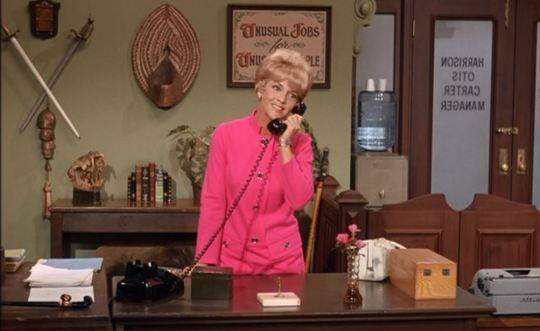
Doris
Singleton
(Doris Singleton) created the role of Caroline Appleby on “I Love
Lucy,” although she was known as Lillian Appleby in the first of
her ten appearances. She made two appearances on “The Lucy Show.”
This is the first of her four appearances on “Here’s Lucy.”Unusually,
the actor gets to use both her first and last names as her
character’s names. Her birth name, however, was Dorthea.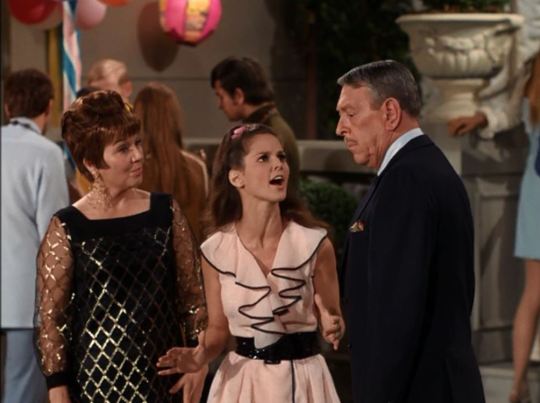
Lew
Parker (Mr. Caldwell, above right) is probably best remembered as
the restaurateur father of Ann Marie, Marlo Thomas’ character on
TV’s “That Girl” (1966-71). He made five appearances on “The
Lucy Show.” This is the first of his two appearances on “Here’s
Lucy.”Nancy
Roth (Laurie Caldwell, above center) had played Lucille Ball’s
stepdaughter in the film Yours, Mine and Ours released earlier
in 1968. She made only three more television appearances before
leaving the business.The
character’s first name is not spoken in the dialogue.Nancy
Howard (Mrs. Caldwell, above left) along with Nancy Roth, also
appeared with Lucille Ball in Yours, Mine and Ours (1968).
This is the first of her four appearances on “Here’s Lucy.”Monty
O’Grady (Party Guest, uncredited) was first seen with Lucille
Ball in The Long, Long Trailer (1953) and played a passenger
on the S.S. Constitution in “Second
Honeymoon” (ILL S5;E14). He was a traveler at the airport
when “The
Ricardos Go to Japan”(1959). He made more than a dozen
appearances on “The Lucy Show” and a half dozen more on “Here’s
Lucy.”Don
Crichton (Featured Dancer, uncredited) makes the first of his
three appearances on “Here’s Lucy.” He was an Emmy nominated
choreographer who worked on “The Carol Burnett Show” and “The
Love Boat,” among others.Carole
Cook
(Lucille Ball’s Singing Voice in “All Alone”, uncredited) played
Thelma Green on “The Lucy Show” as well as many other characters.
She was a protege of Lucille Ball’s during the Desilu Playhouse
years. Although born as Mildred Cook, Ball suggested she take the
name Carole, in honor of Lucy’s great friend, Carole Lombard. Cook
appeared on camera in five episodes of “Here’s Lucy.”Uncredited
background performers play the party guests and the musicians.
This
is the first and only appearance of Doris Singleton as Harry’s
competent and efficient secretary. Originally intended to be a series
regular, the character was dropped to show more of Lucy’s family life
with her kids rather than her job.
When
Harry balks about hiring family, Lucy says “Suppose the
Smothers Brothers didn’t hire relatives. We’d only have one Smother!”
A month before “Here’s Lucy”
premiered, CBS presented a four episode series titled “The Summer
Smothers Brothers
Hour.” Season 3 of their popular variety show premiered a week
later. Lucille Ball was obviously in favor of nepotism. “Here’s
Lucy” employed her children, her husband, her cousins-in-law, and
(in season two) her cousin Cleo.It
is established that Lucy has been working for Harry for two years.The
Carter’s doctor is named Schwartz.Harry
wants to book “that English band” but cannot remember
their name. “The Grasshoppers? The Caterpillars? The
Centipedes? The Beatles!” Just a few weeks after this
episode aired saw the release of the Beatles’ film Yellow
Submarine. The Beatles were previously mentioned on “The
Lucy Show.”Harry
refers to Lucy as “the Lucrezia Borgia of the typists.”
Lucrezia Borgia (1480-1519) was the daughter of Pope Alexander VI
and was rumored to have taken part in murders by poison. Harry is
likely inferring that her typing is deadly (very bad).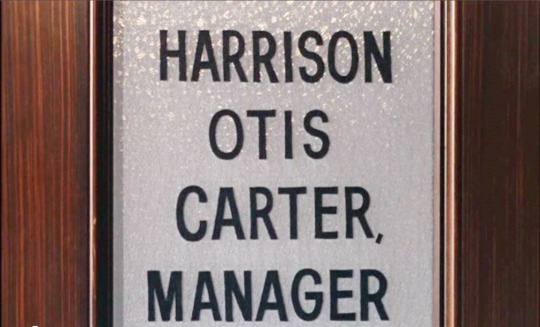
Harry
tells Mr. Caldwell that their company motto is “The difficult we
do immediately. The impossible takes a little longer.” The
slogan may have originated with the US Army.
When
Lucy hears Kim has gone surfing the afternoon before her singing gig
she is worried. “Does Mahalia Jackson go surfing before
she sings?” Mahalia
Jackson (1911-1972) was a
black gospel singer dubbed ‘The Queen of Gospel’ and who was one of
the most popular singers in the world. Jackson played an integral
role in the civil rights movement of the 1960s.
When
Lucy comes up with the idea to take Kim’s place at the party, she
says to Craig “Sonny – meet Cher.”
In 1967 the husband and wife singing duo had released the album “In
Case You’re In Love” which featured top 100 hits “The Beat Goes
On” and “Little Man.” Cher’s
mother, fashion model Georgia Holt, had appeared on both “I Love
Lucy” and “The Lucy Show.” Cher and Lucy would appear on an
Emmy-nominated special together in 1979 (above).The
script has Lucie Arnaz play charades to relate how she got
laryngitis. Pantomime was one of Lucille Ball’s favorite skills, so
naturally she wanted to encourage her daughter’s mime skills. Lucie
receives a round of applause from the studio audience at the
conclusion of the charades.
As
the party scene opens, the band (featuring Craig on drums) is playing
“Goin’
Out Of My Head,”
a song written by Teddy
Randazzo and
Bobby
Weinstein,
initially recorded by Little
Anthony and The Imperials in
1964.
The lyrics are not heard here. “I Know A Place” by Tony Hatch was recorded in 1965 by Petula Clark. It is here performed as a dance number without lyrics.
“All
Alone”
by Irving
Berlin interpolated
into the Broadway show The
Music Box Revue of 1924.
It is here performed
by Lucille
Ball (conspicuously
dubbed by Carole
Cook).
Because Lucille Ball had used her own voice in songs during “The
Lucy Show,” the dubbing sounds nothing like her own voice.Choreography
was by Jack Baker’s history with Lucille Ball dates back to
choreographing “Nobody Loves the Ump” in 1956, a song featured on
“Lucy and Bob Hope” (ILL S6;E1). He also staged dance numbers on
“The Lucy-Desi Comedy Hour” and “The Lucy Show.” This is the
first of 16 choreographic credits on “Here’s Lucy.” He also
directed three episodes of the series. Baker was assisted by Anita
Mann, who would also appear on camera in two episodes. She went on
to choreograph the “Solid Gold” dancers.
Desi
Arnaz Jr. later said that he was very proud of his first on-camera
drum solo in front of his mother.

The
first time Lucille Ball went mod was in the location-filmed special
“Lucy in London” (1966).
In
“Viv Visits Lucy” (TLS S5;E15) Lucy and Viv don mod outfits to
fit in with the crowd on Sunset Strip.

Harry
hiding a pie in the globe when he’s supposed to be dieting is
reminiscent of when Lucy Ricardo went on a hunger strike in “Lucy
Gets a Paris Gown” (ILL S5;E20) yet had food hidden all around her
hotel room.
Lucy pronounces ‘bar mitzvahs’ as ‘bar mitzvers’, perhaps for comic effect. Lucille Ball was married to Gary Morton, a man of Jewish heritage, so would have known the proper pronunciation, but Lucy Carter may not!

“Mod, Mod Lucy” rates 3 Paper Hearts out of 5
While this episode nicely lays out the themes of the series (the generation gap) and allows Lucie and Desi Jr. a showcase, it is a bit disturbing for Lucy’s voice to be dubbed and her playing younger without it being the butt of the joke is a bit uncomfortable to watch.
 All Alone, Anita Mann, Carole Cook, CBS, Desi Arnaz Jr., Don Crichton, Doris Singleton, Gale Gordon, Gary Morton, Goin’ Out of My Head, Here’s Lucy, I Know A Place, Jack Baker, Jack Donohue, Jim Danforth, Lew Parker, Lucie Arnaz, Lucille Ball, Lucrezia Borgia, Lucy Carter, Mahalia Jackson, Milt Josefsberg, Mods, Monty O’Grady, Nancy Howard, Nancy Roth, Ray Singer, Smothers Brothers, Sonny and Cher, Wilbur Hatch
-
Subscribe
Subscribed
Already have a WordPress.com account? Log in now.
 Papermoon Loves Lucy