-
LUCY GOES HAWAIIAN: PART TWO
S3;E24 ~ February 22, 1971


Directed by Jack Donohue ~ Written by Milt Josefsberg, Ray Singer, and Al Schwartz
Synopsis
Lucy and Harry have to put a ‘Farewell Show’ for the final night of their cruise. It’s a good thing that Viv, Harry, Kim and Craig are along to help her to produce a Hawaiian extravaganza.
Regular Cast
Lucille Ball (Lucy Carter), Gale Gordon (Harrison Otis Carter), Lucie Arnaz (Kim Carter), Desi Arnaz Jr. (Craig Carter)
Guest Cast

Vivian Vance (Vivian Jones) was born Vivian Roberta Jones in Cherryvale, Kansas in 1909, although her family quickly moved to Albuquerque, New Mexico where she was raised. She had extensive theatre experience, co-starring on Broadway with Ethel Merman in Anything Goes. She was acting in a play in Southern California when she was spotted by Desi Arnaz and hired to play Ethel Mertz, Lucy Ricardo’s neighbor and best friend. The pairing is credited with much of the success of “I Love Lucy.” Vance was convinced to join the cast of “The Lucy Show” in 1962, but stayed with the series only through season three, making occasional guest appearances afterwards. This is the fourth of her half a dozen appearances on “Here’s Lucy.” She also joined Lucy for a TV special “Lucy Calls the President” in 1977. Vance died two years later.
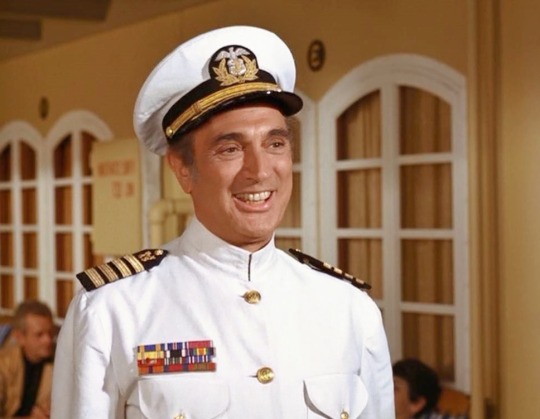
Robert Alda (Captain MacClay) originated the role of Sky Masterson in Broadway’s Guys and Dolls, winning the 1951 Tony Award. He is the father of Alan Alda of “M*A*S*H” fame. He made one appearance on the “The Lucy Show,”
and this is his final appearance on “Here’s Lucy.” Alda died in 1986.The surname MacClay is a tribute to Lucille Ball’s long-time publicist Howard McClay, who also loaned his name to characters on “The Lucy Show.” The end credits, however, spell ‘McClay’ as ‘MacClay.’
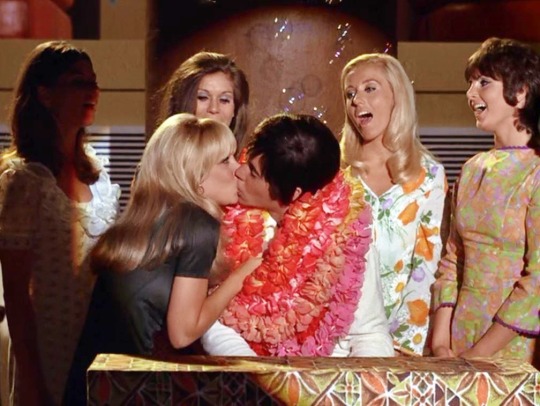
Anita Mann (Wendy) was assistant to the series’ choreographer Jack Baker. This (and Part One) are her only appearances of record on the show. She later choreographed for the Solid Gold Dancers and the Muppets. Mann won an Emmy Award for her work in 1996.
Although credited as ‘Wendy,’ she is not identified by name and has no dialogue. She does, however, get a kiss on the lips by Craig!
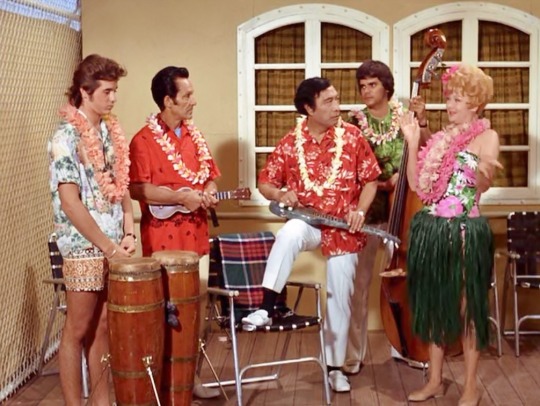
Johnny Ukulele (Himself) was born John Ka’aihue in Kalani, Hawaii in 1901, the son of Prince Koeheo Ka’aihue. He eventually settled in St. Louis to begin a family, playing local clubs and operating an instructional school teaching Hawaiian music. Shortly after World War II ended he joined up with bandleader Harry Owens, remaining with his Royal Hawaiian Orchestra for 15 years, including a nine-year stint on CBS television’s “The Harry Owens Show.” He returned to Hawaii headlining a triumphant homecoming gig. When his children became mainstays on the Las Vegas Strip, Ukulele migrated to Sin City himself, playing casino nightclubs throughout the 1960s. He died in Hollywood in November 1971, just nine months after this episode first aired.
“The Boys” go unbilled and uncredited. Johnny Ukulele has no speakinglines.
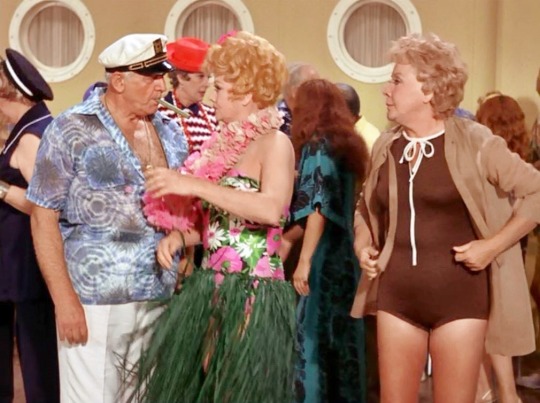
Jack Donohue (Dancer with Cigar) was the director of this episode and 34 others. He also directed 107 episodes of “The Lucy Show” where he was seen on screen as Man in the Bank in “Lucy and the Bank Scandal” (TLS S2;E7) and “Lucy Conducts the Symphony” (TLS S2;E13). He will be seen on camera in one future episode, which he also directed.
Donohue is cast as a typical American tourist, smoking a big cigar and wearing a Hawaiian shirt unbuttoned to his navel.
The ship’s passengers and crew are played by uncredited background performers:
- Nick Borgani appeared with Lucille Ball in the 1937 film Stage Door and in one episode of “The Lucy Show.”
- George DeNormand appearedin three films with Lucille Ball from 1937 to 1963. This is just one of his many appearances on “The Lucy Show” and “Here’s Lucy.”
- Chester Jones makes the last of his four background appearances on “Here’s Lucy.”
- Paul King makes the third of his five background appearances on the series.
- Bernard Sell wasan English-born background player who made three appearance on the “The Lucy Show.” He was also an extra with Lucille Ball and Bob Hope in their films The Facts of Life (1960) and Critic’s
Choice (1963).

- Lisa Pharren (“Tiny Bubbles” Back-up Singer with Red Hair) gave up performing after only four appearances on screen and became a Hollywood make-up artist eventually earning three Emmy nominations for her work. She was also seen in “Lucy the Co-Ed” (S3;E6) in 1970.

The final draft of the script was dated April 1, 1970. This episode, and the preceding one, are sometimes referred to as “Lucy’s Hawaiian Vacation.”

This is Desi Arnaz Junior’s final appearance as a regular cast member. He will make a guest appearance on “Lucy Meets Joe Namath” (S5;E5). He never intended to be on the show more than three seasons, regardless of how successful it was. He was also being offered jobs that he couldn’t turn down, including the filming of Red Sky at Morning (1970).
This is the final episode of season 3, which ends as the #3 show of the year with a 25.9 share, the highest of all six seasons.
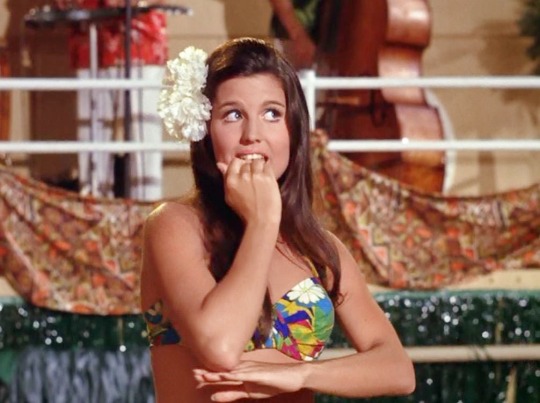
Originally, the two episodes were to be filmed aboard the SS Lurline and on location in Hawaii. When costs proved prohibitive, Lucille Ball productions had a three-quarter scale model of the ship built on the Paramount lot. At the time it was the second largest ship ever built at the studio. The sets occupied three sound stages. It even included a real swimming pool.
These two episodes were a single-camera shoot and filmed without a live studio audience.
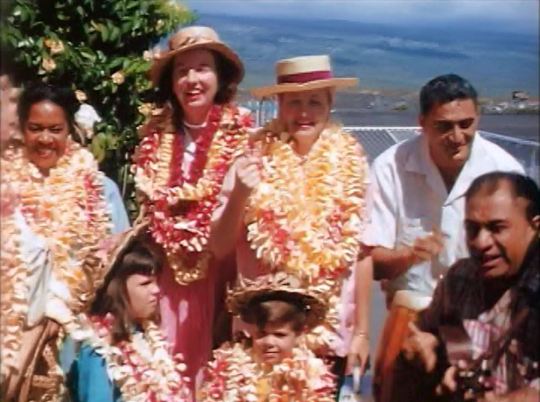
Hawaii was a favorite getaway destination of the Arnaz family. The Season 3 DVD contains home movie footage of the family (and friends) vacationing together in Hawaii. In 2007, Lucie Arnaz remembered their trips to Hawaii fondly:
“It was before my parents were divorced and the time when they were at their happiest. No arguing, no work to take them away, and they just loved being there and with each other.”

The SS Lurline was a real ship sailing from California to Hawaii for the Matson Steamship line from 1932 to 1963, when it was sold to the Chandris Lines and re-christened the RHMS Ellinis. The Matson Line then brought the Matsonia (first known as the Monterey) out of retirement and re-christened it the Lurline, keeping the historic name alive in their fleet. She sailed her last voyage under this name in June 1970, before being sold to Chandris and re-christened Britanis. During the 1980s it was briefly the oldest cruise ship in service. The vessel underwent one more name and ownership change before being deliberately sunk in 2000 after nearly 68 years at sea.
THE FAREWELL SHOW
Captain MacClay acts as the host, introducing the acts:

Vivian sings “Yellow Bird” (aka “Choucoune”) a 19th-century Haitian song composed by Michel Mauleart Monton with lyrics from a poem by Oswald Durand. It was rewritten with English lyrics in the 20th century as “Yellow Bird.” Vance sang it in a high falsetto, with a calypso beat, dressed in yellow with feathers like a canary (including a long tail feather) and perched on a swing decorated as a nest. This is the last full musical solo Vivian Vance sings on a Lucy program.
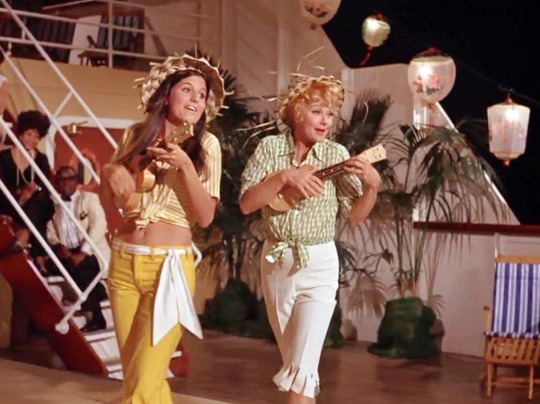
Kim and Lucy sing “Ukulele Talk.” Lucille Ball learned to play the ukulele for “I Love Lucy,” although the only full song she knew was “Has Anybody Seen My Gal?”
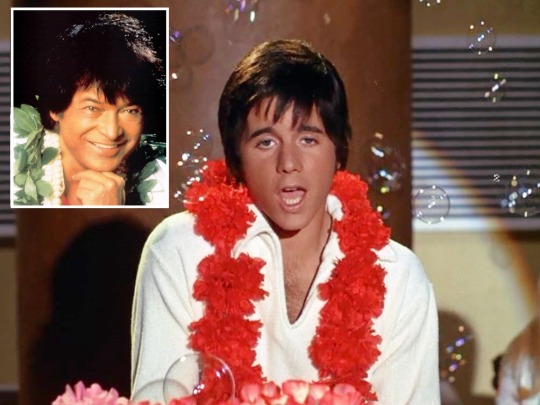
Craig does an impression of Don Ho (inset), singing “Tiny Bubbles” by Martin Denny and Leon Pober. It was released in 1966 by Don Ho (inset) and became his signature song.

Lucy and Viv sing the 1957 novelty song “Mama’s Mumu” by Gene Burdette. Harry makes a special appearances as ‘Mama’, wearing a wig and a padded mumu.
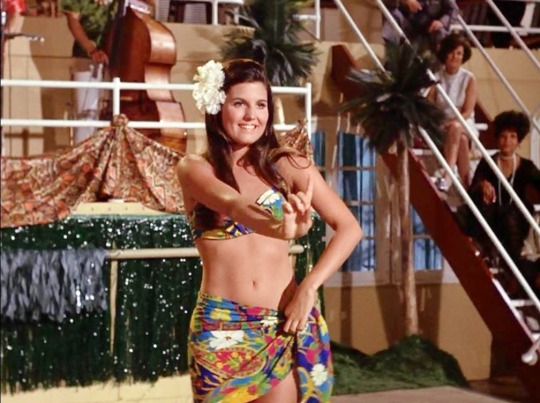
The Captain (Robert Alda) sings “Just Keep Your Eyes on the Hands” while Kim dances a seductive hula. The song was written by Tony Todaro and Liko Johnston and was interpolated into the 1956 film The Revolt of Mamie Stover.
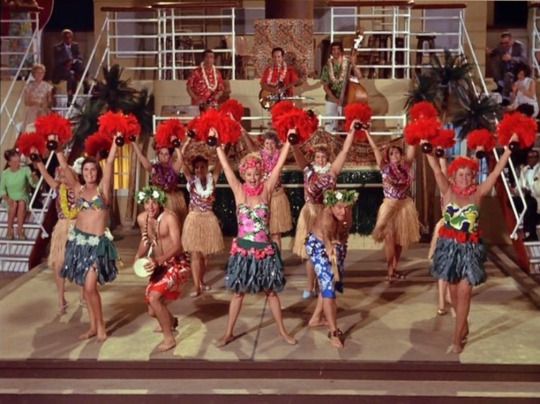
The Carters perform “A Hawaiian War Chant,” written by Johnny Noble, a composer who was a native Hawaiian. The song was previously performed on “I Love Lucy” and “The Lucy Show” making it one of the few songs to be performed on all three of Lucille Ball’s major sitcoms. The finale is filled out with several of the female extras who previously appeared in the Hula lesson scene.

In 1955 Desilu recreated the SS Constitution on their Hollywood sound stage the same way LBP does the SS Lurline in 1971. Both episodes were filmed with the cooperation of the shipping lines, American Export Lines (1955) and Matson Steamship Lines (1970).
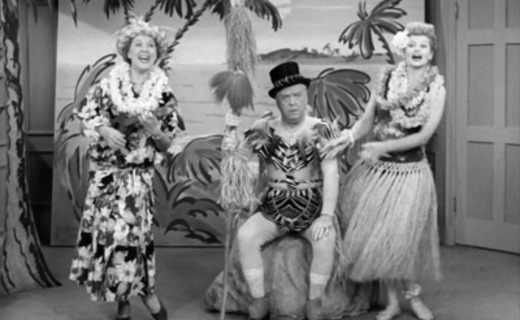
Hawaiian music was featured on “RIcky’s Hawaiian Vacation” (ILL S3;E22)…

…and “Lucy and Carol in Palm Springs” (TLS S5;E8).

Playing his Hawaiian-style conga drum, Desi Jr. bears more than a passing resemblance to his famous father.

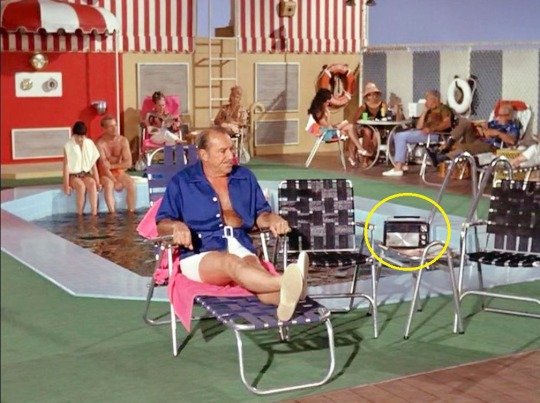
Oops! There is a transistor radio next to Harry while he is lounging poolside. There would be no radio reception if the ship was in the middle of the Pacific Ocean.

Wha’ Happen’? Despite the title, just as on “RIcky’s Hawaiian Vacation” we never see the characters in Hawaii – or even learn later if they got there or what they did. Did the Lurline spend any time in Hawaii or did it immediately return to California? Was Lucy aboard, or did she stay on for a vacation and fly back later? We never find out!
“Lucy Goes Hawaiian: Part Two” rates 3 Paper Hearts out of 5
This is one of those cases where one 45-minute episode would be better than two 30-minute installments. The fist 15 minutes of this show are basically filler for the Hawaiian-themed musical revue that ends the show (and the season). Gale Gordon and Desi Arnaz Jr. are completely bare-chested for the first time in three seasons! Ratings soared!
 1971, A Hawaiian War Chant, Al Schwartz, Bernard Sell, CBS, Chester Jones, Desi Arnaz Jr., Don Ho, Gale Gordon, George DeNormand, Hawaii, Here’s Lucy, Hula, Jack Donohue, Johnny Ukulele, Just Keep Your Hands on the Eyes, Lucie Arnaz, Lucille Ball, Mama’s Mumu, Milt Josefsberg, Nick Borgani, Paul King, Ray Singer, Robert Alda, SS Lurline, Tiny Bubbles, tv, Ukulele Talk, Vivian Vance, Yellow Bird
 -
LUCY GOES HAWAIIAN: PART ONE
S3;E23 ~ February 15, 1971


Directed by Jack Donohue ~ Written by Milt Josefsberg, Ray Singer, and Al Schwartz
Synopsis
Harry takes an usual job as a cruise director and recruits Lucy to be his unpaid assistant. Also on board are her kids and her old friend Vivian Jones (Vivian Vance). A shipboard rivalry erupts when Lucy and Vivian are both attracted to the handsome Captain (Robert Alda).
Regular Cast
Lucille Ball (Lucy Carter), Gale Gordon (Harrison Otis Carter), Lucie Arnaz (Kim
Carter), Desi Arnaz Jr. (CraigCarter)Guest Cast
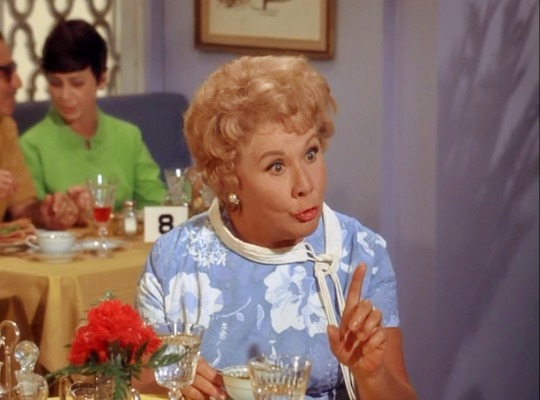
Vivian Vance (VivianJones) was born Vivian Roberta Jones in Cherryvale, Kansas in 1909, although her family quickly moved to Albuquerque, New Mexico where she was raised. She had extensive theatre experience, co-starring on Broadway with Ethel Merman in Anything Goes. She was acting in a play in Southern California when she was spotted by Desi Arnaz and hired to play Ethel Mertz, Lucy Ricardo’s neighbor and best friend. The pairing is credited with much of the success of “I Love Lucy.” Vance was convinced to join the cast of “The Lucy Show” in 1962, but stayed with the series only through season three, making occasional guest appearances afterwards. This is the fourth of her half a dozen appearances on “Here’s Lucy.” She also joined Lucy for a TV special “Lucy Calls the President” in 1977. Vance died two years later.
This is Vivian’s sixth cruise. She is unmarried.

Robert Alda (Captain MacClay) originated the role of Sky Masterson in Broadway’s Guys and Dolls, winning the 1951 Tony Award. He is the father of Alan Alda of “M*A*S*H” fame. He made one appearance on the “The Lucy Show,”
and this is his final appearance on “Here’s Lucy.” Alda died in 1986.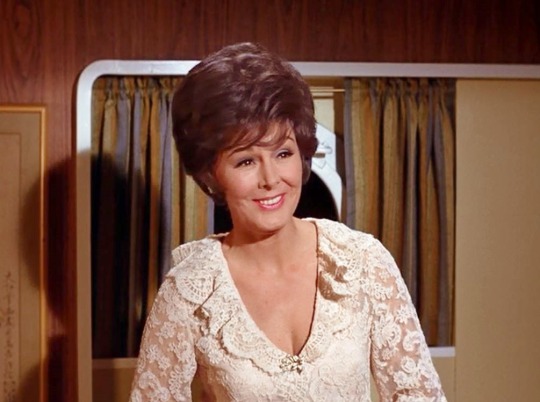
Jean Byron (Mrs. MacCLay) is probably best remembered as Natalie Lane, mother of Patty Duke on “The Patty Duke Show” (1963-66) as well as well as Imogene Burkhart on “The Many Loves of Dobie Gillis” (1959-63). This is her only appearance with Lucille Ball.
The surname MacClay is a tribute to Lucille Ball’s long-time publicist Howard McClay, who also loaned his name to characters on “The Lucy Show.” The end credits, however, spell ‘McClay’ as ‘MacClay.’

Anita Mann (Wendy) was assistant to the series’ choreographer Jack Baker. This (and Part Two) are her only appearances of record on the show. She later choreographed for the Solid Gold Dancers and the Muppets. Mann won an Emmy Award for her work in 1996.
Mann plays a bikini-clad blonde that Craig befriends aboard ship. Although credited as ‘Wendy,’ she is not identified by name in the dialogue.

Maurice Kelly (Sailor) was an English-born actor who played a student in “Lucy and Viv Take Up Chemistry” (TLS S1;E26). This is the second of his three appearances on “Here’s Lucy.” He died at the young age of 46 in 1974.
The ship’s passengers and crew are played by uncredited background performers:
- Nick Borgani appeared with Lucille Ball in the 1937 film Stage Door and in one episode of “The Lucy Show.”
- Paul Bradley made his six appearances on “The Lucy Show” in various roles. This is the second of his two episodes of “Here’s Lucy.”
- George DeNormand appearedin three films with Lucille Ball from 1937 to 1963. This is just one of his many appearances on “The Lucy Show” and “Here’s Lucy.”
- James Gonzales was a popular Hollywood extra who first acted with Lucille Ball in the 1953 The Long, Long Trailer. He was previously seen on “The Lucy Show” as Stan Williams in “Lucy Digs Up a Date” (TLS S1;E2). He was seen in more than 20 episodes of “The Lucy Show” and 3 episodes of “Here’s Lucy.”
- Chester Jones makes the last of his four background appearances on “Here’s Lucy.”
- Paul King makes the third of his five background appearances on the series.
- Victor Romito was seen as the Bartender in “Lucy Meets John Wayne” (TLS S5;E10). He also appeared in four episodes of “Here’s Lucy.” Romito was an extra in the 1960 Lucille Ball / Bob Hope film Critic’s Choice.
- Bernard Sell was an English-born background player who made three appearance on the “The Lucy Show.” He was also an extra with Lucille Ball and Bob Hope in their films The Facts of Life (1960) and Critic’s Choice (1963).

This episode was first aired on February 15, 1971, which was Mary Jane Croft’s 55th birthday. Although not in this episode, Croft will make her tenth of thirty appearances when the program resumes production for season four.
The final draft of this script is date March 30, 1970. A copy was donated by the estate of writer Milt Josefsberg to the Thousand Oaks Library’s American Radio Archives.

Coincidentally, March 30, 1970 also saw the first broadcast of an episode of “Mayberry RFD” titled “Aloha, Goober”! In it, Goober’s Mayberry service station is competing to win a trip to Hawaii.

The title of the episode(s) was doubtless inspired by the 1961 feature film Gidget Goes Hawaiian starring Deborah Walley. Walley would later be a regular on Desi Arnaz series “The Mothers-in-Law” (1967-69). The film also features a character named Lucy (played by Vivian Marshall).
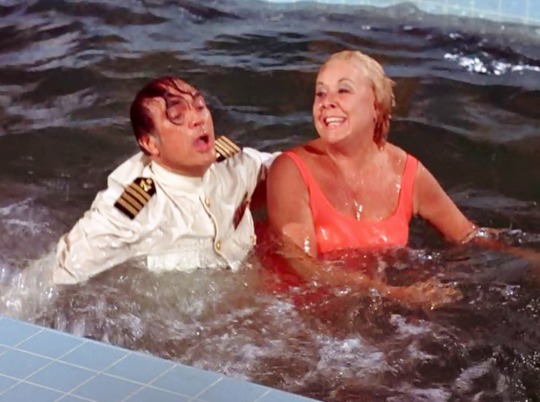
Originally, the two episodes were to be filmed aboard the actual SS Lurline and on location in Hawaii. When costs proved prohibitive, Lucille Ball Productions had a three-quarter scale model of the ship built on the Paramount lot. At the time, it was the second largest ship ever built at the studio. The sets occupied three sound stages. It even included a real swimming pool!

These two episodes were a single-camera shoot and filmed without a live studio audience. Establishing shots of the ship and some dockside location shots were also used.
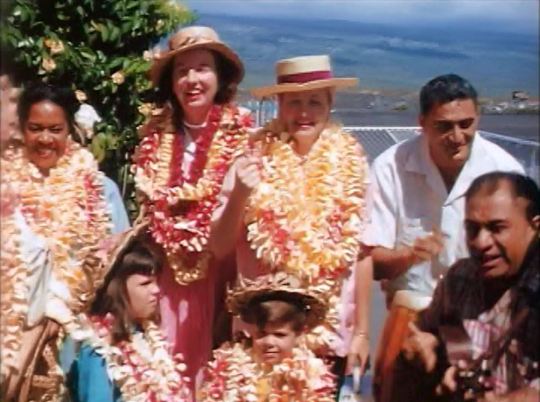
Hawaii was a favorite getaway destination of the Arnaz family. The Season 3 “Here’s Lucy” DVD contains home movie footage of the family (and friends like Mary Wickes) vacationing together in Hawaii.

In 2007, Lucie Arnaz remembered their trips to Hawaii fondly:
“It was before my parents were divorced and the time when they were at their happiest. No arguing, no work to take them away, and they just loved being there and with each other.”
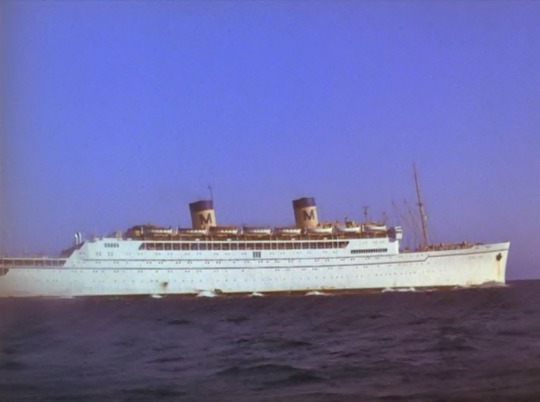
The SS Lurline was a real ship sailing from California to Hawaii for the Matson Steamship line from 1932 to 1963, when it was sold to the Chandris Lines and re-christened the RHMS Ellinis. The Matson Line then brought the Matsonia (first known as the Monterey) out of retirement and re-christened it the Lurline, keeping the historic name alive in their fleet. The Lurline sailed her last voyage under this name in June 1970, before being sold to Chandris and re-christened Britanis. During the 1980s it was briefly the oldest cruise ship in service. The vessel underwent one more name and ownership change before being deliberately sunk in 2000 after nearly 68 years at sea.

The episode incorporates some establishing locations shots of the Lurline departing from San Francisco with the Golden Gate Bridge in the distance.

There is also a location shot of Lucy standing on the dock taking photographs, although this is probably a double for Lucille Ball. With the distance, the streamers, and the camera in front of her face, it is difficult to tell for certain.

The final draft of the script for this episode was dated March 30, 1970, ten months before it was aired in mid-February 1971. Because the Lurline sailed for the last time on June 25, 1970, the establishing shots had to have been filmed during April, May or June 1970.
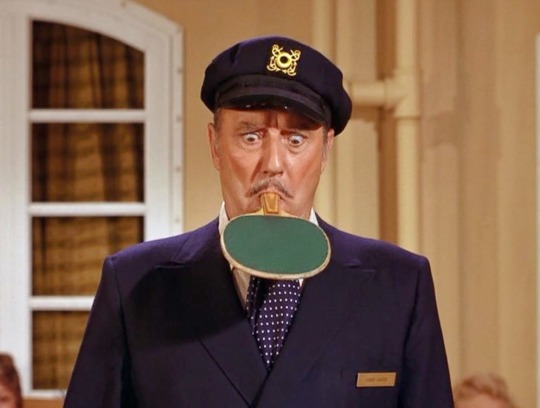
Harry pronounces Hawaii as ‘Havaii’ (with a ‘v’ sound instead of a ‘w’). He also pronounces Los Angeles with a hard ‘g.’ Harry was a linguistic eccentric!

Lucy says the ideal candidate for the cruise director position will be a combination of Cary Grant, Albert Einstein, Joe Namath, and Bob Hope. Lucille Ball did four films with Bob Hope and he appeared on both “I Love Lucy” and “The Lucy Show.” Football player turned entertainer Joe Namath will guest star in a season 5 episode of “Here’s Lucy.” Cary Grant has been mentioned on all of Ball’s sitcoms, including the previous episode “Lucy and Carol Burnett” (S3;E22).

When Vivian burst through the crowd, the production anticipates the home viewers reaction by inserting canned applause! In previous episodes filmed in front of a live studio audience, this was their natural reaction, so one is used here as well. Even the background actors seem happy to see Viv, a character not seen on the series since “Lucy and Viv Visit Tijuana” (S2;E19) a year earlier.

Among the many games and sports items that Assistant Cruise Director Lucy carries is Hasbro’s Automatic Bingo, first manufactured in 1969. Bingo is a mainstay of cruise ship pastimes.
Lucy asks Viv if she is still looking to get married:

VIV: “I dream about orange blossoms so often I sleep with a smudge pot at the foot of my bed.”
Dreams about orange blossoms are said to indicate the search for true love. In orange groves, a smudge pot warms the trees to prevent the fruit from being spoiled by frost and cold weather.

Lucy convinces Harry to disguise himself as rich southerner Colonel Hamilton Hart to woo Vivian away from the Captain MacClay. Harry’s make up and wardrobe are identical to Colonel Harlan Sanders of Kentucky Fried Chicken
fame!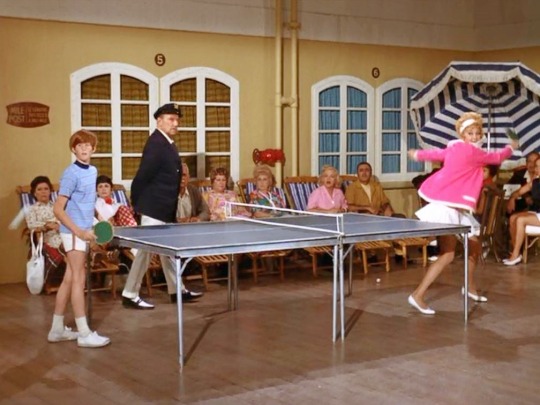
A montage of Lucy being kept busy shows her jogging, shooting skeet, playing tennis, and playing ping-pong.
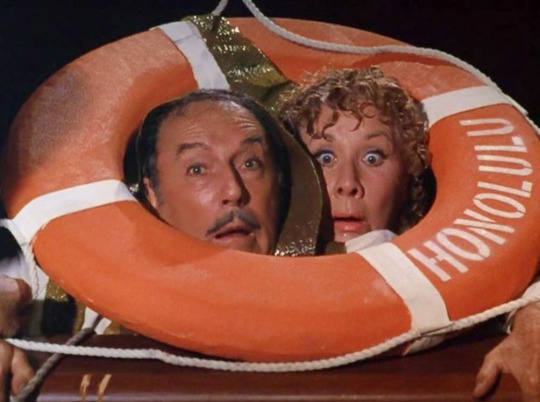
Jumping overboard may be the most extreme example ever of ‘getting Harry wet’ at the end of an episode.

VIVIAN: “Let me through! Let me through! There’s only one person in the whole world who would board ship that way! It’s gotta be… Lucy!”

Boarding ship via the cargo net was a stunt Lucille Ball also did in “Lucy Takes A Cruise To Havana” (LDCH S1;E1) with Ann Sothern at her side – instead of Gale Gordon under her feet!

Another unconventional boarding was in “Bon Voyage” (ILL S5;E13), where Lucy Ricardo missed her sailing for Europe on the S.S. Constitution and was lowered by helicopter to the deck.

Assistant Cruise Director Lucy briefly plays ping-pong with a young boy, just as Lucy Ricardo did on the SS Constitution with Kenneth Hamilton. She first looked for a ping-pong partner by asking an idle bloodhound!

In 1955, Desilu recreated the SS Constitution on their Hollywood sound stage the same way LBP does the SS Lurline in 1971. Both episodes were filmed with the cooperation of the shipping lines, American Export Lines (1955) and Matson Steamship Lines (1970). Both were the most expensive episodes filmed to that date due to construction costs.
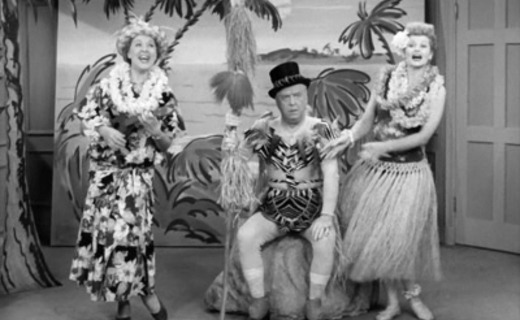
In “Ricky’s Hawaiian Vacation” (ILL S3;E22), Lucy Ricardo pulled out all the stops, including recreating island life in the living room in order to get Ricky to take her along on his booking at the Royal Hawaiian Hotel in Honolulu. When Ricky says no, Lucy schemes to go along by winning a TV quiz show with the Mertzes, but in the end they don’t win the trip. We never learn if Ricky actually went to Hawaii or not.

ETHEL (about the idea of going on a quiz show): “I’d get a pie in my face. She’d get an all-expense cruise.”
It took nearly 16 years, but Lucy and Viv finally got that all-expense paid cruise to Hawaii. But she also did get a pie in the face at the end of the show!

If being Viv being heroically rescued from a swimming pool while pretending she can’t swim sounds familiar, Lucy Ricardo also did it in “The Hedda Hopper Story” (ILL S4;E21).

In the 1955 episode, Freddie Fillmore mentioned a former contestant named Cleo Morgan, which was the name of Lucille Ball’s cousin. She was later the producer of these two episodes of “Here’s Lucy” under her married name of Cleo Smith.

On February 18, 1965, the Douglas family on “My Three Sons” planned a “Hawaiian Cruise” (S5;E23), but illness forced the trip to be canceled. Uncle Charley decides if they cannot go to Hawaii, then Hawaii would come to them and he plans a luau in the backyard.
FAST FORWARD!
In the 1970s and 1980s sitcoms took their cue from Lucy and also traveled to Hawaii.

Probably the most famous of the shows was “The Brady Bunch”, which aired on ABC in 1972, just a year after Lucy’s trip. It, too, was a two-parter. Coincidentally, Eve Plumb (Jan Brady) also played Lucy Carter’s niece Patricia Carter later on in 1972!

In 1980, also on CBS, “The Jeffersons” traveled to the 50th state. Instead of two parts, the show increased their stay to four half-hours! The cast featured an actor named Fred Ball (no relation to Lucille Ball’s brother)!

Hawaii was mention several times on the short lived “Life With Lucy” (1987). In the first episode, Curtis had just returned from vacationing there and in the second episode
guest star John Ritter says that his wife is in Hawaii with the kids. In an un-aired episode, Leonard plans to use his vacation from M&B Hardware to go to Hawaii and lie on the beach.

“Mama Goes Hawaiian” (1988) was also a two-part episode about a Hawaiian vacation. It starred Lucy’s protege Ken Berry and her pal Carol Burnett’s protege, Vicki Lawrence, as Mama.
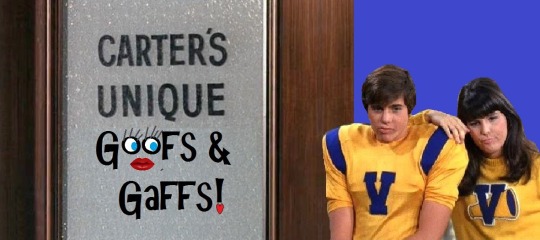

Props! When setting down a large stack of games so she can sit down for a minute, Lucille Ball is so worried that the stack will fall off the deck chair that she keeps her hand nearby to catch them if they do.

Doff Your Hat! When ‘the Colonel’ sits down next to Vivian, he removes his hat and places it on the table. Realizing that this is improper (and that the hat might be in the camera shot) he uses his walking stick to smoothly sweep the hat off the table onto the chair below it. Quick thinking!

“Lucy Goes Hawaiian: Part One” rates 3 Paper Hearts out of 5
This episode is full of Easter eggs for “Lucy” fans with references to four different episodes of “I Love Lucy.” This feels like a cross between “The Love Boat” and “The Golden Girls.” The ending with Harry and Viv both jumping overboard into the Pacific Ocean – at night – is a bit far-fetched, even for Lucy!
 1971, Anita Mann, Bernard Sell, Bob Hope, Cary Grant, CBS, Chester Jones, Cruise, Desi Arnaz Jr., Gale Gordon, Hawaii, Here’s Lucy, James Gonzales, Jean Byron, Joe Namath, Lucie Arnaz, Lucille Ball, Lucy Goes Hawaiian, Matson Line, Maurice Kelly, Nick Borgrani, Paul Bradley, Paul King, ping pong, Robert Alda, Ship, SS Lurline, tv, Victor Romito, Vivian Vance
 -
LUCY AND CAROL BURNETT (aka THE HOLLYWOOD UNEMPLOYMENT FOLLIES)
S3;E22
~ February 8, 1971

Directed
by Jack Carter ~ Written by Ray Singer and Al SchwartzSynopsis
Harry
has fired Lucy again, so she visits the unemployment office where she
reunites with secretary turned actress Carol Krausmeyer (Carol
Burnett) and meets other out of work show biz folk. They decide to
put on a show in order to make some dough!Regular
CastLucille
Ball (Lucy
Carter), Gale
Gordon (Harrison
Otis Carter), Lucie
Arnaz (Kim
Carter)Desi
Arnaz Jr. (Craig
Carter) does not appear in this episode, but is given opening title
credit.Guest
Cast
Carol
Burnett (Carol
Krausmeyer) got her first big break on “The Paul Winchell Show”
in 1955. A years later she was a regular on “The Garry Moore Show.”
In 1959 she made her Broadway debut in Once
Upon a Mattress,
which she also appeared in on television three times. From 1960 to
1965 she did a number of TV specials, and often appeared with Julie
Andrews. Her second Broadway musical was Fade
Out – Fade In which
ran for more than 270 performances. From 1967 to 1978 she hosted her
own highly successful variety show, “The Carol Burnett Show.”
Lucille Ball made several appearances on “The Carol Burnett Show.”
Burnett guest starred in four episodes of “The Lucy Show” and
three episodes of “Here’s Lucy,” only once playing herself.
After Lucille Ball’s passing, Burnett was hailed as the natural
heir to Lucy’s title of ‘The Queen of TV Comedy.’Krausmeyer is
the same last name as the music teacher played by Hans Conried on
Lucille Ball’s radio show “My
Favorite Husband.”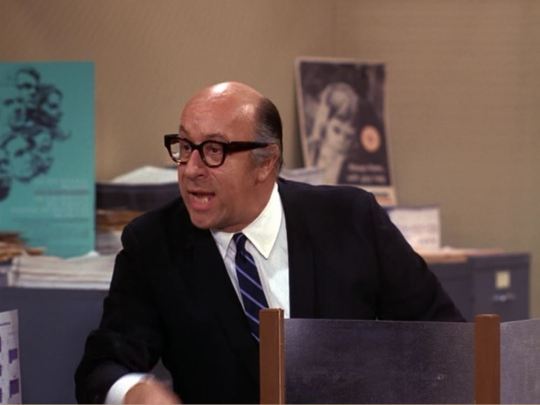
Richard
Deacon (Harvey
Hoople) is probably best remembered as Mel Cooley on “The Dick Van
Dyke Show” (1961-66). He appeared as Tallulah Bankhead’s butler in
“The Celebrity Next Door,” a 1957 episode of “The Lucy-Desi
Comedy Hour.” He was
employed again by Desi Sr. as a regular on “The Mothers-in-Law”
(1968). This is the first of his two appearances on "Here’s
Lucy.”Harvey
Hoople is a clerk at the Unemployment Office, although his name is
never spoken aloud.
Clarence
Landry
and Vernord
Bradley
(“The Highhatters”) were a tap dance duo who both appeared in in
the Vitaphone 1941 short Minstrel
Days.Landry
and Bradley are a introduced to Lucy by Carol using their real first
names.
Jack
Benny (Himself)
was
born on Valentine’s day 1894. He had a successful vaudeville
career, and an even greater career on radio with “The Jack Benny
Program” which also became a successful television show. His screen
persona was known for being a penny-pincher and playing the violin.
Benny was a Beverly Hills neighbor of Lucille Ball’s and the two
were off-screen friends. Benny previously appeared on “The Lucy
Show” as Harry Tuttle (a Jack Benny doppelganger) in “Lucy
and the Plumber” (TLS S3;E2),
did a voice over cameo as himself in “Lucy
With George Burns” (TLS S5;E1),
and played himself in “Lucy
Gets Jack Benny’s Account” (TLS S6;E6).
This is the third of his four episodes of “Here’s Lucy.”
Benny and Ball appeared on many TV variety and award shows
together. He died in 1974.Although
Benny plays into his ‘tightwad’ personae, he is never identified by
name or recognized as a celebrity.Vanda Barra (Unemployment Cashier) was married to Sid Gould so is Lucille Ball’s cousin-in-law. This is just one of her over two dozen appearances on “Here’s Lucy” as well as appearing in Ball’s two 1975 TV movies “Lucy Gets Lucky” (with Dean Martin) and “Three for Two” (with Jackie Gleason). She was seen in half a dozen episodes of “The Lucy Show.”
Unusually, Barra is nothing more than a background performer in this episode, but still gets end credit billing. She has no dialogue.

The ‘Canadian Mounties’
are played by:- Sid
Gould
(left) made
more than 45 appearances on “The Lucy Show,” and nearly as many
on “Here’s Lucy.” Gould (born Sydney Greenfader) was Lucille
Ball’s cousin by marriage to Gary Morton.
He was married to Vanda Barra (Cashier).
- Johnny
Silver
(center right) was a busy Hollywood character actor who was seen with
Richard Deacon (Harvey Hoople) on “The Dick Van Dyke Show” and
with Jack Benny (Himself) on “The Jack Benny Show.” He will do
one more episode of “Here’s Lucy.”
- Mike
Wagner
(right) makes his only appearance on “Here’s Lucy.”
- Kay
Kuter
(center left) was a character actor who made an appearance in the
1970 TV movie Swing
Out, Sweet Land with
Jack Benny and Lucille Ball as the voice of the Statue of Liberty.
Carol
identifies Kuter as “Chuck Walters, a fantastic singer” when they
are the unemployment office. This character was named in honor of Charles Walters, director of the previous episode, “Lucy and Aladdin’s Lamp” (S3;E21). Carol probably should have said “fantastic dancer” since the real Walters was known as dance director of MGM musicals, six of which featured Lucille Ball.Others
at the unemployment office, including two male acrobats and various
clerks, are played by uncredited background performers.
This
episode is sometimes known as “The Hollywood Unemployment Follies”
to distinguish it from previous episodes also titled “Lucy and
Carol Burnett.”Interestingly,
although “The Carol Burnett Show” usually followed “Here’s
Lucy” at 10pm on CBS, there was no new episode the night this
“Here’s Lucy” first aired.On
the series DVD this episode is introduced by Carole
Cook,
who says that Lucille Ball did her own signing on this episode,
despite the fact that Cook had previously dubbed Lucy in other
musical episodes.In
a previous episode, Kim reminds Lucy that Harry has fired her 14
times. This makes 15.Kim
tells Lucy that in California she could get as much as $65 a week in
unemployment
insurance.
As of this writing (late 2017) the maximum was $450 a week for 26
weeks.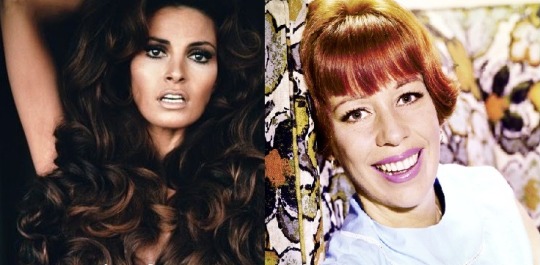
Carol
jokingly tells Lucy that ‘Carol Krausmeyer’ isn’t her professional
name when acting – it’s Raquel Welch. She looks down at her bosom
and says “Ok,
someone let the air out.”
Raquel
Welch was
a voluptuous movie star who was previously mentioned on “Lucy
and Johnny Carson” (S2;E11), “Lucy, the American Mother” (S3;E7) in which she was mentioned alongside Burnett, and
as Jack Benny’s Palm Spring neighbor in the second
episode of
the series. Carol also used Welch’s name as a punchline in “Lucy
Competes With Carol Burnett” (S2;E24).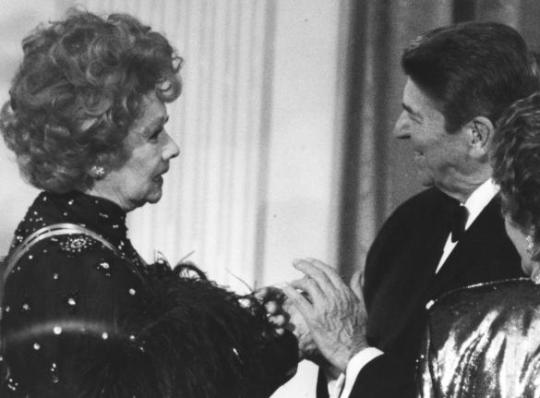
When
Harvey Hoople decides to join up with the unemployed performers to
write and direct their show he says “Governor
Reagan, I quit! You can keep your old job! I’m back in show biz,
Ronnie! Don’t you wish you were?”
Former
Hollywood actor Ronald
Reagan had
been elected Governor of California in 1967, a position he held until
1975. He was later elected 40th President of the United States
and served until 1989. He was previously mentioned in the second
episode of the series, “Lucy
Visits Jack Benny” (S1;E2)
and more recently in “Lucy and the Raffle” (S3;E19).
To
flatter him into being a backer of their show, Carol says that Harry
looks like Cary Grant. He dryly replies “So
do you!”
Harry was compared to Cary
Grant (and others) by Kim (disguised as new secretary Shirley Shoppenhauer) in “Lucy
Protects Her Job” (S2;E14, above). Grant was often mentioned on all of
Lucille Ball’s sitcoms, although the two never acted together.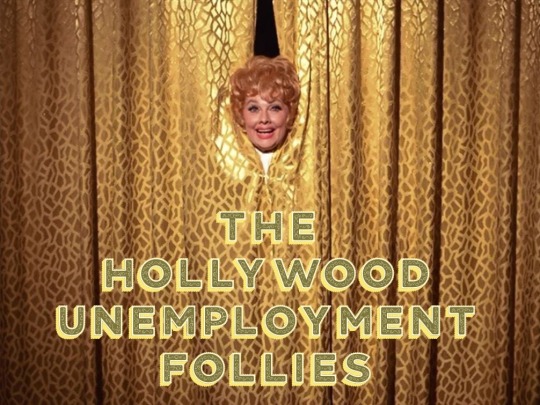

The
subtitle of the “Hollywood Unemployment Follies” is “How to
Starve in Show Business Without Really Trying.” This is a
variation on the title of Frank Loesser’s 1961 Pulitzer Prize-winning
Broadway musical
How
To Succeed in Business Without Really Trying,
which was made into a film in 1967.
The
ensemble sings “Hooray
for Hollywood” a
song by Johnny Mercer and Richard A. Whiting that was first sung in
the 1937 movie Hollywood
Hotel.
This song is the only one to features specially written lyrics to
fit the episode’s theme. This version mentions Henry
Fonda
and his children Jane and Peter. Lucille Ball and Henry Fonda
starred in the film Yours,
Mine and Ours
together in 1968.
Stumbling
onto a Hollywood soundstage, Lucy, Carol and Kim discover a mannequin
of Humphrey Bogart. Kim had a poster of Humphrey
Bogart (inset) on her wall in “Lucy and the Andrews Sisters” (S2;E6). In “Lucy
and the Bogie Affair” (S2;E13) Kim
and Craig name a lost dog Bogie because it has the same sad look as
Bogart did at the end of 1942’s Casablanca.
Ogling the mannequin adoringly, Carol references the famous line “If
you want anything, just whistle,” Lauren
Bacall’s parting words to Humphrey Bogart in the film To
Have and Have Not (1944).
This line was also referenced in “Lucy
and the Bogie Affair” (S2;E13).
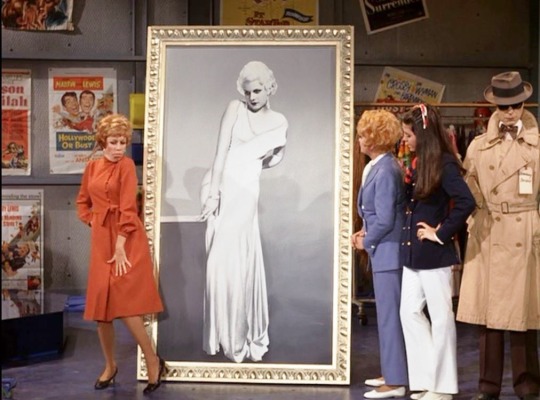
They
then admire a larger than life photo portrait of Jean Harlow.
Jean Harlow
(1911-37) was Hollywood’s original wisecracking blonde bombshell.
Only five months older than Lucille Ball, Harlow died of uremic
poisoning at age 26 just as Lucy’s career was getting started.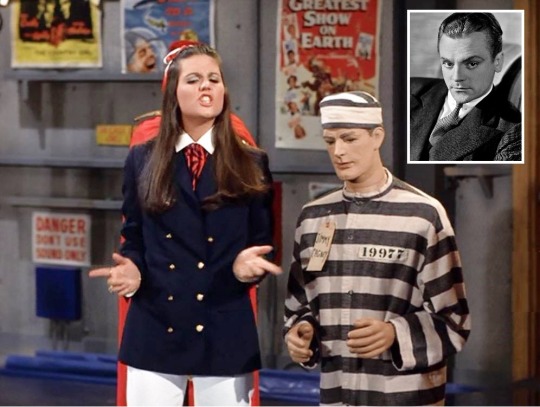
They
move to a mannequin of Jimmy Cagney dressed in prison stripes. Kim
does her impression of Cagney saying “You
dirty rat.”
Cagney
never actually said the famously mis-quoted dialogue but a line in his 1932 film
Taxi!
probably
came closest, calling a philandering man “You
dirty, yellow-bellied rat!”
James
Cagney (1899-1986, inset)
was a singer, dancer and actor best known in Hollywood for playing
tough guys.
They
then encounter mannequins of Clark
Gable and
Vivian Leigh dressed
in costumes from Gone
With the Wind
(1939). Carol, using a high pitched Southern accent, imitates
Scarlet O’Hara. Coincidentally, Carol will play Scarlet (re-named
Starlet) in a one of her most famous sketches from “The Carol
Burnett Show” in 1976 (above right).
Lucille Ball herself was short-listed for the role of Scarlet O’Hara
and even did a screen test for the part. Ball will play Scarlet
O’Hara in “Lucy
and Flip Go Legit” (S4;E1) with Flip Wilson as Prissy.
Lucy imitates Butterfly McQueen, who played Prissy, Scarlet’s maid, using the famous lines “I don’t know nuthin’ ’bout birthin’ babies.” After
Lucy’s imitation of Butterfly
McQueen,
Carol sarcastically says “it
sounded more like Steve.”
Steve
McQueen (1930-80)
was an actor who would
receive an Oscar nomination for The
Sand Pebbles in
1966, the same year that he was mentioned in “Lucy Goes to a
Hollywood Premiere” (TLS S4;E20).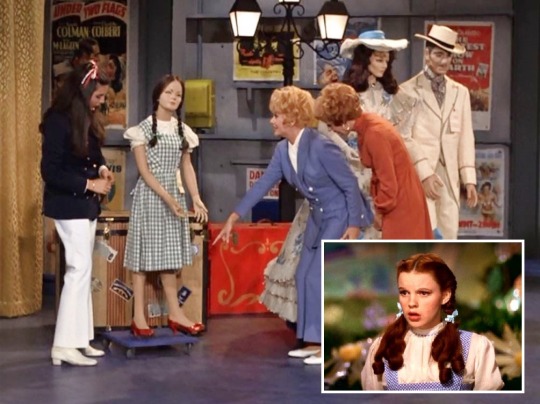
The
final mannequin on the ‘soundstage’ is of Judy
Garland (inset) in The
Wizard of Oz
wearing her famous blue gingham dress and ruby slippers. Kim does a
high-pitched imitation of the Munchkins. Two of the Singer Munchkins,
Jerry Maren and Billy Curtis, appeared in “Lucy and Ma Parker”
(S3;E15) and Shep Houghton, one of the Winkie Guards, was a
background performer on “Here’s Lucy.”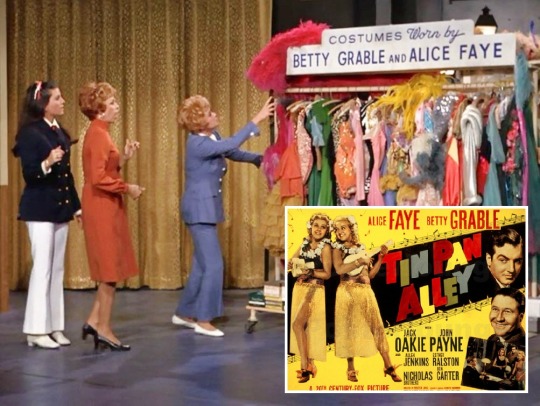
Lucy,
Kim and Carol launch into “We’re
Off to See the Wizard,”
written by Harold Arlen and Yip Harburg for The
Wizard of Oz,
which brings them to a wardrobe rack conspicuously labeled COSTUMES
WORN BY BETTY GRABLE AND ALICE FAYE. Faye and Grable did two films
together, Tin
Pan Alley
(1940) and Four
Jills in a Jeep
(1944). Betty
Grable
(1916-73) made two films with Lucille Ball when they were both at RKO
in the mid-1930s. She then guest-starred as herself with her
second husband bandleader Harry James in “Lucy Wins a Racehorse,”
a 1958 episode of “The Lucy-Desi Comedy Hour.” Alice
Faye
(1915-98) often played gritty, non-nonsense women in films. She was
married to Phil Harris, who will play himself on a 1974 episode of
“Here’s Lucy.”
In
a magical reveal (aka editing) Lucy and Carol become blondes singing
“Chicago
(That Toddlin’ Town”)
a song
written by Fred Fisher and
published in 1922.
After a quick costume change (editing again), they sing “Alexander’s
Ragtime Band”
which was composer Irving Berlin’s first hit in 1911, the same year
Lucille Ball was born.
After
a commercial break, Lucy and Carol discover “the
derby worn by the one and only Bill Robinson.”
Bill
Robinson
(1878-1949)
was the preeminent tap dancer of his day. He is best remembered for
his appearances with young Shirley Temple in four of her
1930s films. Robinson worked with Lucille Ball on the 1935 musical
film Hooray
for Love.
After
some camera trickery (more editing), Kim is wearing the derby and
introducing (through song) one of the Highhatters as Bill “Bojangles”
Robinson (inset) doing a tap routine which she then joins in.
Next
up, four comical Canadian Mounties sing “Stout-hearted
Men,”
a song by Sigmund Romberg and Oscar Hammerstein II for the operetta
New Moon in 1927 with film versions in 1930 and 1940. Richard Deacon
(also dressed as a Mountie) and Carol Burnett sing “Indian
Love Call”
by Rudolf Friml, Herbert Stothart, Otto Harbach, and Oscar
Hammerstein II written for the 1924 operetta Rose-Marie.
The melody was used for the mating call of the wild Gorboona in
“Lucy’s Safari” (S1;E22) which guest-starred Howard Keel, who was
in the 1954 film version of Rose Marie.
Dressed
as Marlene Dietrich, Lucy sings “Falling
in Love Again (Never Wanted To)”
from the 1930 German film The
Blue Angel.
Harry plays a World War I German soldier. Marlene
Dietrich
(1901-92) was born in Berlin, but came to Hollywood to make films in
1930. She was nominated for an Oscar in 1931.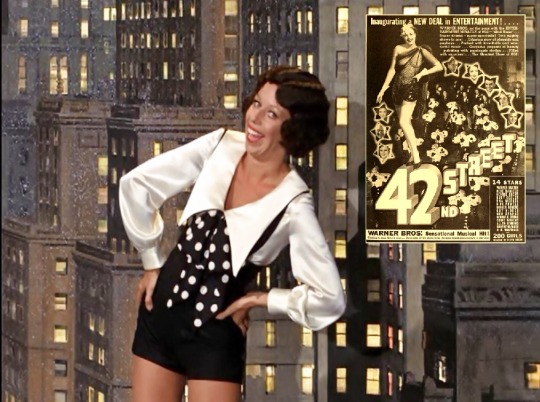
The
Highhatters introduce Carol as Miss Ruby Keeler and they sing
“Shuffle
Off To Buffalo” by
Al Dubin and Hugh Warren, originally written for the 1933 film 42nd
Street.
They then do a dance challenge to the title song from the film. Ruby
Keeler
(1910-93) was a singer, dancer and actress most famous for her
pairing with Dick Powell in a series of movie musicals, including
42nd
Street.
Like Lucille Ball and (now) Lucie Arnaz, Keeler had a home in Palm Springs, California.
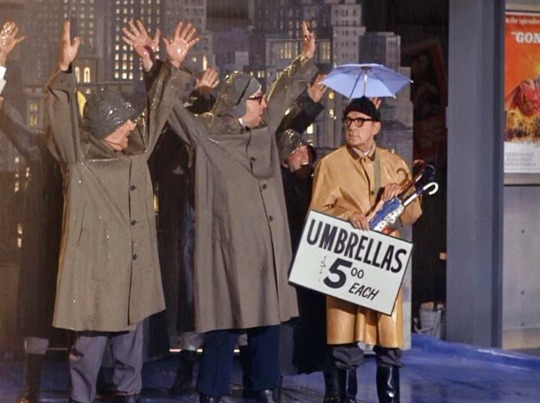
As
the finale, the entire ensemble is dressed in rain slickers and
performs
“Singin’ in the Rain”
written by Arthur Freed and Nacio Herb Brown in 1931. It was most
famously featured in the film Singin’
in the Rain
in 1952.Many
of the movie posters decorating the ‘soundstage’ were from Paramount
Pictures, to which Lucille Ball sold Desilu / RKO and where they
filmed “Here’s Lucy”:- Hollywood
or Bust
(1956) starring Jerry Lewis and Dean Martin - Samson
and Delilah (1949)
starring Hedy Lamarr and Victor Mature - The
Greatest Show on Earth
(1952) starring Charleton Heston, Betty Hutton, and Gloria Grahame,
who replaced Lucille Ball when Lucy became pregnant with Lucie - Short
Cut to Hell (1957)
directed by James Cagney - Gone
With the Wind
(1939) starring Clark Gable and Vivian Leigh - Under
Two Flags
(1936) starring Claudette Colbert and Ronald Colman


“The
Lucy Show” established Lucy Carmichael as a film fanatic in the
Hollywood-themed episode “Lucy Goes To A Hollywood Premiere” (TLS
S4;E20).
The
Scarlet O’Hara dress is the same one Lucy Carmichael wore in 1965 as
Lucybelle in “The Founding of Danfield,” a community theatre play
featured in “Lucy and Arthur Godfrey” (TLS S3;E23).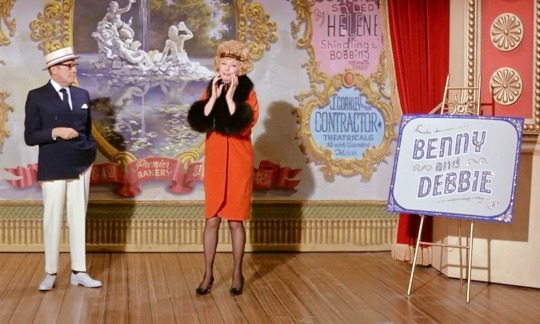
The vaudeville backdrop curtain during “Chicago” and “Alexander’s Ragtime Band” was also used in “Lucy and Jack Benny’s Biography” (S3;E11).

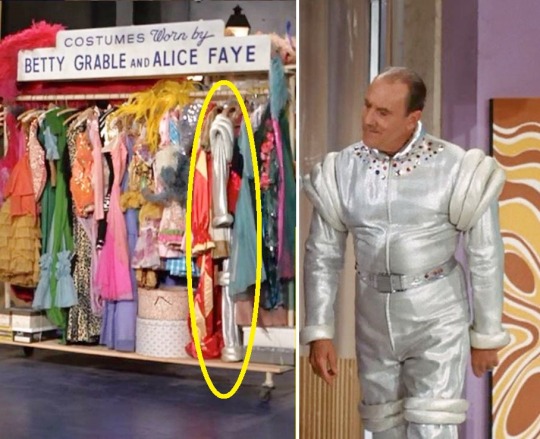
Props!
The
wardrobe rack of costumes worn by Betty Grable and Alice Faye also
contains Gale Gordon’s silver space suit from “Lucy and the
Generation Gap” (S2;E12). It is hard to imagine either woman
wearing that!
Who
Am I?
One mannequin on the ‘soundstage’ doesn’t get identified. It is
dressed in Roman armor. It may have been Charleton Heston in Ben
Hur,
but was cut for time.
Spell-Check!
The end credits miss-spell ‘Mountie’ as ‘Mounty’. The word is an
informal reference to The Royal Canadian Mounted Police.
“Lucy and Carol Burnett” or “The Hollywood Unemployment Follies” rates 4 Paper Hearts out of 5
This
episode seems more like “The Carol Burnett Show” than “Here’s
Lucy” – especially when Lucille Ball is off-screen. A Hollywood
revue is a great idea, but the ‘book scenes’ (in between the songs)
are played in such a naturalistic way that they don’t really seem any
different than the actual show. It is almost as if the trio actually
walked into a Hollywood Hall of Fame and had musical dreams. It all
feels very much like the old Judy Garland / Mickey Rooney ‘let’s put
on a show in a barn’ genre. Gale Gordon has very little to do (not
even a cartwheel!) and Desi Jr. is completely absent. Not
unenjoyable but not the best of these musical comedy episodes either.
 Alexander’s Ragtime Band, Carol Burnett, Carole Cook, Cary Grant, Casalbanca, Clarence Landry, Clark Gable, Gale Gordon, Gone With The Wind, Here’s Lucy, How To Succeed in Business Without Really Trying, Humphrey Bogart, Jack Benny, Jean Harlow, Johnny Silver, Judy Garland, Kay Kuter, Lucie Arnaz, Lucille Ball, Mike Wagner, Raquel Welch, Richard Deacon, Ronald Reagan, Ruby Keeler, Sid Gould, Singin in the Rain, The Wizard of Oz, Unemployment Office, Vernord Bradley, Vivian Leigh
 - Sid
-
LUCY AND ALADDIN’S LAMP
S3;E21
~ February 1, 1971
Directed
by Charles Walters ~ Written by Frank Gill Jr. and Vin BogertSynopsis
When
Lucy holds a garage sale, she discovers an old lamp. When wishes
start to become reality Lucy believes the lamp may posses magic,
until she loses it hiding it from Harry.Regular
CastLucille
Ball (Lucy
Carter), Gale
Gordon (Harrison
Otis Carter), Lucie
Arnaz (Kim
Carter), Desi
Arnaz Jr. (Craig
Carter)Guest
Cast
Mary
Jane Croft (Mary
Jane) played Betty Ramsey during season six of “I Love Lucy.”
She also played Cynthia Harcourt in “Lucy
is Envious” (ILL S3;E23) and
Evelyn Bigsby in “Return
Home from Europe” (ILL S5;E26).
She played Audrey Simmons on “The Lucy Show” but when Lucy
Carmichael moved to California, she played Mary Jane Lewis, the
actor’s married name and the same one she uses on all 31 of her
episodes of “Here’s Lucy. Her final acting credit was playing
Midge Bowser on “Lucy Calls the President” (1977). She died in
1999 at the age of 83.
George
Niese (Mr.
Frost) previously appeared in “Lucy Becomes a Father” (TLS
S3;E9). This is his only episode of “Here’s Lucy.”
Robert
Foulk
(Janitor) played
the policeman on the Brooklyn subway platform in “Lucy
and the Loving Cup” (ILL S6;E12)
and a Los Angeles Detective in “Lucy Goes To A Hollywood Premiere”
(TLS S4;E20). This is the third of his six
characters on “Here’s Lucy.”This
is Foulk’s third episode in a row on the series.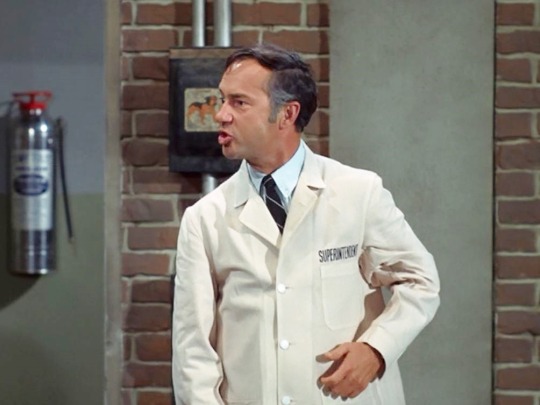
William
Lanteau
(Mr. Minkle) first
appeared with Lucille Ball in The
Facts of Life (1960).
In addition to an episode of “The Lucy Show,” Lanteau did four
episodes of “Here’s Lucy.” He is best remembered for
playing Charlie the Mailman in the play and the film On
Golden Pond (1981).Mr.
Minkle is the superintendent of the office building where Harry and
Lucy work.The
Telegram Delivery Boy is uncredited and has no lines.
Some reports say this episode was filmed on April 6, 1970, ten months before its initial air date. However, that is a Monday, and most all episodes were filmed on Thursday or Friday after four days rehearsal, so this is unlikely.

This is the second of only two episodes directed by 1954 Oscar-winner Charles Walters. The previous entry was “Lucy’s House Guest, Harry” (S3;E20). He went on to direct two of the Lucille Ball Specials: “What Now, Catherine Curtis?” (1976) and “Three for Two” (1975). From 1942 to 1945, Walters served as dance director on six films starring Lucille Ball. This episode is mentioned in the biography Charles Walters: The Director Who Made Hollywood Dance by Brent Phillips.

Likewise, this was the second and final episode written by 1955 Emmy-winner Vin Bogert. The first was “Lucy Stops a Marriage” (S3;E16), which he also co-wrote with Frank Gill Jr. It was a posthumous credit for Gill, who died six months earlier. It was the penultimate screenwriting credit for Bogert, who died in 1978.

The title refers to the Middle Eastern folk tale of the boy Aladdin and a genie that comes from a lamp to grant him three wishes. It is one of the tales in The Book of One Thousand and One Nights (“The Arabian Nights”), and one of the best known – although it was not part of the original Arabic text, but was added in the 18th century by Frenchman Antoine Galland. The story has been the basis for many screen and stage re-tellings, including the current Disney musical Aladdin.
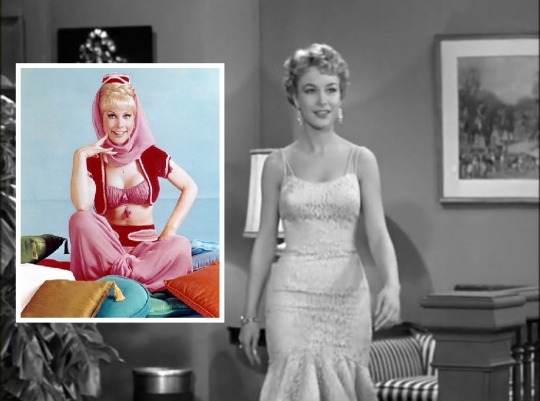
Another television sitcom was based on the legend of Aladdin: “I Dream of Jeannie” (1965-70), which had just ended its long run on NBC. It starred Barbara Eden as the genie named Jeannie, who lived in a bottle rather than a lamp. Barbara Eden made her TV debut on “I Love Lucy.” Hayden Rorke, who played the long-suffering Dr. Bellows on the series, also did an episode of “I Love Lucy” and recently appeared on “Here’s Lucy” as a Judge.

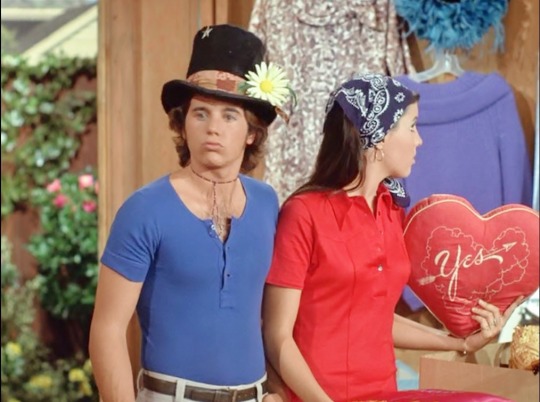
In the first scene, Craig is wearing a top hat with a flower in it. The other actors (Mary Jane Croft and George Niese) seem a bit taken aback by it.
MARY JANE: “Oh! I like your hat. (under her breath) Bless your heart.”
MR. FROST: (Points at the hat, surprised) “Oh! Oh ho ho ho.”
Perhaps it is something Desi Jr. saw in the props pulled for the scene and took a liking to? It also many have some sentimental significance to the actor, but for such a visual statement, it does not figure into the plot, which is unusual.
At
the start of the episode, Kim is holding a heart-shaped
throw cushion that may be a tribute to the opening credits of “I Love Lucy.”
Lucy
gets a Western Union telegram from the (fictional) Murphy Soup Company to tell her she’s won a contest.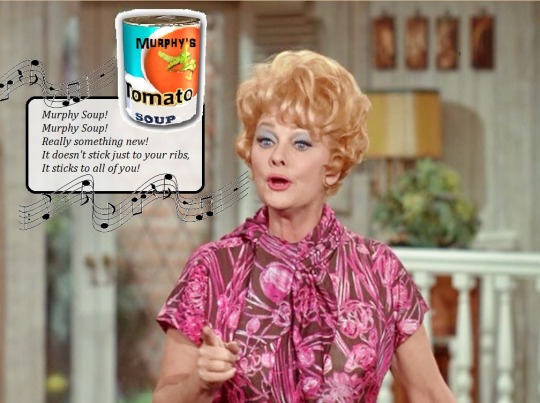
Lucy’s prize-winning soup jingle is to the tune of “Jingle Bells,” a song that was heard many times on “I Love Lucy.”

Aside from Ann-Margret, Craig would wish for two
tickets to the sold-our Rams Football game. After a dramatic thunder
clap, Craig gets a call from his friend Alan who offers him a ticket.
Craig says “How
sweet it is!” Sex
symbol and singing sensation Ann-Margret
charmed Craig in a season 2 episode of “Here’s Lucy.” The
Los Angeles Rams
would have been the Carters’ hometown football team. “How sweet it
is” was the catch phrase of actor / comedian Jackie
Gleason
(“The Honeymooners”), who made a cameo appearance in the second
episode of the series.
Craig
reads the October 1968 issue of McCall’s
with English actress Samantha Eggar on the cover. In
“Ricky Has Labor Pains” (ILL S2;E14), pregnant Lucy Ricardo is
reading the January 1953 McCall’s, which clearly has a cover
that says “Why I Love Lucy” by Desi Arnaz.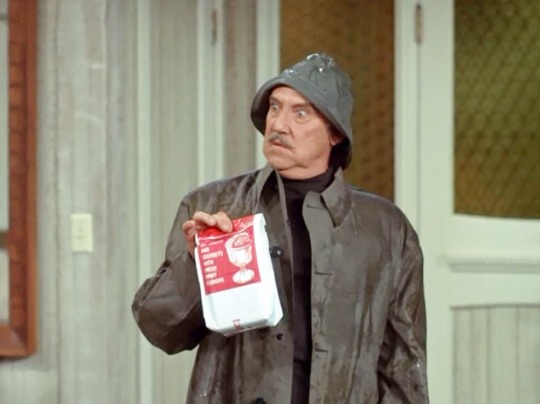
Kim
wishes for Jamoca Almond Fudge Ice Cream, her favorite. After a
dramatic thunder clap, Uncle Harry promptly arrives at the door to
deliver it! Jamoca Almond Fudge is a signature flavor of Baskin-Robbins, who first marketed it in 1959. It is made by combining Jamoca coffee ice cream with roasted almonds and a chocolate ribbon. The bag Harry is holding, however, is not branded with their logo: pink and brown polka dots encircling a large number 31, the number of flavors they offer.
The second scene opens with Harry and Lucy coming to work with a happy Harry (dreaming of great wealth if he got access to the lamp) paraphrasing Robert Browning’s verse drama Pippa Passes (1841). The original goes:
The lark’s on the wing;
The snail’s on the thorn:
God’s in his heaven –
All’s right with the world! — from Act I: MorningHarry’s version replaces mention of larks and snails with “The sun is shining; the birds are singing” and omits any reference to the Deity altogether.

When Lucy won’t let Harry make any monetary wishes on her lamp, he storms off pouting and Lucy calls him Attila the Hun. Attila the Hun, was the ruler of the Huns from 434 until his death in March 453. During his reign, he was one of the most feared enemies of the Roman Empire.

Mary Jane tells Lucy that there’s a sale on Italian knits at Morton’s Department
Store.
Morton is
Lucille Ball’s married name since her marriage to Gary Morton (nee Goldaper) in
1961. Gary Morton is also a producer on “Here’s Lucy.” The fictional Morton’s Department Store joins Morton’s Service Station, Morton Pictures, and a number of other businesses named Morton on the series!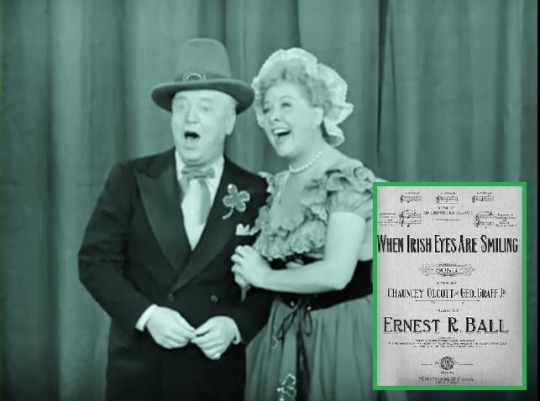
The
janitor comes to empty the waste paper baskets idly singing “When Irish
Eyes Are Smiling.” The song was written by Chauncey
Olcott, George Graff Jr., and Ernest Ball in 1912. It was sung by William Frawley
(Fred Mertz) in the 1936 film It’s
A Great Life! and was heard on “I Love Lucy” in “The Star Upstairs” (ILL
S4;E25).Harry
says the Unique Employment Agency is located in office #1506. This implies that they are on the 15th floor.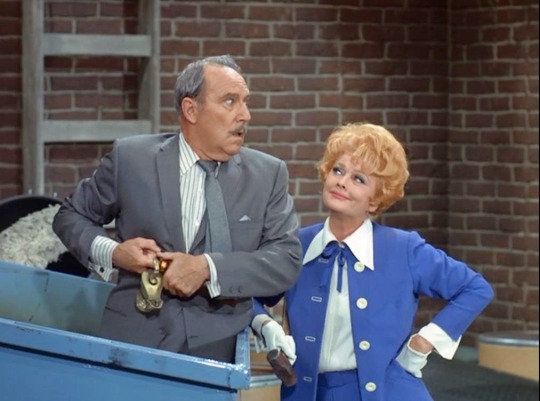
Finally finding the bottle in a dumpster, there is just one thing preventing Lucy from getting it back: a glass bottle! Preparing
himself for Lucy to hit his finger with a hammer to get a bottle off
it, he says “If
John Wayne can do it, so can I.” John
Wayne
appeared with Lucille Ball as himself on “I Love Lucy” and “The
Lucy Show.” Both episodes were titled “Lucy Meets John Wayne.”At the end of the episode, Craig reveals that the lamp is just a novelty store item manufactured in Pittsburgh. A disappointed Lucy corrects him.

The Mexican border city was the location of “Lucy and Viv Visit Tijuana” (S2;E19) aired a year earlier.
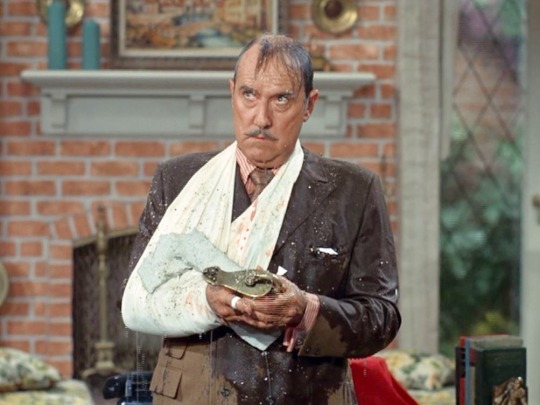
It wouldn’t be “Here’s Lucy” if Gale Gordon didn’t get wet!
Garage Sale Treasures!

Hanging above the steamer trunk is Lucy Ricardo’s iconic blue polka dot dress from “I Love Lucy.” It was designed by Elois Jensen and was seen in many episodes of the series.

Next to the blue dress is an art deco poster of Sarah Bernhardt by Alphonse Mucha (1897). The poster was previously seen in the dorm room in “Lucy, the Co-Ed” (S3;E6) and in the studio of the knife thrower in “Lucy, the Cement Worker” (S2;E10).

The zebra lamp with the red shade was on the tables of the Red Devil nightclub “Lucy and Ma Parker” (S3;E15, left).
Unboxing
items for the garage sale, Lucie finds her favorite doll, Clarabelle.
Clarabelle
made an appearance in “Lucy, the Part-Time Wife” (S3;14),
although she now has on a new frock.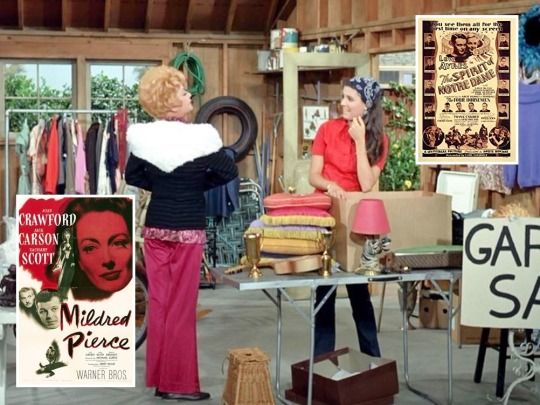
Lucy pulls out a fur-lined jacket she says
was worn by Joan Crawford in Mildred
Pierce.
The 1945 film won Crawford an Academy Award. Joan Crawford guest
starred on “The Lucy Show” in “Lucy and the Lost Star” (TLS
S6;E22). Craig says that judging by the shoulder pads she could have
worn it in The
Spirit of Notre Dame.
Craig is referring to a 1931 football-themed movie starring Lew
Ayres.
Search through the building’s trash for the lamp instantly brings to mind when the Ricardo’s and Mertz’s searched through the trash of 623 East 68th Street to find the pieces of Lucy’s torn-up roman a clef in “Lucy Writes a Novel” (ILL S3;E24).

Lucy and Harry were also up to their necks in trash in “Lucy the Process Server” (S1;E3) – this time in a department store basement – searching for an envelope of cash.

Leaky ceilings in need of plastering was also a plot point in two episodes of “The Lucy Show”: “Lucy and Viv Put in a Shower” (TLS ) and “A Loophole in the Lease” (TLS S2;E12). Both times the leaks were caused by overflowing tubs and showers, but here the cause is the continual rainfall.

Sound vibrations and not water was the cause of the ceiling collapse that ended
“Breaking the Lease” (ILL S1;E18).

Flashing way back to 1813, prolific novelist Maria Edgeworth (1768-1849) penned a children’s book titled Harry and Lucy. In it, they marvel at the power of steam bursting through a kettle spout, comparing it to the magic of Aladdin’s Lamp. Not only did Edgeworth foresee the era of the steam-powered engine, she may have foretold “Here’s Lucy” as well!


Do You Live in a Barn? His arm in a sling, carrying an umbrella, and taking off his hat, Gale Gordon is unable to properly shut the front door, despite the fact it is pouring rain outside. Lucille Ball’s eyes dart over at it, doubtless wondering if she had time to close it without spoiling the take. She doesn’t – and it stays open for the rest of the scene.
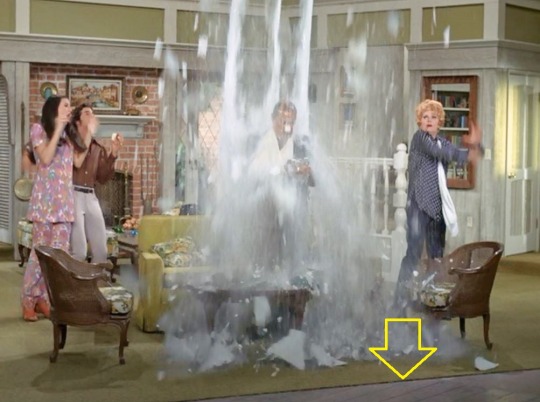
Where
the Floor Ends! When the hole in the ceiling breaks open, the camera is back too far
and viewers can see where the carpet ends and the stage floor begins.Sitcom Logic Alert! Only Lucy would find a miraculous lamp that grants wishes and hide it in a trash can in order to go on a shopping trip for discount sweaters!

“Lucy and Aladdin’s Lamp” rates 4 Paper Hearts out of 5A fun episode that straddles the reality / fantasy line effectively. The Easter eggs in the garage sale scene are a treat for Lucy lovers!
1971, Aladdin, Aladdin’s Lamp, Ann-Margret, CBS, Charles Walters, Desi Arnaz Jr., Frank GIll Jr., Gale Gordon, Garage Sale, George Niese, Here’s Lucy, I love lucy, Jackie Gleason, Joan Crawford, John Wayne, LA Rams, Lucie Arnaz, Lucille Ball, Mary Jane Croft, McCalls, Mildred Pierce, Morton, Robert Foulk, Sarah Bernhardt, The Spirit of Notre Dame, tv, Vin Bogert, When Irish Eyes Are Smiling, William Lanteau -
LUCY’S HOUSE GUEST, HARRY
S3;E20
~ January 25, 1971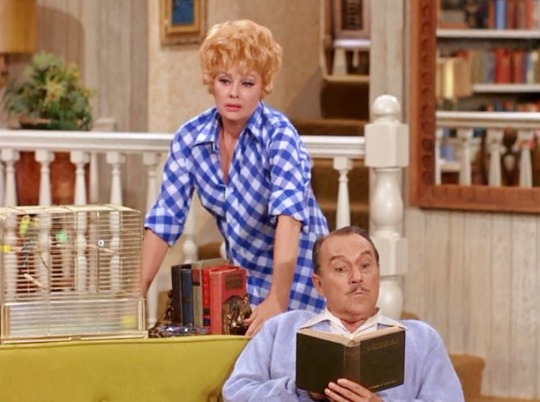
Directed
by Charles Walters ~ Written by Fred S. Fox and Seaman JacobsSynopsis
Harry
is having his house redecorated and needs a place to stay. Naturally,
he imposes on Lucy, who is increasingly aggravated by her
brother-in-law’s obnoxious habits. Rather than ask him to leave, she
schemes with Kim to get him to leave on his own accord.Regular
CastLucille
Ball (Lucy
Carter), Gale
Gordon (Harrison
Otis Carter), Lucie
Arnaz (Kim
Carter)Desi
Arnaz Jr. (Craig
Carter) does not appear in this episode, but he does receive opening
title credit and is mentioned in the dialogue.Guest
Cast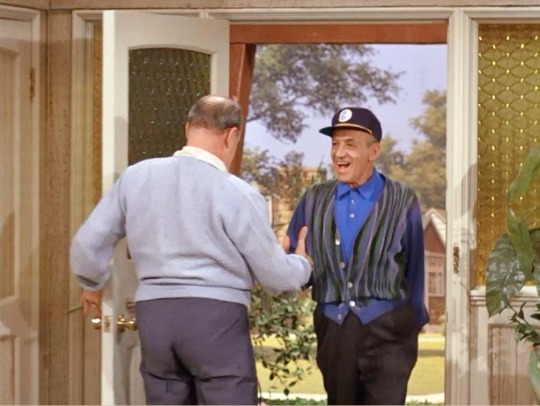
Herbie
Faye
(Poker Player #1) was
a character whose first major acting role (at age 56) was Corporal
Sam Fender in “The Phil Silvers Show” (1955). He also
appeared with Silvers on Broadway in Top
Banana (1951)
and also did the film version (1954) with Silvers. He appeared in a
1968 episode of “The
Lucy Show.” This
is the second of his four “Here’s Lucy” episodes.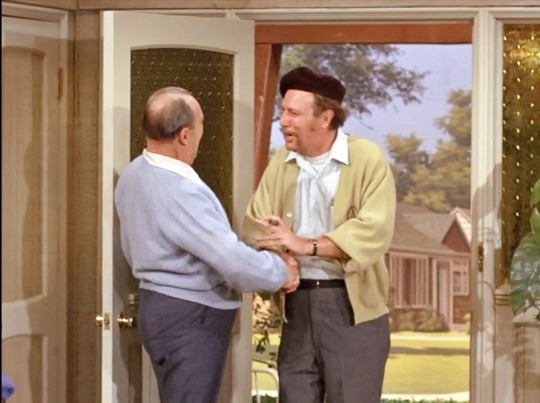
Emile
Autuori
(Poker Player #2) makes
the third of his six appearances on “Here’s Lucy.” He
passed away in early 2017. He was the uncle of writer /
director P.J. Castalleneta.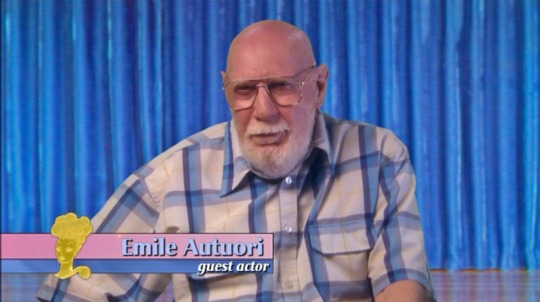
Autuori
introduces the episode on the series DVD. In the episode, he wears a cardigan
sweater monogrammed G.R.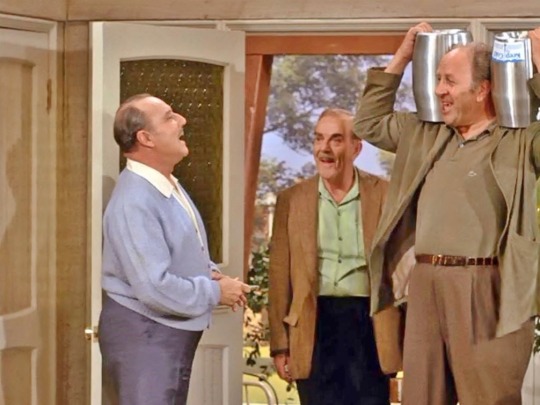
Robert
Foulk
(Poker Player #3, right) played
the policeman on the Brooklyn subway platform in “Lucy
and the Loving Cup” (ILL S6;E12)
and a Los Angeles Detective in “Lucy Goes To A Hollywood Premiere”
(TLS S4;E20). This is the second of his six
characters on “Here’s Lucy,” two which were policemen.Frank
J. Scannell
(Poker Player #4, center) played the Burlesque Comic (“Slowly I
turn…”) in “The Ballet” (ILL S1;E19). He had done two films
with Lucille Ball in 1945, including Lover
Come Back.
This is his only appearance on “Here’s Lucy.”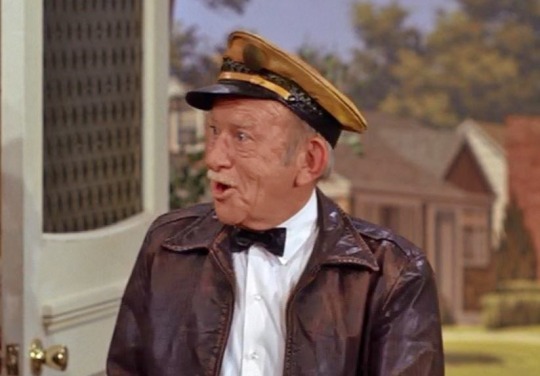
Vince
Barnett
(Cabbie #1) appeared with Lucille Ball in one of her first films, The
Affairs of Cellini
in 1934. He also appeared with her in A
Girl, A Guy, and a Gob
in 1941. This is his only series appearance.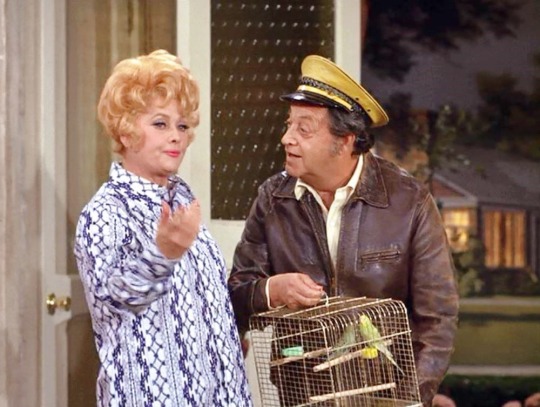
Sid
Gould (Cabbie
#2) made
more than 45 appearances on “The Lucy Show,” and nearly as many
on “Here’s Lucy.” Gould (born Sydney Greenfader) was Lucille
Ball’s cousin by marriage to Gary Morton.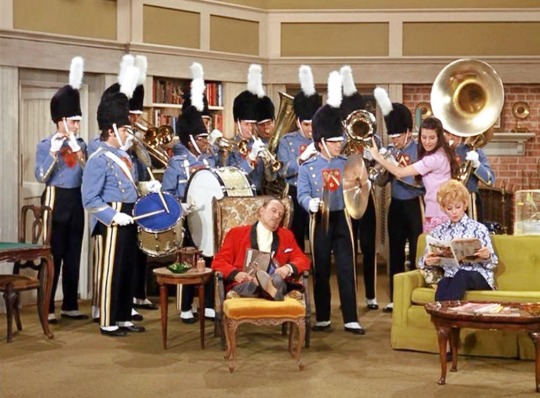
Eugene
Molnar
(Tuba Player) appeared
on four episodes of the series. These are his only screen credits.Molnar
has no dialogue. The character is part of a 12-piece marching band
that appears in full uniform. The band is uncredited.
Anthony
and Cleopatra are
Harry’s pet parakeets.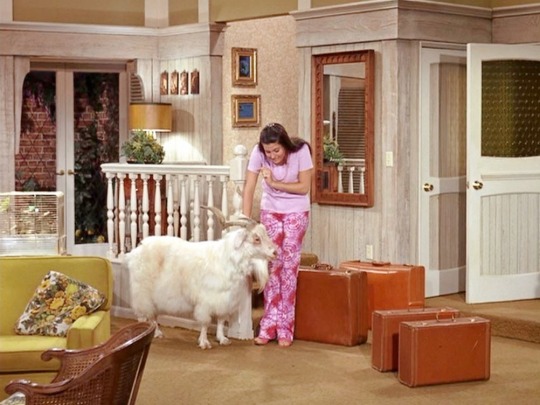
Willy
the Goat
is the mascot of Kim’s college.
This episode was filmed on September 17, 1970.

Charles
Walters
makes his series directing debut with this episode. He directed
Lucille Ball in five motion pictures between 1942 and 1945. He was
nominated for an Oscar in 1953 for directing Lili. He will direct
one more episode of “Here’s Lucy” as well as the Lucille Ball
television movies “Three for Two” (1975) and “What Now,
Catherine Curtis” (1976), which was his final screen credit. He
died in 1982 at the age of 70.Sid
Gould (Cabbie #2), Robert Foulk (Poker Player #3), and Emile Autuori
(Poker Player #3) all appeared in the previous week’s episode “Lucy
and the Raffle” (S3;E19). This is the second episode in a row in
which Desi Arnaz Jr. does not appear. Lucy says he is on vacation
for two weeks.
This
episode was filmed on September 17, 1970. “The
Flip Wilson Show”
(aka “Flip”) premiered that evening on NBC. Flip Wilson will play
himself in the season 4 opener of “Here’s Lucy.” In return, Lucy appears on “Flip.” Both shows
ended their runs in early 1974.Harry
balks at paying $40 a day for a hotel room in Los Angeles overlooking
the park. “For
$40 a day I should overlook Fort Knox!” Both Harry and Mr. Mooney were fond of punchlines that featured Fort
Knox,
a Kentucky military installation that is the repository for most of
the nation’s gold reserves. In today’s money, considering inflation,
$40 a day is the equivalent of spending $250 a day; not unreasonable
in greater Los Angeles.Trying
to ingratiate himself to Lucy to get her to allow him to stay in her
home while his house is being renovated, Harry greets her cheerfully,
coyly asking about “dear
Kim”
and “little
Craig.”
Lucy says that ‘little’ Craig is 5’11” and shaves. ‘Little Craig’
is absent from this episode.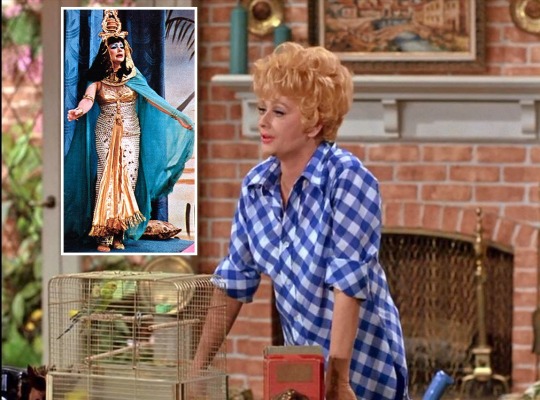
Moving
in to Lucy’s house, Harry brings his parakeets Anthony
and Cleopatra.
These are the names of real-life historical figures that also are
featured in Shakespeare’s play Anthony
and Cleopatra.
Lucy Carmichael played Cleopatra for the Danfield Community Theatre
in 1963.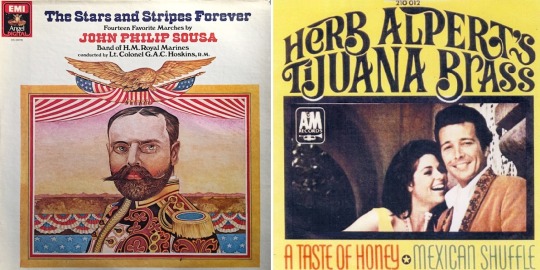
Harry’s suitcases are packed with his John
Philip Sousa
records. He calls them The
Tijuana Brass
of his generation. John Philip Sousa (1854-1932) was a composer
hailed as “The March King.” His music was extensively used in
“Lucy Goest to the Air Force Academy” Parts 1 and 2. The Tijuana
Brass was a modern jazz group led by Herb Alpert. They had numerous
hit records from 1962 to 1969, when they disbanded. In “Lucy and
the Bogie Affair” (S2;E13) in 1969, Kim has a photo of Herb Alpert
posted inside her school locker!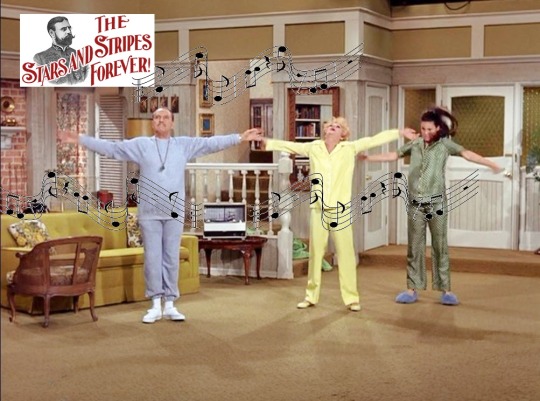
Harry
leads Lucy and Kim through morning exercises to “The
Stars and Stripes Forever,”
which was written by Sousa in 1897. It is considered his most famous
work and was declared the officially march of the United States of
America in 1987. The tempo is sped up a bit on the soundtrack to add
to the comedy of the scene.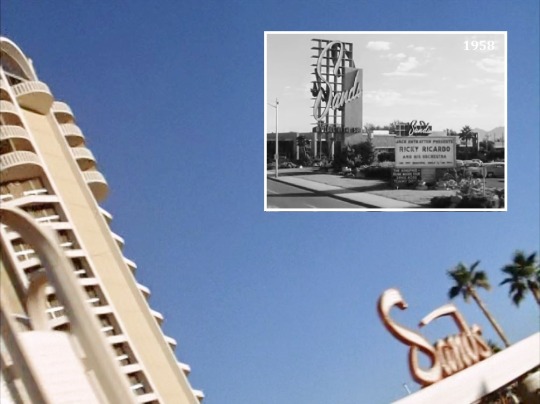
When
Lucy bemoans Harry turning her home into a gambling joint with the
arrival of Harry’s poker pals, Kim says “Maybe
we could sell out to Howard Hughes.”
The real life millionaire aviator was mentioned on several previous
episodes, including the very first “Lucy Visits Jack Benny”
(S1;E1). In the 1960s Howard
Hughes
went on a spending spree and bought several Las Vegas casino hotels,
including the Desert Inn and the Sands, the setting of a 1958 episode
of “The Lucy-Desi Comedy Hour.”In
light of his poker game, Lucy calls Harry Nick the Greek. Nicholas
Andrea Dandolos (1883
-1966), aka Nick
the Greek,
was a was a professional gambler and high
roller from Rethymnon, Crete.
He was inducted into the Poker Hall of Fame in 1979.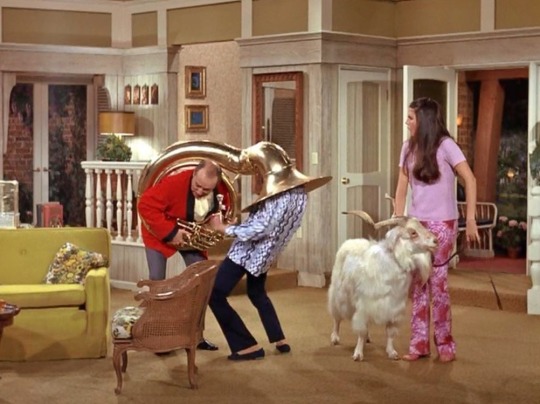
Harry’s
decorator is named Poindexter. On the telephone, Lucy mistakes him
for a her.Kim
suggest checking Emily Post for a polite way to get rid of an
unwanted house guest.
Emily
Post
(1872-1960) was a writer who’s name has become synonymous with proper
etiquette and manners. More than half a century after her death, her
name is still used in titles of etiquette books.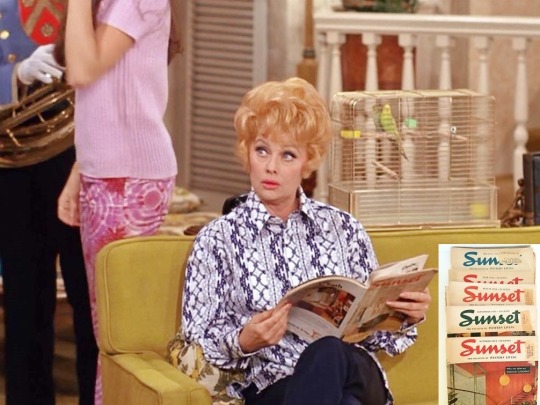
When
the marching band startles awake Harry, Lucy is trying to look
nonchalant by reading a magazine. It is Sunset,
a monthly lifestyle magazine that focuses
on homes, cooking, gardening, and travel, with a focus
almost exclusively on the Western United States.
It was first published in 1898 and still is in circulation today.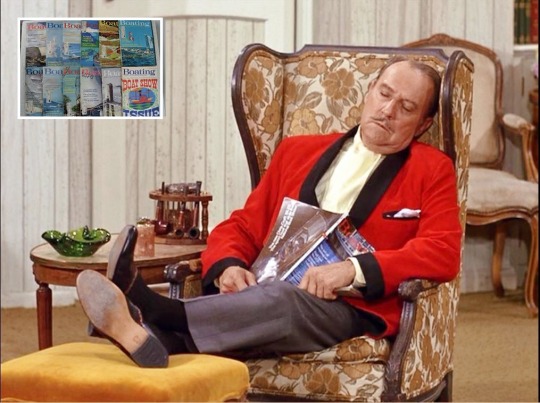
Harry
has fallen asleep reading Boating,
a magazine for boat enthusiasts. It began publication in 1966 and is
still in print today. Harry is a boat enthusiast who decorates his
home and office with model ships and paintings of vessels.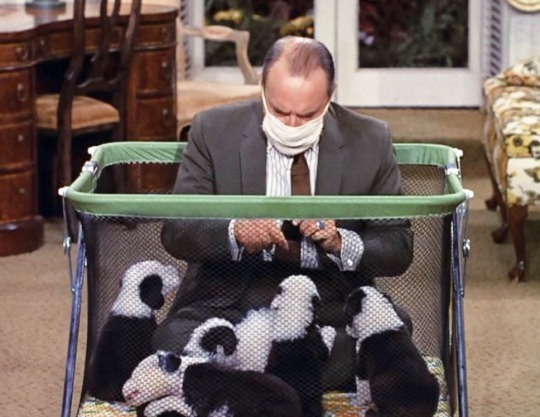
Harry
is allergic to Willy
the Goat
– and all long-haired animals. This is consistent with “Lucy and
the Bogie Affair” (S2;E13, above) where we learn that Harry is allergic to
dogs.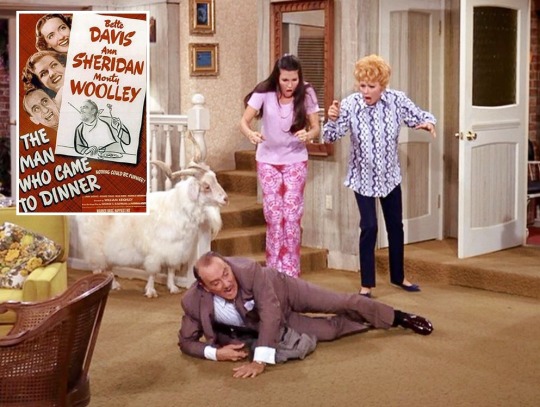
As
Harry is finally is finally about to leave, Lucy has a horrible
thought: what if Harry is like Sheridan Whiteside in the play The
Man Who Came to Dinner
and falls on his way out and must stay with them even longer? The
play, by George S. Kaufman and Moss Hart, was a comedy that opened on
Broadway in 1939. It starred Lucille Ball’s good friend (and “Here’s
Lucy” performer) Mary Wickes as Nurse Preen. Wickes was one of
several stage actors who recreated their roles in the 1942 film
adaptation.
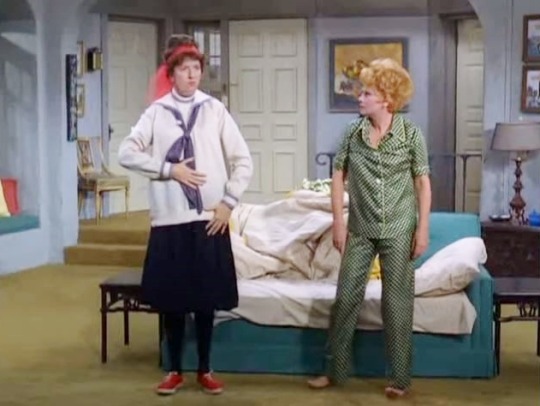
This
episode is similar to “Lucy’s Mystery Guest” (TLS S6;E10), where
Lucy Carmichael’s Aunt Agatha (Mary Wickes) turns up on her doorstep
and turns her life upside down with exercise at dawn, a health food
regimen, and wardrobe requirements.
Gale
Gordon also put Lucy and a pal through their paces with vigorous
exercise in “Lucy and the Countess Lose Weight” (TLS S3;E21) in
which Mr. Mooney helps out at a fat farm to keep the bank from
foreclosing and recruits Lucy and the Countess as members.
Party in the Kitchen! Harry’s poker pals head into the kitchen for their game, despite the fact that Lucy has a green felt-lined card table in the living room!
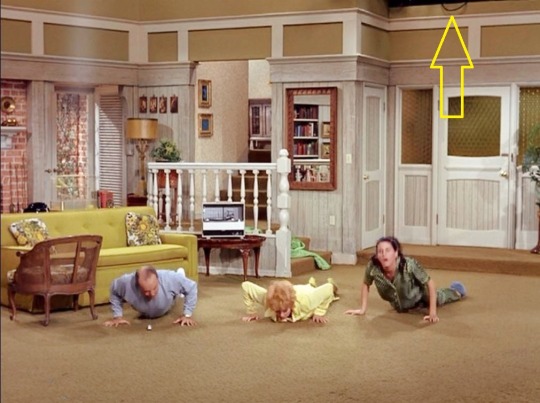
Where
the Ceiling Begins! When
Harry is leading the morning exercises, the camera pulls back for a
long shot and the top of the living room set is visible on the right,
with a loop of cable hanging down.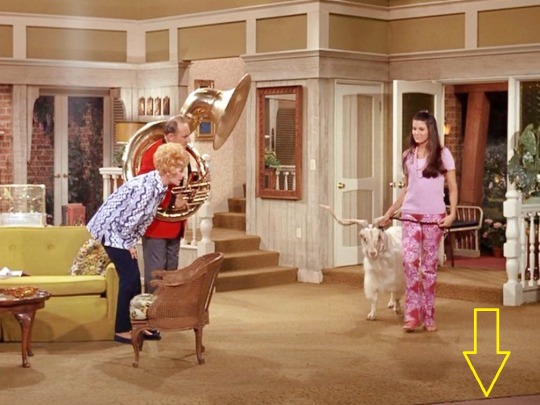
Where
the Floor Ends! Later,
when Kim leads in Willy the Goat, the camera pulls back revealing the
edge of the sound stage floor.
This
is classic (if not hysterical) situation comedy material. No guest
stars, no music, just Lucille Ball and Gale Gordon in a battle of
wit(ticism)s.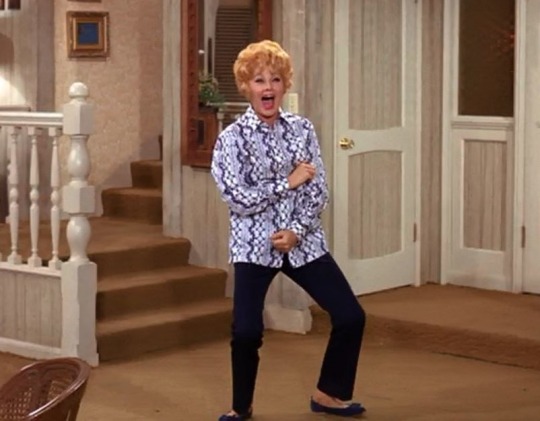 Anthony and Cleopatra, Boating, Charles Walter, Emile Autuori, Emily Post, Eugene Molnar, Flip Wilson Show, Fort Knox, Frank J. Scannell, Fred S. Fox, Gale Gordon, goat, Herbie Faye, Here’s Lucy, house guest, Howard Hughes, John Philip Sousa, Lucie Arnaz, Lucille Ball, marching band, Nick the Greek, Poker Game, Robert Foulk, Seaman Jacobs, Sid Gould, Stars and Stripes Forever, Sunset, The Man Who Came To Dinner, Tijuana Brass, Vince Barrett
 -
LUCY AND THE RAFFLE
S3;E19
~ January 18, 1971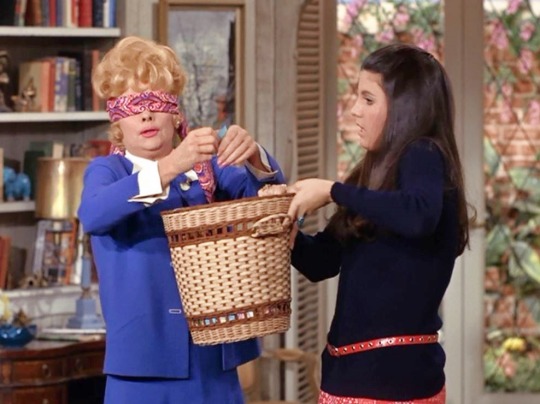

Directed
by Ross Martin ~ Written by Ray Singer & Al SchwartzSynopsis
Kim
wins a fast sports car in a raffle, but Lucy won’t let her keep it.
To pay the taxes on her win, they hold another raffle not knowing
that it is illegal. Lucy, Kim, and Harry are all arrested and hauled
in to court!Regular
CastLucille
Ball (Lucy
Carter), Gale
Gordon (Harrison
Otis Carter), Lucie
Arnaz (Kim
Carter)Desi
Arnaz Jr. (Craig
Carter) does not appear in this episode, but he does receive opening
title credit.Guest
Cast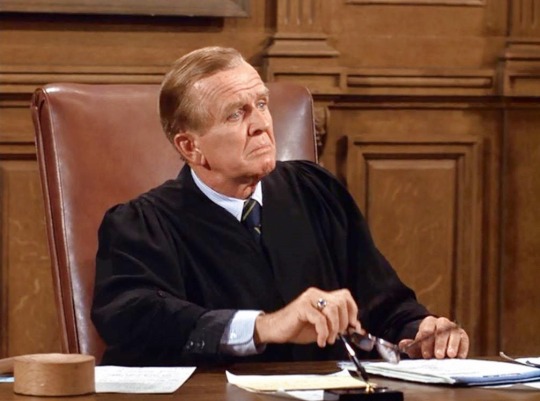
Hayden
Rorke (Judge
Gibson) played one of the “New Neighbors” (ILL S1;E21), Tom
O’Brien, who moved into the Mertz apartment building and are believed
to be spies (but actually are just actors). Rorke
trained at the American Academy of Dramatic Arts and made his
television debut on “I Love Lucy.” Ironically, so did Barbara
Eden, who played the title role in the sitcom that Rorke is best
known for, “I Dream of Jeannie.” In 1947, he appeared on stage with Lucille Ball in Dream Girl. Rorke played the incredulous Dr. Alfred Bellows from 1965 to
1970, even returning for a “Jeannie” reunion special in 1985, his
last screen project. He
died in 1987.Although
the Judge’s name is not spoken aloud, his daughter, Betty Gibson, is named
earlier in the episode as the winner of the raffle.SPOILER: The
Little Old Lady (Florence Lake) is his mother!
Paul
Picerni
(IRS Agent Frank Williams) makes
the second of his four appearances on “Here’s Lucy.” He also
appeared with Lucille Ball in the 1975 TV movie “Lucy Gets
Lucky.” Picerni was a cast member of Desilu’s “The Untouchables” from
1959 to 1963.Picerni
introduces this episode on the series DVD.
Rhodes
Reason
(Lieutenant Egan) marks
the fourth of his five episodes of “Here’s Lucy” having
previously appeared in “Lucy,
the Matchmaker” (S1;E12) and “Lucy
and the Gold Rush” (S1;E13). He
also appeared with Lucille Ball (and Little Old Lady Florence Lake)
in the 1974 TV movie “Happy Anniversary and Goodbye.”Although
the character identifies himself as Lieutenant Egan, the end credits
list him as Detective Haggerty.
Robert
Foulk
(Permit Office Clerk at Window D) played
the policeman on the Brooklyn subway platform in “Lucy
and the Loving Cup” (ILL S6;E12)
and a Los Angeles Detective in “Lucy Goes To A Hollywood Premiere”
(TLS S4;E20). This is the first of his six
characters on “Here’s Lucy,” two of which are also policemen.
Sid
Gould (Permit
Office Clerk at Window C) made
more than 45 appearances on “The Lucy Show,” and nearly as many
on “Here’s Lucy.” Gould (born Sydney Greenfader) was Lucille
Ball’s cousin by marriage to Gary Morton and was married to Vanda
Barra (Waitress).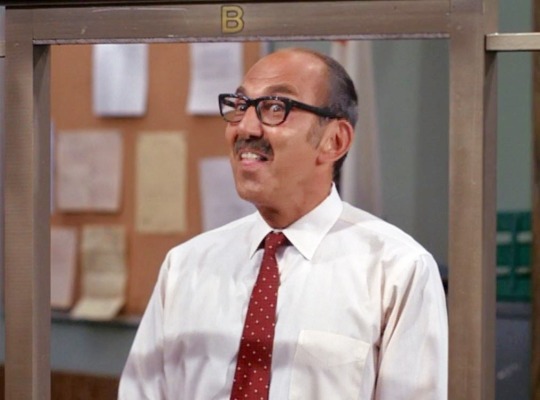
Irwin
Charrone
(Permit Office Clerk at Window B) made
five appearances on “The Lucy Show.” The expressive character
actor also did an equal number of “Here’s Lucy” episodes. He
died in January 2016 in Maplewood, New Jersey, at the age of 93.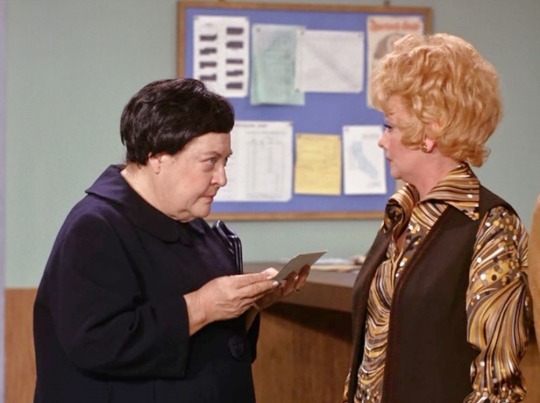
Jody
Gilbert
(Woman in Permit Line aka “Mrs. Kong”)
appeared with Lucille Ball and Gale Gordon on the 1952 special “Stars
in the Eye” celebrating the opening of CBS’s new Television City
studios. She played a prison matron in her only appearance on both “The Lucy Show” and in her next and final appearance on “Here’s
Lucy.”
Larry
J. Blake
(Man at the Front of the Permit Line) appeared
as a Native American Medicine Man in “Lucy
the Rain Goddess” (TLS S4;E15).
He was an ex-vaudevillian making the third of his eight “Here’s
Lucy” appearances.
Florence
Lake
(Little Old Lady aka Mrs. Gibson) did
four films with Lucille Ball between 1936 and 1938. This is her
second and final episode of the series – both times as a classic
Little Old Lady. She went on to appear in the 1974 TV movie “Happy
Anniversary and Goodbye”
starring
Lucille Ball and Rhodes Reason (Lt. Egan).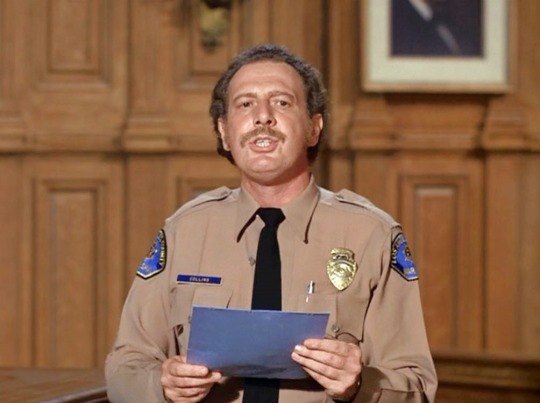
Emile
Autuori
(Officer Collins, First Bailiff) makes
the second of his six appearances on “Here’s Lucy.” He
passed away in early 2017. He was the uncle of writer /
director P.J. Castalleneta.Although
not spoken aloud, his name tag reads “Collins.”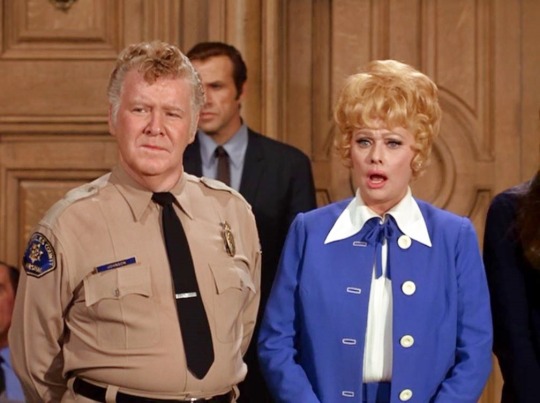
John
J. ‘Red’ Fox
(Second Bailiff) was
best known for playing policemen, which is what he did on five of his
eight appearances on “The Lucy Show” as well as three of his five
episodes of “Here’s Lucy.”
Vanda
Barra
(Waitress) was
Lucille Ball’s cousin-in-law and married to Sid Gould (Permit
Office Clerk at Window C). This is just one of her over two dozen
appearances on “Here’s Lucy” as well as appearing in Ball’s
two 1975 TV movies “Lucy Gets Lucky” (with Dean Martin) and
“Three for Two” (with Jackie Gleason). She was seen in half a
dozen episodes of “The Lucy Show.”
Jack
Berle
(Detective, uncredited, right) was
the older brother of Milton Berle. This is one of his eleven
uncredited appearances on the series. He previously did two
episodes of “The Lucy Show.”Berle
plays the Detective who arrests Harry, but has no dialogue.Leon
Alton (Courtroom
Spectator, uncredited)
appeared
with Lucille Ball in The
Facts of Life (1960)
and Critic’s
Choice (1963).
He was in two episodes of “The Lucy Show.” This is the last
of his three episodes of “Here’s Lucy.”Shep
Houghton (Courtroom
Spectator, uncredited) began
working as an extra while still a teenager, taking background jobs on
weekends and attending high school during the week. Between 1934 and
1947 he made three films with Lucille Ball, including Too
Many Girls,
the movie that brought together Lucy and Desi Arnaz. He did two
episodes of “The Lucy Show” and this, his only episode of “Here’s
Lucy.” Houghton was one of the Winkie Guards in 1939’s The
Wizard of Oz and
a Southern Dandy in Gone
With the Wind (1939).Others
at the Permit Office and in the courtroom are played by uncredited
background performers.
January
19, 1971, the day after this episode first aired, Desi Arnaz Jr.
(Craig Carter) celebrated his 18th birthday. Ironically, he does not appear in this episode.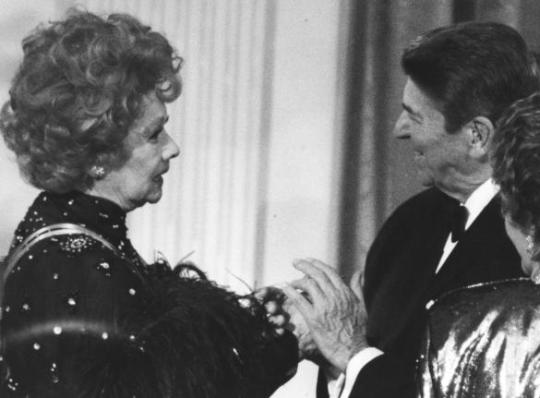
When
Lucy complains that the car her daughter won goes too fast (160mph!),
Kim promises to put a governor in the car. Lucy says “Ronald
Reagan has enough to worry about without riding around with you!”
Former
Hollywood actor Ronald
Reagan had
been elected Governor of California in 1967, a position he held until
1975. He was later elected 40th President of the United States
and served until 1989. He was previously mentioned in the second
episode of the series, “Lucy Visits Jack Benny” (S1;E2).We
learn that Harry plays croquet.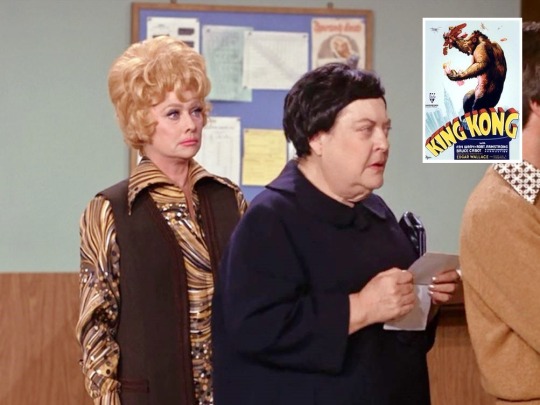
When
the woman at the back of the line (Jody Gilbert) gets snide with
Lucy, she says “Thank
you Mrs. Kong. Give my regards to your son, King.”
King
Kong
(1933) was a Hollywood film about a giant gorilla that attacked
Manhattan. A sequel titled Son
of Kong
was released that same year.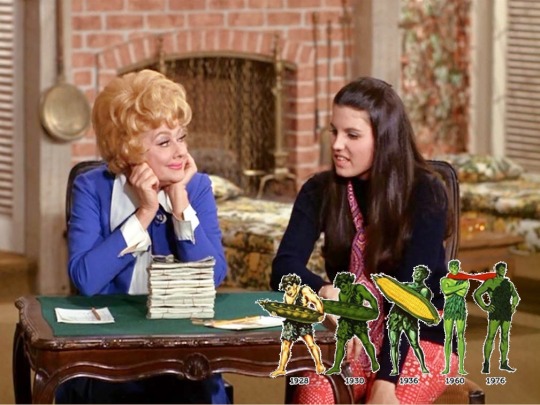
When
Lucy and Kim stack up the money they’ve made from their raffle, Lucy
says
“Oh, ho ho! You jolly green giant!” The
Jolly Green Giant
was the advertising character used to promote Green Giant Frozen
Vegetables. Their ubiquitous TV commercial jingle went:
“In the valley of the giant – ho ho ho – Green Giant!” The
character was previously mentioned in “Lucy and Tennessee Ernie’s
Fun Farm” (S1;E23).The
winning raffle ticket belongs to Betty Gibson, a college friend of
Kim’s.

This
episode is primarily based on “Ricky’s European Booking”
(ILL S5;E10) in which Lucy Ricardo and Ethel Mertz illegally raffle off a
television set to fund their trip to Europe.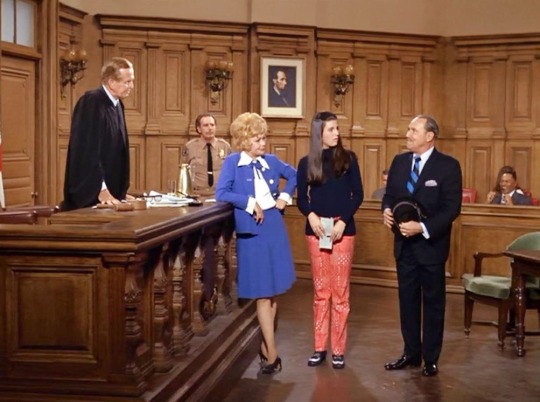
The
Lucy character has been in the courtroom in front of many judges over
the past 20 years: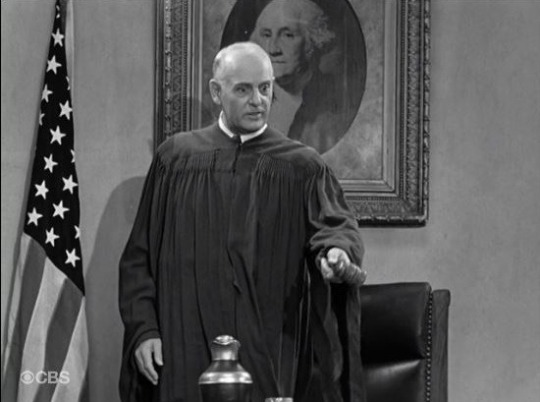
“The Courtroom” (ILL S2;E7) in 1952, in
which Moroni Olsen was the judge.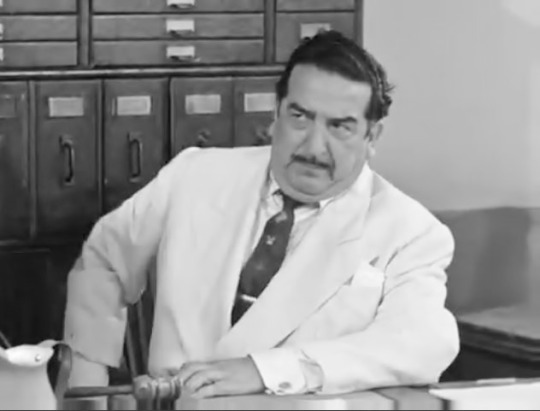
“Lucy Takes a Cruise To Havana” (LDCH) in June 1957, in which Jorge Trevino was the judge.
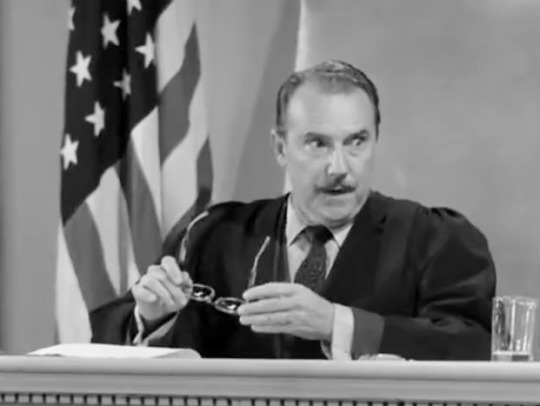
“Lucy
Makes Room for Danny (LDCH) in December 1958, in which Gale Gordon
was the judge.
“Lucy
and the Runaway Butterfly (TLS S1;E29) in 1963, in which Ernest
Sarracino was the judge.
“Lucy
is Her Own Lawyer” (TLS S2;E23) in 1964, in which John McGiver was
the judge.
“Lucy,
the Metermaid” (TLS S3;E7) in 1964, in which Parley Baer was the
judge.
“Lucy and the Soap Opera” (TLS S4;E19) in 1966, in which Sid Gould (who appears here as one of the Permit Office Clerks), played a judge in a TV soap opera. Which neatly brings things full circle!
FAST FORWARD!

Alan Rich plays Judge Cameron Potter in “Lucy, Legal Eagle” (S1;E7) aired on November 8, 1986.

Props!
When Kim is shaking up the basket full of raffle tickets for Lucy to
pick the winner, one ticket pops out. Lucie Arnaz says “Woops!”
and pops it back in again.
“Lucy and the Raffle” rates 3 Paper Hearts out of 5
This
episode isn’t as compact and well-written as its inspiration, but it
does feature a large cast of terrific actors and has a few laughs,
too.1971, Al Schwartz, CBS, Courtrooms, Emile Autuori, Gale Gordon, Hayden Rorke, Here’s Lucy, Irwin Charrone, Jack Berle, Jody Gilbert, John J. Fox, Jolly Green Giant, Judges, King Kong, Larry J. Blake, Leon Alton, Lucie Arnaz, Lucille Ball, Lucy and the Raffle, Paul Picerni, Raffle, Ray Singer, Rhodes Reason, Robert Foulk, Ronald Reagan, Ross Martin, Shep Houghton, Sid Gould, Vanda Barra -
LUCY AND THE 20-20 VISION
S3;E18
~ January 11, 1971
Directed
by Jack Carter ~ Written by Phil Leslie & George BalzerSynopsis
Lucy
wants to take the kids to Tijuana for a long weekend, but first must
get grouchy Harry to give her two days off. Lucy thinks the cause of
his moodiness is due to vision problems and goes to outrageous
lengths to get him to go see an eye doctor.Regular
CastLucille
Ball (Lucy
Carter), Gale
Gordon (Harrison
Otis Carter), Lucie
Arnaz (Kim
Carter), Desi
Arnaz Jr. (Craig
Carter)Guest
Cast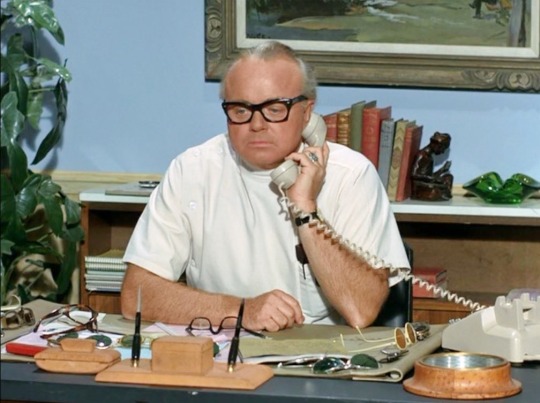
Jack
Collins
(Doctor Collins / ‘Carl Baker’) appeared
on the final two episodes of “The Lucy Show.” He played Russel
Slater on “Dallas” from 1982 to 1987. This is the fourth of his
six appearances on “Here’s Lucy.”The
final credits of the episode list the character as Doctor Proctor,
when he clearly answers the telephone “Doctor Collins.” The name
might have been left over from an earlier draft of the script.
Morreen
and Colleen Gemini (The
Conklin Twins aka ‘Jane Conklin’) make their only screen appearance
in this episode.Their
surname would lead one to believe that these are not their real
names!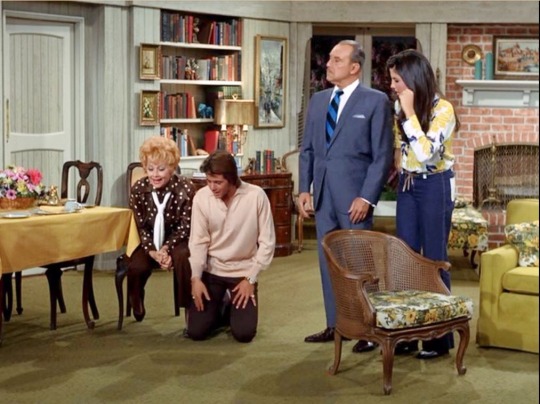
Tippy
the Invisible Dog
(Himself) makes his only (dis)appearance in the Carter living room!Tippy belongs to the Watsons, who live next door.
This episode was rerun by CBS on June 21, 1971. It was up against a major league baseball game on NBC.

The final draft of the script was submitted on June 12, 1970 and read by Lucille Ball in July of that year.

This
is the first of only two directing credits for comedian Jack
Carter,
both on “Here’s Lucy.” Carter was a friend of Lucille Ball and
Gary Morton’s having served as best man at their wedding in 1961. A
few weeks later he married Paula Stewart, who played Lucy’s sister
Janie in Broadway’s Wildcat.
He acted in “Lucy Sues Mooney” (TLS S6;E12). He will direct one
more episode of “Here’s Lucy” later in 1971 starring Carol
Burnett.This
is the second episode in a row where Lucy wants a vacation and tries
to convince Harry to let her have the time off by using unusual
tactics.Kim
and Craig had a grouchy math teacher named Mr. Ridgeway (”the terror”) who had
vision problems rectified by glasses.
Harry
shouts that if he really yelled at Lucy he’d “shatter
every piece of glass from here to Pismo Beach!”
This isn’t the first time that Pismo
Beach
has been used for a punchline on the series. Harry offered Lucy
“three
days in glamorous Pismo Beach” as a bargaining chip in “Lucy Goes
on Strike” (S1;E16). The California beach town was a favorite destination of Bugs Bunny in the Warner Brothers cartoons.
When Harry yells at Lucy from the open door, we see that there is a fallout shelter sign in the hallway. These signs were introduced by the Office of Civil Defense on December 1, 1961 (during the height of the Cold War) to designate federally approved public shelters in the event of a nuclear explosion. This particular sign indicates that the fallout shelter is in the basement. The capacity of the shelter was also sometimes indicated. The Office of Civil Defense was dissolved in 1970, but many of these signs remain on buildings to this day.
Lucy
has the Doctor make-up some nonsense signs and bring them over in
disguise as a painter.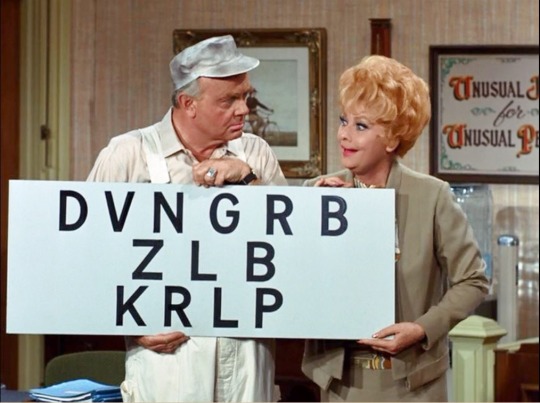
Sign
#1: “Carter’s for Jobs” (in Latvian)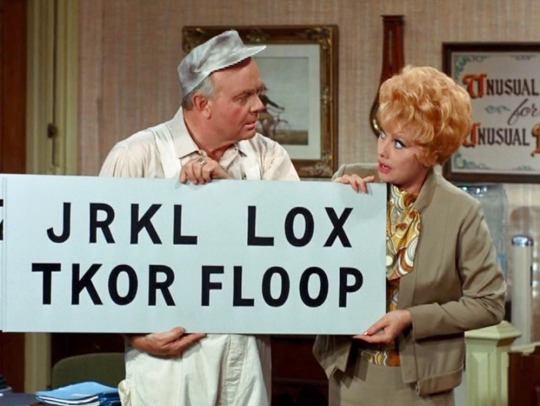
Sign
#2: “Carter’s Gets Best Results” (in Rumakian…where they make
rumaki!)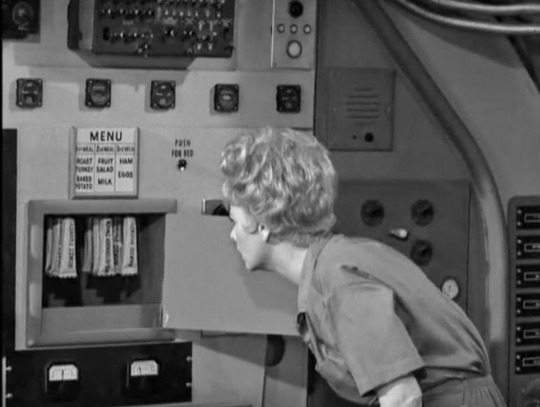
Lucy
says “If
there were free meals on the moon, Harry would have been there three
days before Neil Armstrong.” US Astronaut Neil Armstrong (1930-2012) was the first human to step
foot on the surface of the moon on July 21, 1969. The food on Apollo
11 was freeze dried and the menu consisted of pineapple fruitcake,
peaches, beef with vegetables, beef hash, chocolate pudding,
brownies, and spiced fruit cereal for breakfast! Interestingly, in
“Lucy Becomes an Astronaut” (TLS S1;E6, abouve), Lucy Carmichael is seen eating space foods when in a simulator.
In order to pretend to be surprised by Harry at the door, Lucy acts as if she was putting out the milk bottle. At the time, rural delivery of milk and other dairy products to residential homes was commonplace. In order to ‘recycle’ the milk bottles, homeowners would put the empty bottles on the porch at night, so the milkman could take them away early the next morning. A famous example of this was seen in the closing credits of the primetime cartoon sitcom satire “The Flintstones” (1960-66, inset photo).
Some
of the ways Lucy, Kim, and Craig plan to convince Harry his vision is bad
include:- Disconnecting the doorbell and telling him he missed the
button - Employing
a retractable hat hook so his hat falls to the floor - Pulling
the chair out from under him as he goes to sit - Asking
twin girls to drop by and pretending they are only one girl - Claiming to see an invisible dog
- Asking
him to sign a contract on the dotted line that has no dotted line - Polishing an
invisible magnifying glass to help him find said dotted line
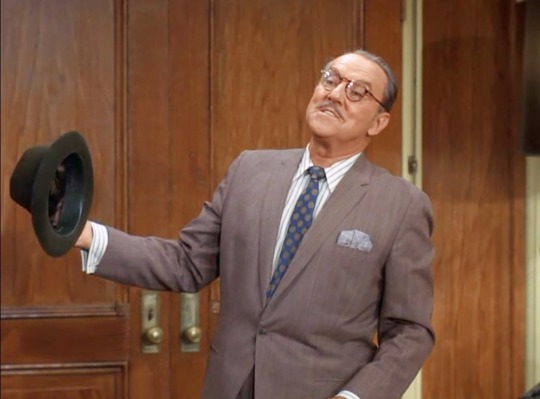
In the twist ending, Harry (now happily bespectacled) exits quoting Romeo and Juliet with a Mexican twist:
HARRY: “Ah, Senorita. Parting is such sweet sorrow. That I could say adios till it be morrow.”
In a 1969 episode of “Here’s Lucy,” Harry says that he was in Romeo and Juliet in college. Because it was an all-men’s college, he played Juliet.
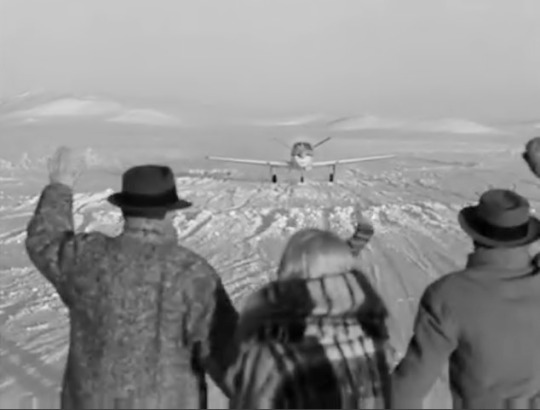
Harry
offers to take Kim and Craig to Lake Arrowhead for a swim, or to San
Diego to visit the zoo. They (coincidentally) settle on Tijuana for
the bullfights. Lake Arrowhead stood in for the 49th state during the location shots for “Lucy Goes to Alaska,” a 1959
episode of “The Lucy-Desi Comedy Hour.”
The famous San Diego Zoo
was suggested as a possible stop-over in “Lucy and Viv Visit
Tijuana” (S2;E19). Finally, Lucy Ricardo went to Tijuana in “Lucy
Goes To Mexico,” a
1958 episode of “The Lucy-Desi Comedy Hour”
which featured second unit footage of a now-demolished Tijuana bull
ring where Lucy disguises herself as a matador and takes on a bull!
Although
“Lucy Has Her Eyes Examined” (ILL S3;E11) ended with Lucy being
seen by the optometrist, it was originally Ricky who had the
headaches that Lucy believed were caused by vision problems.
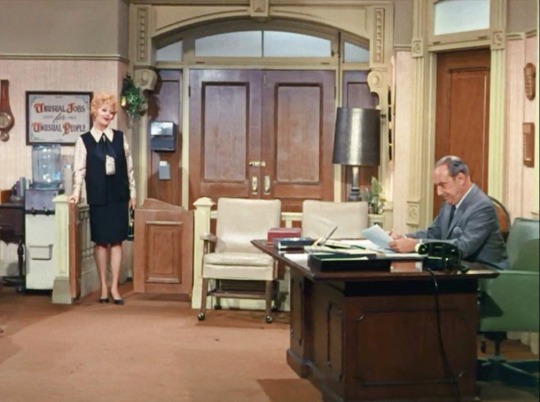
Set Change! This
episode features some changes to the office set including panels in
place of the shaded glass in the office doors plus a time clock next
to the door. The clock is necessary for the finale of the episode,
but there seems no explanation for the sudden replacement of the
glass. The next time we see the office, the glass panes will be back
and the time clock is gone.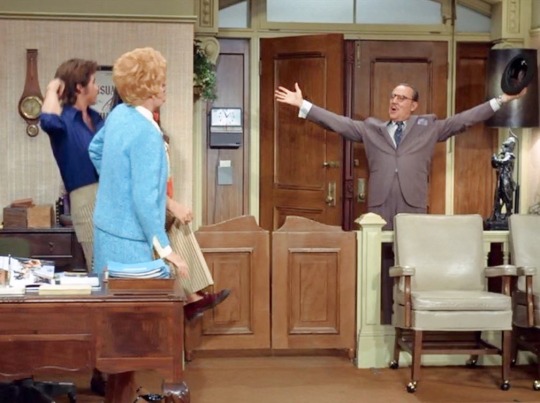
Timeline Troubles! In
this episode, Harry ends up wearing glasses, which he wore
extensively in the previous episode, “Lucy’s Vacation” (S3;E17). It is
likely that this episode was filmed first and aired out of sequence.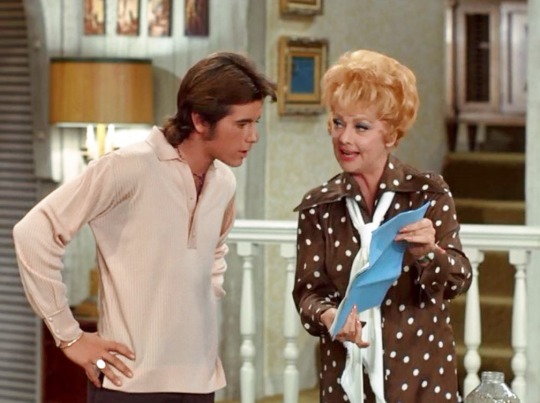
Sound Defects! When
Lucy shows Craig the contract without the dotted line, her lips don’t
move when she says “Here,
see?”
This is either a really bad case of ADR overdubbing due to studio
noise or something Lucy actually said on set that needed to be
changed. A few moments later, as Harry says “Something
smells delicious”
there is an audible squeak on the soundtrack. If this had occurred
earlier (and louder) it could have necessitated the sloppy overdub.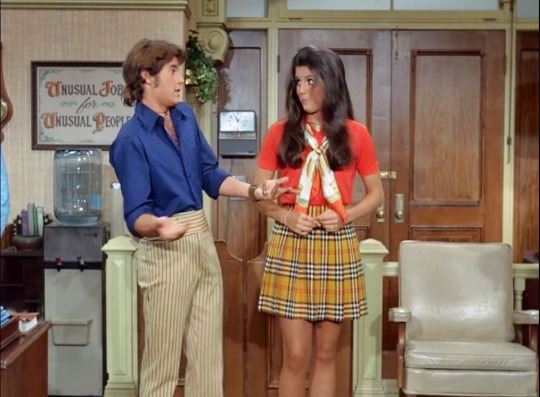
Time Check! Just
before Harry bursts cheerfully through the door wearing his new
glasses, Lucy says “He’s
at his worst in the morning.”
The time clock next to the door, however, reads 1:55!
When Harry bursts through the door shouting “Good Morning!” (although it is clearly afternoon) Kim moves back startled and nearly knocks Craig over when he backs into the side table behind him! He steadies himself just in time.

“Lucy and the 20-20 Vision” rates 2 Paper Hearts out of 5
The
premise of this episode relies on faulty logic that Harry’s new
glasses will make him happy enough to give Lucy two days off – a
real stretch. Suppose Harry believed (thanks to Lucy’s tricks) that
he was going insane and having hallucinations? Although the
elaborate mind-games she plays with Harry are humorous in and of
themselves, the episode doesn’t really go anywhere and is fraught
with odd inconsistencies and errors.1971, All in the Family, CBS, Desi Arnaz Jr., eye exam, eyeglasses, Gale Gordon, George Balzer, Here’s Lucy, Jack Carter, Jack Collins, Lake Arrowhead, Lucie Arnaz, Lucille Ball, Lucy and the 20-20 Vision, Neil Armstrong, optometrist, Phil Leslie, Pismo Beach, San Diego Zoo, Tijuana, Time Clock, tv, twins - Disconnecting the doorbell and telling him he missed the
-
LUCY’S VACATION
S3;E17
~
January 4, 1971


Directed
by Coby Ruskin ~ Written by Fred S. Fox and Seaman JacobsSynopsis
Lucy
wants to chaperone Kim on a trip to Palm Springs, but first needs to
convince Harry to fire her. At the same time, Harry’s psychiatrist
tells him not to lose his temper with Lucy for a whole week, making
getting fired difficult for Lucy.Regular
CastLucille
Ball (Lucy
Carter), Gale
Gordon (Harrison
Otis Carter), Lucie
Arnaz (Kim
Carter)Desi
Arnaz Jr. (Craig
Carter) does not appear in this episode, although he does receive
screen credit in the opening title sequence.Guest
Cast
Parley
Baer
(Dr. Sumler Cunningham) previously
played MGM’s Mr. Reilly in “Ricky
Needs an Agent” (ILL S4;E29) and
furniture salesman Mr. Perry in “Lucy
Gets Chummy with the Neighbors” (ILL S6;E18).
He made five appearances on “The Lucy Show.” He will return as
Dr. Cunningham (alongside Sid Gould) in “Lucy’s Bonus Bounces”
(S4;E16). Baer is perhaps best known for his recurring roles as Mayor
Stoner on “The Andy Griffith Show” and Doc Appleby in “The
Dukes of Hazzard.” He died in 2002 at age 88.His (unseen) secretary’s name is Miss Murdoch. He charges $50 an hour.

Kimetha
Laurie
(Jan) makes her ninth (and final) TV appearance with this episode.Jan
is Kim’s friend. Her parents have a home in Palm Springs. It might
be coincidental, but she resembles Jan Brady (Eve Plumb, inset), a
character on “The Brady Bunch,” then in its second season on ABC.
Sid
Gould (Mr.
Hilliard) made
more than 45 appearances on “The Lucy Show,” and nearly as many
on “Here’s Lucy.” Gould (born Sydney Greenfader) was Lucille
Ball’s cousin by marriage to Gary Morton.Mr.
Hilliard is a window washer.The
cashier, waiter, and diners at the luncheonette are played by
uncredited background performers.

This
is the first episode of calendar year 1971. This year mark’s Lucille
Ball’s second decade on television.
On
the DVD introduction to this episode, Lucie Arnaz mistakenly says
that Parley Baer played Dore Schary in
“Ricky
Needs an Agent” (ILL S4;E29)
when in fact he played Mr. Reilly (above). Dore Schary was played by Phil
Ober (Vivian Vance’s husband) in “Don Juan is Shelved” (ILL
S4;E21).Harry
keeps file cards of Lucy’s excuses for her lateness and absence.
Paul
Revere’s birthday is January 1st (in the modern calendar), so it would be a holiday anyway. Flag Day
is June 14th.It
is revealed that Kim does needlepoint.Kim
says that her Uncle Harry has fired Lucy 14 times!
When
Dr. Chamberlain asks Harry to iterate all the things Lucy does to
irritate him, he remarks that “at
$50 an hour, even Howard Hughes couldn’t afford that!”
Howard
Hughes
(1905-76) was known
during his lifetime as one of the most financially successful
individuals in the world. Later in his life, he was also known for his eccentric behavior.
This joke gets a round of applause from the studio audience.
Although
he waffles and mumbles quite a bit, Harry does say “…and
then she had this ring stuck on her…” likely
referring to when she got Elizabeth Taylor’s priceless diamond ring
stuck on her finger in “Lucy Meets the Burtons” (S3;E1). He then
says “…and
I was put in jail…” but nowhere in that episode (or any other) has Harry been jailed.
Perhaps Gale Gordon is ad libbing and confusing Harry Carter with Mr.
Mooney, who did go to jail once because of Lucy.Back at the office, Harry
asks for the Rylander file but Lucy brings him the Mosier file
instead. This is the umpteenth mention of the names Rylander
and Mosier
by Gale Gordon in both “The Lucy Show” and “Here’s Lucy.”
Carole Cook played a character named Lillian Rylander in “Lucy, the
Part-Time Wife” (S3;E14).

When
setting off firecrackers in the wastepaper basket, Lucy says that in
China it is the year
of the dog.
According to Chinese astrology, Lucy is correct, although it will
change to the year of the pig three weeks after this episode was
first aired.
Trying
to goad Harry into firing her, Lucy uses the window washer’s sponge
to douse him with water. It wouldn’t be “Here’s Lucy” if Harry
didn’t end up soaking wet!

Kim
and Jan talk about needing a chaperone to go to Palm Springs. Lucy
Carmichael chaperoned her daughter Chris (and her friend Cynthia,
coincidentally played by Lucie Arnaz) on a spring break trip in “Lucy
is a Chaperone” (TLS S1;E27).
Lucy,
Kim and Craig went to Palm Springs in the second episode of the
series. In real life, Lucille Ball had a vacation home in Palm Springs.
Both Lucy Ricardo and Lucy Carmichael escaped to Palm Springs. In real life, Lucie Arnaz lives there today.

When
Lucy gets up from the booth at the Luncheonette, she collides with a
waiter carrying a tray that goes flying into the air, just as Lucy
Ricardo did when at the Brown Derby in “Hollywood at Last!” (ILL
S4;E16).
In 1969, Lucy repeated the gag with Johnny Carson standing in for William Holden. In both cases the action was set at the Hollywood Brown Derby. Carson was covered in drinks instead of cream pies.
In this episode, however, the next booth is empty. Kim remarks:
“You see? You haven’t lost your touch!”
The luncheonette where Lucy meets Kim for lunch is the same one seen in “Lucy and Rudy Vallee” (S3;E12). In that episode, the luncheonette was owned by Vallee and he worked there to pass the time. Naturally, he is nowhere to be seen in “Lucy’s Vacation.”

Harry
wears glasses for most of the episode. Previously, he only wore them
when ogling a Playboy centerfold. With glasses, Gale Gordon
resembles Alvin Littlefield, owner of the Tropicana, a character he
played in two episodes of “I Love Lucy.”

Alphabet Soup! Lucy
brings Harry the Mosier file, but she retrieves it from the file
drawer marked “A-D.”
Props! There
is a small blue vase on Lucy’s desk with nothing in it that has never
been there before. Probably Lucy was supposed to put the plucked
orchid in it, but there was not enough stem for it to stay put, so
Lucy just lies it on her desk.
“Lucy’s Vacation” rates 3 Paper Hearts out of 5This
episode isn’t terribly funny but it does have some minor joys. Gale
Gordon gives one of his most interesting performances here and the
interplay between him and Lucy is really good. It is also worthwhile
for Lucy’s outrageous outfit in the second half! The twist ending is
not a surprise, but is fun. -
LUCY STOPS A MARRIAGE
S3;E16
~ December 28, 1970

Directed
by Jack Donohue ~ Written by Frank Gill Jr. and Vincent BogartSynopsis
Harry
makes a business deal with an old high school flame (Jayne Meadows) to
invest $100,000 in Carter’s Unique Employment Agency. Lucy somehow thinks
Harry is going to marry her instead, and goes to outrageous lengths to
assure he doesn’t!Regular
CastLucille
Ball (Lucy
Carter), Gale
Gordon (Harrison
Otis Carter), Lucie
Arnaz (Kim
Carter), Desi
Arnaz Jr. (Craig
Carter)Guest
Cast
Jayne
Meadows
(Laura Trenton) was the older sister of Audrey Meadows (“The
Honeymooners”) who would play Lucy Barker’s sister on “Life With
Lucy” (LWL S1;E8). Between 1977 and 1995 Jayne was nominated for
three prime time Emmy Awards. Meadows was a panelist on “I’ve Got a
Secret” for three of Lucille Ball’s appearances on the quiz show. She was married to
TV host Steve Allen. She died in 2015.The
surname Trenton is the same as the capitol of New Jersey where infant
Lucille Ball lived for a short time.
Marcel
De la Brosse (Maurice,
Maitre d’ at Chez Moi) was a French-born character actor who began
his Hollywood career in 1931. He acted in a 1959 installment of the
“Westinghouse Desilu Playhouse” hosted by Desi Arnaz Sr. This is
his final screen credit before retiring at age 68. He lived another
30 years and died in 2001.The
other diners at Chez Moi are played by uncredited background
performers.
This
is the final new episode of calendar year 1970.
The show returns on January 4, 1971 marking 20 years of Lucille Ball
on television.
This
is the first of two episodes written by Frank
Gill Jr. and Vincent Bogart.
Gill died in July 1970, before this episode was first aired. Bogart
had won a 1956 Emmy Award for his writing on “The Phil Silvers
Show.”
This
episode marks the last time Lucille Ball would do her famous “spider
face” (“Ewwww!”).
The term “spider
face”
was how the writers would describe Ball’s reaction based on a facial expression that originated when she played Little Miss Muffett in a Jell-O commercial.
“Here’s Lucy” started to pepper the dialogue with hip words like “Groovy”
and “Peace”. Later, Lucy chides Craig for calling Laura Trenton
“a beat up old chick.”
After
Harry seals the deal with Laura Trenton, he starts singing “I’m
in the money.”
The
song “We’re
in the Money” (aka
“The Gold Diggers’ Song”) is from the 1933 film Gold
Diggers of 1933
and
was written by Al Dubin and Harry Warren. It is now part of
the stage musical 42nd Street.
It was last heard in “Lucy and the Gold Rush” (S1;E13).
Lucy
says that Harry started a hope chest after getting an autographed
photo of Marjorie Main. Marjorie
Main
(1890-1975) was a character actor known for playing mothers,
like Ma Kettle. She was featured in The
Long, Long Trailer (above)
with Lucille Ball and Desi Arnaz in 1957.
Harry
finds an outdated suit that he says goes back to when Franklin Roosevelt
said “We
have nothing to fear but fear itself.”
This quote is from Roosevelt’s first inaugural address. That means
Harry’s suit dates back to 1933 and is 37 years old!
Telling
Harry there’s a huge stain on the suit, Lucy says that seltzer takes
out stains. That is the cue for Lucy, Kim and Craig to douse Harry
with seltzer water. Harry is all wet – again!
Having
no clothes left, Harry puts on his old Army uniform. Lucy calls him
Smokey the Bear. Smokey
Bear was
an
advertising icon used from 1940 to warn against the dangers of forest
fires. The character usually wears a hat similar to the one
Harry wears with his uniform. Smokey Bear
was mentioned several times on “The Lucy Show.”
Harry
calls Kim and Craig Sonny
& Cher.
The married singing duo had numerous hit songs during the ‘60s and
’70s. In
1970, Sonny and Cher starred in their first television special, “The
Nitty Gritty Hour,” a
mixture of comedy skits
and live music. They were first mentioned in the series opener, “Mod,
Mod Lucy” (S1;E1). Cher’s
mother, fashion model Georgia Holt, had appeared on both “I
Love Lucy” and “The
Lucy Show.” Cher
and Lucy would appear on an Emmy-nominated special together in 1979.

The
title of this episode evokes the famous line spoken by Camille, Queen
of the Gypsies, played by Lucy Ricardo in “The Operetta” (ILL
S2;E5):
“This wedding must never take place!”
Hearing
Harry call the waiter Maurice is reminiscent of when Gale Gordon
played Alvin Littlefield on “I Love Lucy,” owner of the Tropicana, whose Maitre ’d
was also named Maurice(Maurice Marsac, above left).

Lucy
Carter peaking at Harry in the next booth is similar to when Lucy
Ricardo peaked at William Holden in the adjacent booth at the
Hollywood Brown Derby.
Like Father / Like Son! At
the French restaurant, Craig says “Gracias”
to
the French Maitre d’.
This
sounds like an ad-lib line. Although Desi Jr. is being sarcastic, it is something that his father, Desi Arnaz Sr., might say as Ricky Ricardo without intentionally trying to be funny.
“Lucy Stops a Marriage” rates 3 Paper Hearts out of 5
This
episode isn’t hysterical, but it is (unlike some recent episodes)
grounded in reality and the interplay between Gale Gordon and Lucille
Ball is sharp and funny.
-
LUCY AND MA PARKER
S3;E15
~ December 21, 1970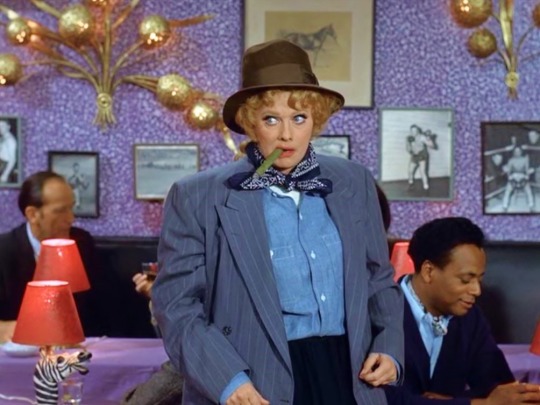
Directed
by Herbert Kenwith ~ Written by Larry Rhine and Lou DermanSynopsis
When
a woman and two children mysteriously move in next door, Lucy
discovers that they’re a band of criminals led by Ma Parker.
Reporting it to the police, Lucy is recruited to impersonate Ma
Parker and help nab a dangerous mob leader.Regular
CastLucille
Ball (Lucy
Carter), Gale
Gordon (Harrison
Otis Carter), Lucie
Arnaz (Kim
Carter), Desi
Arnaz Jr. (Craig
Carter)Guest
Cast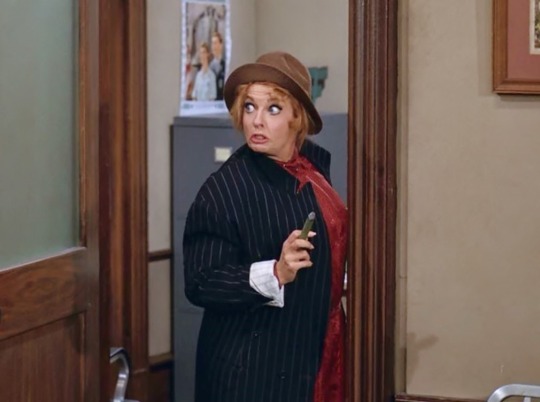
Carole
Cook
(Ma Parker) played
Thelma Green on “The Lucy Show” as well as a host of other
characters. She was a protege of Lucille Ball’s during the Desilu
Playhouse years. Although born as Mildred Cook, Ball suggested she
take the name Carole, in honor of Lucy’s great friend, Carole
Lombard. Cook appeared in five episodes of “Here’s Lucy.”After
many years of playing supporting characters opposite Lucille Ball,
Carole Cook finally guest stars in a title role.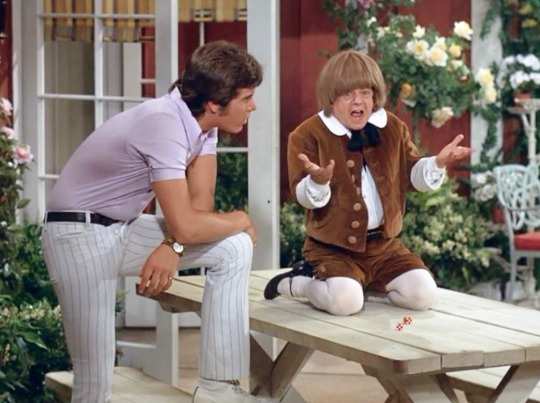
Billy
Curtis
(Herman Golab) was born Luigi Curto in 1909. He appeared as one of
the Munchkins in The
Wizard of Oz
(1939). Although Curtis was a singer, his munchkin singing voice was
dubbed by Pinto Colvig, who voiced all the dogs in 1964’s “Lucy is
Her Own Lawyer” (TLS S2;E23). He famously played McDonald’s Mayor
McCheese from its creation until his death. The character was retired
when Curtis died in 1988.Curtis’s
first job was as a shoe salesman, so it is coincidental that his costume
resembles Buster Brown. Ironically, cast mate Jerry Maren
played Buster Brown on television and radio during the 1950s and
1960s.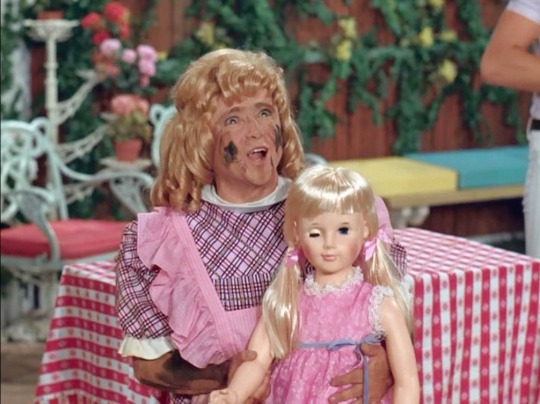
Jerry
Maren (Milton
aka ‘Little Mildred’) played the Munchkin who hands Dorothy a welcome
lollipop in The
Wizard of Oz
(1939). Like Curtis, he also did commercials for McDonald’s, mostly
as the Hamburglar.Mildred
is Carole Cook’s birth name. The character is costumed in the style
of Shirley Temple.Harry
Hickox (Lieutenant
L. Hickox, below left) was
best known for playing anvil salesman Charlie Cowell in the 1962
film The
Music Man. He
played a drill sergeant in “Lucy
Gets Caught Up in the Draft” (TLS S5;E9).
This is the second of his three episodes of “Here’s Lucy,”
all as policemen.The character was named after Lucy and Desi’s real-life business manager and Desilu vice-president Andrew Hickox. It was also given to a character played by Charles Lane in “The Business Manager” (ILL S4;E1).
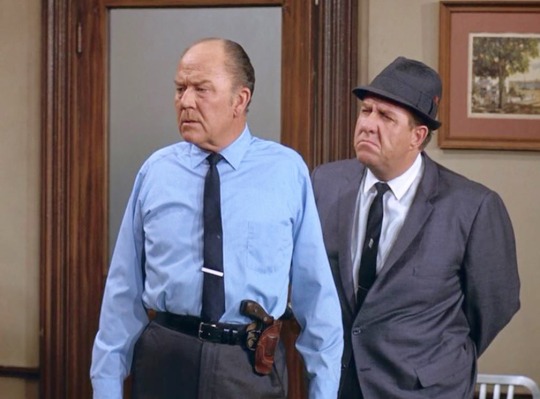
Stafford
Repp
(Police Detective Halloran, above right) made
a career of playing policemen even before he became famous as Chief
O’Hara on TV’s “Batman” (1966-68). He played two different
officers of the law on “Dennis the Menace” in 1962 and 1963,
alongside Gale Gordon. Repp made
two appearances on “The Lucy Show,”
but this is his only “Here’s Lucy” episode.The
character is never addressed by name in the dialogue.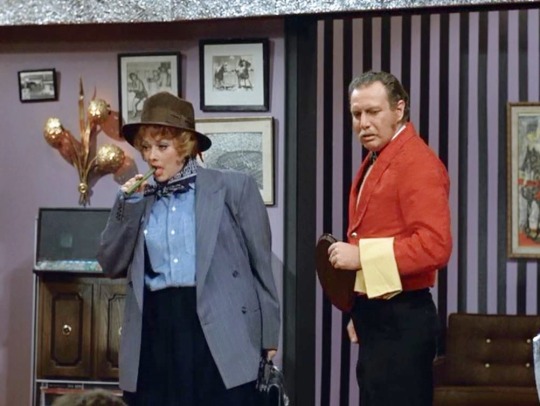
Emile
Autuori (Waiter
at the Red Devil) makes the first of his six appearances on “Here’s
Lucy.” He passed away in early 2017. He was the uncle of writer /
director P.J. Castalleneta.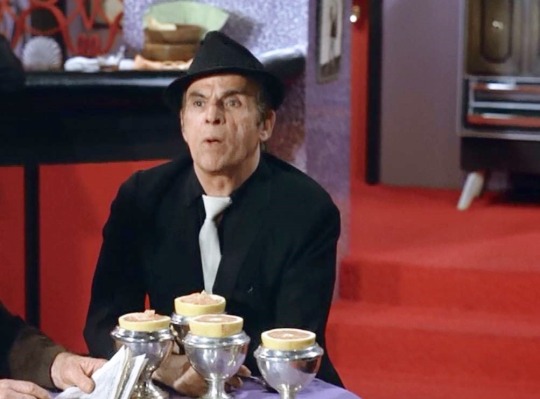
Marc
Lawrence
(Joe Grapefruit) appeared on Broadway in three plays with the Group
Theatre. On screen, Lawrence specialized in playing gangster roles.
He will also appear in “Lucy and Mannix Are Held Hostage”
(S4;E4). Coincidentally, Lawrence appeared in three episodes of
“Mannix,” which was a Desilu show.Joe
Grapefruit is a mobster from Chicago.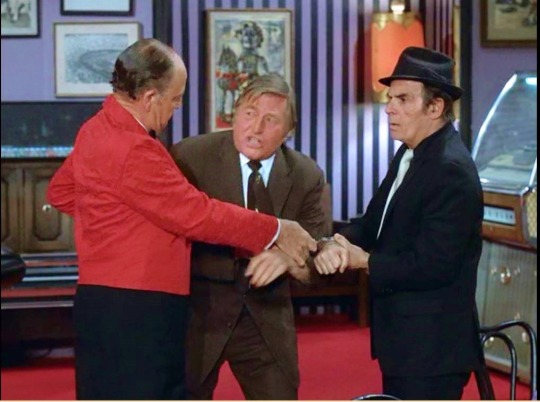
Boyd
‘Red’ Morgan
(Muggsy, above center) was
an actor and stunt man who was seen in “Lucy
and John Wayne” (TLS S5;E10),
with whom he did eleven films. This is the third of his four episodes
of “Here’s Lucy.”Morgan
was cast because the character takes a hit to the face and falls off
a chair just as he did in “Lucy, the American Mother” (S3;E7).Mickey
Martin
(Customer #1 at the Red Devil, uncredited, below center) appeared
with Lucille Ball in the 1934 film Kid
Millions starring
Eddie Cantor. He was also an uncredited extra in the 1947 Elizabeth
Taylor film Cynthia. This
is the last of his three episodes of “Here’s Lucy.”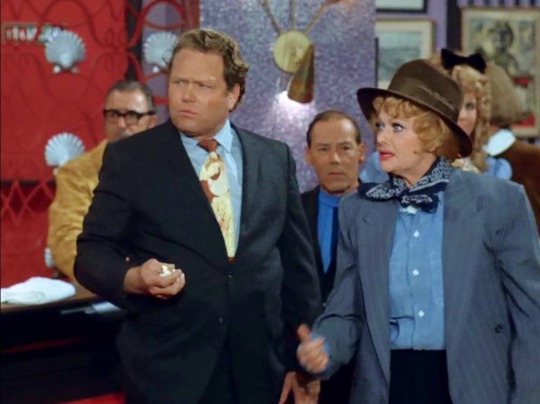
Orwin
Harvey
(Customer #2 at the Red Devil, above left) was
an actor and stuntman who played one of the singing and dancing
teamsters in “Lucy
Helps Ken Berry” (TLS S6;E21).
This is one of his six appearances on “Here’s Lucy.”Harvey
plays the burly man at the bar that Lucy lifts over her head. Both
Customer #1 and #2 do not have any dialogue but were cast for their
size.Tony
Dante
(Customer of the Red Devil, uncredited) made more than 20 uncredited
appearances on Desilu’s “The Untouchables.” He also did two
episodes of “The Lucy Show.”Walter
Smith
(Customer of the Red Devil, uncredited) made
13 mostly uncredited appearances on the series. He also did one
episode of “The
Lucy Show.”Other
customers and staff of the Red Devil are played by uncredited
background performers.
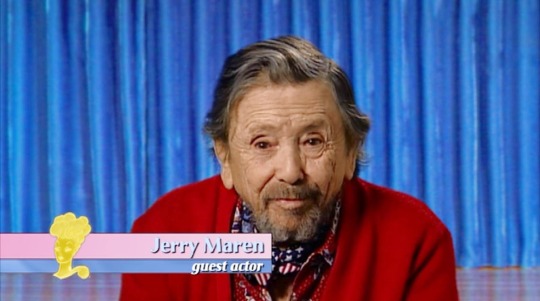
On
the series DVD, the episode is introduced by Carole Cook and Jerry
Maren, who says that the next day on the golf course he was ribbed
for playing ‘Little Mildred’!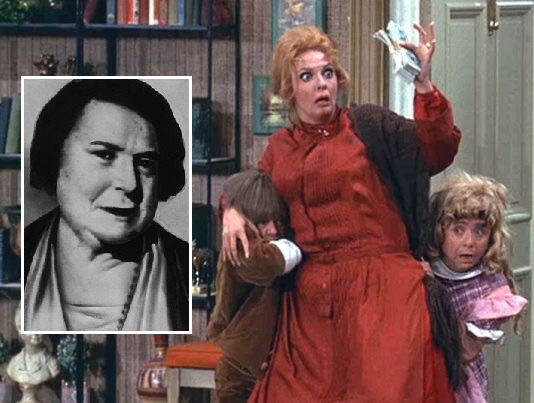
The
title character is a parody of Kate
‘Ma’ Barker (inset),
the
mother of several criminals who ran the Barker
gang
in the 1930s. She
traveled with her sons during their criminal careers.
She was previously mentioned in “Lucy and the Great Bank Robbery”
(TLS S3;E5).
In
2007, Jerry Maren (Milton) appeared at Jamestown’s annual Lucille
Ball Festival to discuss filming this episode. While being
interviewed,
he received
a surprise phone call from Desi Arnaz Jr.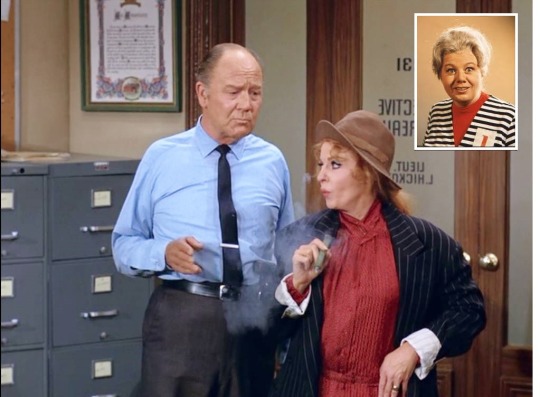
Ma
Parker was also the name of one of TV’s “Batman” villains. She
was played by Shelley Winters (inset), who guest starred on a 1968
episode of “Here’s Lucy.” Winters is just one of many actors who
performed on both “Batman” and “Lucy”.
When
Lucy gets her head stuck in the hedge while spying on the neighbors,
Kim calls her mother “Snoopy Sales.” Milton Supman (aka Soupy
Sales, 1926-2009)
was best
known for his local and network children’s
television show, “Lunch
with Soupy Sales” (1953-66), a series of comedy sketches
frequently ending with Sales receiving a
pie in the face,
which became his trademark. From
1968 to 1975, he was a regular panelist on the syndicated revival of
“What’s
My Line?”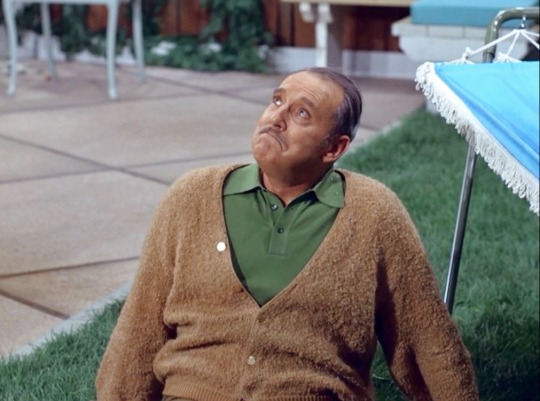
When
Lucy picks up the garden hose, a napping Harry is awakened by a
shower. The well-known “Here’s Lucy” formula: Harry + Garden Hose
= Wet!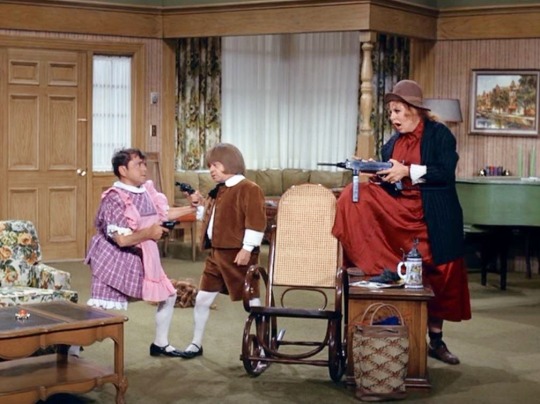
Typical
of Lucille Ball’s sitcom style (and the overall tone of this
episode), the ‘children’ are dressed in outfits that are vaudeville
stereotypes of children, not as children would be in 1970.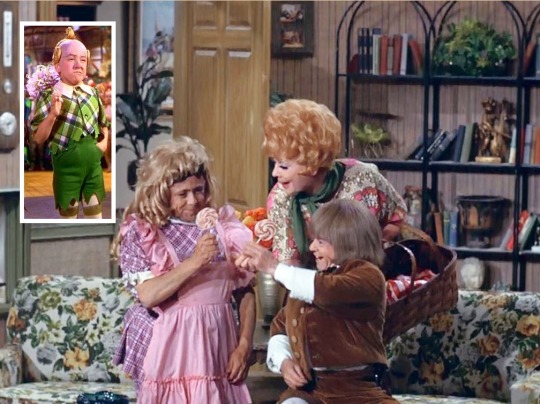
Lucy
gives the ‘children’ lollipops; appropriate since Jerry Maren played
one of the Lollipop Guild in The
Wizard of Oz (1939).
Additionally, Lucy carries a basket similar to Dorothy Gale’s.

Lucy
Ricardo was suspicious of her “New Neighbors” (ILL S1;E21) who
were also suspected criminals (suspected by Lucy, that is). Lucy disguised herself as an armchair and hid in their closet to spy on them!
Lucy
Carmichael developed super-human strength in “Lucy, the Super
Woman” (TLS S4;E26).
Skill Set! Lucy
sits down at Ma Parker’s piano to sing the neighborhood welcome song,
but Lucy Carter has never been able to play the piano, just the
saxophone and the ukulele.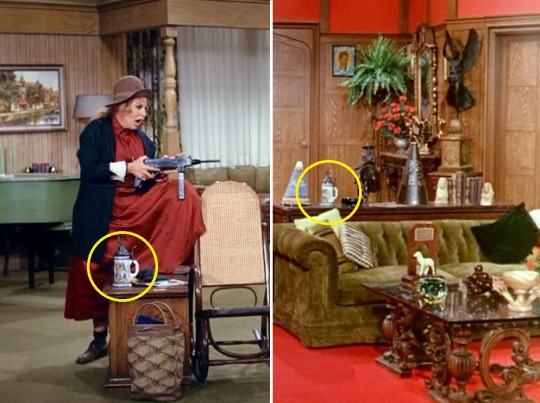
Props! The stein on Ma Parker’s end table is the same one seen in in Rudy
Vallee’s living room table in “Lucy and Rudy Vallee” (S3;E12).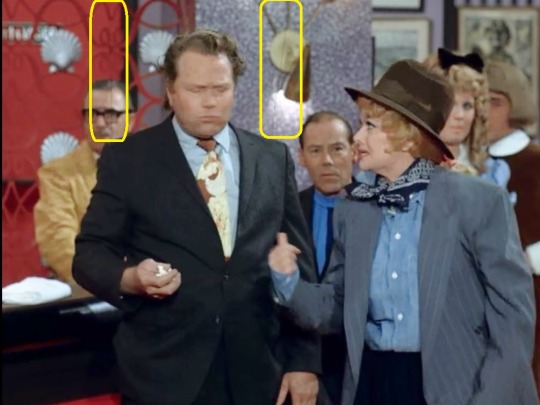
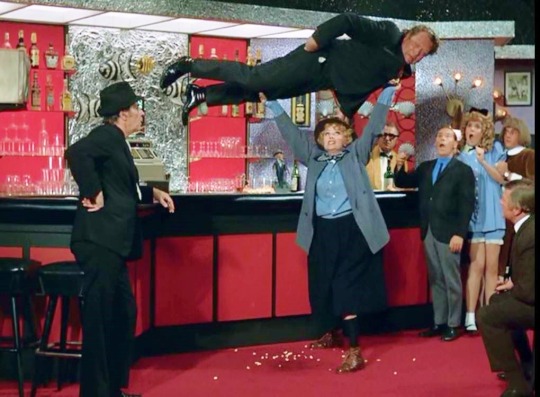
Foy Flaw! In
the medium shots of Customer #2 at the bar, the wires that will help
Lucy lift him in the air can be seen.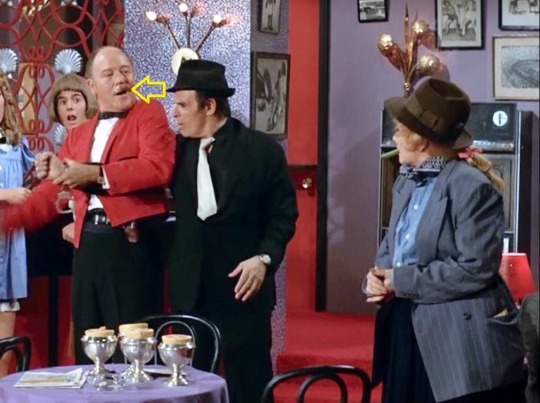
When
Lieutenant Hickox (disguised as waiter) handcuffs Joe Grapefruit, he
also must rip off his false beard with the other hand.
Unfortunately, half his mustache stays glued to his face. He quickly
does a second motion and rips it off, too!
“Lucy and Ma Parker” rates 1 Paper Heart out of 5
The
scene where Lucy visits Ma Parker as part of the neighborhood welcome
wagon feels like a satire or a sketch show – something Lucy and
company might act out in one of their musical episodes, but lacks any
sense of reality. Lucy behaves in a presentational manner as if
she’s putting on an act. I suppose that is what she felt necessary
to pull off the premise of not recognizing adult little people in
costumes. But when she mistakes actual machine gun fire for cork
bullets and lifts a big man over her head, well… so much for
Lucille Ball’s credo of sticking close to the truth. The final scene
is missing one key element – the ‘real’ Ma Parker! Additionally,
some of the comedy in this episode is derived from insulting remarks
and jokes about little people. In 1970 the term ‘midget’ was still
socially acceptable.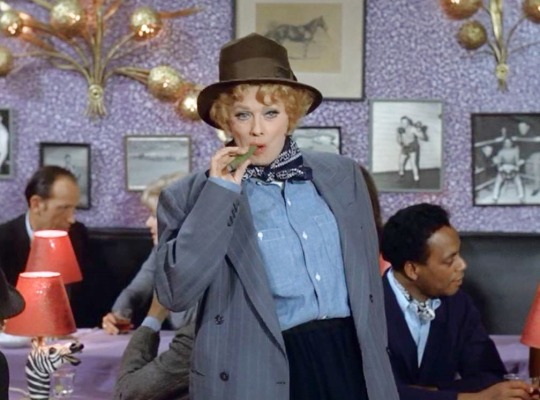 1970, Billy Curtis, Boyd Red Morgan, Carole Cook, CBS, Desi Arnaz Jr., Emile Autuori, Gale Gordon, gangster, grapefruit, Harry Hickox, Herbert Kenwith, Here’s Lucy, Jerry Maren, Larry Rhine, little people, Lollipop Guild, Lou Derman, Lucie Arnaz, Lucille Ball, Ma Barker, Marc Lawrence, Mickey Martin, mobster, Orwin C. Harvey, Soupy Sales, Stafford Repp, The Wizard of Oz, Tony Dante, tv
-
Subscribe
Subscribed
Already have a WordPress.com account? Log in now.
 Papermoon Loves Lucy