S3;E22
~ February 8, 1971


Directed
by Jack Carter ~ Written by Ray Singer and Al Schwartz
Synopsis
Harry
has fired Lucy again, so she visits the unemployment office where she
reunites with secretary turned actress Carol Krausmeyer (Carol
Burnett) and meets other out of work show biz folk. They decide to
put on a show in order to make some dough!
Regular
Cast
Lucille
Ball (Lucy
Carter), Gale
Gordon (Harrison
Otis Carter), Lucie
Arnaz (Kim
Carter)
Desi
Arnaz Jr. (Craig
Carter) does not appear in this episode, but is given opening title
credit.
Guest
Cast

Carol
Burnett (Carol
Krausmeyer) got her first big break on “The Paul Winchell Show”
in 1955. A years later she was a regular on “The Garry Moore Show.”
In 1959 she made her Broadway debut in Once
Upon a Mattress,
which she also appeared in on television three times. From 1960 to
1965 she did a number of TV specials, and often appeared with Julie
Andrews. Her second Broadway musical was Fade
Out – Fade In which
ran for more than 270 performances. From 1967 to 1978 she hosted her
own highly successful variety show, “The Carol Burnett Show.”
Lucille Ball made several appearances on “The Carol Burnett Show.”
Burnett guest starred in four episodes of “The Lucy Show” and
three episodes of “Here’s Lucy,” only once playing herself.
After Lucille Ball’s passing, Burnett was hailed as the natural
heir to Lucy’s title of ‘The Queen of TV Comedy.’
Krausmeyer is
the same last name as the music teacher played by Hans Conried on
Lucille Ball’s radio show “My
Favorite Husband.”
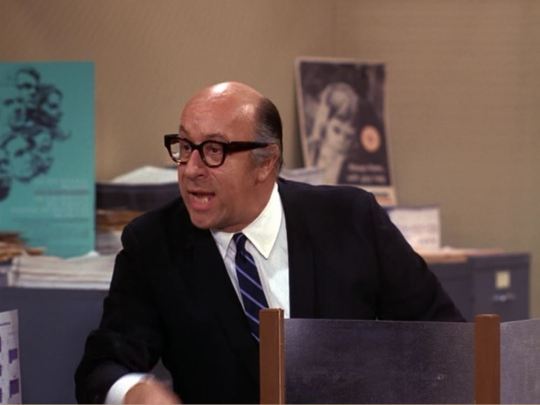
Richard
Deacon (Harvey
Hoople) is probably best remembered as Mel Cooley on “The Dick Van
Dyke Show” (1961-66). He appeared as Tallulah Bankhead’s butler in
“The Celebrity Next Door,” a 1957 episode of “The Lucy-Desi
Comedy Hour.” He was
employed again by Desi Sr. as a regular on “The Mothers-in-Law”
(1968). This is the first of his two appearances on "Here’s
Lucy.”
Harvey
Hoople is a clerk at the Unemployment Office, although his name is
never spoken aloud.

Clarence
Landry
and Vernord
Bradley
(“The Highhatters”) were a tap dance duo who both appeared in in
the Vitaphone 1941 short Minstrel
Days.
Landry
and Bradley are a introduced to Lucy by Carol using their real first
names.

Jack
Benny (Himself)
was
born on Valentine’s day 1894. He had a successful vaudeville
career, and an even greater career on radio with “The Jack Benny
Program” which also became a successful television show. His screen
persona was known for being a penny-pincher and playing the violin.
Benny was a Beverly Hills neighbor of Lucille Ball’s and the two
were off-screen friends. Benny previously appeared on “The Lucy
Show” as Harry Tuttle (a Jack Benny doppelganger) in “Lucy
and the Plumber” (TLS S3;E2),
did a voice over cameo as himself in “Lucy
With George Burns” (TLS S5;E1),
and played himself in “Lucy
Gets Jack Benny’s Account” (TLS S6;E6).
This is the third of his four episodes of “Here’s Lucy.”
Benny and Ball appeared on many TV variety and award shows
together. He died in 1974.
Although
Benny plays into his ‘tightwad’ personae, he is never identified by
name or recognized as a celebrity.
Vanda Barra (Unemployment Cashier) was married to Sid Gould so is Lucille Ball’s cousin-in-law. This is just one of her over two dozen appearances on “Here’s Lucy” as well as appearing in Ball’s two 1975 TV movies “Lucy Gets Lucky” (with Dean Martin) and “Three for Two” (with Jackie Gleason). She was seen in half a dozen episodes of “The Lucy Show.”
Unusually, Barra is nothing more than a background performer in this episode, but still gets end credit billing. She has no dialogue.

The ‘Canadian Mounties’
are played by:
- Sid
Gould
(left) made
more than 45 appearances on “The Lucy Show,” and nearly as many
on “Here’s Lucy.” Gould (born Sydney Greenfader) was Lucille
Ball’s cousin by marriage to Gary Morton.
He was married to Vanda Barra (Cashier).
- Johnny
Silver
(center right) was a busy Hollywood character actor who was seen with
Richard Deacon (Harvey Hoople) on “The Dick Van Dyke Show” and
with Jack Benny (Himself) on “The Jack Benny Show.” He will do
one more episode of “Here’s Lucy.”
- Mike
Wagner
(right) makes his only appearance on “Here’s Lucy.”
- Kay
Kuter
(center left) was a character actor who made an appearance in the
1970 TV movie Swing
Out, Sweet Land with
Jack Benny and Lucille Ball as the voice of the Statue of Liberty.
Carol
identifies Kuter as “Chuck Walters, a fantastic singer” when they
are the unemployment office. This character was named in honor of Charles Walters, director of the previous episode, “Lucy and Aladdin’s Lamp” (S3;E21). Carol probably should have said “fantastic dancer” since the real Walters was known as dance director of MGM musicals, six of which featured Lucille Ball.
Others
at the unemployment office, including two male acrobats and various
clerks, are played by uncredited background performers.

This
episode is sometimes known as “The Hollywood Unemployment Follies”
to distinguish it from previous episodes also titled “Lucy and
Carol Burnett.”
Interestingly,
although “The Carol Burnett Show” usually followed “Here’s
Lucy” at 10pm on CBS, there was no new episode the night this
“Here’s Lucy” first aired.
On
the series DVD this episode is introduced by Carole
Cook,
who says that Lucille Ball did her own signing on this episode,
despite the fact that Cook had previously dubbed Lucy in other
musical episodes.
In
a previous episode, Kim reminds Lucy that Harry has fired her 14
times. This makes 15.
Kim
tells Lucy that in California she could get as much as $65 a week in
unemployment
insurance.
As of this writing (late 2017) the maximum was $450 a week for 26
weeks.
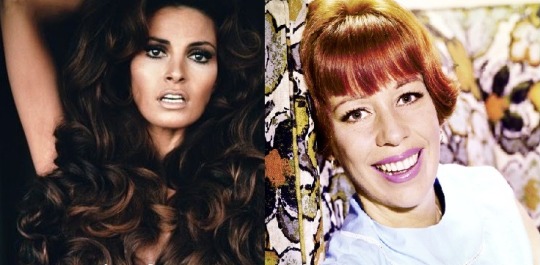
Carol
jokingly tells Lucy that ‘Carol Krausmeyer’ isn’t her professional
name when acting – it’s Raquel Welch. She looks down at her bosom
and says “Ok,
someone let the air out.”
Raquel
Welch was
a voluptuous movie star who was previously mentioned on “Lucy
and Johnny Carson” (S2;E11), “Lucy, the American Mother” (S3;E7) in which she was mentioned alongside Burnett, and
as Jack Benny’s Palm Spring neighbor in the second
episode of
the series. Carol also used Welch’s name as a punchline in “Lucy
Competes With Carol Burnett” (S2;E24).
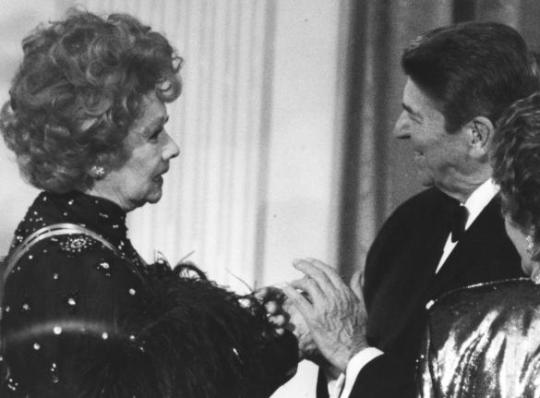
When
Harvey Hoople decides to join up with the unemployed performers to
write and direct their show he says “Governor
Reagan, I quit! You can keep your old job! I’m back in show biz,
Ronnie! Don’t you wish you were?”
Former
Hollywood actor Ronald
Reagan had
been elected Governor of California in 1967, a position he held until
1975. He was later elected 40th President of the United States
and served until 1989. He was previously mentioned in the second
episode of the series, “Lucy
Visits Jack Benny” (S1;E2)
and more recently in “Lucy and the Raffle” (S3;E19).

To
flatter him into being a backer of their show, Carol says that Harry
looks like Cary Grant. He dryly replies “So
do you!”
Harry was compared to Cary
Grant (and others) by Kim (disguised as new secretary Shirley Shoppenhauer) in “Lucy
Protects Her Job” (S2;E14, above). Grant was often mentioned on all of
Lucille Ball’s sitcoms, although the two never acted together.
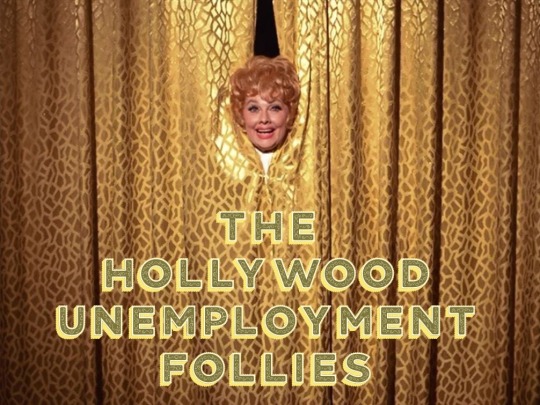

The
subtitle of the “Hollywood Unemployment Follies” is “How to
Starve in Show Business Without Really Trying.” This is a
variation on the title of Frank Loesser’s 1961 Pulitzer Prize-winning
Broadway musical
How
To Succeed in Business Without Really Trying,
which was made into a film in 1967.

The
ensemble sings “Hooray
for Hollywood” a
song by Johnny Mercer and Richard A. Whiting that was first sung in
the 1937 movie Hollywood
Hotel.
This song is the only one to features specially written lyrics to
fit the episode’s theme. This version mentions Henry
Fonda
and his children Jane and Peter. Lucille Ball and Henry Fonda
starred in the film Yours,
Mine and Ours
together in 1968.

Stumbling
onto a Hollywood soundstage, Lucy, Carol and Kim discover a mannequin
of Humphrey Bogart. Kim had a poster of Humphrey
Bogart (inset) on her wall in “Lucy and the Andrews Sisters” (S2;E6). In “Lucy
and the Bogie Affair” (S2;E13) Kim
and Craig name a lost dog Bogie because it has the same sad look as
Bogart did at the end of 1942’s Casablanca.
Ogling the mannequin adoringly, Carol references the famous line “If
you want anything, just whistle,” Lauren
Bacall’s parting words to Humphrey Bogart in the film To
Have and Have Not (1944).
This line was also referenced in “Lucy
and the Bogie Affair” (S2;E13).
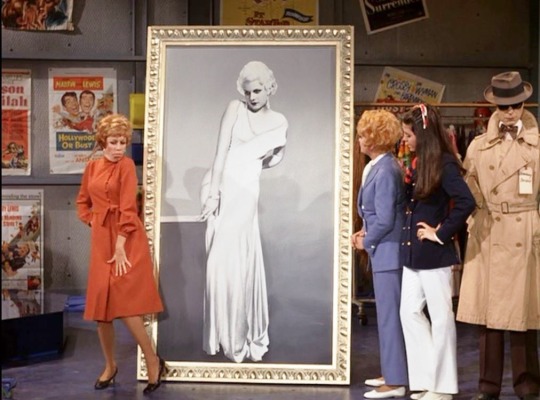
They
then admire a larger than life photo portrait of Jean Harlow.
Jean Harlow
(1911-37) was Hollywood’s original wisecracking blonde bombshell.
Only five months older than Lucille Ball, Harlow died of uremic
poisoning at age 26 just as Lucy’s career was getting started.
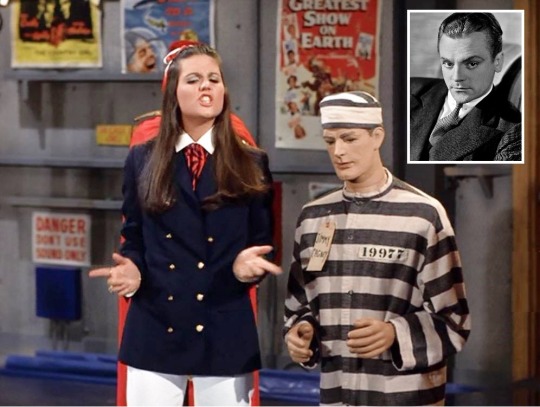
They
move to a mannequin of Jimmy Cagney dressed in prison stripes. Kim
does her impression of Cagney saying “You
dirty rat.”
Cagney
never actually said the famously mis-quoted dialogue but a line in his 1932 film
Taxi!
probably
came closest, calling a philandering man “You
dirty, yellow-bellied rat!”
James
Cagney (1899-1986, inset)
was a singer, dancer and actor best known in Hollywood for playing
tough guys.

They
then encounter mannequins of Clark
Gable and
Vivian Leigh dressed
in costumes from Gone
With the Wind
(1939). Carol, using a high pitched Southern accent, imitates
Scarlet O’Hara. Coincidentally, Carol will play Scarlet (re-named
Starlet) in a one of her most famous sketches from “The Carol
Burnett Show” in 1976 (above right).

Lucille Ball herself was short-listed for the role of Scarlet O’Hara
and even did a screen test for the part. Ball will play Scarlet
O’Hara in “Lucy
and Flip Go Legit” (S4;E1) with Flip Wilson as Prissy.

Lucy imitates Butterfly McQueen, who played Prissy, Scarlet’s maid, using the famous lines “I don’t know nuthin’ ’bout birthin’ babies.” After
Lucy’s imitation of Butterfly
McQueen,
Carol sarcastically says “it
sounded more like Steve.”
Steve
McQueen (1930-80)
was an actor who would
receive an Oscar nomination for The
Sand Pebbles in
1966, the same year that he was mentioned in “Lucy Goes to a
Hollywood Premiere” (TLS S4;E20).
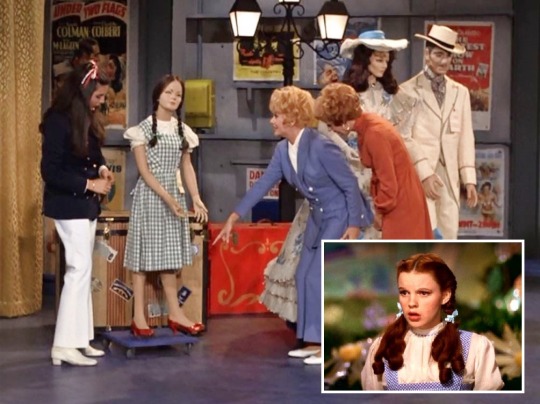
The
final mannequin on the ‘soundstage’ is of Judy
Garland (inset) in The
Wizard of Oz
wearing her famous blue gingham dress and ruby slippers. Kim does a
high-pitched imitation of the Munchkins. Two of the Singer Munchkins,
Jerry Maren and Billy Curtis, appeared in “Lucy and Ma Parker”
(S3;E15) and Shep Houghton, one of the Winkie Guards, was a
background performer on “Here’s Lucy.”
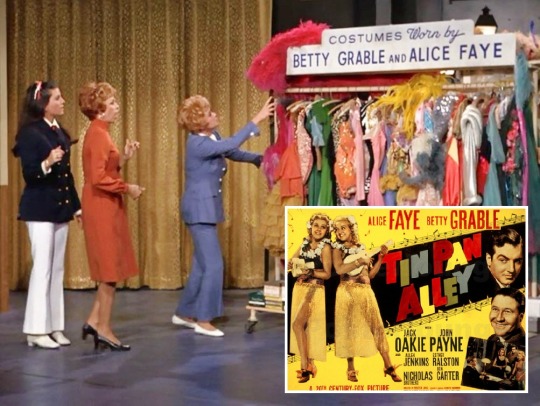
Lucy,
Kim and Carol launch into “We’re
Off to See the Wizard,”
written by Harold Arlen and Yip Harburg for The
Wizard of Oz,
which brings them to a wardrobe rack conspicuously labeled COSTUMES
WORN BY BETTY GRABLE AND ALICE FAYE. Faye and Grable did two films
together, Tin
Pan Alley
(1940) and Four
Jills in a Jeep
(1944). Betty
Grable
(1916-73) made two films with Lucille Ball when they were both at RKO
in the mid-1930s. She then guest-starred as herself with her
second husband bandleader Harry James in “Lucy Wins a Racehorse,”
a 1958 episode of “The Lucy-Desi Comedy Hour.” Alice
Faye
(1915-98) often played gritty, non-nonsense women in films. She was
married to Phil Harris, who will play himself on a 1974 episode of
“Here’s Lucy.”

In
a magical reveal (aka editing) Lucy and Carol become blondes singing
“Chicago
(That Toddlin’ Town”)
a song
written by Fred Fisher and
published in 1922.

After a quick costume change (editing again), they sing “Alexander’s
Ragtime Band”
which was composer Irving Berlin’s first hit in 1911, the same year
Lucille Ball was born.

After
a commercial break, Lucy and Carol discover “the
derby worn by the one and only Bill Robinson.”
Bill
Robinson
(1878-1949)
was the preeminent tap dancer of his day. He is best remembered for
his appearances with young Shirley Temple in four of her
1930s films. Robinson worked with Lucille Ball on the 1935 musical
film Hooray
for Love.

After
some camera trickery (more editing), Kim is wearing the derby and
introducing (through song) one of the Highhatters as Bill “Bojangles”
Robinson (inset) doing a tap routine which she then joins in.

Next
up, four comical Canadian Mounties sing “Stout-hearted
Men,”
a song by Sigmund Romberg and Oscar Hammerstein II for the operetta
New Moon in 1927 with film versions in 1930 and 1940. Richard Deacon
(also dressed as a Mountie) and Carol Burnett sing “Indian
Love Call”
by Rudolf Friml, Herbert Stothart, Otto Harbach, and Oscar
Hammerstein II written for the 1924 operetta Rose-Marie.
The melody was used for the mating call of the wild Gorboona in
“Lucy’s Safari” (S1;E22) which guest-starred Howard Keel, who was
in the 1954 film version of Rose Marie.

Dressed
as Marlene Dietrich, Lucy sings “Falling
in Love Again (Never Wanted To)”
from the 1930 German film The
Blue Angel.
Harry plays a World War I German soldier. Marlene
Dietrich
(1901-92) was born in Berlin, but came to Hollywood to make films in
1930. She was nominated for an Oscar in 1931.
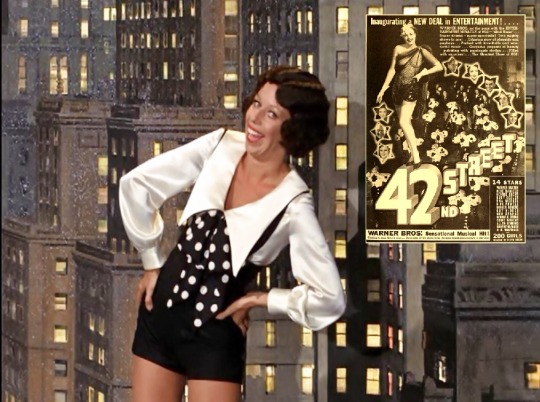
The
Highhatters introduce Carol as Miss Ruby Keeler and they sing
“Shuffle
Off To Buffalo” by
Al Dubin and Hugh Warren, originally written for the 1933 film 42nd
Street.
They then do a dance challenge to the title song from the film. Ruby
Keeler
(1910-93) was a singer, dancer and actress most famous for her
pairing with Dick Powell in a series of movie musicals, including
42nd
Street.
Like Lucille Ball and (now) Lucie Arnaz, Keeler had a home in Palm Springs, California.

As
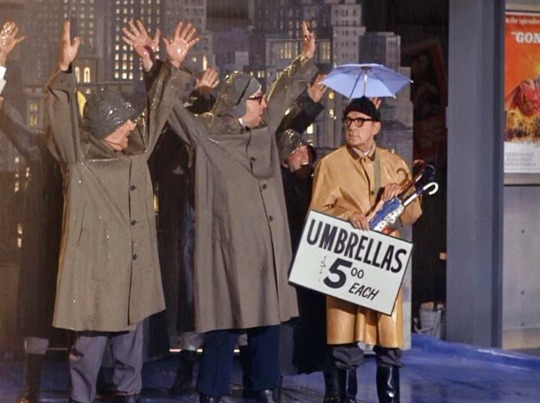
the finale, the entire ensemble is dressed in rain slickers and
performs
“Singin’ in the Rain”
written by Arthur Freed and Nacio Herb Brown in 1931. It was most
famously featured in the film Singin’
in the Rain
in 1952.
Many
of the movie posters decorating the ‘soundstage’ were from Paramount
Pictures, to which Lucille Ball sold Desilu / RKO and where they
filmed “Here’s Lucy”:
- Hollywood
or Bust
(1956) starring Jerry Lewis and Dean Martin - Samson
and Delilah (1949)
starring Hedy Lamarr and Victor Mature - The
Greatest Show on Earth
(1952) starring Charleton Heston, Betty Hutton, and Gloria Grahame,
who replaced Lucille Ball when Lucy became pregnant with Lucie - Short
Cut to Hell (1957)
directed by James Cagney - Gone
With the Wind
(1939) starring Clark Gable and Vivian Leigh - Under
Two Flags
(1936) starring Claudette Colbert and Ronald Colman


“The
Lucy Show” established Lucy Carmichael as a film fanatic in the
Hollywood-themed episode “Lucy Goes To A Hollywood Premiere” (TLS
S4;E20).

The
Scarlet O’Hara dress is the same one Lucy Carmichael wore in 1965 as
Lucybelle in “The Founding of Danfield,” a community theatre play
featured in “Lucy and Arthur Godfrey” (TLS S3;E23).
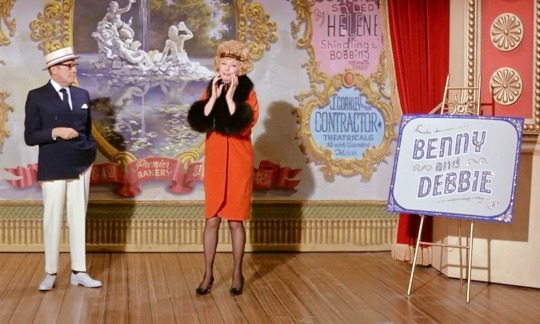
The vaudeville backdrop curtain during “Chicago” and “Alexander’s Ragtime Band” was also used in “Lucy and Jack Benny’s Biography” (S3;E11).

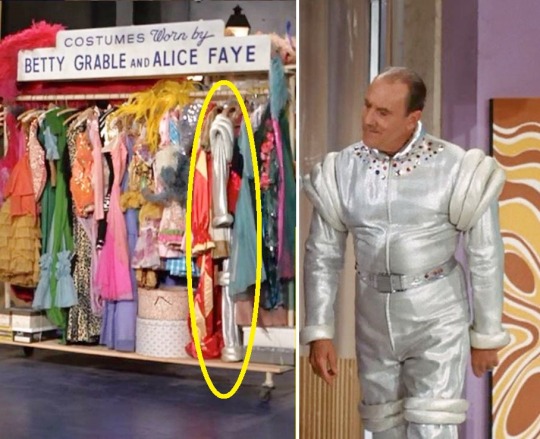
Props!
The
wardrobe rack of costumes worn by Betty Grable and Alice Faye also
contains Gale Gordon’s silver space suit from “Lucy and the
Generation Gap” (S2;E12). It is hard to imagine either woman
wearing that!

Who
Am I?
One mannequin on the ‘soundstage’ doesn’t get identified. It is
dressed in Roman armor. It may have been Charleton Heston in Ben
Hur,
but was cut for time.

Spell-Check!
The end credits miss-spell ‘Mountie’ as ‘Mounty’. The word is an
informal reference to The Royal Canadian Mounted Police.

“Lucy and Carol Burnett” or “The Hollywood Unemployment Follies” rates 4 Paper Hearts out of 5
This
episode seems more like “The Carol Burnett Show” than “Here’s
Lucy” – especially when Lucille Ball is off-screen. A Hollywood
revue is a great idea, but the ‘book scenes’ (in between the songs)
are played in such a naturalistic way that they don’t really seem any
different than the actual show. It is almost as if the trio actually
walked into a Hollywood Hall of Fame and had musical dreams. It all
feels very much like the old Judy Garland / Mickey Rooney ‘let’s put
on a show in a barn’ genre. Gale Gordon has very little to do (not
even a cartwheel!) and Desi Jr. is completely absent. Not
unenjoyable but not the best of these musical comedy episodes either.


Leave a Reply