-
HARRISON CARTER, MALE NURSE
S5;E3
~ September 25, 1972

Directed
by Coby Ruskin ~ Written by Bob Carroll Jr. and Madelyn DavisSynopsis
Lucy
finally comes home from the hospital to be cared for by her friends
and family. But when everyone but Harry has an excuse for canceling
their shift, Harry ends up becoming her full time nursemaid!Regular
Cast
Lucille
Ball (Lucy
Carter), Gale
Gordon (Harrison
Otis Carter), Lucie
Arnaz (Kim
Carter)Guest
CastMary
Jane Croft (Mary
Jane) played Betty Ramsey during season six of “I Love Lucy. ”
She also played Cynthia Harcourt in “Lucy
is Envious” (ILL S3;E23) and
Evelyn Bigsby in “Return
Home from Europe” (ILL S5;E26).
She played Audrey Simmons on “The Lucy Show” but when Lucy
Carmichael moved to California, she played Mary Jane Lewis, the
actor’s married name and the same one she uses on all 31 of her
episodes of “Here’s Lucy. Her final acting credit was playing
Midge Bowser on “Lucy Calls the President” (1977). She died in
1999 at the age of 83.Vanda
Barra (Vanda)
makes one of over two dozen appearances on “Here’s Lucy” as
well as appearing in Ball’s two 1975 TV movies “Lucy Gets Lucky”
(with Dean Martin) and “Three for Two” (with Jackie Gleason). She
was seen in half a dozen episodes of “The Lucy Show.” Barra was
Lucille Ball’s cousin-in-law by marriage to Sid Gould.Sid
Gould (Sam)
made more than 45 appearances on “The Lucy Show” and nearly as
many on “Here’s Lucy.” Gould (born Sydney Greenfader) was
Lucille Ball’s cousin by marriage to Gary Morton.Unlike
everyone else in the episode, Sam is not given any responsibilities
for Lucy’s home care. The character is not addressed by name and does not
have any lines – although there is quite a bit of ad lib (and
indistinct) dialogue in the opening scene.
The
two hospital orderlies who bring Lucy home are uncredited.Except for the two orderlies, this cast is basically the “Here’s Lucy” family. Indeed, except for Gale Gordon and Mary Jane Croft, some of them are actually relatives!

This is the third installment in the longest story arc (Lucy’s
broken leg) of the series. This storyline was dictated by the
fact that Lucille Ball actually broke her leg skiing, necessitating
scripts for the first half of season five be tailored to her being in
a cast.
The
date this episode first aired (September 25, 1972) Time
Magazine
published an issue that looked at new trends in television. Although not overtly stated in the magazine, it heralded a new form of topical comedy, much different from the sort that Lucille Ball was presenting, which was still much like it was in the 1950s.
Lucy
calls Harry “a perfect Florence Nightingale.” Florence
Nightingale (1820-1910)
came to be known as “The Lady with the Lamp.” She was a
pioneering nurse, writer, and noted medical statistician. She tended
wounded soldiers in the Crimean War and became an advocate for care
of the wounded soldier. Her name has become synonymous with
nursing worldwide.
An episode of “The Lucy Show” was titled “ Lucy
Plays Florence Nightingale” (TLS S2;E11) also written by
Madelyn
Davis (then Martin) and Bob Carroll Jr.This
is the first time in season five that we have seen the Carter living
room. It now features a proper dining table, replacing the square
card table previously used for meals.
The
excuses given to Harry by Lucy’s other “nurses” are:- Kim’s car
transmission went out (again) - Vanda
has a bad cold - Mary
Jane has to go to Santa Barbara for work, a reminder that Mary Jane
works for a lawyer, a fact revealed in a previous episode

When
all the others can’t make it, Harry says “now
I know for whom the bell tolls” referring
to the hand bell he gave Lucy to alert someone that she needs help.
For
Whom the Bell Tolls is
a novel by Ernest
Hemingway published
in 1940.
It was filmed in 1943 and was seen on television in 1959 on CBS.
On
the bookshelf behind the bed there is a copy of A
Thousand Days,
a book about John F. Kennedy in the White House written by Arthur M.
Schlesinger first published in 1965 and winner of the Pultizer Prize.
On a 1963 episode of “The Lucy Show,” Lucy Carmichael and Vivian
Bagley took their cub scout troop on a trip to Washington DC to meet President Kennedy. An off-screen voice actor impersonated JFK
for the final scene.
When
Lucy complains that she doesn’t like drinking milk,
Harry says “Everybody
like milk. Pat Boone likes milk. Dear Abby likes milk. Vida Blue
likes milk.”Dear Abby (aka Abigail Van Buren) was previously mentioned on “Lucy, the Superwoman” (TLS S4;E26) while Pat Boone’s first mention goes back to 1957′s “Country Club Dance” (ILL S6;E25) featuring Barbara Eden. This is baseball player Vida Blue’s first and only mention on a “Lucy” show.

Harry’s list of milk-loving celebrities comes from a very popular 1971 television and radio campaign by the California Milk Advisory Board “Every Body Needs Milk”
and its successor “Milk Has Something For Every Body.“ By late 1971 the
campaign also included Ray Bolger, Phyllis Diller, and Karen
Valentine.While
trying to force Lucy to drink her milk, it spills all over Harry,
fulfilling the usual “Here’s Lucy” sight gag of Harry all wet.
This time with milk.
Lucy
asks Harry to play Scrabble, incorporating one of Lucille Ball’s
passions, word games. In the previous two episodes, she was seen
doing crossword puzzles. In 1974, Lucille Ball promoted a Milton
Bradley word game named Cross Up, with her photo on the box cover.
After
nine games of Scrabble, Lucy proposes she and Harry ‘chat.’ Lucy at
first proposes they talk about what water pollution is doing to our
ecological balance. Since neither are particularly well-versed on
the topic, they move on to books. Lucy asks Harry if he has read
David Niven’s The
Moon is a Balloon (no)
or Agatha Christie’s Nemesis
(no),
and Black
Beauty (yes,
but not all of it.)
Lucy
tells Harry the story of when she broke her arm bouncing on the bed
and when she sprained her ankle ice skating on Chautauqua Lake.
Chautauqua Lake (or Lake Chautauqua) is located adjacent to Jamestown
and Celoron, New York, where Lucille Ball actually grew up. The lake
was mentioned by Lucy Ricardo in “The Saxophone” (ILL S2;E2) when
she finds a small fish mounted on a large plaque that Ricky caught
while fishing there. Ethel
dubs it a “rainbow sardine.”
Harry
gets Lucy a modern wheelchair which looks and behaves like a
miniature golf cart. Lucy says it looks like “a surrey with the
fringe on top.” This is a reference to Rodgers and
Hammerstein’s musical Oklahoma!, which premiered on Broadway in 1943
and was filmed in 1954. In “Lucy Tells the Truth” (ILL S3;E6), Lucy Ricardo fibs that she was in Oklahoma! but then has to admit that she meant that she was in Tulsa once.

n Lucy’s bedroom, the camera briefly catches a framed black and white publicity photo of Lucy, Kim, and Craig in “Lucy and Ma Parker” (S3;E15).


The apron Harry wears was worn by Vivian Vance in “Lucy’s Contact Lenses” (TLS S3;E10) in 1964!

The
premise of a well-meaning care-giver being over-worked was previously
used in “Vivian Sues Lucy” (TLS S1;E10). Viv (Vivian Vance) is
confined to be after tripping on one of Lucy’s son’s toys. Like Lucy
Carter, Viv has a bell and her care-giver (Lucy) is run ragged up and
down the stairs bringing meals and fulfilling her every whim.
Character
Consistency!
This is the first time since the end of season 4 that we get a
glimpse into what is going on with Kim. In “Kim Cuts You Know-Whose
Apron Strings” (S4;E24), which was meant as a pilot for a possible
series starring Lucie Arnaz, Kim had moved into a Marina Del Rey
apartment and taken a job with a public relations company. The pilot
did not sell, so it appears that the writers have chosen to ignore
that episode and Kim is back at college. Her previous move to a
nearby garage apartment in “Kim Moves Out” (S4;E20) was also
never resolved.Title Trouble! Lucy slightly mis-states the title of David Niven’s book. Lucy calls it The Moon IS a Balloon but the actual title is The Moon’s a Balloon. Small slip.

“Harrison Carter, Male Nurse” rates 3 Paper Hearts out of 5
This is a really good showcase for Gale Gordon, who gets the spotlight here. His scene with Lucy in her bedroom has lots of levels and nicely surpasses what we usual get from the character.
 1972, A Thousand Days, Black Beauty, Bob Carroll Jr., broken leg, CBS, Chautauqua Lake, Coby Ruskin, Dear Abby, Florence Nightingale, For Whom the Bell Tolls, Gale Gordon, Here’s Lucy, Lucie Arnaz, Lucille Ball, Madelyn Davis, Mary Jane Croft, Milk, Nemesis, Nurse, Oklahoma!, Pat Boone, Scrabble, Sid Gould, The Moon’s a Balloon, Time Magazine, tv, Vanda Barra, Vida Blue
 - Kim’s car
-
LUCY AND EVA GABOR ARE HOSPITAL ROOMIES
S5;E2
~ September 18, 1972

Directed
by Coby Ruskin ~ Written by Bob Carroll Jr. and Madelyn DavisSynopsis
In
the hospital with a broken leg, Lucy gets a new roommate – Miss Eva
Gabor. After the initial surprise wears off, Lucy starts to feel
dejected due to all the attention lavished on her celebrity roomie.Regular
CastLucille
Ball (Lucy
Carter), Gale
Gordon (Harrison
Otis Carter)Lucie
Arnaz (Kim
Carter) does not appear in this episode. Unlike previous episodes in
which she did not appear, Lucie does
not
receive opening title credit. She is, however, mentioned in the
dialogue.Guest
Cast
Eva
Gabor
(Herself) was
born in Hungary in 1919. She came to America with her sisters,
Magda and Zsa Zsa. She began her screen career in 1941. She
also appeared on Broadway five times between 1950 and 1983. Her
signature role was glamorous socialite turned farm wife Lisa Douglas
on “Green Acres” (1965-71), also aired on CBS. Gabor was married
five times. She was also a successful businesswoman, marketing wigs,
clothing and beauty products. Gabor previously played romance
novelist Eva Von Graunitz in “Lucy and Eva Gabor” (S1;E7). She
died in 1995.
Mary
Wickes (Nurse
Sylvia Ogilvy) was one of Lucille Ball’s closest friends and at one
time, a neighbor. She made a memorable appearances on “I Love Lucy”
as ballet mistress Madame Lamond in “The
Ballet” (ILL S1;E19). In
her initial “Lucy Show” appearances her characters name was
Frances, but she then made four more as a variety of characters for a
total of 8 episodes. This is one of her 9 appearances on “Here’s
Lucy” returning to the role she played in the previous episode.
Their final collaboration on screen was “Lucy Calls the President”
in 1977.Wickes
is listed in the final credits as “Miss Ogilvy” although her name
is not spoken in the episode. Her full name was stated in the
previous episode, “Lucy’s Big Break” (S5;E1).
Mary
Jane Croft (Mary
Jane Lewis) played Betty Ramsey during season six of “I Love Lucy.
” She also played Cynthia Harcourt in “Lucy
is Envious” (ILL S3;E23) and
Evelyn Bigsby in “Return
Home from Europe” (ILL S5;E26).
She played Audrey Simmons on “The Lucy Show” but when Lucy
Carmichael moved to California, she played Mary Jane Lewis, the
actor’s married name and the same one she uses on all 31 of her
episodes of “Here’s Lucy. Her final acting credit was playing
Midge Bowser on “Lucy Calls the President” (1977). She died in
1999 at the age of 83.
Vanda
Barra (Vanda
Barra) makes one of over two dozen appearances on “Here’s Lucy”
as well as appearing in Ball’s two 1975 TV movies “Lucy Gets
Lucky” (with Dean Martin) and “Three for Two” (with Jackie
Gleason). She was seen in half a dozen episodes of “The Lucy Show.”
Barra was Lucille Ball’s cousin-in-law by marriage to Sid Gould.For
the first time, Lucy introduces Vanda as “my
friend Vanda Barra”
using her full name.
R.G.
Brown
(Walter) had
appeared on “The Andy Williams Show” (1963) and “The Rich
Little Show” (1976). He previously
played the flamboyant insurance company manager in “Lucy’s
Replacement” (S4;E19).
June
Whitley Taylor
(Nurse) had appeared as Sally, one of Lucy and Ethel’s bridge-playing
friends in both“No Children Allowed” (ILL S2;E22) and “The Camping Trip” (ILL S2;E29). Taylor
also played the same un-named Nurse in
the previous episode “Lucy’s Big Break” (S5;E1).
This
episode is the second installment in the longest story arc (Lucy’s
broken leg) of the entire series, and the first continued story since
Lucy cruised to Hawaii at the end of season 3.
This storyline was dictated by the fact that Lucille Ball actually
broke her leg skiing, necessitating scripts for the first half of
season five be tailored to her being in a cast.
Just
as in the previous episode, Lucy does not leave her hospital bed for
the entire episode. The above is a publicity photo since both stars were in separate hospital beds for the entire episode.
Eva
Gabor is said to be Lucy’s fourth hospital roommate, although we have
only seen one. In the previous episode, “Lucy’s Big Break”
(S5;E1) Lucy’s roomie was the monosyllabic Mrs. Foster (Dorothy
Konrad, above) whose only reply to Lucy was “Mmm hmm.”
When
first Lucy meets Eva Gabor she is so nervous she forgets her own
name. She checks her hospital wristband and hastily introduces
herself as St. John. It can be inferred that Lucy is at St.
John’s Hospital.
This is a real-life Catholic hospital located in Santa Monica,
California, founded in 1942. The hospital has a long list of
celebrity patients, but in 1972 actress Joi Lansing (above right), who was featured
in two episodes of “I Love Lucy,” died there of breast cancer.
Eva
Gabor tells Walter, her assistant, to cancel her dinner date with
Frank
Sinatra in
Palm Springs.
Frank
Sinatra was a resident of Cathedral City, located just outside Palm
Springs. In June 1971 Sinatra was inaugurated as honorary mayor of
Cathedral City and Eva Gabor attended the ceremony.
This episode would have been filmed around that time.
Lucille
Ball wanted to try something new with her hair this season, so her
hairstylist, Irma Kusely, ordered some longer wigs.
She styled them into a bouffant that made it easier to conceal the
lift tapes that Ball often wore to keep skin taut. In the script Eva
Gabor works in a plug for her wig company. When Lucy chimes in that
she has one of Gabor’s wigs, Walter churlishly asks if it is the one
she’s wearing. Lucy says no, but does not deny that she’s wearing a
wig at all. In reality, Lucille Ball was wigged in this episode.
Walter
gives Gabor a script
to study while she’s recuperating from her “foots” injury. The
title of the script is not mentioned. Gabor’s series “Green Acres”
aired its final episode on April 27, 1971. Her next TV project didn’t
come along until 1975, when she guest starred on CBS’s “Big Eddie.”
Lucy
calls Harry and drops clues about who is in the next bed. He guesses
Zsa
Zsa Gabor. Lucy says he is “half right.” Zsa-Zsa is Eva’s real-life sister.
Harry
fawns over Eva Gabor, saying he always watched “Green Acres” and
saw her in Present
Laughter and
The
Happy Time
on Broadway. The
Happy Time,
a comedy by Samuel Taylor, played over 600 performances on Broadway
from January 1950 to July 1951, although Gabor was not with the show
for the entire run. It was her Broadway debut. In February 1958 she
starred in a limited run revival of Present
Laughter
at the Belasco Theatre playing opposite author and director Noel
Coward.
Harry
tells Eva Gabor that her autograph is for his “little” niece.
When Lucy questions the word “little” (Kim is 20 years old),
Harry says that her name is Harry-ette. Next, Mary Jane comes
in asking for an autograph for her niece, M.J. Lucy notes that
Mary Jane does not have any brothers or sisters. Third, and finally,
Vanda comes in asking for an autograph for her niece Randi.
Walter
brings Eva Gabor’s dinner on a silver tray. He says it was prepared
especially for her by Chasen’s. Chasen’s was
a West Hollywood restaurant frequented
by entertainers.
Located on the border of Beverly Hills, it first opened in 1936 and for many years was the venue of the Academy
Awards party.
It was also famous for its chili.
The
restaurant closed for good on April 1, 1995.
Lucille Ball and Desi Arnaz were regulars at Chasen’s and had their
own private booth there. The wrap party after “Lucy Meets the
Burtons” (S3;E1) was catered by Chasen’s.

In this episode Eva Gabor is victim of a rambunctious hospital bed.

The
out-of-control hospital bed was also mined for comic effect in “Lucy and Harry’s Tonsils” (S2;E5)…
on “The Lucy Show” in “Lucy and the Soap Opera” (TLS S4;E19)…

and in “Lucy Plays Florence Nightingale” (TLS S2;E14).

Eva Gabor previously played a version of herself, a romance novelist named Eva Von Graunitz, in “Lucy and Eva Gabor” (S1;E7). Graunitz was also her character’s maiden name on “Green Acres.”


Props!
When Lucy is holding the unopened split of Champagne, viewers can
see through the green glass of the bottle that it is only partially
full. In the next bed, Eva Gabor gets Lucy’s dinner and can tell by
just looking at it that the glass of milk in front of her is skim
milk.
Sitcom
Logic Alert! Lucy must be suffering from more than just a broken
leg. She has been in the hospital for a week and she is taking
pills.
Logistics! Lucy tosses Eva’s necklace right out the window.
Hospital windows do not generally open.
“Lucy and Eva Gabor are Hospital Roomies” rates 3 Paper Hearts out of 5
Another episode of Lucy confined to bed allows some fine acting between Lucille Ball and her cast. This is a more intimate (and refreshing) look at the character. The writing here is much better than in the previous episode. I do, however, wish they could have had Gabor call Lucy “Loosel” as she did in season one!
1972, Bob Carroll Jr., broken leg, CBS, Champagne, Chasen’s, Coby Ruskin, Dorothy Konrad, Eva Gabor, Eva Gabor Wigs, Frank Sinatra, Gale Gordon, Green Acres, Here’s Lucy, Hospital, hospital bed, June Whitley Taylor, Lucille Ball, Madelyn Davis, Mary Jane Croft, Mary Wickes, Palm Springs, Present Laughter, R.G. Brown, St. John’s Hospital, The Happy Time, tv, Vanda Barra, Zsa Zsa Gabor -
LUCY’S BIG BREAK
S5;E1
~ September 11, 1972
Directed
by Coby Ruskin ~ Written by Bob Carroll Jr. and Madelyn DavisSynopsis
Lucy
breaks her leg and is confined to a hospital bed. A handsome doctor
(Lloyd Bridges) catches her eye. Despite her confinement, she does
everything she can to get his attention!Regular
CastLucille
Ball (Lucy
Carter), Gale
Gordon (Harrison
Otis Carter), Lucie
Arnaz (Kim
Carter)Guest
Cast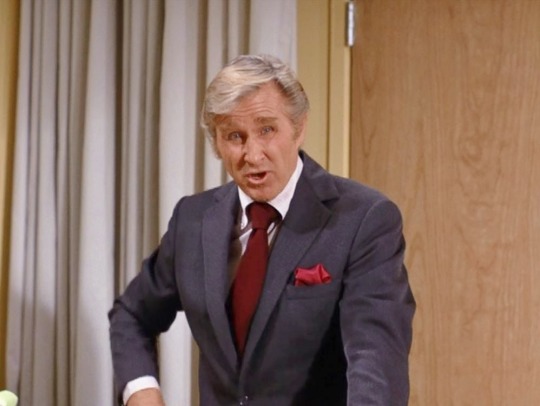
Lloyd
Bridgers (Dr.
Paul Murray) is probably best remembered for his starring role in
TV’s “Sea Hunt” (1958-61). He began his screen acting career in
1936 after acting on the New York stage. In 1959 he starred in an
episode of the “Westinghouse Desilu Playhouse” hosted by Desi
Arnaz. Bridges had his own show on CBS from 1962 to 1963. His skill
at comedy was memorably on display in the films Airplane
(1980) and Hot
Shots
(1991). He died in 1998 at age 85.Bob
Harks (Stand-in for Lloyd Bridges, uncredited) appeared in his first film in 1968 and was seen in the
background of Mame
(1974). In 1970 he popped up on his first television show and was
seen in more than a dozen episodes of “Here’s Lucy.” He died at
age 83 in 2010.
Mary
Wickes (Nurse
Sylvia Ogilvy) was one of Lucille Ball’s closest friends and at one
time, a neighbor. She made a memorable appearances on “I Love Lucy”
as ballet mistress Madame Lamond in “The
Ballet” (ILL S1;E19). In
her initial “Lucy Show” appearances her characters name was
Frances, but she then made four more as a variety of characters for a
total of 8 episodes. This is one of her 9 appearances on “Here’s
Lucy.” Their final collaboration on screen was “Lucy Calls the
President” in 1977.Mary
Wickes returns as Nurse Ogilvy in the next episode, “Lucy and Eva
Gabor are Hospital Roomies” (S5;E2).
Alan
Oppenheimer (Dr.
Matt Parker) got his start in screen acting in a 1963 episode of
Desilu’s “The Untouchables.” In 1974 he began doing voices on
animated shows and has become one of Hollywood’s busiest and most
versatile voice actors.Oppenheimer appeared as Lucy’s brother, Herb Hinkley, in the final episode of season four “Kim Finally Cuts You-Know-Whose Apron String” (S4;E24). This is his last appearance with Lucille Ball.

Oppenheimer provides the DVD introduction to this episode.

Mary
Jane Croft (Mary
Jane Lewis) played Betty Ramsey during season six of “I Love Lucy.
” She also played Cynthia Harcourt in “Lucy
is Envious” (ILL S3;E23) and
Evelyn Bigsby in “Return
Home from Europe” (ILL S5;E26).
She played Audrey Simmons on “The Lucy Show” but when Lucy
Carmichael moved to California, she played Mary Jane Lewis, the
actor’s married name and the same one she uses on all 31 of her
episodes of “Here’s Lucy. Her final acting credit was playing
Midge Bowser on “Lucy Calls the President” (1977). She died in
1999 at the age of 83.Vanda
Barra (Vanda)
makes one of over two dozen appearances on “Here’s Lucy” as
well as appearing in Ball’s two 1975 TV movies “Lucy Gets Lucky”
(with Dean Martin) and “Three for Two” (with Jackie Gleason). She
was seen in half a dozen episodes of “The Lucy Show.” Barra was
Lucille Ball’s cousin-in-law by marriage to Sid Gould.Although
she had played a character named Vanda in two previous episodes,
nearly all her remaining appearances on the series will be as Lucy’s
friend Vanda, including the next episode “Lucy and Eva Gabor are
Hospital Roomies” (S5;E2).
Sid
Gould (Sam) made more than 45 appearances on “The Lucy Show”
and nearly as many on “Here’s Lucy.” Gould (born Sydney
Greenfader) was Lucille Ball’s cousin by marriage to Gary Morton.On
the second episode of “Here’s Lucy” Gould’s character name
was Sam, a tour guide in Palm Springs. Prior to this episode he
twice played a character named Sam who was a waiter. He will play a
character named Sam three more times, in addition to his many other
minor roles.
June
Whitley Taylor
(Nurse) had appeared as Sally, one of Lucy and Ethel’s bridge-playing
friends in both “No Children Allowed” (ILL S2;E22) and “The
Camping Trip” (ILL S2;E29). She will make one more appearance on
the next episode of “Here’s Lucy.”
Dorothy
Konrad
(Mrs. Foster) made a total of six appearances on “The Lucy Show.”
She first played Dorothy Boyer, one of the volunteer firefighters,
then a variety of other characters. This is her only appearance on
“Here’s Lucy.”Mrs.
Foster shares a room with Lucy in the hospital. The surname Foster
was previously used by the writers on “I Love Lucy” for the
Ricardos’ neighbors Bill and Grace.
After
season 4 wrapped, Lucille Ball experienced a run of bad luck. First,
the final episode of the season was designed as a pilot for a
spin-off series starring Lucie Arnaz, but CBS declined to pick-up the
show for production. At the same time, Vivian Vance, who was being
eyed as a reliable sidekick for Lucy should Lucie get her own show,
was diagnosed with breast cancer. Finally, in January 1972 on a ski
trip to her condo in Snowmass, Colorado, Lucille Ball broke her leg.
Instead of canceling the series, Ball had the injury written into the
scripts, so that Lucy Carter would also have a broken leg.
Almost all of this season’s scripts had to be quickly rewritten or
postponed.
The injury meant that Ball would have to limit her physical comedy
and musical numbers and re-think the show’s overall dynamics. It
also meant that her plans to start filming the musical film Mame
would be put on hold until her injuries healed.
This
episode begins the longest story arc (Lucy’s broken leg) of the
entire series, and the first continued story since Lucy cruised to
Hawaii at the end of season 3.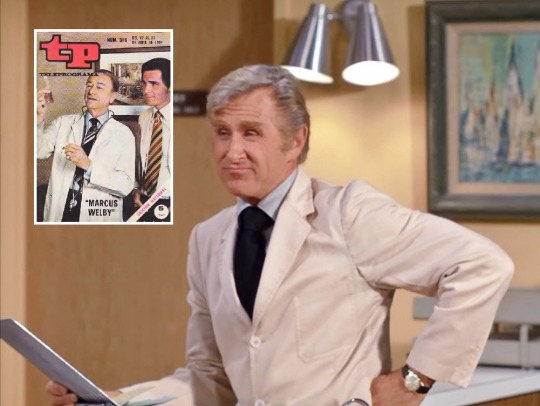
Ironically,
the highest rated TV program the week this episode first appeared was
also set in a hospital with a handsome gray-haired doctor, “Marcus
Welby M.D.” starring Robert Young on ABC.
For
the 1972-73 season, “Here’s Lucy” was followed by the premiere of
“The New Bill Cosby Show.” One of the “Cosby” series
regulars was Susan Tolsky, who played Kim’s neighbor Sue Ann in the
previous episode (and pilot) “Kim Finally Cuts You-Know-Whose Apron
String” (S4;E24). Tolsky will also return for one more episode of
“Here’s Lucy” in season 5.
For
season five the opening title theme music (by Wilbur Hatch) has been
re-orchestrated and Roy Rowan’s announcer voice re-recorded. Some of the visuals involving the spotlight are slightly altered.
The night before this episode originally aired Lucille Ball appeared on “A Salute to Television’s 25th Anniversary” on ABC. Former “Lucy” guest stars that also participated include Bob Hope, John Wayne, Milton Berle, Sid Caesar, Jimmy Durante, and Dinah Shore.
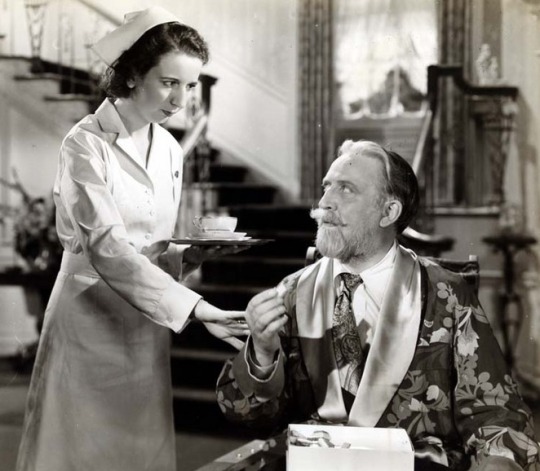
Before
donning a habit to play nuns, Mary Wickes was typecast as a nurse due
to her breakthrough role as Nurse Preen in the Broadway, film, and
television versions of The
Man Who Came To Dinner (above).
In 1960 she played a nurse in the TV film “The Gambler, The Nun
and the Radio,” 1963’s “It’s Mental Work,” and 1975’s “Doc.”
On “Here’s Lucy” she played Nurse Hurlow in “Lucy and Harry’s
Tonsils” (S2;E5) and in the following episode “Lucy and Eva Gabor
are Hospital Roomies” (S5;E2).
The
episode opens with location film of Lucille Ball on the slopes. This
footage was taken from Lucille Ball’s personal home movies. The
images then spiral fade into Lucy Carter’s foot in a cast in a
hospital bed. Lucy says she was skiing down Fanny Hill (the
beginner’s slope) at Snowmass. Fanny
Hill is
also the title of an erotic novel written in 1748 by John Cleland. It
was made into a feature film by director Russ Meyer in 1964.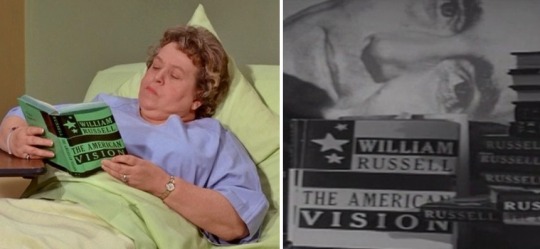
The American Vision, the book Lucy Carter’s hospital roommate is reading, was authored by Henry Fonda’s character William Russell from the 1964 film The Best Man.

With
the exception of a scene in the hospital hallway, the entire episode
takes place in Lucy’s hospital room.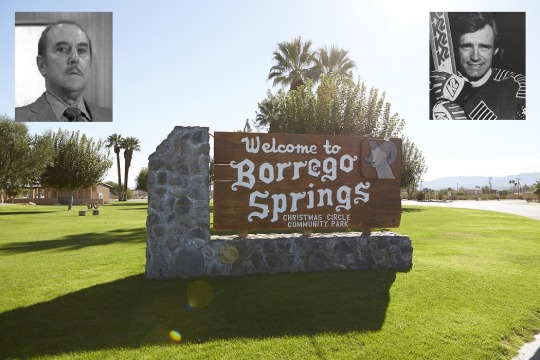
Ribbing
Lucy about her increasingly exaggerated account of the accident,
Harry says “I
thought you carried an injured Jean-Claude Killy down the slope on
your back.” John-Claude
Killy
was a French Alpine skater who experiences world fame when he
competed in the 1964 and 1968 Winter Olympics.
In “Someone’s on the Ski Lift with Dinah” (S4;E7), Harry declared
himself to be “the
Jean-Claude Kily of Borrego Springs.” Borrego Springs is a desert community near San Diego and was Gale
Gordon’s home town.
To
pass the time, Lucy is watching “As the World Turns.” Nurse
Ogilvy says that last time she saw it Mary Gorman had appendicitis.
“As
the World Turns”
was
the second longest running soap opera in American history after
“Guiding Light.” CBS first aired the serial on April 2, 1956. It
followed the personal and professional lives of professionals like
doctors and attorneys. From 1958 to 1978, the show was the highest
rated daytime television program. The soap opera was canceled in
2010.
During
their “gag” examination, the two doctors break into “Dem
Bones” (also
called “Dry
Bones”
or “Dem
Dry Bones”).
The song was composed by James Weldon Johnson (1871–1938) although
some sources also credit his brother, J. Rosomond Johnson. It was
first recorded in 1928.
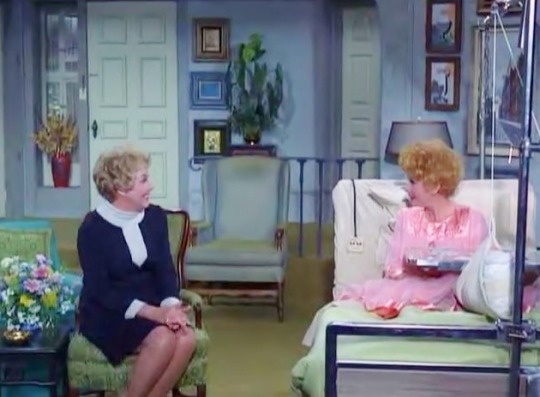
Lucy
Carmichael broke her leg in “Lucy and Viv Reminisce” (S6;E16), a
1968 clips show from “The Lucy Show” starring Vivian Vance. Lucy
is in a hospital bed (in her living room) for the entire
non-flashback portion of the show.
As
the star of the nautical series “Sea Hunt,” Lloyd Bridges’ name
was the punchline of jokes in two ‘water-logged’ episodes of “The
Lucy Show”: “Lucy
and Viv Put in a Shower” (TLS S1;E18)
and “Lucy
Buys a Boat” (TLS S1;E30).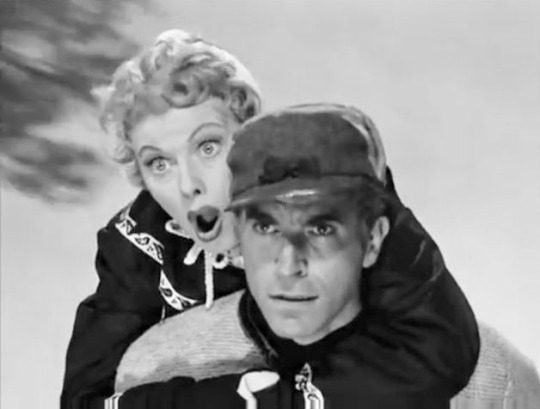
In
“Lucy Goes to Sun Valley,” a 1958 episode of “The Lucy-Desi
Comedy Hour,” Lucille
Ball’s stunt double Jannette Burr Johnson was scheduled to film the
start of Lucy Ricardo and Fernando Lamas’ speedy descent down Mount
Baldy, but Johnson fell and broke her leg so she helped Ball prepare
to do the stunt herself, with several Sun Valley ski patrol members
waiting to catch her 100 feet down slope.
Lucy
Carter went skiing (without breaking anything) in “Someone’s on the Ski Lift
with Dinah” (S4;E7).
When
the two doctors conspire to teach Lucy a lesson for artificially
spiking her temperature, they tell her she has Wolfington’s Tibia Pox
and Galloping Fibulosis compounded by a sever case of Yo-Yo-itis, a
made-up illness. Ricky Ricardo and his friend Hal March conspired to
teach Lucy a lesson by telling her she had the ‘gobloots’ in “Lucy
Fakes Illness” (ILL S1;E16). It, too, was written by Madelyn Davis
and Bob Carroll Jr.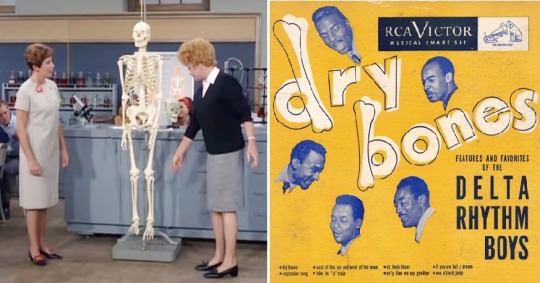
Lucy
Carmichael sang an impromptu chorus of “Dry Bones” during biology
class when “Lucy Gets Her High School Diploma” (TLS S6;E5).
Huh?
Sam (Sid Gould) brings hospitalized Lucy a salami with the brand
name redacted in blue tape. If the salami is supposed to be anything
other than a sight gag, it is unclear. Is Sam a deli owner? In
previous episodes Gould’s Sam was a waiter. Vanda (Vanda Barra)
notes that the salami is without garlic. Again, there may be a joke
here, but it is elusive at best.
Details!
Details! Although
“As the World Turns” is a real soap opera, there is no record of
a character named Mary Gorman.Character
Consistency! Dr. Parker says “I’ve
known Lucy for years”
which accounts for him informally calling her by her first name. This
is, however, the first the viewing audience has heard of him, making
their prior relationship a bit of a surprise. Audiences with sharp
eyes but no memory for names might think the doctor is Lucy’s
brother, since that is the role he played in Lucy’s brother in “Kim
Finally Cuts You-Know-Whose Apron String” (S4;E24).
“Lucy’s Big Break” rates 3 Paper Hearts out of 5
It is a tribute to Lucille Ball’s talent that she can remain confined to a hospital bed and still turn in a funny, entertaining show. If the script feels a bit rushed, it can be forgiven. This is a new, more intimate Lucy by necessity and it is refreshing to watch.
 1972, Alan Oppenheimer, As the World Turns, Bob Carroll Jr., broken leg, CBS, Coby Ruskin, Dem Bones, Doctor, Dorothy Konrad, Dry Bones, Fanny Hill, Gale Gordon, Here’s Lucy, Hospital, Jean-Claude Killy, June Whitley Taylor, Lloyd Bridges, Lucie Arnaz, Lucille Ball, Madelyn Davis, Marcus Welby MD, Mary Wickes, salami, Sea Hunt, Sid Gould, skiing, Susan Tolsky, The Man Who Came To Dinner, Vanda Barra
 -
KIM FINALLY CUTS YOU-KNOW-WHOSE APRON STRINGS
S4;E24
~ February 28, 1972

Directed
by Coby Ruskin ~ Written by Bob Carroll Jr. and Madelyn DavisSynopsis
When
Kim moves out, she goes to live at an apartment building in Marina
Del Rey managed by her Uncle Herb. There she copes with a the amorous
advances of an English race car driver with the help of her kooky
best friend and neighbor.Regular
CastLucille
Ball (Lucy
Carter), Gale
Gordon (Harrison
Otis Carter), Lucie
Arnaz (Kim
Carter)Guest
Cast
Alan
Oppenheimer (Herb
Hinkley) got his start in screen acting in a 1963 episode of Desilu’s
“The Untouchables.” In 1974 he began doing voices on animated
shows and has become one of Hollywood’s busiest and most versatile
voice actors. Oppenheimer will also appear on “Here’s Lucy” in
the very first episode of season 5, but not as Herb Hinkley.Lucy’s unmarried brother manages the Marina Del Rey apartment building where Kim
lives. He is an aspiring song writer.
Susan
Tolsky (Sue
Ann Ditbenner) is probably best remembered for playing Biddie Coom on
the TV series “Here Comes the Brides” (1968-70). Like
Oppenheimer, Tolsky has done voice acting for animation. She will do
one more episode of “Here’s Lucy” in season 5, but not as Sue Ann Ditbenner.Sue
Ann is Kim’s single neighbor who works at the Museum of History. Kim
calls her “Sue-Sue.”
Lloyd
Battista
(Ronnie Cumberland) makes his first and only appearance with Lucille
Ball and Lucie Arnaz. He was, however, seen on Desilu-produced shows
“Mannix” and “Mission: Impossible.” In
1992, he voiced Papa Mousekewitz on the animated series “Fievel’s
American Tails.”Ronnie is a competitive racing car driver from England.

Some sources also list this episode as
first airing on February 21, 1972, not accounting for the show’s
preemption of February 14 so that CBS could air “The Lorax”
special, which bumped “With Viv as A Friend…” from the 14th to the 21st and this episode to the 28th. The DVD introduction by Lucie
Arnaz give the wrong date but the liner notes are correct.
Some sources do not pluralize the last word in the title: “Strings” – after all, most aprons have two! The DVD uniformly uses the pluralized title. The other point of contention seems to be the use of “Whose” versus “Who’s”.
This is the second episode to
have Kim’s name in the title and not Lucy’s, although, cleverly,
Lucy’s name was implied by the “You-Know-Whose” wording. The
expression “cutting the apron strings” refers to a mother and
child’s separation in order that the adult child will become
self-sufficient.
This
was the final episode of Season 4 of “Here’s Lucy.” It placed
10th in the Nielsen ratings with a 23.7 share. This is the lowest rating
of the series so far.
This
episode is actually a pilot for a possible spin-off series starring
Lucie Arnaz as Kim Carter. CBS did not pick-up the pilot for
production and Arnaz remained part of the regular cast of “Here’s
Lucy” in seasons 5 and 6. It is possible that both Oppenheimer and
Tolsky’s single guest spots in season five were because Lucille Ball wanted to offer some compensatory employment to make up
for the pilot not selling.
While it
seems unusual that Lucille Ball was incapable of convincing CBS
to pick up the new series, most likely Ball didn’t pressure CBS due
to Vivian Vance’s sudden illness. Without Vance to fill-in as Lucy’s
side-kick, Lucie was needed on “Here’s Lucy.” Lucy undoubtedly
recalls how difficult it was to replace Vance when she left “The
Lucy Show” after season 3. She went through a string of possible
replacements (Joan Blondell, Ann Sothern, Mary Jane Croft), none of
which panned out to her satisfaction.
The
writers were probably influenced by the success of “The
Mary Tyler Moore Show” (1970-77)
which
also presented a single woman, living in an apartment with a kooky
best friend (Valerie Harper). Alan Oppenheimer bears more than a
passing resemblance to Gavin MacLeod (Murray) and has the paternal
watchfulness of Ed Asner (Mr. Grant). Although both shows featured a
character named Sue Ann (Betty White), “Happy Homemaker” Sue Ann Nivens was not introduced until 1973.
Coincidentally, Laurence Luckinbill (Lucie Arnaz’s second husband)
guest-starred on “Mary Tyler Moore” in 1975, before Lucie met and
married him. Ironically, when the ratings came out for the 1971-72 television season, “Here’s Lucy” tied with “The Mary Tyler Moore Show.”
Lucille
Ball and Gale Gordon are only seen for less than three minutes at the
start of this episode. For some reason Harry (Kim’s Uncle) was not
told of Kim’s move or her new job. He also seems to have a problem
with Lucy’s brother Herb. None of this is developed, however, possibly with a plan to develop it further on the unproduced spin-off series. Kim
is not in the office scene with Lucy and Harry in order to give the
pilot its own identity.
Kim
has moved to an apartment building in Marina Del Rey. Marina
del Rey is
an unincorporated seaside
community in Los
Angeles County, California.
Fisherman’s
Village offers
a view of Marina del Rey’s dominant feature, the Marina, the world’s
largest man-made small craft harbor with
eight basins having a capacity for 5,300 boats.The
building manager is Lucy’s brother, Herb.Kim
has a job working for a public relations firm. Her latest assignment
is posing next to cars at the auto show.
Like
her short-lived garage apartment, Kim owns a spinet piano, although
she doesn’t play. Kim is, however, an aspiring singer. Herb Hinkley (Alan Oppenheimer) plays and sings “Organically Yours,” a song he wrote about shopping at the health food store. He later sings a bar or two of “The Seagull’s Lament,” a song about Ecology. Both the Health Food craze and the Ecology were in the news in the early 1970s.
Lucy
has given Kim a book titled “Self
Defense for Women”
and the episode has Kim and Sue Ann practice some self-defense
techniques. In reality, the book was authored by Alice McGrath and
Bruce Tegner. McGrath served as the episode’s consultant and fight
choreographer. McGrath
was trained by and taught with Bruce Tegner at his school in
Hollywood, CA. Together they developed a special course of
self-defense for girls and women which Miss McGrath introduced in
1967.
Both receive screen credit at the end of the episode.
Regarding her dating life, Susie says she has a card on the bulletin board at the corner market saying “Need a date tonight? Call Sue Sue Delight!” She is paraphrasing the tremendously popular marketing slogan of Chicken Delight. Founded in Illinois in 1952, the chain grew during the 1960s to over 1,000 locations. The jingle “Don’t cook tonight, call Chicken Delight,” emphasizing their delivery and take-out services, was widely advertised on American radio.

The
publicity photo used for “Here’s Lucy” is framed on a table
directly behind Kim’s couch.
Lucy has the same photo on her mantle.
Admiring
her crocheted cloche in the mirror, Kim says “Ali
McGraw, eat your heart out!”
In 1970, McGraw starred in the film Love
Story,
which earned her an Oscar nomination. Her character in the film wore
a crocheted cloche, which vaulted the fashion accessory to
popularity. In 1972, McGraw was voted as Hollywood’s top box office
star.
Sue
Ann drops by to return Kim’s fondue pot. Like the cloche hat, fondue
was nothing new, but experienced a pop culture resurgence during the
1970s. Fondue parties were often held to experience this Swiss
tradition of dining.
More
1970s iconography includes the smiley
face
poster in Kim’s kitchen. According
to the Smithsonian Institution, the round, yellow smiley face
was created by Harvey Ross Ball (inset photo) in 1963. Ball (no
relation) was
employed by Hanover Insurance and asked to create a happy face to
raise the morale of the employees. He created the design in ten
minutes and was paid $45.
The
graphic was further popularized in the early 1970s by Bernard and
Murray Spain, who produced buttons as well as coffee
mugs, t-shirts, bumper stickers and
many other items emblazoned with the symbol and the phrase “Have
a happy day” which later became “Have a nice day.”
This
episode was originally sponsored by Campbell
Soups
and the DVD includes a commercial that features Dodie Goodman and
Eddie Bracken. Coincidentally, Bracken has been credited with
introducing Lucille Ball and Desi Arnaz when they were starring
in the film version of Too
Many Girls
in 1940.
By
the time the second commercial break happens – five minutes later –
the price of the soup has risen a penny a serving! [This may be due
to the editing of the DVD].
Herb
says that he saw Ronnie Cumberland race against
A.J. Foyt.
Foyt is the
only driver to win the Indianapolis
500,
the Daytona
500,
the 24
Hours of Daytona,
and the 24
Hours of Le Mans. In
the NASCAR stock car circuit, he won the 1972 Daytona
500.
After
constant interruptions during their date, Kim cautions Sue Ann and
Uncle Herb that she’s having Ronnie over again tomorrow night and
“guess
who’s NOT coming to dinner.”
Kim is paraphrasing the title of the 1967 Oscar-winning film Guess
Who’s Coming to Dinner.
Sue
Ann demonstrates her ‘less-than-fluent’ Italian by saying “Funiculì,
Funiculà” which
is the title of a famous Neapolitan song composed in 1880
by Luigi Denza to lyrics by Peppino Turco. It was
written to commemorate the opening of the first funicular cable
car on Mount Vesuvius.
After
Kim kicks Ronnie out (literally) he bids her farewell saying “bye
bye birdie.” Bye
Bye Birdie
was the title of a 1960 Broadway musical and 1963 film. Ann-Margret, who starred in the film, was a guest star in “Lucy and Ann-Margret” (S2;E20).
When
Sue Ann realizes that Kim breaking up with Ronnie means she won’t get
to use her Italian, she says “Arrivederci,
Roma”
[translation: “Goodbye, Rome”]. This is the title and
refrain of a popular Italian
song composed by Renato Rascel,with lyrics by Pietro
Garinei and Sandro
Giovannini. It was published in 1957 as
part of the soundtrack of
the Italo-American musical film Seven
Hills of Rome.

This is the second time that Kim has ‘cut the apron strings’. The first was in “Kim Moves Out” (S4;E20), when she moved to an apartment over a garage on the same block as her mother. Like this episode, Kim returns home eventually – without explanation.

Harry says that Lucy will always be an overly protective mother and keep Kim in her ‘pouch’ like a mother kangaroo. For one episode in 1962, Lucy Carmichael was indeed a kangaroo!

Lucy
Carmichael and Vivian Bagley took self-defense courses in “Lucy and
Viv Learn Judo” (TLS S1;E22) also demonstrating self-defense
techniques.
An
overly-amorous Ronnie feels that Kim has been giving out mixed
signals: the wine, the candles, and the way she’s dressed. He says
“this
is hardly the time to start playing Mary
Poppins.”
The nanny character from the 1964 Disney film was satirized by Lucy
in “Lucy’s Mystery Guest” (TLS S6;E10) and mentioned in “Lucy
Saves Milton Berle” (TLS S4;E14, inset photo). Lucy played Mary Poppins in a sketch on 1969′s Dinah Shore special “Like Hep.”
Family Tree! This
is the first time we have heard of Lucy having a brother. In a
previous episode it was noted that Harry was Kim and Craig’s only
uncle. Further, in season 5 Lucy will state that her maiden name is
McGillicuddy (again), not Hinkley.
Bag Drop! When Harry startles Lucy by barking at her, her purse falls off her desk and onto the floor. Lucille Ball glances at it, but decides to finish off the scene instead.

Bag Tape! Herb’s vacuum cleaner has its brand name covered by gray duct tape, but it is a Hoover Upright.

“Kim Finally Cuts You-Know-Whose Apron String” rates 2 Paper Hearts out of 5
Lucie Arnaz is a talented performer, with good comic instincts and terrific musical comedy skills. Sadly, however, this premise for a spin-off show is not a good fit. Her supporting cast, although talented, seem to be trying too hard. It is a valiant attempt but fate intervened. Onward!
A.J. Foyt, Alan Oppenheimer, Ali McGraw, Alice McGrath, Arriverderci Roma, Bob Carroll Jr., Bruce Tegner, Bye Bye Birdie, Campbell Soup, cloche, Coby Ruskin, Dodie Goodman, Eddie Bracken, Feniculi Fenicula, fondue, Gale Gordon, Guess Who’s Coming to Dinner, Here’s Lucy, Lloyd Battista, Love Story, Lucie Arnaz, Lucille Ball, Madelyn Davis, Marina Del Rey, Mary Poppins, Self Defense for Women, Seven Hills of Rome, Smiley Face, Susan Tolsky, The Mary Tyler Moore Show -
WITH VIV AS A FRIEND, WHO NEEDS AN ENEMY?
S4;E23
~ February 21, 1972

Directed
by Coby Ruskin ~ Written by Bob Carroll Jr. and Madelyn DavisSynopsis
Viv
arrives on Lucy’s doorstep with the idea that she might stay a while.
She is hired by Harry, who has just
fired Lucy (again). Lucy schemes to get her job back from
Viv by pretending that retirement has “aged” her!Regular
CastLucille
Ball (Lucy
Carter), Gale
Gordon (Harrison
Otis Carter), Lucie
Arnaz (Kim
Carter)Guest
Cast
Vivian
Vance (Vivian
Jones) was born Vivian Roberta Jones in Cherryvale, Kansas in 1909,
although her family quickly moved to Albuquerque, New Mexico where
she was raised. She had extensive theatre experience, co-starring on
Broadway with Ethel Merman in Anything
Goes.
She was acting in a play in Southern California when she was spotted
by Desi Arnaz and hired to play Ethel Mertz, Lucy Ricardo’s
neighbor and best friend. The pairing is credited with much of the
success of “I Love Lucy.” Vance was convinced to join the
cast of “The Lucy Show” in 1962, but stayed with the series only
through season three, making occasional guest appearances afterwards.
This is her sixth and final appearance on “Here’s Lucy” and her
last sitcom appearance with Lucille Ball although she also joined
Lucy for a TV special “Lucy Calls the President” in 1977. Vance
died two years later.
Mary
Jane Croft (Mary
Jane) played Betty Ramsey during season six of “I Love Lucy. ”
She also played Cynthia Harcourt in “Lucy
is Envious” (ILL S3;E23) and
Evelyn Bigsby in “Return
Home from Europe” (ILL S5;E26).
She played Audrey Simmons on “The Lucy Show” but when Lucy
Carmichael moved to California, she played Mary Jane Lewis, the
actor’s married name and the same one she uses on all 31 of her
episodes of “Here’s Lucy. Her final acting credit was playing
Midge Bowser on “Lucy Calls the President” (1977). She died in
1999 at the age of 83.Vanda Barra (Vanda, above right) makes one of over two dozen appearances on “Here’s Lucy” as well as appearing in Ball’s two 1975 TV movies “Lucy Gets Lucky” (with Dean Martin) and “Three for Two” (with Jackie Gleason). She was seen in half a dozen episodes of “The Lucy Show.” Barra was Lucille Ball’s cousin-in-law by marriage to Sid Gould.

Sid
Gould (Sam,
Waiter) made more than 45 appearances on “The Lucy Show,” and
nearly as many on “Here’s Lucy.” Gould (born Sydney Greenfader)
was Lucille Ball’s cousin by marriage to Gary Morton.The
other diners at the luncheonette and the cashier are played by
uncredited background players.

This is essentially the “Lucy” family: Vivian Vance, Gale Gordon, Lucie Arnaz (her daughter), Mary Jane Croft, Sid Gould and Vanda Barra (her cousins). Behind the scenes were long-time “Lucy” scribes Madelyn Davis and Bob Carroll Jr. as well as Lucy’s cousin Cleo Smith (producer) and husband Gary Morton. If Lucille Ball could credit any group with her success, all of these people would be among them.

When Lucie Arnaz began filming a pilot for her own spin-off series, Vivian Vance was considered to become a regular the following season to fill the void. Unfortunately, Lucie’s pilot didn’t sell and Vivian was diagnosed with breast cancer and could no longer work full-time. Sixty-three year old Vance underwent a mastectomy the following year, as well as having a minor stroke.

There
was no new episode the previous week, February 14, 1972 (Valentine’s
Day) so that CBS could air the new animated special “The
Lorax”
based on the story by Dr. Seuss. Lucy’s romance-themed
episode with guest-star Robert Cummings was moved to a week before
Valentine’s Day. In her introduction to the episode on the series
DVD, Lucie Arnaz incorrectly states that this episode was first
broadcast on February 14, 1972, although the DVD liner notes
correctly list the date as February 21, 1972.
The
day this episode first aired (February 21, 1972) US President Richard
M. Nixon began his historic trip to China.
Nixon became
the first President
of the United States to
visit the People’s Republic of China, ending more than 22 years of
hostility between the two nations.
The
day before this episode first aired, journalist and broadcaster
Walter
Winchell
died at age 74. His name was mentioned in the previous episode of
“Here’s Lucy.” Winchell was
the narrator of Desilu’s “The Untouchables.” His voice was
heard (uncredited) in the 1949 Lucille Ball film Sorrowful
Jones and “Lucy
the Gun Moll” (TLS S4;E25).
His name was in the lyrics of the Desi Arnaz song “We’re
Having A Baby” sung on “Lucy
is Enceinte” (ILL S2;E10).
Viv
tells Lucy that due to the plane trip she had breakfasts in New York,
Kansas City, and Albuquerque. Despite being born in Cherryvale, Kansas,
Vance grew up in Albuquerque,
New Mexico.
Lucy’s reference to Viv “eating her way across the country”
allows the script to make fun of Viv’s voracious appetite, a source
of comedy when she played Ethel Mertz, as well.
Harry
installs a “new” time
clock,
although it looks to be anything but new.
Harry previously installed
a time clock in “Lucy and the 20-20 Vision” (S3;E18) but that was
a modern, state-of-the-art (for 1971) model not the antique on
display here.In “Lucy’s Vacation” (S3;E17) Kim says that Harry has fired Lucy 14 times. This episode brings the total up to 18!

Lucy
lies to Harry that she has gotten a dog and that she might go on a
cruise. Harry says he doesn’t believe her, unless the cruise is in a
rowboat on Echo Park Lake. Lucy and Harry did go on a cruise on a
ship in “Lucy Goes Hawaiian” (S3;E23 & E24). Echo
Park
is a neighborhood in Central Los Angles.
Kim
reminds “old” Lucy (and the viewers) that her son Craig
is away at college. For the first half of season four, Craig’s
absence went completely unmentioned, although in the second half he
has been discussed nearly every episode.
Viv
offers to take “old” Lucy to a beauty parlor for a Henna
Rinse.
This was the coloring that Lucille Ball (and Lucy Ricardo) used to
color her hair. Ball first started coloring her hair red for the
Technicolor film Du Barry
Was a Lady
in 1943. When Ball passed away in 1989, a supply of Henna Rinse was
found in her garage by her hairstylist Irma Kusely.


The
gag of slamming the door so hard that the glass breaks was first done
in “Lucy and Wally Cox” (S2;E21), although it happened to Gale
Gordon as Mr. Mooney in “Lucy
Gets Involved” (TLS S6;E17).
Mary
Jane and Vanda also had lunch with Lucy sitting in the same positions
in the red booth in “Won’t You Calm Down, Dan Dailey?” (S4;E9).
Sid Gould also played the waiter, also named Sam.
Although she has played “old ladies” in the past, this is probably the least stereotypical presentation of aging that Lucille Ball has done in her career. Her hair looks like it might actually look if she weren’t coloring it with Henna Rinse! Still, she has on a floral print dress with frills, so she hasn’t completely let go of the classic little old lady image but it is a far cry from this…

in “Lucy and the Celebrities” (S4;E10) earlier in the season.

Character Consistency! Viv
calls Harry “Mr. Carter” which is very formal considering the two
have a long past that includes dating!
Props! When
“old” Lucy drops her cane in the scuffle, Gale Gordon is quick to
back-kick it out of the way with his foot.
“With Viv as a Friend, Who Needs an Enemy?” rates 5 Paper Hearts out of 5
Vivian
Vance is a breath of fresh air on the series. She allows Lucy and
Gale Gordon to relax and be at their best – even when she’s not in
the scene. This is about as close to Lucy and Ethel as they have
come since the early days of “The Lucy Show.” Sadly, except for
a TV movie in which Vivian was impaired by her stroke, this is the
last time. Vance looks glorious and her ‘haughty’ voice when angry
with Lucy was never funnier. At the end of the episode, Lucy gets
into the most convincing old lady get-up she’s yet worn on camera and
Viv says she hopes to be around when Lucy really gets old. Sadly,
Vance died ten years before Lucy and the two had precious little time
together after this episode. -
LUCY’S PUNCTURED ROMANCE
S4;E22 ~ February 7, 1972
Directed by Coby Ruskin ~ Written by Fred S. Fox and Seaman Jacobs
Synopsis
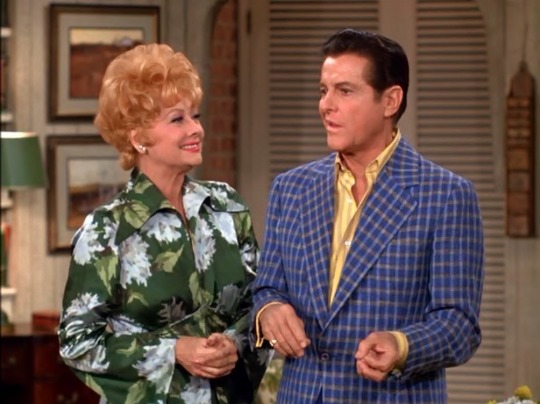
Lucy takes an interest in a new man (Robert Cummings), but the milkman tips off Kim that he may be a womanizing alcoholic. To protect her mother, Kim and Harry scheme to make him think the family is crazy, hoping he’ll run for the hills.
Regular Cast
Lucille Ball (Lucy Carter), Gale Gordon (Harrison Otis Carter), Lucie Arnaz (Kim Carter)
Guest Cast
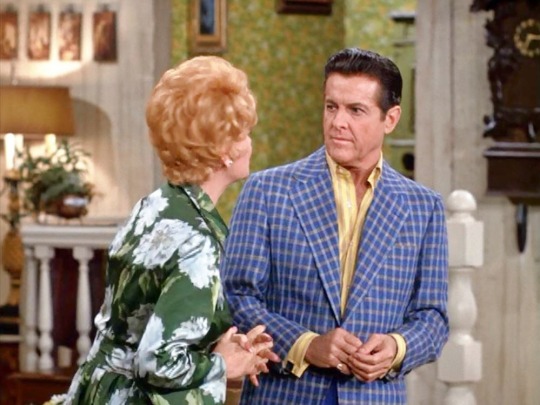
Robert Cummings (Bob Collins) was born in 1910 in Joplin, Missouri. His godfather was the aviation pioneer Wilbur Wright, so naturally he got his pilot’s license and studied aeronautical engineering. After the stock market crash of 1929, he gave flying up to study drama in New York City, making his Broadway debut in 1931. In 1934 he moved to Hollywood and started making films. During World War II he was a captain in the Air Force Reserves. His television career kicked off in 1952, winning an Emmy for his role in the series “My Hero.” Starting in 1955, Cummings starred on a successful NBC sitcom, “The Bob Cummings Show” (aka “Love That Bob”), in which he played Bob Collins (the same character name he uses in this episode of “Here’s Lucy”), an ex–World War II pilot who became a successful photographer. The show ended in July 1959, just a few months prior to filming “The Ricardos Go To Japan” the penultimate episode of “The Lucy-Desi Comedy Hour.” Cummings returned to “Here’s Lucy” for an episode in season 5. Cummings was married five times and fathered seven children. He died in 1990 at the age of 80.
Bob Collins graduated from Carnegie Tech and is a field representative for a cosmetics company. He enjoys dancing.

Mary Jane Croft (Mary Jane Lewis) played Betty Ramsey during season six of “I Love Lucy. ” She also played Cynthia Harcourt in “Lucy is Envious” (ILL S3;E23) and Evelyn Bigsby in “Return Home from Europe” (ILL S5;E26). She played Audrey Simmons on “The Lucy Show” but when Lucy Carmichael moved to California, she played Mary Jane Lewis, the actor’s married name and the same one she uses on all 31 of her episodes of “Here’s Lucy. Her final acting credit was playing Midge Bowser on “Lucy Calls the President” (1977). She died in 1999 at the age of 83.

Billy Sands (Mr. Larson, the Milkman) returns to the role of Lucy’s Milkman from “Lucy’s Lucky Day” (S4;E15). Sands began his professional acting career in 1946 when he appeared on Broadway with Spencer Tracy in Robert Sherwood’s Rugged Path, but he eventually became a television character actor who appeared regularly as Dino Papparelli on “The Phil Silvers Show” and as ‘Tinker’ Bell on “McHale’s Navy.” He will make one more appearance on “Here’s Lucy” (but not as the milkman).
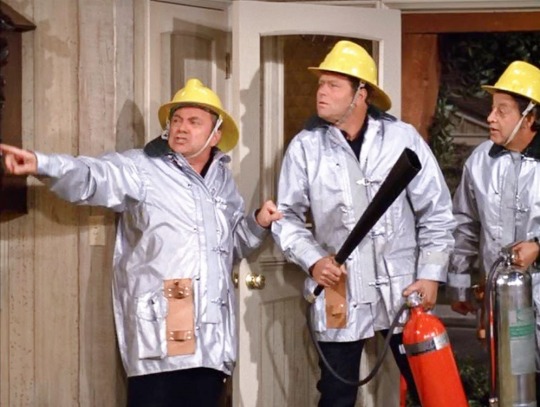
Larry J. Blake (Fire Chief, left) first appeared as a Native American Medicine Man in “Lucy the Rain Goddess” (TLS S4;E15). He was an ex-vaudevillian making the sixth of his eight “Here’s Lucy” appearances.
Orwin C. Harvey (Fireman, center) was an actor and stuntman who played one of the singing and dancing teamsters in “Lucy Helps Ken Berry” (TLS S6;E21). This is one of his six appearances on “Here’s Lucy.”
Sid Gould (Fireman, right) made more than 45 appearances on “The Lucy Show,” and nearly as many on “Here’s Lucy.” Gould (born Sydney Greenfader) was Lucille Ball’s cousin by marriage to Gary Morton.

The script for this episode was dated October 6, 1971. It was filmed on October 28, 1971.

The title may have been inspired by the Charlie Chaplin silent film “Tillie’s Punctured Romance” (1914), remade in 1928 with W.C. Fields. It may have also inspired “Fester’s Punctured Romance,” a 1964 episode of “The Addams Family.”

In his book I Had A Ball: My Friendship with Lucille Ball, Michael Z. Stern recounts when he attended the filming of this episode in 1972.
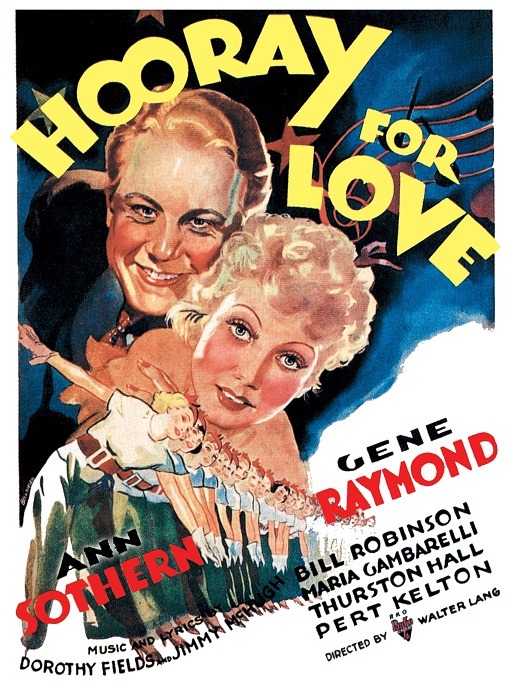
The date this episode was originally aired, film director Walter Lang died at age 75. He had directed Lucille Ball (who was uncredited) in two films in 1935: Carnival and Hooray for Love. In 1957 Lang was nominated for an Oscar for directing The King and I.
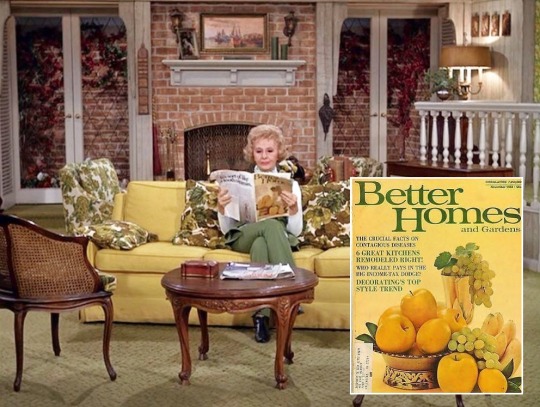
As the episode opens, Mary Jane is sitting on the living room sofa reading the November 1968 issue of Better Homes and Gardens magazine. In “Redecorating the Mertzes’ Apartment” (ILL S3;E8), Lucy Ricardo says she got the idea to hold a painting party from reading Better Homes and Gardens. The magazine got plenty of airtime because the writers felt bad after making a ‘Better Homes and Garbage’ joke in “Men Are Messy” (ILL S1;E8).

In the Carter living room, the large gold-framed mirror on the landing has temporarily been replaced by an ornate cuckoo clock in order to make the final gag pay off. If the clock looks familiar, it was formerly in a home of “The Munsters” (1964-66) at 1313 Mockingbird Lane. The raven has been replaced by a cardinal, but it is otherwise identical. Both “Here’s Lucy” and “The Munsters” were filmed at Universal Studios. [Thanks to Lucy fan Bill Graff for spotting this!] In 1957, the same clock was seen on “Those Whiting Girls” – a Desilu production.
Also, just for this episode, the French doors in the living room can only be opened by banging on the wall above the fireplace mantle.

Lucille Ball’s ‘showgirl style’ entrance down the stairs gets a round of applause from the studio audience. Mary Jane admires her new outfit. Lucy and Bob (her new boyfriend) ‘met cute’ in the supermarket when she dropped her knockwurst and he dropped his sauerkraut.
The studio audience is very enthusiastic, also bursting into spontaneous applause for Bob’s entrance, Mary Jane’s exit, and the end of scene 1.
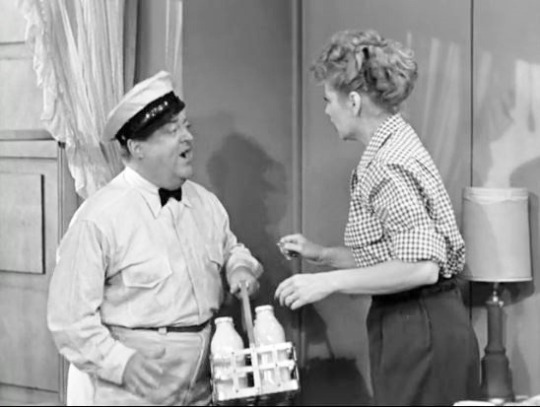
MILKMAN: “Cross my heart and hope to die. May my sweet cream curdle if I tell a lie.”
Mr. Larson the milkman reports that the Wilsons down the street are splitting up. Larson says his wife calls him her “homogenized Walter Winchell.” Walter Winchell (1897-1972) was a journalist and radio host who was the narrator of “The Untouchables.” His voice was heard (uncredited) in the 1949 Lucille Ball film Sorrowful Jones and “Lucy the Gun Moll” (TLS S4;E25). His name was in the lyrics of the Desi Arnaz song “We’re Having A Baby” sung on “Lucy is Enceinte” (ILL S2;E10). Winchell died just two weeks after this episode first aired.
Mr. Larson awkwardly used the ‘modern lingo’ with Kim:
- Pad (apartment)
- Swinger (wolf)
- Splitsville (break up)
Kim calls Bob a “Cut-Rate Casanova”. Giacomo Girolamo Casanova (1725-1798) was an Italian adventurer and memoirist who’s name became synonymous with a man who seduces multiple women. Coincidentally, in "The Gossip” (ILL S1;E24), the milkman was labeled a “cottage cheese Casanova”!

In order to convince Bob Collins that the Carters are crazy, Kim and Harry do the following:
- Convince Lucy that Collins is partially deaf, reads lips and has a hearing aid in his cuff links.
- Pretend that Lucy has been married six times by prominently placing her wedding gown in the hall closet.
- Having Kim make inappropriate advances on Collins while sitting on his lap.
- Spiking Collins’ hors d’oeuvres with a concoction of Tabasco sauce, cayenne pepper, hot mustard and chili pepper.
“Lucy is just a deaf alcoholic who’s been married six times!”

Even after they confess their deceit, things get even crazier when Mary Jane shows up dressed as a chicken, Lucy banging on the wall to open the doors sets off the phonograph and the cuckoo clock, and Lucy burns the roast causing the fire department to smash the front door glass.

A flustered Mary Jane makes it clear to Bob that she is unmarried by stressing that she is MISS Lewis. Miss Lewis was also the name of a single lady who lived at 623 East 68th Street, played by Bea Benadaret in “Lucy Plays Cupid” (ILL S1;E15).

Lucy says that Bob Collins tangos better than Rudolph Valentino. The dance was responsible for the longest laugh in “I Love Lucy” history in “Lucy Does the Tango” (ILL S6;E20). Heartthrob actor of the silent era Rudolph Valentino was also mentioned in that episode. Valentino was one of Mrs. McGillicuddy’s favorite screen stars and was mentioned in “The Hedda Hopper Story” (ILL S4;E20) and “The Homecoming” (ILL S5;E6).
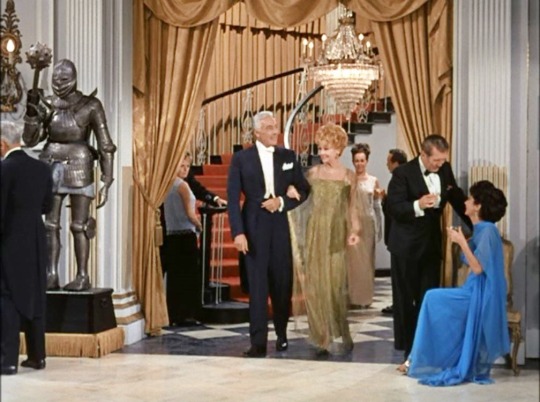
This is the first time that Lucy has had a boyfriend since Tony Rivera (Cesar Romero) in “A Date for Lucy” (S1;E19). Lucille Ball had no plans for Lucy Carter (or Lucy Carmichael) to have a serious relationship.

Robert Cummings played himself in a 1959 episode of “The Lucy-Desi Comedy Hour” set in Japan.

A cuckoo clock played an integral role in “The Kleptomaniac” (ILL S1;E27). Lucy hid the clock under her coat – but the ‘cuckoo’ nearly gave her away!
A milkman (Bobby Jellison) was the conveyor of "The Gossip” (ILL S1;E24) about the marriage of the Ricardo’s neighbors Grace and Bill Foster.

Trying to make her mother out to be undesirable, Kim says that Lucy has always married men who’s last name begins with ‘C’ so she doesn’t have to change the monogram on her luggage! Is this a reference to “The Lucy Show”’s widow, Mrs. Carmichael? Other folks named Collins in the Lucy-verse include:
- Kitty Collins – Lucille Ball’s character in the 1936 film Follow The Fleet
- Sylvia Collins – an unseen character on “I Love Lucy”
- Dr. Collins – Mr. Mooney’s eye doctor on “The Lucy Show”
- Mr. Collins – Manager of Stacey’s Department Store on “The Lucy Show”
- Eddie Collins – Viv’s boyfriend on “The Lucy Show”
- Pat Collins – the ‘hip’ hypnotist on “The Lucy Show”
FAST FORWARD

Lucy would finally become Lucy Collins in a 1975 special titled “Lucy Gets Lucky” co-starring Dean Martin and set in Las Vegas.

Character Consistency! Two episodes earlier Kim moved out of the house into a garage apartment nearby. But in this episode she is apparently still living at home.

Fur Blur! When Lucy comes from the closet after retrieving her stole, the camera momentarily goes out of focus.

Props! On the bookshelves behind Lucy’s head, a small ceramic vase has been tipped over by some books. This was probably caused when the finale with Lucy banging on the wall and the picture frames falling was rehearsed before filming.

No Stove Is A Floating Island! In the kitchen, the counter top island has been awkwardly moved out of the way to make room for Lucy’s tango and give better sight lines of the refrigerator. This island also holds the cook top range, so it would be technically impossible for it to be un-grounded by electric wires or a gas hookup!

Cap Redact! The first letter of the name of the milkman’s dairy (mostly illegible) is covered with white tape. This was likely done to avoid any legal action by a company with the same name.
Let Yourself Out? When Kim marches into the living room to have a heart-to-heart talk with her mother about Bob, she leaves the milkman alone in the kitchen!

Wardrobe! Kim’s picnic table skirt does not have pockets, so there is a conspicuous pouch sewn to her waist in a slightly different pattern in order to hold the small bottle of spices she intends to use to spice up Bob’s
hors d’oeuvres.

Plot Loops! Mr. Larson thinks Bob Collins is a wolf because girls are seen coming and going from his home and he orders five quarts of orange juice daily. He reasons some people mix orange juice with liquor for wild parties. At the end of the episode, the girls are explained by his being a cosmetics distributor but the orange juice surplus is never explained. He may not be a wolf, but he might be a lush!

“Lucy’s Punctured Romance” rates 3 Paper Hearts out of 5
In this episode, the roles of mother and daughter are reversed, giving Lucie Arnaz a larger and more commanding role. This fits in with plans for her to launch a spin-off series after the end of season 4. Lots of sight gags in this episode. The living room runs amok in a very visual (but not very character-driven) finale. Mary Jane in a chicken suit.
1972, Better Homes and Gardens, Billy Sands, Bob Cummings, CBS, Coby Ruskin, Cuckoo Clock, Fred S. Fox, Gale Gordon, Here’s Lucy, Hooray for Love, Larry J. Blake, Lucie Arnaz, Lucille Ball, Mary Jane Croft, Michael Z. Stern, milkman, Orwin C. Harvey, Robert Cummings, Rudolph Valentino, Seaman Jacobs, Sid Gould, Tango, The Munsters, Those Whiting Girls, tv, Walter Lang, Walter Winchell -


RIP CLIFFORD DAVID ~ who played Hank in WILDCAT starring Lucille Ball. He also starred in eight other Broadway shows from 1960 to 1994. He was 89 years old.
-
LUCY SUBLETS THE OFFICE
S4;E21
~ January 31, 1972

Directed
by Coby Ruskin ~ Written by George Balzin and Sam PerrinSynopsis
Harry
is losing money so a loan officer instructs him to put Lucy in
charge. Her first act as boss is to lease office space to an
eccentric toy salesman (Wally Cox) who turns the Unique Employment
Agency into a playground!Regular
CastLucille
Ball (Lucy
Carter), Gale
Gordon (Harrison
Otis Carter)Lucie
Arnaz (Kim
Carter) does not appear in this episode, although her name does
appear in the opening credits. Lucy is on the phone with Kim as the
episode opens. Despite not being in the episode, Lucie Arnaz does
the introduction on the series DVD.Guest
Cast
Wally
Cox
(Tommy Tucker, Toy Tycoon) was
one of Lucille Ball’s favorite character actors and best remembered
for being a panelist on TV’s “The Hollywood Squares” (1965-73)
as well as his hit series “Mr. Peepers” (1953-55).
Cox played a nervous musician on “Lucy
Conducts the Symphony” (TLS S2;E13), a shy bachelor in “Lucy and Wally Cox” (S2;E21), a reformed safe cracker in “Lucy
and the Ex-Con” (S1;E15), and an on-edge jeweler in “Lucy and the Diamond Cutter” (S3;E10). Cox and Lucille Ball both appeared in the 1967 film A Guide for the Married Man. This is his fourth and final appearance on “Here’s Lucy.” Cox died of a heart attack in 1973 at age 48.Tommy
Tucker was the name of the cue card man on “Here’s Lucy.”
Lucille Ball and Tucker would often play word games together.
Richard
Deacon
(Elmer Zellerbach, Loan Officer) is
probably best remembered as Mel Cooley on “The Dick Van Dyke Show”
(1961-66). He appeared as Tallulah Bankhead’s butler in “The
Celebrity Next Door,” a
1957 episode of “The Lucy-Desi Comedy Hour.” He was
employed again by Desi Sr. as a regular on “The Mothers-in-Law”
(1968). This is the second of his two appearances on “Here’s
Lucy.”Mr.
Zellerbach has two college-age children. His first name is never
used in the dialogue and the final credits only list him as “Loan
Officer.”

The
date this show was originally aired, Time
Magazine
published a cover story on Flip Wilson, TV’s first black superstar.
Wilson was a guest-star on “Here’s Lucy” on September 13, 1971.
This
episode was originally sponsored by Lipton Tea, Wesson
Oil, and Whirlpool. On the DVD, commercials for
each are included.
Lucy
tells Mr. Zellerbach that she has two children, Kim and Craig, who
are both in college. Craig has been mentioned consistently over the
past four episodes after not being mentioned for more than 3 months.LUCY (to Harry): “The reason this business is failing is because your head is full of 20 year-old, tired business techniques. While my head is new and fresh. It has nothing in it!”

Lucy charges Tommy Tucker $75 a month to sublet a corner of the office. To come up with the cash, Tucker reaches into his pants pocket…jacket pocket…breast pocket…sock…shoe…and change purse! The studio audience gives Cox a round of applause for the extended exchange. Harry (or, as Lucy calls him here, ‘HC’) has the miraculous ability to know how much money is in his hand without even looking! This too, garners a small round of applause from the studio spectators.

Amidst his loose change Tommy hands Lucy, is a streetcar token, which he quickly takes back. From 1873, the streetcar served as a popular mode of transportation throughout the Los Angeles area. Widespread adoption of diesel buses ultimately led to the abandonment of streetcars on March 31, 1963, nine years before this episode first aired.

Harry
slides down the sliding board into the kiddie pool, getting soaking
wet. Getting Harry wet was part of most all episodes of the series. Off screen, Lucille Ball joking called Gale Gordon ‘old soggy crotch’ and here he lives up to the name!
One
of the three inflatable punching bags in the office is Bozo
the Clown.
The
character first appeared on television in 1949 starring Pinto
Colvig. In 1964, Colvig did all the dog barks and howls in “Lucy is Her Own Lawyer”
(TLS S2;E23). After the creative rights to Bozo were
purchased by Larry
Harmon in
1956, the character became a common franchise across
the United States, with local television stations producing their own
Bozo shows featuring the character.
The large wide-eyed rag doll under the slide was previously seen in the 1969 musical film Sweet Charity as set decoration for Charity’s apartment. It is just behind Chita Rivera in the above scene. Both “Lucy” and Charity were filmed at Universal.


The toy-filled Unique Employment Agency looks very similar
to the Ricardo living room when Lucy wanted to convince Ricky that
their tiny apartment was not big enough for their growing
family in “The Ricardos Change Apartments” (ILL S2;E26).
Both featured inflatable punch toys, plush animals, and a sliding
board that served as the only entrance into the room.
When
Tommy Tucker is demonstrating the remote control somersaulting dog, there is a
wind-up drumming
bear on
the desk nearby that does not get demonstrated. This toy is very similar to
the one used in “Little Ricky Gets Stage Fright” (ILL S6;E4). To
help his son overcome his fear of drumming in public, Ricky wound up
the drumming bear to show him he had nothing to be afraid of.
Although very similar, the toys are different models.
Mr. Zellerbach says that he usually advises financially strapped companies like the Unique Employment Agency to hire an efficiency expert, which is exactly what Mr. Mooney did for the Westland Bank in “Lucy and the Efficiency Expert”
(TLS S5;E13), an episode of “The Lucy Show” in which toys also play an integral part of the story. The Efficiency Expert was played by Phil Silvers who sends Lucy to work the assembly line at a toy factory.
Lucy
Carmichael and Vivian Bagley played with some super-sized toys as
part of an age-regression experiment in “Lucy the Stockholder”
(TLS S3;E25).
The Ricardos sublet their New York apartment to the nervous Mr. Beecher (Jay Novello) in “The Sublease” (ILL S3;E31).

The Ricardos sublet their Connecticut home to the Williams Family in “Lucy Makes Room for Danny” (LDCH S2;E2).

Miss-Take!
Mr. Zellerbach calls Lucy “Miss Carter” despite noting that she
has two dependent children.What’s My Line?
Richard Deacon often glances off at the teleprompter.

Gag
Gift! This
episode features a new desk for Harry in order to accomplish the
novelty hand in a box gag. In order to hide the “hand” actor,
this version of Harry’s desk goes all the way to the floor, where Harry’s usual desk had
dowel legs. The ‘hand in a box’ is reminiscent of Thing, a helpful hand in a box on TV’s “The Addams Family.”
Edit
Room! Tommy
Tucker is never shown re-setting the Rube Goldberg-like “Tantrum
Breaker” (aka “Spanking Machine”). In order for the machine to work again with Harry at the
show’s finale, the entire mechanism would need to be re-set. Although the action of the scene is continuous, the re-set is never shown on screen.For a closer look at “Lucy’s Toy Chest” – a complete look at the toys seen on all the Lucille Ball sitcoms – click here!

“Lucy Sublets the Office” rates 2 Paper Hearts out of 5
Two
things about this episode save it from being bland: First, Lucy
running the Employment Agency gives us a bit of a glimpse into the
sort of no-nonsense executive Lucille Ball really was. Second, Lucy’s
child-like joy playing with the toys with Wally Cox. The range is
worth a watch!
-
KIM MOVES OUT
S4;E20
~ January 24, 1972
Directed
by Coby Ruskin ~ Written by Bob Carroll Jr. and Madelyn DavisSynopsis
Lucy
is concerned when Kim is dating a bearded writer (Tim Matheson).
Deciding she’s tired of her mother’s hovering, Kim moves into a
nearby apartment above a garage. Of course, Lucy can’t help being a
‘helicopter’ mother and visits her daughter at every opportunity.Regular
CastLucille
Ball (Lucy
Carter), Gale
Gordon (Harrison
Otis Carter), Lucie
Arnaz (Kim
Carter)Guest
Cast
Tim
Matheson
(Peter Sullivan) began acting on screen when he was just 14 years
old. He is probably best known as Eric Stratton in the 1978 film
Animal House,
although he also received two Emmy nominations for his work on “The
West Wing” (1999-2006). Matheson first worked with Lucille Ball in
the film Yours,
Mine and Ours
(1968, inset photo) where he played her step-son Mike. It was then that he also
met his first wife, Jennifer Leak, who played Lucy’s daughter Colleen
in the film.
Peter’s
father is a doctor. He hopes to become a writer. He plays piano.In a fit of anger, Lucy calls him a “fuzzy-faced pencil pusher”!

This
is one of two episodes where Kim’s name is in the title, while Lucy’s
is not. This is part of the ill-fated attempt to spin the character
off into her own series at the end of season 4.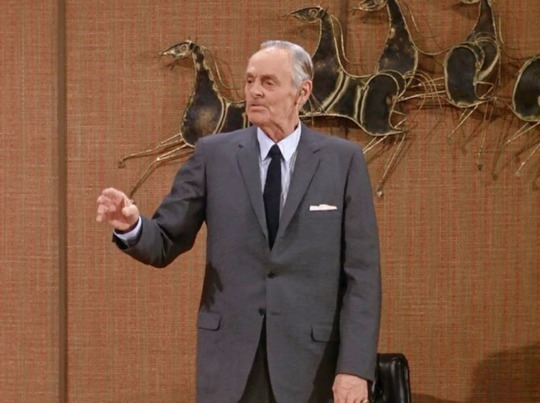
The
day this episode originally aired, actor James
Cowan died
at age 74. Cowan
had
appeared with Lucille Ball in The
Fuller Brush Girl (1950) and Critic’s Choice (1963). He appeared on “The
Lucy Show” in
1966
and as Mr. Gary in “Lucy the Crusader” (S3;E5, above) in 1970.
Lucy says that Kim wants to be a teacher and that Craig wants
to be a musician. This is the third mention of Craig in the past
three episodes, after 14 weeks of not hearing anything about him.
This is also the first time we’ve heard that Kim’s career path is to
be a teacher.
Kim
moves over the Thompson’s garage next door to her mother!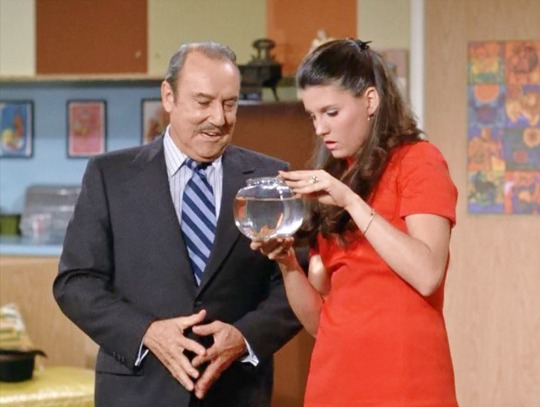
For
a housewarming gift, Uncle Harry brings Kim goldfish named Bertha and
Sam.
Kim
is hoping to be cast by Jack Foley in a college musical revue. Jack
Foley
(1891-1967) was the developer of many sound effects techniques used
in film and TV. To this day, those who work in sound effects
creation are called Foley Artists.
The zodiac poster that decorates Kim’s closet door was issued in July 1968 by Portal Publications. The artwork is by California artist Jane Oka (inset). Each astrological sign was also available as a separate poster. During her tenure at Portal, Oka also designed Kitchen Charts, Gourmet Guides, and Proverbs, many of which were made into calendars. Her work was seen decorating the bedroom walls on Lucille Ball’s favorite sitcom, “Three’s Company” and were also seen in the 1973 Woody Allen movie, Sleeper.

When Lucy opens Kim’s overstuffed closet to try to hide, the dress hanging in on the door is one worn by Kaye Ballard in “Lucy and Harry’s Italian Bombshell” (S4;E3) earlier in the season. There are also a few Saks Fifth Avenue hatboxes in storage. These would have been at home in the Ricardo closet in 1955, but seem out of place in the closet of a 20 year-old in 1972!

With her mother stuffed in the chimney hiding, Kim rehearses the song “I Got Love” with Peter playing the piano. The song was written by Gary Geld and Peter Udell for the Broadway musical Purlie (1970) and was introduced by Melba Moore. It was also the title of Moore’s first solo album, on which it also appeared. In her DVD introduction to the episode, Lucie Arnaz remembers singing the song live on the set with just piano accompaniment.

Note: Tim Matheson did not actually play the piano. It was likely Marl Young who generally provided piano accompaniment, sometime on camera. Actually, if you listen closely, there is also a snare drum added in!
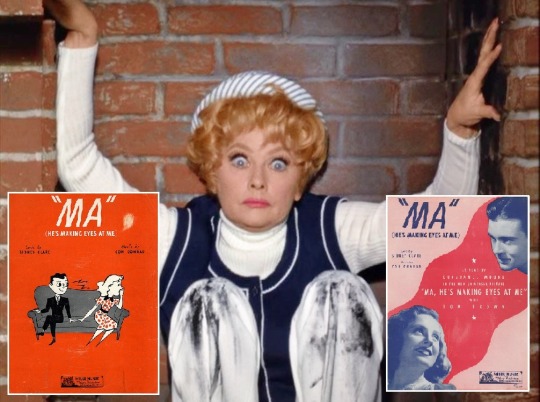
To
teach Lucy a lesson and prolong her stay in the flue, Kim and Harry sing a few hours of old standards. First up
is “Ma,
He’s Making Eyes at Me,”
which was written by Con Conrad and Sidney Clare in 1921 and was
covered by many artists.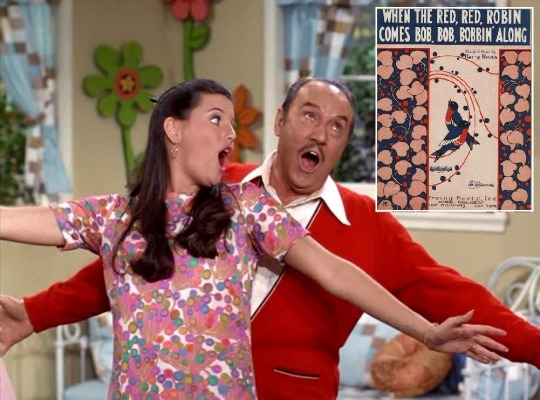
Finally,
Kim and Harry end their punitive jam session with “When
the Red, Red Robin (Comes Bob Bob Bobbin’ Along).”
The
song was previously sung in “Lucy and Ethel Buy the Same Dress” (ILL
S3;E3).
The song’s title was mentioned (but not sung) in “Mertz and Kurtz” (ILL
S4;E2).
Written
in 1926 by Harry Woods, the song was popularized by Al Jolson, with
whom William Frawley (Fred Mertz) had a long-standing rivalry. That
same year (1957) it was recorded by Doris Day, who, coincidentally,
had a television show that followed “Here’s Lucy” on CBS!
Kim
tells Uncle Harry (within earshot of her mother, who is hiding in the
fireplace) that she got a job offer to be a ‘bunny.’ Kim doesn’t say
the words ‘Playboy
Bunny’ but
that is what she is referring to. Bunnies were female staff members at the
Playboy Clubs, which were in business between 1960 and 1988. Based on
Hugh Hefner’s Playboy magazine mascot, they wore
abbreviated costumes that showed off their legs and cleavage while
also featuring rabbit ears and a large fluffy tail. “Here’s Lucy”
has previously made reference to Playboy magazine (above), the bunny costume,
and even top-less waitresses (which the Playboy bunnies were not!)

This
episode is partially inspired by the very first episode of “The
Lucy Show” “Lucy Waits Up For Chris” (TLS S1;E1), in which Lucy
Carmichael waits up for her teenage daughter Chris after her first
date with a boy named Tom, resulting in Lucy getting locked out of
her own home!
Lucy
Carmichael had trouble saying goodbye to her son Jerry in “Lucy and
the Military Academy” (TLS S2;E10). Although Lucy thought it was
best for him to go away to school, she found she missed him too much
and he came home. Ironically, Jerry eventually was sent away to a
military academy when the Carmichaels moved to California.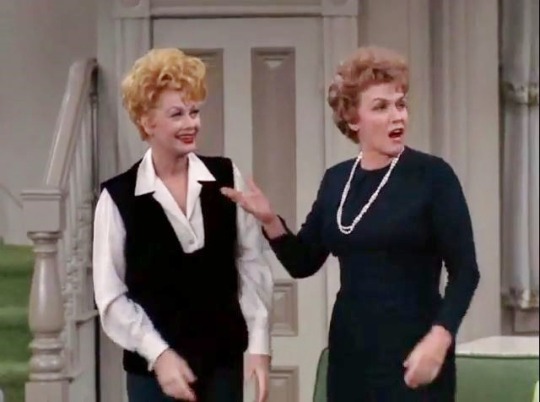
Although
“The Lucy Show” featured an episode titled “Viv Moves Out”
(TLS S2;E22) the title is the only thing these two episodes have in common. Lucy Carmichael rented out Viv’s room to a singer and her
drummer son (!) who rehearse loudly at all hours. The plot was
necessitated when Vivian Vance wanted to work less due to her commute
to Connecticut.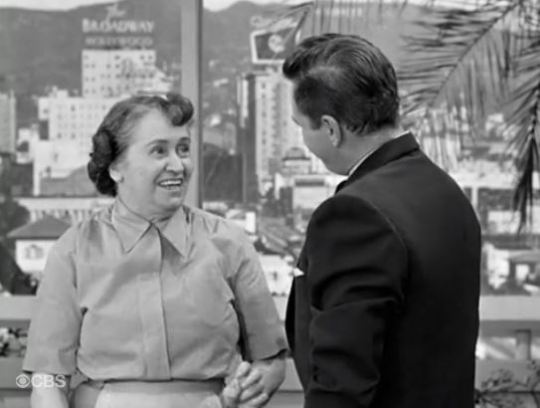
The
first part of the episode featuring Lucy not knowing if Kim came home
or stayed out all night, was inspired by “Don
Juan and the Starlets” (ILL S4;E17) in which Lucy Ricardo thinks
Ricky stayed out all night at a premiere. He has an alibi thanks to
an efficient hotel maid.FAST FORWARD

In 2006, the HBO series “Lucky Louie” also produced an episode titled “Kim Moves Out”, the series’ finale. In this case, however, the character of Kim is the lead’s wife, not daughter. Coincidentally, the cast also included a character named Lucy and an actress named Kim!
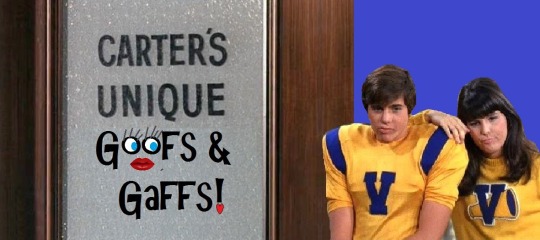

Ground Plan Goof! As
usual with TV show apartments, the room above the Thompson’s garage
is unrealistically spacious. It also features a fireplace, something
unlikely to be found in an over-the-garage flat. In addition, Kim’s
new place has a spinet piano, despite the fact that she doesn’t play. Kim will also have a spinet piano in her apartment when she moves to Marina Del Rey in “Kim Finally Cuts You-Know-Whose Apron String” (S4;E24) at the end of the season.What Color is Her Parachute? This is the first we hear about Kim wanting to be a teacher. In future episodes, she works as an administrative assistant in an entertainment agency.
“Kim Moves Out” rates 3 Paper Hearts out of 5Some nice moments between mother and daughter, but not enough to merit a spin-off, despite the fact that Lucie Arnaz is talented and funny in her own right. She will get another chance at her own series in 1985, but that show, too, did not catch on with viewers and was cancelled after just six episodes.
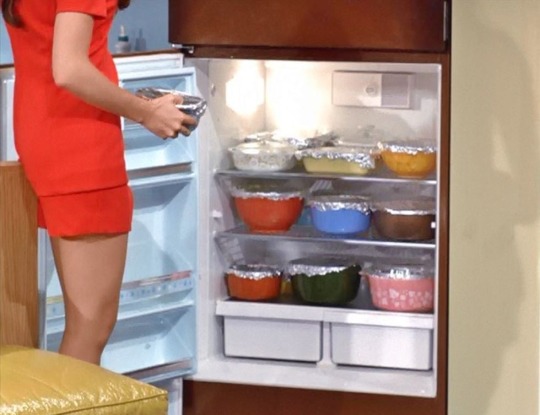
-
LUCY’S REPLACEMENT
S4;E19
~ January 17, 1972

Directed
by Coby Ruskin ~ Written by Fred S. Fox and Seaman JacobsSynopsis
Harry
gets a computer and fires Lucy, who then gets a job in a typing pool
at an insurance company. When she starts to miss Harry, Lucy and Kim
sabotage the computer to get her old job back.Regular
CastLucille
Ball (Lucy
Carter), Gale
Gordon (Harrison
Otis Carter), Lucie
Arnaz (Kim
Carter)Guest
Cast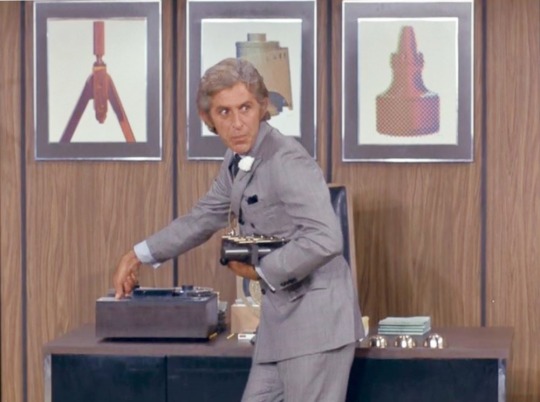
R.G.
Brown (Mr.
Conrad, Insurance Office Manager) appeared on “The Andy
Williams Show” (1963) and “The Rich Little Show” (1976). He
will do one more episode of “Here’s Lucy.”The
character’s name is only used in the final credits.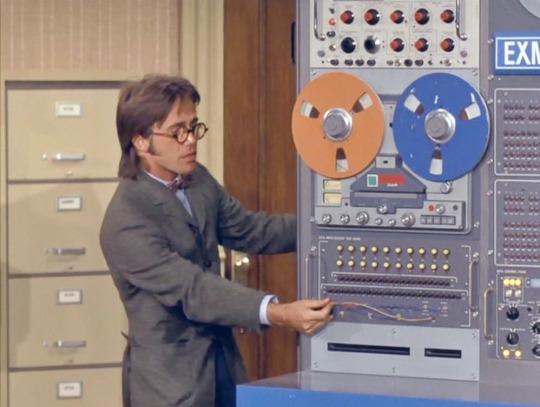
Phil
Vandervort (Joe
Hackley) appeared
in two episodes of “The Lucy Show” where he met Lucie Arnaz. The
two were married from 1971 to 1977. This is the second of his
three episodes on the series.Joe Hackley is an electronics major who Kim is dating
(occasionally). Lucy calls him “that funny looking guy with the glasses.”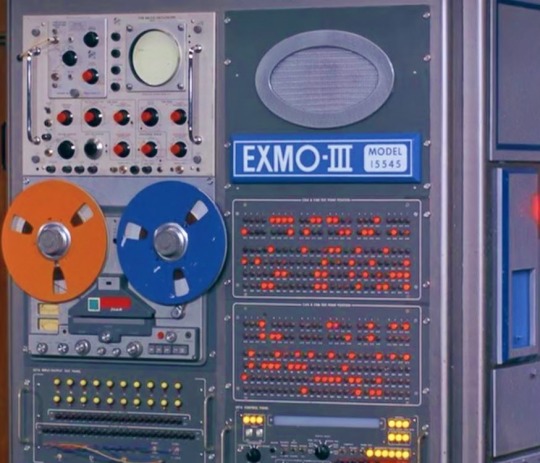
EXMO-III
[Experimental
Model #3] Model 15545 was designed by ‘Al Rylander.’It is established that EXMO is a ‘he’. EXMO speaks, but his voice is uncredited.
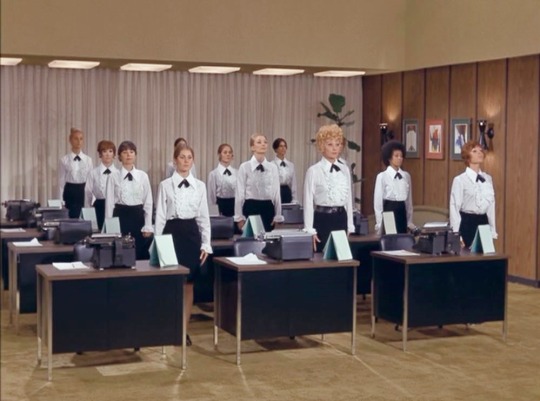
The
11 typists at the insurance company are played by uncredited
background performers.
Coincidentally, two weeks before this episode aired (but well after its filming in late 1971), the first scientific electronic pocket calculator, the HP-35 was introduced by Hewlett-Packard and priced at $395 (equivalent to more than $2,400 today). Although hand-held electronic machines that could multiply and divide had been made since 1971, the HP-35 could handle higher functions including logarithms and trigonometry.

For
this episode (only) Lucy
Carter wears her hair in a bun similar to the way Lucy Ricardo did.
Lucille Ball’s hairstyles are credited to Irma Kusely.
Lucy
calls the behemoth computer “a
left-over from ‘Star Trek’.”
This is the first mention of the space series that was first produced
by Lucille Ball at Desilu. Four days after this episode first aired, the very first convention of ‘Trekkies’ took place in New York City.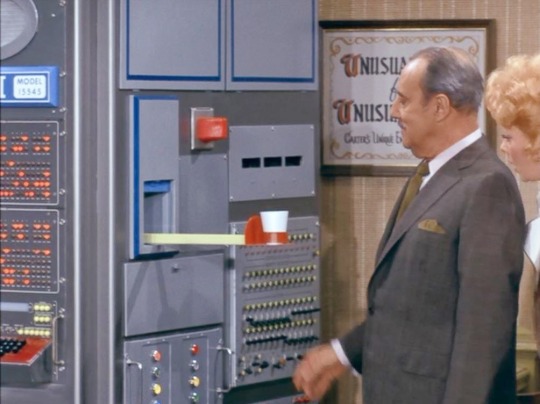
Harry
credits the creation of the computer to his friend Al Rylander.
Rylander
was
Gale Gordon’s ‘go-to’ name during dictation to Lucille Ball on both
“The Lucy Show” and “Here’s Lucy.”Harry
mentions Lucy’s son Craig, despite the character no longer being part
of the series.
Regarding Lucy’s typing skills, Harry facetiously calls Lucy “the high priestess of hunt and peck.” Hunt-and-peck is a method of typing where one looks at the keyboard and only uses the index fingers to depress the keys. The traditional method of typing has the fingers gently resting on the ASDF JKL; keys with eyes on the material being transcribed or the typed paper, not the keys.
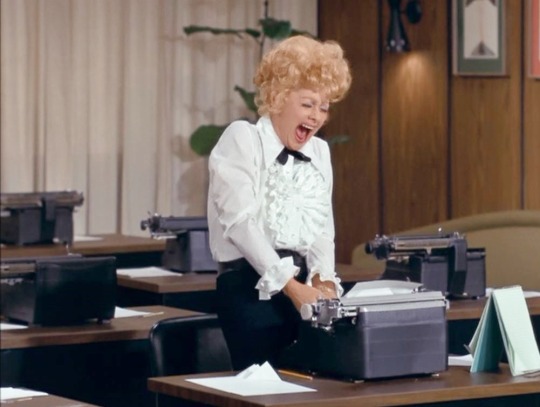
Lucy goes to work in the secretarial pool at The Great Pacific Insurance Company.
In
“Lucy’s Vacation” (S3;E17) Kim says that Harry has fired Lucy 14
times. This episode brings the total up to 17!
The
coordinated typing sequence was ‘choreographed’ by Jim Bates, who
introduces the episode on the series DVD. It is performed to “The
Typewriter”, a novelty instrumental piece written by Leroy
Anderson in
1950, and first performed by the Boston
Pops.
The song was recently seen on Amazon TV’s “The Marvelous Mrs.
Maisel” using archival footage of a performance of it by Liberace
in the late 1950s.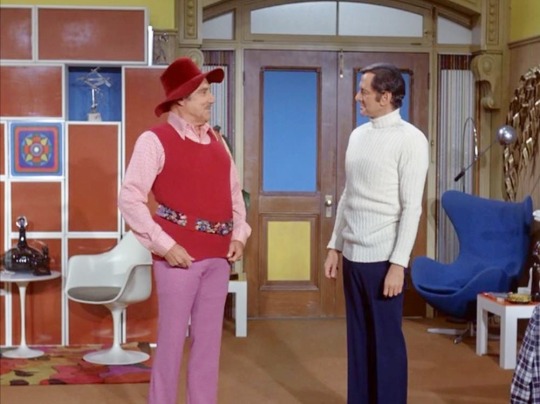
Kim
calls Harry and EXMO the odd couple. “The
Odd Couple”
was a popular television series (based on a 1966 play of the same
name by Neil Simon) that starred Tony Randall and Jack Klugman as
mismatched roommates. It aired on ABC from 1970 to 1975. Tony Randall guest starred on “Here’s Lucy” (above) during “The Odd Couple’s” first season.
After
being sabotaged by Joe Hackley, EXMO squirts coffee and cream in
Harry’s face, thereby fulfilling one of “Here’s Lucy’s” staple
comedy bits: Getting Harry wet! Off screen, Lucy nicknamed Gale Gordon “Old Soggy Crotch”!
When Lucy walks in on a still-reeling Harry after EXMO has nearly electrocuted him, Lucy asks if he is “trying to bring back the Turkey Trot”. The Turkey Trot was a dance done to fast ragtime music popular from around 1900 to 1910. The basic step began with four hopping steps sideways with the feet apart. The dance fell out of favor by 1915.
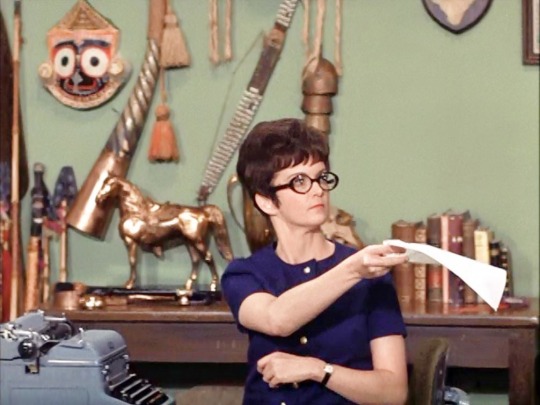
Fast
and precise typing was demonstrated by Wanda Clark in “Lucy
Protects Her Job” (S2;E14). Clark was also Lucille Ball’s
real-life secretary.
Lucy also had trouble with typewriters in the 1949 film Miss Grant Takes Richmond. In the film, Lucille Ball played Ellen Grant, the worst student at the Woodruff Secretarial School.

Although it wasn’t revealed until 1957′s “Lucy Takes A Cruise To Havana” (LDCH S1;E1), Lucy Ricardo also went to secretarial school (with Susie MacNamara) and wrote an operetta,
novel and a play using a typewriter!

Lucy Carmichael was also a skilled typist and became secretary to Mr. Mooney at the bank, where typing was part of her job.

While
working for Mr. Mooney, Lucy Carmichael had a human replacement
played by Ruta Lee in “Lucy’s Substitute Secretary” (TLS S5;E14).
One of the world’s first computers was mentioned on “I Love Lucy” in “Lucy and Bob Hope” (ILL S6;E1) in 1956! UNIVAC (UNIVersal Automatic Computer) was an early computer made by Remington Rand that at the time was used mainly for weather forecasting, but would also correctly predict that outcome of the 1956 Presidential election.

UNIVAC was mentioned again in 1964 in “Chris Goes Steady” (TLS S2;E16). Viv says that UNIVAC “couldn’t have come up with a better match” than Chris and her new boyfriend, Ted.
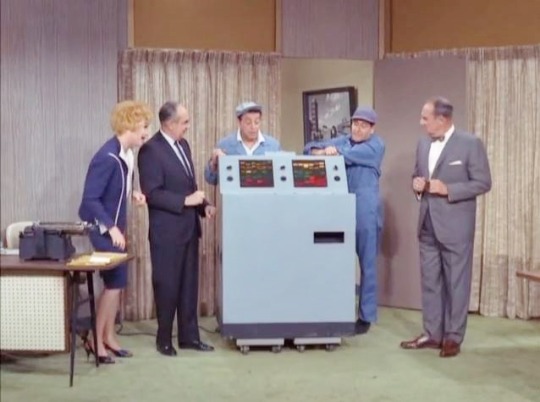
In 1966, ten years after Hope’s ad-lib mention of UNIVAC, Mr.
Mooney (Gale Gordon) installed a computer at the Westland Bank in “Lucy, the
Superwoman” (TLS S4;E26)…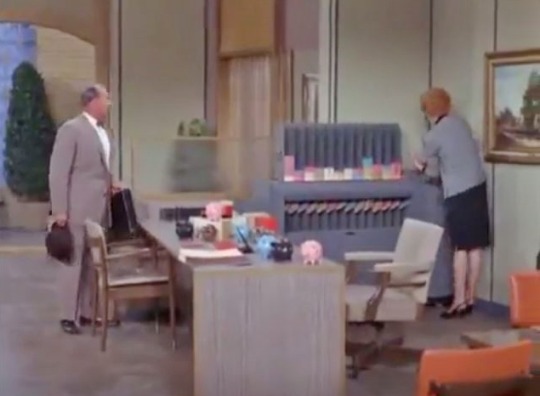
…as well as another one in “Lucy and Bob Crane”
(TLS S4;E22).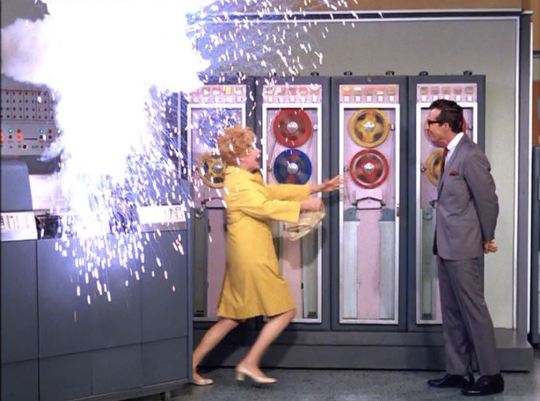
On “Here’s Lucy,” Computer
Dating was the subject of “Lucy the Matchmaker” (S1;E12) in 1968. The comic payoff of most episodes featuring computers was having them short-circuit and run amok!
Logistics! In the office, the door at the left that is usually a closet, now allows Kim, Lucy and Joe to pass through to the outside hallway. Similarly, the door on the right, sometimes a bathroom, is here called the storage room. The exits are used as per the requirements of the plot without regard to prior episodes.
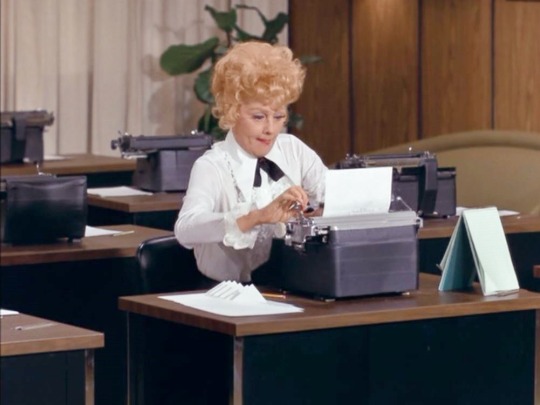
Props!
For the high speed typing practice session, the spare paper is
dog-eared to make it easier for Lucille Ball to pick up.Sitcom Logic Alert! Time flies when EXMO announces it is 2:02pm. Less than 80 seconds of screen time later, EXMO announces it is 2:05pm! At the end of the scene, EXMO announces it is 2:09pm, yet less than 5 minutes have elapsed since he announced it was 2:02! Is is ironic, that on the table just behind EXMO is an hourglass, one of the oldest time-keeping devices known to man!
Knowing Your Place! In the first office scene, EXMO is positioned against the wall behind Lucy’s desk and the shallow table normally there has been removed. In the second office scene, Lucy’s desk has been moved to the side, EXMO has been moved forward and the shallow table has returned! That’s a lot of moving of some very heavy furniture!
“Lucy’s Replacement” rates 3 Paper Hearts out of 5
The worry that computers would replace people was a common TV trope of the ‘60s and ‘70s. The
episode contains a short but wonderful scene between Lucy and Kim
that feels especially real. Lucille Ball shows her joy of working
with her real daughter as Lucie exits. There are also genuine
displays of emotion between Lucy and Harry. Maybe it is her Lucy
Ricardo-like hairstyle, but the comedy here is very reminiscent of “I
Love Lucy.” 1972, CBS, Coby Ruskin, Computer, Computer Dating, Desilu, EXMO III, Fred S. Fox, Gale Gordon, Here’s Lucy, hunt and peck, I love lucy, Lucie Arnaz, Lucille Ball, Miss Grant Takes Richmond, Phil Vandervort, R.G. Brown, Rylander, Seaman Jacobs, secretaries, Star Trek, The Lucy Show, The Odd Couple, The Typewriter, turkey trot, tv, typing pool, typists, UNIVAC, Wanda Clark
-
Subscribe
Subscribed
Already have a WordPress.com account? Log in now.
 Papermoon Loves Lucy