-
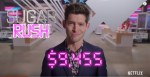
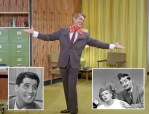
Hunter March (top) is the host of the new baking reality show “Sugar Rush” but he’s also the grandson of Hal March (1920-70), who starred in two episodes of “I Love Lucy” (as Eddie Grant and Lucy’s Doctor) as well as an episode of “The Lucy Show.” Talent must run in the family!
-
STARS IN THE EYE
November 15, 1952

Producer
and Director Ralph
LevyChoreography
by Donald
SaddlerWritten
by
George Balzer, Al Schwartz, Si Rose, Hugh Wedlock, Howard Snyder, and
the writers of the CBS shows represented.The
closing credits indicate that the stars’ dialogue was written by the
writers of their own shows.
THE CBS SHOW AND STARS

“I
Love Lucy” (1951-57)-
Lucille Ball (Herself / Lucy Ricardo)
- Desi
Arnaz
(Himself / Ricky Ricardo) - William
Frawley
(Himself / Fred Mertz) - Vivian
Vance
(Herself / Ethel Mertz)

“The
Jack Benny Program” (1950-65)- Jack
Benny (Himself)
would have Lucille Ball as a guest star on his program in 1962 and
1964. Benny appeared on three episodes of “The Lucy Show” and
three episodes of “Here’s Lucy.” - Eddie
‘Rochester’ Anderson
(Himself / Rochester Van Jones) was Jack Benny’s valet and sidekick
first on radio and then on television. He co-starred with Lucille
Ball on two Jack Benny specials in 1969 and 1970.

“The
George Burns and Gracie Allen Show” (1950-58)- George
Burns
(Himself) was
a
good friend of both Jack Benny and Bob Hope. Consequently, he
co-starred with Lucille Ball on many of their specials. He also
played himself on an episode of “The Lucy Show” and “Here’s
Lucy.” - Gracie
Allen
(Herself), wife and co-star of George Burns.

“The
Amos ‘n’ Andy Show” (1951-56)- Tim
Moore
(Kingfish) - Alvin
Childress (Amos) - Spencer
Williams
(Andy)

“Meet
Millie” (1952-55)- Ellen
Verdugo
(Millie Bronson) - Florence
Halop
(Mama Bronson) played one of the women on a party line during an
episode of “I Love Lucy” (S2;E8) first aired nine days after
this special. In 1974 she did an episode of “Here’s Lucy.” She
is best remembered as Mrs. Hufnagel on “St. Elsewhere” and the
Bailiff on “Night Court.” - Marvin
Kaplan
(Alfred Prinzmetal)

“Life
With Luigi” (1952)- J.
Carrol Naish (Luigi)
did a 1958 episode of “The Westinghouse-Desilu Playhouse” hosted
by Desi Arnaz. - Alan
Reed (Pasquale)
played a cafe owner in a 1963 episode of “The Lucy Show” but is
probably best remembered as the voice of Fred Flintstone. - Jody
Gilbert
(Rosa) appeared on “The Lucy Show” and “Here’s Lucy” both
times as a prison matron!

“My
Friend Irma” (1952-54)- Cathy
Lewis
(Herself) - Marie
Wilson (Herself)

“Our
Miss Brooks” (1952-56)- Eve
Arden
(Herself) had starred with Lucille Ball in the films Stage Door
(1937) and Having Wonderful Time (1938). She did a one-line cameo as
herself on “I Love Lucy” in “Hollywood at Last!” (S4;E16). - Gale
Gordon
(Hubble Robertson) had partnered with Lucille Ball on CBS Radio’s
“My Favorite Husband” but was not available when Lucy and Desi
were casting Fred Mertz. Earlier in 1952 he did a two-episode
appearance on “I Love Lucy” as Tropicana boss Alvin Littlefield.
Gordon joined Ball for the second season of “The Lucy Show” and
from then on was her comic foil for the rest of her career.
Bob
Sweeney
(Harry S. Ackerman) was then starring in “I Married Joan”
(1952-53).Alan
Young
(Himself) was then starring in “The Alan Young Show” (1950-53)
but is probably best remembered for playing Wilbur in “Mr. Ed.”Art
Linkletter
(Himself) was the host of “House Party” which featured the
segment “Kids Say the Darndest Things.” Lucille Ball guest-starred on “House Party” in 1965.Liza
Beatrice West
(Herself) was Eve Arden’s adopted daughter. She was seven years old
during this telecast.Stephen
Crosby (Himself)
was Bob Crosby’s son, and the nephew of Bing Crosby.Bob
Crosby (Himself)
was the younger brother of Bing Crosby. He had appeared with Gisele
MacKenzie on “Cavalade of Stars” as well as “The Jack Benny
Program.”Gisele
MacKenzie (Herself)
was
a violinist and singer, and frequently did duets with her lifelong
friend Jack Benny on his programs.Cass
Daley
(Herself)Margaret
Whiting (Herself)The
Sportsmen Quartet
(Themselves) was a Barbershop Quartet. They were: Bill Days, Max
Smith, Mart Sperzel, and Gurney Bell. They began appearances in 1938
and are most remembered for their thirty-two appearances on “The
Jack Benny Program” from 1950 to 1961. Their final television
appearance was on “The Joey Bishop Show” in 1963.Fletcher
Bowron,
Mayor of Los Angeles (Himself) was elected mayor in 1938 and would
only serve one more
year after this telecast. He
played himself on a 1953 episode of “The
George Burns and Gracie Allen Show”
titled “The
Tax Refund.”Earl
Warren,
Governor
of California (Himself) was
the nominee of the Republican
Party
for Vice
President
in 1948,
as the running mate of Thomas
E. Dewey.
A year after this telecast he was appointed the 14th Chief Justice of the United States. He was chair what became known as
the Warren
Commission,
which was formed to investigate the 1963 assassination
of President John F. Kennedy.Jack
Von Volkenberg,
President of CBS Television (Himself)

The
title refers to the (then) newly created Columbia Broadcasting System
logo: The
CBS
Eye.
Still in use today, it is one of the best-known and most highly
regarded corporate trademarks. It was created by William Golden based
on a Pennsylvania
Dutch
hex
sign
as
well as a Shaker
drawing.
Early versions of the logo had the lens telescope to reveal the
acronym. It was often depicted against a field of clouds. The new
logo made its broadcast debut on October 20, 1951, five days after
the premiere of their mega-hit “I Love Lucy.” In 2015, the logo
was the subject of a museum exhibit: “Revolution
of the Eye: Modern Art and the Birth of American Television” at
The Jewish Museum in New York City.
On
June 2, 1952, Lucille Ball and Mayor Bowron participated in a
ceremony to turn on the electricity at the yet-unfinished site.
CBS
Television City officially opened on November 16, 1952. On
the previous Monday (November 10, 1952) “I Love Lucy” aired “The
Courtroom” (S2;E7).
Television City was built on the site of a former football field and race track,
Gilmore
Stadium, which was the home of a minor league baseball team called
The Hollywood Stars, a rival of the Los Angeles Angels. During “In
Palm Springs” (ILL S4;E26, above) Fred
Mertz bemoans that the rain has caused him to miss “the Hollywood
Stars.” Before the team could make plans to relocate, the Brooklyn
Dodgers confirmed their long-rumored move to Los Angeles. The Stars
were sold to Salt Lake City, becoming the Salt Lake Bees in 1958.During
the opening credits of many of the shows taped here, a voice-over
announced the phrase “from
Television City in Hollywood”.
This
program was broadcast live, but the “I Love Lucy” segments were
pre-filmed because Lucille Ball was seven months pregnant with her
son, Desi Jr., at the time.A
kinescope of the program can be found on the DVD set The
Best of Johnny Carson and Friends.
The
nominal plot of “Stars in the Eye” revolves around the
making of special itself, and the fact that Jack Benny, having
fronted the money for the television center, wants to take over its
production.
THE TELECAST

The
broadcast opens with the stars of the now rarely-seen television
version of “Amos
‘n’ Andy”
on an airplane headed to the opening of CBS Television City. Learning
that they are flying 15,000 feet in the “stradivarius” Kingfish
tries to sell Andy an insurance policy.
The
scene shifts to inside Television City, where CBS Vice President
Harry
Ackerman
(Bob Sweeney) is meeting with VP in charge of programs Hubble
Robertson
(Gale Gordon). Harry Ackerman
(1912-91)
was a real-life CBS employee who stayed with the network until 1958
before forming his own production company. Although not an actor, the
real Harry Ackerman did a cameo on the “I Love Lucy” episode “The
Audition” (S1;E6) in November 1951. Hubble Robertson was also the
name of a real CBS executive. He left the network before the infamous
quiz show scandals of 1959.Ackerman
gets a phone call from Mr. Paley, who was the CEO of CBS. Paley tells
Ackerman and Hubble to handle the situation with Jack Benny, who
wants to take over the entire broadcast. In 1976, Paley opened “CBS
Salutes Lucy: The First 25 Years” with a personal tribute. An angry Cass
Daley
barges into the office.Daley:
“It’s
the wardrobe department! I wanted to look like Marilyn Monroe. Just
look! [plops a wig on her head] I look like President Monroe!”
After
Daley is escorted out, Alan
Young,
now working for the CBS Electrics Department, comes in to check the
office’s television set. With a huge eyedropper, he applies Murine to
the set’s CBS eye, which starts to blink and roll in response. After
Young leaves, all the phones start ringing with complaints.
On
a soundstage, Cass Daley sings “Together”
written in 1928 by Lew Brown, B.G. De Sylva, and Ray Henderson.Back
in the office, Harry Ackerman tells Hubble Robertson that Jack Von
Volkenberg is coming in from the East. He was the very first
President of CBS Television. Alan Young returns, now working for the
props department, looking for a vase. When he turns his back to
leave, his coveralls says NBC.Robertson:
“First
they send us their old comedians, now their old uniforms.”
Jack
Benny and Rochester are discovered in Benny’s living room. Benny is
on the phone to his wife, Mary. Benny says he is going to finish the
show by singing his new song, then proceeds to sing a bit of it for
Mary, only interrupted by her taking an Alka Seltzer. In
1952, searching for gimmicks for the Benny program, writer Sam Perrin
suggested that Jack write a song, and then try, week after week, to
make it a hit. The song was a suitably terrible ballad, “When
You Say `I Beg Your Pardon’, Then I’ll Come Back to You.”
This led to a succession of programs where various reluctant star
vocalists were urged to sing it. Alka
Seltzer
was a frequent sponsor of Benny’s television and radio programs.Desi
Arnaz comes over in the company of his lawyer (Jose Gizzler, who only
speaks Spanish) and his projectionist (Jess, a nod to “I Love Lucy”
head writer Jess Oppenheimer) to announce he is suing Benny for
lousing up filming of “I
Love Lucy.”
Jess sets up a screen and projector so Benny can see the havoc he
wrought on their set. What follows is a filmed segment of Lucy, Desi,
Vivian, and Bill rehearsing scenes on the “I Love Lucy” sets,
then filmed at General Service Studios.
In
the first clip set at the Tropicana, Jack Benny turns up in a
handlebar mustache as the waiter to find out if they’ll be on this
special. His mustache flies off and lands on Ethel / Vivian’s plate
where Fred / Bill smacks it with a spoon. This scene was shot at the
beginning of October 1952 while they were filming “Lucy is
Enceinte” (ILL S2;E10). It would air three weeks after “Stars in
the Eye” on December 8, 1952.
Vivian
(to Bill Frawley):
“Gee, Jack Benny playing a waiter. Radio really must be —.”Vivian’s line may have been deliberately cut off to infer an expletive or just to reinforce the choppy nature of the film clips.

In
the Ricardo apartment, Lucy and Desi are rehearsing another scene
when Benny pops up from behind the sofa, still wondering if they’ll
do the show.
In
the Ricardo bathroom, Ricky is getting ready for work. Lucy turns on
the shower for him, not knowing that Benny is hiding inside. He steps
out dripping wet, his hair dye running down his face.Back
in Benny’s apartment, he tries to convince Desi not to sue, but Desi
mutters something in Spanish that ends with “catastrophic” and
storms out.
Meanwhile,
three of the cast of “Meet
Millie”
(Millie, Mama, and Alfred) visit Mr. Ackerman’s office. The sitcom
was one
of the first series telecast from the CBS Television
City. Although
the voice on the intercom announces them as “the
cast of the Meet Millie Bronson Show”
the actors play their on screen characters, not themselves. Jack
Benny has sent them so that Alfred (who enters eating a banana) can
recite his poem for them.
Ode
to Television City
by
Alfred E. PrinzmetalHail
to thee, child of CBS in Hollywood and New York.
Tonight
you were born weighing two million tons.
(Gee, what a strain on
the store.)
I
thrill to you massive structure,
Over
many an acre you spread.
I
love every rock in your garden,
But
I hope there’s no rocks in your head.
So
all hail thee, mighty newborn child,
Whose
body can never be bent,
Because
your spine is made of steel
And
your bottom is stuck in cement.
In
a hallway of Television City, Alan Young is busy gathering props. He
has trouble distinguishing a prop mannequin’s leg from that of a
dancer – who looks like she has three legs. Since we last saw
Young, he has ripped the “NBC” off the back of his coveralls and
written “CBS” on his exposed back.GOOF:
One of the prop men tells Alan Young to go to the “Luigi” set and
find something in the “Antiques Room” but quickly corrects
himself to say “Antiques Shop.”
“House
Party” host Art
Linkletter
walks on holding the hand of two small children. The boy is Stevie
Crosby
(son of Bob Crosby) and he wants to be a cowboy. The little girl is
named Liza
West
(adopted daughter of Eve Arden). George
Burns
comes on looking for Margaret Whiting.
In
another room, Margaret
Whiting
rehearses “Why
Don’t You Believe Me?”
by Lew
Douglas,
King
Laney,
and Roy
Rodde
and
published in 1952.
George Burns comes by to ask if they could do a duet. He suggests "It
Might as Well Be Spring,”
a
song from the 1945 film,
State
Fair,
with music by Richard
Rodgers
and
lyrics by Oscar
Hammerstein II. It
won the Academy
Award for Best Original Song
that
year.
Whiting had a hit with the song which charted at #6. When Burns asks
if she knows it, she replies dryly “I’ll
fake it.”
Whiting asks the Sportsmen
Quartet
to join them. Every time Burns opens his mouth to sing, the Sportsmen
sing over him. This same comedy routine was used on “I Love Lucy”
when Lucy played Camille, snaggle-toothed queen of the Gypsies in
“The Pleasant Peasant.”
“My
Friend Irma”
star Cathy
Lewis
is looking for co-star Marie
Wilson,
who pops out of a phone booth, thinking it is a small dressing room,
but at least it has a telephone.
GOOF!
Cathy Lewis drops her lipstick. Marie Wilson picks it up saying “I’ll
get it.”Wilson
(to
viewers): “Well,
what can you expect from a girl who goes to night school to study
trigonometry because she wants to learn all about Roy Rogers’ horse?
You see, that’s my friend Irma!”
In
the street, Jack Benny’s dilapidated Maxwell car breaks down with
Rochester driving. Eve
Arden
hitches a ride to the studio when the Mayor of Los Angeles, Fletcher
Bowron,
walks by having run out of gas. He gives a brief history of the site
of Television City, telling Benny there was an oil field there at one
time, something that piques Benny’s interest. When the car refuses to start, Benny and Bowron end up pushing
it!
Bob
Crosby and
Gisele
MacKenzie
are discovered in their shared dressing room (one of 49 at Television
City) rehearsing their duet “Two
To Tango”
by
Al
Hoffman
and
Dick
Manning,
first published in 1952.
Fade to the soundstage, where the number is being danced by couples
throughout history in various musical styles.
Alan
Young finally arrives at the “Life
With Luigi”
set to find the vase. Luigi (J.
Carrol Naish) is
wearing an oversized tailcoat because he’s been invited to the
Television City delicatessen. Pasquale (Alan
Reed) enters
to inform him that it is a ‘dedication’ not a ‘delicatessen’.
Pasquale’s hefty daughter Rosa (Jody
Gilbert) enters
and flirts with Alan Young.Pasquale: “What a combination; Young and beautiful! How-a you think she be on a-TV set?”
Luigi: “Rosa canna go on the television set yet-a.”
Pasquale: “Why not?”
Luigi: “Because they no-a have a hundred inch screen.”The show was popular on radio, but had a short life on television due to pressure from the Italian-American community and returned to radio. The cast featured here was replaced with more ethnically appropriate actors, but it was still canceled within weeks.

“Life
With Luigi” was mentioned on “I Love Lucy” in “The
Black Wig” (S3;E26) in 1954.Fred: “Ethel, why don’t you take off that silly-looking toupee?”
Ethel: “That is the new Italian haircut!”
Fred: “Well on you, it looks like ‘Life With Luigi’.”
In
an official-looking office, California Governor Earl
Warren
is told Mrs. George Burns is there to see him.Governor
Warren:
“Mrs.
George Burns! I’ve heard her husband sing and I’m not gonna pardon
him.”Gracie
Allen
arrives to take the Governor to the dedication ceremony. But first,
the Governor ‘rehearses’ his speech. Gracie has some questions
about taxes. While Gracie writes to Washington, the Governor sneaks
out of his own office. Although George and Gracie both appear in this
program, they do not appear in the same scenes.
Jack
Benny stands in front of a model of CBS Television City talking about
the structure, which covers 63,000 square feet. The amount of
concrete used to build the structure could have created a two-lane
highway eight and a half miles long. Robertson and Ackerman
interrupt Benny to tell him that they are returning his money and
getting it elsewhere. An armored car drives up and dumps piles of
cash out the back doors. They tell him to take his money and go. But
first, Jack needs to count it to make sure it is all there.
In
another studio, the cast of the telecast is gathered around the REAL
president of CBS Television, Jack
Von Volkenberg,
who is introduced by Eve Arden. Von Volkenberg thanks the stars and
the viewers while Jack Benny continues to count his money.
This
Date in Lucy History – November 15
“Ricky’s
Screen Test”
(ILL S4;E7) – November 15, 1954
“Lucy
and the Sleeping Beauty”
(TLS S4;E9) – November 15, 1965
“Lucy
and the Celebrities”
(HL S4;E10) – November 15, 1971
“Mother
of the Bride”
(LWL S1;E8) – November 15, 1986Alan Young, Bob Crosby, Bob Sweeney, CBS, Columbia Broadcasting System, Desi Arnaz, Donald Saddler, Eddie Rochester Anderson, Eve Arden, Gale Gordon, George Burns, Gracie Allen, Harry S. Ackerman, House Party, Hubble Robertson, I love lucy, Jack Benny, Life With Luigi, Liza West, Lucille Ball, Meet Millie, My Friend Irma, Our Miss Books, Ralph Levy, Stars in the Eye, Stevie Crosby, Television City, The Amos n Andy Show, Vivian Vance, William Frawley -
-
WILL THE REAL MR. SELLERS…
December 18, 1969


Directed
by Tony Palmer
Peter
Sellers
(1925-1980) was born Richard Henry Sellers to a well-off English
acting family. His mother and father worked in an acting company run
by his grandmother. He was hailed as one of the greatest comic actors
of his time. He was nominated for three Oscars, including two for
acting in Dr.
Strangelove
(1965) and Being
There
(1979). He was probably best known for playing the bungling Inspector
Clouseau in The
Pink Panther
films. On
July 22, 1980 he collapsed from a massive heart attack and fell into
a coma. He died in a London hospital aged 54.“If
you ask me to play myself, I will not know what to do. I do not know
who or what I am.”
~ Peter Sellers
This
fascinating 50-minute pseudo-documentary was created in 1969 as a
promotional movie for Sellers’ 1969 British film The
Magic Christian.
It defies logical summary and is practically free-form. It features
a voice-over by UK comedy legend Spike Milligan, a frequent
collaborator of Sellers. The
footage provides no coherent through line, which reinforces the
underlying point that the enigmatic Sellers has no tangible essence
to grasp onto. The
documentary includes some graphically strong scenes (a bullfight,
open heart surgery, nudity) and adult language.The
documentary was never re-broadcast by the BBC, reportedly because
Sellers thought he came off as depressed. It was never aired in the
US. Some of the footage was shot on the ship Queen Elizabeth II and
some was centered around finishing an promoting The
Magic Christian.The
film features appearances from the likes of Richard Attenborough,
Lionel Blair, Yul Brynner, Ava Gardner, Laurence Harvey, Raquel
Welch, Roger Moore, three out of the four Beatles, and yes –
Lucille Ball. All except Ball are also in The
Magic Christian.
The film was shot in Mid-1969, which means Lucille Ball was probably
on summer hiatus from “Here’s Lucy.”
How
does Lucy figure into this obscure collection of images? Peter
Sellers is traveling and invites the viewers into a VIP lounge “to
experience a VIP.”Once inside, the VIP is Lucille Ball, who is
seen in silent close-ups putting on make-up and having unheard conversations.
There is no dialogue and the entire sequence lasts just 15 seconds.It is unclear if Lucy is traveling to or from New York or London or if they are traveling by air of on the QE2.

The film feels like hidden camera footage and it would be interesting to know if Lucy knew she was being filmed and if she was aware of the finished project.

As with the rest of the film, the ambiguity of Lucy’s cameo is deliberate.
This Date in Lucy History – December 18th

“LUCY AND THE GROUP ENCOUNTER” (S5;E14)
-
LUCY on AMERICA ALIVE!
November 10, 1978

“America Alive!” was an hour-long NBC daytime show which featured consumer tips, relationship advice, entertainment news and reviews, and comedy, from its home studio in New York City, which resembled a Manhattan loft apartment, as well as remotes from Los Angeles. In the planning phase, the show was titled “People to People.”

Co-hosts were Bruce Jenner (from California) and Janet Langhart [who doe not appear in this episode], with segments from consumer reporter David Horowitz, arts critic David Sheehan, sex researchers Masters and Johnson, Virginia Graham with gossip, and the comedy of Bert Berdis and Dick Orkin. Guests included Bob Hope, Danny Thomas, Jimmy Stewart, Alan King, and Sammy Davis Jr. After its mid-summer premiere on July 24, 1978, the New York Times called it “a light soufflé of entertainment.” Other critics called it “superficial” and “tacky” and another said it was a “dud” that deserved to “get the gong.” Viewers were also conflicted and the show was canceled on January 4, 1979 after just six months on the air.

Jack
Linketter (Host)
was
the son of famed interviewer Art Linkletter, who played himself on an
episode of “Here’s Lucy,” was mentioned on “The Lucy Show”
and hosted “House Party,” on which Lucille Ball guest-starred in
1964. Jack was best remembered for “Hootenanny” (1963). “America
Alive!” was his last job on television before going
into business, serving as president of Linkletter Enterprises, a
developer of commercial and industrial real estate.
He
died in 2007 at age 70 with both parents outliving him.
David
Sheehan
(Co-Host)
became the first
entertainment reporter and critic on a news broadcast in the history
of television in 1970. He
was also the first
local newsman ever to work for two networks simultaneously.
He
produced
and camera-directed for video the hit musical Pippin with Bob Fosse.
Sheehan played himself in the film California
Suite
(1978).
Lucille
Ball was
born on August 6, 1911 in Jamestown, New York. She began her screen
career in 1933 and was known in Hollywood as ‘Queen of the B’s’
due to her many appearances in ‘B’ movies. With Richard Denning,
she starred in a radio program titled “My Favorite Husband” which
eventually led to the creation of “I Love Lucy,” a television
situation comedy in which she co-starred with her real-life husband,
Latin bandleader Desi Arnaz. The program was phenomenally successful,
allowing the couple to purchase what was once RKO Studios, re-naming
it Desilu. When the show ended in 1960 (in an hour-long format known
as “The Lucy-Desi Comedy Hour”) so did Lucy and Desi’s
marriage. In 1962, hoping to keep Desilu financially solvent, Lucy
returned to the sitcom format with “The Lucy Show,” which lasted
six seasons. She followed that with a similar sitcom “Here’s
Lucy” co-starring with her real-life children, Lucie and Desi Jr.,
as well as Gale Gordon, who had joined the cast of “The Lucy Show”
during season two. Before her death in 1989, Lucy made one more
attempt at a sitcom with “Life With Lucy,” also with Gordon,
which was not a success and was canceled after just 13 episodes. She died in 1989.
Gary
Morton
was
a comedian who worked the famed ‘Borscht Belt’ in the Catskills
Mountains. He met Lucille Ball shortly after her divorce from Desi
Arnaz and they married in November 1961. At her request, Morton gave
up his nightclub career and became a producer of “The Lucy Show.”
Morton also served as a warm-up comic for the show’s studio
audience. In many episodes of the series, his loud guffaw can be
heard on the laugh track. Morton passed away in 1999.

This episode of “America Alive!” was videotaped live on location at UCLA, in California, where Lucille Ball took questions from an audience of theatre arts students.

It was the culmination of Lucy co-hosting the show for the previous two days in the Los Angeles studio. Her husband, Gary Morton, also participated. She interviewed Henry Fonda (back in New York), practiced CPR, and Gary talking about being a step-father.
This episode was aired live on the East Coast, meaning that it took place in the early morning in Los Angeles. Going in and out of commercial, the show plays “Disco Lucy” as well as “Hey Look Me Over” and “What Takes My Fancy” from the Wildcat original cast album.

In
November 1978, flagship station WNBC in New York (channel 4) aired
the show live at 11:00am, the same time that WPIX TV (channel 11) was
airing reruns of “I Love Lucy.”This
episode was screened by Lucy aficionado Michael Stern at Jamestown’s
Lucy-Desi Days on
May 24, 2009.
A
week earlier (October 30 to November 3, 1978), Lucille Ball served as
co-host on “The Mike Douglas Show.”
The
show begins with some cheerleading from the college students. David
Sheehan gives some background on Lucille Ball’s trailblazing career.
Gary Morton, serving as a third co-host in the audience, adds that it
wasn’t just “I Love Lucy,” but also “The Lucy-Desi Comedy
Hour,” “The Lucy Show” and “Here’s Lucy” that are
syndicated worldwide.
After
the first commercial break, Lucy takes the stage to a standing
ovation from the students. She sits center stage in a high
director’s chair as their guest lecturer or “professor”.Lucy:
“I’ve
never heard such enthusiasm. Except at protest marches.”The
first question asks Lucy how she encouraged her own children as
performers. Her secret was that she told her kids that a relative or
friend was coming over and wondered if they would perform for the
guests. When “Here’s Lucy” came up, she asked Lucie and Desi if
they wanted to be part of her new show and gave them a month to think
about it. Lucy says they got paid scale and the experience served as
a sort of apprenticeship.Next
question: Who influenced you on your development as a comedienne?Lucy: “My career was built on everything Ann Sothern didn’t have time to do. True! Not funny. And I was very grateful for it.”
Lucy also mentions her friends Carole Lombard, and Buster Keaton.
She says she wasn’t sure what direction she was going, but she was
grateful for the studio she worked for [RKO], calling it a paid
apprenticeship.Question:
“Today,
where do you see the direction of comedy and situation comedy on
television?”
Lucy:
“Down
the toilet. By that I mean we are getting too much ‘terror in the
streets’ as entertainment.”
A
woman wearing an “I Love Lucy” t-shirt asks if Lucy remembers the
“Vitameatavegamin” routine. Lucy says she remembers doing it,
but not word-for-word. The woman says that she knows it
word-for-word. Trying to keep things moving, Lucy says maybe she can
do it for her later.When
a student thanks Lucy “I Love Lucy,” Lucy takes the opportunity
to thank her writers and mentions Vivian [Vance]. The fan asks what became of
Little Ricky. Lucy says he now has a family of his own and lives in a
town named after his family, Thibodeaux, Louisiana.A
student asks if Lucy has any roles she still wants to play. Lucy
declines to iterate them, but says there are still a few stories she
wants to tell. She adds that most people just want to see her do more
“Lucy” shows. “I
just feel I’m too old to be yelled at by Uncle Harry.”A
young man asks if she was ever offered a variety series. Lucy says
many times, but she never considered doing it. Lucy says she doesn’t
want to be just a mistress of ceremonies. Although the state of
variety show on TV is good, they aren’t doing well in the ratings.Lucy
says that as far as television, she spends most of her time watching
PBS.
A
directing student (first name Lucille) asks Lucy for tips on staging
comedy. Lucy says casting is key but also be aware of projection and
‘telegraphing’ upcoming jokes. Although she had no interest in
directing outside projects, she has directed her own shows. [Lucille
Ball only ‘officially’ directed one episode of “Here’s Lucy” in
1974, when she fired Coby Ruskin mid-episode. In 1981 she directed a
pilot called “Bungle Abbey” that was not picked up for series.]A
young lady (last name Ball) asks Lucy is she want’s another
daughter! Lucy quickly replies “Yes!”
Michael
Stern stands up to ask a question and Lucy identifies him as her
“number one fan.” He asks Lucy if she brought the Lucy character
home or left it at the studio. Gary answers for her, saying she came
home as “Mrs. Morton.” He adds that she sometimes does
“Lucy-like” things at home, like tripping over a rug. [Stern
developed a friendship with Ball and wrote the book “I Had A Ball:
My Friendship with Lucille Ball” in 1978. In the book, he recounts
attending this event, including watching it air on a department store
on a wall of television sets.]Another
student asks Lucy to compare her stage work with television. Lucy
says stage work is the greatest and that they should take every
opportunity to perform in front of an audience.A
student asks for tips about playing older characters. Lucy first
credits her make-up people and then says that studying body movement
is invaluable. Even studying animals can be helpful.
After
a break, a young man asks of all her series, which was her favorite.
Lucy says that it was “I Love Lucy” because she was learning so
much.David
Sheehan says that some students want to see her demonstrate some bit
of facial humor. Lucy quickly says no, but then goes into her
“waaaa” crying routine while still protesting. She adds a quick
“spider face” (aka “ewww”) and her “pekingese dog” face
just to satisfy the crowd.An
man says that early in her career Lucy did some dramatic roles and
wonders if she wanted to do more. Lucy quickly replies “Not
really. They were inadvertent.” Lucy says she never wanted to do
Shakespeare.A
young actress looking for her first break wonders if Lucy’s first big
break was as a flower girl in Top
Hat.
Lucy, surprised at the young woman’s knowledge, says “Just about, yes. You shouldn’t stay up that late.”
[Lucy’s estimation “just about” is correct. Top
Hat
was released in 1935, by which time Lucille Ball had done more than
25 films for RKO where she started in 1933.
Roman Scandals
is generally considered her first film.]A
female film production student wants to know how to have marriage,
children, and be a success in the business. Lucy is noticeably more
thoughtful before answering. She insists that it doesn’t matter what
business a woman is in, just worry about being a success, the rest
follows naturally. Lucy appears a bit annoyed by the question.
A
student from West Orange, New Jersey, asks about the [then lost] “I Love Lucy”
Christmas Special. Lucy explains that it wasn’t syndicated because
they knew that they would be airing episodes all through the year and
didn’t think audiences wanted to see a Christmas show when it wasn’t
Christmas. [Another reason is that the Christmas special was
primarily made up of clips of previous episodes.CBS finally aired
the ‘lost’ episode as a Christmas Special in 1989 with portions
colorized. It has become an annual event – teaming it with a second
colorized episode.]A
well-dressed young man who is interested in mime is asked by Lucy
about male performers (aside from Marcel Marceau) who use mime. She
lists Red Skelton, Dick Van Dyke, and Anthony Newley. Lucy says that
mime training is important.A
young lady asks about comedy writing. Lucy gets short with the
student and cuts her off impatiently.Lucy:
“They’re
trying to make comedy out of abortions, mastectomies, name it –
vasectomies. Who the hell wants to hear that for fun?”A
young man asks Lucy for her most famous blooper, but Lucy says she
can’t say because it is too dirty. She says she got in a lot of
trouble for it – but she’ll tell him later.A
young lady asks Lucy the difference to getting started today as
opposed to when she began. Lucy reiterates that the studio system
was her umbrella and she feels sorry that students today have to do
everything for themselves.
This
Date in Lucy History – November 10th
“The
Courtroom”
(ILL S2;E7) – November 10, 1952
“Lucy
at the Drive-In Movie"
(HL S2;E8) – November 10, 19691978, America Alive!, Ann Sothern, Bruce Jenner, David Sheehan, daytime, Gary Morton, Henry Fonda, Here’s Lucy, I love lucy, Jack Linkletter, Janet Langhart, lecture, Lucille Ball, Lucy, Michael Z. Stern, NBC, RKO, seminar, The Lucy Show, The Lucy-Desi Comedy Hour, Top Hat, tv, UCLA, Vitameatavegamin -
HEDDA HOPPER’S HOLLYWOOD
January 10, 1960

Directed by William Corrigan
Written by Sumner Locke Elliott
Original Music by Axel Stordahl

Hedda
Hopper
(1885-1966) was born Elda Furry in Hollidaysburg, Pennsylvania. She
was one of Hollywood’s most powerful and influential columnists. She
appeared on “I Love Lucy” and “The Lucy-Desi Comedy Hour.”
Among her hundreds of films as an actress, she did two with Lucille
Ball: Bunker
Bean
(1936) and That’s
Right – You’re Wrong
(1939). Hopper was best known for her flamboyant hats. She was also a
well known conservative, Republican, and staunch supporter of
blacklisting suspected communists. In
films and television, Hedda Hopper has been portrayed by such actors
as Fiona Shaw (RKO
281),
Jane Alexander (Malice
in Wonderland),
Katherine Helmond (Liz:
The Elizabeth Taylor Story),
Helen Mirren (Trumbo),
Tilda Swinton (Hail,
Caesar!),
and Judy Davis (“Feud”), to name a few.Special Appearances By (in alphabetical order)
Jerry
Antes (uncredited) was
an actor with the Desilu Workshop who also appeared with Lucille Ball
and Hedda Hopper on the Christmas Day 1959 “Desilu Revue”
presented as part of the “Westinghouse Desilu Playhouse.”
Lucille
Ball (1911-89)
was finishing her run as Lucy Ricardo with the final episode of “The
Lucy-Desi Comedy Hour” airing in April 1960. She announced that she
was divorcing Desi that very month.John Barrymore (uncredited, archival footage)
Anne
Bauchens
(1882-1967) was Cecil B. DeMille’s film editor for forty years. She
won an Oscar in 1941. Bauchens edited Reap
the Wild Wind
(1943) and played herself in Sunset
Boulevard
(1950), just as Hopper did.Stephen
Boyd
(1931-77) was an Irish-born actor best known for Ben
Hur
(1959), which won him a Golden Globe Award in 1960. In 1966 he played
the leading role in The
Oscar,
which featured Hedda Hopper as herself.Francis
X. Bushman (1883-1966)
was a silent film actor who received an honorary Golden Globe in 1960
as well as getting a star on the Hollywood Walk of Fame.
Coincidentally, Bushman played the same role as Stephen Boyd in the
1925 silent version of Ben
Hur.
Even more coincidental, Bushman was mentioned as Mrs. McGillicuddy’s
favorite movie stars in the same “I Love Lucy” episode that starred Hedda Hopper!John
Cassavetes
(1929-89) was an actor and director who was then starring in the
series “Johnny Staccato.” Later in his career, he was nominated
for three Academy Awards.
Gary
Cooper
(1901-61) co-starred with Hedda Hopper in the 1927 films Wings and
Children of Divorce, as well as the 1930 film The
Stolen Jools.
In 1942 he was featured in the third newsreel version of this TV
special. In “Lucy Meets Harpo Marx” (1955) Lucy Ricardo dressed
up in a Gary Cooper mask to fool her nearsighted friend Caroline
Appleby. His name was also mentioned in two other episodes of “I
Love Lucy.”Ricardo
Cortez
(1900-77) was an actor / director who (like Bushman) got his star
on the Hollywood Walk of Fame in 1960. His final appearance was an
episode of “Bonanza” which aired a week before this special.
Robert
Cummings (1910-90)
appeared on television with Hopper in “The Colgate Comedy Hour”
(1955) and “Disneyland ‘59”, a celebration of the park’s fifth
anniversary. Cummings guest-starred in “The Ricardos Go To Japan”
(1959, above) and on two episodes of “Here’s Lucy.”William
H. Daniels
(1901-70) was cameraman for 24 out of 26 of Greta Garbo’s films.Georgine
Darcy
(uncredited)
was
an actor with the Desilu Workshop who also appeared with Lucille Ball
and Hedda Hopper on the Christmas Day 1959 “Desilu Revue”
presented as part of the “Westinghouse Desilu Playhouse.”Marion
Davies (1897-1961)
acted with Hopper in 1925’s Zander
the Great.
This
TV special marked the first filmed appearance by Davies
since she had retired from the screen in 1937. It was also her last.Walt
Disney (1901-66)
is the founder of Disney Motion Pictures and the Disney theme parks.
He appeared on television with Hopper (and Bob Cummings) on “The
Colgate Comedy Hour” (1955) and “Disneyland ’59”, a celebration
of the park’s fifth anniversary. In 1956 he was on “The Ed
Sullivan Show” with Lucille Ball.Janet
Gaynor (1906-84)
won an Oscar in 1929. Between 1925 and 1930 she was in four films
with Hedda Hopper. She was part of the group of 1960 recipients of a
star on the Hollywood Walk of Fame.
Bob
Hope
(1903-2003) and Hedda Hopper first worked together in the film Thanks
for the Memory
(1938), the title tune of which became Hope’s theme song for the rest
of his career. In addition, they were together in “Hedda Hopper’s
Hollywood #4” (1942), “The Colgate Comedy Hour” (1955), three
episodes of “The Bob Hope Show” and the film The
Oscar
in 1966. Hope and Lucille Ball did four films together as well as
episodes of both Lucy and Bob’s television shows.Hope
Lange
(1933-2003) appeared in a 1957 episode of “Playhouse 90” hosted
by Hedda Hopper. She was nominated for an Oscar in 1958 for Peyton
Place.Mario
Lanza (uncredited
/ voice only)
Harold
Lloyd
(1893-1971) was considered one of the great silent film clowns of
film history. He directed Lucille Ball in A
Girl, A Guy, and a Gob
in 1943.Harold
Lloyd Jr.
(uncredited) was the only son of Harold Lloyd. He died after a
massive stroke at age 34.Suzanne
Lloyd
(uncredited) is the granddaughter of Harold Lloyd. She became a film
producer nominated for a primetime Emmy.Jody
McRea
(1934-2009) was the son of actor Joel McRea. He was most famous for
his work in beach party movies.
Liza
Minnelli
(born 1946) was the daughter of Judy Garland and Vincente Minnelli, who
directed Lucille Ball in The
Long, Long Trailer.
In the 1970s, she dated Lucille Ball’s son, Desi Jr. She won an
Oscar in 1973 for Cabaret.
She was just 14 years old when this special was filmed.Don
Murray
(born 1929) appeared with Hope Lang (his then wife) on Hedda Hopper’s
“Playhouse 90” in 1957, the same year he earned an Oscar
nomination in 1957 for
Bus Stop,
also starring Lange.Ramon
Navarro
(1899-1968) was a Mexican-born actor who appeared with Francis X.
Bushman and Stephen Boyd in the 1925 silent version of Ben-Hur.
He also acted with Hedda Hopper in The Barbarian (1933). Along with
Bushman, Navarro was mentioned as one of Mrs. McGillicuddy’s favorite
movie stars in the “I Love Lucy” episode “The Hedda Hopper
Story” (ILL S4;E20).Anthony
Perkins
(1932-92) is probably best remembered as Norman Bates in
Hitchcock’s Psycho
(1960).Tyrone
Power
(uncredited / voice only)
Debbie
Reynolds (1932-2016)
is best remembered for the musicals Singing
in the Rain
(1952) and The
Unsinkable Molly Brown
(1964). Reynolds and Hedda Hopper both played themselves in the 1960
film Pepe.
Lucille Ball and Reynolds appeared on talk and awards shows
together. Her photograph was prominently seen on the cover of a movie
magazine read by Lucy Ricardo on “I Love Lucy,” although her name
was not spoken. Ironically, Hedda Hopper’s chief rival Louella Parsons is mentioned on the same cover!Teddy
Rooney (1950-2016)
was the son of Mickey Rooney and Martha Vickers. In 1960 he did a
number of television shows and films. He is the youngest participant
in this special at age 10.Venetia
Stevenson
(born 1938) is a British-born starlet whose career ended just one year
after this special.James
Stewart
(1908-97) was one of Hollywood’s most treasured actors. He was an
Oscar winner who was nominated again in 1960. Stewart and his wife
Gloria were friends and neighbors of Lucille Ball’s. He appeared on
shows tributing Ball such as “All-Star Party for Lucille Ball”
(1984) and “CBS Salutes Lucy: The First 25 Years” (1976).
Celebrity voice artist Rich Little imitated Stewart on an episode of
“Here’s Lucy.”
Gloria
Stewart (uncredited)
was married to James Stewart in 1949.They had twin daughters,
Judy
and
Kelly.
Gloria also had two boys from her first marriage, Ronald
and Michael
McLean. Stewart starred in Roman Scandals (1933) which featured a young Lucille Ball. She later became famous again for appearing in James Cameron’s Titanic (1997).Gloria
Swanson (1899-1993)
was a silent film star whose career managed to transition to talkies,
something typified in the 1951 film Sunset Boulevard, which earned
her a third Oscar nomination. Hedda Hopper played herself in the
film.King
Vidor
(1894-1982) was a film director who directed Hedda Hopper in the 1924
silent film Happiness.Perc
Westmore
(1904-70) did make-up for The
Life of Emile Zola
(1937) and The
Virgin Queen
(1955). He made up Hedda Hopper on the 1932 film The
Man Who Played God
and did Lucille Ball’s make-up for The
Big Street (1942).Bud
Westmore
(1918-73) did make up for
Mr. Peabody and the Mermaid
(1948) and Man
of a Thousand Faces
(1957). He did make-up for “The Jack Benny Show” when Lucille
Ball appeared in 1964.Wally
Westmore
(1906-73) did make-up for Barbara Stanwyck in The
Great Man’s Lady
(1943). He also did make-up for Lucille Ball’s films Sorrowful
Jones
(1949) and Fancy
Pants
(1950), as well as a 1968 episode of “The Lucy Show.” He also
did make-up for four films starring Hedda Hopper.Frank
Westmore
(1923-85) claims he put hair on Yul Brynner. It was for the 1958
film The
Buccaneer.

In
1938, actress Hedda Hopper was given a chance to write a gossip
column for the LA Times. It was called “Hedda
Hopper’s Hollywood.”
This
also the title given to a series of six 9 or 10-minute documentary
short films that accompanied feature films from December 1941 to
October 1942.
In the second entry, Desi Arnaz was seen at the
Mocambo. Although Lucy was mentioned, she didn’t get any camera time.
The title was also given to a 1964 episode of “The Beverley
Hillbillies” which featured Hopper playing herself.
In 2011, author
Jennifer Frost used the title for her book Hedda
Hopper’s Hollywood: Celebrity
Gossip and American Conservatism.
Throughout
the hour-long special, Hopper is never in the same frame with the
celebrities. Rather she introduces ‘talking heads’ segments and uses
voice-over narration to link them together.
The
special was presented as part of NBC’s “Sunday Showcase”
(1959-1960), an anthology series of specials. In 1959 the series
presented a “The Lucy-Desi Milton Berle Special” which featured
Lucille Ball and Desi Arnaz as Lucy and Ricky Ricardo, visiting Las
Vegas. It was only one of two times Lucille Ball played Lucy Ricardo
on NBC, rather than CBS. Their presentation of “The
Sacco-Vanzetti Story” earned a 1961 Emmy nomination for Program
of the Year.
Richard
Adler
composed
the opening theme music, titled “Sunday Drive.”

The
special opens with Hedda Hopper wearing one of her trademark big
hats, strands of pearls and a fur stole, sitting on a scenic layby
overlooking Hollywood in the valley below.Hedda:
“This is a story of my town. There’s no town like it on the face of
the earth. Because it’s business is make-believe. And for over fifty
years the people in this town have been getting up and going to work
to to to tell the world a story. Down in that valley, some of them
are busy crowning an emperor and some others are fighting the Civil
War again. Somewhere else a band of cattle thieves are shooting it
out with the sheriff’s posse and two people who only met this morning
are being married in front of an army of cameramen and crew for this
– is Hollywood.”Hopper
says she’s been in Hollywood for 21 years.
The scenes
switches to a studio gate where Lucille Ball drives up. This is
Desilu, formerly RKO, where Lucille Ball got her start. After
phenomenal success on television, she and husband Desi Arnaz
eventually bought the studios. The car stops in front of the Desilu
Workshop, which Lucy says was inspired by the RKO workshops she
attended as a young contract player, conducted by Ginger Rogers’
mother, Lela. Lucy calls out to a few of the students waiting for
her – Jerry [Antes] and Georgine [Darcy]. At the time, the group
was preparing for a TV variety show to be broadcast on Christmas Day
1959 as part of “The Westinghouse-Desilu Playhouse,” the same
anthology series that would present the very last “Lucy-Desi Comedy
Hour” episode just four months later, bringing the end to an era.
In return for this appearance, Hopper made a brief appearance as
herself in the show, titled “The Desilu Revue.”Lucy (about the Desilu Workshops): “We have paid audiences, because I feel a paid audience is a more demanding audience.”
Lucille Ball is
also just weeks away from formally divorcing husband Desi Arnaz. Lucy
talks about the special in the past tense as the special will air a
week after the Workshop.
Getting
into a golf cart, Lucy says she is on her way to “The Untouchables”
set, where Nick Georgiadi is a series regular, and also a member of
the workshop. She says she also has to visit stage 3 where Ann
Sothern is rehearsing in order to convince her to use some of her
workshop students. Sothern, a great friend of Ball’s, was filming
“The Ann Sothern Show.” Finally, Lucy says she has to check on
some costumes at wardrobe.
Bob
Cummings
sits on a sound stage telling the story of how he was discouraged
from pursuing an acting career. Despite this he got an opportunity
that turned into the film Three
Smart Girls Grow Up (1939).
While filming this story for Hedda Hopper, his second TV series “The
Bob Cummings Show” had just finished a five season run on CBS. A year earlier, he guest-starred in “The Ricardo’s Go To Japan”, a 1959 installment of “The Lucy-Desi Comedy Hour.”
On
another stage (actually the same set, slightly redressed), Anthony
Perkins
talks about young actors trying to carve a unique niche in Hollywood.Four (of the six) Westmore
Brothers,
make-up artists from the Westmore dynasty, sit in front of a dressing room mirror. Perc, Wally,
Bud, and Frank all reveal one of their famous make-up credits.
The
scene shifts to the western street of a back lot. Jody
McRae sidles
up to disclose that he’s working with his father (Joel McRae) on a
series called “Wichita Town” (1959-60). Unfortunately for father and son, the series was canceled after just one season.
Inside
a western street saloon sits Gary
Cooper,
who says his first talking picture was The
Virginian
(1929). The show assumes that viewers know who he is on sight, so
Cooper does not introduce himself, nor does Hopper’s voice-over.
Cooper says some of his favorite films were The
Pride of the Yankees
(1942), Sergeant
York
(1941), Mr.
Deeds Goes to Town
(1936), and High
Noon
(1952).Cooper:
“We used to wonder when the Western story material would peter out.
Seems like it never will.”In 1960, that may have seemed true, but by the mid-1970s the Western genre had gone out of fashion on screens big and small.
Cooper
ends his segment with his trademark “yep” something he memorably
did in the 1949 Warner Brothers picture It’s
a Great Feeling.
Hopper’s voice over says that one of the best westerns he did was The
Plainsman (1936),
directed by Cecil B. DeMille. This leads to a visit to DeMille’s
library where we he planned “the dividing of the red sea” – a
reference to The
Ten Commandments
(1956). We are introduced to his editor
Anne Bauchens.
DeMille died just one year before this program was filmed.Hopper
(voice):
“Spectacle
was Hollywood’s cup of tea. From the San Francisco earthquake to
William Wyler’s chariot race.”
Hopper
is referring to the films San
Francisco (1936)
and Ben-Hur
(1959). At a table at The Brown Derby (actually a reasonable
facsimile), Stephen
Boyd, Ramon Navarro,
and Francis
X. Bushman discuss
the spectacle of shooting chariot races in both the 1925 and 1959
films of Ben-Hur.
Bushman is strategically positioned sitting in front of a line
drawing of Hedda Hopper. Both “I Love Lucy” and “The Lucy Show”
set scenes at The Brown Derby. After their stories, the camera pans
over to the next booth, where Hedda Hopper is sitting, listening. She
is positioned in front of a line drawing of Mickey Rooney.Hopper:
“Thirty
five years has passed between the first Ben-Hur and the one you’re
seeing today. You know, it wouldn’t surprise me if they made another
Ben-Hur sometime.”Hopper’s
prediction came true in 2016 – 56 years later – when a brand new
Ben-Hur
was released starring Jack Huston as the title character.
Hopper
(in
front of her home): “You
know, every morning when I go to work, I thank the good Lord I’m
still alive. Like everybody else in this town I go to work and come
home at night. There are many kinds of homes in Hollywood. This is
mine. I bought it 17 years ago, and oh, I love it. I hope to go on
living in it for the rest of my life.”Paparazzi-style
film captures Jimmy
and
Gloria Stewart
leaving their homes and getting into the family car to go to out on a
Sunday afternoon.
Next, the camera goes inside the home of Hope
Lange
and Don
Murray,
who is putting on a puppet show for their two children, Christopher
and
Patricia.
Their marriage broke up the following year.
The
camera takes the long trip up the driveway of the Greenacres, the palatial home of Harold
Lloyd. The
silent film star strolls out onto the portico with his son Harold
Jr.
and his granddaughter Suzanne (by his daughter Gloria)
to wave for cameras. Hopper’s voice over describes some of the home’s
charity events and parties with famous silent film stars.
Lloyd’s
wife, Marion Davies, dressed to the nines, says a few words of
welcome. It
marked her final filmed appearance. Davies was fighting cancer when
she appeared on this show. It was her final film appearance.Hopper:
“Yes,
there are still many great houses that belong to the glorious gilded
days – before income tax.”
From
real Hollywood homes, we are now on the back lot at MGM where the
homes were used in the filming of Meet
Me in St. Louis (1944)
starring Judy Garland.
Ten year-old Teddy
Rooney
(son of Mickey Rooney) is discovered on Carville Street, where the
Andy Hardy pictures were made by his father. Teddy says he is about to start
shooting his first television series “Man of the House.” The show
co-starred his real life mother, Martha Vickers, but only a pilot
episode was ever shot.
Hopper
is found sitting in a box at the Paris Opera House set from the
original 1925 film version of The
Phantom
of the Opera
starring Lon Chaney. Hopper hears voices from the past like John
Barrymore, Tyrone Power, and
Mario Lanza.
While Hopper is listening to the voices, director John
Cassavetes
appears on the stage to tell her that they will need the set to
rehearse a scene from his series “Johnny Staccato.”
Producer
King
Vidor
talks about location shooting taking over for back lots. Downsizing
of background artists is also the way of the future.
Gloria
Swanson
talks about the way films have changed for audiences and actors.
Debbie
Reynolds
(in the same dressing room occupied by Swanson) tells us how busy
she’s been and how she craves to get away.As
an example of how young starlets conduct themselves today [1960]
Venetia
Stevenson
drives onto the studio lot in a tiny sports car, casually dressed,
grabs her script and runs into the soundstage. Right behind her is a
chauffeur driven Rolls Royce. A maid gets out holding a puppy
wearing a huge bow. Hedda Hopper steps out of the car, bedecked in
jewels and furs. “This
is the way they used to do it!” The maid holds the train on Hopper’s gown as she heads into the
soundstage.Hedda
Hopper (without her trademark hat) says that only one person has the
right to be called a Hollywood legend: Greta Garbo. Hopper shows
still photos of Garbo in Anna
Karenina
(1935), Mata
Hari
(1931), Queen
Christina (1933),
and Camille
(1936). Hopper played Garbo’s sister in As
You Desire Me
(1932) and says that the reclusive star briefly let down her guard
with her to reveal a warm and intelligent person.William
Daniels,
Garbo’s cameraman on 24 of her 26 pictures, says he hopes that she
will return to the screen someday, to let a new generation appreciate
her beauty and talent. Her last film before going into self-imposed
retirement was in 1941. Hopper tells of Garbo’s first (silent)
picture, The
Torrent
(1926), where her leading man was Ricardo
Cortez.
Cortez (above) recalls that Garbo was sensitive and shy, but a hard worker.

Walt
Disney
talks about Mickey Mouse, the first mouse ever to win an Oscar.
Disney shows a still of Mickey’s premiere in Steamboat
Willy
(1928) for $1,200. To balance out Mickey, Disney created a more
mischievous character, Donald Duck. From there, Disney was able to
produce Snow
White and the Seven Dwarfs (1937),
their first feature length animated film. That first Mickey Mouse
cartoon also led to Disneyland and their upcoming animated feature
101 Dalmatians (1961).
Sitting
in a void, 14 year-old Liza
Minnelli
sings “Somewhere Over the Rainbow,” a song her mother Judy Garland introduced
in 1939’s The Wizard of Oz.
Janet
Gaynor talks
about winning the very first Academy Award in 1928 for Seventh
Heaven, Sunrise, and
Street
Angel.
These were her first three roles. Ever since, it has only been given
for one performance.
Standing
amid a pile of suitcases, Bob
Hope
talks about Hollywood in general, presenting almost a monologue on
the subject. He riffs on make-up artists and then starts to joke
about the investigations surrounding the quiz show scandals, which
came to a head in 1959.Hope:
“I
think they’re going too far with this honesty thing. The other night
on ‘Wells Fargo’ the heavies held up the stagecoach and gave back all
the money from the week before.”Hope:
“Hedda
has a fabulous fund of Hollywood knowledge. She knows whose who,
who’s where, where’s what, and how, when, and where there’s going to
be some hoo-hooing. Hedda’s a listener in the largest party line in
the world. She has to wear those big hats to keep the secrets from
leaking out.”Hope:
“I
think Hedda’s gowns are very colorful tonight. She makes the NBC
peacock look like a beatnik seagull.”Although
this program may have been filmed and aired in color (most “Sunday Showcase” episodes were), it only remains in monochrome kinescope copies.
Back
on the scenic overlook as the sun sets, Hopper sums up her feelings
about “her” town – Hollywood.
Lucy
Ricardo and Hedda Hopper
In
1952’s “The
Gossip”
(ILL S1;E24) Lucy calls Ricky and Fred “Hedda and Lolly” after
hearing them indulge in gossip about the Tropicana hat check girl.
Lolly refers to Hopper’s chief competition, gossip columnist Louella
Parsons. Ricky usually pronounced her name Hedda Hooper.
In 1955′s “The
Hedda Hopper Story”
(ILL S4;E20), Lucy comes up with an elaborate plan conspire to get into Hopper’s column and get some much-needed publicity for Ricky. Little do they know that Lucy’s mother has invited her over for tea.Ricky:
“Mother,
darling. Why didn’t you tell us it was Hedda Hooper?”
Mrs.
McGillicuddy:
“You
didn’t ask me!”
To
kick off “The Lucy-Desi Comedy Hour,” a flashback to how Lucy and
Ricky met was framed by an interview with Hedda Hopper in “Lucy
Takes a Cruise to Havana”
(1957). Desi convinced the network to extend the show by fifteen
minutes for this episode. As a result, Hedda Hopper’s framing
interview is usually cut for syndication. Here
Ricky finally learns how to pronounce Hopper’s name. Unfortunately,
the apple doesn’t fall far from the Latin-American tree: Little
Ricky greets her by saying “How
do you do, Miss Hepper!”
This
date in Lucy History – January 10th
“California,
Here We Come!”
(ILL S4;E13) – January 10, 1955
“Lucy
and Art Linkletter”
(TLS S4;E16) – January 10, 1966
“Lucy
and the Chinese Curse”
(HL S4;E18) – January 10, 1972Anne Bauchens, Bob Hope, Cecil B. DeMille, Donald Duck, Francis X. Bushman, Gary Cooper, Georgine Darcy, Greta Garbo, Harold Lloyd, Hedda Hopper, Hedda Hopper’s Hollywood, Hollywood, Hope Lange, I love lucy, Janet Gaynor, Jerry Antes, John Barrymore, John Cassavetes, Liza Minnelli, Lucille Ball, Mario Lanza, Marion Davies, Mickey Mouse, Ricardo Cortez, Robert Cummings, Steamboat Willy, Stephen Boyd, The Lucy-Desi Comedy Hour, Walt Disney, William H. Daniels -
BOB HOPE’S LEADING LADIES
“A Bob Hope Comedy Special”
(S17;E1)
~
September
28, 1966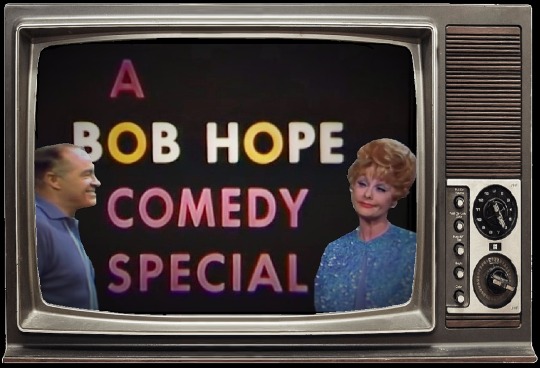
Directed
by Jack
SheaWritten
by Mort
Lachman, Bill Larkin, John Rapp, Lester A. White, Charles Lee, Gig
Henry
Bob
Hope
(Himself, Host) was born Lesley Townes Hope in England in 1903.
During his extensive career in virtually all forms of media he
received five honorary Academy Awards. In 1945 Desi Arnaz was the
orchestra leader on Bob Hope’s radio show. Ball and Hope did four
films together. He appeared as himself on the season
6 opener
of “I Love Lucy.” He did a brief cameo in a 1964 episode of “The
Lucy Show.”
When Lucille Ball moved to NBC in 1980, Hope appeared on her welcome
special.
He died in 2003 at age 100.The Leading Ladies (in alphabetical Order):

Lucille
Ball (1911-1989)
was
born in Jamestown, New York. She began her screen career in 1933 and
was known in Hollywood as ‘Queen of the B’s’ due to her many
appearances in ‘B’ movies. With Richard Denning, she starred in a
radio program titled “My Favorite Husband” which eventually led
to the creation of “I Love Lucy,” a television situation comedy
in which she co-starred with her real-life husband, Latin bandleader
Desi Arnaz. The program was phenomenally successful, allowing the
couple to purchase what was once RKO Studios, re-naming it Desilu.
When the show ended in 1960 (in an hour-long format known as “The
Lucy-Desi Comedy Hour”) so did Lucy and Desi’s marriage. In 1962,
hoping to keep Desilu financially solvent, Lucy returned to the
sitcom format with “The Lucy Show,” which lasted six seasons. She
followed that with a similar sitcom “Here’s Lucy” co-starring
with her real-life children, Lucie and Desi Jr., as well as Gale
Gordon, who had joined the cast of “The Lucy Show” during season
two. Before her death in April 1989, Lucy made one more attempt at a
sitcom with “Life With Lucy,” also with Gordon, which was not a
success and was canceled after just 13 episodes.
Joan
Caulfield
(1922-1991) with Bob Hope: Monsieur
Beaucaire
(1946), Variety
Girl
(1947), “The Bob Hope Show” (1957, 1960)
Joan
Collins (b.
1933)
with
Bob Hope: The
Road to Honk Kong
(1962), “The Bob Hope Show” (1959, 1962)With
Lucille Ball: “All-Star Party for Lucille Ball” (1984), “Night
of 100 Stars II” (1985)With
Lucille Ball and Bob Hope: “Women I Love: Beautiful But Funny”
(1982)
Arlene
Dahl
(b. 1925) with Bob Hope: Here
Come The Girls
(1953)
Phyllis
Diller (1917-2012)
with
Bob Hope: “Hollywood Star Spangled Revue” (1966), “The Bob Hope
Vietnam Christmas Show” (1966), Boy
Did I Get a Wrong Number!
(1966), “Kraft Music Hall: The Phyllis Diller Happening” (1967),
“The Phyllis Diller Show: Learn To Be A Millionaire” (1967), “The
Bob Hope Show” (1967, 1970), Eight
on the Lam
(1967), “Rowan and Martin at the Movies” (1968), The Private Navy
of Sgt. O’Farrell (1968), “George Jessel’s Here Comes the Stars:
Bob Hope” (1969), “The Bob Hope Show: Bob Looks at Women’s Lib”
(1970), “The Bob Hope Show: Bob Hope’s 22nd Anniversary” (1971), “Plimpton! Did You Hear the One About?”
(1971), “The Dean Martin Celebrity Roast: Bob Hope” (1974), “Bob
Hope’s Bicentennial Star-Spangled Special” (1976), “Joys”
(1976), “The Bob Hope Comedy Special from Palm Springs” (1978),
“The Bob Hope Funny Valentine Special” (1981), “The
Merriest of the Merry: Bob Hope’s Christmas Show, A Bagful of Comedy”
(1982), “George Burns Celebrates 80 Years in Show Business”
(1983), “Bob Hope’s Happy Birthday Homecoming” (1984),
“All-Star Party for Dutch Reagan” (1985), “All-Star Tribute to
General Jimmy Doolittle” (1986), “Hope News Network” (1988),
“Bob Hope’s USO Christmas from the Persian Gulf: Around the World
in Eight Days” (1988), “Ole! It’s Bob Hope’s Spring Fling of
Comedy and Music from Acapulco” (1990), “Bob Hope: The First 90
Years” (1993), “Bob Hope’s Birthday Memories” (1994), “Bob
Hope’s Young Comedians” (1995), “100 Years of Hope and Humor”
(2003)With
Lucille Ball and Bob Hope:
“Swing Out, Sweet Land” (1970), “The Dean Martin Celebrity
Roast: Lucille Ball” (1975), “Women I Love: Beautiful But Funny”
(1982), “Happy Birthday, Bob” (1978) (1983), “Bob
Hope’s Unrehearsed Antics of the Stars (1984)”, “Bob
Hope Buys NBC?” (1985), “Bob Hope’s High-Flying Birthday”
(1987), “Bob Hope’s High-Flying Birthday Extravaganza” (1986),
“America’s Tribute to Bob Hope” (1988), “Happy
Birthday, Bob: 50 Stars Salute Your 50 Years with NBC” (1988)Female
Impersonator Jim Bailey did his impersonation of Phyllis Diller on a
November 1972 episode of “Here’s Lucy.”
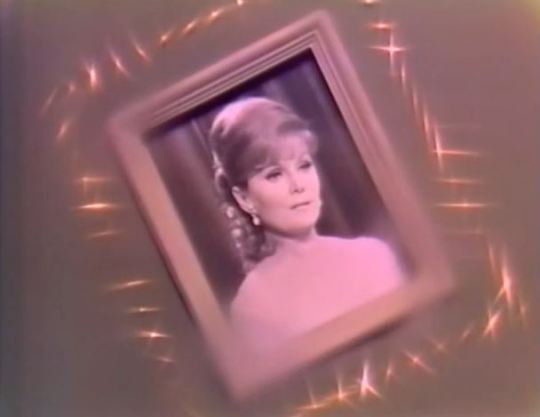
Rhonda
Fleming (b.
1923) with
Bob Hope: The
Great Lover
(1949), “The Bob Hope Show” (November 24, 1957 & December 11,
1959) “The All-Star Christmas Show” (1958), Alias
Jesse James (1959),
The
Road to Eltham
(1978), “All-Star Party for Dutch Reagan” (1985)With
Lucille Ball and Bob Hope: “Bob Hope Presents: Have Girls, Will
Travel” (1964), “Dinah: Bob Hope The Road to Hollywood” (1977),
“Bob Hope’s Road to Hollywood” (1983)
Joan
Fontaine
(1917-2013) with Bob Hope: Casanova’s
Big Night
(1954)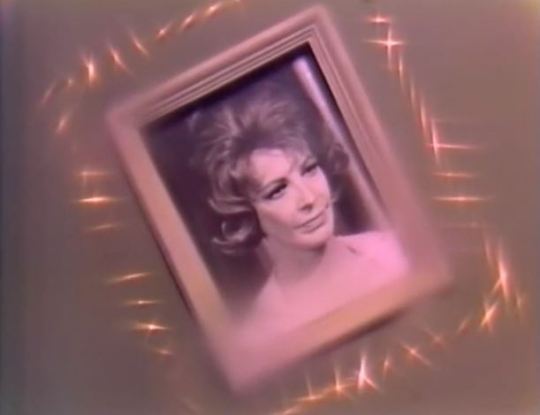
Signe
Hasso (1910-2002)
with Bob Hope:
Where There’s Life (1947),
“Bob Hope Presents: Code Name Heraclitus Parts One and Part Two“
(1966 & 1967)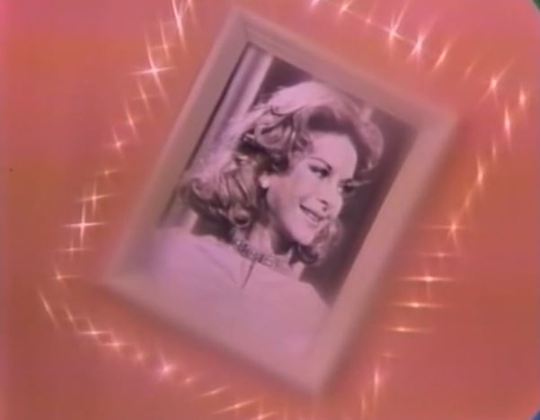
Hedy
Lamarr
(1914-2000) with Bob Hope: My
Favorite Spy
(1951)
Dorothy
Lamour
(1914-1996) with Bob Hope: The
Big Broadcast of 1938, Road To Singapore
(1940), Road
To Zanzibar
(1941), Caught
In the Draft
(1941), Road
To Morocco (1942),
Star
Spangled Rhythm
(1942), They
Got Me Covered (1943),
Road
To Utopia
(1945), My
Favorite Brunette
(1947),
Variety Girl
(1947), Road
To Rio
(1947), “All-Star Revue” (1951), The
Greatest Show on Earth (1952),
Road
to Bali
(1952), “The Bob Hope Show” (1954 & 1956), “The Arthur
Murray Special for Bob Hope” (1960), “The Bob Hope Show” (March
& April 1962), The
Road To Honk Kong (1962),
“Bing Crosby Special: Making Movies” (1968), “The Annual
National Sports Award” (1974),
The Road To Eltham (1978),
“The John Davidson Show” (February 1982), “All-Star Party for
Dutch Reagan” (1985), “Bob Hope and Friends: Making New Memories”
(1991),With
Lucille Ball and Bob Hope: “Dinah: Bob Hope The Road to Hollywood”
(1977), “Women I Love: Beautiful But Funny” (1982), “Bob Hope’s
Road to Hollywood” (1983), “Happy 100th Birthday Hollywood” (1987)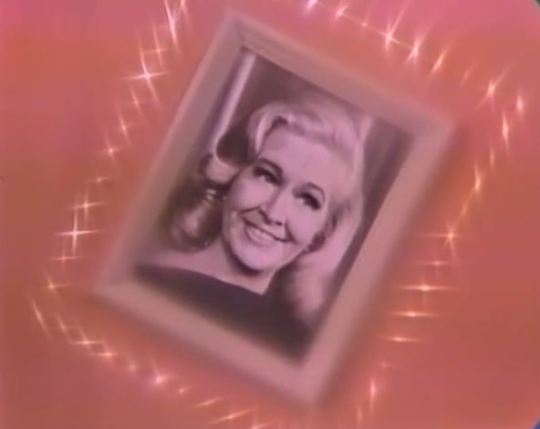
Marilyn
Maxwell (1920-1972)
with Bob Hope: “The Colgate Comedy Hour” (1950, 1951, 1953,
1953), The
Lemon Drop Kid
(1951), Off
Limits
(1952), “The Bob Hope Show” (1954)With
Lucille Ball: DuBarry
Was A Lady
(1943), Thousands
Cheer
(1943), Forever
Darling (1956),
“Here’s Lucy: Lucy The Co-Ed” (1970)With
Lucille Ball and Bob Hope: Critic’s
Choice
(1963), “Bob Hope Presents: Have Girls, Will Travel” (1964)
Virginia
Mayo
(1920-2005) with Bob Hope: The Princess and the Pirate (1944),
“All-Star Party for Dutch Reagan” (1985)With
Lucille Ball and Bob Hope: “Bob Hope’s Road to Hollywood” (1983)
Dina
Merrill
(1923-2017) with Bob Hope: I’ll
Take Sweden
(1965)With
Bob Hope and Lucille Ball: “Bob Hope’s Road to Hollywood” (1983)
Vera
Miles (b.
1929) with Bob Hope: Beau
James
(1957), “America’s All-Star Tribute To Elizabeth Taylor” (1989)
Janis
Paige (b. 1922) with Bob Hope: “The Colgate Comedy Hour” (1951),
“The Bob Hope Show” (1954, 1955, 1957, 1957, 1959, 1961, 1962,
1963, 1963, 1965),
Roberta
(1958), “The Tonight Show” (1963), Roberta
(1969), “All-Star Party for Dutch Reagan” (1985)With
Bob Hope and Lucille Ball: “Women I Love: Beautiful But Funny”
(1982), “Bob Hope’s Road to Hollywood” (1983)Also
Starring: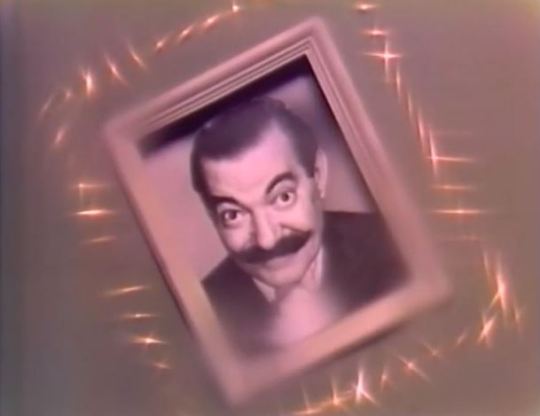
Jerry
Colonna
as Smithers,
Lucy’s Chauffeur
(1904-1986) with Bob Hope: Watch
the Birdie (1935),
College Swing
(1938), Road
To Singapore
(1940), Star-Spangled
Rhythm
(1942), Road
To Rio
(1947), “The Colgate Comedy Hour” (1953), “The Bob Hope Show”
(1954, 1956, 1959, 1959, 1960, 1961, 1962, 1964, 1966, 1967, 1968,
1969, 1970, 1971, 1973), The
Road To Honk Kong
(1962), “The Bob Hope Christmas Show” (1962), “The Bing Crosby
Show” (1964), “The Bob Hope Vietnam Christmas Show” (1966),
“The Bob Hope Special” (1971), “Dinah!” (1975), “Joys”
(1976)With
Lucille Ball: G.I.
Journal (1946)
Paul
Lynde as Doctor Fleischer (1926-1982)
with Bob Hope: “Bob Hope Presents: The Blue-Eyed Horse” (1966),
“The Bob Hope Show” (1967), “The Hollywood Squares” (1967),
“Donny and Marie” (1975), “The Dean Martin Celebrity Roast:
Dean Martin” (1976), “Bob Hope for President” (1980)With
Bob Hope and Lucille Ball: “The Dean Martin 1968 Christmas Show”,
“The Dean Martin Show” (1970)With
Lucille Ball: “Donny and Marie” (1977)
Ken
Murray as Harvey Sarnoff (1903-1988)
with Bob Hope: Rough But Hopeful (1946), “The Colgate Comedy Hour”
(1951), “The Bob Hope Show” (1957, 1967, 1973)With
Lucille Ball: “The Ken Murray Show” (1950)
Les
Brown and His Band of RenownFeaturing
on Tonight’s Show (End Credits):Phil
Arnold as Delivery Boy (1909-1968)
with Bob Hope: I’ll Take Sweden (1965), “The Bob Hope Show”
(1967), Eight on the Lam (1967)With
Lucille Ball: “I Love Lucy”: “Lucy is Matchmaker” (1953)
and “Lucy Changes Her Mind” (1953)Frank Barton (Announcer)
Lilyan
Chauvin
as Mary,
Dina Merrill’s Maid (1925-2008)Bob
Jellison as Phyllis Diller’s Hairdresser (1908-1980)
with Bob Hope: “The Bob Hope Show” (1955, 1963, 1968, 1969, 1969,
1970, 1971)With
Lucille Ball: “I Love Lucy: The Gossip” as the Milkman
(1953); “I Love Lucy” Hollywood episodes as Bobby the Bellboy (6
episodes,1955); “The Lucy-Desi Comedy Hour: Lucy Hunts
Uranium” as Las Vegas Bellhop (1958)With
Lucille Ball and Bob Hope: “The
Bob Hope Show” (1962)Ray
Kellogg
as H.B., Dina Merrill’s Director
(1919-1981) with Bob Hope: “The Bob Hope Show” (1969, 1971, 1971)With
Lucille Ball: “I Love Lucy” (1954, 1955), “The Lucy Show” (6
episodes 1964-68), “Here’s Lucy” (1968, 1969), “Jack Benny’s
Birthday Special” (1969)Johnine
Lee
as NBC
Page
(b. 1950) with Bob Hope: “The Bob Hope Show” (April 1966)Peter
Leeds
as Hank Hellman, Reporter (1917-1996)
with Bob Hope: “The Red Skelton Hour: Clem and Married Life”
(1951), “The Bob Hope Show” (13 episodes, 1955-1967), “The
Colgate Comedy Hour” (1955), “The Bob Hope Christmas Show”
(1962, 1965), “The Bing Crosby Show” (1964), “The Bob Hope
Comedy Special” (1965, 1972), I’ll
Take Sweden
(1965), The
Oscar
(1966), Eight
on the Lam (1967),
“Bob Hope Lampoons Show Business” (1990), “Bob Hope and
Friends: Making New Memories” (1991)With
Lucille Ball and Bob Hope: “I Love Lucy: Lucy and Bob Hope”
(1956), The
Facts of Life
(1960)With
Lucille Ball: “I Love Lucy: The Publicity Agent” (1952), The
Long, Long Trailer
(1954), “Here’s Lucy: Lucy and Candid Camera” (1971)Eddie
Marr as Joseph, Joan Caulfield’s Chauffeur (1900-1987)
with Bob Hope: “The Bob Hope Show” (8 episodes, 1956-1972), “Bob
Hope’s All-Star Comedy Spectacular from Lake Tahoe” (1977)With
Bob Hope and Lucille Ball: “The Bob Hope Show” (1970)With
Lucille Ball: The
Affairs of Annabel (1938)Michael
Ross as Bob Hope’s
Masseur
(1911-1993) with Bob Hope: My
Favorite Spy
(1951), The
Lemon Drop Kid (1951),
Off
Limits
(1952), Here
Come the Girls
(1953), Casanova’s
Big Night
(1954), Alias
Jesse James
(1959), “The Bob Hope Christmas Show” (1965), “The Bob Hope
Show” (1965, 1969)With
Lucille Ball: Miss
Grant Takes Richmond
(1949)Archive
FootageMadeleine
Carroll (1906-1987)
as Karen Bentley in My
Favorite Blonde
(1942)Anita
Ekberg (1931-2015)
as Luba in Call
Me Bwana
(1963)Jane
Russell (1921-2011)
as Calamity Jane in The
Paleface (1948)
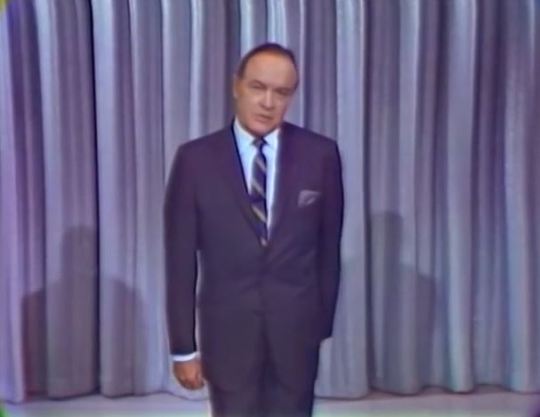
Bob’s
Opening MonologueHope:
“I’m
B.O.B. Hope. They only performer on TV who isn’t from
U.N.C.L.E.”“The
Man from U.N.C.L.E” (1964-68) was a hit NBC spy series at the time.
Two days later the show presented the third episode of their third
season, which coincidentally also starred Joan Collins.Hope
jokes that the title of this show is “15 of My Leading Ladies” or
“Richard Burton Eat Your Heart Out”. Both Burton and Elizabeth Taylor are mentioned during the show. Two years earlier, the two stars had wed and become one of Hollywood’s super couples. They would appear on “Here’s Lucy” in 1970.Hope:
“I always enjoyed working with Lucille Ball. She’s the nicest
producer I’ve ever kissed.”Hope
says that he will be appearing on Lucy’s show in exchange. He
actually had already done so, doing a walk-on cameo in a 1964 episode
of “The Lucy Show” guest-starring Jack Benny. Reciprocal appearances
by Hope and Ball were common and date back to the early 1950s.Hope
talks about the new TV shows like “How The West Was Won,” linking
it to discussion of California politics talking about Governor Pat
Brown and Ronald Reagan, who ran against Brown and won, becoming
Governor in January 1967. Hope jokes about First Lady Lady Bird
Johnson’s visit to California on a “Beauty and Conservation Tour”
in early September 1966.He
talks more about TV shows with animal names in the title like “Rat
Patrol,” “T.H.E. Cat,” “Iron Horse” and “The Monkeys”.
He says that “Run Buddy, Run” and “The Fugitive” had a
head-on collision. “Daktari” and “Rawhide” are both
returning.

After
a commercial break, a film segment depicts an armored car with a two
motorcycle escort pulling up to the NBC Studios where Bob Hope, golf
clubs in tow, emerges from the truck. When Bob gets inside his
dressing room there is a surprise party waiting for him, thrown by
the NBC executives to celebrate his 30th year at the network. One of the men is named Sarnoff (Harvey, a
nephew of NBC founder David Sarnoff), and the other two are named Hubert and
Humphrey, a jab at the current vice president.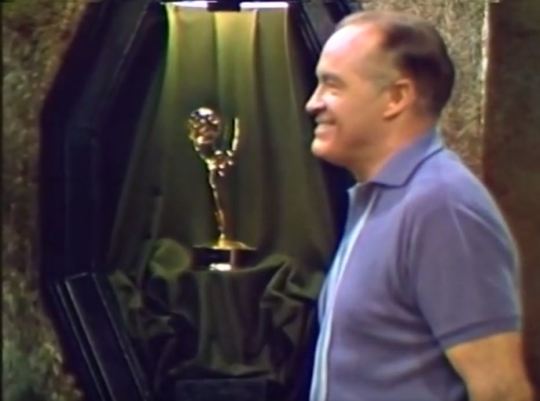
Hope’s Emmy is dramatically
behind an elaborate curtain. He won it in 1966 for “Bob Hope
Presents The Chrysler Theatre.” Although Hope received the
Governor’s Award in 1984, this was his only competitive Emmy.The
Executives leave Hope to get a physical by a doctor (Paul Lynde) –
which is an exercise in futility, especially when a buxom blonde Page (Johnine Lee) delivers some telegrams to Hope, making his face twitch. The Doctor
turns into Hope’s therapist. He recalls some of his leading ladies
accompanied by clips of the films in which he starred with them.
Madeleine
Carroll
in My
Favorite Blonde
(1942), Anita
Ekberg
in Call
Me Bwana
(1963), and Jane
Russell
in The
Paleface (1948),
and a gorilla (“The one time Crosby let me win the girl.”)
Hope
relates that he has the same dream every night, all alone with his
leading ladies. The dream materializes, and Hope is seen in a tuxedo
in an elegant, cloud-like setting with fountains and chandeliers. He
sees Marilyn
Maxwell
and they slow dance.Maxwell:
“Bob,
when are we going to do another picture together?”
Hope:
“Don’t
be greedy. I put you in this dream, didn’t I?”Maxwell
dances off and is replaced by Rhonda
Fleming.Fleming:
“Is
this a private dream, or can anyone cut in?”Fleming
asks for a kiss. Hope dips her and up comes Arlene
(“with
the beauty spot”)
Dahl.
Dahl sings “I Believe In You,” a song written by Frank Loesser
for the 1961 Broadway musical How
To Succeed in Business…Without Really Trying.
Maxwell and Fleming join Dahl in singing to Hope. The three women
vanish as the show goes to commercial.

Back
with the Doctor in his dressing room Bob is having his blood pressure
taken.Hope
(muttering):
“Shirley
Ross, Martha Hyer, Yvonne DeCarlo, Milly Vitale, Vera Zorina, Betty
Grable…”While
he’s listing the women, the blood pressure cuff balloons! The Doctor
asks Hope when it all started, and a flashback begins at Schwab’s
Drugstore 28 years earlier (1938). [An establishing slide of the
exterior of Schwab’s looks nothing like the actual Hollywood
landmark.]
In the flashback, Hope walks into the drug store with a
head of dark hair, sunglasses, yellow shoes, pink trousers, and a
purple check sport coat. Virginia
Mayo is
behind the pharmacy counter.Hope:
“I
got so many jobs right now I’m trying to decide between a big musical
for Arthur Freed or a comedy for George Marshall.”George Marshall would later direct several on-location episodes of “Here’s Lucy.” Marshall had first directed Ball in Valley of the Sun (1942) and with Hope in Fancy Pants (1950).

Mayo
says she’s working on a new act, but one of her two partners is
quitting. She calls the act in and it is a pantomime horse. Mayo
intimates that Hope could play the back end to
“take advantage of his best side.”Bob
runs into Janis
Paige. He
tries to convince her to be his escort to a soiree. While pasting his
8 by 10 over magazine covers, he meets Joan
Collins.
They have lunch together at the soda fountain counter where Hope
criticizes everything she orders. Janis Paige grabs him away and
sings “Big Spender,” a song written by Cy Coleman and Dorothy
Fields for the 1966 Broadway musical Sweet
Charity.
Mayo and Collins join her.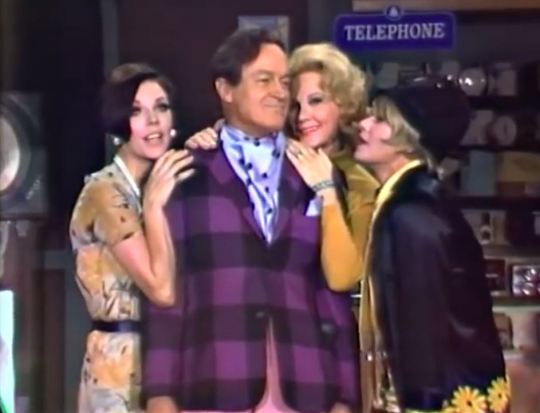
Back
in the dressing room, the Doctor leaves Bob with a prescription and
Harvey Sarnoff returns to introduce Hope to Hank Hellman (Peter Leeds), a reporter.
After checking the room for spies, Bob announces that he’s going to
make Gone
With The Wind
as a musical.Hellman:
“It’ll
be bigger than ‘My Fair Lady’ and ‘Mary Poppins’ combined!”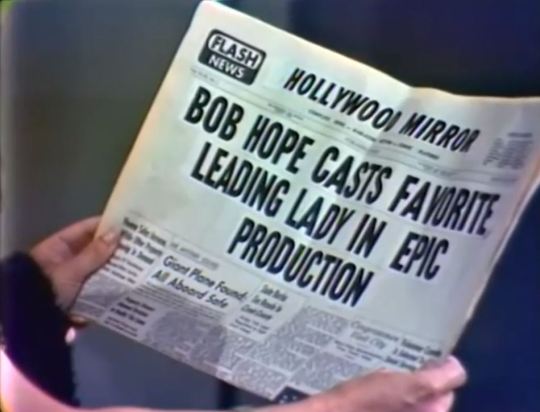
Actually,
there was a Gone
With The Wind
musical by Harold Rome – on the London stage. It premiered in 1972
and was revived in 2008. The search for an actress to play Scarlett
O’Hara for the original 1939 film was one of Hollywood’s biggest
publicity stunts, with over 1,400 actresses auditioned before the
role went to Vivien Leigh.- On
a sound stage, Vera
Miles
walks off her latest picture thinking she is the one to play Scarlet. - At
an airport, Joan
Caulfield cancels
a trip thinking she is the next Scarlett. - At
her home, Dina
Merrill
tells her maid to unpack because Bob Hope needs her. - At
a corner newsstand, Signe
Hasso tells a news vendor that she’s from the south – of Sweden – so ideal for Scarlett. - At
the beauty salon, Phyllis
Diller
is perusing a magazinethat makes her think she’s the one to get the
role.

At
Bob Hope’s home, he’s getting ready for bed. Hedy
Lamarr
shows up to thank him for casting her. Joan
Fontaine
is on her way up, so Hope asks Lamarr to study the script – in the
closet. When he hears Dorothy
Lamour
is coming, he stows Fontaine in another room. Hearing sirens, he
tells Lamour to wait in the bathroom. It is Lucy!
Lucile Ball arrives pedaling
an adult-size tricycle with Smithers (Jerry Collona), her chauffeur behind
her.Hope:
“Lucille
Ball! What happened to your car?”
Ball:
“Oh,
Gary got up earlier than I did.”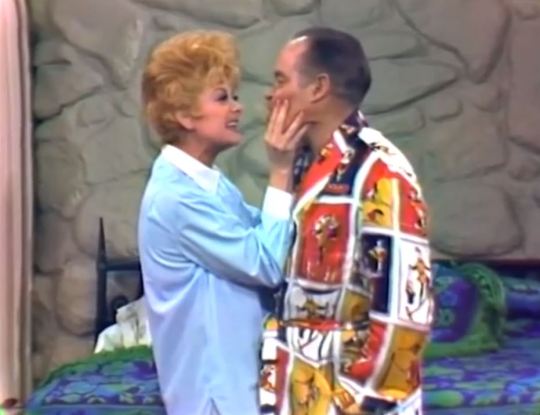
Like
the other leading ladies, Lucy is convinced she’s the one playing
Scarlett. As a young RKO contract player, Lucille Ball was one of
the 1,400 actresses considered for the role in the 1939 MGM film.
Soon, all the women come into the room demanding to know which one
has been cast.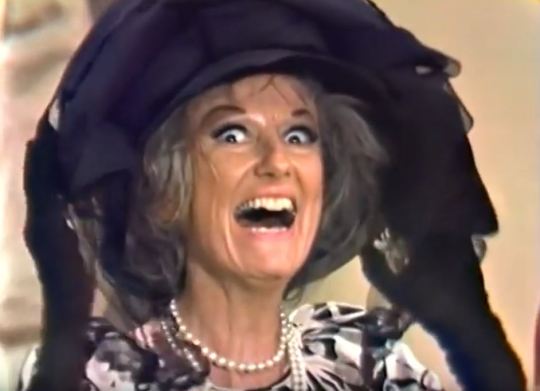
Including a surprise contender with a black veil –
Phyllis Diller, who gets the part!
In
this scene, Lucille Ball and Bob Hope crack each other up to the
point that Lucy looks to the director as if to say “Are we cutting
or not?” The other actresses in the sequence are all directed to
acknowledge the studio audience’s entrance applause before going back
into the scene. The scene is somewhat clumsily filmed and edited,
with the boom mic frequently in the shot, and even the end of the
bedroom carpet visible.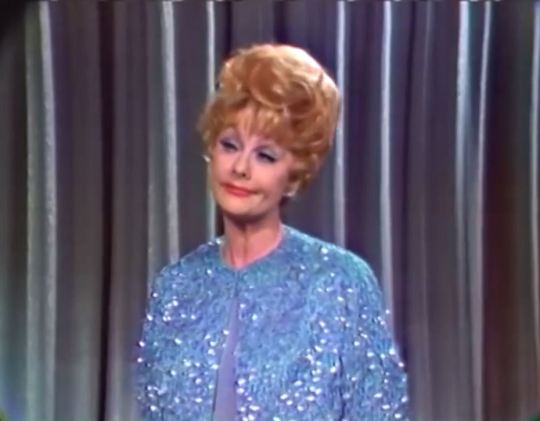
After
a preview of “And Baby Makes Five,” the next presentation on “Bob
Hope Presents The Chrysler Theatre,” Hope and all the leading
ladies (each on their own) sing “Thanks For the Memory” with
special lyrics about Bob Hope. Lucy’s verse compares him to Turhan
Bey, a Turkish actor active
in Hollywood
from
1941 to 1953.

“Lucy the Bean Queen” (TLS S5;E3) ~ was aired on CBS two days earlier,
September 26, 1966. Interestingly, Lucille Ball wears the same blue shirt that she wears on the “Bob Hope Show”!
This
Date in Lucy History ~ September 28th
“Lucy
and the Plumber” (S3;E2) – September 28, 1964 (coincidentally featuring a cameo by Bob Hope!)
“Lucy
and Sammy Davis, Jr.”
(S3;E3) – September 28, 1970Anita Ekberg, Arlene Dahl, Bob Hope, Bob Hope Comedy Special, Bob Jellison, Dina Merrill, Dorothy Lamour, Eddie Marr, Frank Barton, Jane Russell, Jerry Collona, Joan Caulfield, Joan Collins, Joan Fontaine, Ken Murray, Leading Ladies, Les Brown, Lucille Ball, Lucy, Madeleine Carroll, Marilyn Maxwell, Michael Ross, Paul Lynde, Phil Arnold, Phyllis Diller, Ray Kellogg, Rhonda Fleming, Signe Hasso, Vera Miles, Virginia Mayo - On
-
LUCY’S BICENTENNIAL MINUTE
November 28, 1974

“The Bicentennial Minutes”
Premiering July 4, 1974, the CBS series consisted of 732
one-minute programs, each recounting an authenticated piece of
American history – everything from the momentous to the obscure.
Each dealt with something that happened exactly 200 years earlier on
the same date as the broadcast. The series was originally slated to
end on July 4, 1976, but was extended to the end of the year. In
1976, the series received an Emmy Award in the category of Special
Classification of Outstanding Program and Individual Achievement.
The narrator of each minute was a well-known personality
from various professions; celebrities such as Richard Widmark,
Edward Asner, Norman Cousins, Jean Stapleton, Glenn Ford, Walter
Cronkite, Cleveland Amory, Richard Chamberlain, and Father Ellwood
Kieser.
Actor Charleton Heston narrated the first one, which
described George Washington’s concern about the closing of Boston
Harbor by the British as a result of the Boston Tea Party. The
Bicentennial Minute on July 3, 1976, was narrated by Vice President
Nelson Rockefeller. The episode on Independence Day 1976, was
narrated by First Lady Betty Ford. The final Bicentennial Minute on
December 31, 1976 was narrated by President Gerald Ford.The series was so popular it was parodied and referenced
on many other television programs like “The Carol Burnett Show,”
“Rhoda,” “Hee Haw,” “All in the Family,” and many others.
When it ended, it was replaced by CBS Newsbreak, a one-minute
recounting of the day’s headlines.
Lucille Ball was invited to narrate the episode that
would air on Thanksgiving evening, November 28, 1974, at the
conclusion of a two-hour episode of “The Waltons.” The subject
matter dealt not with the impending Revolution, but with corn
husking, and how the activity provided colonists in New England with
a welcome break from the monotony of farm life. Born in upstate New
York, Lucy closely identified with New England, something she talked
about on several talk shows.
“Bicentennial Minutes” were produced for CBS by William Kayden. Lewis Freedman served as Executive Producer, and Meryle Evans and Researcher and Assistant Producer. The program was sponsored by Shell Oil Company then later by Raid (insecticide) from July 1976 onward.

Ten days earlier, on November 19, 1974, CBS presented the first of Ball’s
post-”Here’s Lucy” specials, “Happy Anniversary and Goodbye”
starring Nanette Fabray, Peter Marshall, and Art Carney.Because the “Minutes” may never be seen again (except possibly in some home video format) here are some stills from the segment and the text of Lucy’s narration. The segment was video-taped on October 15, 1974.

The Script of Lucy’s Minute:
Two hundred years ago today…New England farmers were
enjoying lively corn shucking parties in the crisp night air.Corn was piled into great heaps, and bonfires burned in
the fields. Young people ran and flirted in the shadows.A Yankee farmer remembered how it was: “…the
neighboring swains are invited and after the corn is finished, they
give three cheers…but cannot carry in the husks without a rum
bottle. They feign great exertion, but do nothing until the run
enlivens them, then all is done in a thrice…”And when the work was done?
“The chairs in wild disorder flew quite around the
room.
Some threatened with firebrands, some brandished a
broom,
While others resolved to increase the uproar,
Lay
tussling the girls in wild heaps on the floor.”I’m Lucille Ball and that’s the way it was.
The closing line (used in every episode) was an
offhand reference to the close of the CBS Evening News with Walter
Cronkite, who always ended each news telecast by saying, “And
that’s the way it is."
More Revolutionary Revelations!

During her career Lucy did her own riff on the Revolutionary War
period. The last episode of “I Love Lucy” (1956) was set during
Westport’s Yankee Doodle Dandy Day and finds the characters dressed
in revolutionary era costumes – with Lucy standing in for the
statue of a Minuteman she accidentally destroyed by backing into it
with the station wagon.
When “Lucy and Viv Open a Restaurant” (TLS S2;E20) in 1964,
one of the concepts they try out is a colonial-themed restaurant with
Lucy and Viv dressed as George and Martha Washington to lure in
patrons!
That same year, on “The Jack Benny Program”
(S15;E2) Lucille Ball took the role of Mrs. Rachel Revere, opposite
Benny’s Paul to tell the true story of what happened that fateful
night of April 18, 1775. Betsy Ross and George Washington were also characters in the sketch.
On a 1973 episode of “Here’s Lucy” an antique chair (a rare
Twimby) is rumored to have belonged to George Washington at his Mount
Vernon home. Naturally, Lucy Carter can’t live without it –
especially when she learns it may be valuable. Unfortunately for Lucy, the unscrupulous antiques dealer feels the same way!
Lucille Ball often said that there was some Ball blood in George
Washington since his mother’s maiden name was Mary Ball. Genealogists say that the Father of Our Country is the 8th cousin
7 times removed to the Queen of Comedy!

-
LUCY & CHER… AND OTHER FANTASIES
April 3, 1979

Directed
by Art FisherWritten
by Buz Kohan, Arthur Sellers, Patricia Resnick, Cher
Choreography
by Joe Layton
Cher
(Cher) was born Cherilyn Sarkisian in 1946 and has gone on to be one
of entertainments most enduring celebrities. She has been seen on
Broadway, in films (winning an Oscar in 1987), on television (Emmy
Award in 2003), and concert stages worldwide. As
a singer Cher is the only performer to have earned top 10 hit singles
in four consecutive decades. She is also one of the most imitated
singers of all time, including by Lucie Arnaz on a 1973 episode of
“Here’s Lucy” (with full cooperation of Cher herself). Cher’s
mother, Georgie Holt, appeared as one of the Jacques Marcel models in
“Lucy Gets a Paris Gown” (ILL S5;E20) as well as as a fur fashion
model in “Lucy and Pat Collins” (TLS S5;E11). Cher is currently
promoting her appearance in the movie musical Mamma
Mia: Here We Go Again (2018) and a Broadway musical based on her life, The Cher Show.
Lucille
Ball (Cleaning
Lady)
was
born on August 6, 1911 in Jamestown, New York. She began her screen
career in 1933 and was known in Hollywood as ‘Queen of the B’s’
due to her many appearances in ‘B’ movies. With Richard Denning,
she starred in a radio program titled “My Favorite Husband” which
eventually led to the creation of “I Love Lucy,” a television
situation comedy in which she co-starred with her real-life husband,
Latin bandleader Desi Arnaz. The program was phenomenally successful,
allowing the couple to purchase what was once RKO Studios, re-naming
it Desilu. When the show ended in 1960 (in an hour-long format known
as “The Lucy-Desi Comedy Hour”) so did Lucy and Desi’s
marriage. In 1962, hoping to keep Desilu financially solvent, Lucy
returned to the sitcom format with “The Lucy Show,” which lasted
six seasons. She followed that with a similar sitcom “Here’s
Lucy” co-starring with her real-life children, Lucie and Desi Jr.,
as well as Gale Gordon, who had joined the cast of “The Lucy Show”
during season two. Before her death in 1989, Lucy made one more
attempt at a sitcom with “Life With Lucy,” also with Gordon,
which was not a success and was canceled after just 13 episodes.
Elliott
Gould (Sign
Painter) is an actor best known for playing Trapper John in the 1970
film M*A*S*H. He was nominated for an Oscar for Bob
& Carol & Ted & Alice
(1969), a film Lucille Ball helped parody (as Alice) on a 1969
episode of “The Carol Burnett Show.” Gould was featured in
Oceans
8 and
is currently in pre-production for Romancing
Brazil. This is his only appearance with Lucille Ball.
Shelley
Winters
(Shelley) was
born Shirley Schrift in 1920 (some sources list 1922) in Illinois.
Her screen acting career began in 1943 under the name Shelley Winter
(no ‘s’). It culminated in two Oscars for Best Supporting Actress
in the films The
Diary of Anne Frank
in
1960 and A
Patch of Blue in
1966. She also won a 1964 Emmy. Winters was married four times and
known for her brash sexuality. She had an uncredited role in the 1946
Lucille Ball film Two
Smart People and
played a version of herself in “Lucy and Miss Shelley Winters”
(HL S1;E4) in 1968.
She
died in 2006.
Andy
Kaufman
(Adam) was
a performance artist and comedian. He is best known for playing Latka
Gravas on the TV sitcom “Taxi.” Andy appeared in movies, on
Broadway, did a one man show at Carnegie Hall, enjoyed a brief
professional wrestling career, and performed in concerts nationwide.
He appeared with Lucy on “Van Dyke & Company” in December
1976. He died in 1984 of lung cancer although the internet keeps alive the theory that he may be still alive.
Bill
Saluga
(Johnson, Cher’s Driver) of
the Ace Trucking Company comedy troupe, was seen all over television
in the seventies and early eighties as an obnoxious little fellow
named “Raymond J. Johnson, Jr.” When addressed as “Johnson”
though, he would launch into a tirade starting, “You doesn’t has
ta call me Johnson–you can call me RAY or you can call me JAY….”
He appeared on “The Tonight Show” with Lucille Ball in 1974.

Bob
Mackie and Ret Turner were nominated for Emmy Award for their
costumes. Mackie still creates fashions for Cher to this day and is depicted in the upcoming musical The Cher Show, as well as designing the show’s costumes. Turner died in 2016.This special was only aired once and never made commercially available on video, although low-quality copies can be found on YouTube and have been available by private dealers.

In
a cold open, Cher is alone singing “Ain’t Nobody’s Business”
(written
in 1922 by Porter
Grainger
and
Everett
Robbins)
as a variety of women from history, all adorned in period costumes by
Bob Mackie, of course. Among the fashion parade are some recognizable
figures: Eve, Cleopatra, Scarlett O’Hara, all in a cloud-like
setting. At the end of the number, the scene cross fades to Cher, dressed in street clothes, stepping off a dingy elevator into an empty building’s atrium.
With
no one around Cher talks to the camera – about herself (in the
third person) until she sees a sign painter (Elliott Gould) looking
for “the blue”.
Looking for a party, he directs her to enter a
door labeled “Food
for Thought Inc.”
The elegant room features eight fancy dressed, bejeweled party-goers,
gossiping around a dining table, the elegant hostess looking very
much like Cher. In fact, it is Cher. At one point a more somber Cher ‘leaves her body’
wearing jeans and a man-tailored shirt and sings “Love & Pain”
(written by Richard
T. Bear
in 1979). She observes hostess Cher getting an engagement ring from a handsome
guest. At the end of the song, the two Chers
merge.
Back
in the hallway of the atrium, street clothes Cher encounters the Sign Painter
again, complaining that it was the wrong party. He directs her to a
door labeled “Misery
Loves Company” where
she (now in a new outfit) encounters primly-dressed Shelley Winters
in a dark bedroom setting. As a saleslady, Shelley offers Cher tragedies
from the four corners of the world. “Your basic one, two, three
and four handkerchief categories.” [A laugh track is discretely
used here to suggest this is comedy.] She suggests something from the film Rocky, but Cher
finds the ending too happy. =Shelley’s eye catches sight of a movie
poster for Wuthering
Heights (1939),
which she calls “Withering Heights.” It’s not quite what Cher is
looking for, so Shelley offers Gone
With The Wind
(1939). Shelley is not doing a good job of selling the tragedy, so
Cher coaches her through a scene, pushing her face into a burlap sack
of dirt. Shelley does the same to Cher saying “Share [Cher] and Cher [share] alike!”Cher:
“Do
you have ‘Bambi’?”
Shelley:
“DEAR [deer],
you’re not the type. I don’t have that in stock, but I’ve got a rifle
from ‘Winchester 73.’”Winchester
73 was a 1950 film about a prized rifle that starred Shelley Winters and
James Stewart. Shelley fires the rifle in the air and Cher takes on
the roles of Bambi’s mother and father. The suggestions start coming
fast and furious: The
Wizard of Oz (1939),The
Fly (1958). Shelley becomes desperate to make a sale. [A poster for the
1970 film Love
Story is on the wall, but not mentioned.] Shelley’s real life turns out to
be just the tragedy that Cher needs, so she plunks down some cash on
the counter and leaves.
Back
in the atrium, the Sign Painter is labeling a door titled “By
The Numbers, Inc.”
Inside a surreal hallway with huge file cabinets holds back-up
dancers for Cher to sing an upbeat “Feel Like A Number” (written
by Bob Seger).
Back
in the atrium, the Sign Painter is on roller skates. He tells Cher the story of “The
Red Skates.”
Cher goes through a curtain and is in a fairy tale cobbler’s shop
where the Skate Maker is working. The Sign Painter narrates the story,
which is presented without dialogue. The red skates transform roller
disco Cher into a glamorous female Mercury on wheels. But the story
takes a dark turn when the Skate Maker teaches her a lesson about
giving in to the allure of the red skates.
Back
in the atrium, the Sign Painter has a sign around his neck “Out to
Lunch” and is sitting at a small cafe table. Cher joins him for
lunch and they eat imaginary food. Pointing Cher to an unseen door,
he says “Little
does she know, it’s a jungle out there.” Inside, Cher is found dressed in a leopard body suit lounging on a red velvet
settee in a jungle singing “More Than You Know” (written
by Youmans,
Rose and Eliscu in 1929).
Dribbling
a basketball and dressed as Adam (a leafy loin cloth over long
underwear) Andy Kaufman comes into the jungle naming various plants.
Cher is now a snake in a tree. She is there to give Adam some advice
before the arrival of Eve.Adam:
“But
why do I need an Eve? What can she do? Can she play ball?”
Snake (to camera):
“Does
Eddie Haskell love the Beaver?”
Eve
appears (also played by Cher) as a gum-snapping, sharp-tongued, nag wearing a
leopard print jumpsuit and cat glasses, a variation on a character Cher frequently played on her past variety shows.Eve:
“Hey
Adam! They told me you look like Redford, dance like Travolta, and
swing like King Kong.”
Back
in the atrium, street clothes Cher is running around looking for an
exit. The scene fades to a swanky lobby setting where Cher sings
“Take Me Home” (written by Michele Aller and Bob Esty for Cher’s
1979 album of the same name). For the first time, the ‘dream Cher’
is seen in the atrium setting. Taking the dingy elevator to the ground
level, street clothes Cher emerges singing the end of the song –
the personalities have merged.
From
one of the doors comes a Cleaning Lady (Lucille Ball) pushing a cart
and singing “Bibbidi–Bobbidi–Boo,”
a song written in 1948 by Al Hoffman, Mack David, and Jerry
Livingston for the 1950 Disney animated film Cinderella.
Cher startles the Cleaning Lady, who says she had ambitions to be a lawyer.
Cher just wants to get out of the building. The Cleaning Lady
suggests she wait till midnight when her white mice and pumpkin turn
into a coach and horses.
Cleaning
Lady:
“By
the way don’t bother catching a lizard because you don’t need a
footman these days. It’s gauche. Very gauche.”
Cher
(to camera): “I
wish I was the crying type. I’d be a lot happier right now.”The
Sign Painter dances on and the Cleaning Lady tells Cher they have a
“cursing acquaintance.” He suggests that Cher simply close her
eyes and wish herself home, a better method than the mice and pumpkin
suggested by the Cleaning Lady.
Cher:
“I
don’t know what to believe anymore.”
Sign
Painter:
“Faith can move mountains!”
Cleaning
Lady: “But
can it open doors?”Taking
a snip of the Sign Painter’s hair, the Cleaning Lady moves on and he
instructs Cher to click her heels together three times and say
“There’s no place like home.” She does it but it does not work.Cher:
“Nothing
happened! You’re no wizard!”
Sign
Painter:
“And
you’re no Judy Garland.”After
the commercial, street clothes Cher sits dejectedly on the atrium
steps singing a sad “Take Me Home.” Across the lobby she sees
the revolving doors open and runs out onto the street. She steps
into a car and tells the driver (Ray Saluga) “Home, Johnson!”
This launches the driver into his famous “Oh, you doesn’t have to
call me Johnson. You can call me Ray, or you can call me…”
routine. Cher looks directly into the camera with a smile as the
vehicle pulls away from the curb.End credits roll.
Other Fantasies…

Lucille Ball and Cher’s mother, Georgia Holt, first met when Holt played one of Jacques Marcel’s fashion models on “I Love Lucy” in “Lucy Gets a Paris Gown” (ILL S5;E26) in 1956. Cher was 9 years old at the time.

Holt also played a model on “The Lucy Show” in “Lucy and Pat Collins” (TLS S5;E11) in 1966. Cher was 19.

On “Here’s Lucy” (S6;E11) in 1973, Kim (Lucie Arnaz) and Frankie Avalon played Sonny and Cher at a talent show. Preparing for her imitation of the superstar, Avalon and Arnaz went to see a taping of “The Sonny and Cher Comedy Hour” in order to get some pointers. Cher loaned Lucie a wig, earrings and a pair of her eyelashes for the episode. They perform “I Got You Babe.”

Sonny and Cher were first mentioned in the series opener, “Mod, Mod Lucy” (S1;E1) in 1968 and then again in a 1970 episode (S3;E16), when Uncle Harry (Gale Gordon) calls Kim and Craig (Desi Arnaz Jr.) Sonny and Cher.

The Cher Show, the Broadway musical about Cher’s life includes Lucille Ball as a character. Her appearance is based on tabloid reports that Lucy gave Cher marital advice.
“Among the show’s nuttier moments is an encounter with Lucille Ball, when Cher is concerned about how the American public will react to her separation from Sonny Bono (Jarrod Spector) after he has worked her to exhaustion and shafted her out of a financial stake in their company. "Fuck him,” snarls Lucy, played by Emily Skinner as a brassy vaudevillian ham. Hilariously, she then launches into a big-sisterly take on “Heart of Stone,” all the while chugging on a cigarette. “My hand to God, guys, this conversation actually happened,” [Cher] tells us in one of many wry, fourth wall-breaking asides peppered through the show.“ ~ David Rooney, Hollywood Reporter, 12/3/18
1979, Andy Kaufman, Bambi, Bob Mackie, Cher, Cher and Other Fantasies, Cinderella, Elliott Gould, Emmy Award, Feel Like a Number, Georgia Holt, Gone With The Wind, Here’s Lucy, I love lucy, Joe Layton, Love Story, Lucille Ball, Lucy, More Than You Know, Ray Saluga, Shelley Winters, Sonny and Cher, Take Me Home, The Cher Show, The Fly, The Lucy Show, The Wizard of Oz, tv, Winchester 73, Wuthering Heights -
LUCY & GONE WITH THE WIND

In one of the biggest publicity stunts in Hollywood history, over 1,400 actresses were considered for the role of Scarlett O’Hara in MGM’s Gone With The Wind. Producer David O. Selznick had the rights to the book, but did not have the money to make it. To keep interest alive in the project during pre-production, he auditioned nearly every starlet in Hollywood: Paulette Goddard (the favorite), Bette Davis, Joan Crawford, Jean Arthur, Lana Turner, Barbara Stanwyck, Claudette Colbert, Susan Hayward, Katharine Hepburn, Tallulah Bankhead and Lucille Ball, who read for the role but never made a screen test.

On “Bob Hope’s Unrehearsed Antics of The Stars” (September 28, 1984) Ball recounted – with a fair amount of embellishment for comedic effect – her audition.
I had to audition for Mr. David O. Selznick and it was for Scarlett O’Hara in ‘Gone With the Wind’. Everybody knew it was just a huge publicity gimmick. But I was just a young starlet when you’re a under contract to a studio you do what you’re told to do.
After working six dreadful weeks with a dialogue coach who had a southern accent that just dripped molasses, the big day finally arrived. I knew it was ridiculous, but I had to go. I climbed into my old rattletrap car and as I reached Culver City I got caught in the biggest cloudburst I ever saw. The streets were flooded. My car stalled. I had to get out and wade six blocks to the studio. I got to the Selznick office looking like a drowned rat. Marcella, Selznick’s girl Friday, didn’t even recognize me. My hair was down over my face and the henna was running and so was my mascara. I was soaked clear through. Marcella made me take off all my clothes, gave
me a big towel and a huge brown sweater and put me on the floor in front of a roaring fireplace in Mr. Selznick’s private office. And she gave me a big brandy snifter with brandy in it.A half hour and four slugs of brandy later I was still a mess and still on my knees at the fireplace. Suddenly Mr. Selznick came in and said “Well, what have we here?” I said, “Well, I ain’t Scarlett O’Hara. I’m Lucille Ball and I wanna go home.” He said “Now, now. We have to do the scenes.” I said “I can’t. I can’t stand up.” I couldn’t stand up because what I was wearing didn’t cover me – and the four shots of brandy didn’t help either. But he said “Alright then, do it from there.” I had to audition on my knees.
Now the first scene was Scarlett as a sixteen year-old. When I tried to bat my eyes my eyelashes stuck together and they wouldn’t bat. Scarlett said something like “Well, I do declare! I do declare! You boys are so handsome in your gray uniforms. I swear, I’m just gonna miss you all so very, very much.” I’m still on my knees. Then I had a scene with Rhett Butler. I said“ Rhett Butler, you’re nothing but a no-good low-down Yankee spy and you can go back to where you come from and you can stay there!”
Selznick said “You were very interesting. Very interesting.” I said “I was not and you know it.” And then I just crawled out of the office on my knees holding onto the sweater trying to keep all the vital parts covered.
Although some of Ball’s recounting sounds plausible, she remarks that her henna (red hair dye) was running down her face. Ball didn’t dye her hair red for the first time until asked to do so by MGM for DuBarry Was a Lady in 1943. She was a natural brunette who was a blonde in some of her early work in order to stand out from the crowd.

During the time period that Gone With The Wind shot (January through July 1939), Lucille Ball made five films for RKO, with the fifth (That’s Right – You’re Wrong) released just three weeks before Gone With The Wind.

But this was not the last time Lucy would encounter Scarlett and Gone With the Wind. In the 1954 “I Love Lucy” episode “Lucy Writes a Novel” (ILLS3;E24) Lucy Ricardo is inspired to write a roman a clef about her life called “Real Gone with the Wind.” Fred replies “Yeah. Real gone!”

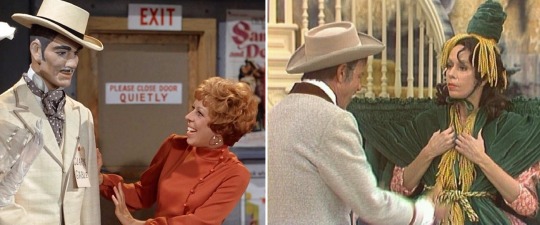
In 1971’s “Lucy and Carol Burnett: The Hollywood Unemployment Follies” (HL S3;E22) Lucy and Carol encounter mannequins of Clark Gable and Vivian Leigh dressed in costumes from Gone With The Wind. Carol, using a high pitched Southern accent, imitates Scarlet O’Hara. After the network premiere of the movie in 1976, Carol Burnett produced one her most famous sketches ever, playing Scarlett (re-named Starlett) in the parody “It Went With The Wind” on “The Carol Burnett Show.”


In September 1971, in “Lucy and Flip Go Legit” (HL S4;E1), Lucy Carter convinces Flip Wilson to play Prissy in her daughter Kim’s community theatre version of Gone With The Wind. Kim (Lucie Arnaz) plays Melanie, Uncle Harry (Gale Gordon) is Rhett, and Lucy finally gets to play Scarlett. Although Flip Wilson wearing an Abe Lincoln t-shirt as Prissy is very funny, the sketch does not hold a candle to Burnett’s 1976 endeavor.

In “Lucy’s Lucky Day” (HLS4;E15) Lucy Carter finds an overdue library book – Gone With The Wind – which she says took out when it was first published. The novel by Margaret Mitchell dates from 1936, which means that in 1971 Lucy has had the book out for 35 years! Imagine the fines!

In the 1958 promo film “Lucy Buys Westinghouse” Desi takes a Westinghouse representative on a helicopter tour of Desilu Culver (formerly RKO), a back lot located in Culver City, also known as Forty Acres. This is where MGM made Gone With The Wind. They pass over a destroyed Tara, twenty years after the film was made. Ironically, it is now owned by Lucille Ball!
Although Lucille Ball did not get cast, actors who did get roles in the film and later worked for Lucille Ball included:

George Reeves, Stuart Tarleton in GWTW / Superman in “Lucy and Superman” (ILL) [Reeves is incorrectly credited as Brent Tarleton in the film and only credited as ‘Superman’ on “I Love Lucy.”]

Olin Howland, Carpetbagger Businessman in GWTW/ Mr. Skinner in “First Stop” (ILL).

Irving Bacon, Corporal in GWTW / Will Potter in “Ethel’s Home Town” (ILL) and Mr. Willoughby in “The Marriage License” (ILL).

Alberto Morin, Rene Picard in GWTW / Waiter Robert DuBois in “The French Revue” (ILL) and Carlos in “Cuban Pals” (ILL)
Shep Houghton, Southern Dandy in GWTW / Courtroom Spectator in “Lucy and the Raffle” (HL) [That same year, Houghton was also a Winkie Guard in The Wizard of Oz.]
Ralph Brooks, Gentleman at 12 Oaks Barbecue in GWTW / Casino Patron in “Lucy Goes to Vegas” (TLS)
Hans Moebus, Party Guest in GWTW / Man on Dock in “Bon Voyage” (ILL), Riverboat Patron in “Lucy and Arthur Godfrey” (TLS) and Spectator in “Lucy at Marineland” (TLS) [Lucy wore the same dress in “Lucy and Arthur Godfrey” as she did as Scarlett O’Hara in “Lucy and Flip Go Legit.”]

Hattie McDaniel (Mammy in GWTW, inset) was the first black actress ever to win an Oscar, but she wasn’t the only McDaniel to have a ‘first ever’ recognition in show business. Her brother Sam McDaniel played the Porter in “The Great
Train Robbery” (ILL), and was the first and only black actor to have dialogue on “I Love Lucy.”Alberto Morin, Bob Hope, Carol Burnett, Culver City, David O. Selznick, Desilu, Flip Wilson, Gale Gordon, George Reeves, Gone With The Wind, Hans Moebus, Hattie McDaniel, Here’s Lucy, I love lucy, Irving Bacon, Lucie Arnaz, Lucille Ball, Lucy, Margaret Mitchell, MGM, Olin Howland, Ralph Brooks, RKO, Sam McDaniel, Scarlett O’Hara, Shep Houghton, Tara, That’s Right You’re Wrong, The Carol Burnett Show, The Lucy Show -
HOLLYWOOD THE GOLDEN YEARS: THE RKO STORY
“A Woman’s Lot”(S1;E3) ~ July 17, 1987

“Hollywood
the Golden Years: The RKO Story” is a six-part series produced and
aired on the BBC in 1987. Each
episode is at least an hour long, and touches on a different aspect
of the studio’s history (1928 to 1957) mixing comments, clips, and
interviews. Interviews with Lucille Ball are part of episodes 3 and 6.- “Birth
of a Titan” (S1;E1) – July 1, 1987 - “Let’s
Face the Music and Dance” (S1;E2) – July 8, 1987 - “A
Woman’s Lot” (S1;E3) – July 17, 1987 - “It’s
All True” (S1;E4) – July 24, 1987 - “Dark
Victory” (S1;E5) – July 31, 1987 - “Howard’s
Way” (S1;E6) – August 7, 1987

Edward
Asner (Narrator)Featuring Interviews with
-
Lucille Ball
-
Ginger
Rogers - Katharine
Hepburn - Douglas
Fairbanks Jr. -
Pandro S. Berman (Producer)
- Garsin
Kanin (Writer) - Fay
Kanin
(Writer) - Linwood
Dunn
(Optical Effects)

This
episode begins with the last of the Astaire and Rogers films
(detailed in the previous episode). Ginger Rogers wins her first
Academy Award for Kitty
Foyle (1940),
a solo effort without Astaire.
Interviews
with Pandro S. Berman and Katharine Hepburn’s talk about her start at
RKO and the film Morning
Glory
(1933), a film originally intended for another RKO star.
Lucille
Ball talks about Ginger Rogers’ mother, Lela, who was an acting coach
who provided workshops on the RKO lot. Lucy would later replicate this by creating the Desilu Playhouse.Lucy talks about life on the
lot as an RKO contract player, getting a few lines, meeting people, and
learning how to conduct herself on the set.
A clip from her brief
appearance in Roberta
(1935) is shown. Lucy was under contract to RKO for seven years.Lucy:
“There
were people who made demands. I was not one of them.”
Lucy:
“One day I saw on a script ‘Lucille Ball type.’ That was one of the
biggest thrills I could imagine. And I didn’t get the part!”
Lucy: “I liked it. I enjoyed it. I was learning. I was part of ‘the biz’ finally.”

Hepburn
says that RKO was one big family and everyone knew everyone else.
Rogers, conversely, says that there were hundreds of people and there
were many people she never met working there at the very same time.
Ed
Asner reads a fan letter to Ginger Rogers from a young English
policeman pledging his devotion should she employee him as a butler
or chauffeur. Rogers says she regrets she never got the letter, nor any of the
other thousands the studio regularly received. This leads to a clip
from Professional
Sweetheart
(1933).
The episode presents a clip of Sylvia
Scarlett
(1936) with Katharine Hepburn doing drag. Hepburn says she knew the
film was going wrong while making it. Asner says it was considered
the worst ‘A’ picture ever released by RKO. Asner reads some of the
original preview audience’s comments from the film, all uniformly
negative. The film’s sexual ambiguity made it a cult movie with
modern audiences, something Hepburn cannot fathom.
Hepburn
(about
Sylvia
Scarlett):
“It
just didn’t go anywhere. And it still doesn’t go anywhere. It makes
absolutely no sense.”
Writer
Garsin Kanin tells the story of how Ginger Rogers was keen to play
Queen Elizabeth in Mary
of Scotland
(1936) opposite Hepburn in the title role. RKO was worried that
Rogers’ casting would trivialize the serious film. Determined, Rogers
made her own screen test, and left her name off the finished test.
Producers eventually discovered it was Rogers and the role went to
relative newcomer Florence Eldridge.Hepburn:
“I don’t think I was very suited to Mary of Scotland. I would have
liked to have played Elizabeth. I always thought Mary was an absolute
jackass.”Writer
Fay Kanin says that this was the period of the ‘strong woman’ –
both the actors and the characters. Kanin mentions the only female
film director of the 1930s Dorothy Arzner, and her film Christopher
Strong
(1933) starring Hepburn.
RKO’s
Stage
Door
(1937) was the only time Hepburn and Rogers (along with Lucille Ball)
appeared together.
Lucy
says she was terrified of Hepburn. Ball, not known for her celebrity
impressions, imitates Hepburn’s lockjaw voice while talking about
her.
Hepburn says they went into the shooting without a script
(despite that the property had first been a stage play). Director
Gregory La Cava tailored the dialogue to the actors.
Optical
Effects expert Linwood Dunn talks about the special effects involved
in having Hepburn and Cary Grant star opposite a live leopard in
Bringing
Up Baby
(1938). The film is considered a classic screwball comedy today, but
lost RKO $365,000. This ended Hepburn’s tenure at RKO. She retreated
to New York and didn’t emerge for two years – and then only for
MGM.Fay
Kanin discusses ‘meet cute’ plot conventions in RKO films of the late
1930s.
Kanin
and Berman discuss Bachelor
Mother
(1939), a film Rogers refused to do, until she was taken off payroll
for three weeks and finally relented. Although audiences loved it,
Rogers continued to loathe the film calling it “a
dog.”
Asner reads a variety of typed messages from Rogers to producers, rejecting
their various script submissions.
The
Hunchback of Notre Dame
(1939) ends the decade on a triumphant note for RKO. The scene where
Quasimodo
rescues Esmerelda from the gallows is presented. “Sanctuary!
Sanctuary!”Berman
resigned from RKO when new president George Schaeffer reorganized the
studio.

“Howard’s Way” (S1;E6) ~ August 7, 1987
This episode (the final installment) concerns the Howard Hughes years at RKO (1948 to 1955). It ends with the sale of the studio to Desi Arnaz and Lucille Ball’s company Desilu, who needed more space. In 1956 they paid six million dollars. Lucy says it was like a ghost town when she toured the set before her purchase of it.
Lucy: “It was depressing.”

Lucille Ball concludes the six part series with the apocryphal story that as a young contract player she marched onto the RKO lot and said “Some day I’ll own all of this.”
Lucy: “The last thing I ever thought of was owning the studio.”
After the divorce of Lucille Ball and Desi Arnaz, Desilu was dissolved and Ball sold the studios to Paramount.

“Ginger Rogers Comes to Tea” (HL S4;E11) ~ November 22, 1971
1987, Bachelor Mother, BBC, Bringing Up Baby, Christopher Strong, Desilu, Douglas Fairbanks Jr., Edward Asner, Fay Kanin, Garsin Kanin, Ginger Rogers, Here’s Lucy, Hollywood, Howard Hughes, Katharine Hepburn, Kitty Foyle, Lela Rogers, Linwood Dunn, Lucille Ball, Mary of Scotland, Morning Glory, Pandro Berman, Professional Sweetheart, RKO, RKO Studios, Roberta, Stage Door, Sylvia Scarlett, The Hunchback of Notre Dame, tv - “Birth
-
Subscribe
Subscribed
Already have a WordPress.com account? Log in now.
 Papermoon Loves Lucy