-
MORNING AFTER “MONEY”
What Went Right! What Went Wrong! What Was Left Out!

To combine the two episodes into one themed hour of entertainment, the opening title sequence of “Bonus Bucks” was replaced with a quick intro and the final credits were replaced by combined credits for both shows.

On the whole the colorization gets better with each episode converted. “The Million Dollar Idea” seemed a bit more natural than “Bonus Bucks.” Working from photographs and written records, the colors selected were amazingly accurate. The producers are trying to replicate the kind of color film that would have been found in the 1950s, not the vivid HD images we see today.

The outfits worn by Lucy and Desi in the opening dinner table scene of “The Million Dollar Idea” matched perfectly with color publicity photos.

The greens of their Franciscan Ivy dinnerware is spot-on as is Lucy’s Caliprint Ivy table cloth. Also, the apartment walls are a robin’s egg blue, but the Lucy-Desi Museum in Jamestown has rendered them in a light brown.

One of the most genius moments of the colorization came when Ethel is looking at herself on the studio TV monitor (actually just a TV set) when doing the TV commercial for Aunt Martha’s Old Fashioned Salad Dressing. Naturally the image on the screen is in black and white – the original film!

In “Bonus Bucks” colorization comes in handy when Lucy and Ricky are trying to find their laundry bag among all the others in the sorting room of the Speedy Laundry. Ricky shouts out that theirs is BLUE. But in the original film, it looked dark gray. Here, the blue bag is instantly discernible among all the others, helping viewers (and Lucy) follow the plot while the action spins out of control.

The first half hour of “Funny Money” earned CBS a 3.0 / 6 share, making it #2. The second half hour dropped a tenth of a point, but moved up to #1 in that half hour. This bodes well for future themed colorized specials.
Airing shows from the 1950s during today’s primetime sometimes means editing out a few moments to make way for more commercials. Here’s what you missed when FUNNY MONEY was broadcast on CBS on April 19, 2019.

“THE MILLION DOLLAR IDEA” (S3;E13) originally aired January 11, 1954
EDITS
- Original Syndication Title Sequence
- When Lucy is stalling for time by eating the little dessert cakes she eats only six cakes, while in the original film she ate 12!
- The last line before the first commercial break when Lucy is on the phone to Caroline Appleby: “It’s your old friend Lucy!” is cut from the colorized version.

- At the start of the scene at the television studio, Dickie Davis originally mentioned that the sponsor Nelson Photo Finishing located at Leed and Hickox. Frank Nelson played Dickie Davis, Martin Leeds was a Desilu Executive, and Andrew Hickox was the Arnazes business manager. These inside references are not in the colorized version nor is the company’s clever slogan “Our Business is Developing.”
- After coming back from commercial, in Lucy’s kitchen, Ethel is adding salt to the two pots. In the original version she starts with spoonfuls 142 and finishes with 146. The colorized version opens with Ethel adding the final spoonful: #146.
- When Lucy and Ethel are peeling onions, through their tears they dream about what they will buy with their first million. Ethel says she is going to go right out and buy herself a mink coat. Lucy says she wants a big house in the country with a swimming pool, tennis court, and horses. In the colorized version, Ethel’s mink and Lucy’s house are not mentioned and Lucy immediately says that she is going “right down and buy that bank and fire that teller.”
- In the final scene, Lucy is counting hundreds of jars of salad dressing stacked in her apartment. In the original film she goes from her bedroom, to the hallway, and into the living room. In the colorized version Lucy goes directly from the bedroom into the kitchen, where Ethel is affixing labels. This edit makes dramatic sense. Ricky enters from the kitchen door and Lucy shows him the living room full of jars, which we the viewers have already seen. In the colorized version it is more of a surprise if the main room of the apartment / ‘warehouse’ is revealed to viewers at the same time as it is to Ricky: We share his reaction.

“BONUS BUCKS” (S3;E28) originally aired March 8, 1954
EDITS
- Original Syndication Title Sequence
- In the original film, Lucy and Ethel check the serial numbers of FOUR dollar bills before Ricky and Fred enter. In the colorized version they check only TWO.
- When Ricky returns home from work that night, he enters stealthily through the front door, looking around the living room for Lucy’s purse to hide the Bonus Buck. In the colorized version, the scene starts with him quietly entering the bedroom.

- Finding Lucy’s purse on the dresser, he takes out a dozen items. Among the 12 assorted items in the tiny purse are: a compact, a pack of Philip Morris cigarettes, a lighter, a crumpled handkerchief, keys, a safety pin chain (my favorite), one of Little Ricky’s toys, and some emery boards. Once he has hidden the bill, he crams most of the items back in the purse. When Lucy stirs in her bed, he ducks. In the colorized version Ricky only pulls out the emery boards before Lucy stirs. The joke about the crazy items found in a woman’s handbag is lost.
- Ricky then crawls out of the bedroom and goes to the living room door, where he makes a more vocal entrance. He encounters Lucy awake and groggy in the bedroom, coming from checking on the baby. He tucks her into bed and the scene fades out. In the colorized version the scene ends with Ricky crawling out of the bedroom.
- As the scene opens at the Speedy Laundry, one of the uniformed delivery men arrives with laundry bags, presents his slip to the Checker, who stamps it, and the laundry man wheels his bundles into the laundry. This establishes for the viewer what the Ricardos must do to sneak into the laundry in the next scene. In the colorized version, the scene begins with the Ricardos rushing in and speaking to the Checker.
- When Ricky breathlessly tries to explain to the Checker what happened (in Spanglish), the colorized version cuts a few lines from the middle of his rambling speech.

-
FUNNY MONEY!

Prepare for tonight’s FUNNY MONEY special on CBS – two newly colorized episodes of “I Love Lucy” by reading all the background and insider trivia on each of these hilarious episodes!
“Bonus Bucks” (Click Here)
“The Million Dollar Idea” (Click Here)Check back tomorrow to see what CBS edited out of these classic shows!
-

-
LUCY, JOE & ALVIN, TOO!

Lucille Ball always wanted to be a star on Broadway – until the silver screen and the small screen claimed her for posterity. Using
the stage name Diane Belmont, she was chosen to appear in Earl Carroll’s Vanities, for the third road company of Ziegfeld’s Rio Rita, and for Step Lively, but none of these performances materialized.

In 1937 she was cast in a new play titled Hey Diddle Diddle that was Broadway bound – until the leading man fell ill and the production fell apart.

Ten years later, as a recognizable film star, she starred in a tour of Elmer Rice’s play Dream Girl. Upon returning home to Hollywood, she began doing radio until her fate was changed by television – and “I Love Lucy.”

Two years into the show’s tremendous success, Ball was accused of being a Communist by the House Un-American Activities Committee (HUAC) headed by Senator Joseph McCarthy. Before the filming of the first episode after the news hit the papers,
Desi introduced Lucy to the studio audience by saying:
“And now I want you to meet my wife, my favorite redhead, in fact, that’s the only thing RED about her and even that’s not legitimate.”

The accusation was prompted by a 1936 voter registration form that Ball claimed she filled out to appease her Socialist grandfather. She never attended meetings or was politically active in the Communist Party. While Lucy’s career went relatively unaffected, Joseph McCarthy’s zealous red hunt destroyed the lives of many of Hollywood’s most brilliant artists.

In 1960, after nine years of playing Lucy Ricardo, Ball was determined to fulfill her life-long dream of appearing on Broadway by accepting the title role in the new musical Wildcat. It opened at the Alvin Theatre in New York City in late December 1960.

This was the same theatre where her friend and co-star Vivian Vance (Ethel Mertz) had appeared in two musicals in a row by Cole Porter: Anything Goes (1934) and Red Hot & Blue (1936). Both shows starred Ethel Merman, whose first name would be used for Vance’s character on “I Love Lucy.” Merman would also appear with Vance on two episodes of “The Lucy Show.”

The Alvin’s 1958-59 musical tenant Bells Are Ringing mentioned Lucille Ball’s name during its song “Drop That Name” – along with many other pop culture icons.

Wildcat gave Lucille Ball her signature song, “Hey Look Me Over,” but eight performances a week took its toll on the health of its star. Wildcat went on a two week hiatus during Lucille Ball’s recuperation from exhaustion.

The production was to take a 9-week break and re-open in August 1961; however by June 1961, the re-opening had been canceled and the Alvin went unexpectedly went dark.

Fast forward to Lucille Ball’s sudden passing on April 26, 1989. One of the New York City television stations sent a reporter to the street in front of the Alvin Theatre to deliver the sad news to the metropolitan area. By this time, the Alvin’s name had been changed to the Neil Simon Theatre. The marquee, prominently visible to TV news watchers, was for a new musical called Senator Joe, which had closed in previews six weeks earlier. Its producer was accused of financial misconduct and landed in jail.

The musical’s main character was the same Senator Joe who had tried to ruin Lucille Ball’s career by naming her as a Communist in 1953.

In fact, Senator Joe featured huge cut-outs of the heads of Lucy and Ricky Ricardo voiced by actors in the show.

Skipping ahead to 2018, Lucille Ball returned to the Alvin (aka Neil Simon) – again in musical comedy form. In The Cher Show, the same actor who plays Cher’s mother, Georgia Holt (who appeared on “I Love Lucy” and “The Lucy Show”), also plays Lucille Ball. At one point in the musical, Lucy gives marital advice to a depressed Cher, whose very public marriage to Sonny Bono mirrored the rocky one Lucy had with Desi Arnaz.

Although Lucille Ball’s Broadway stardom was physically short-lived, she continues to be part of the Great White Way in new plays and musicals that honor her contributions to the world of entertainment.
Alvin Theatre, Anything Goes, Broadway, Cher, Cole Porter, Communism, Desi Arnaz, Dream Girl, emily skinner, Ethel Merman, Georgia Holt, Hey Diddle Diddle, Hey Look Me Over, HUAC, I love lucy, Joseph McCarthy, Lucille Ball, Musical, Neil Simon Theatre, Paula Stewart, Playbill, Red Hot and Blue, Rio Rita, Senator Joe, The Cher Show, Vivian Vance, Wildcat -
THE KING AND I LOVE LUCY
Did you hear about the time Lucille Ball met the King of Siam?

Vivian Vance was at Lucy’s Beverly Hills home on a Saturday in the early 1960s with Lucy putting blonde dye on Vivian’s hair and henna on her own. The pair would be lounging around in comfortable clothing talking for hours.

On this particular Saturday, Ball had just had surgery on her toenails, and she had her feet propped on the coffee table with cotton and sticks sticking out. Then they heard sirens. Lucy thought something had happened at her neighbor, Jack Benny’s home, and asked Vivian to go to the door to see what was going on.

To Lucy’s surprise, Vivian said, “Lucille, Lucille, it’s here! They are all coming up the walk.”
So Lucy told her “Come and sit down, they’ll never recognize us.”

A huge entourage walked into Lucy’s home with a man who bowed low as they went by and speaking a different language.
As the retinue left, the man said “Thank you very much.”
Vivian asked, “Who was that?”

The man responded, “That was the King of Thailand. He thanks you very much.”
Vivian replied, “Well, you’re very welcome. We will drop in on you someday when we are in your country.”

The King of Thailand at the time was King Bhumibol Adulyadej (or Rama IX). He was crowned in 1950. The King depicted in the Broadway musical and film was named Mongkut.

“Who are these children, left over from ‘The King and I’?” – Tallulah Bankhead in “The Celebrity Next Door” (LDCH 1957)
The King and I is a Broadway musical by Richard Rodgers and Oscar Hammerstein II that premiered in 1951. The pair were frequently mentioned on “I Love Lucy.” The musical is based on Margaret Landon’s novel, Anna and the King of Siam (1944), which is in turn derived from the memoirs of Anna Leonowens, governess to the children of King Mongkut of Siam in the early 1860s. The musical was filmed in 1956.
-


The new Progressive Insurance commercial shows ‘Flo’ in various sitcom situations…like this one. Anyone else catch this? No pun intended.
Thanks to waynelvslcy for catching this! Pun intended!
-


Hello Lucy Lovers!
Thanks for being readers of Papermoon Loves Lucy!
I am currently in the process of updating and expanding all the “I LOVE LUCY” blog entries. Although this will take some time, I encourage you to search for your favorite episodes. You will know they are the updated versions if you see production data at the top (Director / Writers / Film Date / Studio / Rating).
Don’t forget that all references to other episodes of all of Lucy’s TV work are HYPERLINKED! Just click on the underlined text to take you to that episode!
Happy reading!
-
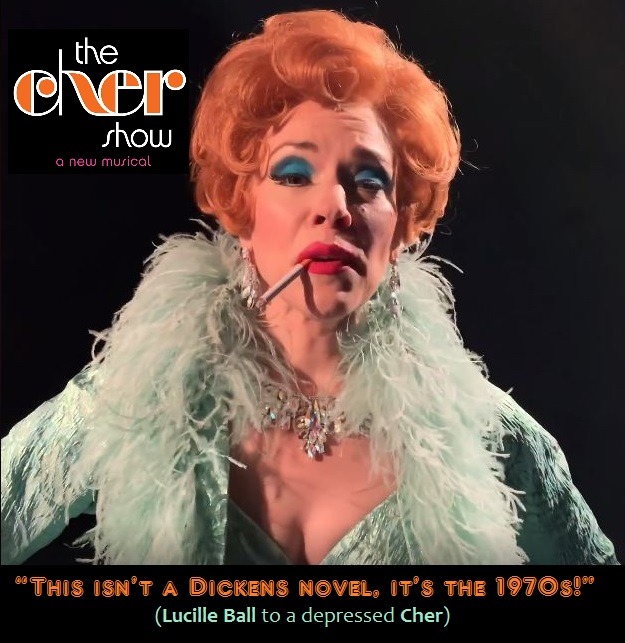
Emily Skinner as Lucille Ball in THE CHER SHOW on Broadway.
-


I LOVED LUCY by Lee Tannen based on his memoir, starring Lee Tannen and Charles Busch as Lucille Ball. A staged reading to benefit the Bridge Theatre Company, Catskill, New York, presented March 22 and 23, 2019. Directed by Carl Andress with musical accompaniment by Tom Judson.
-
RIP Richard Erdman
1925-2019


Richard “Dick” Erdman first appeared on screen with Lucille Ball in 1949′s Easy Living as Buddy Morgan. In 1970, he made an appearance on “Here’s Lucy” as a short-tempered supermarket manager in “Lucy Loses Her Cool” (S3;E13) guest starring Art Linkletter.

Erdman made his first films in 1944, and worked all the way up to 2017. He recently was a series regular on “Community” (2009-15) playing Leonard.
-
Subscribe
Subscribed
Already have a WordPress.com account? Log in now.
 Papermoon Loves Lucy