-
JERRY HAUSNER
May 20, 1909

James Bernard Hausner, known professionally as Jerry Hausner, was a radio and television actor, best known as Ricky Ricardo’s agent in “I Love Lucy” and as the voice of Waldo in “Mr. Magoo” and several characters such as Hemlock Holmes, The Mole, Broodles and Itchy in “The Dick Tracy Show.” He also worked as a dialogue director for both of these cartoons.
On Broadway, Hausner had the role of Sammy Schmaltz in Queer People (1934). On radio, he was a regular on such shows as “Blondie”, “The Jim Backus Show”, “The Judy Canova Show”, “Too Many Cooks”, and “Young Love”. Hausner died of heart failure on April 1, 1993. He was 83 years old.
From 1948 to 1951, Hausner frequently appeared on Lucille Ball’s radio program “My Favorite Husband” on CBS Radio.

The above happened on October 2, 1954, nine months after he left “I Love Lucy”. In addition to MacMurray, the episode also featured Bobby Jellison, who was just two months away from returning to “I Love Lucy” to play Bobby the Bellboy, after playing the Ricardo’s milkman in 1952. Coincidentally, Jellison and MacMurray would both appear in “Lucy Hunts Uranium” in January 1958.

Hausner created the role of Jerry, Ricky’s agent, in the original “I Love Lucy” pilot in early 1951. He was intended to be a series regular, but when the characters of Fred and Ethel Mertz were added to the series (they were not in the pilot), his role was scaled back.

Jerry the Agent would appear in 8 episodes, all during the first 3 seasons of the series:
-
“Lucy Thinks Ricky Is Trying to Murder Her”
(1951) -
“Lucy’s Show-Biz Swan Song”
(1952) -
“Ricky Has Labor Pains”
(1953) -
“Lucy’s Last Birthday”
(1953) uncredited background appearance -
“The Camping Trip”
(1953) -
“Changing the Boys’ Wardrobe”
(1953) - “Ricky’s Old Girlfriend” (1953)
- “Fan Magazine Interview” (1954)

Inexplicably (perhaps due to illness) in “The Handcuffs” (1952), Jerry the Agent is not played by Jerry Hausner but by Paul Dubov. Two months later, Hausner returned to the role that he originated.

In “The Adagio” (1951), Ricky has a heated phone conversation with Jerry, although the character is not seen or heard. Ironically, this is the same scenario that caused the rift between Hausner and Arnaz three years later.

As a radio actor, one of Hausner’s specialties was baby cries.
In 1953 he provided the off-screen cry of Little Ricky in several episodes:
- “The Indian Show” (1953)
- “Lucy Hires a Maid” (1953)
- “No Children Allowed” (1953)
- “The Club Election” (1953)

Although Hausner is in one of the most famous episodes of all time, “Lucy Does a TV Commercial” (1952), he does not play Jerry. Instead, he is addressed as Joe and is one of the television studio crew. Oddly, in the episode’s first scene, Ricky is on the phone with Jerry, although we don’t see or hear him.

During the filming of “Fan Magazine Interview” (1954), Hausner and Desi Arnaz got into a heated argument on the set. The basis for the argument was that he was not able to hear his cues during a telephone scene where he was located across the soundstage from Desi. Hausner quit the show and never appeared on the series again.

From 1952 to 1954, while playing Jerry on “I Love Lucy,” Hausner was also appearing on the show’s main competition “I Married Joan” on NBC, where he played a variety of characters in eight different episodes. “Joan” and “Lucy” both initially filmed on the same lot. Marc Daniels directed Hausner on both sitcoms.

Despite his departure, Hausner later turned up on a 1963 episode of “The Lucy Show” as an indecisive customer at the soda fountain. The story goes that in a fit of anger he told Desi Arnaz that he was not critical to “I Love Lucy” and that he would be around long after Desi was gone. When Lucille Ball hired him for this “Lucy Show” episode nearly nine years later, she reminded him of his statement and added “You were right.” Arnaz was initially executive producer of “The Lucy Show” but bowed out after a dozen episodes. Many sources say that Hausner and Arnaz patched up their hard feelings in the ensuing time.

In 1964, Hausner made a guest appearance on “My Three Sons” that featured William Frawley (Fred Mertz) as Bub.

From 1962 to 1965 he made half a dozen appearances (as different characters) on “The Dick Van Dyke Show” which filmed on the Desilu lot.

By 1968, Hausner and Desi’s relationship must have reconciled, because he made two appearance’s on Arnaz’s sitcom “The Mothers-in-Law”.

His final appearance with Lucille Ball happened a decade later on a 1973 episode of “Here’s Lucy.” Here, Hausner’s character name is Jimmy, which is ironic since Lucille Ball once called her TV son Jimmy, when his character name was actually Jerry!

-
-

Papermoon Loves Lucy turned 5 today!
-
EDWARD STEVENSON
May 13, 1906

Edward Manson Stevenson was an Academy Award-winning costume designer. His film and television credits include Citizen Kane (1941) and It’s a Wonderful Life (1946). He did costumes for 16 films featuring Lucille Ball from 1936 to 1960. He worked for Lucille Ball as costume designer for:
- “I Love Lucy” (1955-57) Season 5 & Season 6
- “The Lucy-Desi Comedy Hour" (1957-60)
- “The Desilu Revue” (1959)
- “The Lucy Show” (1962-68) Seasons 1-6
- “Mr. & Mrs.” (1964) co-designer with Edith Head
- “Lucy in London” (1966)
- “Here’s Lucy" (1968-1969) Season 1

Dance, Girl, Dance (1940) designed by Edward Stevenson, just one of the 16 films where Lucille Ball wore Stevenson’s designs.
Stevenson joined “I Love Lucy” in 1955, after the departure of Elois Jenssen.

Stevenson had the enormous task of designing the various Jacques Marcel dresses seen in “Lucy Gets a Paris Gown” (ILL S5;E20) in 1956.

In 1957, he also designed this form-fitting green fish-tail dress for “The Country Club Dance” (ILL S6;E25).

Stevenson was responsible for Lucille Ball’s wardrobe for “The Lucy-Desi Comedy Hours”.

In 1961 Stevenson shared his only Oscar (Best Costume Design Black and White) with the legendary Edith Head for the Lucille Ball / Bob Hope film The Facts of Life.

Stevenson again collaborated with Head, Lucy, and Hope for TV’s “Mr. & Mrs.” in 1964.

On “The Lucy Show” Stevenson got to design a wide array of historical periods and styles.
Lucy as Cleopatra was the very first episode of “The Lucy Show” filmed in color.

“What happens in Vegas…” – including this emerald green sequined outfit… – “should stay in Vegas”

But it didn’t – the green feathered hat was also seen when “Lucy Goes To A Hollywood Premiere” (S4;E20) in 1966.

Taking a cue from Cecil Beaton’s award-winning costumes from My Fair Lady, Stevenson transformed a lowly Liza Lumpwaller (Lucy Carmichael) into a majestic Eliza Doolittle-type head-turner in “My Fair Lucy” (TLS S3;E20) in 1965.

In “Lucy in London” (1966), Stevenson dressed Lucille Ball in everything from Tudor finery…

… to mod, Carnaby Street fashions.

In 1968, Stevenson (center) designed the multi-function black and white dress that Lucy models to help her working daughter with her new job at a fashion boutique.

Having worked at RKO in the 1930s and ‘40s, Stevenson was well equipped to design these costumes for the Gone With the Wind sketch in “Lucy and Flip Go Legit” (HL S4;E1). “The Lucy Show” scripts often required a variety of movie-referenced costumes.

He also tackled the exotic with “Lucy’s Impossible Mission” (HL S1;E6) in 1968.

This elegant gold gown with a shear gold overlay was Stevenson’s last seen work for Lucille Ball. He died of a coronary on December 2, 1968, fittingly while shopping for fabric on La Cienega Boulevard.
The episode (with guest star Cesar Romero) was aired posthumously in February 1969.

Idaho State University Library maintains a collection of Stevenson’s sketches.
NOTE: Although Edward Stevenson is credited for wardrobe and costumes for each of the above shows, it does not necessarily mean that he designed every costume on screen. While some specialty and star costumes may indeed be created from the ground up, many times the job of wardrobe or costume designer is to co-ordinate existing pieces with an eye toward visual cohesion and adherence to period – all while staying within a production’s budget. Wardrobe items are often pulled from stock, shopped, or recycled. The above photos do not necessarily reflect exclusively Stevenson’s designs.
-
MOTHER’S DAY

The world created by Lucille Ball’s 40 year television career was one dominated by mothers. Owing to the fact that her own father died while she was a young child, mothers are celebrated time and again on Lucycoms! Here’s a comprehensive look at Lucy and Motherhood!

A celebration of motherhood with the Arnaz Family 1951! Lucille had just become a mother for the first time when her mother Desiree (aka Dede) and Desi’s mother Dolores posed for this photo. Baby Lucie would also grow up to become a mother, step-mother, and grandmother herself!

It is said that Dede was in the studio audience for all of her daughter’s shows. Here she got to be on camera as part of the studio audience (of extras) in “Lucy and Johnny Carson” (HL S2;E11) in 1969.

“The Password is Motherhood!” Wherever her daughter was performing or being interviewed, Lucille assured that her mother Dede would be welcomed.

Three mothers having a ball!

Lucie Arnaz emulates her legendary mother’s famous face!

Although Liz Cooper of Lucille Ball’s radio show “My Favorite Husband” was not a mother herself, she had a mother and a mother-in-law! Sarah Selby voiced Liz’s mother, Adele Elliott, and Eleanor Audley played Laeticia Cooper, George’s Mother.

In 1953, Lucy Ricardo became a mother. Her son was Ricky Ricardo Jr. (aka Little Ricky). The character would be played by 8 actors over the course of 7 years. His birth was timed to coincide with Lucille Ball becoming a mother for the second time, on January 19, 1953, giving birth to her son, Desi Arnaz IV aka Desi Jr.

Becoming a mother again put Lucille Ball on the cover of the very first National Edition of TV Guide! Twenty years later, Lucy and her son once again celebrated motherhood with a cover story!

Lucy Ricardo’s onscreen infant son was played by The Simmons Twins, who are shown here with their mother (extreme right) and their grandmother (standing). The other two women are a nurse and social worker.

Eva Jean Mayer, the real life mother of The Mayer Twins, the second set of twins to play Little Ricky, was one of the neighbors in “Homecoming” (ILL S5;E26). This allowed Lucy to hand off the child to someone who would soothe him in the large and chaotic crowd scene. A crying or distracted child would cause costly and time-consuming re-takes!

In 1954 the series introduced “Lucy’s Mother-in-Law” (ILL S4;E8), Mrs. Ricardo, played by Mary Emery. The language barrier proved the source for the comedy in this rare mother-in-law comedy not based on the usual tropes.

Mary Emery would reprise the role of Mother Ricardo in “The Ricardos Visit Cuba” (ILL S6;E9), which would be her last appearance before retiring from show business.
Little Ricky politely calls her Abuela, Spanish for Grandmother.

During Season 1, long before we meet Mother Ricardo, Lucy assumes Ricky misses his mother in Cuba Lucy and lip syncs to “Mamãe Eu Quero” (“I Want My Mama”), a song composed by Vicente Paiva in 1937. Lucy says that she knows his mother was a great singer and dancer and that he had five brothers: Pedro, Pablo, Chu-Chu, Josinte, and Jose. Mother Ricardo was busy!

Later in 1954, Kathryn Card joined the cast to play the role of Lucy’s mother, Mrs. McGillicuddy. She played the role 9 times including one episode of “The Lucy-Desi Comedy Hour” in 1959, her last time playing the scatterbrained but loveable mother. As far as we know, Lucy was her only child. Unusually, in all those appearances, the writers never gave her a first name!

Mrs. McGillicuddy (Kathryn Card) also became a doting grandmother and (along with Mrs. Trumbull) watched over Little Ricky while the gang was off on their adventures. Here they say goodbye as his parents and godparents (the Mertzes) say “California Here We Come” (ILL S4;E13).

And as soon she returns home from Hollywood, Lucy leaves for Europe, where she hates to say “Bon Voyage” (ILL S5;E13) to her only child telling her mother
“You don’t know what it’s like to be a mother, mother!”

Ethel Mertz never became a mother, but she is Godmother to Little Ricky. To explain Vivian Vance’s absence when “Lucy Does a TV Commercial” (ILL S1;E30), Fred says that she went to see her mother. Ethel tells Fred that she’ll be visiting her mother during “The Camping Trip” (S2;E29) so she can sneak away and help Lucy. Since we never meet Ethel’s mother when we visit “Ethel’s Hometown” (ILL S4;E15) and she is never mentioned in the episode, we can only speculate that in Ethel’s mother is living in another city, probably close to New York, within visiting range!

Similarly, Fred’s mother is never seen, but in “Lucy’s Mother-in-Law” (ILL S4;E8),
Ethel tells Lucy that her mother-in-law comes all the way from Indiana once a year just to look under her rug for dirt! William Frawley was 67 years old at the time, so it is not inconceivable that his mother might still be alive. Or Ethel could be just joking!

Before she became Mrs. Trumbull, Elizabeth Patterson played Mrs. Willoughby, who her husband Bert (Irving Bacon) always called ‘Mother’ in “The Marriage License” (ILL S1;E26). Mother was also the Mayor!

Lucy and Georgia Holt, mother of one of the biggest superstars in entertainment history – Cher – appeared in “Lucy Gets a Paris Gown” (ILL S5;E20).

This superstar’s mama turned up again (as a fur model) on a 1966 episode of “The Lucy Show”. Coincidentally, in the Broadway musical Cher, moms Holt and Lucille Ball were played by the same performer!

The rivalry between mothers Lucy and Caroline Appleby (Doris Singleton) was the subject of several episodes. Little Ricky and Little Stevie (uncredited) appear bored stiff by their mothers’ antics!

Little Stevie was later played by Steven Kaye [don’t look at the camera, Steven!] in “Lucy and Superman” (ILL S6;E13) where the mothers vie for who will have the better birthday party! Lucy goes out on a ledge (literally) and books Superman!

Connecticut neighbor Betty Ramsey (Mary Jane Croft) is mother of little Bruce (Ray Ferrell). Husband and father Ralph is played by Frank Nelson in “Lucy Gets Chummy With the Neighbors” (ILL S6;E18).

Mrs. Benson (Norman Varden), was the tearful mother of a daughter who has left the nest to get married (to a nincompoop), and finds no comfort in her husband (meh), in “The Ricardos Change Apartments” (ILL S2;E26).

Actors Verna Felton and Lee Millar never played mother and son on their six combined appearances on “I Love Lucy”, although that was their relationship in real life. He did, however, get to act opposite his mom on Desilu’s “December Bride” where she was a series regular.

Little Diana’s mother, Mrs. Van Fossen, is is beaming with pride after hearing her daughter play “Swanee River” on the violin at a music recital, the same one where “Little Ricky Gets Stage Fright” (ILL S6;E4) in 1956.

Ida Moore played the kindly old mother-in-law of Ruth Knickerbocker, swing vote in “The Club Election” (ILL S2;E19) in 1953.

Mothers on a plane! Lucy Ricardo, mother of baby
CheddarChester, and Evelyn Bigsby (Mary Jane Croft), mother of baby Caroline, in “Return Home From Europe” (ILL S5;E26). Before landing in New York, Lucy commits matriphagy (when mothers eat their young) by devouring baby Chester!
In a dream sequence in “Ricky’s Old Girlfriend” (ILL S3;E12), Lucy is mother two two different Little Ricky’s – both of whom were uncredited. Despite an eerie resemblance the first dream Little Ricky is NOT the Beaver!

When “Lucy Writes a Play” (ILL S1;E17), Ethel takes the role of Lucita’s Mamacita in ‘A Tree Grows in Havana’. When the play undergoes a rewrite…

Ethel switches to the role of Pamela’s Mater in ‘The Perils of Pamela’.

Ethel played Lucy’s dowdy ‘Ma’ in the very first episode aired “The Girls Want to Go to a Nightclub” (ILL S1;E1). “All the single ladies!”

Lucy pretends to be Fred and Ethel’s Ma to win a trip to Hawaii in “Ricky’s Hawaiian Vacation” (ILL S3;E22). Things get complicated when radio host Freddy Fillmore wants to meet Lucy AND Ma at the same time!

Mother and step-mom Kathy Williams (Marjorie Lord) rented the Ricardo home for the summer with her husband Danny (Danny Thomas) in “Lucy Makes Room for Danny” (LDCH S2;E2) in 1958. When the Ricky’s summer gig is cancelled, the two families must learn to co-exist! Kathy Williams was Danny’s second wife, and became mother to his son Rusty (Rusty Hamer) and Danny adopted her daughter Linda (Angela Cartwright) making it one of TV’s first blended families!

In Critic’s Choice (1960) Angela Ballantine (Lucille Ball) showed motherly affection for her son John (Rickey Kelman) even when arguing with his father (Bob Hope).

The premise of “The Lucy Show” (1962-68), was initially about two single mothers, Vivian Bagley (a divorcee) and Lucy Carmichael (a widow), raising their children on their own under one roof. Chris and Jerry (Candy Moore and Jimmy Garrett) were Lucy’s kids and Sherman (Ralph Moore) was Viv’s only child. In real life, Lucille Ball was also the mother of a son and daughter. Vivian was never a mother, but she was a godmother to her friend Jane’s son, John Sebastian.

In “Lucy the Chaperone” (TLS S1;E27) Lucille Ball shared the sound stage with her TV daughter (Candy Moore) and her real-life daughter (Lucie Arnaz).

Being mothers of rowdy young boys was the subject of many season one episodes of “The Lucy Show.”

Lucy Carmichael and her son Jerry (Jimmy Garrett).

Lucy Carmichael and her teenage daughter Chris (Candy Moore).

In “Lucy is a Soda Jerk” (TLS S1;E23), both of Lucille Ball’s real children were in the cast. This is an on-set publicity photo from that shoot. Lucie Arnaz played Cynthia, and Desi Jr. played Billy Simmons.

In later years, supportive mama Lucille often cast her own daughter in one-off supporting roles, as in this “The Lucy Show” episode in 1967. Look who grew up before our eyes!

Lucy Carmichael loved her son – but after he went away to military school, she had trouble remembering his name! Here, Lucy calls him Jimmy, despite everyone off screen telling Lucille Ball that it was actually Jerry! Lucille is probably remembering the actor’s real name, Jimmy Garrett.

Three sports moms: Viv, Lucy, and Audrey Simmons (Mary Jane Croft), watch their sons play Little League baseball – until they get ejected from the park for un-sportsmanlike conduct! Billy Simmons was played by Lucy’s real-life son, Desi Arnaz Jr. This is the only episode of “The Lucy Show” where the Simmons mother and son share the screen.

Over-protective mother Elizabeth Westcott (Charlotte Lawrence) showed up unexpectedly at her daughter Debbie’s (Patti Garrity) spring break bungalow in “Lucy the Chaperone” (TLS S1;E27). Coincidentally, Garrity also played Lucille Ball’s daughter in Yours, Mine and Ours.

The mother of Mr. Mooney’s children was never seen! Irma Mooney was mother to Ted (Michael J. Pollard), Arnold (Barry Livingston & Ted Eccles), Bob (Eddie Applegate), and an unseen / un-named daughter, who we learn lives in Trenton NJ and is a mother herself. The name ‘Irma’ was doubtless chosen for its association with the film, radio and television series “My Friend Irma” which starred Gale Gordon’s mother, Gloria Gordon, who died in 1962, the same year “The Lucy Show” began.

Mrs. White (Mabel Albertson), mother of Junior White in “Lucy and the Lost Stamp” (TLS S3;E14). Mabel Albertson shared a mom with another Lucy character actor, Jack Albertson! She was also one-time mother-in-law to TV icon Cloris Leachman.

Mrs. Collins (Queenie Smith) was doting momma to Lucy’s new beau Brad (Keith Andes) in “Lucy and Joan” (TLS S4;E4).

Single mother and torch songstress Roberta Sherwood (Roberta Schaeffer), moved into the Carmichael home with her drummer Bob (Robert Lanning) – who also happened to be her teenage son. As on the show – they were mother and son in real life as well!

On a sketch in “Carol + 2” (1966) obsessed new mother Alice (Carol Burnett) refuses to allow her sister Rita (Lucille Ball) to go on vacation without first hearing her baby say bye-bye!

During the 1960s, a television commercial for Anacin featured an overwrought housewife snapping at her mother, who is attempting to help her in the kitchen. The commercial was widely parodied, including on “The Lucy Show”…

…and on “Here’s Lucy.”

Reformatting “The Lucy Show” into “Here’s Lucy” served many purposes, but most noticeably it allowed proud mother Lucille Ball to star her own two children, Lucie Arnaz and Desi Arnaz Jr. as her TV kids.

Helicopter mother Lucy Carter hides in the chimney flue while her daughter croons “Ma, He’s Makin’ Eyes at Me” with her Uncle Harry in “Kim Moves Out” (HL S4;E20).

Mrs. Caldwell (Nancy Howard), mother of Laurie (Nancy Howard) in “Mod, Mod Lucy” (HL S2;E1). Mr. Caldwell is played by Lew Parker.

“Lucy, the American Mother” (HL S3;E7), is both the name of the episode and her son’s documentary film about Mrs. Lucille Carter. Needless to say, Craig’s candid camera disrupts his mother’s routine!

Mumsie Westcott (Elsa Lanchester) in “Lucy Goes to Prison” (HL S5;E18), mother to her unseen son Cecil and Cynthia and Heathcliff, the plants on the window sill behind her! In Great Britain, ‘Mum’ can mean mother, or it can mean to keep something quiet. For criminal Westcott, it is both! In this episode, Lucy goes undercover as Dede Peterson, which was also the name of her mother after her remarriage.

In “The Amateur Hour” (ILL S1;E14), Mrs. Hudson (Gail Bonney) didn’t seem to especially enjoy being a mother – especially of rambunctious twin sons Timmy and Jimmy (David Stollery and Sammy Ogg – not real life twins at all).

She tricks Lucy into thinking she’s babysitting for one child, not two – then goes off to get her hair done! A mother’s hair is never done!

In “Lucy the Babysitter” (TLS S5;E16), Mary Wickes (who was not a mother in real life) played Mrs. Winslow, mother of Danny, Charlie, and Bobbie (aka Roberta). When she is in need of a babysitter, Lucy answers the call.

What Lucy doesn’t realize is that Mrs. Winslow’s three children are actually baby chimps! The famous Marquis Chimps played the trio that Lucy must mind.

Lucy Carter, Mother Penguin in “Lucy and the Franchise Fiasco” (HL S5;E20) and Lucy Ricardo, Mother Chicken in “Lucy Does the Tango” (ILL S6;E20).

Lucille Ball played carny mom Agnes Kubelsky, mother of Jackie (Johnny Carson) in “Jack Benny’s Carnival Nights” (1968). In reality, Jack Benny’s mother was named Emma Sachs Kubelsky.

A few years later, Lucy Carter played Jack Benny’s Mother in “Lucy and Jack Benny’s Biography” (HL S3;E11).

“Lucy, the Helpful Mother” (HL S2;E15) proved mama Carter would do anything for her children, including turning her home into a pet store!

Lucy Carter plays a modern mother of this low-brow bickering family, a commercial for ‘Uncle Ernie’s Fun Farm’ on season one of “Here’s Lucy”.

In “Lucy, The Part-Time Wife” (HL S3;E14) she also pretends to be Lucy, the new mother in order to save Harry from the clutches of an over-bearing old flame (Jean Willes).

Lucy’s daughter Kim pretends to be an expectant mother for a Gone With The Wind sketch in “Lucy and Flip Go Legit” (HL S4;E1). “I don’t know nothin’ about birthin’ babies!”

Ma Parker (Carole Cook) is mother in name only to Herman (Billy Curtis) and Little Mildred aka Milton (Jerry Maren) in “Lucy and Ma Parker” (HL S3;E15). Any resemblance to the real outlaw Ma Barker is purely intentional.

When “Lucy Goes Hawaiian – Part 2″ (HL S3;E24), Lucy and Kim perform the 1957 novelty song “Mama’s Mumu” while Harry makes a special appearances as ‘Mama’!

“Where is My Wandering Mother Tonight?” (HL S6;E23), wonders her worried daughter Kim.

Norma Michaels learns from her only daughter Linda (Doria Cook) that she is going to be a grandmother – only a few months after becoming a mother-in-law!

In Three For Two (1975) Lucy played a domineering mother named Pauline forced to recognize her college-aged children’s need for independence. Paul Linke played her son Alfred and Tammi Bula was her daughter Maureen. Jackie Gleason was Mike, their father.

In “What Now Catherine Curtis?” (1976), a voice-over by Lucille Ball introduces Catherine Curtis, who is mother to two daughters, Melinda and Elizabeth, facing life as a single woman again. Catherine is also a grandmother (or, as she calls herself “Nana”).

Carol Coogan (Gloria DeHaven) tries to be supportive when her teenage son Scotty (Scotty Plummer) wants a motorcycle for his birthday in the ‘Music Mart’ portion of “Lucy Moves to NBC” (1980).

Late in “Stone Pillow” (1985), Florabelle (Lucille Ball) says she lived on a farm with her husband and son (‘Sonny’). Ball named her homeless woman after her real-life grandmother Florabelle Emmaline Hunt, who was also mentioned in two episodes of “Here’s Lucy” – “Lucy Takes Over” (HL S2;E23) in 1970, and “Lucy, The Sheriff” (HL S6;E18) in 1974.

Two mothers in “Mother of the Bride” (LWL S1;E8): Lucy Barker (Lucille Ball), mother of Margo McGibbon (Ann Dusenberry), who is mother of Becky (Jenny Lewis) and Kevin (Philip Amelio, not pictured).

In “World’s Greatest Grandma” (LWL S1;E13), an un-aired episode of “Life With Lucy”, Lucy Barker competes to win a Grandma Talent Contest.
MEGA MOMS!

In “Lucy Plays Cupid” (ILL S1;E15), knowing overly-amorous Mr. Ritter doesn’t like children, ‘Mother’ Lucy Ricardo trots out a stream of youngsters as her offspring. Mr. Ritter (Edward Everett Horton) counts 25, although Lucy says six are missing. In reality, ten uncredited child performers were featured in the episode, one even dressed as a “little” Ricky playing a conga drum, a full year before Lucy Ricardo became a mother for real!

Donna Colucci (Kaye Ballard) is mother of Ricardo, Anna Maria, Louisa, Luigi, Vincenzo, Dino, Lucrezia, Alfredo Jr., Margarito, Bruno, Rosa, and Frederico (all uncredited) in “Lucy and Harry’s Italian Bombshell” (HL S4;E3). Their father is played by Emile Autuori.

Helen North Beardsley (Lucille Ball), mother of 19 in 1968′s Yours, Mine and Ours. Lucy’s partner in bringing up this blended family is played by Henry Fonda.
Other Mothers!

Mother Goose helps Lucy increase her dictation speed in “Lucy is a Process Server” (TLS S2;E27).

Lucy plays Mother Hubbard and shows her border Ernie that the cupboards are bare – hoping his hunger will drive him away when “Tennessee Ernie Hangs On” (ILL S3;E29).

Lucy and Viv were introduced as Cub Scout Den Mothers when “Lucy Goes to the White House” (TLS S1;E25).

Fairy Godmother in “Like Hep” (1969).

Mommie Dearest was what Joan Crawford’s adopted daughter Tina later titled her book about her domineering mother. The book later became a blockbuster film starring Faye Dunaway (right) as Mommie Dearest.

“It’s not nice to sue Mother Nature!” But “Lucy, Legal Eagle”, takes Hilda Loomis (Dina Dietrich) to court anyway – over a teddy bear! Dietrich was known for playing Mother Nature on a series of Chiffon Margarine commercials.
 Carol Burnett, Critic’s Choice, desi arna, Desi Arnaz Jr., Dina Dietrich, Eve Arden, Godmother, Grandmother, Here’s Lucy, I love lucy, Joan Crawford, Kaye Ballard, Life With Lucy, Lucie Arnaz, Lucille Ball, Ma, Mama, Mamma, Mom, Mommie, Mommie Dearest, Mommy, Mother, Mother Goose, Mother Nature, Mothers, Mothers Day, Stepmother, The Lucy Show, The Mothers in Law
 -
ELLIS IN FREEDOMLAND
Spring 1952

Directed by Abby Berlin
Produced by Roland D. Reed
Written by Arthur Hoerl
Music by Albert Colombo
Choreography by Alex RomeroSynopsis ~ A 82 minute, technicolor promotional film for salesmen of Westinghouse appliances, featuring the voices of major Hollywood celebrities. Westinghouse claims its electric appliances “freed women from the drudgery of housework.” The first half involves dream salesman Ellis at work; the second focuses on the “Spring Sales Event,” called “Freedomland.”
Westinghouse Electric Corporation was founded on January 8, 1886 by George Westinghouse (1846–1914). The corporation purchased CBS in 1995.
Live Cast

Robert Rockwell (Ellis Homan) is probably best remembered as biology teacher Mr. Boynton on the Desilu series “Our Miss Brooks” (1952-56). Although not the first to play Mr. Boynton, he assumed the role on radio and made the transition with the show to television. He played Viv’s handsome match in “Lucy Digs Up a Date” (TLS S1;E2) the second installment of “The Lucy Show” in 1962. He then played night school teacher Jack Scott in “The Not-So-Popular Mechanics” (HL S5;E23). He continued working until 1995 and died in 2003 at age 82.

Robert Carson (Phil Pryor, Westinghouse Representative)
was a busy Canadian-born character actor who appeared on six episodes of “The Lucy Show” and made five appearance on “Here’s Lucy.”

Byron Foulger (Andy, Night Watchman)
played the leader of the Friends of the Friendless in “Lucy’s Last Birthday” (ILL S2;E25). He appeared on “The Lucy Show” in “My Fair Lucy” (TLS S3;E20) and “Lucy Meets the Law” (TLS S5;E19).

Ann O’Neal (Customer in Mink) appeared in more than 100 films in the 1940s including the Lucille Ball film Lover Come Back (1946).

Betty Furness (Herself, Spokeswoman for Westinghouse) was an actress and model who became the face and voice of Westinghouse in many television commercials. When “The Lucy-Desi Comedy Hour” was sponsored by Westinghouse, Furness appeared with Lucille Ball and Desi Arnaz in commercials for their products.

The Starlighters (Vocals) was a singing group that performed mainly as backing vocalists, frequently backing Jo Stafford as well as many other artists on a number of singles. They also performed songs in cartoon and live short films and the feature films Song of Idaho (1948) and With a Song in My Heart (1952).
Voice Cast

Lucille Ball (Lina the Laundromat) was then filming the second half of her first season of “I Love Lucy” playing Lucy Ricardo, although her voice alone was familiar to radio audiences as Liz Cooper in “My Favorite Husband.”
Edward Arnold (Speedy the Range) lends his deep baritone voice to the role. He appeared with Lucille Ball in Roman Scandals (1933) and Ziegfeld Follies (1945). He died in 1956.
James Mason (Frosty the Refrigerator) was a three time Oscar-nominee who appeared as Lucille Ball’s Angel in Forever Darling (1956).
Percy Kilbride (Drip the Dehumidifier) was best remembered as Pa Kettle in a series of films from 1947 to 1954.
Jerry Colonna (Chop-Along Waste-Away the Garbage Disposal) was a comic sidekick of Bob Hope on radio and television. In 1966 he played Smithers, Lucille Ball’s chauffeur on “Bob Hope’s Leading Ladies”.
Andy Devine (Lanky the Water Heater) brought his high-pitched raspy voice to the film. He was known for his many appearances in westerns on both the small and big screen.
Marie Wilson (Dinah the Dryer) is best known for playing the title role in the film and television series “My Friend Irma”. Later in 1952, Wilson and Lucille Ball were both part of “Stars in the Eye” celebrating the opening of CBS Television Center. Coincidentally, Gale Gordon’s mother Gloria was also in “My Friend Irma” and on “The Lucy Show” Mr. Mooney’s off-screen wife was named Irma in her honor.
Maureen O’Sullivan (Pearly the Dishwasher) played Jane in the early Tarzan films. Her career lasted from 1930 to 1994. In 1987, Lucille Ball and O’Sullivan were two of the many stars in “Happy 100th Birthday, Hollywood”.
Mannequins

Jack Mulhall appeared with Lucille Ball in Broadway Bill (1934).

Alan Hale Jr. (Hunter) will forever be remembered as the Skipper on “Gilligan’s Island” but also appeared with Lucille Ball on “The Lucy Show” and “Here’s Lucy”.

Iron Eyes Cody (Chief Running Water) made a career of playing Native American characters despite the fact that he was of Italian ancestry. He first worked with Lucy and Desi in 1940’s Too Many Girls and 1942’s Valley of the Sun both as an Indian character. He played an Eskimo in a 1959 episode of “The Lucy-Desi Comedy Hour,” but is probably best remembered as the Indian that sheds a single tear in the ‘Keep America Beautiful’ ads that ran from 1971 to the 1980s. He played a Navajo Medicine Man in “Lucy and the Indian Chief” (HL S2;E3).

Willie Best (Chauffeur) was one of the most popular African-American actors of Hollywood’s Golden Era. He starred alongside some of film’s great comedians including the Marx Brothers, Bob Hope, Laurel and Hardy, and three films with Shirley Temple. He did one film with Lucille Ball: Muss ‘em Up (1936).
Karen Sharpe appeared on the “Westinghouse Desilu Playhouse” in 1959.
Mickey Simpson appeared with Lucille Ball in the 1939 film Panama Lady.

Anthony Sydes (Bobby, the Boy in Buster Brown Outfit) was 8 years old at the time of filming. He left the business in 1958 and died in 2015 at age 74.
With…
Lisa Abbott, Mildred Coles,
Richard Crane, Nancy Hadley, Noreen Michaels, Crystal Reeves, Darla Ridgeway, Anne Rubin, Carol Lowe, Frances Zucco

Uncredited Cast
Ralph Brooks (Stove Demonstrator) appeared in four films with Lucille Ball, as well as “The Lucy-Desi Milton Berle Special” and “Lucy Goes to Las Vegas” (TLS S3;E17).
Sam Harris (Showroom Guest)
did a dozen films with Lucille Ball before appearing in the audience of Over the Teacups in “Ethel’s Birthday” (ILL S4;E8) and playing a subway passenger in “Lucy and the Loving Cup” (ILL S6;E12). In between, he was a wedding guest in Lucy and Desi’s film Forever Darling (1956). Along with Monty O’Grady and Murray Pollack, he was in the airport when “The Ricardos Go to Japan” in 1959.Stuart Holmes (Showroom Guest) appeared with Lucille Ball in Lover Come Back (1946) and Critic’s Choice (1963).
Hans Moebus (Washer / Dryer Demonstrator) appeared as an uncredited background performer in hundreds of movies and TV shows, including the Lucille Ball films DuBarry Was a Lady (1943), A Woman of Distinction (1950) and The Facts of Life (1960). He was seen on the dock during the “I Love Lucy” episode “Bon Voyage” (ILL S5;E13) and part of the riverboat chorus in “Lucy Meets Arthur Godfrey” (TLS S3;E23).
Charles Sherlock (Television Viewer) appeared in three feature films with Lucille Ball from 1935 to 1963.

PART ONE – DON’T MEET COMPETITION, MAKE IT!
Westinghouse Rep Phil Pryer meets salesman Ellis Homan at his office on the department store showroom. Ellis tells Phil about the time he dozed off at his desk and the mannequins came to life: menswear, formal wear, beach wear, and (inexplicably) an American Indian in full regalia. Frosty the Refrigerator (James Mason) gets Ellis’ attention to demonstrate his frost-free features, as well as his unique butter tray and meat keeper.
Ellis then has a conversation with Speedy the Electric Range (Edward Arnold) about all its features. Ellis even makes coffee and cookies for Mabel, a mannequin standing in for a ‘prospect’.
MABEL: “Ellis, you’re cute. I wish you were a dummy.”
Ellis then has a chat with Pearly the Dishwasher (Maureen O’Sullivan) and Chop-Along Waste-Away the Garbage Disposal (Jerry Colonna), who sings during his demonstration.
Lanky the Water Heater (Andy Devine) is upset because no one pays him much attention. Pearly draws Ellis’s attention to the drip who has shown up in the showroom lately, the Dehumidifier (Percy Kilbride) who promises to rid homes of damaging dampness.

Chiming in (literally) Lina the Laundromat (Lucille Ball) and Dinah the Dryer (Marie Wilson) sing their greeting. Known as ‘The Westinghouse Twins’, they often finish each others’ sentences and speak at the same time – all in aid of showing that they are a perfect freedom-fighting duo in a home. Ellis demonstrates a typical wash cycle.
PART TWO – FREEDOM FAIR

Back in the present, Phil tells Ellis that Westinghouse is sponsoring radio and television coverage of the summer’s 1952 Republican and Democratic conventions, with ‘Get Out the Vote’ programs to follow. In the meantime, Phil tells Ellis about the big Spring Selling Event – Freedom Fair. The event will be rolled out in the April 11, 1952 issue of Life Magazine and the April 16, 1952 issue of the Saturday Evening Post. On television, it will be announced by Betty Furness on “Studio One”.
After Phil leaves, the scene changes to a typical suburban couple’s bedroom where the morning alarm has just gone off. The bedraggled housewife dances through the home trying to get ready for the day ahead – despite the fact that she does not have any time-saving Westinghouse electric appliances. As the harried husband downs a quick cup of coffee and dashes off to work, the song begins (with offscreen vocals by the Starlighters) and the frustrated housewife realizes just how much work she has ahead of her to clean her home. Just then an ethereal voice sings the name “Westinghouse! Westinghouse!” and there is suddenly a handsome young salesman ringing her doorbell. He sings:
“They say that Lincoln freed the slaves,
With that I disagree.
Women have been slaves for years
Till Westinghouse set them free!”
He whisks her away to ‘Westinghousewives’ Heaven’ where all the products we previously saw demonstrated are extolled in joyous song, some even have angel wings! The housewife (still in her curlers and pajamas) ducks behind a cloud and is suddenly revealed in a diaphanous white gown complete with apron! Amid a large group of ballet dancers, the Westinghousewife and Salesman dance in blissful happiness.

At the last moment the Starlighters appear and sing to us about Westinghouse, while the dancers swirl merrily around the May Pole!
Stereotypes
This film is obviously aimed at a male sales force. All the ‘prospects’ are assumed to be female and referred to in such terms as “the little lady”. The female mannequins are only interested in Ellis as romantic partners. Clearly, housewives were the main target of male salesmen.
The film also presents a stereotypical black chauffeur, the only person of color in the cast. The actor is asked to pull comical faces that make him appear silly – the source of humor

“Mmmm. There’s gonna be a watermelon missin’, ‘round here.”
Needless to say, that an American Indian chasing a scantily clad Caucasian woman around the store plays on stereotypical images of predatory Native Americans. The actor playing the Chief is Iron Eyes Cody, who, despite his name, was born Espera Oscar de Corti, an Italian-American. When trying to communicate all he says is “Ugg!”

Homosexuals don’t escape either. A man with an effeminate manner and lisping voice wearing a coonskin cap swishes in to say “Hello, Fellas” with a toss of the raccoon tail he swans off. The two men in suits look uncomfortable and deny knowing him.
Voice casting reflects gender stereotypes of the time. Cooling and heating appliances are voiced by men while washing appliances are voiced by women.
Trivia

Lucille Ball’s participation in this film may have influenced or been influenced by the fact that for the first season of “I Love Lucy” Lucy Ricardo had a 1951 Westinghouse Frost-Free refrigerator in her kitchen – very similar to “Frosty” – the model shown here in the film. It was widely promoted in print publications and on TV during 1951. Previously, the freezer cabinet had to be thawed manually when frost and ice built up in and around it.

LUCY: “Didn’t you watch the conventions on television?”
Phil tells Ellis that Westinghouse will take out extensive advertising on radio and TV during the Conventions. In July 1952 both the Republican and Democratic National Conventions were televised live from Chicago. Although the conventions were also televised in 1948, few Americans owned a TV set to watch them. This time, an estimated 70 million voters watched the broadcasts, which ended with the nominations of Adlai Stevenson II and Dwight D. Eisenhower. There is a popular myth that Stevenson lost the election because of backlash from interrupting airings of “I Love Lucy” with hour-long campaign ads. Perhaps from Westinghouse? The conventions were mentioned on “I Love Lucy” (appropriately) in “The Club Election” (ILL S2;E19) which aired in February 1953. However, it was filmed in September 1952, when the reference would have been much more timely. By the time it eventually aired, Eisenhower had been inaugurated and the conventions were a distant memory.
Distribution: Who Saw It – The film series reached 25,000 dealers in 75 cities in a single week. Released in Technicolor and in 16mm. Longest of four dealer promotion films in a two-hour series produced to promote Westinghouse home appliances.
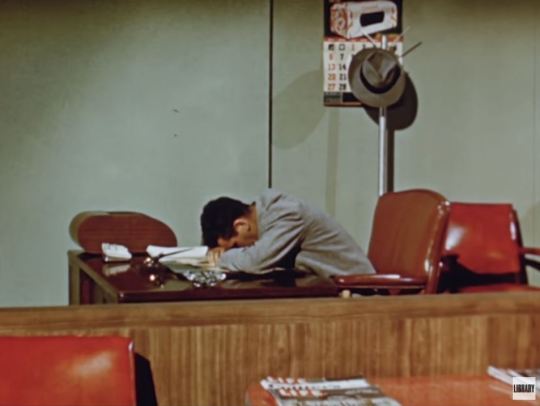
The wall calendar above Ellis’s desk matches the calendar for January 1952, which was likely the filming date. The calendar depicts a loaf of bread with the brand name redacted for filming. On the table close to the bottom of the frame are copies of Life Magazine. Later on, Ellis makes instant coffee from a jar labeled Maxwell House Coffee, although the dish washing detergent and the food in the fridge are obviously props with no brand identification. The laundry soap, however, is clearly labelled ‘All’ but is not in their usual bright colored packaging.
Blooper Alerts!


Dates! Phil tells Ellis that Freedom Fair will be announced in the April 11 issue of Life. However, the issue is actually dated April 7, 1952, not April 11. Interestingly, copies of Life Magazine are used as set decoration in Ellis’s office. Similarly, the April 16 edition of the Saturday Evening Post is really dated April 12.

Weather Forecast! The put-upon housewife at the end of the film realizes her wash is still on the line when there is a sudden cloudburst (she does not own an electric dryer). The next moment, she answers the door to the Westinghouse Salesman and it is a clear day. Not really a blooper, just an indication that Westinghouse makes a rainy day into a sunny one – at least in the movies!
Fast Forward!

“Westinghouse Desilu Playhouse” was a television anthology series produced by Desilu Productions. The show ran on CBS between 1958 and 1960. Two of its 48 episodes served as pilots for the 1950s television series “The Twilight Zone” and “The Untouchables.” It also presented 11 of the 13 episodes of “The Lucy-Desi Comedy Hour” after its initial sponsorship by Ford.

In joining forces with Desilu, Westinghouse canceled their other anthology series “Studio One” which ran on CBS from 1948 to 1958.
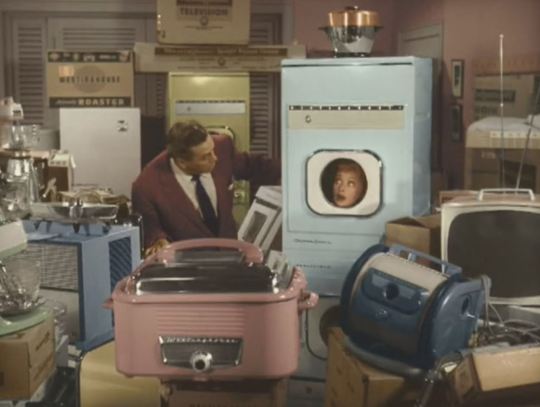
To kick off the partnership between Desilu and Westinghouse, a similar film (informally titled “Lucy Buys Westinghouse”) was produced which depicted Lucy and Desi giving a Westinghouse Executive a tour of their studio, formerly RKO. All through the tour, much to the dismay of Desi, Lucy is trying to order appliances for her dressing room from the executive! At the end, Lucy appears inside a Westinghouse dryer – hiding from Desi! Like Ellis in Freedomland, this film was only shown to Westinghouse employees. Unlike Ellis, it was filmed in black and white – only later colorized for home video. Throughout the film, Desi mispronounces the company’s name as “Westin-Gouse” and its spokesperson as Betty “Furnace”.
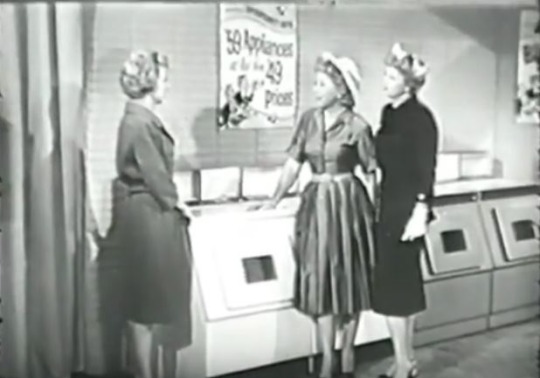
During that time, the cast often did long-form commercials for Westinghouse. Here, Betty Furness and Vivian Vance join Lucille Ball to talk about the 1959 Westinghouse washing machine, the same type of appliance Ball voiced in this film seven years earlier.

Naturally, during this period Lucy Ricardo had the most up-to-date Westinghouse appliances in her Westport home. Like this two-toned refrigerator and freezer.

Back in New York City, the Ricardos owned a Westinghouse Clock Radio!
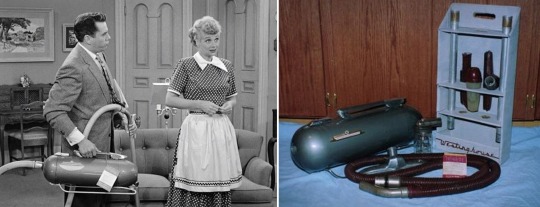
The Handy Dandy vacuum cleaner was actually a Westinghouse model!

In 1954, Lucy made breakfast with her
Westinghouse “Grill-n-Waffler” Waffle Iron – if only she can remember to pay the electricity bill, that is!

Lucy squeezes oranges for juice with her Westinghouse Model #FM-511 Food Crafter with juicer attachment (sold separately).

Lucy owned two different models of the Westinghouse Commander Super-Corox Range. This 1950 model was used during season one…

…and this 1954 Model on a later season. It looks similar to the 1950 model, but the controls have a different layout.

In 1953, ownership of a washing machine was a point of contention between the Ricardos and Mertzes. The appliance used in the episode is labeled Epernay (a fictional brand). In actuality, it is probably a Launderall Horton 500 with gas stove handles affixed to the sides to help move it back and forth on the narrow porch.

Lucy uses the washing machine (a lot!) in Yours, Mine and Ours (1968). It is impossible to see what brand it is.

Coincidentally, in April 1952, “I Love Lucy” did an episode titled “The Freezer” (ILL S1;E29) where Lucy and Ethel want to buy a home freezer to economize, but end up buying a walk-in model instead. In Jess Oppenheimer’s book, he states that newspapers and magazines were full of ads for home freezers at the time. Once they came up with the idea of Lucy getting trapped in the freezer, they had to abandon the home freezer idea for a larger, walk-in model.

In 1966, a TV musical titled “Evening Primrose” with music by Stephen Sondheim and a book by George Furth, also explored the idea of department store mannequins coming to life. Anthony Perkins starred.

The idea of anthropomorphized laundry room appliances was also explored in the 2004 Broadway musical Caroline, or Change, in which actors played embodiment of the Washing Machine and the Dryer. A revival of the musical was on track for Broadway but interrupted by the Corona Virus pandemic.

In 1987, the film Mannequin starring Andrew McCarthy and Kim Cattrall also explored the idea of department store mannequin coming to life. It was partly based on the 1948 film One Touch of Venus, although in that film, the mannequin was a statue.
 1952, Alan Hale, Alan Hale Jr., Andy Devine, Betty Furness, Byron Foulger, Edward Arnold, Ellis in Freedomland, I love lucy, Iron Eyes Cody, James Mason, Jerry Colonna, Lucille Ball, Marie Wilson, Maureen O’Sullivan, Percy Kilbride, Robert Carson, Robert Rockwell, Vivian Vance, Westinghouse, Willie Best
 -
FRANK NELSON
1911-1986

Frank Nelson was born on May 6, 1911 (three months before Lucille Ball) in Colorado Springs, Colorado. He started working as a radio announcer at the age of 15. He later appeared on such popular radio shows as “The Great Gildersleeve,” “Burns and Allen,” and “Fibber McGee & Molly”. Aside from Lucille Ball, Nelson is perhaps most associated with Jack Benny and was a fifteen-year regular on his radio and television programs. His trademark was playing clerks and other working stiffs, suddenly turning to Benny with a drawn out “Yeeeeeeeeees?”
LUCY & FRANK: RADIO DAYS…

October 23, 1948 – “My Favorite Husband: The Quiz Show"
To afford a new dishwasher to help Katie the maid, Liz (Lucille Ball) goes on a Quiz Show hosted by Frank Nelson. Note: This episode was the basis for the episode of “I Love Lucy” with the same title, also starring Nelson as the quiz master. On radio, however, he is known as Smiley Stembottom instead of Freddy Fillmore.
November 11, 1948 – “My Favorite Husband: Learning To Drive"
As a new driver, Liz (Lucille Ball) has an incident that involves the police (Frank Nelson).
November 27, 1948 – “My Favorite Husband: Is There A Baby In The House?”
Liz babysits for a new neighbor. When George’s boss decides to use the baby to make a good impression on a new client (Frank Nelson), it turns out to be the baby’s father!
December 18, 1948 – “My Favorite Husband: Liz’s New Dress"
Liz (Lucille Ball) pranks a department store clerk (Frank Nelson) to get herself a new dress.
February 4, 1949 – “My Favorite Husband: Speech For Civic Organization"
When George brings a new client home for dinner (Frank Nelson), Liz (Lucille Ball) decides to show off her newly-learned vocabulary words.
February 18, 1949 – “My Favorite Husband: Secretarial School"
Liz (Lucille Ball) is a substitute secretary trying to appease an impatient Chairman of the Board (Frank Nelson).
February 25, 1949 – “My Favorite Husband: Absent Mindedness"
Liz (Lucille Ball) reports to a policeman (Frank Nelson) that her car has been stolen.
April 3, 1949 – “The Martin and Lewis Show”
Dean and Jerry welcome Lucille Ball as their first guest star while Frank Nelson plays their agent.
June 3, 1949 – “My Favorite Husband: Television”
Liz (Lucille Ball) and George visit a neighbor (Frank Nelson) and accidentally break his television set. Note: This program was used as a basis for “I Love Lucy” episode “The Courtroom”, although Nelson was not involved.
June 24, 1949 – “My Favorite Husband: Liz Changes Her Mind"
Nelson plays a snooty waiter who loses patience with an indecisive Liz (Lucille Ball). Note: Nelson later played the same role on “I Love Lucy: Lucy Changes Her Mind” although the comedy is now not about the waiter’s snootiness but his near-nearsightedness, a much more visual source of comedy.
July 1, 1949 – “My Favorite Husband: Reminiscing”
Frank Nelson plays a driving instructor assigned to teach Liz (Lucille Ball).
April 23, 1950 – “Liz Appears on Television”
Nelson plays a cigar store clerk, and a TV host.
LUCY & FRANK: TV TIME…

Nelson appeared in 11 episodes of “I Love Lucy”, including three as quiz master Freddy Fillmore, and two as Ralph Ramsey, plus appearance on “The Lucy-Desi Comedy Hour” – making him the only actor to play two different recurring roles on “I Love Lucy.”

Sharp-eyed viewers will notice that the quiz master’s first and last names are spelled differently over the course of the three episodes. Freddy v Freddie and Filmore v Fillmore. For the sake of this blog, we will stick with the more commonly seen “Freddy Fillmore”.
His first appearance was in…
“The Quiz Show” (ILL S1;E5) ~ November 12, 1951

Fillmore is the host of radio’s “Females Are Fabulous” in which Lucy will do anything to win a thousand dollars.
“Lucy Gets Ricky on the Radio” (ILL S1;E32) ~ May 19, 1952

Fillmore is now hosting “Mr. & Mrs. Quiz,” a program Lucy believes will boost Ricky’s public profile by answering trivia questions. To assure he wins – she steals the answers but is thwarted when Fillmore changes the questions!
“Ricky’s Hawaiian Vacation” (ILL S3;E22) ~ March 22, 1954

This is Fillmore’s third and final appearance, having finally made the leap from radio to television to host “Be a Good Neighbor.” Lucy is trying to win a trip to Hawaii so she can go along with Ricky on his business trip.
“Lucy Changes Her Mind” (ILL S2;E21) ~ March 30, 1953

Nelson plays Henry, a nearsighted waiter who ends up calling it quits when Lucy can’t make up her mind! Note: Nelson repeats the role he did on radio’s “My Favorite Husband: Liz Changes Her Mind” starring Lucille Ball.
“Ricky’s Movie Offer” (ILL S4;E6) ~ November 8, 1954

Ethel mistakes talent scout Ben Benjamin (Frank Nelson) for an intruder and Lucy conks him on the head with a vase.

Lucy and Ethel then do a ‘Weekend at Bernie’s’ by sitting the unconscious talent scout upright on the sofa like nothing had happened. Ethel combs his hair, and for a few seconds puts the comb under his nose making the lifeless Benjamin looks exactly like Adolf Hitler although less cynical viewers claim it was Oliver Hardy.
“Ricky and Fred Are TV Fans”
(ILL S2;E30) ~ June 22, 1953)

Sergeant Nelson of the NYPD mistakes Lucy and Ethel for Sticky Fingers Sal and Pickpocket Pearl!
“The Million-Dollar Idea” (ILL S3;E13) ~ January 11, 1954

Nelson plays another alliteratively-named TV host, Dickie Davis, who introduces Mary Margaret McMertz to sell Aunt Martha’s Old Fashioned Salad Dressing. To test the salad dressing, McMertz brings on an ‘average housewife selected at random’: Lucy, calling herself Isabella Clump.
“The Great Train Robbery” (ILL S5;E5) ~ October 31, 1955

Nelson played a frazzled Union Pacific Train Conductor who must contend with Lucy’s tendency to pull the emergency break! Nelson first played this character on radio on “The Jack Benny Program.” He was generally teamed with Mel Blanc, who would do the station calls, although Blanc was not used here.
“Return Home from Europe” (ILL S5;E26) ~ May 14, 1956

When Lucy lands in New York after her mid-air cheese / baby debacle, Frank Nelson plays the US Customs Officer in charge of sorting things out.
“Lucy Gets Chummy with the Neighbors” (ILL S6;E18) ~ February 18, 1957

We meet Betty and Ralph Ramsey, the Ricardos’ Westport neighbors. Ralph works at the Burton Warshman and Ramsey Agency and is a member of the Westport Country Club, where he makes his second and final appearance in…
“Country Club Dance” (ILL S6;E25) ~ April 22, 1957

Ralph joins Ricky and Fred in paying a bit too much attention to young Diana Jordan (Barbara Eden), much to the dismay of his wife Betty (Mary Jane Croft).
“Lucy Takes a Cruise To Havana” (LDCH S1;E1) ~ November 6, 1957

Nelson appears as the Cruise Director of the RMS Caronia in 1940 trying to get private secretaries Lucy McGillicuddy and Susie MacNamara (Ann Sothern) involved in something more than just finding a husband!

Nelson returned to the role of the frazzled Train Conductor for an episode of “The Lucy Show” in 1963. This marks his final appearance on a Lucille Ball sitcom.
“Jack Benny’s New Look” ~ December 3, 1969

Nelson plays a Camera Store Clerk who (conveniently) demonstrates the sponsor’s product, Kodak Cameras. He does not share the stage with Lucille Ball, who only momentarily appears at the very end of the special as herself.
“Jack Benny’s 20th Anniversary Special” ~ November 16, 1970

Nelson plays an Airport Ticket Clerk who naturally greets Jack Benny with his trademark “Yeeeeeeeeees?” Lucille Ball does not appear in this sketch. She plays Benny’s maid in another sketch on the program.

In “The Handcuffs” (ILL S2;E4) Ricky is interviewed and introduced by Veola Vonn. In real-life, Vonn was married to Frank Nelson from 1970 until his death in 1986.

In “Ethel’s Birthday” (ILL S4;E9) Mary Lansing provided the offstage voice of Cynthia in “Over the Teacups”. Lansing was Nelson’s first wife, marrying him in 1933 and with whom he had two children.
-
HEDDA HOPPER
May 2, 1885

Hedda Hopper was born Elda Furry in Hollidaysburg, Pennsylvania. She became one of Hollywood’s most powerful and influential columnists. She appeared on “I Love Lucy” and “The Lucy-Desi Comedy Hour.” Among her hundreds of films as an actress, she did two with Lucille Ball: Bunker Bean (1936) and That’s Right – You’re Wrong (1939). Hopper was best known for her flamboyant hats. She was also a well known conservative, Republican, and staunch supporter of blacklisting suspected communists.

In films and television, Hopper has been portrayed by such actors as (clockwise from top left): Helen Mirren (Trumbo), Tilda Swinton (Hail, Caesar!), Jane Alexander (Malice in Wonderland), Judy Davis (“Feud”), Fiona Shaw (RKO 281), Katherine Helmond (Liz: The Elizabeth Taylor Story), and (not pictured) Holly Kaplan (Netflix’s Hollywood).

Hopper and Ball were friends, although her dedication to her profession often tested that friendship.

Lucy knew it was best to keep the Hollywood press on her side – even against unlikely odds. Hopper, for example, named names during the hunt for communists in the 1950s. Lucille Ball was one of those who were named – although not specifically by Hopper – nearly ending her career.

Talking About Hedda…

In 1952’s “The Gossip” (ILL S1;E24) Lucy calls Ricky and Fred “Hedda and Lolly” after hearing them indulge in gossip about the Tropicana hat check girl. Lolly refers to Hopper’s chief competition, gossip columnist Louella Parsons.

Lucy reads in Hedda Hopper’s column that Rock Hudson is “In Palm Springs” (ILL S4;E26) resting up after a personal appearance tour for his latest film ‘Captain Lightfoot’ (1955).

In “Lucy Becomes a Reporter” (TLS S1;E17) Viv calls Lucy ‘Louella’, a reference to gossip columnist Louella Parsons. Later in the episode, Lucy invokes the name of Parsons’ chief rival, Hedda Hopper.
Hedda On Camera…

Lucille Ball and Hedda Hopper both appeared in the 1936 motion picture Bunker Bean, also starring Owen Davis Jr. and Louise Lattimer.

in 1939, Lucy and Hedda were both in That’s Right – Your’re Wrong starring Kay Kyser. Hedda played herself – something she would do for most of her subsequent screen appearances, despite her roots as an actress.

“The Hedda Hopper Story” (ILL S4;E21) ~ March 14, 1955
Lucy comes up with an elaborate plan to get into Hopper’s column and get some much-needed publicity for Ricky. Little do they know that Lucy’s mother has invited her over for tea.
Ricky:“Mother, darling. Why didn’t you tell us it was Hedda Hooper?”
Mrs. McGillicuddy:“You didn’t ask me!”
“Lucy Takes a Cruise To Havana” part of “The Lucy-Desi Comedy Hour” ~ November 6, 1957
Hopper visits the Ricardos in their Westport home to get a story on how they first met. This sets up the flashback to the cruise to Havana. Desi insisted the first installment be 75 minutes instead of an hour. Consequently, in syndication, Hopper’s opening scene was often cut to make the episode fit the time slot.
Little Ricky: “How do you do, Miss Hepper!”

“The Desilu Revue” part of The Westinghouse Desilu Playhouse ~ December 25, 1959
Sixteen of the Desilu Workshop actors join the “I Love Lucy” cast in creating a holiday special. The show aired on Christmas Day 1959 and featured Hedda Hopper as well as many other stars working on the Desilu lot. Hopper arrives at the Playhouse to do a story on the ‘kids’ in the show, and compliments their Christmas tree:
Hedda Hopper:“It would make a stunning hat!”

“Hedda Hopper’s Hollywood” ~ January 10, 1960
Throughout the hour-long special named after her newspaper column, Hopper is never in the same frame with the celebrities. Rather, she introduces ‘talking heads’ segments and uses voice-over narration to link them together. Lucille Ball appears on the Desilu lot, talking about the Desilu Playhouse.
Hedda Hopper died on February 1, 1966 at age 80.

-
A NIGHT TO REMEMBER
May 1, 1944

On May 1, 1944, Lucille Ball joined the cast of the Screen Guild Players to perform in the radio broadcast “A Night To Remember” based on the 1942 film of the same name.
SYNOPSIS:
A mystery writer and his newlywed wife move into a Greenwich Village apartment and find themselves with a corpse and a half dozen red herrings.

Ball played Nancy Troy, a role originated on film by Loretta Young. Brian Donlevy played Jeffrey Troy, the role originated by Brian Aherne in the film. In 1934, Young and Ball had appeared together in the film “Bulldog Drummond Strikes Back.”
Truman Bradley was the announcer and the orchestra was led by Wilbur Hatch, who would go on to do the same job on “I Love Lucy.”

The original film was directed by Richard Wallace, and is based on the novel The Frightened Stiff by Kelley Roos published in 1942.

Donlevy and Ball were photographed together with the MGM stars in 1943, just a few months prior to this broadcast. At the conclusion of the broadcast the announcer notes that Lucille Ball appeared through the courtesy of MGM pictures, “producers of ‘The White Cliffs of Dover’.” That film featured Lucy’s friend Van Johnson and “I Love Lucy” character actress Norma Varden. Ball signed with Metro-Goldwyn-Mayer in the 1940s, but never achieved major stardom there. She would return to them in the 1950s when she and Desi were television stars making films as a couple.

For radio, the mysterious Greenwich Village address was changed from 13 Gay Street in the film to 39 Gay Street, the same as in the original novel. The reali-life NYC street’s name does not refer to the LGBTQ character of Greenwich Village. Rather, the name comes from a family named Gay who owned land or lived there during colonial times.

There may have been some problem with using a real address (#13 today, above) for the original film – or CBS radio’s legal department may have just erred on the side of caution. There actually is no 39 Gay Street, which would alleviate the problem. The film was made in Hollywood, not in New York City.

The show was produced by Lady Esther’s Screen Guild Players on CBS Radio. Screen Guild Players, otherwise known as The Screen Guild Theater, was one of the most popular drama anthology series during the Golden Age of Radio. From its first broadcast in 1939, up to its farewell in 1952, it showcased radio adaptations of popular Hollywood films. Many Hollywood names became part of the show, including Bette Davis, Bing Crosby, Clark Gable, Judy Garland, Frank Sinatra, and many more. The actors’ fees were all donated to the Motion Picture Relief Fund, an organization that provides aid to retired actors. Screen Guild Players was heard on different radio networks, beginning with CBS from 1939 to 1948, NBC from 1948 to 1950, ABC from 1950 to 1951, and back to CBS until its last episode on June 29, 1952. Throughout its run, a total of 527 episodes were produced.

During the Golden Age of Radio, there were similar shows like “Screen Directors’ Playhouse” and the “Lux Radio Theatre.” Ball appeared on these as well.

From late 1942 to July 1947 Lady Esther Cosmetics sponsored the show which had been previously sponsored by Gulf Oil. It was first known as the “Lady Esther Presents the Screen Guild Players” and then became the Lady Esther Screen Guild Theater. The radio show brought movies to radio for thirty minutes each Monday evening on CBS. The show aired for 242 programs beginning with “Yankee Doodle Dandy” starring James Cagney and ending with “My Reputation.” In between were all time classics such as “Casablanca” with Humphrey Bogart and Ingrid Bergman, “Sergeant York” with Gary Cooper and “Holiday Inn” with Bing Crosby, Fred Astaire, and Dinah Shore.

After the story concludes the announcer promotes next week’s screen to air production, “The Dark Angel” starring Merle Oberon, the 1935 film’s original star. There is also a pitch for War Bonds.
More Screen Guild Players Radio Productions

Six months later, Lucy returned to the Screen Guild Players to recreate her role in “A Girl, A Guy, and a Gob” with her original 1941 co-star George Murphy.

In 1942, Lucy took the role originated by Binnie Barnes in a radio recreation of the 1941 film “Tight Shoes.” Her co-star was Red Skelton.
“A Night To Remember” was again produced two years later on the series. While Donleavy recreated his role as Jeff, but Claire Trevor played opposite him instead of Lucy.
Also in 1944, Lucy stepped into the shoes of Jean Harlowe to present “China Seas” with its original 1935 star Clark Gable.
In April 1947, Lucy appeared with Bob Hope and Frank Sinatra in “Too Many Husbands” which had graced the big screen in 1940 starring Jean Arthur, Fred MacMurray, and Melvyn Douglas.

In late April 1948, Lucille Ball returned to the series once again for “It Had To Be You” with Cornel Wilde. Lucy took the role originally played by her friend Ginger Rogers in the 1947 film starring Wilde. In 1955, Wilde guest starred as himself on “I Love Lucy” as “The Star Upstairs” (ILL S4;E25).

In February 1951, Eve Arden took Lucille’s role in an adaptation of Ball’s 1949 film “Miss Grant Takes Richmond” with William Holden repeating his film role. Coincidentally, Arden and Holden both appeared on the same episode of “I Love Lucy” in 1955.
-
Patti LuPone on ‘Hollywood’ costar Darren Criss, family friend Lucille Ball
Broadway Diva Patti LuPone talks about her unique connection to Lucy!
Patti LuPone on ‘Hollywood’ costar Darren Criss, family friend Lucille Ball
-
APPLE BLOSSOM LUCY
April 30, 1964
The annual Shenandoah Apple Blossom Festival and Parade in Winchester, Virginia began in 1929. The event features an Apple Blossom Queen (aka Queen Shenandoah), a parade with a Grand Marshal, and celebrity appearances.

In 1964, TV legend Lucille Ball, served as the Festival’s Grand Marshal. The Queen of Comedy was joined by another famous Lucy – Luci Baines Johnson, who was Queen Shenandoah.
Luci Baines Johnson (born July 2, 1947) is the younger daughter of U.S. President Lyndon B. Johnson and his wife, Lady Lady Bird Johnson. Her father was president from November 22, 1963 (President Kennedy’s assassination) to January 20, 1969. Her first name was originally spelled “Lucy” just like Lucille Ball’s nickname, but in her teens she changed the spelling. As her parents both had the initials LBJ, they named their two daughters so that they would have these initials as well.
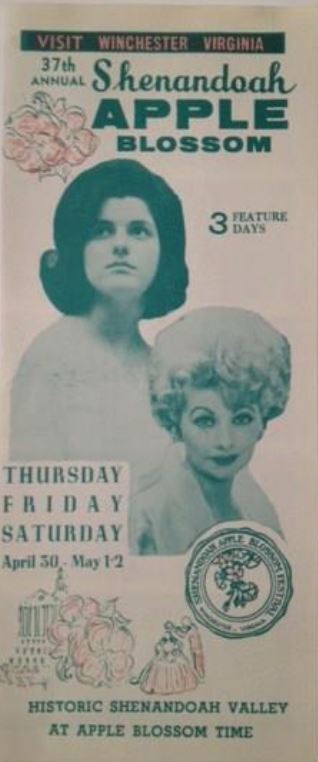
A brochure for the 1964 event shows both Luci and Lucille on the cover.

A more generic tourist guide was also available for visitors.

A program book was available for fifty cents.

Naturally, the ‘two Lucy’ event gathered a good deal of press, as with this brief column in Variety.

The Post Office even commemorated the Festival with special envelopes and postmarks. The top left envelope is from the 1964 event and shows the Johnson family home.
If Lucille Ball needed to be convinced to be Grand Marshal, she just had to ask some of her famous friends, who also went to Winchester at Festival Time.
- 1949 & 1975 – Bob Hope
- 1953 – Howard Keel
- 1953 – Arthur Godfrey
- 1954 – Ed Sullivan
- 1957 – Johnny Roventini (Philip Morris Bellboy) also present in 1964 with Lucille Ball
- 1958 – Audrey Meadows
- 1968 – Eddie Bracken (Too Many Girls)
- 1969 – Ed McMahon
- 1973 – Mike Douglas

Three days before Lucy’s appearances at the Apple Festival, “Lucy Enters A Baking Contest” (TLS S2;E28) was aired for the first time. The episode depicts Lucy making pies, although they were cream pies, not apple!

For the 75th Anniversary Festival in 2002, Lucy’s granddaughter, Katharine Desiree Luckinbill, served as Queen Shenandoah. Lucille Ball’s daughter, Lucie Arnaz and Lucie’s husband Larry Luckinbill, accompanied their daughter Katharine to the event and also rode in the parade.

AN APPLE A DAY…

Although audiences never knew it, apple sauce was the main ingredient in the pies dumped on William Holden in “Hollywood at Last!” (ILL S4;E16) and apple pectin was the secret ingredient in Vitameatavegamin in “Lucy Does a TV Commercial” (ILL S1;E30).


“Lucy’s Notebook” – a publication from the mid-1950s – includes a recipe for Apple Pie de Luxe!

She was also known for her Sweet Apple John – recipe above!

Speaking of Apple John, in “Lucy Goes to Art Class” (TLS S2;E15), Viv bakes an apple pie for John, a handsome new bachelor she met at art class.

In the same episode, Lucy ‘meets cute’ with John when the contents of her purse spill out on the floor and he helps pick them up – including an apple!

In “Lucy Buys a Boat” (TLS S1;E30), Lucy snacks on an apple while Viv is out cold from too many sea sickness pills!

In “Lucy Learns To Drive” (ILL S4;E12) Lucy tries to coax a catatonic Fred out of his daze by tempting him with a piece of her apple pie!

In “Lucy and Chuck Connors Have a Surprise Slumber Party” (HL S6;E13) Connors decides to spend the night in the Carter house. His director (Ryan MacDonald) informs him there’s plenty of apple pie in the fridge!

Lucy Ricardo owned an apple cookie jar! Lucy’s Hull Apple Cookie Jar, was often seen in the Ricardo kitchen. Hull Pottery was quite popular in the 1950’s.

In early episodes of “I Love Lucy” apples (and other fruits) were readily available in the Ricardo living room!

Int “The Kleptomaniac” (ILL S1;E27) while Lucy is stealing Fred’s cuckoo clock for her club bazaar, she grabs an apple from the sideboard as a snack!

A ravenous Lucy takes a bite out of juicy looking apple – only to discover that it is made of wax – in “Lucy’s Schedule” (ILL S1;E33).
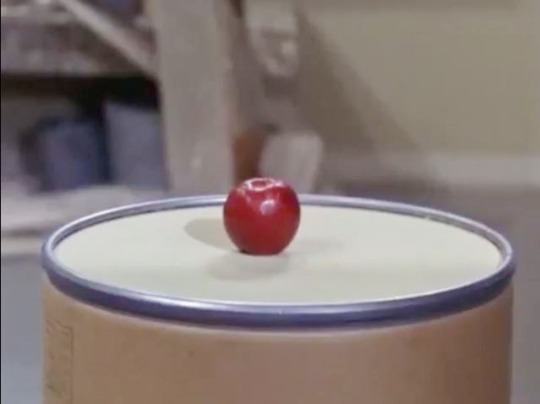
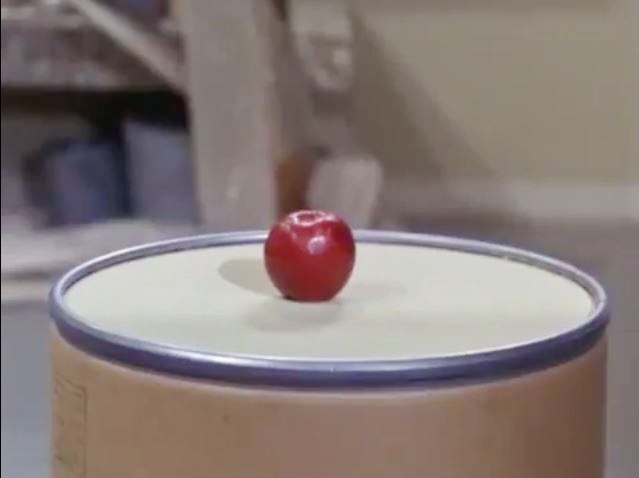
In “Lucy Helps the Countess” (TLS S4;E8), Lucy Carmichael, the Countess, and Mr. Mooney, accidentally get locked in a vacant high rise apartment for the weekend! The only food they have is one solitary apple!
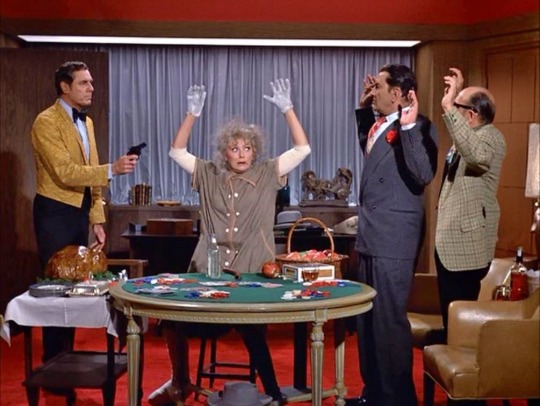
In “Dirty Gertie” (HL S5;E10), Lucy Carter goes downtown to bring a basket of surplus apples to her hairdresser, and is mistaken for an impoverished “Apple Annie” by some local mobsters.

In “Lucy in London” (1966), after Anthony Newley’s medley, there is a quick shot of Lucy as an Eliza Doolittle-type figure in the balcony of a theatre munching an apple! Technically, London theatres were known for their orange sellers, but why quibble?

In “Lucy Becomes a Reporter” (TLS S1;E17), Viv’s old flame Argyle (John Vivyan) says she was known in high school was as ‘Truckie’ because of her dance moves while doing “The Big Apple.” In “Love Among the Two By Fours” (LWL S1;E3). Lucy Barker and her old flame Ben (Peter Graves) say they first met doing the same dance!

Apples are 18 cents a pound in 1970′s “Lucy Loses Her Cool” (HL S3;E13).

In a silent movie sketch in “Lucy and Mickey Rooney” (TLS S4;E18) The Kid (Rooney) swipes an apple from a fruit stall, but The Tramp (Lucy) stops him.

He was only emulating the Keystone Cop!

At the start of “Lucy the Gun Moll” (TLS S4;E25), Lucy Carmichael wants Mr. Mooney to install an apple vending machine for the employees at the bank.
Although vending machines offering fresh fruit are rare in today’s world, the Fruit-O-Matic Company started to manufacture such machines around 1950.

In “World’s Greatest Grandma” (LWL; unaired) Lucy Barker considers singing “Don’t Sit Under the Apple Tree (With Anyone Else But Me)” for a talent show – except (as usual) she can’t sing!

In “Lucy and the Andrews Sisters” (HL S2;E6), Lucy Carter and daughter Kim join Patty Andrews in a medley that contains the song. It was originally sung by the Andrews Sisters in the 1942 film Private Buckaroo.
1964, Andrews Sisters, Apple, Apple Festival, Apple Pectin, Apple Pie, Apple Sauce, Apples, Desi Arnaz, Gale Gordon, Here’s Lucy, I love lucy, Katharine Luckinbill, Luci Baines Johnson, Lucie Arnaz, Lucie Luckinbill, Lucille Ball, Lucy, Mickey Rooney, Patty Andrews, Shenandoah, Shenandoah Apple Blossom Festival, The Lucy Show, Vivian Vance, William Frawley, Winchester Virginia
-
Subscribe
Subscribed
Already have a WordPress.com account? Log in now.
 Papermoon Loves Lucy