-
OLD GOLD COMEDY THEATRE
“A GIRL, A GUY, AND A GOB” ~ February 11, 1945

The Old Gold Comedy Theatre (aka Harold Lloyd Comedy Theatre) was NBC Radio’s attempt to replicate the success of CBS’ Lux Radio Theatre. It debuted on October 29th, 1944. Silent film star and producer (and Lucille Ball’s mentor) Harold Lloyd introduced condensations of movie comedies. This film happened to be one of his own. NBC programmed the series Sunday nights at 10:30PM for east coast audiences. The series was cancelled on June 10th, 1945.

Lucille Ball had done the second episode of the series, starring in Ball of Fire on November 5, 1944. Ball took the role originated in the 1941 film by Barbara Stanwyck while Cary Grant reprised his role for radio.

A Girl, a Guy and a Gob is a 1941 RKO film produced by Harold Lloyd and starring Lucille Ball, George Murphy, and Edmond O’Brien.
Ball and Murphy reprise their film roles for radio.The film had previously been dramatized for radio on “The Screen Guild Radio Theatre” on October 9, 1944, also starring Ball and Murphy.

Synopsis ~ A shy, quiet executive for a shipping firm who finds himself with a dilemma: he’s become smitten with his young temporary secretary but she’s the girlfriend of his Navy buddy – and the buddy is scheduled to be discharged in only a few days.
Note: “Gob” is a slang word for a sailor. This term first showed up in regard to sailors around 1909 and may have come from the word gobble. Reportedly, some people thought that sailors gobbled their food. The term also may come from the word gob, which means to spit, something sailors also reportedly do often.
CAST

- Lucille Ball as Dorothy (Dotty) Duncan aka ‘The Girl’
- George Murphy as Claudius (Coffee) Cup aka ‘The Gob’ ~ was in four films with Lucille Ball between 1934 and 1941. In 1959, Murphy served as guest host of “The Westinghouse Desilu Playhouse” when Desi Arnaz took a role in his own anthology series. He was also a performer in “The Desilu Revue” aired in December 1959. As the host of “MGM Parade”, he interviewed Lucy and Desi in February 1956.
- Will Wright as Pop Duncan ~ would appear with Lucille Ball in the 1949 film Miss Grant Takes Richmond, and played the locksmith in “The Handcuffs” (ILL S2;E4) in 1952, and the Bent Fork Sheriff in “Tennessee Bound” (ILL S4;E14) in 1955.
The role was played on screen by George Cleveland.
EPISODE

The announcer introduces the evening’s play and its stars as well as the director, Harold Lloyd. Lloyd states that he has recruited the original stars of the film version. Murphy and Ball take the microphone. Lucille’s next film, MGM’s Without Love, is briefly mentioned. Llloyd sets the story,
Executive Stephen Herrick is taking his date to a piano concert at Carnegie Hall when he discovers people are already sitting in his usual box seats. It is Dotty (Lucille Ball) and Coffee Cup (Murphy). Lucy whacks Mr. Herrick in the head with her handbag when he threatens to call the manager. Coffee Cup admits that he did not exactly purchase the tickets legally and they decide to make a hasty departure.
COFFEE CUP: “For my money, Count Basie’s got it all over this guy Josie Iturbe.”

José Iturbi Báguena (1895-1980) was a Spanish conductor, pianist and harpsichordist. He appeared in several Hollywood films of the 1940s, playing himself in the 1943 musical Thousands Cheer, which also featured Lucille Ball. Lucille Ball mentions Iturbi again on an October 7, 1949 episode of her radio show “My Favorite Husband.” William James “Count” Basie (1904-84) was an American jazz pianist, organist, bandleader, and composer.
Next day, at Mr. Herrick’s office, his new secretary arrives – it is Dotty! Herrick threatens to throw her out if she won’t leave and Dotty quickly explains that she gave him the money for the tickets but he lost it on a horse. Herrick reluctantly agrees to hire her anyway.
Sailors Coffee Cup and Eddie meet Dotty for lunch. He begs Dotty to allow him to get a tattoo like Eddie. She is adamant – no tattoos. Eddie claims he can grow four inches right in front of them – with his heels flat on the ground. Mr. Herrick comes by and sees the growing crowd watching this. A bet is wagered if Eddie can truly do it. Dotty borrows five bucks from Mr. Herrick so that Coffee Cup can make the bet.
When Eddie succeeds, the assembled crowd soon turns into a mob and there is a fist fight and a broken store window. Mr. Herrick gets knocked out by a big lug, who in turn is knocked out by Dotty’s lethal purse.
END of ACT ONE

A live Old Gold Cigarette commercial touts that the tobacco blend includes apple honey, to prevent dryness.
Earlier in her career, Lucille Ball was a spokes model for Chesterfield Cigarettes. Later, she would be associated with Philip Morris when they agreed to sponsor “I Love Lucy.” Despite this, Lucille Ball herself remained a Chesterfield smoker for most of her life.
“And remember, when the gremlins gang up on you, why be irritated? Light up an Old Gold.”
ACT TWO
Eddie and Coffee Cup have taken Herrick back to Dot’s busy brownstone to calm his nerves, giving him a sleeping powder. There he is watched over by Mr. and Mrs. Duncan, Dot’s parents. Her father is listening to “The Lone Stranger” on the radio while Mrs. Liebowitz (an upstairs neighbor) is about to have a baby!

“The Lone Stranger” is a comical reference to “The Lone Ranger.” The masked cowboy first appeared on radio in 1933 and proved to be a hit. It spawned a series of books and later an equally popular television show that ran from 1949 to 1957.
Coffee Cup comes by to check on Mr. Herrick, who is only concerned with finding his pants. Dotty comes in to help him find them. They are about to set the table for dinner – corned beef and cabbage – when Liebowitz number 9 comes in to the world. Mr. Herrick wins the baby weight pool. He agrees to go out on the town and celebrate with them.
A few days later, Dotty is late back from lunch, showing off her new engagement ring. She tells Mr. Herrick that Coffee Cup has a wrestling match that night. If he wins, the prize money will pay for their wedding. Mr. Herrick confesses that he hopes Coffee Cup loses.
At the wedding chapel, Eddie wonders why he asked Mr. Herrick to be their best man when he is obviously in love with Dotty. Mr. Higgenbottom, photographer, interrupts to get a photo, mistaking Mr. Herrick for the groom. The sailors need to get back to the ship, so Coffee Cup allows them to give Dotty a farewell kiss before the wedding. Mr. Herrick gets in line. Dotty suddenly feels awkward and runs out.

Coffee Cup follows her to talk privately. She has been crying. He wonders if she has feelings for Mr. Herrick. While she fixes her face, Coffee Cup steps out and tells Mr. Herrick he should go in and console her. Coffee Cup tells Eddie to inform Dot’s mother that he went to get cigarettes.
END of ACT TWO

Another live commercial for Old Gold Cigarettes. The announcer reminds listeners that the men in uniform get first consideration in the distribution of Old Gold Cigarettes.
ACT THREE

Harold Lloyd sets the scene. The bride and the best man are at the alter, but the groom is nowhere to be found. Mr. Herrick realizes what has happened and rushes out to follow Coffee Cup, who has driven away on motorcycle. Mr. Herrick yells at him from a taxi cab.
Suddenly, Coffee Cup crashes, but is unharmed. When Herrick threatens to bring him back to the alter, Coffee Club slugs him and tells the cabbie to take them back to the chapel. He writes a note on the unconscious Herrick’s shirt front and with a loud honk of the taxi horn, speeds away toward the ship yard. Dotty and the wedding party find Herrick on the street and she reads the note:
“Dot, this guy loves you and I know now you love him. It’s a good thing I found out before it was too late. See you next time I’m on leave. ~ Coffee Cup. PS: The wedding’s all paid for, why don’t you use it and you and him get married.”
At the shipyard, Eddie catches up with Coffee Cup, who reports that Dot did indeed marry Mr. Herrick. As they board the ship, they discuss plans for Coffee Cup’s new tattoo.END OF EPISODE
Harold Llloyd, George Murphy, and Lucille Ball bid audiences goodnight. He reminds them to tune in next week for Jack Haley, Jimmy Gleason, and Eve Arden in The Milky Way.
The Announcer thanks RKO, producers of Experiment Perilous.
George Murphy appeared courtesy of MGM, producers of National Velvet.
-
EVA GABOR
February 11, 1919

Eva Gabor was born in Budapest, Hungary, the youngest of three sisters, Zsa Zsa, and Magda.

She was the first of the sisters to immigrate to the US, shortly after her first marriage in 1937 when she was 18 years old.
“I was the first actress in the family, and I am still the only actress in the family. I shouldn’t be saying it, but it slipped out!” ~ Eva Gabor

Her first movie role was in 1941’s Forced Landing at Paramount Pictures.

She made her television debut in a 1949 episode of NBC’s “Your Show Time” titled “A Lodging for the Night”, the final episode of the anthology series. “Your Show Time” was the first television series to be shot on film and the first to receive an Emmy Award.

She worked for Desilu in two episodes of “The Ann Sothern Show” (1959 & 1961). Lucille Ball played Lucy Ricardo on the series in October 1959.

Despite her many appearances on stage and screens large and small, she is best known for playing Lisa Douglas on CBS TV’s “Green Acres” (1965-71) doing 170 episodes with Eddie Albert, who played her husband. She also played the character on “The Beverly Hillbillies,” “Petticoat Junction”, “Honey, I’m Home” and on a 1990 reunion show.

The series also featured many of Lucille Ball’s co-stars and friends: Barbara Pepper, Eleanor Audley, Jerry Hausner, Sid Melton, Bea Benadaret, Shirley Mitchell, Parley Baer, and many others.

While still doing “Green Acres,” Gabor played romance novelist Eva Von Graunitz in “Lucy and Eva Gabor” (HL S1;E7).

She returned to the series (this time using her own name) in “Lucy and Eva Gabor Are Hospital Roomies” (HL S5;E2) in September 1972. (The above is a publicity photo since both stars were in separate hospital beds for the entire episode.)

This episode was hastily written to accommodate Lucille Ball’s broken leg.

She also appeared on Broadway five times between 1950 and 1983.

She was also a successful businesswoman, marketing wigs, clothing and beauty products.

In 1984, Eva Gabor was present at the “All-Star Party For Lucille Ball” although she was uncredited and did not speak. Gabor and Ball were also in the audience (and briefly on camera, although not together) when AFI gave it’s “Lifetime Achievement Award” to Jack Lemmon in 1988.

Her final screen appearance was in a 1994 episode of “Burke’s Law” a re-boot of a series she had also appeared on in 1963.
Gabor was married five times.
- Eric Valdemar Drimmer (1937-42), a Swedish-born masseur turned osteopath and psychologist.
- Charles Isaacs (1943-49), an American investment broker.
- John Elbert Williams, MD (1956-57), a plastic surgeon.
- Richard Brown (1959-73), a textile manufacturer, who later became a writer and director.
- Frank Gard Jameson Sr. (1973-83), an aerospace executive.
After her final marriage, Gabor was involved in a relationship with TV producer Merv Griffin until her death. It was rumored that this was a platonic relationship to hide Griffin’s suspected homosexuality.
She died in 1995 at age 76.

-
VALENTINE’S DAY
February 11, 1949

“Valentine’s Day” (aka “Valentine’s Day Mischief”) is episode #30 of the radio series MY FAVORITE HUSBAND broadcast on February 11, 1949 on the CBS radio network.
Synopsis ~ Katie, the Maid, is sweet on Mr. Dabney, the butcher, and Liz offers to help. But when Liz’s Valentine to George gets switched with her check to pay the butcher’s bill, Mr. Dabney gets the wrong idea.

Note: This program was a basis for the “I Love Lucy” episode “Lucy Plays Cupid” (ILL S1;E15) filmed on December 13, 1951 and first aired on January 21, 1952. The titled was changed to reflect the fact that it would not be aired on or around Valentine’s Day. The TV cast included Bea Benadaret, who had already been heard on “My Favorite Husband” and would soon be assigned the regular role of Iris Atterbury. It is ironic that Benadaret was cast as Miss Lewis since she is not heard in the radio version.

“My Favorite Husband” was based on the novels Mr. and Mrs. Cugat, the Record of a Happy Marriage (1940) and Outside Eden (1945) by Isabel Scott Rorick, which had previously been adapted into the film Are Husbands Necessary? (1942). “My Favorite Husband” was first broadcast as a one-time special on July 5, 1948. Lucille Ball and Lee Bowman played the characters of Liz and George Cugat, and a positive response to this broadcast convinced CBS to launch “My Favorite Husband” as a series. Bowman was not available Richard Denning was cast as George. On January 7, 1949, confusion with bandleader Xavier Cugat prompted a name change to Cooper. On this same episode Jell-O became its sponsor. A total of 124 episodes of the program aired from July 23, 1948 through March 31, 1951. After about ten episodes had been written, writers Fox and Davenport departed and three new writers took over – Bob Carroll, Jr., Madelyn Pugh, and head writer/producer Jess Oppenheimer. In March 1949 Gale Gordon took over the existing role of George’s boss, Rudolph Atterbury, and Bea Benadaret was added as his wife, Iris. CBS brought “My Favorite Husband” to television in 1953, starring Joan Caulfield and Barry Nelson as Liz and George Cooper. The television version ran two-and-a-half seasons, from September 1953 through December 1955, running concurrently with “I Love Lucy.” It was produced live at CBS Television City for most of its run, until switching to film for a truncated third season filmed (ironically) at Desilu and recasting Liz Cooper with Vanessa Brown.
REGULAR CAST

Lucille Ball (Liz Cooper) was born on August 6, 1911 in Jamestown, New York. She began her screen career in 1933 and was known in Hollywood as ‘Queen of the B’s’ due to her many appearances in ‘B’ movies. With Richard Denning, she starred in a radio program titled “My Favorite Husband” which eventually led to the creation of “I Love Lucy,” a television situation comedy in which she co-starred with her real-life husband, Latin bandleader Desi Arnaz. The program was phenomenally successful, allowing the couple to purchase what was once RKO Studios, re-naming it Desilu. When the show ended in 1960 (in an hour-long format known as “The Lucy-Desi Comedy Hour”) so did Lucy and Desi’s marriage. In 1962, hoping to keep Desilu financially solvent, Lucy returned to the sitcom format with “The Lucy Show,” which lasted six seasons. She followed that with a similar sitcom “Here’s Lucy” co-starring with her real-life children, Lucie and Desi Jr., as well as Gale Gordon, who had joined the cast of “The Lucy Show” during season two. Before her death in 1989, Lucy made one more attempt at a sitcom with “Life With Lucy,” also with Gordon.
Richard Denning (George Cooper) was born as Louis Albert Heindrich Denninger Jr., in Poughkeepsie, New York. When he was 18 months old, his family moved to Los Angeles. Plans called for him to take over his father’s garment manufacturing business, but he developed an interest in acting. Denning enlisted in the US Navy during World War II. He is best known for his roles in various science fiction and horror films of the 1950s. Although he teamed with Lucille Ball on radio in “My Favorite Husband,” the two never acted together on screen. While “I Love Lucy” was on the air, he was seen on another CBS TV series, “Mr. & Mrs. North.” From 1968 to 1980 he played the Governor on “Hawaii 5-0″, his final role. He died in 1998 at age 84.
Ruth Perrott (Katie, the Maid) was also later seen on “I Love Lucy.” She first played Mrs. Pomerantz (above right), a member of the surprise investigating committee for the Society Matrons League in “Pioneer Women” (ILL S1;E25), as one of the member of the Wednesday Afternoon Fine Arts League in “Lucy and Ethel Buy the Same Dress” (ILL S3;E3), and also played a nurse when “Lucy Goes to the Hospital” (ILL S2;E16). She died in 1996 at the age of 96.
In this episode we learn that Katie is a redhead, like Liz, and a heavy-set woman.
Bob LeMond (Announcer) also served as the announcer for the pilot episode of “I Love Lucy”. When the long-lost pilot was finally discovered in 1990, a few moments of the opening narration were damaged and lost, so LeMond – fifty years later – recreated the narration for the CBS special and subsequent DVD release.
Gale Gordon (who appears here as the Judge) and Bea Benadaret had not yet joined the cast in the roles of Rudolph and Iris Atterbury.
GUEST CAST

Gale Gordon (Judge Skinner) had worked with Lucille Ball on “The Wonder Show” on radio in 1938. One of the front-runners to play Fred Mertz on “I Love Lucy,” he eventually played Alvin Littlefield, owner of the Tropicana, during two episodes in 1952. After playing a Judge in an episode of “The Lucy-Desi Comedy Hour” in 1958, he would re-team with Lucy for all of her subsequent series’: as Theodore J. Mooney in ”The Lucy Show”; as Harrison Otis Carter in “Here’s Lucy”; and as Curtis McGibbon on “Life with Lucy.” Gordon died in 1995 at the age of 89.

Hans Conried (Mr. Dabney, the Butcher / Weary Mailman) first co-starred with Lucille Ball in The Big Street (1942). He then appeared on “I Love Lucy” as used furniture man Dan Jenkins in “Redecorating” (ILL S2;E8) and later that same season as Percy Livermore in “Lucy Hires an English Tutor” (ILL S2;E13) – both in 1952. The following year he began an association with Disney by voicing Captain Hook in Peter Pan. On “The Lucy Show” he played Professor Gitterman in “Lucy’s Barbershop Quartet” (TLS S1;E19) and in “Lucy Plays Cleopatra” (TLS S2;E1). He was probably best known as Uncle Tonoose on “Make Room for Daddy” starring Danny Thomas, which was filmed on the Desilu lot. He joined Thomas on a season 6 episode of “Here’s Lucy” in 1973. He died in 1982 at age 64.
On television, the character will be renamed Mr. Ritter and be played by Edward Everett Horton, who had appeared in three movies with Lucille Ball, including 1935’s Top Hat.
EPISODE

ANNOUNCER: “Now let’s look in on the Coopers. It’s three days before Valentine’s Day. Well, she’s been hinting about it all morning, but George doesn’t seem to notice. And now at breakfast, Liz is making one last try – by arranging her toast crusts in the shape of a heart.”
George doesn’t get the message so Liz comes right out and announces that St. Valentine’s Day is coming up. George calls it a racket and cynically tells her the day started with two kindly old gentlemen: a candy maker and a florist.
LIZ: “What’s Valentine’s Day without candy and flowers?”

Much to his surprise, Liz screams her love for George at the top of her lungs! When George warns that they neighbors might hear, they switch to hushed whispering. Katie comes in to serve more coffee and says she has a written a poem for her Valentine – Mr. Dabney the butcher. Liz calls him “old heavy thumbs”.
KATIE: “Some people may have better beef, but his liver’s good. And no one has oxtails and pig’s feet like him!”
Katie is too shy to hand Mr. Dabney the Valentine herself, so Liz volunteers to give it to him when they go shopping. George warns Liz against playing Cupid, but she figures they might get better cuts of meat in the long run.
Later, at the meat market, Katie hands Liz the Valentine, which is soggy with bacon grease. Liz greets Mr. Dabney (Hans Conried) and tells him that one of his customers likes him a lot.
MR. DABNEY: “You know something, Mrs. Cooper. I like you a lot, too!”
Liz tries to correct his misapprehension and hands him the Valentine, which she hopes will clear things up.
MR. DABNEY (sniffing): “How did you know? My favorite aroma! Swift’s Premium!”

Swift & Company was meat-packing company founded in 1855 and based in Chicago from 1875. The majority of their products were pork-based. They perfected vacuum packing and the refrigerated boxcar. Swift was subsumed by Brazilian company JBS in 2007.
He reads the Valentine aloud:
If you’ll be mine, then I’ll be thyne.
You set my heart a-quiver.
Say you’ll be my Valentine,
And send two pounds of liver.It is signed “your bashful redhead”. Mr. Dabney is convinced that the Valentine is from Liz, even though Katie is a redhead, too!
MR. DABNEY: “Listen, two houses may have red roofs, but you don’t pick the one with the sagging foundation! Don’t try to fight this thing, my little tenderloin, it’s bigger than both of us!”
LIZ: “Now stop this, Mr. Dabney. What about Katie?”
MR. DABNEY: “She’s bigger than both of us, too! I’ve admired you for years. Each little lamb chop you bought I personally put the pants on!”Liz storms out and Mr. Dabney chases her down the street. Katie isn’t too bothered. She has a date with the milkman! She’s written him a poem, too! She left it in an empty milk bottle.

I love you, dear, don’t be surprised.
Leave two quarts of homogenized!Liz off-handedly refers to Katie as Edgar Guest.

Edgar Albert Guest (1881-1959) was a British-born American poet who became known as the People’s Poet. His poems often had an inspirational and optimistic view of everyday life. In 1949 he wrote Living the Years.
Liz tells Katie to mail Mr. Dabney a check so she doesn’t have to see him and also pop into the mail a copy of the first Valentine she wrote to George at age 16. She thinks it will be fun for him to get it at the bank.
George comes home in the middle of the afternoon because he has to pack to go out of town to Chicago on bank business and won’t be back before Monday. Liz rushes out to find Katie before she mails the Valentine. She intercepts the weary mailman (Hans Conried, again) as he is about to empty the mailbox.
LIZ: “Are you picking up the mail?”
MAILMAN (sarcastically): “No, I’m a Confederate soldier and these are messages for General Lee.”
Robert Edward Lee (1807-70) was a Confederate general best known as commander of the Confederate States Army during the American Civil War. He commanded the Army of Northern Virginia from 1862 until its surrender in 1865 and earned a reputation as a skilled tactician. Coincidentally in 1949, his face was on a postage stamp commemorating the 200th anniversary of Washington and Lee University in Lexington, Virginia.
Liz wants to retrieve the Valentine, but the mailman won’t allow her to touch the mail without proof of identity. Liz shows him her purse with the monogram L.C. on it, but that isn’t enough for him.
L.C. will also be Lucille Ball’s initials when she plays Lucy Carmichael in “The Lucy Show”, Lucy Carter in “Here’s Lucy” and Lucy Collins in “Lucy Gets Lucky.”
She urges the mailman to peak inside the envelope to confirm that it is just a Valentine to her husband. When he does, he is shocked to find the check to Mr. Dabney, and assumes she is trying to steal from the US Mail! Liz realizes that the check went to George and the Valentine went to Mr. Dabney, who already believes Liz to have a crush on him as it is!

Early the next morning, Liz is at the Meat Market to intercept the Valentine when the mail is delivered. To make it look as if she is there merely shopping, she continually makes purchases.
MR. DABNEY: “Mrs. Cooper, you’ve already bought a roast, two pounds of bacon, three steaks, four lamb chops, five veal cutlets, and some liverwurst! You now have more meat than I do. Why don’t you start selling it back to me?”
She finally asks him when the mailman arrives, but he still thinks she is just staying around to be near him. The mailman arrives and Liz tries to grab the envelope, blurting out that there is a Valentine inside. She grabs the envelope and runs. The postman and the butcher call the police!
At home at last, Liz tells Katie all that has happened, including being dragged in front of a judge! George comes home from work.
GEORGE: “Well, what’s new?”
LIZ: “I am being sent to Alcatraz!”
GEORGE: “Liz! You’ve joined a pyramid club!”
Alcatraz is a maximum security prison located on an island off the coast of San Francisco. It opened in 1934, and closed in 1963. Today, Alcatraz is a public museum and one of San Francisco’s major tourist attractions, attracting some 1.5 million visitors annually.

A pyramid club (aka pyramid scheme) is a fraudulent system of making money based on recruiting an ever-increasing number of “investors.” The initial promoters recruit investors, who in turn recruit more investors, and so on. The scheme is called a “pyramid” because at each level, the number of investors increases. The pyramid club scams hit their peak in 1949 in California, with their Grand Jury handing down indictments just two days before this episode aired!
Liz explains the convoluted story which ends with the fact that the judge will drop the charges if she and George will appear in domestic relations court tomorrow.
LIZ: “The Judge wants to make up his mind or whether I should marry Mr. Dabney.”

Next morning, in the courtroom, Judge Skinner (Gale Gordon) introduces the case with George, Liz, and Mr. Dabney present.
JUDGE: “There is no problem too big to solve. Into every life a little rain must fall. Every cloud must have a silver lining, and it is always darkest before the dawn.”
LIZ: “Well, now that we’ve had the weather report, let’s get on with the case.”Liz asserts that she’s NOT in love with Mr. Dabney, although he is convinced otherwise. George insists it is all a mix-up. The Judge assumes that she is a bored and frustrated housewife who is bored with her marriage. He directs Mrs. Cooper to read the Valentine in question aloud:

LIZ: “Dear sweetheart, I’m under your spell. I love you more than tongue can tell.”
MR. DABNEY: “Ah ha! Tongue! Fifty nine cents a pound!”
LIZ: “My lover, I have this to say: I care for you in the very worst way.”
MR. DABNEY: “That oughta prove it: Lover worst!”
LIZ: “My love for you is not a phony, this Valentine is…no baloney.”
JUDGE: “I must say she writes a Valentine with a lot of meat in it.”George strongly objects that after ten years of marriage, no one is going to take her away from him! The Judge bangs his gavel and hands down his ruling, giving custody of Liz to… Mr. Cooper. He summarizes that although Liz may love Mr. Dabney, he must consider the needs of a husband who would be lost without his wife. This judgment brings considerable conversation from both sides. George is glad things didn’t get nasty and leak to the newspapers!

JUDGE: “Quiet! Quiet! You have been listening to your daily radio session in kindly Judge Skinners Domestic Relations Court.”
LIZ: “Oh, no, George! This whole thing’s been on the air!”End of Episode

-
SCALING MOUNT PARAMOUNT

Lots of familiar faces are seen climbing Mount Paramount.

Two of them are in black and white and date back to 1956.

Lucy and Ricky (Lucille Ball and Desi Arnaz) briefly scaled Mount Paramount in the Super Bowl Sunday ad introducing Paramount+ streaming service. The characters join Jeff from “Survivor”, Mr. Spock from “Star-Trek” (original series by Desilu) and many other CBS / Paramount stars in the ad.

Lucy and Desi were lifted from the “I Love Lucy” episode “Lucy in the Swiss Alps” (ILL S5;E21) first aired on March 26, 1956.
Don’t blink or you’ll miss them!
-
MRS. COOPER’S BOYFRIEND
February 10, 1950

“Mrs. Cooper’s Boyfriend” is episode #75 of the radio series MY FAVORITE HUSBAND broadcast on February 10, 1950.
Synopsis ~ Liz decides that the only way to keep George’s mother from coming over on Valentine’s Day is to get her a boyfriend.

“My Favorite Husband” was based on the novels Mr. and Mrs. Cugat, the Record of a Happy Marriage (1940) and Outside Eden (1945) by Isabel Scott Rorick, which had previously been adapted into the film Are Husbands Necessary? (1942). “My Favorite Husband” was first broadcast as a one-time special on July 5, 1948. Lucille Ball and Lee Bowman played the characters of Liz and George Cugat, and a positive response to this broadcast convinced CBS to launch “My Favorite Husband” as a series. Bowman was not available Richard Denning was cast as George. On January 7, 1949, confusion with bandleader Xavier Cugat prompted a name change to Cooper. On this same episode Jell-O became its sponsor. A total of 124 episodes of the program aired from July 23, 1948 through March 31, 1951. After about ten episodes had been written, writers Fox and Davenport departed and three new writers took over – Bob Carroll, Jr., Madelyn Pugh, and head writer/producer Jess Oppenheimer. In March 1949 Gale Gordon took over the existing role of George’s boss, Rudolph Atterbury, and Bea Benaderet was added as his wife, Iris. CBS brought “My Favorite Husband” to television in 1953, starring Joan Caulfield and Barry Nelson as Liz and George Cooper. The television version ran two-and-a-half seasons, from September 1953 through December 1955, running concurrently with “I Love Lucy.” It was produced live at CBS Television City for most of its run, until switching to film for a truncated third season filmed (ironically) at Desilu and recasting Liz Cooper with Vanessa Brown.
MAIN CAST

Lucille Ball (Liz Cooper) was born on August 6, 1911 in Jamestown, New York. She began her screen career in 1933 and was known in Hollywood as ‘Queen of the B’s’ due to her many appearances in ‘B’ movies. With Richard Denning, she starred in a radio program titled “My Favorite Husband” which eventually led to the creation of “I Love Lucy,” a television situation comedy in which she co-starred with her real-life husband, Latin bandleader Desi Arnaz. The program was phenomenally successful, allowing the couple to purchase what was once RKO Studios, re-naming it Desilu. When the show ended in 1960 (in an hour-long format known as “The Lucy-Desi Comedy Hour”) so did Lucy and Desi’s marriage. In 1962, hoping to keep Desilu financially solvent, Lucy returned to the sitcom format with “The Lucy Show,” which lasted six seasons. She followed that with a similar sitcom “Here’s Lucy” co-starring with her real-life children, Lucie and Desi Jr., as well as Gale Gordon, who had joined the cast of “The Lucy Show” during season two. Before her death in 1989, Lucy made one more attempt at a sitcom with “Life With Lucy,” also with Gordon.
Richard Denning (George Cooper) was born Louis Albert Heindrich Denninger Jr., in Poughkeepsie, New York. When he was 18 months old, his family moved to Los Angeles. Plans called for him to take over his father’s garment manufacturing business, but he developed an interest in acting. Denning enlisted in the US Navy during World War II. He is best known for his roles in various science fiction and horror films of the 1950s. Although he teamed with Lucille Ball on radio in “My Favorite Husband,” the two never acted together on screen. While “I Love Lucy” was on the air, he was seen on another CBS TV series, “Mr. & Mrs. North.” From 1968 to 1980 he played the Governor on “Hawaii 5-0″, his final role. He died in 1998 at age 84.
Gale Gordon (Rudolph Atterbury) and Bea Benadaret (Iris Atterbury) are not heard in this episode.
Ruth Perrott (Katie, the Maid) was also later seen on “I Love Lucy.” She first played Mrs. Pomerantz (above right), a member of the surprise investigating committee for the Society Matrons League in “Pioneer Women” (ILL S1;E25), as one of the member of the Wednesday Afternoon Fine Arts League in “Lucy and Ethel Buy the Same Dress” (ILL S3;E3), and also played a nurse when “Lucy Goes to the Hospital” (ILL S2;E16). She died in 1996 at the age of 96.
Bob LeMond (Announcer) also served as the announcer for the pilot episode of “I Love Lucy”. When the long-lost pilot was finally discovered in 1990, a few moments of the opening narration were damaged and lost, so LeMond – fifty years later – recreated the narration for the CBS special and subsequent DVD release.
GUEST CAST
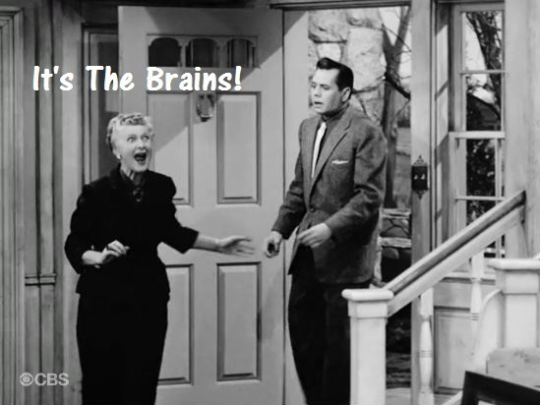
Eleanor Audley (Leaticia Cooper, George’s Mother) previously played this character in “George is Messy” and “Dinner for 12″. She would later play Eleanor Spalding, owner of the Westport home the Ricardos buy in “Lucy Wants To Move to the Country” (ILL S6;E15) in 1957, as well as one of the Garden Club judges in “Lucy Raises Tulips” (ILL S6;E26).

Hans Conried (Mr. Anderson) first co-starred with Lucille Ball in The Big Street (1942). He then appeared on “I Love Lucy” as used furniture man Dan Jenkins in “Redecorating” (ILL S2;E8) and later that same season as Percy Livermore in “Lucy Hires an English Tutor” (ILL S2;E13) – both in 1952. The following year he began an association with Disney by voicing Captain Hook in Peter Pan. On “The Lucy Show” he played Professor Gitterman in “Lucy’s Barbershop Quartet” (TLS S1;E19) and in “Lucy Plays Cleopatra” (TLS S2;E1). He was probably best known as Uncle Tonoose on “Make Room for Daddy” starring Danny Thomas, which was filmed on the Desilu lot. He joined Thomas on a season 6 episode of “Here’s Lucy” in 1973. He died in 1982 at age 64.

Hal March (Mr. Jenkins / Mr. Crockett) first appeared on the “I Love Lucy” in “Lucy Fakes Illness” (ILL S1;E16) using his own name to play an actor posing as the doctor who diagnoses Lucy with ‘golbloots.’ March got his first big break when he was cast as Harry Morton on “The George Burns and Gracie Allen Show” in 1950. He eventually lost the part to Fred Clark who producers felt was better paired with Bea Benaderet, who played Blanche, and here plays Iris Atterbury. He stayed with the show in other roles, the last airing just two weeks before his appearance as Eddie Grant in “Lucy is Matchmaker” (ILL S2;E27). In 1966 he was seen on “The Lucy Show.”

Frank Nelson (J.Q. Williams, Chairman of the Bank) was born on May 6, 1911 (three months before Lucille Ball) in Colorado Springs, Colorado. He started working as a radio announcer at the age of 15. He later appeared on such popular radio shows as “The Great Gildersleeve,” “Burns and Allen,” and “Fibber McGee & Molly”. This is one of his 11 performances on “My Favorite Husband.” On “I Love Lucy” he holds the distinction of being the only actor to play two recurring roles: Freddie Fillmore and Ralph Ramsey, as well as six one-off characters, including the frazzled train conductor in “The Great Train Robbery” (ILL S5;E5), a character he repeated on “The Lucy Show.” Aside from Lucille Ball, Nelson is perhaps most associated with Jack Benny and was a fifteen-year regular on his radio and television programs.
EPISODE
ANNOUNCER: “As we look in on the Coopers it’s morning. George Cooper is eating breakfast, while Liz in the kitchen talking to Katie, the maid.”

Liz is planning the menu for an intimate Valentine’s Day dinner with George.
LIZ: “Hearts of beef, hearts of artichoke, hearts of lettuce, heart-shaped candy, and heart-shaped cake.”
KATIE: “That oughta give ya heart-shaped heartburn!”Liz joins George for breakfast and notices that he has nicked himself shaving – several times.
LIZ: “You look like you have your face up in paper curlers.”
Liz confesses she used George’s razor to string beans! Liz apologizes with a smooch. She brings up Valentine’s Day, and George breaks it to her that his mother is coming. George reminds Liz that his mother always spends the holidays with them.
LIZ: “It’s Valentine’s Day, not Halloween! Can’t we give her a rain check until Groundhog Day or something?”

Groundhog Day is an American folk tradition established in Pennsylvania around 1840, that supposes that if a groundhog comes out of his burrow and sees his shadow, we are in for six more weeks of winter. The tradition has inspired a Hollywood film and a Broadway musical. Since the date is traditionally February 2 (before Valentine’s Day), Liz is really extending her hospitality into 1951! 1955′s “Lucy Goes to a Rodeo” (ILL S5;E8) opens with Ricky penciling in Lucy for a kiss on February 2nd, which Lucy notes is Groundhog Day.
Liz is upset that her romantic dinner for two will become a threesome. she suggests that if his mother wants to celebrate Valentine’s Day she should get a boyfriend. George says she has no interest in men.
LIZ: “Well, she did once. Or did she win you in a game of Canasta?”

Canasta is a card game of the rummy family devised around 1939. It is most commonly played by four in two partnerships with two standard decks of cards. The game was mentioned several times on episodes of “I Love Lucy.”
George comes around to the idea of getting his mother a boyfriend – but who?
LIZ: “Gee, all I can think of is the Smithsonian Institute!”

In “Never Do Business With Friends” (ILL S2;E31), Ethel complains that her washing machine is old enough to belong in the Smithsonian Institution. Dubbed ‘the Nation’s attic’, the Smithsonian museums (located primarily in Washington DC) will be mentioned again in reference to the antique Cadillac that Fred buys for the trip to Hollywood.
George rushes off to work. The new bank Chairman is visiting. Liz tells Katie to plan to serve three for Valentine’s Day dinner. Liz says that her mother-in-law uses any excuse to visit – even Boys Week.

Boys (and Girls) Week was a movement to help build citizenship among youth. The movement began in 1920 with boys. In 1934, Boys Week became known as Youth Week, and in 1936, Boys and Girls Week. A project of the Rotary International, their sponsorship ceased in 1954.
Liz has invited Mother Cooper (Eleanor Audley) over to talk about the idea and before they know it, she has arrived.
LIZ (to Katie): “Well, speak of the devil-in-law.”
KATIE (hushed): “How does she get in the house so quietly?”
LIZ: “She’s got a muffler on her broom.”No sooner is she in the kitchen when she is telling Liz that there’s dust on top of her bookcase. Liz quickly changes the subject to dating.
MOTHER COOPER: “It would be nice to have dates, but not a man!”
LIZ: “Not a man!?! Well, I don’t know any kangaroos!”Mother Cooper is intrigued by the idea, but doesn’t think anyone would be interested in a woman of her age.
MOTHER COOPER: “The man isn’t man living who’d have plain old me!”
LIZ: “Well, we’ll dig someone up.”Mrs. Cooper describes her ideal man. Liz urges her to compromise. Mother insists he is only 41 years old. As she leaves, she tells Liz to forget the whole thing.
Katie tells Liz to try looking at the Sheridan Falls Friendship Center, where her sister found all her husbands.
LIZ: “Katie, I’ll do it! I’m going to get a man for Mother Cooper if I have to get an Erector Set and build her one!”

Erector Set was a brand of metal toy construction sets which were originally sold by the Mysto Manufacturing Company in 1913, a successor to wooden Lincoln Logs and a predecessor to plastic LEGO.
END of PART ONE
After a short Jello-O commercial featuring announcer Bob LeMond providing a macaroon pudding recipe, the story resumes.
Liz has embarked on her manhunt and we find her downtown at the Sheridan Falls Friendship Center. The building is marked by a large neon sign that says “Lonesome?” The doorbell sounds “Here Comes The Bride”.

Thomas ‘Cupid’ Jenkins (Hal March), the founder, opens the door.
LIZ: “I’d like to order a man!”
Liz immediately states that it is not for her, although Mr. Jenkins clearly doesn’t believe her.
MR. JENKINS: “I understand perfectly. He’s a gift for a friend.”
Liz tells him it is for his mother-in-law. The phone rings and Mr. Jenkins answers it congratulating the caller on her success and promising to remove her card from his file.
MR. JENKINS: “Goodbye, Lady Ashley.” (hangs up)
LIZ: “Was that THE Lady Ashely?”
Sylvia, Lady Ashley (1904-77) was an English model, actress, and socialite who was best known for her numerous marriages to British noblemen and American movie stars. On December 20, 1949, she married Clark Gable, the fourth of her five husbands. The pair divorced in 1952.
It turns out to be a different Lady Ashley. Liz and Mr. Jenkins fill out an application card for Mother Cooper. Although Liz describes her as ‘41, attractive and wealthy’, Mr. Jenkins immediately interprets that as ‘65, old battle axe, and broke’! Liz wants someone to come to the house tonight. Mr. Jenkins promises the perfect man will come with a written 30-day guarantee!
At the bank, George is visited by the new Chairman of the Board, J.Q. Williams (Frank Nelson). He wants to get to know the employees and George invites him over for dinner that evening. Unfortunately, their home phone seems to be out of order so he can’t alert Liz. He tells Mr. Williams the address to meet him there.

That evening, Mrs. Cooper is preparing to meet the gentleman Mr. Jenkins is sending over. The doorbell rings. It is Mr. Williams from the bank. Liz immediately assumes that he is from the Friendship Society and that the Mrs. Cooper he has come to meet is her mother-in-law.
Liz doesn’t want Mother Cooper to know that he is an arranged suitor, so she asks him what they should say about his professional life.
MR. WILLIAMS: “Let’s just tell her I’m Chairman of the Board at the Bank.”
LIZ: “Come, now. Let’s not overdo it.”Believing Mother Cooper to be George’s wife, he sits down next to her. Just then George comes home from work. Liz heads him off at the hallway to tell him that she’s arranged a Lonely Hearts prospect to come over for dinner. George is sure he’s a bum.
LIZ: “You’ll die when you see him!”
Before going into the living room to meet him, George tells Liz that he’s invited the new Chairman of the Board of the Bank to dinner – a Mr. Williams. Liz screams in horror and explains what she’s done. The doorbell rings again.
While George takes Mr. Williams aside to explain things to him, Liz answers the door. It is Mr. Crockett (Hal March again). Before he can get a word out, Liz immediately assumes him to be the man from the Lonely Hearts Club. She quickly instructs him to act like an old friend of hers and ushers him in to meet Mother Cooper.

MOTHER COOPER: “I liked the other one better.”
The doorbell rings again, it is Mr. Anderson (Hans Conried), the man from the Sheridan Falls Friendship Center. He immediately assumes that Liz is the woman that Mr. Jenkins has sent him to meet!
MR. ANDERSON: “After 15 years of sending me lemons, he’s finally sent me a peach!”
Liz is confused, but shows him in to the living room to meet Mother Cooper.
MR. ANDERSON: “Shucks. Back to Lemons again.”
Having explained the confusion, George returns with Mr. Williams, who eagerly agrees to be Mother Cooper’s escort for the rest of the evening. Liz tells Mr. Anderson and Mr. Crockett to go back to the Friendship Center, but Mr. Crockett is confused.
MR. CROCKETT: “What Friendship Center? I just came here to fix the telephone!”
LIZ: “Oh, no!!!”END of EPISODE
In the live Jell-O commercial, Lucille Ball and Bob LeMond go South of the Border, where all the ‘J’s are pronounced like ‘H’.
Lucille is Hosephine and her brother is named Himmy, who is strong as Jerkules. She reads a poem:
I know a little café
It’s a perfect place to go
Because they always serve Jell-O vanilla tapio-
Ca pudding. It’s delicious and tempting
And you sap,
You also ought to order some Jell-O chocolate tap-
Ioca. It’s so rich the kids all say it’s good
I cannot rhyme Jell-O orange vanilla tapioca, I wish I could.Bob LeMond sums up her poem with one succinct line. But Lucille concludes:
Those lines they tell the story,
They cut the time in half.
They talk of Jell-O pudding, but they don’t get any laughs! -
THE MISUNDERSTANDING OF THE BLACK EYE
February 10, 1951

“The Misunderstanding of the Black Eye” (aka “Liz’s Black Eye”) is episode #118 of the radio series MY FAVORITE HUSBAND broadcast on February 10, 1951.
This was the 20th episode of the third season of MY FAVORITE HUSBAND. There were 31 new episodes, with the season (and series) ending on March 31, 1951.
Synopsis ~ When the Atterburys ask how Liz got her black eye, Liz jokingly answers “Oh, George slugged me,” and now they won’t believe any other explanation.

This radio program was the basis for the “I Love Lucy” TV episode “The Black Eye” (ILL S2;E20), filmed on September 15, 1952 and first aired on March 9, 1953.

“My Favorite Husband” was based on the novels Mr. and Mrs. Cugat, the Record of a Happy Marriage (1940) and Outside Eden (1945) by Isabel Scott Rorick, which had previously been adapted into the film Are Husbands Necessary? (1942). “My Favorite Husband” was first broadcast as a one-time special on July 5, 1948. Lucille Ball and Lee Bowman played the characters of Liz and George Cugat, and a positive response to this broadcast convinced CBS to launch “My Favorite Husband” as a series. Bowman was not available Richard Denning was cast as George. On January 7, 1949, confusion with bandleader Xavier Cugat prompted a name change to Cooper. On this same episode Jell-O became its sponsor. A total of 124 episodes of the program aired from July 23, 1948 through March 31, 1951. After about ten episodes had been written, writers Fox and Davenport departed and three new writers took over – Bob Carroll, Jr., Madelyn Pugh, and head writer/producer Jess Oppenheimer. In March 1949 Gale Gordon took over the existing role of George’s boss, Rudolph Atterbury, and Bea Benaderet was added as his wife, Iris. CBS brought “My Favorite Husband” to television in 1953, starring Joan Caulfield and Barry Nelson as Liz and George Cooper. The television version ran two-and-a-half seasons, from September 1953 through December 1955, running concurrently with “I Love Lucy.” It was produced live at CBS Television City for most of its run, until switching to film for a truncated third season filmed (ironically) at Desilu and recasting Liz Cooper with Vanessa Brown.
MAIN CAST

Lucille Ball (Liz Cooper) was born on August 6, 1911 in Jamestown, New York. She began her screen career in 1933 and was known in Hollywood as ‘Queen of the B’s’ due to her many appearances in ‘B’ movies. With Richard Denning, she starred in a radio program titled “My Favorite Husband” which eventually led to the creation of “I Love Lucy,” a television situation comedy in which she co-starred with her real-life husband, Latin bandleader Desi Arnaz. The program was phenomenally successful, allowing the couple to purchase what was once RKO Studios, re-naming it Desilu. When the show ended in 1960 (in an hour-long format known as “The Lucy-Desi Comedy Hour”) so did Lucy and Desi’s marriage. In 1962, hoping to keep Desilu financially solvent, Lucy returned to the sitcom format with “The Lucy Show,” which lasted six seasons. She followed that with a similar sitcom “Here’s Lucy” co-starring with her real-life children, Lucie and Desi Jr., as well as Gale Gordon, who had joined the cast of “The Lucy Show” during season two. Before her death in 1989, Lucy made one more attempt at a sitcom with “Life With Lucy,” also with Gordon.
Richard Denning (George Cooper) was born Louis Albert Heindrich Denninger Jr., in Poughkeepsie, New York. When he was 18 months old, his family moved to Los Angeles. Plans called for him to take over his father’s garment manufacturing business, but he developed an interest in acting. Denning enlisted in the US Navy during World War II. He is best known for his roles in various science fiction and horror films of the 1950s. Although he teamed with Lucille Ball on radio in “My Favorite Husband,” the two never acted together on screen. While “I Love Lucy” was on the air, he was seen on another CBS TV series, “Mr. & Mrs. North.” From 1968 to 1980 he played the Governor on “Hawaii 5-0″, his final role. He died in 1998 at age 84.
Gale Gordon (Rudolph Atterbury) had worked with Lucille Ball on “The Wonder Show” on radio in 1938. One of the front-runners to play Fred Mertz on “I Love Lucy,” he eventually played Alvin Littlefield, owner of the Tropicana, during two episodes in 1952. After playing a Judge in an episode of “The Lucy-Desi Comedy Hour” in 1958, he would re-team with Lucy for all of her subsequent series’: as Theodore J. Mooney in ”The Lucy Show”; as Harrison Otis Carter in “Here’s Lucy”; and as Curtis McGibbon on “Life with Lucy.” Gordon died in 1995 at the age of 89.
Bea Benadaret (Iris Atterbury) was considered the front-runner to be cast as Ethel Mertz but when “I Love Lucy” was ready to start production she was already playing a similar role on TV’s “The George Burns and Gracie Allen Show” so Vivian Vance was cast instead. On “I Love Lucy” she was cast as Lucy Ricardo’s spinster neighbor, Miss Lewis, in “Lucy Plays Cupid” (ILL S1;E15) in early 1952. Later, she was a success in her own show, “Petticoat Junction” as Shady Rest Hotel proprietress Kate Bradley. She starred in the series until her death in 1968.
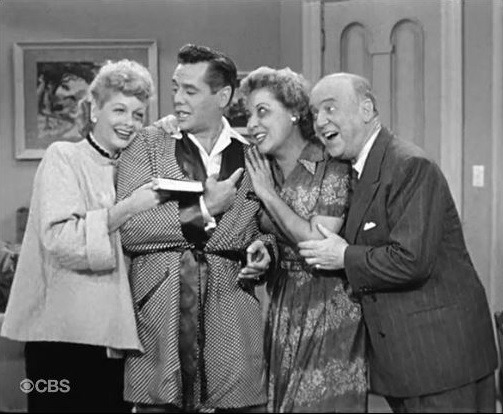
Ruth Perrott (Katie, the Maid) was also later seen on “I Love Lucy.” She first played Mrs. Pomerantz (above right), a member of the surprise investigating committee for the Society Matrons League in “Pioneer Women” (ILL S1;E25), as one of the member of the Wednesday Afternoon Fine Arts League in “Lucy and Ethel Buy the Same Dress” (ILL S3;E3), and also played a nurse when “Lucy Goes to the Hospital” (ILL S2;E16). She died in 1996 at the age of 96.
Bob LeMond (Announcer) also served as the announcer for the pilot episode of “I Love Lucy”. When the long-lost pilot was finally discovered in 1990, a few moments of the opening narration were damaged and lost, so LeMond – fifty years later – recreated the narration for the CBS special and subsequent DVD release.
GUEST CAST

Robert ‘Bobby’ D. Jellison (Mr. Benton, Florist) will play the recurring character of Bobby the bellboy throughout the Hollywood episodes of “I Love Lucy.” Prior to that, he was the milkman in “The Gossip” (S1;E24). He made one more appearance as another luggage jockey in “Lucy Hunts Uranium,” a 1958 episode of “The Lucy–Desi Comedy Hour” set at the Sands Hotel & Casino, Las Vegas. He died in 1980.
Lester Jay (Delivery Boy) was a child actor who appeared extensively on ”Let’s Pretend” for CBS-Radio. He was one of three actors to play Chester on “The Gumps” (1935-37), Robinson Brown, Jr. on “Robinson Crusoe, Jr.” (1934-35) and Terry on “Terry And Ted” (1937-48).
EPISODE
ANNOUNCER: “As we look in on the Coopers tonight, dinner is over and Liz is curled up in the living room with a good book. George enters.”

George is looking for the book he was reading, only to find Liz is reading it. She refuses to give it up and insists that they sit close and read it together. Liz mumbles when she reads, distracting George, so she reads passages about Madge and Gordon, and their fateful love affair, aloud.

Liz gets carried away acting out the story.
Outside the Cooper home, the Atterbury’s are approaching the front door, but Iris is uncomfortable about not calling first.
IRIS: “Emily Post wouldn’t do it!”

Emily Post (1872-1960) was a writer who’s name has become synonymous with proper etiquette and manners. More than half a century after her death, her name is still used in titles of etiquette books. Her name was invoked by Kim in “Lucy’s Houseguest, Harry” (HL S3;E20) in 1971, twenty years after this mention on “My Favorite Husband”!
Before they can ring the doorbell, Iris and Rudolph hear Liz acting out violent passages of the book and think that they are overhearing real violence between Liz and George!

The dialogue for the television script is nearly identical to the radio version, with Fred and Ethel (William Frawley and Vivian Vance) taking the lines originally spoken by Rudolph and Iris. A few lines about Ricky (Desi Arnaz) and his hot Latin temper are added for TV.
They decide to hurry down to the drugstore and call the Coopers to tell them they are coming over – so they are prepared. When Liz answers the phone, she cryptically acts as if Liz might have something to tell her, but Liz is clueless.
LIZ: “Iris, have you been nipping at the cooking sherry?”

On television, Lucy is more direct. Cooking sherry, a fortified wine for culinary use, was something housewives might have in their pantry. To say a woman sipped cooking sherry was a polite way of saying that a woman drank, usually unbeknownst to her husband.
IRIS: “Anything we can bring over? Ice cream? Candy? Bandages?”
On television, Ethel offers iodine in lieu of bandages!
Liz urgently tells George to help her clean up the living room before the Atterburys arrive.LIZ: “And put your shoes on!”
GEORGE: “Why? They know we have feet.”
This exchange was used in “Men Are Messy” (ILL S1;E8) in 1951, so it was not repeated in “The Black Eye” in 1952:
LUCY: “Put your shoes on and pick up those papers. Company is coming.”
RICKY: “It isn’t company, it’s Fred and Ethel.”
LUCY: “Well, put your shoes on.”
RICKY: “They know I have feet.”Cleaning up, George tosses the book to Liz and it hits her in the eye. She quickly develops a black eye! The Atterburys arrive and are dismayed to see Liz with a shiner. Liz jokingly says that “George slugged me!” and George laughingly plays along. The Atterbury’s are appalled!
LIZ: (laughing) “Nobody ever believes the real story of a black eye so I made one up!”
The next day, Iris has been waiting outside the Cooper home until George goes to work, then she rushes in to console Liz. She wants the ‘true’ story of the black eye. Liz realizes that Iris will not be satisfied with the truth, so she makes up a dramatic story of domestic violence, while Liz eagerly listens.Liz casually infers that she told him she was in love with another.IRIS: “Another man?”
LIZ: “No, a Shetland pony. I couldn’t tell you his name.”
IRIS: “It wouldn’t be cricket, would it?”
LIZ: “No. It’s somebody else.”At the bank, Mr. Atterbury calls George in to his office for a private conversation about George striking Liz. He admits that he struck Iris once. In return, she beat him to a pulp! George finally tells Mr. Atterbury the full truth about the book. Mr. Atterbury still doesn’t believe him. He tells his secretary Miss Roberts that he is going down to the florists.

At the flower shop, Mr. Atterbury orders two dozen rose from Mr. Benton, the florist (Bobby Jellison) to be delivered to Liz. Since the delivery truck is just about to depart, Mr. Atterbury rushes to fill out the card. Mr. Benton assumes Rudolph is sending the flowers to a paramour. To prove he is just trying to save George’s marriage, he recounts the message he just put in the box:
“Dearest Sweetheart. Nothing that happens can dim my love for you. Signed, adoringly, Rudolph.”
Saying it out loud, Mr. Atterbury suddenly realizes his error and rushes to the Cooper home to intercept the delivery.
On television, the small role of the florist is played by Bennett Green, Desi Arnaz’s camera and lighting stand-in.
Katie the maid shrieks when she sees Mr. Atterbury lurking in the bushes. Iris and Liz are about to go shopping so Katie hides Mr. Atterbury in the hall closet until they leave. The doorbell rings. It is a delivery boy (Lester Jay) with the flowers. Iris assumes they are from M.L. – Liz’s ‘Mystery Lover’. To show her that she is being silly, Liz invites Iris to read the card for herself, fully expecting them to be from George. When Iris reads that the roses are from Rudolph, she is aghast!
LIZ: “You think these flowers are from Rudolph Atterbury?”
IRIS: “They aren’t from Rudolph Valentino!”
On “I Love Lucy” silent film heartthrob Rudolph Valentino (1895-1926) was a favorite of Lucy’s mother, Mrs. McGillicuddy. In Hollywood, she couldn’t wait to go see the house where once Valentino lived.

On television, however, this exchange necessitated another big name star be substituted.
- LUCY: “Oh, now, Ethel, you certainly don’t think that these are from Fred Mertz, do you?”
- ETHEL: “Well, this card certainly wasn’t written by Fred MacMurray.”
In 1958, MacMurray would guest star on “Lucy Hunts Uranium”, an episode of “The Lucy–Desi Comedy Hour.” Starting in 1960, William Frawley (Fred Mertz) would co-star with MacMurray on the family sitcom “My Three Sons.”
Liz calls Mr. Atterbury ‘fat’ and Iris calls him ‘an old goat’! Furious, Iris gets her coat to leave and finds her husband hiding in the closet!
IRIS (to Rudolph): “You can explain, but there’s something I want to do first!”
Iris punches Rudolph in the eye! Just then, George comes home. Mr. Atterbury accuses George of starting the whole thing by hitting Liz and hauls off and punches him in the eye! Liz is adamant that George never hit her and shows them exactly what happened by re-enacting the book toss – hitting Iris square in the eye!
END of EPISODE
-
OLIN HOWLAND
February 10, 1886

Olin Ross Howland was born in Denver, Colorado. His father was one of the youngest enlisted participants in the Civil War. His older sister was the famous stage actress Jobyna Howland. As a young man, he learned to fly airplanes from the Wright Brothers!

From 1909 to 1928, Howland appeared on Broadway in musicals. His first screen appearance was 1918′s Paramount short Hick Manhattan. He appeared under the name Olin Howlin. He went on to make more than 200 film and television appearances.

He and Irving Bacon (Will Potter, Ethel’s father) are the only actors to appear in both the 1937 and 1954 versions of A Star Is Born. The two were also in the legendary 1939 film Gone With The Wind.
He also appeared with William Frawley (Fred Mertz) in the less-than-classic Ambush (1939) and Crime Doctor’s Manhunt (1946).

He played the same role (Mr. Davis, Amy March’s schoolteacher) in both the 1933 and 1949 versions of Little Women.

Two of his very last roles were in classic 1950s science fiction films: first as the alcoholic in Them; then as the rancher who is the first victim of The Blob (1958).

He made his television debut in a 1952 episode of “Hopalong Cassidy” (above left with William Boyd and Edgar Buchanan, right).

One of his most memorable roles was also one of his last; he appeared on “I Love Lucy" in “First Stop” (ILL S4;E14) filmed on November 11, 1954 and first aired on January 17, 1955. Howlin played the owner of One Oak, a broken down motel in the middle of nowhere, at which the Ricardos and Mertzes are forced to stay at for the night. This was his only appearance with Lucille Ball.

From 1958 to 1959 he was back at Desilu as the recurring character of Charley Perkins in “The Real McCoys”. He did five episodes of the series.

His final screen appearance was posthumously on an episode of “Father Knows Best” aired on October 5, 1959. Howland had died on September 20, 1959 at age 73.
Howland never married and had no children.
-
JIMMY DURANTE
February 10, 1893
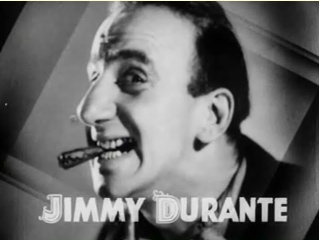
James Francis Durante was born on the Lower East Side of New York City. He was the youngest of four children. His distinctive gravelly voice, New York accent, and prominent nose helped make him one of America’s most popular personalities from the 1920s through the 1970s. He often referred to his nose as ‘The Schnozzola’ (Yiddish slang meaning big nose), which became his nickname.

Durante dropped out of school in seventh grade to become a ragtime pianist.
His routine of breaking into a song to deliver a joke became a Durante trademark.
By the mid-1920s, Durante had become a vaudeville star and radio personality.
Durante appeared in the Cole Porter musical The New Yorkers, which opened on December 8, 1930.

Earlier in 1930, he made his screen debut (above center) in Roadhouse Nights.

Five years later, in 1935, Lucille Ball played a nurse in his Columbia film Carnival. Ball was uncredited.

On October 29, 1947, Lucille Ball appeared on “The Jimmy Durante Show” on radio. Their comic banter concerned making movies.

On April 28, 1948, Lucille Ball, then starring in Sorrowful Jones and preparing to do “My Favorite Husband”, appeared once again on Jimmy Durante’s radio show. Lucy tries to convince Jimmy that if he wants to be elected President of the US in 1948, he should champion women in industry.

Durante made his television debut on November 1, 1950 as the host of “4-Star Revue” (aka “All-Star Revue”).

In October 1952, Lucille Ball and Jimmy Durante were on the cover TV Digest.

In “Hollywood at Last!” (ILL S4;E16), Durante’s caricature on the wall at the Brown Derby restaurant takes up two frames – one for his nose. Durante himself was not in the episode but Lucy and Ethel mention his name.

Nor is he actually featured in “Lucy Meets Harpo Marx” (ILL S4;E28), in which Lucy Ricardo dons a novelty store mask and trench coat to impersonate Durante for a nearsighted Carolyn Appleby.

In December 1965, Lucille Ball appeared with Durante (as well as Jerry Lewis and Danny Thomas) on “The Wonderful World of Burlesque”.

Durante finally appeared on a Lucille Ball sitcom in “Lucy Goes to a Hollywood Premiere” (TLS S4;E20) on February 7, 1966. Durante has a wordless cameo as himself, attending a Hollywood premiere with his real-life wife, Margie Little.

In a December 1967 episode of “The Lucy Show” air hostesses Lucy and Carol imitate Jimmy Durante as they sing “Start Out Each Day with a Song” which was written by Durante in 1944.

In May 1969, Desi Arnaz sang a duet with Durante on “The Lennon Sisters Hour”. Durante calls Desi’s conga drum a “Cuban waste basket”! Lucille Ball was not part of the show.

In the TV special “Lucy Gets Lucky” (1975) Lucy Collins is strolling through the Hall of Fame at the MGM Grand Hotel in Las Vegas.
Lucy does a ‘ha-cha-cha-cha’ in front of a photo of Jimmy Durante. She also pauses at photographs of Spencer Tracy, Katharine Hepburn, Cary Grant, Grace Kelly, Frank Sinatra, Fred Astaire, Ginger Rogers, and (yes) even Lucille Ball.
Other programs that featured both Ball and Durante include:
- “A Tribute To Eleanor Roosevelt on Her Diamond Anniversary” ~ October 11, 1959
- “The Ed Sullivan Show” ~ February 12, 1961
- “The 14th Annual Primetime Emmy Awards” ~ May 22, 1962
- Candid Hollywood ~ 1962
- “The 23rd Annual Primetime Emmy Awards” ~ April 22, 1971
Durante’s first wife Jeanne died in 1943. He and his second wife Margie adopted a baby girl, Cecelia Alicia (aka CeCe) on Christmas day 1961.
Jimmy Durante died on January 29, 1980 at age 86.

“Goodnight, Mrs. Calabash, wherever you are.” ~ Jimmy Durante
-
TV GUIDE
February 9, 1991

Lucille Ball and Desi Arnaz appeared posthumously on the cover of the February 9, 1991 issue of TV Guide (issue #1976) in connection with the unauthorized bio-pic “Lucy and Desi: Before The Laughter” airing that week.

Lucie and Desi Jr. felt the film was “biased” while the filmmakers contended it was “truthful”.

The inside article was written by Timothy Carlson, with photographs from the teleplay.

Frances Fisher recreated Lucille Ball’s ‘Professor’ routine for the film.

The film starred Frances Fisher and Maurice Bernard as Lucy and Desi. Programmed against two other network films – Big and The Chase – it narrowly won its time slot with a rating of 16.4 and a 25 share.
-
FOREVER GIMBELS!
February 8, 1956

Gimbel Brothers was founded by Adam Gimbel opened in 1887 and went out of business in 1987. It’s New York City store opened in 1910.

Their flagship store in Herald Square held a long-standing rivalry with neighbor Macy’s. Gimbels NYC store had three basement levels where customers could find deep discounts thereby creating the first ‘bargain basement.’ The term has since entered popular culture. Gimbles was mentioned several times on “I Love Lucy”.

When “Lucy and Ethel Buy The Same Dress” (ILL S3;E3) in 1953, Ethel says she got her dress at Macy’s, while Lucy got hers at Gimbels.

In “The Fashion Show” (ILL S4;E19) in 1955, Ethel states that she’s more comfortable in Gimbels basement than at Don Loper’s salon.

The store was also mentioned when Lucy and Desi guest-starred on “The Danny Thomas Show” in 1959.
Ricky Ricardo: “Do you know what Lucy could buy at Macy’s alone?”
Danny Williams: “What?”
Ricky Ricardo: “Gimbels!”Forever, Darling premiered in Lucille Ball’s hometown of Jamestown, New York, the previous evening, February 7, 1957. They then head directly to New York City to appear at Gimbels and to do promotion on television programs.

The film starred James Mason and opened wide at cinemas across the country on February 8, 1956.


The evening of Wednesday, February 8, 1956, Lucy and Desi appeared on “MGM Parade” at 7:30pm…

…and “I’ve Got A Secret” at 8:30pm.
-
Subscribe
Subscribed
Already have a WordPress.com account? Log in now.
 Papermoon Loves Lucy