-
THAT NEVER HAPPENED!
February 28, 1934-1954

~FEBRUARY 28, 1938~

When the film started filming on August 8, 1938, Lucille Ball was not on the call sheet. Her supporting role had been taken by Frances Mercer, who would be in Ball’s next RKO film, Annabel Takes A Tour, later in 1938.

The leads, too, were not as promised. Hepburn and Fairbanks were replaced by Barbara Stanwyck and Henry Fonda.
~FEBRUARY 29, 1949~


Alas, it remained just talk. No film pairing of Gable and Ball ever materialized, although he remained a favorite of Lucys Ricardo, Carmichael, and Carter.

The closest Ball got to “giving out with the kind of dialog Jean Harlow used to” was when she took on the role of Kitty Packard on the 1940 radio production of Dinner at Eight, played by Harlow in the 1933 film version. Harlow died in 1937 at the tragic age of 26, so the item was likely a sentimental one.
~FEBRUARY 29, 1949~


Twentieth Century is a 1932 play by Ben Hecht and Charles MacArthur (The Front Page) based on the unproduced play Napoleon of Broadway by Charles B. Millholland, inspired by his experience working for the eccentric Broadway impresario David Belasco. The play was filmed in 1933 starring Lucille Ball’s friend Carole Lombard in the role that Lucy is rumored for here. Arlen and Harburg had written the music for the 1939 film The Wizard of Oz, including the break-out hit “Over the Rainbow”, but there is no record of them writing a musicalization of Twentieth Century, nor was a production of the play with Ball ever staged. After Dream Girl in 1947, Ball would not appear on stage again until 1960 in Wildcat.

In 1978, however, Cy Coleman, Betty Comden and Adolph Green created the stage musical, On the Twentieth Century, based on the film and the original play. It ran on Broadway for 460 performances, and was revived on in February 2015. Coincidentally, the musical first starred Madeline Kahn, who, in 1973, was announced to play Agnes Gooch in Lucy’s film musical Mame, but was replaced before filming by Jane Connell. The original cast also included another wacky redheaded television comedienne of the 1950s – Imogene Coca!
~FEBRUARY 28, 1954~

This Associated Press (AP) story by Wayne Oliver gets a lot of its predictions right, but some missed the mark.

“I Love Lucy” did run three more seasons, as predicted (not counting the hour-long specials), but when all was said and done, the total did not quite hit 200. They produced 179 half-hour episodes of “I Love Lucy,” not counting the pilot and the “Christmas Special”. It also does not include filming of flashback intros, which were generally less than a few minutes.

Unfortunately, despite best intentions, no episodes of “I Love Lucy” (or the hour-long specials) were ever filmed in color. Desi was being extremely optimistic in his speculation that color would be in wide use inside three years (1957). In fact, it took more than ten years until color was common on CBS. The network was reluctant to use the same color technology developed by their rival, RCA / NBC and was seeking to create their own.

While Spring Byington’s “December Bride” was a hit for Desilu, the pilot starring Charles Coburn based on material by A.J. Cronin, was not. It was titled “Country Doctor” and featured Joseph Kearns alongside Coburn. It went unsold and unaired.

A bit of an ambitious, though logical expectation, based on the average output of seasons 1-3. Season 4, however, only produced 30 new half-hours; Season 5 merely 26; and season 6 just 27.
-
ELIZABETH TAYLOR
February 27, 1932

Elizabeth Rosemond Taylor was born on February 27, 1932, in Hampstead Garden Suburb, London. She received dual British-American citizenship at birth, as her parents were United States citizens. The family lived in London during Taylor’s childhood. In early 1939, the Taylors returned to the United States due to fear of impending war in Europe.

In California, Taylor’s mother (a former stage actress) was frequently told that her daughter should audition for films. She made her screen debut in There’s One Born Every Minute (1942). She was ten years old. Two years later she played the leading role in National Velvet. This launched a meteoric film career that won her two Oscars (1961 and 1967).
Lucille Ball first met Elizabeth Taylor in an arranged ‘set visit’ during the shooting of 1953′s The Long, Long Trailer. After that, they appeared twice on the same television shows, but did not share screen time.
- “’A Star Is Born’ World Premiere” (1954) ~ a live television broadcast of the red carpet interviews before film’s world premiere.
- “Sunday Showcase: A Tribute to Eleanor Roosevelt on Her Diamond Jubilee” (1959)

Although she started appearing on television in the early 1950s, her scripted TV debut came in 1970 when Lucille Ball invited her to appear (along with her priceless engagement ring and her actor husband, Richard Burton) on a very special episode of “Here’s Lucy” titled “Lucy Meets the Burtons” (HL S3;E1).

For this show, a special Guest Star credit was created. Liz got top billing!
Although this episode kicked off the third season, it was filmed much later and moved up as the season premiere airing on September 14, 1970.

It ultimately became CBS’s highest rated show on the air for the 1971-72 television season. It was also the best remembered episode of the entire series.

This show’s plot was built around the real-life publicity achieved when Richard Burton bought his wife Elizabeth Taylor a 68 carat Cartier diamond ring worth over a million dollars. Property Master Ken Westcott created two replica rings for the medium and long shots which were crafted from chandelier crystals. Although he wanted to keep one after the shoot, Ball took one and Taylor took the other.

A thirty minute documentary film “Lucy Meets the Burtons: A Comedic Gem” was included on DVD release of “Here’s Lucy” season 3. It includes interviews with Lucie Arnaz, Carole Cook, and behind the scenes footage.
Although this was their first and last time acting together, Taylor and Ball appeared on several television specials together, although they usually did not share screen time.
- “Dinah!” (1977) ~ Dinah Shore interviews the First Ladies of Entertainment. Taylor is interviewed via remote telephone connection.
- “Happy Birthday, Bob” (1978) ~ 75th birthday salute to Bob Hope at the Kennedy Center in Washington D.C.
Taylor talks about the previous evening’s reception featuring President Jimmy Carter and reads a message from Prince Philip, The Duke of Edinburgh. Taylor talks about Hope’s contributions to the USO. - “General Electric’s All-Star Anniversary” (1978)
- “Women I Love: Beautiful But Funny” (1982) ~ Bob Hope takes a look back at the beautiful and funny women he has worked with over the years.
- “Bob Hope’s Unrehearsed Antics of the Stars” (1984)
- “Bob Hope’s High-Flying Birthday” (1987)

Elizabeth Taylor’s personal life was no less dramatic than her on screen roles. She was married eight times to seven men, marrying Richard Burton twice.
- Larry Fortensky (1991-1996)
- John Warner (1976-1982)
- Richard Burton (1975-1976)
- Richard Burton (1964-1974) 1 child
- Eddie Fisher (1959-1964)
- Mike Todd (1957-1958, his death) 1 child
- Michael Wilding (1952-1957) 2 children
- Conrad Hilton (1950-1951)
Taylor’s later years were spent doing philanthropic work, concentrating on AIDS and LGBTQ rights. Following her conversion to Judaism, Taylor became an active supporter of Jewish and Zionist causes.
In 2000, Taylor was designated a dame, the female equivalent of knight, on the queen’s coveted New Year’s list of titles and awards.
“Well, I’ve always been a ‘broad.’ Now it’s a great honor to be a dame!”
Dame Elizabeth Taylor died on March 23, 2011 of congestive heart failure at age 79.

TAYLOR MADE!
Although she may not have appeared, Elizabeth Taylor’s name was mentioned on Lucille Ball’s sitcoms many times.

(ILL S2;E27 ~ May 25, 1953) Elizabeth Taylor’s name is not mentioned, but her face is quickly seen on camera on the cover of a magazine in a newsstand!

Although her name is never stated,
Elizabeth Taylor was clearly one of the influences when Lucy donned “The Black Wig” (ILL
S3;E26 ~ April 19, 1954). Taylor sported short dark hair throughout much of the 1950s, including in her latest film at the time, The Girl Who Had Everything. Instead, Lucy gives Italian actresses like Gina Lollobridgida and Anna Magnani the credit.
In “Ricky’s Movie Offer” (ILL S4;E6 – November 8, 1954) Lucy and Ethel accidentally knock out talent scout Ben Benjamin. Lucy revives him and tries to act casual, as if in mid-conversation. “Do you mean to tell me that Elizabeth Taylor looks just as pretty off screen as she does on?”

In “Hollywood Anniversary” (ILL S4;E24 ~ April 4, 1955) the list of celebrity guests supposedly coming to Lucy’s anniversary party includes Elizabeth Taylor and Michael Wilding, her second husband.

Incredibly (or perhaps legally), Liz Taylor’s name IS NOT explicitly mentioned in “Lucy Plays Cleopatra” (TLS S2;E1 ~ September 30, 1963) although the premise was clearly influenced by the smash hit film that came out that same year starring Taylor as Cleo. She was the third to play the Egyptian queen on film, after Theda Bara (1917) and Claudette Colbert (1934).

In “Lucy Goes to a Hollywood Premiere” (TLS S4;E20 ~ February 7, 1966) one of Lucy’s rare movie magazines has a (fictional) article titled “Marriage is Not for Me” (supposedly) written by Elizabeth Taylor when she was 12 years old! By that time, Taylor’s love life was fodder for Hollywood gossip mongers and tabloids.

In “Lucy Dates Dean Martin” (TLS S4;E21 ~ February 14, 1966) Eddie Feldman (Dean Martin) says that while Lucy is attractive, she is no Liz Taylor. Or Gina Lollobrigida. Or Brigitte Bardot.

In “Lucy and the Starmaker” (TLS S6;E4 ~ October 2, 1967), after singing for Lucy, Tommy (Frankie Avalon) says he never thought he had more than an average voice. Lucy replies “if that is an average voice Elizabeth Taylor is an average housewife.”

In “Lucy and Robert Goulet” (TLS S6;E8 ~ October 30, 1967) Lucy Carmichael says she once entered an Elizabeth Taylor look-alike contest and never even heard from them!

In “Lucy and the Lost Star” (TLS S6;E22 ~ February 26, 1968) starring Joan Crawford, Lucy says that “Mr. Mooney wouldn’t lend a dime to Richard Burton even if he left Elizabeth Taylor as collateral.”

In “A Date For Lucy” (HL S1;E19 ~ February 10, 1969) Lucy and Mary Jane fantasize about dream dates for an upcoming soiree. They mention Richard Burton, but add that Elizabeth Taylor wouldn’t approve.

In “Lucy the Stunt Man” (TLS S4;E5 ~ October 18, 1965), Mr. Mooney jokingly says that he’s testing for the male lead in Liz Taylor’s next picture!

In “Lcuy Goes on Her Last Blind Date” (HL S5;E16 ~ January 8, 1973), when Vanda is trying on the engagement ring Ben gave Lucy, she says “Liz Taylor, eat your heart out.”

In “Milton Berle is the Life of the Party” (HL S6;E19 ~ February 11, 1974) Elizabeth Taylor is just one of the more than 15 celebrity names mentioned!
-
ROBERT ALDA
February 26, 1914

Robert Alda was born Alfonso Giuseppe Giovanni Roberto D’Abruzzo in New York City to Italian-American immigrants. He began his performing career as a singer and dancer in vaudeville after winning a talent contest, and moved on to burlesque. His professional surname derives from the first two letters of each of his first name and his surname at birth: ALphonso D’Abruzzo.
“I learned my trade in the best of schools – burlesque.” ~ Robert Alda

In 1950 he won a Tony Award for his Broadway debut as Sky Masterson in Guys and Dolls, although he was passed over for the film in favor of Marlon Brando. Over the next two decades he appeared in four more Broadway shows.

Five years earlier he had made his screen debut playing George Gershwin in Rhapsody in Blue (1945). The film also featured future Lucy cast members Jay Novello, Hans Moebus, Will Wright, Jack Chefe, Oliver Blake, Paul Cristo, and Bess Flowers. It wouldn’t take more than twenty years, but Alda would also be added to this list.

He made his TV acting debut on the 1949 anthology series “Your Show Time” episode “The Substitute”. The program was repeated in 1951 on “Your Story Theatre”. He also appeared as himself in “The Teen Club” in September 1949.

In 1955 he hosted “The Robert Alda Show” although not much is known about the program. At the same time he played his first leading role on television in “Secret File USA” doing 8 out of the 22 episodes of the series.

His first appearance with Lucille Ball (and with Desilu) came on January 13, 1964 in “Lucy Goes To Art Class” (TLS S2;E15). Alda played Danfield’s most eligible bachelor – and both Lucy and Viv set their sights on him at the same time when he signs up for an art class.

Six years later, Alda played himself as the emcee of the Secretary Beautiful Pageant when “Lucy Competes with Carol Burnett” (HL S2;E24) in March 1970. The role was originally written for Don Ameche, then re-cast with Ross Martin, before Alda was finally contacted for the part. He got to use his musical theatre skills singing the pageant’s theme. Coincidentally, his first wife Joan Browne (mother of actor Alan Alda), was a beauty contest winner. They divorced in 1946 after 14 years of marriage.

It wasn’t long before Alda was back, doing what was familiar, playing musical comedy in a revival of Harry’s 1928 college show. Alda played the Dean of Bullwinkle U in “Lucy, the Co-Ed” (HL S3;E6) in October 1970.

Oddly, Robert Alda has a principal role in the musical-within-the-show but has no corresponding ‘real life’ character as the others do. Perhaps the character was cut from the opening scenes for time? It is possible that Alda was playing himself again.

His final series appearance came a year later in the two-parter “Lucy Goes Hawaiian” (HL S3;E23 & E24) first aired February 15 & 22, 1971. In both parts he played Captain MacClay, of the Hawaii-bound cruise ship USS Lurline.

Again, Lucy and Viv compete for the handsome Alda’s attentions – until they find out that there is a Mrs. MacClay and she’s on the ship, too! The surname MacClay is a tribute to Lucille Ball’s long-time publicist Howard McClay, who also loaned his name to characters on “The Lucy Show.” The end credits, however, spell ‘McClay’ as ‘MacClay.’ Although Part Two ends with a musical revue, Tony-winning singer Alda is relegated to introductions and does not get a solo feature.

Alda’s final collaboration with Lucille Ball was in 1980′s “Lucy Moves To NBC” special. Alda plays Mickey Ludin, Lucille Ball’s attorney, advising her about signing a contract with the peacock network. He shared his scene with Ruta Lee and Gary Imhoff as Fred Silverman. Coincidentally, Lucy gets a telephone call from Howard McClay, who was the real-life Executive Producer and was also the name of Alda’s character in “Lucy Goes Hawaiian”.

Alda continued acting, notably making two appearances (1975 and 1980) on “M*A*S*H”, the series that starred his real-life sons Alan. In one episode his other son Anthony made it a family affair. Anthony’s mother was Alda’s second wife, Italian actress Flora Marino.

His final screen appearance was on an episode of the Bea Arthur sitcom “Amanda’s Place” (a “Fawlty Towers” inspired failure) in 1983. Alda died on May 3, 1986, aged 72, after a long illness following a stroke.

-
TONY RANDALL
February 26, 1920

Anthony “Tony” Randall was born Aryeh Leonard Rosenberg to a Jewish family in Tulsa, Oklahoma. He is best known for his role as Felix Unger in a television adaptation of the 1965 play The Odd Couple by Neil Simon. In a career spanning about six decades, Randall received six Golden Globe Award nominations and six Primetime Emmy Award nominations, winning one.
Randall attended Northwestern University before going to New York City to study acting. Randall worked as a radio announcer and served four years with the US Army during World War II.
Randall appeared on Broadway in Katharine Cornell’s production of Antony and Cleopatra (1947–48) alongside Cornell and Charlton Heston and Maureen Stapleton.

This began a love of theatre that spanned more than fifty years and won him a 1958 Tony nomination for Oh Captain!

Randall’s first major role in a Broadway hit was in Inherit the Wind (1955–57) portraying Newspaperman E. K. Hornbeck (based on real-life cynic H. L. Mencken), alongside Ed Begley and Paul Muni. In the 1960 film his role was played by Gene Kelly.
His first screen appearance was a brief appearance (uncredited) as a camera man in Alfred Hitchcock’s Saboteur (1942).

Busy with theatre, his next screen appearance was also his television debut: a recurring character on “One Man’s Family” (1950-51) with Eva Marie Saint (above).

He played the title role in a February 1959 episode of “The Westinghouse Desilu Playhouse” titled “Martin’s Folly”. The episode also featured now-iconic television performers Jay North, Bart Braverman, Frank Cady, George O’Hanlon, Phil Ober, and Carl Reiner. The show was hosted by Desi Arnaz.

In September 1970 he began playing the role that would make him a household name, Felix in “The Odd Couple” appearing in all 114 episodes of the series alongside the other half of the ‘couple’, Jack Klugman as Oscar Madison.

During his second year of “The Odd Couple” he took time to appear on “Here’s Lucy” in “Lucy and the Mountain Climber” (HL S4;E2) on September 20, 1971.

From 1978 to 1981 he had his own show, “The Tony Randall Show” playing a Judge for 2 seasons on CBS. From 1981 to 1983 he had another show titled “Love, Sidney” playing a middle-aged gay artist sharing his New York apartment with a single mother and her little girl.

Randall appeared on several awards shows and specials that also featured Lucille Ball:
- “CBS On The Air” (1978) ~ Randall represented Saturday nights on the five-night celebration, a night also led by Carol Burnett, Audrey Meadows, Betty White, Fred MacMurray, and Mike Connors.
- “Dean Martin Celebrity Roast for Jimmy Stewart” (1978) ~ Randall and Ball are both on the dais.
- “Night of 100 Stars II” (1985) ~ held at Radio City Music Hall.
-
“Happy Birthday, Bob: 50 Stars Salute Your 50 Years with NBC”
(1988)

Randall shares a birthdate with other “Lucy” guest stars Jackie Gleason and Robert Alda. When “Goodbye, Mrs. Hips” (HL S5;E23) first aired on their birthdays in 1973, Randall turned 53, Gleason was 57, and Alda was 59.

In “Lucy’s Replacement” (HL S4;E19) in January 1972, Kim calls Harry and EXMO (computer) “the odd couple”. While it might be taken as a general reference (and Randall’s name or character is not mentioned), the sitcom was proving immensely popular with viewers at the time of filming.

Randall was married to his high school sweetheart Florence Gibbs from 1938 until her death in 1992. He remarried in 1995 to Heather Harlan, 50 years his junior. The couple had two children and remained married until his death in May 17, 2004 of pneumonia contracted following coronary bypass surgery.
Randall was an advocate for the arts founding the short-lived National Actors Theatre. He was also an anti-smoking advocate and did charity work to fight AIDS.
"The public knows only one thing about me: I don’t smoke.” ~ Tony Randall

-
JACKIE GLEASON
February 26, 1916

Jackie Gleason was born as Herbert Walton Gleason Jr. but baptized as John Herbert Gleason. He was born at 364 Chauncey Street in Brooklyn, an address he later used for Ralph and Alice Kramden on his iconic series “The Honeymooners.”

For most of the 1940s Gleason appeared on Broadway, featured in Keep Off The Grass, Artists and Models, Follow the Girls, and Along Fifth Avenue. His greatest success on the Great White Way came after his television success, in 1959′s Take Me Along, which won him a Tony Award.

He made his screen debut in 1941 with Navy Blues starring Ann Sheridan and Jackie Oakie.

He entered the new medium of television transferring “The Life of Riley” from radio to television in 1949. It became the first sitcom to win an Emmy Award. Curiously, the TV pilot starred Lon Chaney Jr. William Bendix was originally supposed to play Chester Riley, reprising his role from the radio series. But because Bendix was committed to the film The Life of Riley (1949) he was unable to star in the series but he later starred in the revived series “The Life of Riley” in 1953.

“The Honeymooners” sketches aired originally on the “Cavalcade of Stars”, which Gleason hosted, and subsequently on “The Jackie Gleason Show.” The popularity of the characters led Gleason to rework “The Honeymooners” as a filmed half-hour series which debuted on October 1, 1955. Production ended after 39 episodes (now referred to as the ‘Classic 39’). Gleason sporadically revived the characters until 1978. The characters were so popular, references to them turned up on several “Lucy” sitcoms.

In the second episode of “Here’s Lucy” “Lucy Visits Jack Benny” (HL S1;E2 on September 30, 1968), Gleason makes a totally unexpected and wordless cameo as “Honeymooners” bus driver Ralph Kramden. Having these three comedy icons on screen in one shot was rare.

Gleason joined Lucy and Desi to with Ed Sullivan a happy eighth anniversary on June 24, 1956, although they shared no screen time.

In 1957, Lucy and Desi appeared on “The Jackie Gleason Show” to mark the 65th Birthday of Eddie Cantor, who Lucille worked with when she first got to Hollywood in the early 1930s. Coincidentally, Lucille is on the cover of TV Guide that week to celebrate TV’s tenth year!

Lucy turned up on “Jackie Gleason’s 51st Birthday Celebration” in February 1967.

On December 4, 1973, the Friars Club celebrated Milton Berle’s 60 years in show business. Sammy Davis Jr. hosts with guests Lucille Ball, Jackie Gleason, Bob Hope, Kirk Douglas, Red Foxx, and Carol O’Connor.

Although he made a wordless walk-on cameo in the second-aired “Here’s Lucy”,
“Three for Two” (aired on December 3, 1975) was the first time Lucille Ball and Jackie Gleason actually acted together on screen. The special was comprised of three separate stories, all focused on characters played by Gleason and Ball.

Herb and Sally, a middle-aged couple from Cleveland with grown children who are on a month-long vacation in Italy after 24 years of marriage.

Fred and Rita, a couple carrying on a discrete affair and trying to decide whether they should tell their spouses. They meet at a dimly lit nightclub.

Mike and Pauline,
domineering parents involved in a New Year’s Eve family crisis forced to recognize their college-aged children’s declaration of independence. This was Gleason’s final collaboration with Lucille Ball.

A passion project of Lucille Ball’s was to play Lillian Russell with Jackie Gleason as Diamond Jim Brady. For various reasons, this project never got off the ground, despite a finished script (tentatively titled “Diamond Jill & Lil”) and even a production budget (above).

His final screen appearance was in the feature film Nothing in Common (1986) opposite Tom Hanks.

Jackie Gleason died of colon and liver cancer on June 24, 1987, two years before Lucille Ball. He was 71 years old.
GLEASON ON THEIR LIPS!
Although he may have not been actually in the episodes, Jackie Gleason’s name was always good for a laugh on Lucycoms!

When “Lucy Meets Danny Kaye” (TLS S3;E15) in 1964, she begs him for tickets to his TV show. Kaye gets on the phone with the network president to call in a favor, but the best Paley can do is two tickets for “The Jackie Gleason Show” next April!

In “Lucy Helps Danny Thomas” (TLS S4;E7) she mistakenly attributes the catch phrase “And away we go!” to Thomas when it was actually Jackie Gleason’s.

When Mary Jane first suspects Milton Berle as someone famous in “Lucy Saves Milton Berle” (TLS S4;E13) in 1965, Lucy thinks he may be Jackie Gleason.

In “Lucy and the Efficiency Expert” (TLS S5;E13) in 1966, Lucy repeats a joke she heard on “The Jackie Gleason Show” which aired on Saturday nights on CBS. On her way out of the office after mentioning the show, Lucy does Gleason’s famous “away we go” exit.

Striving to stay thin to resemble Sid Caesar, Frankie the Forger (also played by Caesar) wishes he looked like Jackie Gleason instead in “Lucy and Sid Caesar” (TLS S6;E23) on March 4, 1968.

In “Lucy and Liberace” (HL S2;E16) in 1970, Kim answers the front door saying “It’s probably Craig with his arms loaded down with that something he had to get from a big star.” Lucy replies: “Maybe he’s got his arms full of Jackie Gleason.” Turns out he had his hands full of Liberace’s trademark candelabra!

When Lucille Ball guest-starred on “Make Room For Granddaddy” in 1971, Lucy’s taxi driver (Joseph Mell) says Danny is one of his favorite comedians, although he thinks he is Jack Benny. Danny corrects him and says he is Jackie Gleason!

Gleason shares a birthdate with other “Lucy” guest stars Tony Randall and Robert Alda. When “Goodbye, Mrs. Hips” (HL S5;E23) first aired on their birthdays in 1973, Gleason was 57, Randall turned 53, and Alda was 59.
-
LUCY & DESI / BILL & VIV
February 27, 1955


I was having dinner with William Frawley at Chasen’s restaurant in Hollywood not long ago when a bunch of enthusiastic tourists from Texas swarmed around us. They were holding out their menus for Frawley to autograph and all yelling at once about how they thought he was just divine as Desi Arnaz’ pal Fred Mertz, in the “I Love Lucy” television show.
One of the gang lingered after the others had drifted back to the bar. He contemplated Frawley for a few awkward seconds and then blurted out:
“Say fella, how’d you go about getting a job like you’ve got in this town? Me and the wife are thinking of settling down out here and it would sure be fun to get on TV so the folks back home could see us. It’d sure give them something to talk about."
"You an actor?” asked Frawley.
“No,” the Texan answered.
“Do you gotta be an actor to get on a television show?"
"It helps,” said Bill. “It sure helps."
"Gee, I didn’t know you were an actor,” replied the puzzled gent from the great open spaces. “I thought you were just yourself. How long you been studying acting?"
"Plenty of years, man, plenty of years,” said Bill. The Texan shook his head and walked away.
“That’s what’s so fascinating about television,” Bill said. “The people think you’re just one of them coming into their living rooms to visit with them. They go to a movie theatre or to a stage show and they expect to see actors, but not on television."
"Give our love to your wife,” called the Texans as they left. “We think she’s wonderful, too."
"They believe Vivian Vance who plays Ethel Mertz is my wife and it wouldn’t do any good to disillusion them. They’d never believe me anyway,” Bill said as he Waved, good-by.
Lucille Ball shouted with glee when I told her about the scene at Chasen’s. “That’s why we picked Bill Frawley and Vivian Vance,” she said. “They look and act like people you’d meet every day.”

Vivian says it is sometimes very embarrassing when she’s out with her husband, actor Phil Ober, and she meets up with farts who think she’s married to Frawley.
“The women give me suspicious looks as if they’ve caught me stepping out,” Vivian laughed.
“I can’t always stop and tell them that Phil is my real husband.”
Frawley isn’t married. He lives with his sister in an old-fashioned comfortable house in the middle of Hollywood.
Vivian Vance had just about given up all thought of ever working again at her acting profession when Mel Ferrer ferreted her out of hiding on an Arizona ranch. He persuaded her to play the role of Olive Lashbrooke, the old meanie, in “Voice of the Turtle.” She’d done the part and Ferrer remembered her.
“I was terrified at the thought of walking out on a stage again,” says Vivian. “I thought I had given the whole thing up after a nervous breakdown.”
And that’s how she happened to be chosen by Lucy and Desi to be their Ethel Mertz. They saw her at Ferrer’s little theatre in La Jolla and Lucy said, “There’s our Ethel.”
Vivian was born in Kansas and in her early teens got the bug to go on the stage, although she was the only member of her family who thought well of the idea. She studied dramatics and when she landed in Albuquerque, N.M., she was ready to show off her talents. The townsfolk were so impressed with Vivian’s ability as an actress they financed her journey to New York. She finally won the chance to audition for a job in the chorus in “Music in the Air.” She had a strong voice and she used it in night club work after the show shut up for the night.
“I just kept working at everything in every spot I could find,” Vivian recalled. “I got plenty of experience and you know it all comes in handy now. It seems there isn’t much I can’t do when it comes to working out routines on this TV show. There’s nothing like a lot of experience when the big break comes."
Frawley was born in Burlington, Iowa, a small railroad town, and his mother was very, happy when he learned enough shorthand and bookkeeping to land a job as a railroad clerk in Omaha. But Bill didn’t see eye to eye with her. He wanted to go on the stage and he kept flirting with theatrical work until he managed to get his toes in far enough to earn a fair living. He played the Pacific Coast vaudeville circuit for four years and then landed in the movies.
Bill quit films for the legitimate stage, finally getting his big role in "Twentieth Century."
It looks as if this competent pair of character actors is going to be busy for years to come with the "I Love Lucy” show.
“And we love it,” chorused Bill and Vivian as I left them getting ready for a strenuous rehearsal.
“How about that pair of cuties!” yelled Lucy. “We sure couldn’t put on this show without them.”
-
BARBARA BABCOCK
February 27, 1937

Barbara Babcock was born in Fort Riley, Kansas, although she spent much of her youth in Japan because her father was a US Army General stationed abroad. Babcock studied in Switzerland and Italy and graduated from Wellesley College, where she was a classmate of Ali MacGraw.
From 1962 to 1968 she was married to actor Jay Sheffield.

Her screen (and television) debut came on a 1956 episode of “United States Steel Hour” titled “Bang the Drum Slowly” starring Paul Newman.

Babcock worked with Lucille Ball in October 1967, playing the English Teacher in “Lucy Gets Her Diploma” (TLS S6;E5).

The character does not have a name, but calls upon Lucy to recite a soliloquy from Hamlet. Unfortunately, a mischievous boy has put itching powder down her blouse and “To Be Or Not To Be” is not to be!

Babcock was back at Desilu for six episodes of their hit space series, the original “Star-Trek”. She provided voice work for four of those and actually appeared in two: “A Taste of Armageddon” (1967) and “Plato’s Stepchildren” (1968), the latter opposite Majel Barrett, who also did voice and acting work on the series and also had first appeared on “The Lucy Show.”

Babcock is probably best remembered for playing Grace Gardener on “Hills Street Blues” (1981-87) for which she won an Emmy Award. She was also a regular on “Dallas” (1978-82) as Liz Craig.
She was ranked in People Magazine’s 50 Most Beautiful People in the World in 1994.
She retired from acting in 2004 when she was diagnosed with Parkinson’s disease and now resides in Carmel, California.

-
ABSENTMINDEDNESS
February 25, 1949
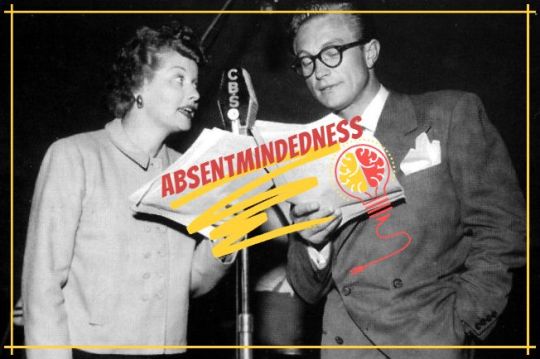
“Absentmindedness” (aka “Liz’s Absent-mindedness”) is episode #32 of the radio series MY FAVORITE HUSBAND broadcast on February 25, 1949 on the CBS radio network.
Synopsis ~ Liz goes to see a doctor about her absentmindedness, and then reports her car to be stolen when she forgets that George dropped her off at the doctor! Liz takes a memory course. It works in reverse and she ends up with amnesia and George finds himself in jail.

“My Favorite Husband” was based on the novels Mr. and Mrs. Cugat, the Record of a Happy Marriage (1940) and Outside Eden (1945) by Isabel Scott Rorick, which had previously been adapted into the film Are Husbands Necessary? (1942). “My Favorite Husband” was first broadcast as a one-time special on July 5, 1948. Lucille Ball and Lee Bowman played the characters of Liz and George Cugat, and a positive response to this broadcast convinced CBS to launch “My Favorite Husband” as a series. Bowman was not available Richard Denning was cast as George. On January 7, 1949, confusion with bandleader Xavier Cugat prompted a name change to Cooper. On this same episode Jell-O became its sponsor. A total of 124 episodes of the program aired from July 23, 1948 through March 31, 1951. After about ten episodes had been written, writers Fox and Davenport departed and three new writers took over – Bob Carroll, Jr., Madelyn Pugh, and head writer/producer Jess Oppenheimer. In March 1949 Gale Gordon took over the existing role of George’s boss, Rudolph Atterbury, and Bea Benadaret was added as his wife, Iris. CBS brought “My Favorite Husband” to television in 1953, starring Joan Caulfield and Barry Nelson as Liz and George Cooper. The television version ran two-and-a-half seasons, from September 1953 through December 1955, running concurrently with “I Love Lucy.” It was produced live at CBS Television City for most of its run, until switching to film for a truncated third season filmed (ironically) at Desilu and recasting Liz Cooper with Vanessa Brown.
REGULAR CAST

Lucille Ball (Liz Cooper) was born on August 6, 1911 in Jamestown, New York. She began her screen career in 1933 and was known in Hollywood as ‘Queen of the B’s’ due to her many appearances in ‘B’ movies. With Richard Denning, she starred in a radio program titled “My Favorite Husband” which eventually led to the creation of “I Love Lucy,” a television situation comedy in which she co-starred with her real-life husband, Latin bandleader Desi Arnaz. The program was phenomenally successful, allowing the couple to purchase what was once RKO Studios, re-naming it Desilu. When the show ended in 1960 (in an hour-long format known as “The Lucy-Desi Comedy Hour”) so did Lucy and Desi’s marriage. In 1962, hoping to keep Desilu financially solvent, Lucy returned to the sitcom format with “The Lucy Show,” which lasted six seasons. She followed that with a similar sitcom “Here’s Lucy” co-starring with her real-life children, Lucie and Desi Jr., as well as Gale Gordon, who had joined the cast of “The Lucy Show” during season two. Before her death in 1989, Lucy made one more attempt at a sitcom with “Life With Lucy,” also with Gordon.
Richard Denning (George Cooper) was born as Louis Albert Heindrich Denninger Jr., in Poughkeepsie, New York. When he was 18 months old, his family moved to Los Angeles. Plans called for him to take over his father’s garment manufacturing business, but he developed an interest in acting. Denning enlisted in the US Navy during World War II. He is best known for his roles in various science fiction and horror films of the 1950s. Although he teamed with Lucille Ball on radio in “My Favorite Husband,” the two never acted together on screen. While “I Love Lucy” was on the air, he was seen on another CBS TV series, “Mr. & Mrs. North.” From 1968 to 1980 he played the Governor on “Hawaii 5-0″, his final role. He died in 1998 at age 84.
Ruth Perrott (Katie, the Maid) was also later seen on “I Love Lucy.” She first played Mrs. Pomerantz (above right), a member of the surprise investigating committee for the Society Matrons League in “Pioneer Women” (ILL S1;E25), as one of the member of the Wednesday Afternoon Fine Arts League in “Lucy and Ethel Buy the Same Dress” (ILL S3;E3), and also played a nurse when “Lucy Goes to the Hospital” (ILL S2;E16). She died in 1996 at the age of 96.
Bob LeMond (Announcer) also served as the announcer for the pilot episode of “I Love Lucy”. When the long-lost pilot was finally discovered in 1990, a few moments of the opening narration were damaged and lost, so LeMond – fifty years later – recreated the narration for the CBS special and subsequent DVD release.
Gale Gordon and Bea Benadaret had not yet joined the cast in the roles of Rudolph and Iris Atterbury.
GUEST CAST

Hans Conried (Doctor Millmoss / Doctor Grimly) first co-starred with Lucille Ball in The Big Street (1942). He then appeared on “I Love Lucy” as used furniture man Dan Jenkins in “Redecorating” (ILL S2;E8) and later that same season as Percy Livermore in “Lucy Hires an English Tutor” (ILL S2;E13) – both in 1952. The following year he began an association with Disney by voicing Captain Hook in Peter Pan. On “The Lucy Show” he played Professor Gitterman in “Lucy’s Barbershop Quartet” (TLS S1;E19) and in “Lucy Plays Cleopatra” (TLS S2;E1). He was probably best known as Uncle Tonoose on “Make Room for Daddy” starring Danny Thomas, which was filmed on the Desilu lot. He joined Thomas on a season 6 episode of “Here’s Lucy” in 1973. He died in 1982 at age 64.
Conried played Professor Millmoss in “Be Your Husband’s Best Friend” (December 4, 1948).

Frank Nelson (Sergeant Nelson) was born on May 6, 1911 (three months before Lucille Ball) in Colorado Springs, Colorado. He started working as a radio announcer at the age of 15. He later appeared on such popular radio shows as “The Great Gildersleeve,” “Burns and Allen,” and “Fibber McGee & Molly”. This is one of his 11 performances on “My Favorite Husband.” On “I Love Lucy” he holds the distinction of being the only actor to play two recurring roles: Freddie Fillmore and Ralph Ramsey, as well as six one-off characters, including the frazzled train conductor in “The Great Train Robbery” (ILL S5;E5), a character he repeated on “The Lucy Show.” Aside from Lucille Ball, Nelson is perhaps most associated with Jack Benny and was a fifteen-year regular on his radio and television programs.
Frank Nelson previously played Sergeant Nelson in “Liz Learns To Drive” (November 13, 1948) and would play Sergeant Nelson on TV in “Ricky and Fred Are TV Fans” (ILL S2;E30).
Officer Joe is played by an uncredited and unidentified actor.
EPISODE

ANNOUNCER: “As we look in on the Coopers it’s about ten o’clock at night and Liz and George are just coming home. They’ve put the car in the garage and are walking around the house to the front door.”
George and Liz are upset that they drove to the Ricky’s and they weren’t even home. Liz realizes that she got the night wrong and they aren’t due there till tomorrow night. George says that Liz’s absentmindedness is getting out of control. She can’t find her front door key – the fifth one she’s lost this month. They ring the bell and Katie the Maid lets them in.
When Liz explains why they are home so early, Katie says that she’s not surprised – the Ricky’s were there for dinner! Liz invited them for dinner and forgot.
GEORGE (dramatically): “This is getting serious. Who knows where it could lead? First you forget little things; your keys, social engagements. Pretty soon you forget your friends, your family. You forget who you are. They find you wandering in the streets. They take you to a sanitarium. Give you shock treatments. But nothing does any good. And there you are; a nameless nobody!”
LIZ (sarcastically): “Thank you, Olivia de Havilland.”
Olivia de Havilland (1916-2020) was a British-American actress whose cinematic career spanned from 1935 to 1988. She appeared in 49 feature films and was one of the leading actresses of her time. In November 1948, she appeared in The Snake Pit, a detailed chronicle of a woman during her stay in a mental institution. It earned her an Oscar nomination. She had been previously nominated for Gone With The Wind (1939) and Hold Back The Dawn (1941) and won for To Each His Own in 1946. She would win a second Oscar for The Heiress (1949). All were highly dramatic roles.
George says that a co-worker took a course in memory training, but Liz doesn’t think she needs that drastic a step. Katie wonders which dress Liz wore to the Rickys. Liz insists she wore the blue one, but Katie says its still hanging in her bedroom. Liz checks under her coat and immediately decides to enroll in the course!
George drives Liz to Doctor Millmoss’s Memory School. He drops her off and takes the car to work. The Doctor interviews Liz and guarantees she can improve her memory. He tells her memory is based on association of idea. To remember her name he associates COO with birds and PER with the purring of cats.
DR. MILLMOSS: “I can never forget that your name is Birdie Katz!”
He tests her on her car license plate number, which is written on her driver’s license: 37MW66. 37 reminds her of George’s age. MW reminds her of Mae West. 66 is the number of the Lincoln Highway.In reality, Richard Denning (George) was 34 years old when this episode aired.He turned 35 a month later.

Mae West (1893-1980) was a stage and screen performer who capitalized on her sex appeal and was well-known for her scandalous sexual innuendo. Liz did an imitation of West in a 1948 episode “You Matrons League Tryouts”. In a 1977 episode of “Donny & Marie” (above) Lucille Ball did her Mae West impersonation yet again this time in full costume and make-up.

Route 66 was not the same as the Lincoln Highway – except for three blocks – briefly! The Lincoln Highway was the first paved, transcontinental highway, ultimately stretching 3,400 miles, from New York to San Francisco. Route 66, however, is a different, but no less storied highway.
It originally ran from Chicago, Illinois, to Santa Monica, California, covering a total of 2,448 miles
The two historic highways cross paths only in the town of Plainfield, Illinois. They were one roadway briefly, when the postwar Route 66 Bypass alignment (aka Route 59) met the Lincoln Highway and merged together for three blocks. Could this be the model for fictional Sheridan Falls?
Doctor Millmoss ends the first lesson because he has a house call to make on Bundy Drive. Liz says that since she lives on Bundy drive, she’ll drive him. If she can only find her car keys – and then her car! After a ten-minute search, she decides to call the police from the cigar shop pay phone.
Sergeant Nelson (Frank Nelson) answers the phone and asks Liz to describe the car. She replies that it is a green Nash, which doesn’t clash with her hair. He asks her if she knows her license plate number.
LIZ: “My husband is on the Lincoln Highway and why don’t you come up and see me sometime?”

The quote is Mae West’s signature line, which she first spoke as the character Lady Lou in the 1933 film She Done Him Wrong. What eventually became, “Come up and see me sometime,” began its life as, “Why don’t you come up some time and see me…” Nash Motors was founded in 1916 by former General Motors president Charles W. Nash. It continued to make vehicles even after it was acquired by AMC, who finally dissolved the make in 1957.
Despite the tantalizing offer, Sergeant Nelson agrees to put out an APB for the missing car.

Later, at the Sheridan Falls Police Station, Officer Joe hauls George Cooper in to be booked by Sergeant Nelson. They don’t believe him when he claims to be the car’s owner and vice president of the Second National Bank.
NELSON: “Oh, sure you are. And I’m President Truman. And this is Margaret.”
JOE (falsetto voice): “Charmed, I’m sure!”Officer Joe sings randomly as he locks up George for auto theft!

Harry S. Truman (1884-1972) was the 33rd president of the United States from 1945 to 1953, succeeding Franklin D. Roosevelt after his death. His daughter Margaret (1924-2008) was the only child of Harry and Bess Truman. As such, he was a doting father, who was very protective of his daughter, who fancied herself a classical singer.
Later, Liz arrives at the police station to press charges against the thief. She thinks he should get the ‘hot seat’ (electric chair). Officer Joe brings in George and Liz gasps!
The police are convinced of George’s identity, but to cover up her memory loss, Liz pretends to have complete amnesia! Sergeant Nelson says he knows all about ‘magnesia’ because he reads the medical page of Time Magazine.

Lucy Ricardo pretends to have amnesia in “Lucy Fakes Illness” (ILL S1;E16). “Lucy Gets Amnesia” (TLS S3;E4) on “The Lucy Show” too, but isn’t faking.
Sergeant Nelson and George try to remind her of who she is. George tries kissing her, but to no avail. George promises to forgive her anything she’s ever done. Liz comes to her senses – until George’s tone turns threatening – then back to amnesia. The psychiatrist Dr. Grimly (Hans Conried) arrives and wants to know who “snapped her twig”. Before the doctor can give her a sedative, Liz runs out the door.
Catching up with Liz on the sidewalk, she is distraught that he may not love her anymore. A big smooch fixes everything. Except that now George can’t find where he parked the car! They assume it is stolen and agree that one of them will have report it to Sergeant Nelson. Liz volunteers to be the one since they already think she’s crazy.
During this Liz / George dialogue, Richard Denning stumbles over his lines a bit, but gets back on track.

In “Ricky and Fred Are TV Fans” (ILL S2;E30) Sergeant Nelson (Frank Nelson) accuses Lucy and Ethel of being Sticky Fingers Sal and Pickpocket Pearl.
Before they get there, Sergeant Nelson and Joe are wondering if the Coopers may in fact have been Red Top Rosie and Willie The Weasel, who were also car thieves. Just then, Liz walks in and Officer Joe draws his gun. Nelson accuses them of being Red Top and Willie. She facetiously claims to be Lizzy the Louse and Cooper the Snooper. Dr. Grimly enters.
LIZ: “Uh, oh. Snake Pit is back again.”

The Snake Pit (1948) was hinted at earlier in the episode with the mention of Olivia de Havilland in the context of sanitariums.
Instead of a needle, Dr. Grimly intends to hypnotize her. It backfires and Sergeant Nelson goes under instead! Grimly snaps him out of it, but Liz teases him and says he did a naughty striptease while under hypnosis. Dr. Grimly takes another tact: word association. But after a rapid-fire exchange, Officer Joe reveals that the real Red Top Rosie has been in jail for years. Liz is free to go.
On the street she tells George why it took so long. They suddenly see their car and decide to drive it right home – but it is out of gas. The police race up and want to know where they are going in a stolen car!
SERGEANT NELSON: “Well, what do you have to say this time?”
LIZ AND GEORGE: “Where am I?”End of Episode
Bob LeMond reminds listeners that Lucille Ball will soon be seen in Sorrowful Jones.
-
MOTHER-IN-LAW
March 4, 1949
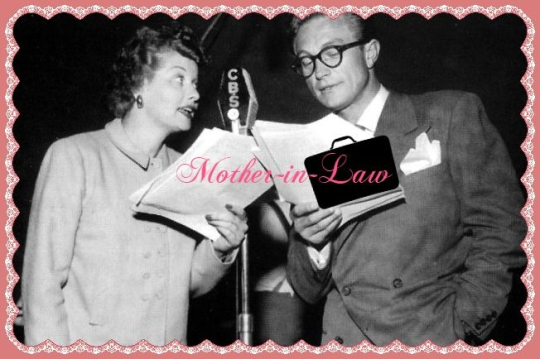
“Mother-in-Law” (aka “Mother Cooper Visits”) is episode #33 of the radio series MY FAVORITE HUSBAND broadcast on March 4, 1949 on the CBS radio network.
Synopsis ~ George’s mother comes to visit. Liz hopes to drive her out by spreading ragweed and other allergy-inducing plants around the house, but her plan backfires when George’s mother starts dating her allergist.

“My Favorite Husband” was based on the novels Mr. and Mrs. Cugat, the Record of a Happy Marriage (1940) and Outside Eden (1945) by Isabel Scott Rorick, which had previously been adapted into the film Are Husbands Necessary? (1942). “My Favorite Husband” was first broadcast as a one-time special on July 5, 1948. Lucille Ball and Lee Bowman played the characters of Liz and George Cugat, and a positive response to this broadcast convinced CBS to launch “My Favorite Husband” as a series. Bowman was not available Richard Denning was cast as George. On January 7, 1949, confusion with bandleader Xavier Cugat prompted a name change to Cooper. On this same episode Jell-O became its sponsor. A total of 124 episodes of the program aired from July 23, 1948 through March 31, 1951. After about ten episodes had been written, writers Fox and Davenport departed and three new writers took over – Bob Carroll, Jr., Madelyn Pugh, and head writer/producer Jess Oppenheimer. In March 1949 Gale Gordon took over the existing role of George’s boss, Rudolph Atterbury, and Bea Benaderet was added as his wife, Iris. CBS brought “My Favorite Husband” to television in 1953, starring Joan Caulfield and Barry Nelson as Liz and George Cooper. The television version ran two-and-a-half seasons, from September 1953 through December 1955, running concurrently with “I Love Lucy.” It was produced live at CBS Television City for most of its run, until switching to film for a truncated third season filmed (ironically) at Desilu and recasting Liz Cooper with Vanessa Brown.
MAIN CAST

Lucille Ball (Liz Cooper) was born on August 6, 1911 in Jamestown, New York. She began her screen career in 1933 and was known in Hollywood as ‘Queen of the B’s’ due to her many appearances in ‘B’ movies. With Richard Denning, she starred in a radio program titled “My Favorite Husband” which eventually led to the creation of “I Love Lucy,” a television situation comedy in which she co-starred with her real-life husband, Latin bandleader Desi Arnaz. The program was phenomenally successful, allowing the couple to purchase what was once RKO Studios, re-naming it Desilu. When the show ended in 1960 (in an hour-long format known as “The Lucy-Desi Comedy Hour”) so did Lucy and Desi’s marriage. In 1962, hoping to keep Desilu financially solvent, Lucy returned to the sitcom format with “The Lucy Show,” which lasted six seasons. She followed that with a similar sitcom “Here’s Lucy” co-starring with her real-life children, Lucie and Desi Jr., as well as Gale Gordon, who had joined the cast of “The Lucy Show” during season two. Before her death in 1989, Lucy made one more attempt at a sitcom with “Life With Lucy,” also with Gordon.
Richard Denning (George Cooper) was born Louis Albert Heindrich Denninger Jr., in Poughkeepsie, New York. When he was 18 months old, his family moved to Los Angeles. Plans called for him to take over his father’s garment manufacturing business, but he developed an interest in acting. Denning enlisted in the US Navy during World War II. He is best known for his roles in various science fiction and horror films of the 1950s. Although he teamed with Lucille Ball on radio in “My Favorite Husband,” the two never acted together on screen. While “I Love Lucy” was on the air, he was seen on another CBS TV series, “Mr. & Mrs. North.” From 1968 to 1980 he played the Governor on “Hawaii 5-0″, his final role. He died in 1998 at age 84.
Gale Gordon (Dr. Griswold Stephenson) had worked with Lucille Ball on “The Wonder Show” on radio in 1938. One of the front-runners to play Fred Mertz on “I Love Lucy,” he eventually played Alvin Littlefield, owner of the Tropicana, during two episodes in 1952. After playing a Judge in an episode of “The Lucy-Desi Comedy Hour” in 1958, he would re-team with Lucy for all of her subsequent series’: as Theodore J. Mooney in ”The Lucy Show”; as Harrison Otis Carter in “Here’s Lucy”; and as Curtis McGibbon on “Life with Lucy.” Gordon died in 1995 at the age of 89.
Gordon usually plays Rudolph Atterbury, George’s boss, but the character does not appear in this episode, although he is mentioned.
Bea Benadaret (Laeticia Cooper, George’s Mother) was considered the front-runner to be cast as Ethel Mertz but when “I Love Lucy” was ready to start production she was already playing a similar role on TV’s “The George Burns and Gracie Allen Show” so Vivian Vance was cast instead. On “I Love Lucy” she was cast as Lucy Ricardo’s spinster neighbor, Miss Lewis, in “Lucy Plays Cupid” (ILL S1;E15) in early 1952. Later, she was a success in her own show, “Petticoat Junction” as Shady Rest Hotel proprietress Kate Bradley. She starred in the series until her death in 1968.
This role of Mother Cooper had previously been played by Eleanor Audley. Bea Benadaret normally plays Iris Atterbury, but the character does not appear in this script.
Ruth Perrott (Katie, the Maid) was also later seen on “I Love Lucy.” She first played Mrs. Pomerantz (above right), a member of the surprise investigating committee for the Society Matrons League in “Pioneer Women” (ILL S1;E25), as one of the member of the Wednesday Afternoon Fine Arts League in “Lucy and Ethel Buy the Same Dress” (ILL S3;E3), and also played a nurse when “Lucy Goes to the Hospital” (ILL S2;E16). She died in 1996 at the age of 96.
Bob LeMond (Announcer) also served as the announcer for the pilot episode of “I Love Lucy”. When the long-lost pilot was finally discovered in 1990, a few moments of the opening narration were damaged and lost, so LeMond – fifty years later – recreated the narration for the CBS special and subsequent DVD release.
EPISODE
ANNOUNCER: “As we look in on the Coopers this morning, the members of the household are in various stages of preparing for the new day. George is in the shower singing “Old Man River”, Katie the maid is getting breakfast, and Liz is just coming into the kitchen.”
KATIE: “Good morning, Mrs. Cooper. Has Mr. Cooper finished his shower yet?”
LIZ: “I don’t think so. He through toting the barge and lifting the bale, and he was getting a little drunk, so I guess he’s just about landing in jail now.”
“Old Man River” by Oscar Hammerstein II and Jerome Kern, was written for the 1927 musical Show Boat. A revival of the musical ran on Broadway in 1946. There was a radio adaptation in 1944. In “Never Do Business With Friends” (ILL S2;E31), Lucy Ricardo analogizes her housework without an electric washing machine to that of the slaves who sing “Old Man River”.
Liz tells Katie that her mother is coming to visit. She needs to break it to George by being sweet to him. When she goes in the breakfast room, George comes down to breakfast and tells Katie that his mother is coming to stay.
KATIE: “I wish I’d known about this earlier. I could have sold tickets!”
Liz smooches George and George is as sweet in return, which tips Liz off that something’s up. She decides to tell him outright that they are going to have a visitor. George thinks Liz is expecting a baby!
LIZ: “She’ll arrive the day after tomorrow. On the Super Chief!”

The Super Chief was one of the named passenger trains and the flagship of the Atchison, Topeka and Santa Fe Railway. It claimed to be “The Train of the Stars” because of the various celebrities it carried between Chicago and Los Angeles. Lucy and Desi traveled aboard the Super Chief known as the “Forever Darling Express” to promote their film in 1956.
In “The Ricardos Change Apartments” (ILL S2;E26),
Lucy calls the electric toy trains “the Super Chief” as it circles the room!
Liz breaks it to him that she is not expecting anyone – except her mother. George immediately confesses that his mother is also coming! Neither George nor Liz want to tell their mothers not to come. George insults Liz’s mother as twice as repulsive and she dissolves into tears. They decide to send both mothers telegrams that the house is being fumigated for termites and not to come!
A while later, a telegram arrives for Miss Liz Elliott to confirm she’s not coming, but George’s mother sends a telegram to say she’s coming anyway! Liz isn’t happy about it, but promises to try to be nice to her anyway.
A few days later the doorbell rings and it is George’s mother. Mother Cooper ignores Liz but isn’t happy when she’s ignored by Liz. George’s mother has brought him a solid gold cigarette case with his name engraved on it. She’s brought Liz a bottle of Air-Wick.

Air-Wick is a brand of air freshener that is owned by the British company Reckitt Benckiser. It was first launched by creator Guy Paschal in 1943 in the United States, and is now sold worldwide.
Liz tries to keep her temper, even when Mother Cooper tells Liz she is on a diet of raw vegetables and goats milk – and that while she’s there they will all eat the same thing. Liz puts her foot down – no goats milk!
A week later, George and Liz are drinking goats milk. Liz is bleating like a goat and George nearly head butt Mr. Atterbury at the drinking fountain! Mother Cooper asserts that “Mother Knows Best”.
Katie the maid is angry because Mother Cooper has burst into her room to confiscate her roses. Liz reminds her that Mother Cooper is allergic to roses.
KATIE: “Four Roses?”

Four Roses is a brand of Kentucky straight bourbon whiskey. The brand’s distillery in Lawrenceburg, Kentucky, was built in 1910 and the company’s warehouse for aging and bottling operations is in Cox’s Creek, Kentucky.
Liz admits to Katie that she’s trying to get Mother Cooper to leave by putting various weeds and flowers discretely around the house. Just then, Mother Cooper arrives saying that she’s been to a specialist named Dr. Stephenson and he’s told her that he can rid her of her allergies if she just stays in Sheridan Falls and gets a shot every day for the next six weeks. Six weeks! Katie reveals that the ragweed Liz hid in Mother Cooper’s pillow was actually poison ivy!
A few weeks later, Mother Cooper has been steadily going out with Dr. Stevenson. She saunters merrily through the house singing “Ah, Sweet Mystery of Life.”

“Ah! Sweet Mystery of Life” is from the 1910 operetta Naughty Marietta by Victor Herbert and Rida Johnson. It was briefly sung by Mrs. Trumbull in “Ricky’s Movie Offer” (ILL S4;E6).
George wants to know when they will meet this Mr. Stephenson, but Mother Cooper admits she is embarrassed by Liz. An indignant Liz insists that she has royalty in her blood – Lord Calvert.

Lord Calvert was George Calvert, 1st Baron Baltimore (1580-1632) whose name was used on two products sold in 1949: Lord Calvert Coffee (made by Leverings) and Lord Calvert Canadian Whiskey. Liz might mean either!
Dr. Stephenson has invited them all to dinner tomorrow night and George says they are going not matter what!
Before they go to dinner, Mother Cooper tells Liz to be sure to conduct herself correctly. Liz is resentful of her condescending attitude, but Mother Cooper says Liz can always learn something from someone like her who has a tremendous background.
LIZ: “Well, just stay on that diet and it will go away!”
Mother Cooper is sure Liz will ruin everything so Liz refuses to go. George isn’t pleased, but when she hears Mother Cooper may marry Doctor Stephenson, so she changes her mind. She confides in Katie she must break up the romance so that her mother-in-law doesn’t marry and move to town! She decides to do everything wrong!
When they arrive at the Doctor’s for dinner, Liz suddenly adopts the attitude, jargon, and voice of a Brooklyn floozy!

Lucille Ball adopted this same voice and demeanor in “Lucy Wants to Move to the Country” (ILL S6;E15) in order to appear undesirable to the owners of the Connecticut house, one of whom is played by Eleanor Audley, who, coincidentally, played Mother Cooper in two previous episodes of “My Favorite Husband”!
Liz calls the Doctor ‘sawbones’, Mother Cooper ‘grandma’, and then asks the Doctor to look at her throat!
DOCTOR: “Mrs. Cooper, would you take my arm for dinner.”
LIZ: “Sure, but I’d rather have a steak!”MOTHER (to Liz): “Ill sit on your left hand and George will sit on your right hand.”
LIZ: “How’ll I eat? Out of a nose bag?”Liz is concerned that the lamb the maid is green. Is it spoiled? Mother Cooper says it is mint jelly.
MOTHER: “Take it on the lamb.”
LIZ: “Why, is the joint being raided?”Mother Cooper is appalled at Liz’s behavior, but Dr. Stephenson is delighted! He’s from Brooklyn himself! He’s happy to be marrying into such a down-to-earth family!
LIZ: “Oh, no!”
In the bedtime tag, Liz and George are happy that his mother has left and life has returned to normal. Just then, the doorbell rings. Katie answers it an announces that they have another house guest – Liz’s Mother!
End of Episode
The Announcer reminds listeners that Lucille Ball will soon be seen in the Paramount Picture Sorrowful Jones.

-
MILTON FROME
February 24, 1909

Milton Frome was born in Philadelphia, Pennsylvania in 1909.

Frome made his first screen appearance in the short Daredevil O’Dare in 1934. His first feature was in 1939′s Ride ‘Em Cowgirl.
His first television appearance (of many) was a 1950 episode of “The Chevrolet Tele-Theatre” titled “Once A Gentleman”.

He played Sam Carter, the object of “The Matchmaker” (ILL S4;E4) on “I Love Lucy,” filmed on June 10, 1954 and aired on October 25, 1954.

Lucy tries to get Sam to propose to Dorothy, but it backfires and nearly ruins her own marriage!

Frome returned to work with Ball in a 1965 episode of “The Lucy Show” playing Jerry Bike, Milton Berle’s Agent, although the agent’s last name is never mentioned in dialogue.

The agent also works for Danny Thomas and Bob Hope – flipping the photos over when Berle enters the room!
The Agent’s last name is the same as Lester Bike, Ernie Ford’s friend and TV host in “Tennessee Ernie Hangs On” (ILL S3;E29).

He was back for a 1972 episode of “Here’s Lucy” starring Donny Osmond, in which he played Henry the Waiter. Henry the Waiter was also the nearsighted server played by Frank Nelson (inset photo) in “Lucy Changes Her Mind” (ILL S2;E21).

For Desilu, From also appeared on “The Ann Sothern Show” (December 1958, above), “Lepke” on “Westinghouse Desilu Playhouse” (November 1959) with Desi Arnaz as host, “Guestward Ho!” (March 1961), and “Glynis” (November 1963).

Shows he appeared on that were filmed at Desilu Studios (but not produced by Desilu) included “The Danny Thomas Show” (1958-1963), “The Andy Griffith Show” (1965, above), “The Dick Van Dyke Show” (1965 & 1966), and “Gomer Pyle USMC” (1966 & 1967).

Like many character actors who worked for Lucille Ball, Frome appeared on “Batman” playing Laughing Larry in a December 1966 episode featuring the arch villain Shame (Cliff Robertson). Frome also appeared in the Batman feature film (1967) playing Vice-Admiral Fangschliester.

His final screen appearance was in the Telly Savalas film Beyond Reason in 1985 although it was filmed in 1977. His final television role was a December 1982 episode of “Trapper John MD”.
He was married to Marjorie Ann Widman from April 16, 1978 to his death at age 80 on March 21, 1989. They had one child.
-
Subscribe
Subscribed
Already have a WordPress.com account? Log in now.
 Papermoon Loves Lucy