-
LUCY + DESI = BIG BUSINESS
April 8, 1956

Lucille Ball and Desi Arnaz appeared on the cover of the New York Herald Tribune’s TV and Radio Magazine on April 8, 1956.


(The remainder of the article was not available.)

In this week’s listing is “Lucy Gets Homesick in Italy” (ILL S5;E22) first aired on Monday, April 9, 1956. In reality, the cast had just finished filming the final episode of season five “Return Home from Europe” (ILL S5;E26) which was also intended to be the final episode of the series.

Lucille Ball had previously appeared on the cover of the Herald Tribune’s TV & Radio Magazine on May 22, 1953, along with some of TV’s famous redheads Audrey Meadows and Nanette Fabray. She appeared on the cover again on November 3, 1957, again with Desi Arnaz.
-
MAXINE SEMON
April 8, 1909

Maxine Semon was born on April 8, 1909 in Kalamazoo, Michigan. She made her screen debut in October 1944 in one of RKO’s Edgar Kennedy short films titled “Feather Your Nest”. In 1936, Lucille Ball had appeared in one of the shorts titled “Dummy Ache”.

In 1950 she made her television debut as Honeybee Gillis on four episodes of “The Life of Riley” starring Jackie Gleason. Two of them also featured Bobby Jellison (aka Bobby the Bellboy). Coincidentally, on radio the role was played by Shirley Mitchell aka Marion Strong) and when the series was re-booted in 1953 starring William Bendix, Honeybee was played by Gloria Blondell (aka Grace Foster).

In August 1955, she did an episode of the “I Love Lucy” summer replacement series Desilu’s “Those Whiting Girls.” Just prior to that she had done three episodes of “I Married Joan,” NBC’s answer to “I Love Lucy.”

On November 3, 1955, she played a nurse on “I Love Lucy” in “Nursery School” (ILL S5;E9) which aired on December 5, 1955.

She returned to the series six months later to film “Lucy and Bob Hope” (ILL S6;E10) on June 5, 1956. The episode aired on October 1, 1956. She played a baseball fan at Yankee Stadium sitting in the box next to Hope with Dick Elliott. Semon and Elliott both order hot dogs from Lucy with Hope as the go-between.

On a 1958 episode of “The Lucy-Desi Comedy Hour” set in Las Vegas, Semon played a chambermaid at the Sands hotel.

“Lucy Hunts Uranium" (1958) also featured Bobby Jellison, with whom she made her TV debut on “Life of Riley” in 1950.

From 1962 to 1964 she played the recurring character of the heard-but-not-seen Mrs. Jillson on “The Joey Bishop Show” filmed at Desilu Studios. Her on-screen husband was played by Joe Besser. Semon appeared on camera as other characters in three of her thirteen episodes of the series.
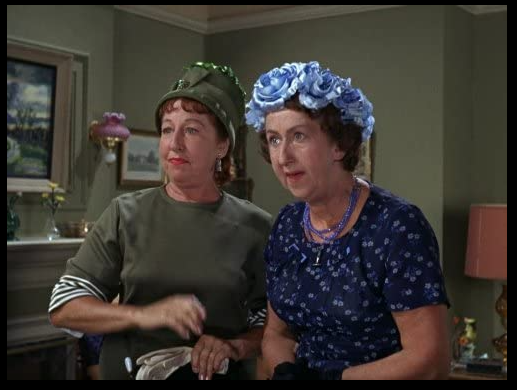
Back on the Desilu Studios backlot in 1966, she played nosey neighbor Tillie Kinkaid (above left) in two episodes of “The Andy Griffith Show.”

The following year she did a day on “Gomer Pyle U.S.M.C.” on the Desilu backlot, playing a Marine Sergeant. “The Lucy Show” did a cross-over episode with “Gomer Pyle” in November 1966.

Her last time on the Desilu lot was to film an episode of “My Three Sons” in 1967. She had previously done an episode in 1964 opposite William Frawley.

Her final screen appearance was on a January 1973 episode of “Maude”. She played a confused patient in a doctor’s office and had no dialogue.
She died on October 18, 1985 at age 76 of undisclosed causes.

-
ZIEGFELD FOLLIES
April 8, 1946

Directors: Lemuel Ayers, Roy Del Ruth. Vincente Minnelli, George Sidney,
Norman Taurog, Charles Walters. Robert Lewis
Producer: Arthur Freed for Metro Goldwyn MayerThe shooting schedule ran between April 10 and August 18, 1944, with retakes plus additional segments filmed on December 22, 1944 and then between January 25 and February 6, 1945. The film was first proposed in 1939.
Synopsis ~ We meet a grayed, immaculately garbed Florenz Ziegfeld, Jr. in Paradise (his diary entry reads “Another heavenly day”), where he looks down upon the world and muses over the sort of show he’d be putting on were he still alive.
PRINCIPAL CAST

Lucille Ball (‘Here’s to the Ladies’) is appearing in her 64th film since coming to Hollywood in 1933.
Fred Astaire (‘Here’s to the Ladies’ / Raffles in ‘This Heart of Mine’ / Tai Long in ‘Limehouse Blues’ / Gentleman in ‘The Babbit and the Bromide’) also appeared with Lucille Ball in Roberta (1935), Top Hat (1935), and Follow the Fleet (1936). His name was mentioned twice on “I Love Lucy.”
Lucille Bremer (Princess in ‘This Heart of Mine’ / Moy Ling in ‘Limehouse Blues’)
Fanny Brice (Norma Edelman in ‘A Sweepstakes Ticket’) appeared in the original stage version of many editions of The Ziegfeld Follies on Broadway.
Judy Garland (The Star in ‘A Great Lady Has An Interview’) also starred with Lucille Ball in Thousands Cheer (1943).
Kathryn Grayson (Kathryn Grayson in ‘Beauty’)
also starred with Lucille Ball in Thousands Cheer (1943).
Lena Horne (Lena Horne in ‘Love’) also starred with Lucille Ball in Thousands Cheer (1943).
Gene Kelly (Gentleman in ‘The Babbit and the Bromide’) also starred with Lucille Ball in Thousands Cheer (1943), Du Barry Was A Lady (1943), and A Guide for the Married Man (1967). He made an appearance on the Lucille Ball special “Lucy Moves to NBC” (1980).
James Melton (Alfredo in ‘La Traviata’)
Victor Moore (Lawyer’s Client in ‘Pay the Two Dollars’)
Red Skelton (J. Newton Numbskull in ‘When Television Comes’) also starred with Lucille Ball in Having Wonderful Time (1938), Thousands Cheer (1943), Du Barry Was A Lady (1943), and The Fuller Brush Girl (1950). On TV he appeared on “The Lucy-Desi Comedy Hour” in “Lucy Goes To Alaska” (1958). Ball and Skelton appeared in numerous TV specials together.
Esther Williams (Esther Williams in ‘A Water Ballet’) also appeared with Lucille Ball in Easy To Wed (1946).
William Powell (Florenz Ziegfeld Jr.) also played the same character in The Great Ziegfeld (1936).
Edward Arnold (Lawyer in ‘Pay the Two Dollars’) appeared with Lucille Ball in Roman Scandals (1933) and Ellis in Freedomland (1952).
Marion Bell (Violetta in ‘La Traviata’)
Cyd Charisse (Ballerina in ‘Beauty’) also starred with Lucille Ball in Thousands Cheer (1943).
Hume Cronyn (Monty in ‘A Sweepstakes Ticket’) was honored by The Kennedy Center in 1986, at the same ceremony as Lucille Ball.
William Frawley (Martin in ‘A Sweepstakes Ticket’) played the role of Fred Mertz on “I Love Lucy” and “The Lucy-Desi Comedy Hour”. He also appeared on “The Lucy Show,” his final screen appearance.
Robert Lewis (Chinese Gentleman in ‘Limehouse Blues’ / Telephone Voice in ‘Number Please’)
Virginia O’Brien (Virginia O’Brien in ‘Here’s to the Ladies’) also starred with Lucille Ball in Thousands Cheer (1943), Du Barry Was A Lady (1943), and Meet The People (1944).
Keenan Wynn (Caller in ‘Number Please’) appeared with Lucille Ball in Easy To Wed (1946), Without Love (1945), and The Long, Long Trailer (1954).
SUPPORTING CAST

Ziegfeld Girls
- Karin Booth
- Lucille Casey
- Aina Constant
- Elizabeth Dailey
- Frances Donelan
- Natalie Draper
- Karen X. Gaylord
- Aileen Haley
- Carol Haney
- Shirlee Howard
- Margaret Laurence
- Helen O’Hara
- Noreen Roth
- Elaine Shepard
- Kay Thompson
- Dorothy Tuttle
- Dorothy Van Nuys
- Eve Whitney – appeared on “I Love Lucy” episode “The Charm School” (ILL S3;E15).

Dancers
- Gloria Joy
Arden - Jean Ashton
- Irene Austin
- Judi Blacque
- Bonnie Barlowe
- Norman Borine
- Hazel Brooks
- Ed Brown
- Kathleen Cartmill
- Jack Cavan
- Marilyn Christine
- Laura Corbay
- Rita Dunn
- Meredyth Durrell
- Shawn Ferguson
- Jeanne Francis
- Jean French
- Mary Jane French
- David Gray
- Bill Hawley
- Doreen Hayward
- Charlotte Hunter
- Virginia Hunter
- Patricia Jackson
- Margaret Kays
- Laura Knight
- Laura Lane
- Dale Lefler
- Melvin Martin
- Diane Meredith
- Lorraine Miller
- Joyce Murray
- Janet
Nevis - Ray Nyles
- Billy O’Shay
- Jane Ray
- Dorothy Raye
- Beth Renner
- Melba Snowden
- Walter Stane
- Ivon Starr
- Robert Trout
Chorus Boys
- Rod Alexander
- Milton Chisholm
- Dick D’Arcy
- Dante DiPaolo
- Don Hulbert
- Herb Lurie
- Matt Mattox
- Bert May – appeared on “The Lucy Show” in “Lucy and Tennessee Ernie Ford”
- Jack Purcell
- Tommy Rall
- Ricky Ricardi (!)
- Alex Romero

“LIMEHOUSE BLUES” starring Fred Astaire, Lucille Bremer, and Robert Lewis
- Robert Ames (Masked Man)
- James Barron (Couple with Banners)
- Eleanor Bayley (Couple with
Branches) - Mary Jo Ellis (Couple with Banners)
- Sean Francis (Ensemble)
- James King (Rooster)
- Harriet Lee (Bar Singer)
- Eugene Loring (Costermonger)
- Charles Lunard (Masked Man)
- Patricia Lynn (Ensemble)
- Ruth Merman (Ensemble)
- Garry Owen (1st Subway Policeman)
- Ellen Ray (Couple with
Parasols) - Jack Regas (Masked Man)
- Billy Shead (Couple with Parasols)
- Ronald Stanton (Couple with Branches)
- Wanda Stevenson (Ensemble)
- Ray Teal (2nd Subway Policeman)

“LOVE” starring Lena Horne
- Juliette Ball (Club Patron)
- Lennie Bluett (Dancer)
- Suzette Harbin (Flirt)
- Avanelle Harris (Club Patron)
- Maggie Hathaway (Dancer)
- Charles
Hawkins (Club Patron) - Marie Bryant (Woman Getting Her Man Taken)
- Cleo Herndon (Dancer)

“THIS HEART OF MINE” starring Fred Astaire and Lucille Bremer
- Helen Boyce (Countess)
- Feodor Chaliapin Jr. (Lieutenant)
- Naomi Childers (Duchess)
- Charles Coleman (Majordomo)
- Sam Flint (Majordomo’s Assistant)
- Sidney Gordon (Masked Man)
- Count Stefenelli (Count)
- Robert Wayne (Dyseptic)

“PAY THE TWO DOLLARS” starring Edward Arnold and Victor Moore
- William
Bailey (Subway Passenger) - Joseph Crehan (1st Judge) – played a Detective on “I Love Lucy” “The Great Train Robbery”
- William
B. Davidson (2nd Judge) - Eddie Dunn (3rd Subway Policeman)
- Harry Hayden (Warden)
- George Hill (2nd Subway Policeman)
- Wilbur Mack (Subway Passenger)
- Larry Steers (Magistrate)

“NUMBER PLEASE” starring Keenan Wynn
- Peter Lawford (Voice of Porky)
- Grady Sutton (Texan)
- Audrey Totter (Phone Operator Voice)
- Kay Williams (Girl)
OTHERS
- Bunin’s Puppets
- Elise Cavanna (Tall Woman)
- Jack Deery (Man)
-
Rex Evans (Butler in “A Great Lady Has An Interview”)
- Sam Garrett (Roping / Twirling Act)
- Silver (Horse in "Here’s to the Ladies’)
- Arthur Walsh (Telegraph Boy in "A Sweepstakes Ticket”) – appeared on “I Love Lucy” in “Lucy Has Her Eyes Examined” (ILL S3;E11).

‘FOLLIES’ TRIVIA

Sidney
Guilaroff, Lucille Ball’s hair dresser, who takes responsibility for her
famous ‘golden red’ for this movie, becoming her trademark color.
Although they appear in different segments, this is the only feature film collaboration between “I Love Lucy co-stars" Lucille Ball and William Frawley. Coincidently, Frawley’s character in this film shares a striking similarity with his iconic character of Fred Mertz on “I Love Lucy.” In this film he plays a money-hungry curmudgeon of a landlord, much like the show. In the above photo, he appears with director Minnelli and co-star Brice.

The horse ridden by Lucille Ball is the Lone Ranger’s Silver!

Lucille Ball was actually fired by Ziegfeld from his road company production of Rio Rita in the 1930s.

In February 1956, Lucy and Desi appeared on “MGM Parade” to promote their MGM film Forever Darling. The show also included footage of Lena Horne singing from Ziegfeld Follies.

Lucy also played a showgirl in pink in “Lucy Gets Into Pictures” (ILL S4;E19) aired on February 21, 1955. The scene was inspired by Ziegfeld’s legendary stage shows featuring beautiful women wearing elaborate costumes navigating long staircases. To solidify the comparison, Ricky says he is going to a meeting with Mr. Minnelli. Vincente Minnelli was one of the directors of Ziegfeld Follies.

Lucy Ricardo had previously cavorted around in a lampshade in the manner of a Ziegfeld girl in both the unaired pilot and “The Audition” (S1;E6).

Ziegfeld Follies includes a sketch for Red Skelton called “When Television Comes” aka “Guzzler’s Gin” in which a (future) television spokesman gets increasingly sloshed on his product. This sketch was an obvious influence on Lucy’s Vitameatavegamin routine in “Lucy Does a TV Commercial” (ILL S1;E30) aired on May 5, 1952.

Ziegfeld Girl Eve Whitney appeared on “I Love Lucy” episode “The Charm School” (ILL S3;E15). She used her own name for the character.

The Telegraph Boy in “A Sweepstakes Ticket" Arthur Walsh
– appeared on “I Love Lucy” in “Lucy Has Her Eyes Examined” (ILL S3;E11) as Arthur ‘King Cat’ Walsh. He teaches Lucy how to jitterbug.

The first Judge in the “Pay the Two Dollars” James Crehan also played the Police Detective on “I Love Lucy in “The Great Train Robbery” (ILL S5;E5) first aired on October 31, 1955.

Porky, a voice on the telephone in “Number Please” Peter Lawford, played “Password” against Lucille Ball on September 24, 1964. At the time, Lawford was married to President Kennedy’s sister, Patricia. On November 26, 1968, Ball was a guest on “The Tonight Show” when Peter Lawford was sitting in for Johnny Carson.

Chorus Boy Bert May appeared as a solo dancer on “The Lucy Show” in “Lucy and Tennessee Ernie Ford” (TLS S5;E21) in February 1967.

In the dressing room, Lucy jokes with Fanny Brice, one of the funniest women in showbusiness. This was the only time Ball and Brice collaborated and was Brice’s last film.

Ziegfeld’s follies began on Broadway, so it was appropriate that the show featured past and future Broadway musical stars:
- Lucille Ball ~ Wildcat (1960)
- Carol Haney ~ The Pajama Game (1954)
- Tommy Rall ~ Call Me Madame (1950)
- Fanny Brice ~ The Ziegfeld Follies
- Marion Bell ~ Brigadoon (1947)
- Victor Moore ~ Anything Goes (1934)
There was a lot of material that was not filmed, but written and cast. Some of the original skits would have added “Lucy” performers Mickey Rooney, Ann Sothern, and Van Johnson to the cast.
1946, Arthur Walsh, Bert May, Cyd Charisse, Esther Williams, Eve Whitney, Fanny Brice, Florenz Ziegfeld, Fred Astaire, Gene Kelly, I love lucy, James Crehan, Judy Garland, Keenan Wynn, Lena Horne, Lucille Ball, Lucille Bremer, MGM, peter lawford, Red Skelton, Vincente Minnelli, William Frawley, William Powell, Ziegfeld Follies -
TIME: THE NEW TYCOON
April 7, 1958


THE NEW TYCOON
Battered old movie posters still flapped in the Hollywood breezes on the high walls of the old RKO lot last week. But towering above the lot, in huge black letters on the freshly painted silver water tower, loomed a new hallmark: Desilu Studios. Below it, cameramen were already shooting TV films on five of the lot’s 14 stages, while an army of wreckers, carpenters, painters and plasterers exorcised the past for the arrival of the new owners: onetime Bongo Drummer Desiderio Alberto Arnaz y De Acha III, 41, and his round-eyed, henna-crested wife, Comedienne Lucille Ball, 46.
For Desi and Lucy, the trip to the RKO lot was at once a sentimental journey and an ironic triumph. It is where they met, fell in love—and left in the early ‘40s under the shadow of Desi’s dropped option. Since then, babyfaced. Cuban-born Desi has become not only half of TV’s most popular comedy team, but the self-made boss of a company that produces, or takes a hand in producing, 27 TV shows. This year on three different lots Desilu will grind out 270 hours of filmed television entertainment—more than twice the footage of any movie studio—rivaling TV’s Revue Productions as the biggest film producer in the new Hollywood.
Pile & Putter
While Lucy moves into the dressing room that Ginger Rogers once occupied as queen of RKO and keeps an eye on the commissary (she hates “bad studio food”), Desi will reign in an oak-and-leather throne room, surrounded by deep pile, a disappearing bar, and a putter alongside the desk. The new Hollywood tycoon is already awakening echoes of older ones. As workmen remodeled buildings for directors, producers and writers, he said: “Those cubbyholes were no good. Our offices are going to be twice that size. These are creative people, and creative people gotta have room to think.” Madelyn Pugh Martin, one of the company’s favorite writers, will even get a built-in nursery for her new baby.
Desi has begun buying galley proofs of novels directly from publishers, “the same way major studios do,” and is looking for fresh writing talent in colleges. He hopes to set up a studio workshop for acting tyros and a system of talent scouts. And he does not stop there in emulating the lost grandeur of the big studios. Says he: “If we get a good story that just won’t fit on that small screen, then we’ll do it as a movie feature.”
Back in 1951, when Arnaz and his wife started I Love Lucy on a shoestring, they knew so little about the business that they sent their cameraman to Manhattan to pick up pointers from live shows. Today even the janitors on his payroll of 2,500 still call him by his first name, but Desi is equally authoritative behind the cameras directing a pilot film or rattling off shrewd decisions in long-distance calls with network brass, sponsors and ad agencies.
Since he and Lucy are sole owners, there is no lag at Desilu when he decides to make a deal. He beat two major bidders for the RKO studios when he strolled off a Lucy set one day last fall and made a phone call nailing down the purchase from General Tire & Rubber Co., RKO’s owner since 1955, for a bargain $6,150,000. Desi usually spends ten hours a day at work, chauffeurs himself in his black Thunderbird from the Beverly Hills mansion where he and Lucy live with their two children, Lucie Desirée, 6, and Desi IV, 5, manages three-day golf weekends at another home in Palm Springs.
The Guy in Omaha
“This coming year,” says Tycoon Arnaz, “is going to be probably the most important year in television’s history. You might call it the industry’s moment of truth. Only quality stuff will draw an audience, so I think only the fittest will survive. We’re going to go all out.”
Desi will plow $7,500,000 into his 1958-59 production schedule so confidently that “this time we’re going to do the shows first and then go looking for a sponsor.” The main project: Desilu Playhouse, which, with Desi as host, will offer weekly hour-long dramatic and musical productions, plus a dozen 90-minute spectaculars, including Don Quixote and six Desi-Lucy comedies. All the shows will be tailored to this Arnaz pattern: “No violence, no psychopaths, no dirtiness. There will never be any need to send the kids to bed when we come on.”
Will the results please the critics—or confirm a rival’s description of Desilu as “a sausage factory”? Snort Producer Arnaz, embracing the code of Hollywood tycoons old and new: “I’ve never yet made a show for the 21 Club or the Romanoff’s crowd, and I’m not going to start now. The viewers have to be able to identify themselves with the characters or you’re going to lose them. I’ve always got the guy in Omaha in mind.”
-
WALTER WINCHELL
April 7, 1897

Walter Winchell was born in New York City, the son of immigrants. He left school in the sixth grade and started performing in vaudeville as a tap dancer. Winchell served in the U.S. Navy during World War I. He began his career in journalism by posting notes about his acting troupe on backstage bulletin boards. He was hired on June 10, 1929, by the New York Daily Mirror, where he became the author of the first syndicated gossip column, entitled On-Broadway.
He made his radio debut on May 12, 1930 with a 15-minute feature that provided business news about Broadway. That same year he made his screen debut (based on his column) in the Warner Brothers short film The Bard of Broadway, in which he played himself.

In 1933, he appeared as himself in Broadway Thru A Keyhole (aka Walter Winchell’s Broadway Thru a Keyhole), also featuring Lucille Ball. He was given a ‘story by’ credit on the film.
“Hollywood is a place that must be seen to be disbelieved.” ~ Walter Winchell

His voice was heard in the 1949 Lucille Ball film Sorrowful Jones. His first time on the small screen was on “Damon Runyon Cancer Fund Telethon” in April 1950.

In real life, Lucille Ball became pregnant in June 1950 and the lab doing the testing leaked the results to Winchell, who announced it immediately. Lucy and Desi heard it on the radio even before the doctor had time to call them. Sadly, Lucy miscarried the baby.
In 1953, when Lucille Ball was accused of being a Communist, it was Walter Winchell who publicly named her. The FBI’s J. Edgar Hoover was said to rely upon information gathered by Winchell. Despite this, Lucy and Desi knew the power of the press and kept Winchell as a ‘frienemy’.

In “Lucy is Enceinte” (ILL S2;E10) in 1952, Ricky sings “We’re Having a Baby (My Baby and Me)” which included
the lyrics:
“You’ll read it in Winchell, that we’re adding a branch to our family tree.”
As timely as the song is, especially considering Lucy’s miscarriage in 1950, it was actually written in 1941 for the Broadway musical Banjo Eyes by Vernon Duke, Harold Adamson and John La Touche.

In “Ricky Has Labor Pains” (ILL S2;E14) in January 1953, Ricky reads a item in the paper that says that Lucy is ‘infanticipating’ (a euphemism for the forbidden word ‘pregnant’).

In 1957, Desilu produced “The Walter Winchell File” (1957-59) based on true crime stories that Winchell had reported.

In 1959, Winchell was narrator of the “Westinghouse-Desilu Playhouse” presentation of “Lepke” as well as the two-part pilot of “The Untouchables.”
When “The Untouchables” went to series, Winchell remained as narrator, doing all 119 episodes over four seasons, although he never appeared on camera.

When Lucille Ball wanted to parody “The Untouchables” on “The Lucy Show” she enlisted most of the now-canceled show’s principal cast, including narrator Walter Winchell. The episode was titled “Lucy the Gun Moll” (TLS S4;E25) and aired March 14, 1966.
Winchell announced his retirement on February 5, 1969.
He was married to Rita Greene from 1919 to 1928. He never legally married June Magee, the mother of his children, because he had been introducing her as his wife for some time before the birth of their first child, Walda, and he did want anyone to know that Walda was illegitimate. He and June kept the secret all their lives.
Walter Winchell died on February 20, 1972.
His son Walt Jr. committed suicide and his adopted daughter Gloria died of pneumonia. His daughter, Walda, who was mentally unbalanced, was the only person at his graveside when he died.

-
DAVID FROST
April 7, 1939

Sir David Paradine Frost was born in Tenterden, Kent. Throughout his school years he was an avid football and cricket player, and was offered a contract with Nottingham Forest Football Club. Frost studied at Cambridge. He was secretary of the Footlights Drama Society, which included actors such as Peter Cook and John Bird.During this period Frost appeared on television for the first time in an edition of Anglia Television’s “Town And Gown”, performing several comic characters.
“The first time I stepped into a television studio it felt like home. It didn’t scare me. Talking to the camera seemed the most natural thing in the world.” ~ David Frost

Frost was chosen to host the satirical program “That Was the Week That Was” in 1962. This began his career as a host and presenter. He interviewed some of the most famous people of the twentieth century, including Richard Nixon after Watergate. These high-rated interviews served as the basis for the play and film Frost / Nixon.

From 1969 to 1972, Frost hosted an syndicated American talk show called “The David Frost Show”. Lucille Ball appeared on the show four times:
- January 29, 1970 ~ also with Harry Goz, Harry Lorayne, and Tom Wolfe
- May 26, 1970 ~ also with Carol Burnett (above) and George Burns
- April 29, 1971 ~
Arte Johnson, Jim Nabors, and Donald Sutherland
- November 12, 1971 ~ Gary Morton, and Dr. Norman Vincent Peale
The program won him an Emmy Award in 1970 and 1971.

“The David Frost Revue” (November 7, 1971) was a satirical sketch series in which Frost and his troupe of players focus on one theme each show and are joined by guest stars. Unfortunately, there are no photo or video records of Lucy’s appearance on the show.

On “Here’s Lucy,” David Frost plays himself and Lucy Carter acts as his seat-mate on his business trip from LA to London in “Lucy Helps David Frost Go Night-Night” (HL S4;E12) aired November 29, 1971.

Lucy’s airplane antics prevent the pair from getting any sleep, and the next day in London jet lag sets in – on the air!

Frost died on August 31, 2013 while aboard a cruise ship in the Mediterranean. He was 74 years old.
He was married to Lynne Frederick from 1981 to 1982. He married Lady Carina
Fitzalan-Howard in 1983 and they were together until his death.“Don’t aim for success if you want it; just do what you love and believe in, and it will come naturally.” ~ David Frost

-
LIFE: TV’S FIRST FAMILY
April 6, 1953

The cover of the April 6, 1953 issue of LIFE depicted TV’s First Family: Lucille Ball, Desi Arnaz, Lucie, and Desi Jr.
Lucille Ball appeared on the cover of LIFE twice more: in 1962 and 1976. The photo magazine was a weekly from 1936 to 1972 and a monthly from 1978 to 2000. It maintained a web presence until 2012.

“Lucy’s Boys: One at Home Means Pair on TV”

The photographs show the Simmons Twins, who played Little Ricky, with their mother, their grandmother, their nurse, and an on-set social worker. By the time this issue was published, the Simmons Twins had already filmed their last episode. The Mayer Twins would assume the character in October 1953.

This cover of LIFE inspired Lucy and Desi to create the episode “Ricky’s Life Story” (1953), which featured an inside spread of photos on the Ricardo family , just like the real LIFE looked at the Arnaz family at home. Although the props department used a real cover, the inside photos above only appeared on the air.

When this issue hit the stands, “I Love Lucy” was preparing to film “Lucy’s Last Birthday” (ILL S2;E25).
-
TV GUIDE: 10th ANNIVERSARY
April 6, 1963

Lucille Ball was once again on the cover of TV Guide on April 6, 1963 (vol. 11, no. 14). The issue celebrated their tenth anniversary.
Lucille Ball and her little Desi were on our first cover. She is there again this week. We’re sentimental about her.

The Table of Contents page features the first cover, from April 3, 1953, featuring infant Desi Arnaz Jr., and Ball. The article on page 22 is titled “Lucille Ball, Madame President” by Dan Jenkins. Lucy fans may remember this as the name of the used furniture salesman played by Hans Conried in “Redecorating” (ILL S2;E8) aired on November 24, 1952. He was one of Lucy and Desi’s favorite writers, so they honored him by naming a character after him.

In this photo by Philippe Halsman (who also did the cover), Ball is seen relaxing at the Desilu Playhouse on the backlot, smoking a cigarette.


That week on television, America got its first look at “Lucy is a Chaperone” (TLS S1;E7) on Monday, April 8, 1963.
-
JOI LANSING
April 6, 1929

Joi Lansing was born Joy Rae Brown, in Salt Lake City, Utah. In 1940, her family moved to Los Angeles. She began modeling at the age of 14 was signed to a contract at MGM. She completed high school on the studio lot. She was noted for her pin-up photos and roles in B-movies, as well as a prominent role in the famous opening “tracking shot” in Orson Welles’ 1958 crime drama Touch of Evil.

Her parents were devout Mormons who divorced when she was young. She was considered for the role that eventually went to Marilyn Monroe in All About Eve (1950). Most TV fans remember her as the wife of Lester Flatt on “The Beverly Hillbillies” from 1965 to 1968. She married Clark Kent (aka Superman) in a 1958 episode of “The Adventures of Superman” and might have become a regular had the series not ended when George Reeves died.

Lansing was often cast in roles similar to those played by her contemporaries Jayne Mansfield and Mamie Van Doren. She frequently was clad in skimpy costumes and bikinis that accentuated her figure. She made her screen debut in When A Girl’s Beautiful, playing one of the “eight temptation girls”.

She made her television debut in a March 1952 episode of “Racket Squad” titled “Home Wreckers”.

She first worked for Desilu on a February 1955 episode of “December Bride”. She did two more episodes in October 1955 and February 1957.

She first worked with Lucille Ball on “I Love Lucy” in “Desert Island” (ILL S6;E8) filmed on October 4, 1956 and aired on November 26, 1956. She played a beauty contestant Keith Thibodeaux (aka Little Ricky) recalled,
“I remember watching the chemistry between Joi Lansing and Desi, and Lucy’s reaction. Even at my age, I knew this couldn’t be good.”
In 1956 she also made two appearances on “Cavalcade of America” filmed at Desilu Studios.

In 1957 she made two appearances on “The Danny Thomas Show”, filmed at Desilu Studios.

Lansing also played Miss Long-Neck in “Lucy Wants a Career” (LDCH 1959). Her character name reflects her low-cut blouse! She tells the secretary her name is Joanne Lansing.

In January 1960 she did an episode of Desilu’s “The Untouchables” titled “The Noise of Death”.

In January 1963, she did an episode of “The Joey Bishop Show” filmed at Desilu Studios.

In March 1969, she made an appearance on Desi Arnaz’s “The Mothers-in-Law” playing Roger’s new secretary.
In December 1970 she made her final screen appearance on an episode of “The Governor and J.J.”
Joi Lansing was diagnosed with breast cancer, and died at age 43 on August 7, 1972. She was married to Jerry Safron for six months in 1950. The then married Lance Fuller in 1951. Her third husband was Stanley Laurence Todd. They were married in 1960 and stayed together until her death.

-
SUSAN TOLSKY
April 6, 1943

Susan Gaye Tolsky was born on April 6, 1943, in Houston, Texas. She attended Bellaire High School, where she grew fond of acting. When her father advised her not to pursue a career in acting, she enrolled at the University of Texas in Austin to major in nursing. She switched to drama two years later. In her senior year, a talent scout and casting director advised her to try acting in Hollywood, where she later moved after graduating in 1967.

Her career began in the late 1960s, when she had a main role as Biddie Cloom on the ABC comedy Western series “Here Come the Brides” (1968–70).

Her fame on “Brides” earned her a profile in TV Guide on June 21, 1969.

In February 1972, Tolsky appeared as Sue Ann Ditbenner, a neighbor of Kim Carter’s on the “Here’s Lucy” episode “Kim Finally Cuts You-Know-Whose Apron Strings” (HL S4;E24). This was also a pilot for a possible spin-off for Lucie Arnaz, but it was not picked up for series. Had it been sold, Tolsky would have played Kim’s whacky neighbor.

Possibly feeling bad for Tolsky about the failure of the spin-off, Lucille Ball re-hired Tolsky later in 1972, at the start of season five of “Here’s Lucy,” to play an off-beat secretary named Miss Quigley, who subs for Lucy at the Employment Agency while her broken leg is healing in “A Home is Not an Office” (HL S5;E4). Interestingly, on both episodes of “Here’s Lucy,” Tolsky has no scenes with Lucille Ball!

At the same time, she was also a series regular on the variety series “The New Bill Cosby Show” (1972–73).

Later, Tolsky was part of the main cast as Bernadette Van Gilder on the syndicated sitcom “Madame’s Place” (1982–83).

Beginning in the early 1990s, Tolsky worked exclusively as a voice actress in animated television. Her most recent work was on the Disney Chanel’s “The Buzz on Maggie” voicing Mrs. Frieda Pesky from 2005 to 2006.

-
Subscribe
Subscribed
Already have a WordPress.com account? Log in now.
 Papermoon Loves Lucy