-
BYRON KANE
May 9, 1923

Byron Kane was born as Byron Harold Kaplan in St. Albans, Vermont. He served in the US Special Services during World War II. On radio, he was the droll announcer for “The Story Lady” series as well as “Tales of the Texas Rangers.”

He made his film debut as a reporter (uncredited) in Orson Welles’ The Lady From Shanghai (1947). The very next year he made his television debut on an episode of “Oboler Comedy Theatre.”

He appeared on “I Love Lucy” in “Ricky Loses His Temper” (ILL S3;E19) filmed on January 21, 1954 and first aired on February 22, 1954. Kane played Morris Williams, a theatrical agent who represents Max Terhune and his pal Elmer Sneezeweed. The name Morris Williams is an inside joke based on the famous theatrical agent William Morris, who’s agency still operates today.

Kane returned to the series during its final season for “Lucy and the Loving Cup” (ILL S6;E12) filmed on November 1, 1956 and first aired on January 7, 1957. Kane played a commuter, getting on the subway at the Spring Street stop.
LUCY: “Pardon me, can you tell me where the stairs are?”
KANE: “You’d better get off the train first!”
LUCY: “I am off!”
KANE: “You’re telling me!”
He served as Blake Edwards production assistant on numerous television shows and was an associate producer for the “Peter Gunn” series (1958-61). He also appeared on the series as Barney the Bartender in more than 40 episodes and even directed an episode.

In February 1974, records show that Warner Brothers employed Kane for a day of work as “Narrator” on Lucy’s Mame. As the film was already shot at the time, this was likely to narrate radio or TV ads promoting the film.

His final screen appearance was for his friend Blake Edwards in S.O.B. in 1981 playing a funeral home owner. He had a role in the movie Mickey and Maude but died before his scenes were filmed.
He died on April 10, 1984 at the age of 60.
-
EDITH MEISER
May 9, 1898

Edith Meiser was born on May 9, 1898 in Detroit, Michigan. She was an actress and an author who wrote mystery novels, stage plays, and numerous radio dramas. She is perhaps best known for bringing adaptations of Sherlock Holmes stories to radio in the 1930s. Lucy fans will remember her as Phoebe Littlefield in two episodes.

At Vassar College, Meiser began performing with the drama society. She made her Broadway debut in 1923 and went on to appear in over 20 Broadway shows, including the 1941 musical Let’s Face It! co-starring Vivian Vance (top right). The two introduced the Cole Porter song “A Lady Needs a Rest.”

She made her screen debut the same year (1941) in Go West Young Lady. She made her television debut in August 1949 on an episode of “Kraft Television Theatre”.

She appeared on “I Love Lucy” in “Lucy’s Schedule” (ILL S1;E33) filmed on April 28, 1952 and first aired on May 26, 1952. She played Phoebe Littlefield, wife of Alvin (Gale Gordon), owner of the Tropicana. Phoebe teams with Lucy and Ethel to turn the tables (literally) in a fast-paced dinner scene.

The Littlefields return in “Ricky Asks for a Raise” (ILL S1;E35). Phoebe arrives for opening night of the Tropicana with the new headliner Xaviar Valdez, just to find the club empty!

Her final screen role was playing Mrs. Hatchard on PBS’s Great Performances production of Edith Wharton’s “Summer” (1981).
She died on September 26, 1993 at age 95.
-
PEOPLE: LUCY 1911-1989
May 8, 1989

On May 8, 1989, People Weekly (vol. 31, no. 18) dedicated its cover to the late Lucille Ball (1911-1989). The cover photograph is by Neal Peters.


QUIZ: Name the above episodes! Which is not from “I Love Lucy”? Which classic “Lucy” moment is missing from this collage?

In the beginning…

The movie years….

Broadway at last!

After “I Love Lucy”…

Family and Home Life….

More Family and Home Life…
1989, Ann Miller, Bob Hope, Dede Ball, Desi Arnaz, Desi Arnaz Jr., Desilu Studios, Dick Powell, Gale Gordon, Gary Morton, Ginger Rogers, I love lucy, Lucie Arnaz, Lucille Ball, Lucy, Mame, People Magazine, Red Skelton, Robert Preston, Stone Pillow, The Lucy Show, The Lucy-Desi Comedy Hour, TV Guide, Vivian Vance, Wildcat -
FRANK J. SCANNELL
May 7, 1903

Frank J. Scannell was born on May 7, 1903 in Boston, Massachusetts, as Francis J. Scannell. He was 18 years old when he began his career as a tap dancer and singer at a Chicago speakeasy owned by Al Capone who was his first boss in 1922.

He made his screen debut in an uncredited role in 1943′s Whistling in Brooklyn starring Red Skelton and William Frawley (aka Fred Mertz).

In October 1945 he had an uncredited role in Bud Abbott and Lou Costello in Hollywood in which Lucille Ball played herself in a cameo.

A year later, he played a reporter in Lover Come Back starring Lucille Ball.

In February 1952 he played the Burlesque Clown (aka ‘the poor soul’) who teaches Lucy Ricardo the ‘Slowly I Turn’ routine in “The Ballet” (ILL S1;E19).

From 1955 to 1958, Scannell did six episodes of “The
Life and Legend of Wyatt Earp” in various roles. The series was shot at Desilu Studios.
On Desilu’s “The Untouchables” he played a Carnival Barker in three episodes from 1960 to 1961.

Also in 1960, Scannell was one of the partygoers in the film musical Bells Are Ringing who sing “Drop That Name”, a song by Comden and Green that rhymes “Lauren Bacall” with “Lucille Ball”!

In 1969 he was reunited with Red Skelton (the star of his film debut) on “The Red Skelton Show”. Two years later he was re-united with Lucille Ball when he guest starred as one of Harry’s Poker buddies on “Here’s Lucy.”

His final screen role was on a 1976 episode of “McMillan and Wife” titled “All Bets Are Off”. He played a roulette dealer in Las Vegas.
Scannell died on November 19, 1989. He was 86 years old.

-
THE HEALTH FARM
May 7, 1950

“The Health Farm” is episode #87 of the radio series MY FAVORITE HUSBAND broadcast on May 7, 1950.
Synopsis ~ Liz and Iris are fed up with their husbands taking them for granted, so they check in to a fat farm.

This episode features elements that later went into the “I Love Lucy” episodes “The Diet” (ILL S1;E3 ~ October 29, 1951) and “The Charm School” (ILL S3;E15 ~ January 25, 1954). Lucy Carmichael and the Countess Frambois went to a fat farm run by Mr. Mooney in “Lucy and the Countess Lose Weight” (TLS S3;E21) on February 15, 1965.
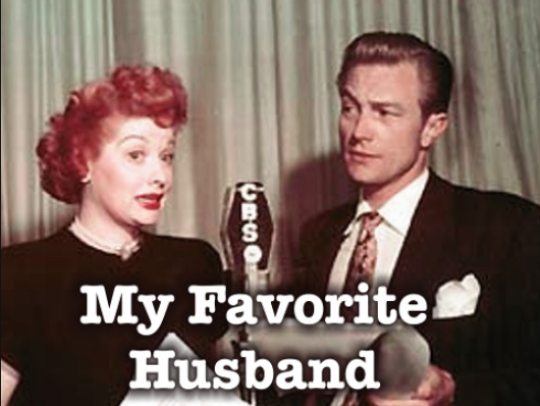
“My Favorite Husband” was based on the novels Mr. and Mrs. Cugat, the Record of a Happy Marriage (1940) and Outside Eden (1945) by Isabel Scott Rorick, which had previously been adapted into the film Are Husbands Necessary? (1942). “My Favorite Husband” was first broadcast as a one-time special on July 5, 1948. Lucille Ball and Lee Bowman played the characters of Liz and George Cugat, and a positive response to this broadcast convinced CBS to launch “My Favorite Husband” as a series. Bowman was not available Richard Denning was cast as George. On January 7, 1949, confusion with bandleader Xavier Cugat prompted a name change to Cooper. On this same episode Jell-O became its sponsor. A total of 124 episodes of the program aired from July 23, 1948 through March 31, 1951. After about ten episodes had been written, writers Fox and Davenport departed and three new writers took over – Bob Carroll, Jr., Madelyn Pugh, and head writer/producer Jess Oppenheimer. In March 1949 Gale Gordon took over the existing role of George’s boss, Rudolph Atterbury, and Bea Benadaret was added as his wife, Iris. CBS brought “My Favorite Husband” to television in 1953, starring Joan Caulfield and Barry Nelson as Liz and George Cooper. The television version ran two-and-a-half seasons, from September 1953 through December 1955, running concurrently with “I Love Lucy.” It was produced live at CBS Television City for most of its run, until switching to film for a truncated third season filmed (ironically) at Desilu and recasting Liz Cooper with Vanessa Brown.
MAIN CAST

Lucille Ball (Liz Cooper) was born on August 6, 1911 in Jamestown, New York. She began her screen career in 1933 and was known in Hollywood as ‘Queen of the B’s’ due to her many appearances in ‘B’ movies. With Richard Denning, she starred in a radio program titled “My Favorite Husband” which eventually led to the creation of “I Love Lucy,” a television situation comedy in which she co-starred with her real-life husband, Latin bandleader Desi Arnaz. The program was phenomenally successful, allowing the couple to purchase what was once RKO Studios, re-naming it Desilu. When the show ended in 1960 (in an hour-long format known as “The Lucy-Desi Comedy Hour”) so did Lucy and Desi’s marriage. In 1962, hoping to keep Desilu financially solvent, Lucy returned to the sitcom format with “The Lucy Show,” which lasted six seasons. She followed that with a similar sitcom “Here’s Lucy” co-starring with her real-life children, Lucie and Desi Jr., as well as Gale Gordon, who had joined the cast of “The Lucy Show” during season two. Before her death in 1989, Lucy made one more attempt at a sitcom with “Life With Lucy,” also with Gordon.
Richard Denning (George Cooper) was born Louis Albert Heindrich Denninger Jr., in Poughkeepsie, New York. When he was 18 months old, his family moved to Los Angeles. Plans called for him to take over his father’s garment manufacturing business, but he developed an interest in acting. Denning enlisted in the US Navy during World War II. He is best known for his roles in various science fiction and horror films of the 1950s. Although he teamed with Lucille Ball on radio in “My Favorite Husband,” the two never acted together on screen. While “I Love Lucy” was on the air, he was seen on another CBS TV series, “Mr. & Mrs. North.” From 1968 to 1980 he played the Governor on “Hawaii 5-0″, his final role. He died in 1998 at age 84.
Gale Gordon (Rudolph Atterbury) had worked with Lucille Ball on “The Wonder Show” on radio in 1938. One of the front-runners to play Fred Mertz on “I Love Lucy,” he eventually played Alvin Littlefield, owner of the Tropicana, during two episodes in 1952. After playing a Judge in an episode of “The Lucy-Desi Comedy Hour” in 1958, he would re-team with Lucy for all of her subsequent series’: as Theodore J. Mooney in ”The Lucy Show”; as Harrison Otis Carter in “Here’s Lucy”; and as Curtis McGibbon on “Life with Lucy.” Gordon died in 1995 at the age of 89.
Bea Benadaret (Iris Atterbury) was considered the front-runner to be cast as Ethel Mertz but when “I Love Lucy” was ready to start production she was already playing a similar role on TV’s “The George Burns and Gracie Allen Show” so Vivian Vance was cast instead. On “I Love Lucy” she was cast as Lucy Ricardo’s spinster neighbor, Miss Lewis, in “Lucy Plays Cupid” (ILL S1;E15) in early 1952. Later, she was a success in her own show, “Petticoat Junction” as Shady Rest Hotel proprietress Kate Bradley. She starred in the series until her death in 1968.
Ruth Perrott (Katie, the Maid) does not appear in this episode.
Bob LeMond (Announcer) also served as the announcer for the pilot episode of “I Love Lucy”. When the long-lost pilot was finally discovered in 1990, a few moments of the opening narration were damaged and lost, so LeMond – fifty years later – recreated the narration for the CBS special and subsequent DVD release.
GUEST CAST

Elvia Allman (Mrs. Fataway) was born on September 19, 1904 in Enochville, North Carolina. She started her performing career on radio in the 1920s, as both a storyteller and singer. This led to work voicing cartoon characters for Warner Brothers. Simultaneously, she was pursuing stage acting, appearing at the Pasadena Playhouse. Allman made her film debut as an actress in 1940’s The Road to Singapore as a homely woman who pursues Bob Hope. Allman played the strident forewoman of Kramer’s Kandy Kitchen in “Job Switching” (ILL S2;E1). She would return to the show as one of Minnie Finch’s neighbors in “Fan Magazine” (ILL S3;E17) and as reporter Nancy Graham in “The Homecoming” (ILL S5;E6). She made two appearances each on The Lucy–Desi Comedy Hour“ and ”The Lucy Show.“
EPISODE
ANNOUNCER: “As we look in on the Coopers today, we find George in his office at the bank. Suddenly, the door bursts open and in strides Mr. Atterbury, his boss.”
Mr. Atterbury is upset that somehow Liz’s girdle got entered on his balance sheet. George is worried about Liz. She has been buying lots of new clothes lately. Mr. Atterbury tells him the trick of combating new clothing bought by wives. When they try it on and ask “How do you like my new dress?” you say “What new dress?” They immediately return it as looking just like her old one!

Liz and Iris are out shopping. Liz shockingly says she’s not going to buy anything today. She is doing it because of George’s concern about her budget.

They see a sign:
GET YOUR SPRING TUNE-UP! WE CAN MAKE A 1950 MODEL OUT OF AN OLD WRECK! SPEND 11 GLORIOUS DAYS AT FATAWAY FARM
Liz sees some ‘dirty words’ that tempt her: “Gigantic Clearance Sale!” Liz attempts to turn her back away from temptation, but when somebody is looking at the same dress she likes – she give in to temptation.
Liz and Iris arrive home with their shopping. They go to the bedroom to put Liz’s new things away: a dress, a bag, and shoes. She now has to think about what lie to tell George before the bill arrives in a month. Iris tells her that George won’t notice if she wears the dress because husbands only notice OTHER women!
IRIS: “Every time I get a new dress I show it to Rudolph and he says ‘What new dress?’ and as long as he doesn’t know it’s new, I keep it!”
Iris dares her to put the new dress on and see if George notices. George comes home and Liz takes the dare. Liz parades in front of George in the new dress. Just as Iris said, George doesn’t notice anything. She finally breaks down and asks him about her new dress.
GEORGE: “What new dress? I’ve seen it a hundred times!”
Liz is indignant that George takes her for granted and bursts into tears.
ANNOUNCER: “As we return to the Coopers, we find Liz and Iris Atterbury down at the corner drugstore. Iris is trying to console Liz, who believes George takes her for granted.”

LIZ: “What are you supposed to do when you think that you’re the apple of your husband’s eye and find out you’re the core?”
IRIS: “You’re not alone, Liz! The world is full of single apples and married cores. It’s part of living.”Iris tells Liz that she’s expecting her husband to act like a fiancé! Liz realizes she’s let herself go. She’s taken herself for granted. They remember the ad in the beauty shop and decide to go for the free tune-up – if not the whole overhaul! They decide to tell their husband’s that they are staying at Marge Van Tassel’s country place.
At Fataway Farms, they arrive at the office. Mrs. Fataway (Elvia Allman) greets them, and outlines their plan. They get scared of their fierce founder, but they are locked in!

Mrs. Fataway leads Iris and Liz in exercises, which they struggle with mightily. Next Liz and Iris try out the steam cabinets.

LIZ: “If they don’t come soon, they’ll have to pick me up with a blotter.”
Liz is a limp rag when Mrs. Fataway finally opens the cabinets. She announces a two-mile hike!
LIZ: “Keen dipped in pickle juice.”

On their hike they finally reach their destination. They have the option to ride back or march back. Liz is to weak to even express an opinion, and ends up walking back.
After 11 days, Liz and Iris arrive home, feeling rejuvenated and revitalized! Their husbands greet them with affection.
George notices that Liz looks thin and calls her a plucked chicken. Liz breaks down in tears.
GEORGE: “I didn’t want you beautiful. I want you just the way you were.”
Liz is relieved and starts to gorge herself with food! Iris is just about to join in, when Rudolph stops her!
MR. ATTERBURY: “I like you just as you are now!”
End of Episode
In the live Jell-O commercial tag, Lucille plays a siren from ancient mythology and Bob LeMond a sailor being lured toward the rocks.
Lucille’s first line as a siren is to imitate a police siren. She then lapses into a chirpy, pinched nosed voice.
LUCILLE / SIREN: “Oh, sailor! Oh, sailor boy! I have Jell-O tapioca pudding!”
He asks her if she has Jell-O orange coconut tapioca.
LUCILLE / SIREN: “A wonderful blend of refreshing orange and tropical coconuts?”
BOB / SAILOR: “Yes! Do you?”
LUCILLE / SIREN: “No. I just wanted to see what happened.”The siren lures him to the rocks. The sound effects end with a motorboat crashing with a big boom!
ANNOUNCER: “Watch for Lucille Ball in today’s issue of Parade.”
-
JOY OF LIVING
May 6, 1938

- Directed by Tay Garnet
- Produced by Felix Young for RKO Radio Pictures
- Written by Gene Towne, Graham Baker, Allan Scott, based on an original story by Dorothy and Herbert Fields
Synopsis ~ Broadway star Margaret Garrett (Irene Dunne) has spent her whole life working to support her sponging relatives. When she meets carefree Dan Webster (Douglas Fairbanks Jr.), she learns how to have fun for the first time.

The film was in production at RKO Studios from December 6, 1937 until February 8, 1938.
PRINCIPAL CAST

Lucille Ball (Salina Pine) makes her 36th film since coming to Hollywood in 1933.
“Do you expect me to support this family of leeches?” ~ Salina Pine
Irene Dunne (Margaret “Maggie” Garret) had appeared with Lucille Ball in 1935′s Roberta. Between 1931 and 1949 she was nominated for five Oscars.

Douglas Fairbanks, Jr. (Dan Brewster) also appeared with Lucille Ball in Having Wonderful Time (1938).
Alice Brady (Minerva) won an Oscar in 1938 for In Old Chicago. This is her only film with Lucille Ball.
Guy Kibbee (Dennis) also appeared with Lucille Ball in Don’t Tell The Wife (1937).
Jean Dixon (Harrison) also appeared with Lucille Ball in I’ll Love You Always (1935).
Eric Blore (Potter) appeared with Lucille Ball in Old Man Rhythm, I Dream Too Much, and Top Hat, all in 1935. He also appeared with Ball in Fancy Pants (1950).
Warren Hymer (Mike) also appeared with Lucille Ball in Kid Millions (1934).
Billy Gilbert (Café Owner) appeared with Lucille Ball in His Old Flame (1935), I Dream Too Much (1935), So and Sew (1936), and Valley of the Sun (1942).
Frank Milan (Bert Pine) makes his only appearance with Lucille Ball.
Dorothy & Estelle Steiner (Dotsy & Betsy Pine) were real-life sisters making their first and only appearance with Lucille Ball.

Phyllis Kennedy (Marie) appeared with Lucille Ball in 1937′s Stage Door. She was also Tallulah Bankhead’s maid in “The Celebrity Next Door”, a 1957 episode of the “Lucy-Desi Comedy Hour.”
Franklin Pangborn (Band Leader) appeared with Lucille Ball in Stage Door (1937), A Girl, A Guy, and a Gob (1941), and Lover Come Back (1946).

James Burke (Mac) appeared with Lucille Ball in Blood Money (1933), The Bowery (1933), and The Affairs of Annabel (1938). He was also seen on “I Love Lucy” as the owner of “The Diner” (ILL S3;E27) in 1954, and would go on to make an appearance on “The Lucy–Desi Comedy Hour” (1958) as the man who deliver Whirling Jet the racehorse to the Ricardos.
John Qualen (Oswego) appeared with Lucille Ball in The Three Musketeers (1938).
Spencer Charters (Magistrate) appeared with Lucille Ball in The Farmer and the Dell (1936) and Look Who’s Laughing (1941).
UNCREDITED CAST
- Richard Alexander (Angry Man in Revolving Door)
- Stanley Blystone (Cop at Dock)
- Bill Cartledge (Boy at Skating Rink)
-
George Chandler (Taxi Driver)
- Joe De Stefani (Waiter)
- Bill Dooley (Courtroom Janitor)
-
Pat Flaherty (Autograph Hound)
- Tay Garnett (Man on Phone in Newspaper Office)
- Chuck Hamilton (Court Bailiff)
- Al Hill (Look Photographer)
- Kenner G. Kemp (Roller Skater)
- Fuzzy Knight (Sideshow Piano Player)

- Mike Lally (Backstage Photographer) was a background performer who did ten films with Lucille Ball as well as two episodes of “I Love Lucy,” and at least one of “The Lucy Show”.

- Charles Lane (Fan in Margaret’s Dressing Room) was a ubiquitous character actor appeared in 7 films with Lucille Ball between 1933 and 1949; four episodes of “I Love Lucy” from 1953 to 1956, all as different characters; two episodes of “The Lucy-Desi Comedy Hour”; and four episodes of “The Lucy Show” as Banker Barnsdahl.
-
Frank Moran (Cop with Gravel Voice)
- Clarence Nash (Donald Duck Voice)
-
Dennis O’Keefe (Man in Building Lobby)
- Franklin Parker (Third Producer)
- Bob Perry (Seaman)
- Russ Powelll (Man Leaving Elevator)
- Cyril Ring (Man in Margaret’s Dressing Room)
-
Bert Roach (German Waiter)
-
Grady Sutton (Florist)
-
Frank M. Thomas (Arthur)
- Charles Williams (Pitchman at Recording Studio)
- Harry Woods (Cop)
JOY OF TRIVIA


“Why do you always smile when I talk to you?” Miss Ball queries Doug [Fairbanks] between takes. “Because I’m a polite little boy,“ he replies. "You Rat” says Lucille coldly.

The film features the hit song "You Couldn’t Be Cuter,” written by Jerome Kern and Dorothy Fields.

The working title of this film was Joy of Loving.

According to an October 1937 news item, John Barrymore was set for the lead in the production.

It seems that the entire town of Tulare, California go on board to promote Joy of Living, with a give-away contests and all the local merchants participating.

On April 16, 1942, a tragic car accident happened outside the Tudor Theatre in New York City where the film was playing. A car plowed into a pole by a drunken driver, killing his passenger. The press flashcubes also captured the ironic marquee in the background as the police attempted to cover the body.

Ty Garnett’s production budget quickly ballooned out of control, topping out at over a million dollars, an astronomical sum for films at that time. Despite the priceless talent, Joy of Living didn’t have a chance at recouping its costs and was a financial failure for the studio.

A publicity photo of Lucille Ball taken for Joy of Living.
Lucille Ball remembered watching the stars and comparing their styles; “Hepburn ‘telegraphed,’ she said – ‘Well, I’m going to be funny’ – whereas [Irene] Dunne always surprised, even in repeated takes of the same scene. But I watched her do takes-literally, one day there were thirty-two takes-and twenty-five must have been different. She really worked on how to do that scene. Where Kate would do it the same way every time and telegraph it every time.’”

The film enjoyed a worldwide release. Here are film posters for France (left) and Belgium, which include both the Flemish (”Levens Vreugd”) and French titles.

The film was released on DVD (Warners Archive Collection) on April 20, 2009.

-
OVERWEIGHT
May 6, 1949

“Overweight” (aka “The Five-Dollar-A-Pound Diet”) is episode #42 of the radio series MY FAVORITE HUSBAND broadcast on May 6, 1949 on the CBS radio network.
Synopsis ~ After viewing some old home movies, Liz and Iris decide to go on a diet.

Although far from a direct transcription, some elements of this radio script were used to create the “I Love Lucy” episode “The Diet” (ILL S1;E3) first aired on October 29, 1951.

“My Favorite Husband” was based on the novels Mr. and Mrs. Cugat, the Record of a Happy Marriage (1940) and Outside Eden (1945) by Isabel Scott Rorick, which had previously been adapted into the film Are Husbands Necessary? (1942). “My Favorite Husband” was first broadcast as a one-time special on July 5, 1948. Lucille Ball and Lee Bowman played the characters of Liz and George Cugat, and a positive response to this broadcast convinced CBS to launch “My Favorite Husband” as a series. Bowman was not available Richard Denning was cast as George. On January 7, 1949, confusion with bandleader Xavier Cugat prompted a name change to Cooper. On this same episode Jell-O became its sponsor. A total of 124 episodes of the program aired from July 23, 1948 through March 31, 1951. After about ten episodes had been written, writers Fox and Davenport departed and three new writers took over – Bob Carroll, Jr., Madelyn Pugh, and head writer/producer Jess Oppenheimer. In March 1949 Gale Gordon took over the existing role of George’s boss, Rudolph Atterbury, and Bea Benaderet was added as his wife, Iris. CBS brought “My Favorite Husband” to television in 1953, starring Joan Caulfield and Barry Nelson as Liz and George Cooper. The television version ran two-and-a-half seasons, from September 1953 through December 1955, running concurrently with “I Love Lucy.” It was produced live at CBS Television City for most of its run, until switching to film for a truncated third season filmed (ironically) at Desilu and recasting Liz Cooper with Vanessa Brown.
MAIN CAST

Lucille Ball (Liz Cooper) was born on August 6, 1911 in Jamestown, New York. She began her screen career in 1933 and was known in Hollywood as ‘Queen of the B’s’ due to her many appearances in ‘B’ movies. With Richard Denning, she starred in a radio program titled “My Favorite Husband” which eventually led to the creation of “I Love Lucy,” a television situation comedy in which she co-starred with her real-life husband, Latin bandleader Desi Arnaz. The program was phenomenally successful, allowing the couple to purchase what was once RKO Studios, re-naming it Desilu. When the show ended in 1960 (in an hour-long format known as “The Lucy-Desi Comedy Hour”) so did Lucy and Desi’s marriage. In 1962, hoping to keep Desilu financially solvent, Lucy returned to the sitcom format with “The Lucy Show,” which lasted six seasons. She followed that with a similar sitcom “Here’s Lucy” co-starring with her real-life children, Lucie and Desi Jr., as well as Gale Gordon, who had joined the cast of “The Lucy Show” during season two. Before her death in 1989, Lucy made one more attempt at a sitcom with “Life With Lucy,” also with Gordon.
Richard Denning (George Cooper) was born Louis Albert Heindrich Denninger Jr., in Poughkeepsie, New York. When he was 18 months old, his family moved to Los Angeles. Plans called for him to take over his father’s garment manufacturing business, but he developed an interest in acting. Denning enlisted in the US Navy during World War II. He is best known for his roles in various science fiction and horror films of the 1950s. Although he teamed with Lucille Ball on radio in “My Favorite Husband,” the two never acted together on screen. While “I Love Lucy” was on the air, he was seen on another CBS TV series, “Mr. & Mrs. North.” From 1968 to 1980 he played the Governor on “Hawaii 5-0″, his final role. He died in 1998 at age 84.
Gale Gordon (Rudolph Atterbury) had worked with Lucille Ball on “The Wonder Show” on radio in 1938. One of the front-runners to play Fred Mertz on “I Love Lucy,” he eventually played Alvin Littlefield, owner of the Tropicana, during two episodes in 1952. After playing a Judge in an episode of “The Lucy-Desi Comedy Hour” in 1958, he would re-team with Lucy for all of her subsequent series’: as Theodore J. Mooney in ”The Lucy Show”; as Harrison Otis Carter in “Here’s Lucy”; and as Curtis McGibbon on “Life with Lucy.” Gordon died in 1995 at the age of 89.
Bea Benadaret (Iris Atterbury) was considered the front-runner to be cast as Ethel Mertz but when “I Love Lucy” was ready to start production she was already playing a similar role on TV’s “The George Burns and Gracie Allen Show” so Vivian Vance was cast instead. On “I Love Lucy” she was cast as Lucy Ricardo’s spinster neighbor, Miss Lewis, in “Lucy Plays Cupid” (ILL S1;E15) in early 1952. Later, she was a success in her own show, “Petticoat Junction” as Shady Rest Hotel proprietress Kate Bradley. She starred in the series until her death in 1968.
Ruth Perrott (Katie, the Maid) was also later seen on “I Love Lucy.” She first played Mrs. Pomerantz (above right), a member of the surprise investigating committee for the Society Matrons League in “Pioneer Women” (ILL S1;E25), as one of the member of the Wednesday Afternoon Fine Arts League in “Lucy and Ethel Buy the Same Dress” (ILL S3;E3), and also played a nurse when “Lucy Goes to the Hospital” (ILL S2;E16). She died in 1996 at the age of 96.
Bob LeMond (Announcer) also served as the announcer for the pilot episode of “I Love Lucy”. When the long-lost pilot was finally discovered in 1990, a few moments of the opening narration were damaged and lost, so LeMond – fifty years later – recreated the narration for the CBS special and subsequent DVD release.
GUEST CAST

Hans Conried (Mr. Dabney, the Butcher) first co-starred with Lucille Ball in The Big Street (1942). He then appeared on “I Love Lucy” as used furniture man Dan Jenkins in “Redecorating” (ILL S2;E8) and later that same season as Percy Livermore in “Lucy Hires an English Tutor” (ILL S2;E13) – both in 1952. The following year he began an association with Disney by voicing Captain Hook in Peter Pan. On “The Lucy Show” he played Professor Gitterman in “Lucy’s Barbershop Quartet” (TLS S1;E19) and in “Lucy Plays Cleopatra” (TLS S2;E1). He was probably best known as Uncle Tonoose on “Make Room for Daddy” starring Danny Thomas, which was filmed on the Desilu lot. He joined Thomas on a season 6 episode of “Here’s Lucy” in 1973. He died in 1982 at age 64.
Conried also played Mr. Dabney in “Valentine’s Day” (February 11, 1949) and will play him again in “Reminiscing” (July 1, 1949).

Peter Leeds (Man at the ‘Battle of the Bulge’) was born in Bayonne, NJ, and was seen as the Reporter questioning the Maharincess of Franistan in “The Publicity Agent” (ILL S1;E31). He starred with Lucy in the films The Long, Long Trailer (1953) and The Facts of Life (1960) with Bob Hope. Coincidentally, he also appeared in “Lucy and Bob Hope” (ILL S6;E1) as well as an episode of “Here’s Lucy” in 1971.
EPISODE
ANNOUNCER: “As we look in on the Coopers tonight, a familiar scene is taking place. Company is coming to dinner, and Liz is cautioning George about the evening’s entertainment.”
Liz makes George take a vow that he will not show his home movies when the Atterbury’s come over to dinner. George thinks his movies could win a contest, but Liz says he cuts off heads, and shoots feet. She reminds him of his footage of the Grand Canyon.
LIZ: “Pictures of the Grand Canyon in beautiful black and black!”
GEORGE: “Well, they were a little under-exposed. I forgot what film I had in the camera.”After dinner, the Atterbury’s and the Coopers are wondering what to do to entertain themselves. Naturally, George wants to show his movies, but Liz suggests playing bridge. It isn’t long before George has broken out the projector and dimmed the lights.

LIZ: “George, try not to get the picture upside down.” (George turns on the projector) “I knew it! There I go! Walking across the ceiling. Liz Cooper: The Human Fly!”
George adjusts the orientation, and the Grand Canyon is finally right-side up. The husbands begin to notice that their wives were a lot slimmer six or seven years ago. Liz and Iris vow that first thing tomorrow morning they will go on a diet and get rid of their extra weight: no starches, no sweets, nothing fattening of any kind. But tonight, they are headed to the drugstore for a double hot fudge sundae!

Next day at the bank, Rudolph is sharing with George the secret of getting a Coke out of the machine without putting in a Nickle! They start to talk about their wives’ diets and become defensive of their spouses. They decide to make a bet. They husband whose wife loses the most weight will pay the loser five dollars a pound!
At home, George gets busy trying to get his wife in shape by becoming her weight loss supervisor. He finds her munching on a candy bar – to keep up her energy. He has brought home a variety of exercise equipment to get her in shape.
LIZ: “Who will I fight? Joe Lewis retired.”

Prizefighter Joe Louis retired from boxing on March 1, 1949, with a record of 68 wins and one loss. He came out of retirement in 1950, needing to earn money, but he could not recapture his previous winning streak; he lost his last major bout on October 26, 1951, against future champion Rocky Marciano.
George tells Liz that he made a bet with Mr. Atterbury that she’d loose the most weight.
LIZ: “If it’s money your after, why bother with exercise? Just don’t feed me. I’ll bet you could get me down to fifty pounds, coffin and all!”
Liz is about to quit reducing – until he hears that Mr. Atterbury thinks Iris has a better figure than hers! George agrees to split the winnings with Liz and the battle of the bulge is on!

A week later, Liz is exhausted but George is still urging her on. For lunch, Liz is ravenous – but George has prepared her a nice, juicy radish! What’s to drink?
LIZ: “How about a nice glass of skim water?”
George reminds her that they need to go down to Dabney’s Meat Market and weigh in. Liz finds it embarrassing to be weighed at a meat market.

During the first half of the 20th century, public scales (called lollipop scales because of their distinctive shape) were common sights in shops and bus and train stations. The cost was a penny to get your weight – and sometimes a fortune, too! Now that bathroom scales have become common, these lollipop scales have become vintage collectibles.
The butcher Mr. Dabney (Hans Conried) has started a pool betting on Liz’s weight loss! Iris arrives for her weigh-in, similarly exhausted. Banker Atterbury suggests that Iris gets on the scale before Liz gets off so that they save a penny. Iris weights 123 – same as Liz. But Iris started two pounds heavier so she’s ahead. George is more determined than ever!
At home, Liz is dreaming of food: fried chicken and mashed potatoes. To make sure he wins, George has put a padlock on the icebox!

In “Goodbye, Mrs. Hips” (HL S5;E23) in 1973, Lucy Carter padlocks the refrigerator so that her slimming sisters Mary Jane and Vanda don’t nibble at night!
At the Atterbury’s, Rudolph tells Iris that Liz is a pound ahead of them. Iris is barely able to keep her head up. He has bought a new exercise book and is determined to put her through the paces. She falls asleep with her leg in the air.
MR. ATTERBURY: “If that isn’t the silliest sight I ever saw. She looks like a submarine.”
At the Coopers, Katie the Maid calls Liz into the kitchen, where there’s a tempting cake. Katie tells Liz that Mr. Dabney (a sweetheart of hers) has told her how to rig the scale! Katie will hide behind a large display of canned goods and make sure Liz wins! In the meantime, Liz starts in on that cake – and everything else in the kitchen!
At Dabney’s Meat Market, a crowd has gathered for the final weigh-in. There’s a sign in the window:
TODAY! 2 O’CLOCK! THE BATTLE OF THE BULGE!

This is a common pun on what was historically known as the Ardennes Counteroffensive during World War II, which took place from December 16, 1944 to January 25, 1945. The “bulge” in Battle of the Bulge refers to the shape, as depicted on maps, created by German troops that had wedged westward in the Ardennes through the Allies’ front line. The term was coined by Larry Newman, an American war correspondent.
Mr. Dabney becomes ring announcer for the ‘battle of the bulge’! He introduces the two dieters. Mr. Atterbury suddenly excuses himself to make a phone call. Liz steps on the scale and Mr. Dabney announces her at 118! Mr. Dabney is the winner! There’s some sort of fracas from behind the scales and Katie reveals herself. She says there was someone behind the scale with her – determined to make Liz weigh more. Mr. Atterbury!
End of Episode
Bob LeMond reminds listeners that Lucille Ball will soon be seen in the motion picture Sorrowful Jones.

-
DOWNBEAT
May 6, 1953

Lucille Ball and Desi Arnaz appeared on the cover of DownBeat (Volume 20, no. 9) on May 6, 1953. The writing across the black and white photo implies that Desi Arnaz is America’s most famous bandleader – but not available. This was likely due to his hectic schedule on television.

DownBeat was established in 1934 in Chicago, Illinois. In September 1939, the magazine announced that its circulation had increased from “a few hundred five years ago to more than 80,000 copies a month”, and that it would change from monthly to fortnightly from the following month. In April 1979, DownBeat went to a monthly schedule for the first time since 1939. In 1953, DownBeat wasn’t a magazine in the traditional sense, but a folded newspaper that often used one color print on the cover and front page. In this case, the color for the week was green. Because it was essentially newsprint, back issues are very rare, and often in very poor condition. Sadly, there were no images of the inside article about Desi Arnaz on page three that is promised on the cover.

In “Men Are Messy” (ILL S1;E8) filmed on October 25, 1951 and aired on December 3, 1951 Lucy learns that a photographer is coming over. She assumes he is from HalfBeat magazine, a musician’s rag. HalfBeat is actually a veiled reference to the popular DownBeat. Unfortunately, after Lucy sabotages the photo shoot by pretending to be a hillbilly, she learns from mess cat Ricky that the photographer is not from Half Beat, but from prestigious Look magazine! Uh oh!

Two years later, Lucy and Desi would make the covers of both Look and DownBeat in real life! It is curious that the real DownBeat name could not be used. It is likely that CBS was not able to get clearance from the publishers. It did lead to some confusion by life-long reader Desi Arnaz…

When Lucy and Ricky BOTH answer the phone (it is on the line) Ricky has to listen, while Lucy has to repeat his words into the mouthpiece to convey the message to Kenny, his press agent. Desi Arnaz stumbles over the words, struggling to remember that for the show, DownBeat has been changed to HalfBeat. Lucille Ball imitates his broken English (”Febreeary” and “‘splain”) but does not repeat his bloopers! When Desi has to say the name of the magazine again later in the episode, he also momentarily trips over his words.


The words emblazoned across the top of the issue about Nat (King Cole) being stricken, are more fully explained on the first page. Cole had to withdraw from a concert tour with Sarah Vaughan due to bleeding ulcers. He took time to tell the waiting audience at Carnegie Hall what had happened before going directly to the hospital.

When this magazine hit the stands, America was still talking about the most recent adventures of Lucy and Ricky in “The Indian Show” (ILL S2;E24), which had aired two days earlier.

Lucille and Desi, on the other hand, where deep in rehearsals for “The Camping Trip” (ILL S2;E29), which was filmed on May 8, 1953, and would air exactly one month later.
-
TV GUIDE: TV IS 50!
May 6, 1989

Lucille Ball and Desi Arnaz appeared on the cover of TV Guide (vol. 37, No. 18, #1884) on May 6, 1989 celebrating the 50th Anniversary of Television.
Lucy and Desi share the cover with:
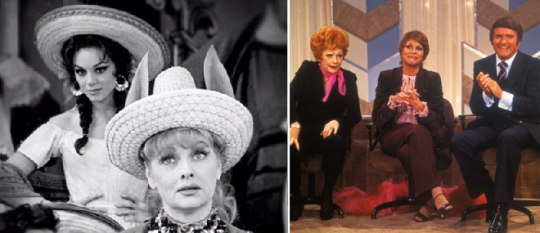
Mary Tyler Moore, Georgia Engel, and Valerie Harper on “The Mary Tyler Moore Show” ~ A sitcom that showed a modern, independent woman in the workplace. Lucile Ball did Moore’s variety show, and Valerie Harper was a chorus girl in Lucy’s Broadway debut in Wildcat (1960).

John F. Kennedy Jr. saluting his father’s casket on November 25, 1963 ~ which also happened to be his third birthday. President Kennedy was the destination when “Lucy Visits the White House” (TLS S1;E25) just eight months before the iconic photo was taken. On the show, an off-screen voice provided Kennedy’s famous New England accent.

Bill Cosby & Keisha Knight-Pulliam of “The Cosby Show” ~ In 1968, former Emmy-winner Bill Cosby presented Lucille Ball with an Emmy.

Neil Armstrong Walking on the Moon on July 20, 1969 ~ In “Lucy Becomes an Astronaut” (TLS S1;E6) aired on November 5, 1962 Lucy and Viv spend 24 hours in a simulated space ship as part of a “Women in Space”. On October 11, 1971 “Lucy and the Astronauts” (HL S4;E5) Harry takes Lucy along to a NASA splash-down, but before the astronauts can be medically cleared, Lucy has kissed them forcing Lucy and Harry to join the space travelers in isolation.

Carroll O’Connor as Archie Bunker of “All in the Family” ~ The advent of socially-aware sitcoms all but signaled the death knell of Lucille Ball’s family-friendly situation comedy. Ironically, both were products of CBS. The National Comedy Center in Lucy’s hometown of Jamestown, New York, has both iconic shows (and characters) side by side in their display case of famous comedy costumes.

Alan Alda, Mike Farrell and Harry Morgan in “M*A*S*H” ~ another CBS show that had a long run, and record viewership. Coincidentally, “I Love Lucy” was on the air during the Korean War (1950-53) during which the series took place. Lucille Ball often employed Alan Alda’s father, Robert Alda. She also employed Harry Morgan on the hit Desilu show “December Bride” (1954-59).

The inside article about Lucille Ball is titled “The Day Lucy Set Fire To Her Nose” by Lawrence Eisenberg. It includes a photo of Ball and William Holden from “Hollywood at Last!” (ILL S4;E16).

“The Moments You Can Never Forget” naturally includes the birth of Little Ricky on January 19, 1953. The photo, however, is not from the episode aired that day, but from “The French Revue” (ILL S3;E7).

“Our TV Hall of Fame” includes Lucille Ball, the Queen of Comedy. The photo is a rare color photo from behind the scenes of “Lucy’s Italian Movie” (ILL S5;23) in 1956.
-
ROBERT FOULK
May 5, 1908

Robert Foulk was born in Philadelphia, Pennsylvania on May 5, 1908. He attended the University of Pennsylvania as an architecture student but became interested in theatre and by the age of 23 had made his Broadway debut in 1931. He did six plays on Broadway up until 1939, when he moved to Hollywood.

His first job in Hollywood was not on screen, but as a dialog director for Warner Brothers, where he worked on ten films (including The Maltese Falcon) before making his feature film acting debut in Road House (1948) starring Ida Lupino. In it, he played a policeman (uncredited), something he would do countless times again in the future.

In June 1951, he made his television debut in an episode of “Racket Squad”. Television would keep him busy for the rest of his life.

His first job for Desilu was in April 1953, on Desilu’s “Cavalcade of America” anthology series. He would do six more episodes through November 1956.

In January and May 1956, Foulk did two episodes of Desilu’s hit sitcom “December Bride.”

In 1956 he also did two episodes of Desilu’s co-production of “The Adventures of Jim Bowie”.

In 1956 and early 1957, he did two episodes of Desilu’s “The Sheriff of Cochise.” In addition to law enforcement, westerns were keeping him busy.

Foulk also did three episodes of Desilu’s “The Texan” in from 1958 to 1960.

Not strictly a western, he was also seen in 1960 episode of Desilu’s “Guestward Ho!”

LUCY (to a Policeman): “Oh, good grief, no. Don’t get a policeman. You know how nosy they are, always asking those foolish questions and then, instead of helping, after you’ve gone through all the trouble of explaining for half an hour, all they do is just mess things up. Don’t get a policeman!”
He had been playing policemen for “The George Burns and Gracie Allen Show” so it was natural to cast him as the Cop on the Brooklyn subway platform on “I Love Lucy” in “Lucy and The Loving Cup” (ILL S6;E12), filmed on November 1, 1956, but first aired on January 7, 1957.

After “I Love Lucy” Foulk did two episodes of their copter series “Whirlybirds” in 1957 and 1958.

On Desilu’s “The Real McCoys” he played five different characters in five appearances between 1959 and 1963.

He also did a single episode of their mega-hit “The Untouchables" in 1961. He played a Sheriff (uncredited) in “The Big Train – Part 2″.

From Brooklyn to Beverly Hills, Foulk played an undercover policeman in “Lucy Goes to a Hollywood Premiere” (TLS S4;E20) on February 7, 1966. He gives Mr. Mooney a hard time for hustling Hollywood maps to the stars homes.

He returned to work for Lucille Ball again, this time with Lucille Ball Productions, in “Lucy and the Raffle” (HL S3;E19) on January 18, 1971, the first of his six appearances on “Here’s Lucy.” He played a government clerk who gives Lucy a hard time when she seeks a permit for her raffle.

The very next week he was back as one of Harry’s poker pals (with Frank J. Scannell) in “Lucy’s House Guest, Harry” (HL S3;20) on January 25, 1971. Those are small kegs of beer for such a large man!

Foulk returns for a third week in a row (virtually unheard of with Lucy) to play the janitor in the building where Carter’s Unique Employment Agency rents space. The episode was titled “Lucy and Aladdin’s Lamp” (HL S3;E21) and it aired on February 1, 1971).

He’s back in blue for “Lucy and Mannix Are Held Hostage” (HL S4;E4) on October 4, 1971. Although it is a new season, only six new episodes had passed since his previous appearance.

It had been more than a year, but he kept his uniform on for “The Case of the Reckless Wheelchair Driver” (HL S5;E6) on October 16, 1972.

Foulk looked a bit different for his final appearance with Lucille Ball in “The Big Game” (HL S6;E2) on September 17, 1973, where he dons a beard as a football fan who can’t score a ticket for ‘the big game.’ When Lucy tries to sell him some scalped tickets, he thinks she is trying to sell herself!
Foulk’s final screen role was playing an old sea captain in the Disney film Pete’s Dragon in 1977.
In the 1930s, Foulk married actress Alice Frost. In 1947, he married Barbara Slater. They remained married until his death in 1989 at age 80.
-
Subscribe
Subscribed
Already have a WordPress.com account? Log in now.
 Papermoon Loves Lucy