-
100 ARTISTS & ENTERTAINERS OF THE CENTURY
June 8, 1998

Lucille Ball was one of the figures chosen to appear on the cover of Time Magazine’s June 8, 1998 issue celebrating the top 100 artists and entertainers of the century. In a drawing by Al Hirschfeld, Ball shares the cover with filmmaker Stephen Spielberg, musician Bob Dylan, and artist Pablo Picasso.

In the table of contents page, there is a photo of Lucille Ball, and her article is listed below Rodgers and Hammerstein, names that were frequently mentioned on “I Love Lucy.” Also mentioned was Frank Sinatra, Marlon Brando, and Charlie Chaplin, who Lucy embodied on several occasions.

LUCILLE BALL: The TV Star
The first lady of comedy brought us laughter as well as emotional truth. No wonder everybody loved Lucy
By Richard Zoglin
It happened somewhere between the clunky premier episode (”Lucy Thinks Ricky Is Trying to Murder Her”) and her first classic routine, the Vitameatavegamin commercial, in which Lucy gets steadily soused as she keeps downing spoonfuls of the alcohol-laced potion she’s trying to hawk on TV. (Watch the spasm that jolts her face when she gets her first taste of the foul brew; it could serve as a textbook for comics well into the next millennium.) “I Love Lucy” debuted on CBS in October 1951, but at first it looked little different from other domestic comedies that were starting to make the move from radio to TV, like “My Favorite Husband”, the radio show Ball had co-starred in for three years. Lucy Ricardo was, in those early “I Love Lucy” episodes, just a generic daffy housewife. Ethel (Vivian Vance), her neighbor and landlady, was a stock busybody. Desi Arnaz, as bandleader Ricky Ricardo, hadn’t yet become one of the finest straight men in TV history. William Frawley, as Fred Mertz, seemed a Hollywood has-been in search of work, which he was.
Then magic struck. Guided by Ball’s comic brilliance, the show developed the shape and depth of great comedy. Lucy’s quirks and foibles – her craving to be in show biz, her crazy schemes that always backfired, the constant fights with the Mertzes – became as particularized and familiar as the face across the dinner table. For four out of its six seasons (only six!), “I Love Lucy” was the No. 1-rated show on television; at its peak, in 1952-53, it averaged an incredible 67.3 rating, meaning that on a typical Monday night, more than two-thirds of all homes with TV sets were tuned to Lucy.
Ball’s dizzy redhead with the elastic face and saucer eyes was the model for scores of comic TV females to follow. She and her show, moreover, helped define a still nascent medium. Before “I Love Lucy”, TV was feeling its way, adapting forms from other media. Live TV drama was an outgrowth of Broadway theater; game shows were transplanted from radio; variety shows and early comedy stars like Milton Berle came out of vaudeville. “I Love Lucy” was unmistakably a television show, and Ball the perfect star for the small screen. "I look like everybody’s idea of an actress,” she once said, “but I feel like a housewife.” Sid Caesar and Jackie Gleason were big men with larger-than-life personas; Lucy was one of us.
She grew up in Jamestown, N.Y., where her father, an electrician, died when she was just three. (1) At 15 she began making forays to New York City to try to break into show business. She had little luck as an actress but worked as a model before moving to Hollywood in 1933 for a part in the chorus of “Roman Scandals”. Strikingly pretty, with chestnut hair dyed blond (until MGM hairdressers, seeking a more distinctive look, turned it red in 1942), she landed bit parts in B movies and moved up to classy fare like “Stage Door”, in which she held her own with Katharine Hepburn and Ginger Rogers.
Buster Keaton, the great silent clown working as a consultant at MGM, recognized her comic gifts and worked with her on stunts. She got a few chances to show off her talent in films like “Du Barry Was a Lady” (with Red Skelton) and “Fancy Pants” (with Bob Hope) but never broke through to the top. By the end of the 1940s, with Ball approaching 40, her movie career was all but finished.
It was her husband Desi – a Cuban bandleader she married shortly after they met on the set of “Too Many Girls” in 1940 – who urged her to try television. CBS was interested in Ball, but not in the fellow with the pronounced Spanish accent she wanted to play her husband. To prove that the audience would accept them as a couple, Lucy and Desi cooked up a vaudeville act and took it on tour. It got rave reviews (“a sock new act,” said Variety), and CBS relented.
But there were other haggles. Lucy and Desi wanted to shoot the show in Hollywood, rather than in New York City, where most TV was then being done. And for better quality, they insisted on shooting on film, rather than doing it live and recording on kinescope. CBS balked at the extra cost; the couple agreed to take a salary cut in return for full ownership of the program. It was a shrewd business decision: “I Love Lucy” was the launching pad for Desilu Productions, which (with other shows, like “Our Miss Brooks” and “The Untouchables”) became one of TV’s most successful independent producers, before Paramount bought it in 1967.
Today “I Love Lucy”, with its farcical plots, broad physical humor and unliberated picture of marriage, is sometimes dismissed as a relic. Yet the show has the timeless perfection of a crystal goblet. For all its comic hyperbole, Lucy explored universal themes: the tensions of married life, the clash between career and home, the meaning of loyalty and friendship. The series also reflected most of the decade’s important social trends. The Ricardos made their contribution to the baby boom in January 1953 – TV’s Little Ricky was born on the same day that Ball gave birth, by caesarean, to her second child, Desi Jr. (A daughter, Lucie, had been born in 1951.) They traveled to California just as the nation was turning west, in a hilarious series of shows that epitomized our conception of –and obsession with – Hollywood glamour. And when the nation began moving to the suburbs, so too, in their last season, did the Ricardos.
Ball was a lithe and inventive physical comedian, and her famous slapstick bits – trying to keep up with a candy assembly line, stomping grapes in an Italian wine vat – were justly celebrated. But she was far more than a clown. Her mobile face could register a whole dictionary of emotions; her comic timing was unmatched; her devotion to the truth of her character never flagged. She was a tireless perfectionist. For one scene in which she needed to pop a paper bag, she spent three hours testing bags to make sure she got the right size and sound.
Most of all, I Love Lucy was grounded in emotional honesty. Though the couple had a tempestuous marriage off-screen (Desi was an unrepentant philanderer), the Ricardos’ kisses showed the spark of real attraction. In the episode where Lucy finds out she is pregnant, she can’t break the news to Ricky because he is too busy. Finally, she takes a table at his nightclub show and passes him an anonymous note asking that he sing a song, “We’re Having a Baby”, to the father-to-be. As Ricky roams the room looking for the happy couple, he spies Lucy and moves on. Then he does a heartrending double take, glides to his knees and asks, voice cracking, whether it’s true. Finishing the scene together onstage, the couple are overcome by the real emotion of their own impending baby. Director William Asher, dismayed by the unrehearsed tears, even shot a second, more upbeat take. Luckily he used the first one; it’s the most touching moment in sitcom history.
Tired of the grind of a weekly series, Lucy and Desi ended “I Love Lucy” in 1957, when it was still No. 1. For three more years, they did hourlong specials, then broke up the act for good when they divorced in 1960. Ball returned to TV with two other popular (if less satisfying) TV series, “The Lucy Show” and “Here’s Lucy”; made a few more movies (starring in “Mame” in 1974); and attempted a final comeback in the 1986 ABC sitcom “Life with Lucy”, which lasted an ignominious eight weeks. But “I Love Lucy” lives on in reruns around the world, an endless loop of laughter and a reminder of the woman who helped make TV a habit, and an art.
TIME senior writer Richard Zoglin still watches “I Love Lucy” reruns each day at 9 a.m.
(1) Ball’s father did not die in Jamestown, New York. He died in Wyandotte, Michigan, while on assignment for Bell Telephone.

Some editions of the issue had an overlay cover that completely blocked Lucy from view! She is not even mentioned in the text on the overlay!
-
TWO SMART PEOPLE
June 4, 1946

-
Director: Jules Dassin
- Producer: Ralph Wheelwright for MGM
- Writers: Ethel Hill & Leslie Charteris, story by Ralph Wheelwright & Allan Kenward

Synopsis ~ One of two con-artists ends up arrested and given five days of freedom before he must go to jail. The man loves to eat; knowing that prison food is lousy, he decides to spend his days stuffing himself with the finest foods available. He is accompanied to numerous 4-star restaurants by his partner and the arresting officer. Each of these two are interested in learning where he stashed a half-million dollars in loot. Eventually the man begins looking at his lovely partner and thinking of things other than his stomach. This leads to marriage. After serving his time, he and his bride go on to lead honest lives.
PRINCIPAL CAST
Lucille Ball (Ricki Woodner) makes her 65th film appearance since coming to Hollywood in 1933.

John Hodiak (Ace Connors) appeared on Ed Sullivan’s “Toast of the Town” on October 3, 1954, which was a Salute To Lucy and Desi. He was also seen in the 1944 film Lifeboat with Tallulah Bankhead.

Lloyd Nolan (Bob Simms) went on to appear with Lucille Ball in Easy Living in 1949. Nolan and Ball both did cameos on a 1970 episode of “The Dean Martin Show.” They both were in attendance for the “AFI Salute to Henry Fonda” in 1978.
Hugo Haas (Senor Rodriguez) was a Moravian-born actor who makes his only appearance with Lucille Ball.
Lenore Ulric (Senora Maria Ynez) makes her only appearance with Lucille Ball.
Elisha Cook, Jr. (Fly Felleti) makes his only appearance with Lucille Ball.
Lloyd Corrigan (Dwight Chandwick) had previously appeared with Lucille Ball in A Girl, A Guy, and a Gob (1941). He would do three episodes of “The Lucy Show” as well as “The Lucy-Desi Milton Berle Special” in 1959.
Vladimir Sokoloff (Jacques Dufour) makes his only appearance with Lucille Ball.
David Cota (Jose) makes his only appearance with Lucille Ball.
Clarence Muse (Porter) had previously appeared with Lucille Ball in Kid Millions (1934), Broadway Bill (1934), Muss ‘em Up (1936), and Without Love (1945).

UNCREDITED CAST
- Gloria Anderson (Grecian Girl)
- Jean Andren (Policewoman)
- Lucius Brooks (Waiter)
- George Calliga (Stewart)
- Gabriel Canzona (Monkey Man)
- Harold DeGarro (Stilt Walker)
- Harry Depp (Spectator)
- Helen Dickson (Woman)
- Marie Dodd (Woman)
- Phil Dunham (Drunk)
- Mary Emery (Woman)
- Bess Flowers (Policewoman) was known as “The Queen of the Hollywood Extras,“ appearing in more than 950 films and television shows in her 41-year career. Flowers holds the record for sharing the screen with Lucille Ball in more movies than any other performer: 17 films from 1933-1963. She appeared in episodes of “I Love Lucy,” “The Lucy Show,” and other Desilu Productions.
- Jessie Graves (Dining Car Porter)
- Jimmie Horan (Reveler)
- Margaret Jackson (Bystander)
- Frank Johnson (Fat Man)
- Bobby Johnson (Waiter)
- Erwin Kalser (Franz)
- Paul Kruger (Cop)
- Lorenzo Lopez (Gardener)
- James Magill (Reveler)
- George Magrill (Taxi Driver)
- Leo Mostovoy (Headwaiter in French Restaurant)
- Cleo Morgan (Cleopatra) was Lucille Ball’s cousin who was adopted by Lucy’s mother. She went on to become Producer of “Here’s Lucy” as well as a number of other productions.
- Fred Nurney (Victoire)
- Frank O’Connor (Night Club Waiter)
- John Piffle (Jolly Fat Man)
- Tom Quinn (Sheik)
- Emil Rameau (Riverboat Waiter)
- William McKeever Riley (Pete)
- William Tannen (Clerk) did three more films with Lucille Ball and a 1969 episode of “Here’s Lucy.”
- Fred "Snowflake” Toones (Redcap)
- Peter Virgo (Indian Attendant)
- Connie Weiler (Hat Check Girl)
- Lynn Whitney (Swedish Girl)
- Marek Windheim (Captain)
- Shelley Winters (Princess) makes her twelfth film appearance. She won Oscars in 1960 and 1966. In1968 she appeared on “Here’s Lucy” as Shelley Summers in “Lucy and Miss Shelley Winters” (HL S1;E4).

“SMART” TRIVIA!

“Except for a lively and colorful series of Mardi Gras sequences in New Orleans, which are introduced quite late in the picture, Two Smart People is an otherwise dreadfully boring hodgepodge about love and the confidence racket… John Hodiak and Lucille Ball are the principals and they are painfully defeated by the script at almost every turn. Lloyd Nolan as the patient sleuth fares a little better, however. But in addition to its pedestrian plot, Two Smart People also suffers from lack of competent direction.”
This film failed at the box office, resulting in a loss to MGM of $252,000 ($3.5M in 2018) according to studio records.

“How About You?” by Burton Lane is playing in the background when Ace arrives at the restaurant for his meeting with Dwight Chandwick. Lucille Ball and Van Johnson sang (and danced) to this song on “I Love Lucy” in “The Dancing Star” (ILL S4;E27) in 1955. It was first heard in the 1941 movie Babes on Broadway.

This film was first telecast in Philadelphia December 8, 1957 on WFIL, in New York City on December 28, 1957 on WCBS, in San Francisco on March 9, 1958 on KGO, and in Los Angeles on April 8, 1958 on KTTV.
The working title for this film was Time for Two.

It’s True! Well… not exactly. Lucille Ball was NOT born in Butte, Montana!
-
-
TRIB TV WEEK TURNS TEN!
June 4, 1966

Lucille Ball was one of ten stars who were on the cover of the Chicago Tribune’s TV Week Tenth Anniversary issue for the week of June 4, 1966.

1. BOZO the CLOWN ~ was first played by Pinto Colvig, who voiced dogs for “The Lucy Show” in 1964.
The Chicago Bozo franchise was the most popular and successful locally produced children’s program in the history of television. WGN-TV’s “Bozo’s Circus” debuted on September 11, 1961.

2. LEE PHILLIP ~ From 1955 to 1982 in Chicago, “The Lee Phillip Show” tackled rarely considered social problems. The show quickly became a fixture in Chicago daytime television, drawing many celebrity guests including Lucille Ball on April 21, 1977.

3. LASSIE ~ is one of the most famous canine characters in history, appearing in books, radio, television, and films. The television series was filmed by Desilu studios, although they did not produce the show. Lassie made a guest appearance on “The Desilu Revue”, a holiday special in 1959. Lassie was first mentioned by Lucy Ricardo in “The Young Fans” (ILL S1;E20).

4. JACKIE GLEASON ~ was one of Lucille Ball’s favorite comic actors. His series “The Honeymooners” ran concurrently with “I Love Lucy.” Ball collaborated with Gleason on several occasions, although they never made their dream project – the story of Diamond Jim Brady and Lillian Russell.

5. BILL COSBY ~ In 1968, former Emmy-winner Bill Cosby presented Lucille Ball with an Emmy. In 1966 he was the star of “I Spy.”

6. RED SKELTON ~ Found kinship with Lucille Ball through their shared hair color! The two appeared in several films together, and he guest-starred as himself on “The Lucy-Desi Comedy Hour” in 1959.
7. LUCILLE BALL ~ was then preparing her first location-filmed special “Lucy in London” as well as the fifth season of “The Lucy Show”.

8. ROBERT VAUGHN ~ was known for playing the role of Napoleon Solo in “The Man from U.N.C.L.E.” In “Lucy and the Undercover Agent” (TLS S4;E10) aired on November 22, 1965, there was a reference to Vaughn’s character: Agent Zoorkin (Jack Cassidy) answers his cigarette case telephone and says “Napoleon who? You’ve got the wrong number!”

9. ROBERT GOULET ~ was then appearing in a World War II series “Blue Light”. He was best known for playing Lancelot in the Broadway musical Camelot. In October 1967, he played himself (and two doppelgangers) on an episode of “The Lucy Show.”

10. LIZ MONTGOMERY (aka ELIZABETH MONTGOMERY) ~ was the star of the phenomenally successful sitcom “Bewitched” from 1964 to 1972. Montgomery was married to Bill Asher, who had directed more than 100 episodes of “I Love Lucy,” and directed and produced “Bewitched”, often borrowing moments from “Lucy” as well as many of the actors he worked with on her show.

On Monday, June 6, 1966, CBS aired a re-run of “The Lucy Show” (here called “Lucy”). “Lucy Goes to a Hollywood Premiere” (TLS S4;E20) first aired on February 7, 1966

On Wednesday, June 8, 1966, Chicago’s channel 7 ran Lucille Ball’s 1946 film Dark Corner at 10:30pm.

Lucile Ball was a popular cover girl for the Chicago Trib’s TV Week. Other covers include: September 1956, November 1956, November 1957, October 1963, May 1964, January 1965, March 1966, December 1967, May 1970, and June 1976.

The headline for that day’s Chicago Tribune. From June 3 to June 6, 1966, the Gemini 9A mission was in space flown by Thomas P. Stafford and Eugene Cernan. Due to Cernan’s health, the space walk was not accomplished.

-
JACK MANNING
June 3, 1916

Jack Manning was born as Jack Wilson Marks in Cincinnati, Ohio. He developed an interest in acting while he was at the University of Cincinnati. He changed his professional name to Jack Manning after he was advised that Jack Marks was too short to appear on a theater marquee.

Following graduation, Manning moved to New York City in 1941. He soon found a job on The Aldrich Family radio show, where he played one of Henry Aldrich’s friends. Manning appeared in a number radio dramas. Manning made his Broadway debut in the comedy Junior Miss in 1941. He ultimately appeared in more than 20 Broadway plays and musicals.

He made his screen debut on television in 1969′s “Winter of the Witch” starring Hermione Gingold and Burgess Meredith. In 1970 he appeared in two feature films made in New York: Where’s Poppa and The Owl and the Pussycat (above).

On November 20, 1972 he played the manager of the showroom presenting teen idol Donny Osmond in “Lucy and Donny Osmond” (HL S5;E11). “Brady Bunch” star Eve Plumb played Lucy’s niece, Patty, who had a crush on Donny.

He returned to “Here’s Lucy” to play Mr. Hubbell, a ceramics store owner who runs art classes, in “Lucy and Uncle Harry’s Pot” (HL S5;E21) airing on February 12, 1973.
The same month, he was also seen on ABC’s “Jigsaw” and “Marcus Welby M.D.” This is his last appearance on the series.
Manning died on August 31, 2009 at age 93. He was married twice and had three children.
-
A CLOSE-UP ‘LOOK’
June 3, 1952

Lucille Ball was on the cover of Look Magazine on June 3, 1952, volume 16, no. 12. She was joined by Marilyn Monroe, Governor Adlai Stevenson, boxer Harry Matthews, and an unnamed baby. The issue reviews Monroe’s film Clash By Night, although the photo was from Don’t Bother To Knock.
“How
Lucy Bounces Back From Real-life Tragedies – Quiet dinners at home:
nourishing dish of hamburgers, onions, and tomatoes … called
Desilu Goulash…”
The cover photo was by Larry Fink. The inside article was “Laughing Lucille” by Leonore Silvian.
This was the first of Lucille Ball’s nine covers of Look. [Unfortunately, the article was not available for preview.]

When Look turned up on “Lucy Gets Ricky on the Radio” (ILL S1;E32), the June 3, 1952, issue actually had Lucille Ball on the cover! Lucy and Desi often featured magazines on screen to thank them for their continued coverage.
One weird thing to note. That magazine has a cover date of June 3, 1952. “Lucy Gets Ricky on the Radio” originally aired on April 11, 1952, and filmed weeks prior to that.

Although magazines were often post-dated for publication, this is probably an advance mock-up of the cover. Notice that the blue square about West Point photographs white on black and white film.

Also notice that the back cover, advertising Camels cigarettes, is not visible on “I Love Lucy.” If this had been an actual issue, it would have been replaced due to conflict with “Lucy” sponsor Philip-Morris, but since it was an advance mock-up, no such doctoring of the prop was necessary.

Coincidentally, the Marilyn Monroe film being reviewed in this issue (Clash By Night) starred Paul Douglas, who would later guest star on
“Lucy Wants a Career,” a 1959 episode of “The Lucy–Desi Comedy Hour”
and Keith Andes, who would later play Lucy’s male lead on Broadway in Wildcat, and her boyfriend on “The Lucy Show.” Barbara Stanwyk was also in Clash By Night. Her brother Bert Stevens was a background performer in the film, something he also did often on “I Love Lucy.” It was filmed at RKO, before it was purchased by Desilu.
For more about Look on Lucy, click here!
-
THEY DRIVE BY NIGHT
June 2, 1941


Lux Radio Theatre (1935-55) was a radio anthology series that adapted Broadway plays during its first two seasons before it began adapting films (”Lux Presents Hollywood”). These hour-long radio programs were performed live before studio audiences in Los Angeles. The series became the most popular dramatic anthology series on radio, broadcast for more than 20 years and continued on television as the Lux Video Theatre through most of the 1950s. The primary sponsor of the show was Unilever through its Lux Soap brand.

They Drive By Night was a 1940 motion picture produced by Warner Brothers. It was directed by Raoul Walsh and starred George Raft, Ann Sheridan, Ida Lupino, and Humphrey Bogart.
It was released in the UK under the title The Road to Frisco. The film was based on A. I. Bezzerides’ 1938 novel Long Haul, which was later reprinted under the title They Drive by Night to capitalize on the success of the film. Part of the film’s plot was borrowed from another Warner Bros. film, Bordertown (1935) with Paul Muni and Bette Davis.
Synopsis ~ When one of two truck-driving brothers loses an arm, they both join a transport company where the other is falsely charged as an accessory in the murder of the owner.
CAST

Lucille Ball (Marie Carlsen) was born on August 6, 1911 in Jamestown, New York. She began her screen career in 1933 and was known in Hollywood as ‘Queen of the B’s’ due to her many appearances in ‘B’ movies. “My Favorite Husband” eventually led to the creation of “I Love Lucy,” a television situation comedy in which she co-starred with her real-life husband, Latin bandleader Desi Arnaz. The program was phenomenally successful, allowing the couple to purchase what was once RKO Studios, re-naming it Desilu. When the show ended in 1960 (in an hour-long format known as “The Lucy-Desi Comedy Hour”) so did Lucy and Desi’s marriage. In 1962, hoping to keep Desilu financially solvent, Lucy returned to the sitcom format with “The Lucy Show,” which lasted six seasons. She followed that with a similar sitcom “Here’s Lucy” co-starring with her real-life children, Lucie and Desi Jr., as well as Gale Gordon, who had joined the cast of “The Lucy Show” during season two. Before her death in 1989, Lucy made one more attempt at a sitcom with “Life With Lucy,” also with Gordon.
The role was played on screen by Ida Lupino. For radio, the character’s first name was changed from Lana to Marie.

George Raft (Joe Fabrini) had appeared in the 1933 film The Bowery with Lucille Ball, also directed by Walsh.
Repeats the role he played in the film version.

Brian Donlevey (Paul Fabrini) was a 1940 Oscar nominee for Beau Geste. In 1967, he finally appeared on screen with George Raft in Five Golden Dragons.
The role was played on screen by Humphrey Bogart.
“US Highway 99. A concrete ribbon of commerce, winding its way over the hills from San Francisco to Los Angeles. In the dark hours of the morning, a steady stream of trucks roars along this road, huge six wheeled monsters with their headlights burning into the blackness, their mighty tires pounding the concrete, hour after hour and mile after mile.”

Brothers Joe and Paul Fabrini are independent truck drivers who make a meager living transporting goods. Joe convinces Paul to start their own small, one-truck business, staying one step ahead of loan shark Farnsworth, who is trying to repossess their truck.
At a diner, Joe is attracted to waitress Cassie Hartley. Later, on their way to Los Angeles, the brothers pick up a hitchhiker; Joe is pleased when it turns out to be Cassie, who quit after her boss tried to get a bit too friendly with her. They park at a diner for a meal and chat with a trucker acquaintance, McNamara, who is extremely overworked and tired; later, back on the road, the brothers and Cassie find themselves driving behind McNamara and soon become aware that he must be asleep at the wheel. They put themselves in danger trying to awaken him, but McNamara’s truck goes off the road and explodes in flames.
At his home just outside of Los Angeles, Paul is reunited with his patient though worried wife, Pearl, who would rather have Paul settle down in a safer, more regular job. Paul is troubled about his future, too, but will not leave his brother “out on a limb as long as he thinks we have a chance in this business”. In the city, Joe finds Cassie a place to stay. They talk and begin to establish a relationship.
The next morning, from a window overlooking the market, Joe’s good friend Ed Carlsen, watches Joe get into a brief fist fight. Ed is a trucking business owner and former driver; he calls Joe up to his office and offers him a job. Joe insists on remaining independent. Ed’s wife, Marie Carlsen, has wanted Joe for years but he has always rebuffed her advances.
MARIE: “You’re crude, you’re uneducated, you never had a pair of pants with a crease in ‘em, and yet – I can’t get you off my mind, Joe.”
Ed gives Joe a tip on a load which results in the brothers earning enough money to finally pay off Farnsworth.
Part Two

On the return trip, Paul falls asleep at the wheel, causing an accident which costs him his right arm and wrecks the truck.
When Ed hires Joe as a driver, Marie persuades her husband to make him the traffic manager instead; she starts dropping by the office frequently. Joe continues to spurn her advances. One night, when Marie drives a drunk, unconscious Ed home from a party, she murders him on impulse, by leaving him in the garage with the car motor still idling. When the police investigate, it appears to be an accident.
Part Three

She later gives Joe a half-interest as a partner in the business in a subsequent attempt to attract him.
Paul has been bitter over his inability to land a proper job in order to support his wife and plan a family. He returns to work as a dispatcher for Joe. Joe does a fine job managing the business but, when Marie learns he plans to marry Cassie, she becomes so enraged she reveals to him that she killed Ed so that she could have him. She then goes to the police, accusing Joe of forcing her to help commit murder. During the trial, the weight of circumstantial evidence looks bad for Joe, but a guilt-ridden Marie breaks down on the witness stand, laughing hysterically and claiming the electric garage doors made her do it.
After Marie is determined to be insane, the case is dismissed. Joe considers going back to the road, but Cassie, Paul – who happily announces that Pearl and he are having a baby – and the boys manage to convince him otherwise. He thus returns to the trucking business that he had dreamed of owning, with his brother as traffic manager and Cassie as his bride-to-be.
LUPINO-LESS, BALL PINCH HITS
This recreation of the film was supposed to star two of its original stars. Ida Lupino had signed on to play Mrs. Carlsen, but had conflicts with her film work.

This newspaper item gets a few things wrong. First, the brothers’ last name is Fabrini, not Sambrini. Also, Lucille Ball plays Marie Carlsen, not Cassie. This same information is reprinted in other newspapers. It looks as though Ball was originally cast as Cassie, until Lupino’s departure.

It turns out that Lupino left the radio show at the last minute (film commitments) and Ball was moved up to her role. The fact reached a few newspapers in time, but not all.

In the frenzy to re-cast, several Hollywood names were mentioned – and published. Rita Hayworth for one…

… and Lana Turner! It is possible that Lupino’s film name ‘Lana’ (changed to Marie for radio) caused the confusion.

This article doesn’t mention the role Ball will play, possibly to avoid confusion should she not move into Lupino’s role.
The film version featured background actors Mike Lally and Bess Flowers, Queen of the Extras. They both did frequent background work on “I Love Lucy.”
-
BLAZING BEULAH FROM BUTTE
May 31, 1950

Hedda Hopper kicked off her May 31, 1950 column with the news that Lucy and Desi were planning a film for the pair titled “Beulah from Butte.” The plot would concern a Mexican man (Desi) who comes to America to marry a cultured woman – and falls for Lucy (aka Beulah). Needless to say, the film was never made.

This idea seems to have originated with Lucille’s early (and long-held) claim that she was born in Butte, Montana. In 1952, Time Magazine reported the most insightful origin story about Ball claiming Butte as a birthplace.
“Another make-believe identity was Madeline, a beauteous cowgirl who emerged from the pages of Zane Grey’s melodramatic novel, ‘The Light of Western Stars’. To get authentic background for Madeline, young Lucille corresponded with the chambers of commerce of Butte and Anaconda, Mont. She read and reread their publicity handouts until she felt she knew more about Montana than the people who lived there. It was the powerful spirit of Madeline that caused her for many years to claim Butte, Mont., as her birthplace.”

A few months later, in August 1950, between shows in New York City, Lucy and Desi shared a cab ride / interview with Earl Wilson, who the next day quoted Desi in his column:
“Lucille comes from Butte, Mont., and, as everybody knows, has red hair. Lucille made up a description of herself around which a movie will be made. The title which describes her so accurately is “Blazing Beulah From Butte,” and we figure it ought to get the money.”
From the 2020 book “The Forgotten Desi and Lucy TV Projects: The Desilu Series and Specials that Might Have Been” by Richard Irvin.

From the 2015 book “The Five Sedgwicks: Pioneer Entertainers of Vaudeville, Film and Television” by Michael Zmuda.

Although Lucille Ball was not born in Butte, her father did work in Montana for Bell Telephone. Coincidentally, an actress strongly associated with Ball was born in Butte: Kathryn Card, who played Mrs. McGillicuddy. Ironically, she played Lucy’s mother! In 1948, Card did a film called The Sainted Sisters with Hollywood’s most famous Beulah – Beulah Bondi!
-
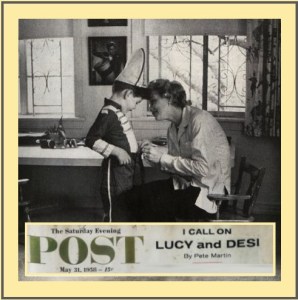
SATURDAY EVENING POST
May 31, 1958


-
HAROLD MILLER
May 31, 1894

Harold Miller was born as Harold Edwin Kammermeyer in Redondo Beach, California. He was a veteran of more than 425 television programs and films, most of them as a background performer, nearly all uncredited. He made his screen debut in the Selznick Pictures 1919 release Upstairs and Down.

From 1938 to 1947 he was in six Lucille Ball films including Joy of Living (1938), Beauty for the Asking (1939), The Big Street (1942), Abbott and Costello in Hollywood (1945), The Dark Corner (1946), and Lured (1947).
From 1939 to 1951 he was in nine films with William Frawley (Fred Mertz).

From 1935 to 1963 he was in 43 films with the Queen of the Extras, Bess Flowers. With television episodes that number zooms to 274 shared credits. The last of those was Critic’s Choice, starring Lucille Ball. Flowers also holds the record of doing the most films with Ball.
He did the screen versions of many hit stage musicals like Bye Bye Birdie (1963), Gypsy (1962), Pal Joey (1957), Anything Goes (1956), Guys and Dolls (1955), and Call Me Madam (1963).
He started doing television in 1952 with an episode of “The Adventures of Superman”. He returned the following year for a second ‘adventure’. In 1956 the series did a cross-over episode with “I Love Lucy.”

In 1954, he was part of the audience for “Over the Tea Cups”, a play attended by the Ricardo’s and Mertzes to celebrate “Ethel’s Birthday” (ILL S4;E9). The episode was filmed on October 7, 1954, and first aired on November 29, 1954.
Miller was also in the audience of a concert in Lucille Ball’s film Lured (1947) and also played an audience member in her film Critic’s Choice (1963). During his long career, he was frequently seen in a theatre seat:
- 1962 ~ Perry Mason: “The Case of the Ancient
Romeo” - 1962 ~ Gypsy
- 1961 ~ Thriller: “Dark Legacy (1961)
- 1961 ~ Cry for Happy
- 1956 ~ Serenade
- 1953 ~ Here Come the Girls
- 1952 ~ Somebody Loves Me
- 1951 ~ The Stooge
- 1951 ~ Golden Girl
- 1950 ~ The Toast of New
Orleans - 1949 ~ That Midnight Kiss
- 1948 ~ The Velvet
Touch - 1948 ~ B.F.’s Daughter
- 1945 ~ George White’s
Scandals - 1944 ~ Music for
Millions - 1943 ~ The Voice That Thrilled the
World (Short) - 1943 ~ The Constant
Nymph - 1943 ~ Slightly Dangerous
- 1939 ~ Charlie Chan at Treasure
Island - 1938 ~ The Rage of Paris
- 1935 ~ A Feather in Her
Hat - 1934 ~ The Man with Two
Faces - 1934 ~ This Side of Heaven
- 1929 ~ On with the Show!

In 1956, he returned to “I Love Lucy” as a passenger aboard the S.S. Constitution in “Second Honeymoon” (ILL S5;E14). The plot of this episode very closely follows the adventures of Lorelei Lee (Marilyn Monroe) in the 1953 film Gentlemen Prefer Blondes, which Miller was also in!
Miller was often seen at sea. He even went down on the Titanic in 1953! Here’s a list of films where he was aboard a vessel:
- 1958 ~ Auntie Mame
- 1958 ~ The World Was His Jury
- 1957 ~ An Affair to Remember
- 1956 ~ Anything Goes
- 1955 ~The Eternal Sea
- 1954 ~ The Lone Wolf: “The Werewolf Story”
- 1953 ~ The French Line
- 1953 ~ The Stranger Wore a
Gun - 1953 ~ Cruisin’ Down the
River - 1953 ~ Dangerous Crossing
- 1953 ~ Titanic
- 1952 ~ April in Paris
- 1951 ~ Payment on Demand
- 1950 ~ Please Believe Me
- 1948 ~ Luxury Liner
- 1948 ~ Romance on the High
Seas - 1942 ~ Now, Voyager
- 1941 ~ Our Wife
- 1941 ~ Blondie Goes Latin
- 1941 ~ The Lady Eve
- 1940 ~ Road to Singapore
- 1939 ~ In Name Only
- 1939 ~ Love Affair
- 1936 ~ Mummy’s Boys
- 1936 ~ Dodsworth
- 1936 ~ Love Before Breakfast
- 1935 ~ Navy Wife
- 1935 ~ Dante’s Inferno
- 1931 ~ Smart Woman
- 1928 ~ Souvenirs (Short)
Miller also was a background performer (a wedding guest) in the Lucy / Desi film Forever, Darling (1956).

In 1958, he did two episodes of Desilu’s “The Adventures of Jim Bowie” and two episodes of “The Danny Thomas Show” which was filmed by Desilu. Later that year, “The Lucy-Desi Comedy Hour” did a reciprocal cross-over with “Danny Thomas”.

In March 1959, he did an episode of Desilu’s “The Real McCoys”. As usual, he was a guest at a big party.

In 1960, Miller was a background artist on “The Man in the Funny Suit” for “Westinghouse Desilu Playhouse” hosted by Desi Arnaz.

From 1960 to 1962, Miller was part of six episodes of Desilu’s “The Untouchables”.

In 1963, he was seen in the Lucille Ball film Critic’s Choice, as an audience member. It would be one of his last films. He retired after making The Incredible Mr. Limpett in 1964.
Harold Miller died on July 18, 1972 at the age of 78.
- 1962 ~ Perry Mason: “The Case of the Ancient
-
RIP GAVIN MACLEOD
1931-2021

Although Gavin MacLeod never acted with Lucille Ball, she was responsible for his first role on television, as he recounts in his autobiography This Is Your Captain Speaking. On February 18, 1954, MacLeod had a brush with Lucy and Desi, who were attending the premiere of their film The Long, Long Trailer.

A few years later…

He remembers his first Desilu audition…

He appeared on “The Walter Winchell File” in “Act of Folly” (S1;E12) on December 18, 1957. He played Willy. He returned to the series for a second episode on February 28, 1958 titled “The Walkout” (S1;E22) that co-starred Marion Ross (”Happy Days”) and Bruce Gordon (”The Untouchables”).
On November 15, 1958, he did an episode of Desilu’s “U.S. Marshal” titled “The Arraignment” (S1;E6). That same year he did an episode of Desilu’s helicopter series “Whirlybirds” titled “Baby Face” (S2;E28).

In December 1959, he did his first of four episodes (one was a two-parter) of Desilu’s hit mobster series “The Untouchables.”
- “The Tri-State Gang” (as Artie McLeod) ~ December 10, 1959
- “The Big Train: Part One” (as Three-Fingered Jack White) ~ January 5, 1961
- “The Big Train: Part Two” (as Three-Fingered Jack White) ~ January 12, 1961
- “Loophole” (as Whitey Metz) ~ November 16, 1961
- “Man in the Middle” (as William ‘Porker’ Davis) ~ April 5, 1962

Nine years before he joined the cast of “The Mary Tyler Moore Show” he acted opposite Moore on an episode of “The Dick Van Dyke Show” filmed by Desilu. He played Maxwell Cooley, cousin of Mel Cooley (Richard Deacon) in “Empress Carlotta’s Necklace” (S1;E12) on December 12, 1961.

On January 8, 1965, he was back on the Desilu lot to film an episode of “Gomer Pyle USMC” titled “Dance, Marine, Dance” (S1;E16), in which he played a conman posing as a dance instructor named Freddie Fey.

The Desilu backlot also was home to Mayberry, where MacLeod appeared in two episodes of “The Andy Griffith Show”. On March 1, 1965 he was in “TV or Not TV” (S5;E23) playing a member of a team of producers looking to make a TV show about a small town sheriff – or are they?

On November 1, 1965, Andy and family went to Hollywood where they were making a movie of his life – starring Bryan Bender (Gavin MacLeod) as ‘Andy’! “The Taylors in Hollywood” (S6;E8) also featured “Lucy” alumni Herb Vigran, Hayden Rorke, Eddie Quillan, Ross Elliott, and Sid Melton.

His last time on the Desilu lot was for an episode of “Hogan’s Heroes” titled “Hello, Zolle” (1;E19) playing the title character. Although he did three more episodes of the series, Desilu had been sold to Paramount.
In the fall of 1970 he started playing the first of his signature roles: Murray Slaughter, news writer, on “The Mary Tyler Moore Show” (1970-77) doing all 168 episodes – from first to last. It wasn’t long before her created his second iconic role, Captain Meryl Stubing on “The Love Boat” (1977-87), doing all 250 episodes of the series, plus subsequent specials. He was forever identified as a ambassador for Princess Cruise Lines. In January 1978, Desi Arnaz Jr. appeared in two-part episode of the series. At the time of his death, Gavin MacLeod was a resident of Palm Desert, nearby Lucie Arnaz.
Although he never acted with Lucille Ball, they did appear on several of the same television shows.

On November 1, 1978, Lucille Ball was co-host on “The Mike Douglas Show” and Gavin MacLeod was one of the guests.

On March 13, 1982, Lucy and Gavin were both presenters on the “8th Annual People’s Choice Awards.”

Two years later (1984) they did the same chores for “The 36th Annual Primetime Emmy Awards.”

In February 1985, Lucille Ball, Lucie Arnaz, and Gavin MacLeod (plus 97 others) were at Radio City Music Hall (where it all started for Lucy and Gavin) for “Night of 100 Stars 2”.
-
Subscribe
Subscribed
Already have a WordPress.com account? Log in now.
 Papermoon Loves Lucy