-
HAPPY IN HER NEW DOUBLE ROLE
July 7, 1963


HOLLYWOOD (AP) – The president of Desilu Productions Inc. had a special interest in inspecting the sumptuous new quarters for television’s Dr. Casey, Vincent Edwards. (1)
It was the same building in which the president Lucille Ball had a tiny dressing room when she was an RKO starlet 25 years ago.
Long the major asset of Desilu, Lucille also took over as president and principal stockholder of the television empire last November. She succeeded her ex husband and co-star Desi Arnaz.
Two Jobs Easy
A half-year later, she appears to be handling a double career – as corporation boss and series star – with the greatest of ease.
The success story:
1. Desilu’s most recent statement snowed gross income up percent to $15,794,836 and net income up to $415,812 from 39-week period.
2. “The Lucy Show” soared immediately to the top ranks in audience ratings, marking one of to the most successful returns in television. One of her jobs would be enough to keep anyone busy. How does she manage both? Says she:
Leave Help Alone
“If I have any method, it’s something I’ve known for a long time: when you’ve got competent people working for you, leave them alone and let them do their jobs.”
She credits the production team smooth operation of Desilu, which operates three large studios, makes its own television series, rents space for other television series – Danny Thomas, Lassie, Joey Bishop – and movies – "The Greatest Story Ever Told” – and syndicates television films.
Yet Lucille is no mere letterhead president. She described her activities during a luncheon break from her show. The scene was her dressing room at the Desilu Gower Studio, a colorfully decorated, not over-large suite from which she conducts her business.
Sees Good Year
Lucille foresees a healthy year for Desilu. Besides her own show, the firm will produce “The Greatest Show on Earth,“ a circus hour in color with Jack Palance; a comedy mystery with Glynis Johns and Keith Andes; and possibly "Fair Exchange.” (2)
# # #
FOOTNOTES FROM THE FUTURE

(1) “Ben Casey” was a medical drama series that aired on ABC from 1961 to 1966 starring Vince Edwards in the title role. It was filmed at Desilu Studios, but produced by Bing Crosby Productions. Edwards did a cameo in “Lucy Goes to a Hollywood Premiere” (TLS S4;E20) aired on February 7, 1966.

(2) “The Greatest Show on Earth” (1963-64) starring Jack Palance and set in a traveling circus. Lucy made a guest appearance on the series in December 1963.

“Glynis” (1963) starred Glynis Johns and Keith Andes (Lucille’s Wildcat leading man) played an absent-minded private detective and her lawyer husband.

“Fair Exchange” (1962-63) starred Eddie Foy Jr. and Vic Madden as World War Two buddies who exchange teenage daughters (Judy Carne and Lynne Loring) for a year.

Robert Joseph Thomas (1922–2014) was a Hollywood biographer and reporter who worked for the Associated Press from 1944. As of 2014, he was twice listed in the Guinness World Records, for the longest career as a reporter, and for the most consecutive Academy Awards shows covered by an entertainment reporter.
-
LUCILLE BALL(S)
July 6, 1955

Binghamton (NY) Press, July 6, 1955
By Muriel Kappeler
LUCILLE BALL washes dishes at 1009 Catherine Street, West Corners, and plays with a rattle at 328 Front Street, Vestal.
No, the famous red-headed ball of fire, star of the “I Love Lucy” television program is not losing her mind, nor Is she in the Triple Cities area.
You could have fooled an excited nurse at Wilson Hospital though. About a year ago, the nurse was told to come down and take care of Lucille Ball. “Good heavens Is Lucille Ball here?” she explained speeding down the corridors. “This I’ve got to see.” What she found in the hospital room was a very sick Lucille Ball, infant daughter of Mr. and Mrs. Mark L. Ball of 328 Front Street, Vestal. The baby was hospitalized with an attack of spinal meningitis.
“We came pretty close to not having a Lucille Ball in our family,” her mother recalled grimly. “But everything is just fine now and the baby is wonderful."
The blue-eyed, brown haired child, who is now 18 months old, was named, not after the Hollywood bombshell whose wacky antics delight millions, but after a great-grandmother on her father’s side of the family. Great-grandmother Lucille was, according to family records, a nurse during the Civil War.
"Friends have asked us if we named her after the TV actress,” her mother said, “or if Lucille Ball was related to us. But we actually named her after her great-grandmother and Miss Ball is no relation."
Over in West Corners, Lucille Ball washes the dishes regularly. Called Lucky by her friends, this Lucille Ball is 14, and an eighth grader at Jennie F. Snapp Junior High School.
Last year. Lucky, whose hair is a flaming red just like the TV comedienne’s, was captain of the cheerleaders in school and played basketball.
Her gray-blue eyes sparkle with enthusiasm when she talks about her favorite records, her sports activities and her family. She was named after her aunt, Mrs. Paul Vroman of Day Hollow Road, Endicott.
"Her father,” Lucky’s mother recalled, “was teasing me just after she was born. We had selected the name, Lucille and he suggested calling her ‘Lucky’ because I always give people nicknames. I agreed because I didn’t want to call her Lucy."
Lucille mentioned that her friends In school alternate between calling her Lucky and Lucy. Fascinated friends, who comment on the red hair she and the TV star share, have sent in Lucky’s name to the TV program "The Name’s the Same.” But so far, their efforts have been in vain.
When she is introduced to members of the younger generation, whose sense of humor always bubbles up. Lucky has learned to grin when they say:
“There’s Lucille Ball, I wonder where Desi is.”
# # #
FOOTNOTES FROM THE FUTURE

“The Name’s the Same” was a TV panel / quiz show where guests who have the same name as famous persons, fictional characters, or things, are quizzed by celebrity panelists who try to determine their name. It aired from December 1951 to October 1955 on ABC TV. It was hosted by Robert Q. Lewis.

Binghamton, New York, is located approximately 225 miles south east of Jamestown, New York, Lucille Ball’s birthplace. Considering the proximity, it is reasonable to assume Ball descendants might be found in the area.
-
PILL-POPPING LUCY
July 5, 1973


BEVERLY HILLS, Calif.
Lucille Ball has become a pill-popper, but not in the way you think.
“It’s to grow bone marrow and build up the strength of my broken leg,” said the actress-tycoon in the course of a lawn party for the TV press. “I have to take all kinds of pills six bone meal, six calcium, generous amounts of Vitamin A, B, C and E pills every day. They’ve not only helped my leg, but they’ve made me feel stronger and they’ve even helped my eyesight.
"I also worked two and a half hours a day for four months on exercises before starting my new motion picture, ‘Mame’ (due out next Easter), and I must say the calisthenics and therapy helped me through my rigorous schedule – singing, dancing, etc. – without any problems.”
As a matter of fact, my broken leg is now stronger than the other one, and I have to build that one up, too. And I was able to lose 10 pounds – which didn’t hurt.“
Lucille fractured her leg in a Colorado skiing accident a year and a half ago, but that did not prevent her from going through her 21st season of "Lucy” episodes – much of it with her limb in a cast. She’ll be back and more active this year, of course but she has sworn off skiing. “Although I’ll still go on ski tours,” she added, “and my mother, who is 80, will be going with me."
Conspicuous by their absence at the party were her two sprouts, Desi and Lucie, who were busy elsewhere. Luci, separated from her husband, Phil Vandervoort, was in Flint, Learn to be a Mich., playing Liza Minnelli’s role in "Cabaret.” Desi’s activity was undesignated. Of Desi’s busted romance with Liza, Miss Ball commented, “I’m glad it happened like this. I’ve known Liza since she was a little girl; Desi hasn’t. It’s hard to domesticate a dynamo. ”
He was absolutely devastated for a while. But then he had a hot date with another girl – and I haven’t seen him since.“ Liza has of course, since broken with Desi’s successor Peter Sellers. ‘
For her 22d season on the air, Lucy will have such guests as Steve Lawrence and Eydie Gorme (opening show), Bill Holden, Danny Thomas, John Wayne, Andy Griffith, O.J. Simpson, Ed McMahon, Joan Rivers, Dick Sargent, Martin Milner, Gary Crosby – and "even, Desi Arnaz Jr., if he can find the time.” (1)
This season marks the 50th year of performing for Gale Gordon, who plays her choleric brother-in-law in the show. “I began in 1923 as a member of the ensemble for $15 a week,” he recalled, “and I got $10 extra for being actor Richard Bennett’s dresser. I’d rather be Lucille Ball’s dresser by a damn sight, but to tell you the truth, at my age I have trouble dressing myself."
Making "Mame” kept Lucy busy six months between seasons, and she weathered those arduous dance routines and musical numbers in good shape. “Yes, I had to sing all my own songs.” she said, “because no one else sounds like me."
Her co-star in the production is another well known TV name, Beatrice Arthur of "Maude” fame, “and together we sound like two frogs in heat,” she commented wryly. Lucille, too, began in the chorus – in “Rio Rita” at the age of 15 – but after a number of films and a year of radio in “My Favorite Husband,” (2) she developed her “I Love Lucy” format with her then-husband, Desi Arnaz, and quickly became America’s favorite comedienne.
The show goes from year to year virtually unchanged “because people like something familiar on the tube,” and rarely has she fallen out of the top 10 in the ratings.
~~ The Boston (MA) Globe, July 5, 1973
# # #
FOOTNOTES FROM THE FUTURE

(1) Bill Holden did not end up guest-starring on season six of “Here’s Lucy.” He may have been supposed to play the role played by Ed McMahon in “Lucy, the Wealthy Widow” (HL S6;E4), or perhaps the role played by Jackie Coogan in “Lucy’s Tenant” (HL S6;E7). Steve and Eydie Gorme were not in the opening show, but in the third episode, “Lucy The Peacemaker” (HL S6;E3), which aired on September 23, 1973. Martin Milner was likely supposed to play one of the policeman (in a nod to “Adam-12″) in “Lucy Plays Cops and Robbers” (HL S6;E14). Desi Jr. did not find the time to return to “Here’s Lucy” in season six.

(2) Ball did more than a year of “My Favorite Husband”. The radio show’s pilot aired July 5, 1948. The series was broadcast for the last time on March 31, 1951.
-
MY FAVORITE HUSBAND ~ Season 1, Part 1 (Cugat)
July 5, 1948 – December 26, 1948

“My Favorite Husband” ~ Season one aired on CBS Radio from July 5, 1948 to July 1, 1949. There were 51 half hour episodes. Starting in 1949, the characters would have their last name changed to Cugat, the character of Cory Cartwright would was phased out, Gale Gordon and Bea Benadaret became regulars as the Atterburys, and the main sponsor became Jell-O.
Regular Cast: Lucille Ball as Elizabeth ‘Liz’ Cugat, Richard Denning as George Cugat, Hal March / John Hiestand as Cory Cartwright, Ruth Perrott as Katie the Maid, and Bob LeMond, Announcer.
Season 1 (Part One) Guest Cast:
Hans Conried (12 episodes), Frank Nelson (8 episodes),
Bea Benadaret (5), Jay Novello (4 episodes),
Joe Kearns (4 episode),
Florence Halop (3 episodes)
Herb Vigran (3 episodes),
Jean Vander Pyl (3 episodes), William Johnstone (2 episodes), Mary Shipp (2 episodes),
Jack Carroll (2 episodes),
Elvia Allman, Richard Crenna, Doris Singleton, Rolfe Sedan, Harry Bartell, Jeff Chandler, Isobel Randolph, Sarah Selby, Laurette Fillbrandt, Janet Scott, Sandra Gould, Barbara Eiler, Erwin Lee, Gil Stratton, Mary Lansing, Frances Chaney, Ed Max, Frankie Albertson, and Tommy Bernard.
To Experience the Full Episode Blogs – for both “My Favorite Husband” and “I Love Lucy” – simply click on the hyperlinked (underlined) text.
* = Episodes not available for preview or considered lost.
“The Cugat’s Tenth Wedding Anniversary”* ~ July 5, 1948
Synopsis ~ A married couple who have been happily married for 10 years, and still seem to be actually in love. The Cugats flashback to moments of their wedding day, as they prepare for their anniversary. Liz, the well to do socialite, and George, the up and coming banker.
- Lee Bowman played George in this pilot episode.
“Literary Club’s Speaker Comes to Dinner”* ~ July 23, 1948
Synopsis ~
Liz invites the Literary Club’s guest speaker, big game hunter and author Captain Derek Allingham, over to the house for dinner.
“The Magazine Photographer”* ~ July 30, 1948
Synopsis ~
With George sick in bed, a magazine photographer is coming to take pictures of the Cugat home.

“The Portrait Artist” (aka “The Portrait Painter” aka “The Portrait”) ~ August 6, 1948
Synopsis ~ Liz is having her portrait painted by a handsome but gruff artist. George gets jealous and fakes illness, and he is attended to by a sexy young nurse – causing the green-eyed monster to rear between both Cugats!
“The Kissing Booth” (aka “The Charity Bazaar Kissing Booth”)* ~ August 13, 1948
Synopsis ~ George and Liz both think helping out the local charity bazaar is a great idea, until each finds out that the other one volunteered to run a kissing booth.
“Liz Teaches the Samba”* ~ August 20, 1948
Synopsis ~ George talks Liz into teaching Wally, the son of the bank’s First Vice President, Mr. Kimbrough, how to dance the Samba, and Wally gets a crush on Liz.
- Re-made on February 17, 1950. This is the first script written by Madelyn Pugh and Bob Carroll Jr.
“Is Your Ship of Matrimony on the Rocks?”* ~ August 27, 1948
Synopsis ~ Liz buys a book called "Is Your Ship of Matrimony on the Rocks”, and George goes to talk to the psychiatrist author, who turns out to be a gorgeous female.

“Liz’s Mother Has Second Thoughts” (aka “Mother’s Surprise”) ~ September 3, 1948.
Synopsis ~ Liz’s mother Adele Elliott is all set to marry Houston oil man Dan Carson, but suddenly gets cold feet.
“The Swami” (aka “Liz Has Her Fortune Told”)* ~ September 7, 1948
Synopsis ~ A swami at the Gypsy Tea Room predicts that one of Liz’s old flames will reappear to menace her marriage.

“Liz and the General” (aka “Making Friends with General Timberlake”) ~ September 17, 1948.
Synopsis ~ Liz befriends an eccentric neighbor, General Timberlake, who makes her re-enact major battles from history – in the living room!

“Knitting Baby Booties” ~ September 24, 1948
Synopsis ~ Liz is knitting baby booties for an expectant friend, and George and Mr. Atterbury think Liz is pregnant.
“George’s Old Flame”* ~ October 3, 1948
Synopsis ~ Instead of celebrating their tenth wedding anniversary, George takes Liz to a party to see his old flame, Myra Ponsonby.

“Young Matron’s League Tryouts” ~ October 2, 1948
Synopsis ~ Liz tries to butter up George in hopes that he’ll let her try out for the play that the Young Matrons League will be performing.
- First episode scripted by Jess Oppenheimer. The show moved from Fridays at 9:00pm to Saturdays at 7:00pm.

“Young Matron’s League Play” ~ October 9, 1948
Synopsis ~ George finds out that Liz is in the Young Matrons’ League play and finds a clever way to surprise her!

“Liz Sells Dresses” ~ October 16, 1948
Synopsis ~ Liz accidentally returns a dress to a more expensive store than where she bought it, and makes money on the deal. She then decides to go into business buying dresses at one store and returning them at another.

“The Quiz Show” ~ October 23, 1948
Synopsis ~ Liz and George need a new dishwasher, and Cory gets them a chance to win one on the radio quiz show, “His and Hers.”
- Basis for the “I Love Lucy” episode “Lucy Gets Ricky On the Radio” (ILL S1;E32).
“The Election”* ~ October 30, 1948
Synopsis ~ Liz and George run against each other in the Sheridan Falls City Council elections.

“Katie & Roscoe” ~ November 6, 1948
Synopsis ~ Katie, the Cugat’s maid, has been telling her long-distance romance that she was rich. Can Liz convince Roscoe that she’s the maid and Katie is her employer? It all depends on whether or not George finds out!
-
Partly the basis for the “I Love Lucy” episode “Mertz and Kurtz” (ILL S1;E32).

“Liz Learns To Drive” (aka “Liz’s Driving License” and “Liz Learns to Drive”) ~ November 13, 1948.
Synopsis ~ George teaches Liz to drive and she immediately gets in an accident. Through a communications mix-up, George thinks Liz has intentionally run over George’s high school sweetheart, Myra Ponsenby!

“George Attends a Teenage Dance” ~ November 20, 1948
Synopsis ~ Liz gives advice to her adolescent neighbor, Sally Hopkins, on how to snare the boy she likes, but her meddling only makes things worse.
-
Basis for the “I Love Lucy” episode “The Young Fans” (ILL S1;E20).

“Is There A Baby In The House?” (aka “There’s A Baby In The House”) ~ November 27, 1948
Synopsis ~ Liz goes over to meet the new neighbors and winds up minding a four-month old baby overnight.

“Be Your Husband’s Best Friend” (aka “Be a Pal to Your Husband”) ~ December 4, 1948
Synopsis ~ Liz buys a book that says that the way to get along with your husband is to share all of his interests. With that in mind, she joins him in a poker game and tags along on a camping trip.
- Re-written as a 1950 episode of “My Favorite Husband” also titled “Be a Pal” and broadcast June 18, 1950. This program was also the basis for the “I Love Lucy” episode “Be a Pal” (ILL S1;E2). This radio version also contains story elements in its second half that were later incorporated into “The Camping Trip” (ILL S2;E29).
“Respective Mustaches”* ~ December 11, 1948
Synopsis ~ Liz puts on a fake mustache to show George how ridiculous his real one looks, but by mistake she uses cement instead of spirit gum, and it won’t come off.
- Basis for the “I Love Lucy” episode “The Mustache” (ILL S1;E23).

“Liz’s New Dress” ~ December 18, 1948
Synopsis ~ Liz is determined to have a new dress to wear to he Atterburys’ party, even if she has to make it herself!
“Numerology”* ~ December 25, 1948
Mr. Curry, George and Liz’s landlord, is raising the rent, supposedly on instructions from his late wife, Bernice. Liz figures that she can fix things with a crooked Ouija Board.
- Basis for the “I Love Lucy” episode "The Séance” (ILL S1;E7). The show moves to Sunday for this program only as a Christmas Special. This episode was re-written and aired on May 14, 1950.
-
BY LUCILLE BALL
July 4, 1972

During Cynthia Lowry’s vacation, the column is being written by invited guests, each of whom was asked to respond to specific questions. Here is a report on bringing up show business kids by television’s, if not the entertainment world’s, most beloved comedienne.
Q. With both your children making successes in your field, you obviously have done something right. Did you nudge them, urge them or just let them come into your orbit on their own? Did they aim in the direction of the theatre from the beginning?
A. No parent is ever 100 per cent certain that he did everything right in raising his children, but I do believe that if parents spend at least 50 per cent of their time working at it, the results can be gratifying. It’s a full-time job, though, equipped with responsibilities and challenges, any one of which could give you a migraine.
I am reasonably sure that I did a few things right in raising Lucie and Desi. First, I spent as much time with them and on them as I could. Because our “I Love Lucy” schedule in those early days, Desi and I were able to devote almost as much time to the children as any other working parents. We had long weekends and spent them with the kids. We also had time off during spring and early summer, which gave us a chance to take regular vacations.
I think sometimes I worried a little too much, loved a little too much or perhaps admonished a little too much. But that’s part of a parent’s job, isn’t it, and the time comes all too quickly when you’ve got to let them fly a little on their own. It’s not an easy time and you spend a lot of hours biting your tongue.
I did urge, nudge and encourage, but in slow stages. If they wanted to put on a backyard play, we helped. We built a playhouse, provided some wardrobe and props and let them go. I think it was those backyard performances that gave Lucie and Desi their first taste of show business. They always loved performing.
Through the years, they watched all our shows on television and recreated some of the scenes I did with such per formers as Red Skelton, Maurice Chevalier, Jack Benny and Bob Hope. I was pleasantly surprised at their timing and mimicry. When I returned from New York after. “Wildcat” which Lucie and Desi saw 17 times, I decided to do “Here’s Lucy.” (1) Meanwhile, I had married Gary
Morton, executive producer of the current series. The format called for me to have two children. When time came to cast the roles of two teen-agers, Gary and I discussed using Lucie and Desi. We reminded the kids that school came first and warned them that if they did the series it meant having a special teacher and going to school on the lot. They voted to try it and their grades improved and both were able to graduate with their high school classes.
Desi has since left the series and is pursing a motion picture career. Lucie is still with me on the series and, speaking as a fellow performer, I am proud to have her at my side.
I’m happy to report that family vacations are still going strong. Last winter at our home in Snow Mass, Colorado, Gary and I were deluged with Lucie and her husband, Phil Vandervort; Desi and Liza Minnelli; (2) and mother DeDe, and all their friends. Vacations are like family reunions and I love it.
# # #
FOOTNOTES FROM THE FUTURE

(1) Lucy (or the editor) is conflating “The Lucy Show” with “Here’s Lucy” (1962), which didn’t come along until 1968.

(2) Lucie Arnaz married Phil Vandervort on July 17, 1971. They divorced in 1977. At the time, Desi was engaged to Liz Minnelli, seven years his senior. By January 1973, the engagement was off.


Headlines were not written by syndicated columnists, but by the newspapers. Hence, when this same column by Cynthia Lowry appeared in different newspapers, it had a different headline. Some of those headlines are above.
-
ALL IN A DAY FOR LUCY
July 3, 1966

CAMERA ANGLES
It’s all in a day for Lucy
by Aleen MacMinn
Lucille Ball, the television executive, looked around her spacious, handsome and newly refurbished office at Desilu Studios and commented: “This is a great office. I wish I could spend more time here."
However, Lucille Ball, television executive, doesn’t put in a "typical day” at the office, as other executives do. That’s because Lucille Ball, the television star, must be in front of the cameras a goodly number of hours per week working on ‘The Lucy Show’ for CBS.
There is, too, Lucille Ball, wife of Gary Morton and mother of two children, Lucie Arnaz, 15, and Desi Arnaz Jr., 13. How does she manage all of these careers? She shrugs off that question with an “I sandwich it all in” answer, then quickly says that “I have a lot of people helping me.” But her schedule, nonetheless, is one that would leave many executives (or stars, for that matter) reeling.
Meetings in the morning before 10, luncheon interviews, board meetings, production meetings, program planning meetings, publicity, big studio decisions… all in addition to starring in a weekly series that has consistently stayed near the top of the ratings.
CBS had its usual case of quivers earlier this year when Miss Ball announced that she didn’t care to do another season of ‘The Lucy Show’. “I wanted to do something different,” she said, “I think it’s healthy to stick your neck out” Her plan: four specials and no series. But when the negotiations with CBS were over, she was booked for a fifth season of ‘The Lucy Show’ and two specials. "Now,“ she sighed, "I’m stuck with two specials and no time to do them!"
Thus, she’s spending her "vacation” from her TV series in London, shooting special number one. It has Anthony Newley as guest star and will be seen in November. (1)
Busy as she is, she doesn’t complain. “I had my free time,” she said. “I think I had a day and a half back there a few weeks ago. I forced myself and I do mean forced myself to go sit and knit. I seem to fall apart if I have the opportunity to rest. I guess I just thrive on activity."
# # #
FOOTNOTES FROM THE FUTURE

(1) "Lucy in London” was part of Lucille Ball’s 1966-67 contract negotiations with CBS. She was supposed to star in three such ‘travel’ specials, but this is the only one that ever materialized. Ball originally planned to co-star with Mitzi Gaynor as two nuns touring Europe, followed by a French-based production called “Lucy in Paris,” and a Middle Eastern-set comedy called “Lucy in Arabia” or “Lucy in the Desert.” "Lucy in London” aired on October 24, 1966 in “The Lucy Show” time slot.

This article was part of the Los Angeles (CA) Times’ TV Times magazine, a supplement to the Sunday Times on July 3, 1966.

The Guide notes that “Vacation Playhouse” would replace “The Lucy Show” for the summer. “Vacation Playhouse” was an anthology series presenting pilots for new shows.
-
PRE-, EARLY-, AND LATE-LUCY
July 2, 1967

When the one great broadcaster in the sky someday chronicles the history of television, it will be divided in three parts pre-Lucy, early-Lucy and late-Lucy.
There will never be a period known as post-Lucy because Lucy is without end.
Wars have come and gone. Generations have been born, reared and procreated, but Lucy continues. Lucy’s march through video history reached a landmark recently when CBS decided to relinquish its grip on the “I Love Lucy” series after sixteen years.
This doesn’t mean “I Love Lucy” will disappear from your living room. Rather, it’s a rebirth of the ancient series, since it now will be sold station-by-station across the country.
Of course, CBS has Lucille Ball headed for a sixth season in her sequel show, “The Lucy Show,” which also appears destined to run practically forever.
More than one third of all Americans living today weren’t yet born when “I Love Lucy” made its debut in the fall of 1951 as the star of the CBS line-up.
The show, filmed in a Hollywood studio, turned the TV industry inside out. Until Lucy, television operated with electronic cameras transmitting live programs to a few select cities, with kinescope duplicates for the hinterlands.
After Lucy showed the way, the TV industry moved to Hollywood and film. Today, you can count the non-film TV programs on your fingers. In the beginning, “I Love Lucy” had four stars. Lucille Ball, of course, was the pivotal character. Alongside her was her husband, Desi Arnaz.
And down the hall in their mythical apartment were the Mertzes the late William Frawley and Vivian Vance, who retired from Lucy’s new show two years ago to go home to Connecticut.
Desi became a Hollywood tycoon off the “I Love Lucy” show, founded the Desilu Studio complex, then sold out and left Hollywood. Now, he’s back and starting a second time around.
Desi Arnaz, Jr., now of the Dino, Desi and Billy rock trio, was virtually born before millions of Lucy fans as Miss Ball played one season enceinte. (And in those days, pregnancy on the screen was unheard of.)
“I Love Lucy” also made history in the advertising business. Although it was the highest rated show on the air in its prime, it didn’t do a thing for the sponsor’s cigarettes.
When “I Love Lucy” ceased to have new episodes, it never left the air. CBS continued with reruns. The Ricardos and the Mertzes were in a sort of time-lock, never aging, never changing.
Lucy and Desi divorced and both remarried, but on CBS in the morning, they remained in love for another decade.
The 179 episodes kept replaying until the audience lost track of how many shows it had committed to rote. When CBS hit the bottom of the stack, it started over, and over, over again.
This routine might have gone on forever except for an incident in February, 1966, which alerted everyone to the Lucy situation. The network chose to broadcast a fifth rerun of an “I Love Lucy” episode in preference to live testimony from the Senate Foreign Relations Committee’s Vietnam hearing. The network’s news chief stomped out in a huff.
Last September, CBS retired “I Love Lucy” from daily duty and put it on reserve status.
Then in late March, the decision was made to release “I Love Lucy” from the network and the old episodes were released for sale in syndication to individual stations.
But even before the ink was dry on the contract, the American Federation of Television and Radio Artists called a strike. The network was caught without its live soap operas.
To fill the emergency, naturally, CBS reached up on the shelf and pulled down some battered reels of “I Love You-know-what."
# # #
This article was part of TV Week, a supplement to the Sunday Baltimore (MD) Sun, on July 2, 1967.

That same day (July 2, 1967) Baltimore’s Channel 13 showed The Affairs of Annabel (1938), Lucille Ball’s 39th movie.

On Thursday, July 6, 1967, Baltimore area viewers saw Miss Grant Takes Richmond (1949) on Channel 9. It was Ball’s 72nd film.

Later that same night, “Milton Berle Hides Out at the Ricardo’s” (LDCH S3;E1), originally aired in September 1959, was on their CBS affiliate. Curiously, there is a small © next to the title, which indicates color. This show was not filmed in color.

Interestingly, as the article states, there are no re-runs of “I Love Lucy” on the schedule! But the Ricardos and Mertzes are still visible via “The Lucy-Desi Comedy Hour.”

The headlines that day talked about Canada’s centennial, tensions in the Suez, President Johnson’s relationship with Democratic governors, and America’s precarious financial relationship with Germany.

When Shull’s column was printed in other papers, it was often retitled. Headlines were written by the newspapers, not the columnists. Here (The Indianapolis News) they decided on “Maybe It Should Be Renamed ‘Forever Lucy’”. He also got his headshot with this byline.
-
MY FAVORITE HUSBAND ~ Season 2
July 2, 1949 – June 25, 1950

“My Favorite Husband” ~ Season two aired on CBS Radio from September 2, 1949 to June 25, 1950. There were 40 half hour episodes sponsored by Jell-O. Episodes were also aired on Armed Forces Radio & Television Service (AFTRS) without advertising.
Regular Cast: Lucille Ball as Elizabeth ‘Liz’ Cooper, Richard Denning as George Cooper, Gale Gordon as Rudolph Atterbury, Bea Benadaret as Iris Atterbury (and others), Ruth Perrott as Katie the Maid, and Bob LeMond, Announcer.
Season 2 Guest Cast:
Hans Conried (17 episodes), Frank Nelson (11 episodes), Hal March (8 episodes), Jay Novello (5 episodes), Eleanor Audley (5 episodes), Peter Leeds (4 episodes), Elvia Allman (3 episodes), Richard Crenna (3 episode), Herb Vigran (2 episodes), Jerry Hausner (2 episodes), Anne Whitfield (2 episodes),
Doris Singleton, Jack Kruschen, Rolfe Sedan, Joe Kearns, Wally Maher, Johnny McGovern, Sam Hearn, Norma Zimmer, Sam Edwards, Jim Backus, Gege Pearson, Joe Forte, Mary Jane Croft, Harry Bartell, and Veola Vonn (1 episode).To Experience the Full Episode Blogs – for both “My Favorite Husband” and “I Love Lucy” – simply click on the hyperlinked (underlined) text.

“The Elves”
~ September 2, 1949Synopsis ~ Liz and George arrive home from summer vacation to find that someone has been ordering strawberry ice cream from the milkman every day, and the pink trail leads to the doorstep of their new neighbors, Mr. and Mrs. Wood, and their ten children.
“The Auction”* ~ September 9, 1949

“The Bank Outing Baseball Game” ~ September 16, 1949
Synopsis ~ Liz is determined not to be left out of the baseball game at the Annual Bank Outing, so she persuades her neighbor Mr. Wood to teach her how to play the game.

“The Attic” ~ September 23, 1949
Synopsis ~ One of George’s old Glee Club friends is in town and George wants to find his old ukulele, so he and Liz search for it in the attic but get locked in.

“Women’s Club Election” ~ September 30, 1949
Synopsis ~ George has cause for alarm when Liz is elected treasurer of the local women’s club because he knows how much trouble she has with figures but Liz has a surprise for him.
- Basis for the “I Love Lucy” episode “The Club Election” (ILL S2;E19)

“George Needs a Raise”~ October 7, 1949
Synopsis ~ Liz tries every trick in the book to convince Mr. Atterbury to give George a raise. To get results she even resorts to selling apples in front of the bank where he is employed.
- Basis for “Ricky Asks for a Raise” (ILL S1;E35)

“Too Many Television Sets” ~ October 14, 1949
Synopsis ~ Liz can’t get George interested in buying a television set, until they spend an evening at the Atterburys, who have one. With his interest piqued, George arranges one be sent over on trial. Little does he know Liz has done the same thing – as have the Atterbury’s!

“Liz’s Superstitions” ~ October 21, 1949
Synopsis ~ A chirping cricket in the Cooper’s hearth is driving George crazy, but Liz is convinced it means good luck. When Liz insists that it isn’t lucky to banish a cricket, George gets upset with her superstitions.

“Halloween Surprise Party” ~ October 28, 1949
Synopsis ~ The Atterburys decide to throw a Halloween surprise party for Liz and George, but when Liz hears about their party at the beauty salon, she thinks that she and George just weren’t invited.

“Mother-in-Law” ~ November 4, 1949
Synopsis ~ George gets a letter from his mother that she’s moving to Sheridan Falls. Liz has no doubt that means staying with them! But when will she ever leave?
-
Although similarly titled, this radio episode is not the basis for the “I Love Lucy” episode “Lucy’s Mother-in-Law” (ILL S4;E8) in 1954.

“BABY SITTING” ~ November 11, 1949
Synopsis ~ Liz takes up baby sitting to balance her financial books and earn money for George’s Christmas present.
- Shares plot elements with the “I Love Lucy” episode “The Amateur Hour” (ILL S1;E14)

“Liz The Matchmaker” ~ November 18, 1949
Synopsis ~ After dating Mr. Negley the postman for three years, Katie feels that their relationship is not going anywhere, so she enlists Liz’s help!
- Although similarly titled and themed, this radio episode is not the basis for the “I Love Lucy” episodes “Lucy Plays Cupid” (ILL S1;E15), “Lucy is a Matchmaker” (ILL S2;E27), “The Matchmaker” (ILL S4;E4), or “Lucy, the Matchmaker” (HL S1;E12).
“College Homecoming”* ~ December 2, 1949

“The French Lessons” ~ December 9, 1949
Synopsis ~ Liz and Iris are humiliated when they can’t read the menu at a French restaurant, so they decide to take French lessons. The lessons lead to the prospect of a duel between her favorite husband George and her amorous French teacher.
- Basis for the “I Love Lucy” episodes “The Adagio” (ILL S1;E12) and “The French Revue” (ILL S3;E7)

“George’s Christmas Present” ~ December 16, 1949
Synopsis ~ Liz vows to finish knitting George a sweater by Christmas. She finds George’s Christmas presents for her and exchanges it too early.

“The Sleigh Ride” ~ December 23, 1949
Synopsis ~ Liz is taken for a sleigh ride (figuratively and literally) when she and her neighbors borrow a milkman’s horse and make a jingle bell trip to the countryside for a yule log. The party turns sour down when the horse insists upon making all the stops on his milk route.

“Liz & George Are Handcuffed” ~ December 30, 1949
Synopsis ~ Liz is playing ‘cops and robbers’ with little Tommy Wood from next door, and lets him handcuff her and George with what turn out to be real handcuffs! During the time the Coopers are linked George finds himself under the hair dryer and Liz later has to stand by at the barber’s while her husband gets a shave.
- Basis for the “I Love Lucy” episode “The Handcuffs” (ILL S2;E4)

“Is There Another Woman?” ~ January 6, 1950
Synopsis ~ Liz buys a book that lists the danger signs to look out for to tell if your husband is being unfaithful, and George has them all! Liz then she finds herself innocently coupled with her husband’s boss!

“Liz Teaches Iris To Drive” ~ January 13, 1950
Synopsis ~ The Atterburys have bought a new car but Rudolph refuses to teach Iris how to drive. Liz readily volunteers to be Iris’s driving instructor.

“Liz & The Green Wig”
~ January 20, 1950Synopsis ~ George goes over Liz’s accounts and discovers that she has listed $180 for miscellaneous expenses! George decides she can eliminate the $10 a week she’s spending on her hair. Liz buys a green wig to show George what might happen if she dyed her hair at home.

“Liz Writes a Song” ~ January 27, 1950
Synopsis ~ Liz is convinced that she is a musical talent, but when a music professor tells her she’ll never be a singer, she decides to take up songwriting.
- Portions of this script were used as inspiration for “The Benefit” (ILL S1;E13)

“Country Club Dance” ~ February 3, 1950
Synopsis ~ Iris and Liz want to go to the country club dance, but George and Rudolph want to go to the fights. The girls decide to get dates and go anyway, until their plan ends in disaster.
- The plot inspired elements of the story in “The Girls Want To Got To A Nightclub” (ILL S1;E1)

“Mrs. Cooper’s Boyfriend” ~ February 10, 1950
Synopsis ~ Liz decides that the only way to keep George’s mother from coming over on Valentine’s Day is to get her a boyfriend.

“Liz Teaches the Samba” ~ February 17, 1950
Synopsis ~ George talks Liz into teaching Wally, the son of the bank’s newest director, Mr. Forsythe, how to dance the Samba, and Wally gets a crush on Liz.
- Basis for the “I Love Lucy” “The Young Fans” (ILL S1;E20)

“Liz Redecorates the House” ~ February 24, 1950
Synopsis ~ Liz wants to hire the town’s new interior decorator, Andrew, to redecorate her house, but George tells her she’ll have to do the job all by herself.
- Although this script never directly inspired any specific episode of “I Love Lucy” it is most like 1952′s “Redecorating” (ILL S2;E8)

“Women’s Rights – Part 1″ ~ March 5, 1950
Synopsis ~ Liz and Iris start a campaign for equal rights, so George and Rudolph take them out to dinner but insist they pay their own check. With no choice but to do dishes, Liz plots to make the boys resent abandoning them – but even when everything is patched up they still want equal rights.
- Basis for the “I Love Lucy” episodes “Equal Rights” (ILL S3;E4)

“Women’s Rights – Part 2″ ~ March 12, 1950
Synopsis ~ Liz and Iris have bet George and Rudolph that they can hold down a job, and the boys have bet the girls that they can take care of the housework and cooking.
- Basis for the “I Love Lucy” episode “Job Switching” (ILL S2;E1)

“The Wills” ~ March 19, 1950
Synopsis ~ After Liz and George make out their wills, Liz is convinced that George intends to do away with her. Liz is startled to find a receipt for some arsenic and rope in his pocket, but is shocked when George suggests a trip to the country – with a one-way ticket for Liz!
- Basis for a scene in “I Love Lucy” episode “Lucy Thinks Ricky Is Trying to Murder Her” (ILL S1;E4)

“Liz’s Radio Script” ~ March 26, 1950
Synopsis ~ Liz’s entry is a finalist in a playwriting contest, and the Coopers and the Atterburys perform it on the local radio station.
- Portions of this script inspired the “I Love Lucy” episode “Lucy Writes a Play” (ILL S1;E17)
“April Fool”* ~ April 2, 1950

“Hobbies” ~ April 9, 1950
Synopsis ~ Liz and Iris are tired of waiting at home on weekends while George and Rudolph are at the golf course, so they decide to leave half-smoked cigars around the house to make the boys jealous.
- Some elements that were later used on “I Love Lucy” in “The Golf Game” (ILL S3;E30)
“Anniversary”* ~ April 16, 1950

“Liz Appears on Television” ~ April 23, 1950
Synopsis ~ Liz and Iris make an appearance on a television show celebrating Friendship Week. Their friendship is tested, though, when they discover they’ve bought the same dress for the occasion.
- Basis for the “I Love Lucy” episode “Lucy and Ethel Buy the Same Dress” (ILL S3;E3)

“Spring House Cleaning” ~ April 30, 1950
Synopsis ~ Liz sends George an anonymous love letter that she wrote to him during his bachelor days, and he thinks its from his secretary, Gladys.

”The Health Farm” ~ May 7, 1950
Synopsis ~ Liz and Iris are fed up with their husbands taking them for granted, so they check in to a fat farm.
- This episode features elements that later went into the “I Love Lucy” episodes “The Diet” (ILL S1;E3) and “The Charm School” (ILL S3;E15) as well as the “Lucy Show” episode “Lucy and the Countess Lose Weight” (TLS S3;E21)

“Numerology” ~ May 14, 1950
Synopsis ~ Mr. Curry, George and Liz’s landlord, is raising the rent, supposedly on instructions from his late wife, Bernice. Liz figures that she can fix things with a crooked Ouija Board.
- Basis for the “I Love Lucy” episode “The Seance” (ILL S1;E7). It is a revision of the script used for “My Favorite Husband” episode #24, also titled “Numerology” when the characters were then known as the Cugats.

“Mrs. Cooper Thinks Liz is Pregnant” ~ May 21, 1950
Synopsis ~ Liz tells George’s mother that she’s ill so the older Mrs. Cooper won’t try to come to Liz’s bridge game, but George’s Mother thinks Liz is really pregnant, and tells all of Liz’s friends what she thinks.

“Liz Sells Dresses” ~ May 28, 1950
Synopsis ~ Liz accidentally returns a dress to a more expensive store than where she bought it, and makes money on the deal. She then decides to go into business buying dresses at one store and returning them at another.
- Basis for a scene in “I Love Lucy” episode “The Freezer” (ILL S1;E29). It was a revision of the script for episode #14 from season one, when the characters were known as the Cugats.

“George is Messy” ~ June 4, 1950
Synopsis ~ Liz is fed up with George’s messy habits around the house, so she draws a line down the middle of the living room and divides the house in two -her half and half his.
- Basis for “Men Are Messy” (ILL S1;E8) of “I Love Lucy”

“Liz Learns to Swim” ~ June 11, 1950
Synopsis ~ George makes a bargain with Liz: If she’ll learn to swim, they can go to the beach with the Atterburys for their vacation.

“Be a Pal” ~ June 18, 1950
Synopsis ~ Liz feels thinks George would rather not spend time with her anymore, so she tries everything she can think of to be a pal to her husband.
- Basis for the “I Love Lucy” episodes
“The Camping Trip” (ILL S2;E29) and “Be a Pal” (ILL S1;E2). It is a revision of the “My Favorite Husband” season one episode "Be Your Husband’s Best Friend” when the characters were named Cugat.

“Dance Lessons” ~ June 25, 1950
Synopsis ~ Liz cons George in to taking her to a nightclub by telling him it is to celebrate their anniversary but it is actually to celebrate the anniversary of the last time they went out to a dinner dance.
-
LUCY LOCO? DIZZY DESI?
July 1, 1946


On the first of July 1946, Dorothy Kilgallen reported that Lucille Ball was considering an offer by Broadway producer Jed Harris to come to New York in the fall and star in the play Loco written by Dale Eunson and Katherine Albert. Lucille Ball appealed to MGM where she was under contract, to allow her to go East to do the play. The lured of Broadway was strong for Ball, who had been fired by Flo Ziegfeld from Rio Rita early in her career. Her Broadway-bound play Hey Diddle Diddle was cancelled out-of-town when her leading man got seriously ill. She would have some minor success with a tour of Dream Girl in 1947. Broadway would have to wait until 1960 when she appeared in the new musical Wildcat.

August 2, 1946 ~ Lucy was out. MGM could not spare her for the length of a Broadway contract – which could last up to six months, if the show were a hit. It is probably no coincidence that by fall Lucille Ball was filming Lured, not for MGM, but United Artists, and followed it up with a role at Columbia Pictures in Her Husband’s Affairs.

August 22, 1946 ~ Candy Jones was reading for the role denied Lucille Ball. Jones had just completed back-to-back runs in the musicals Mexican Hayride and Polonaise.


August 27, 1946 ~ Hedda Hopper reported that Jean Parker was offered Loco. Candy didn’t have enough clout for Harris. Like Lucy, Parker had been under contract to MGM and was an up-and-coming film star. Also like Lucy (at least in the 1940s), she was from Butte, Montana! They were both in the 1936 film The Farmer in the Dell.

September 11, 1946 ~ The play goes into rehearsal for an October 16, 1946 opening night. Jed Harris acted as producer and director. Parker’s co-star Jay Fassett was making his penultimate Broadway appearance, after nearly thirty productions. In the cast is a young actress named Elaine Stritch, who would go on to great success on Broadway.
The play was a critical and public failure, running 37 performances. Lucy had made the right decision.

November 25, 1946 ~ After Burlesque, Parker stayed East to understudy and replace Jan Sterling (who had replaced Judy Holliday) in Born Yesterday.
Meanwhile, at around the same time, Ball’s husband Desi Arnaz was also being tempted East for work on the Great White Way. He starred on Broadway in Too Many Girls. Making the film version is what brought him to Hollywood… and Lucy. He never went back.

Apparently Durocher was not amenable to the writers using his name, so they switched the action (baseball!) to Mexico in order to star Cuban Desi Arnaz. While this certainly could be true, it is even more likely to be a clever way to transition to an item about Lucille Ball. It may also be Kilgallen’s way of telling readers that Durocher had effectively killed the project and pointing up the absurdity of doing it without him.

April 7, 1946 ~ “The Filly From Flatbush” by John Cecil Holm and Charles K. Peck was being shopped around to Broadway producers.

April 14, 1946 ~ There was no further mention of re-setting the action to Mexico and starring Desi. Perhaps Arnaz had indicated that he wasn’t interested, so they idea was never pursued. Or, more likely, it was never true.


October 2, 1946 ~ Coincidentally, this item was around the time of the World Series games – a natural tie-in.

June 12, 1948 ~ Two years later, the authors were still trying to get the show produced. The new angle was to offer the lead to Leo Durocher’s actress wife, Laraine Day.

August 21, 1950 ~ Hollywood finally gets involved! With no prospects of Broadway for “Filly”, Tineseltown seemed the next logical place to shop the property. This item from Erskine Johnson’s column confirms that it was the Dodgers who stalled production by asking for six digit payoff for use of their name. Five years later, the Yankees were not so costly, and the authors of a different baseball musical created an unqualified hit that would also be a home run in Hollywood – Damn Yankees!
-
LUCY THE FIRECRACKER!
July 1, 1962


To most people July 4 means a big celebration with family picnics and plenty of fireworks. Channel 8 celebrates two days early by welcoming a redheaded firecracker named Lucille Ball to its summer schedule.
Lucy, along with the guest stars pictured with her on the cover, (1) will be featured in a weekly series of hour long “Lucy-Desi Specials”, starting Monday at 9 p.m.
It’s hard to believe that such a bundle of energy as Miss Ball was unable to walk for three years. Shortly after she had started modeling in New York, she contracted pneumonia with severe complications and, was bedridden for eight months. It took three years of convalescing before she regained complete control of her legs. (2)
Ironically, years later in 1941, Miss Ball got her first big Hollywood, break playing a showgirl who becomes paralyzed in "The Big Street.” Miss Ball was born in Jamestown, New York, on August 6, the daughter of a mining engineer father (3) and a concert pianist mother. She left home when she was fifteen and enrolled in The John Murray Anderson Dramatic School in New York. She was told she had no future in show business.
IN ZIEGFELD SHOW
Taking the challenge, Miss Ball went out on her own and landed a chorus job in the road company production of Ziegfeld’s "Rio Rita”. She was fired after five weeks. After working in a New York drugstore, she decided to try her luck in the modeling field.
During this time she got pneumonia, and it was almost four years before she could start her modeling career again. Magazine and billboard advertisements attracted Eddie Cantor’s attention and he gave her her first Hollywood role in his “Roman Scandals”. (4) For a while she did bit
parts at Columbia and Paramount, and finally landed a contract at RKO and a substantial role in “Roberta”.

Broadway, which had scorned Lucy, now took notice and gave her the lead in an unsuccessful musical, “Hey, Diddle, Diddle”. When it folded, she returned to Hollywood to star in “Stage Door” and “Too Many Girls.” (5) It was during the filming of the latter she met and married a Latin band leader named Desi Arnaz. After a year of marriage to Arnaz, Lucy landed a part in "The Big Street.” She followed this with roles in "Easy to Wed”, “Du Barry Was A Lady”, “Best Foot Forward”, “Meet the People” and “Her Husband’s Affairs”.
After Arnaz returned from the service at the end of World War II, he joined with Lucy to form Desilu Productions, Inc., which handled their joint business ventures. (6) With writers Jess Oppenheimer, Madelyn Pugh Martin and Bob Carroll, Jr., they developed the format for the "I Love Lucy” show.
The debut of the “I Love Lucy” television series was heralded by the birth of their daughter, Lucie Desiree. The couple’s second child, a son, Desi IV, was born while the series was at the top of TV polls.
After completing the “I Love Lucy” series, Miss Ball and Arnaz made a limited number of hour-long specials – the ones Channel 8 viewers will see this summer.
Although their marriage ended in 1960, the couple maintain a professional relationship. In October, 1960, Lucy opened in the hit Broadway show, “Wildcat”, and continued to receive rave notices until illness forced her out of the show. Now recovered, she plans to return full-time to television with the new “Lucille Ball Show”, slated for a fall premiere. (7)
Lucy lives with her second husband, comedian Gary Morton, and her two children in Beverly Hills, Calif.
# # #
FOOTNOTES FROM THE FUTURE

(1) Surrounding Lucille Ball in the bursts of fireworks, are the headshots of Red Skelton (“Lucy Goes to Alaska”), Betty Grable (“Lucy Wins a Racehorse”), Ida Lupino (“Lucy’s Summer Vacation”), Fred MacMurray (“Lucy Hunts Uranium”), and Milton Berle (“Milton Berle Hides Out at the Ricardos”). Curiously, Danny Thomas is not included, although his episode (”Lucy Makes Room for Danny”) was first to be aired and is included in this week’s listings. This also means the episodes are being aired out of their original broadcast order.
Subsequent air dates:
- July 8 ~ “Lucy Takes A Cruise To Havana” (Hedda Hopper, Caesar Romero, Rudy Vallee, Ann Sothern)
- July 15 ~ “Lucy Wins a Racehorse” (Betty Grable, Harry James)
- July 22 ~
(Maurice Chevalier)
- July 29 ~ “Milton Berle Hides Out at the Ricardos” (Milton Berle)
- August 5 ~ “Lucy Goes to Alaska” (Red Skelton)
- August 12 ~ “The Celebrity Next Door” (Tallulah Bankhead)
- August 19 ~
“Lucy Hunts Uranium” (Fred MacMurray, June Gable)
- August 26 ~ “Lucy Meets the Mustache” (Ernie Kovacs, Edie Adams)
- September 2 ~ “Lucy Goes To Sun Valley” (Fernando Lamas)
- September 9 ~ “Lucy’s Summer Vacation” (Ida Lupino, Howard Duff)
- September 16 ~ “The Ricardos Go To Japan” (Bob Cummings)
The only episode not being aired is “Lucy Wants A Career” (Paul Douglas). The episode does not feature an exotic locale, or music, and Douglas, while familiar, was not a star in the same category as those featured in the other episodes.
(2) Other versions of this period in Ball’s life state that she was hit by a car, not sidelined by pneumonia. This has led Lucille Ball biographers to speculate that she may have been been concealing a pregnancy or had an abortion – none of which has been substantiated.

(3) Henry Durrell Ball (Lucille’s Father) was not a mining engineer. He was a telephone lineman.

(4) This is a glamorized version of what actually happened. Lucille was stopped on a New York City street by someone organizing Goldwyn Girls traveling to California to appear in a film starring Eddie Cantor. One of the girls cast dropped out, and Lucille Ball was asked to go in her stead as a last-minute substitute. It is highly unlikely Cantor saw Lucille until she appeared on the set for filming.

(5) “Hey Diddle Diddle” opened in Princeton, New Jersey, in 1937 and was scheduled for a couple of out-of-town engagements before opening on Broadway. But it never happened. Leading man Conway Tearle got seriously ill and the production was abandoned. As the article says, Lucille returned to Hollywood. Lucille made fifteen films between 1937′s “Stage Door” and 1940′s “Too Many Girls,” where she met Desi. In that time, she was engaged to be married twice: to Broderick Crawford and Alexander Hall.

(6) Desilu Inc. was not formed until 1950. Desi Arnaz was discharged from the Army (with honors) on December 1, 1945. In the intervening years, he toured with his rhumba band.

(7) “The Lucille Ball Show” (or “The New Lucille Ball Show”) was the working titled of “The Lucy Show” almost right up until its premiere on October 1, 1962.
INSIDE TV WEEK


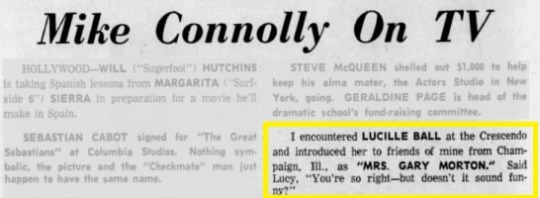
Seven months after saying “I Do,” Lucille Ball was still having trouble getting used to being addressed as Mrs. Gary Morton. (Not half as much, I fear, as Gary had getting used to being addressed as Mr. Lucille Ball!)

The headline of the Lancaster (PA) Sunday News, the newspaper that included this issue of TV Week.
-
Subscribe
Subscribed
Already have a WordPress.com account? Log in now.
 Papermoon Loves Lucy