-
“New Neighbors”

(S1;E21 ~ March 3, 1952) Directed by Marc Daniels. Written by Jess Oppenheimer, Madelyn Pugh, and Bob Carroll, Jr. Filmed on January 25, 1952 at General Service Studios. Rating: 58.0/78
Synopsis ~ New neighbors have just moved in to 323 East 68th Street and Lucy and Ethel can’t help but snoop around their apartment. When Lucy gets stuck hiding in their closet, she overhears the couple practicing their lines for a TV play and jumps to conclusion that they are foreign spies ready to kill them and blow up the Capitol!

The day this episode was filmed Hollywood actress Polly Moran died at age 68. Moran and William Frawley (Fred Mertz) both appeared in the 1939 film Ambush.

The episode features classic farce elements: overheard and misunderstood conversations, hiding and escaping, and physical comedy. Lucy even has to pretend to be an armchair to get out of the apartment!

Although we never learn the title of the teleplay the O’Briens are rehearsing, judging by their accents it is obvious that they are playing Communist spies from the Soviet Union. This episode was filmed at the start of Cold War, which most historians date from approximately 1947 to 1990, and less than two years before Lucille Ball herself was accused of being a Communist.

This season 1 episode features a couple of ‘firsts’.
- This is the first (and only) time we literally ‘break the fourth wall’ and see a window in the living room of the Ricardo’s first apartment. At the end of season 2 they switch apartments with the Bensons, whose roomier flat has a picture window.
- Another first is seeing the gang behind bars. They would be jailed again while “Tennessee Bound” (S4;E14) on their way to Hollywood.
-
In this episode, we learn that Lucy’s middle name is Esmeralda.

The opening of the episode, with everyone looking through the window with binoculars at the new neighbors moving in, was taken from the “My Favorite Husband” episode “Is There A Baby In The House” aired on November 27, 1948.

Speaking of neighbors, Fred mentions “the Lewis apartment.” Miss Lewis was an elderly spinster that was played by Bea Benadaret in “Lucy Plays Cupid” (S1;E15, above). Her name will crop up from time to time throughout the series, although the character was never seen again.

Anxious to meet the ‘new blonde’ in the building, Fred calls the operator to find out their number. The voice of the telephone operator (who we never see) is actually Lucille Ball, doing her nose-pinched operator voice! The O’Briens’ new phone number is MUrray Hill 5-9579.
Trying to hide what he was doing when Ethel comes into the room, Fred pretends to be talking to Mr. Thompson, a tenant on a lower floor. The surname is likely a reference to Maury Thopmson, a Desilu crew member. On camera, however, we never see Mr. Thompson, or hear about him again.

Having established in the first scene that the movers broke one of the O’Briens’ lamps (a comic bit we never see but only registers on Lucy and Ethel’s faces and a sound effect), the props department shows great attention to detail by having the broken lamp prominently displayed on the mantle!

When Ethel is looking through the O’Brien’s belongings, she holds up a bronze of a man on horseback. She deems it “early Pullman.” Pullman refers to railroad sleeping cars that were built and operated by the Pullman Company from 1867 to 1968. The cars were often decorated with inexpensive items that sometimes found their way into travelers’ suitcases!

The new neighbors have yet to hang their artwork, including Red Deer (1912) by German Expressionist Franz Marc (1880-1916). It is a horizontal image being stored on its left side in the episode.

In the hallway just outside the O’Brien’s apartment is a framed lithograph of Off to Market (1937) painted by Mexican artist Diego Rivera (1886-1957). The original is now in the gallery of Ferdinand Roten of Baltimore, Maryland.

“That’s pretty corny dialogue, even for television. Well, it’s a living!”
The new neighbors, Mr. and Mrs. Tom O’Brien, are played by Hayden Rorke and K.T. Stevens. William Henry Rorke (1910-87) trained at the American Academy of Dramatic Arts. He appeared with Lucille Ball onstage in the play Dream Girl (1947), and made his first television appearance on “I Love Lucy.” Ironically, “I Love Lucy” was an early credit for Barbara Eden, who played the title role in the sitcom that Rorke is best known for, “I Dream of Jeannie.” Eden played the sexy Diana Jordan in “The Country Club Dance” (S6;E25) in 1957. Rorke played the incredulous Dr. Alfred Bellows from 1965 to 1970, even returning for a “Jeannie” reunion special in 1985, his last screen project.

In 1971, Rorke was seen as a Judge on “Here’s Lucy” in 1971. After his death, Barbara Eden disclosed that Rorke was unabashedly gay, calling him a ‘prince of a man.’

K.T. Stevens (1919–94) was one of Vivian Vance’s best friends. They met while Stevens was performing with her husband, Hugh Marlowe, in The Voice of the Turtle in Chicago in 1945. Ironically, this is the same play Desi Arnaz saw Vivian performing at La Jolla Playhouse in July 1951 when he cast her as Ethel Mertz. Stevens was the daughter of Academy Award-nominated director Sam Wood (Goodbye, Mr. Chips) and made her screen debut in one of her father’s films when she was just two years old. On Broadway she was seen as Laura (1947) with Marlowe in roles made famous on film by Gene Tierney and Dana Andrews. Her last screen role was in 1994’s Corrina, Corrina, released posthumously. Ironically, in this episode Stevens and Vance do not have any scenes together!

LUCY: “He better see his dentist.”

LUCY: “These people are agents of some foreign government!”
SERGEANT MORTON: “What’s their name?”
LUCY: “O’Brien!”Oops! Ricky says he will go get his shotgun and Fred says he’s got two guns downstairs, but in the next scene all four have rifles. Where did the fourth gun come from?

Before creating their own vigilante militia, Lucy reports the spies to the police, who apathetically ask if she’s been nipping at the cooking sherry. Allen Jenkins plays Sergeant Morton, who turns up at the Ricardo apartment to investigate.

From this unique angle, we get the one and only glimpse of Georges Braque’s Still Life With Jug and Lemons seen on the wall of the hallway to the bedroom. Braque (1882-1963) produced hand signed lithographs of this print and this could be one of them. He worked closely with Picasso to develop the cubist style of painting.

David Allen Curtis Jenkins (Sergeant Morton) also studied at the American Academy of Dramatic Arts, like Hayden Rorke. He made a career out of playing policemen and tough guys in films throughout the ’30s and ’40s including Five Came Back (1939) with Lucille Ball. This was the first of his three appearances as a policeman on “I Love Lucy,” returning for “Ricky and Fred are TV Fans” (S2;E30) and “Too Many Crooks” (S4;E23).
The surname Morton was just used by Richard Crenna (Arthur Morton) in the previous episode “The Young Fans” (S1;E20). Interestingly, ten years later Lucille Ball herself will have the surname Morton when she marries Gary Morton (nee Goldaper).

Sitcom Logic! When Sergeant Morton discovers the O’Briens are really just actors, the gang is released without any charges! Even in 1952, opening fire on a police officer must have incurred some sort of penalty!
FAST FORWARD

Two years later, the Ricardos and Mertzes will also have trouble with new neighbors, Sam and Nancy Johnson from Texas, when they believe the couple own “Oil Wells” (S3;E18, above).

Even when they move to Connecticut, there is trouble with the neighbors. This time it is the Ramseys: Ralph, Betty, and Bruce – in “Lucy Gets Chummy With the Neighbors” (S6;E18).

In “Lucy and The Monsters” (TLS S3;E18), Lucy Carmichael encounters a haunted house with a living Morris Chair. There is an actor inside the chair costume, just like Lucy Ricardo did to hide from the O’Briens.

In 2001, a Polish remake loosely based on “I Love Lucy” titled “Kocham Klara” (”I Love Clara”), presented “New Neighbors” loosely based on this episode and co-written with the cooperation of the original “I Love Lucy” writers.
New tenants, a married couple of actors, move into the Nowak tenement house. Clara overhears them as they rehearse a scene from the movie. She takes an excerpt of dialogue from a crime movie as an actual conversation and is convinced that the new neighbors are a gangster couple.
 1952, Allen Jenkins, Barbara Eden, Cold War, Communists, Desi Arnaz, Ethel Mertz, Fred Mertz, Hayden Rorke, Here’s Lucy, Hugh Marlowe, I Dream of Jeannie, I love lucy, K.T. Stevens, Laura, Lucille Ball, Lucy, New Neighbors, Ricky Ricardo, Spies, The Voice of the Turtle, tv, Vivian Vance, William Frawley
 -
“Drafted”

(S1;E11 ~ December 24, 1951) Directed by Marc Daniels. Written by Jess Oppenheimer, Madelyn Pugh and Bob Carroll, Jr. Filmed on November 2, 1951. It was the 9th episode filmed, but the 11th aired.

Synopsis ~ A letter from Fort Dix makes Lucy and Ethel think that Fred and Ricky have been drafted. When the boys catch their wives crying and knitting socks, they assume that they are pregnant. Confusion reigns when the girls hold a surprise going-away party for their husbands at the same time as the boys hold a surprise baby shower for their wives.

Like many early episodes of the show, this plot is almost identical to “George Is Drafted – Liz’s Baby” (#115), a January 1951 episode of Lucy’s “My Favorite Husband” radio show.

Early in the episode, Lucy gets a postcard from the Bishers, who are on vacation in Florida. The comedy trope of the landlord / landlady (Ethel) reading the tenants’ postcards to keep up on gossip is used here!

Geoffrey Mark Fidelman, author of The Lucy Book, quips that this is one of the few times we can be sure that Ethel and Fred have some sort of sex life. Otherwise, why would Fred so quickly believe that Ethel could be pregnant?

Re-sealing Ricky’s letter from Fort Dix, Ethel says “I’ve had lots of practice at this” but in “Lucy Meets the Mustache” of “The Lucy–Desi Comedy Hour” (1959, above), the reverse is true when Lucy has to get a letter from Ricky’s Uncle Alberto back into an envelope!

Fort Dix Army Base is a real-life military installation in Burlington County, New Jersey, that first opened in 1917. On July 15, 1947, it became an Army basic training center and the home of the 9th Infantry Division. Ricky and Fred are performing for the troops because this episode was filmed during the Korean War (June 1950-July 1953). The draft (aka conscription) has been employed by the federal government on three occasions. The third came into being in 1940 and ended when the United States military became all-volunteer in 1973.

Fred remembers that he did a Civil War act in vaudeville and still has the costumes. Fred wears the Northern Army uniform, while Ricky, in gray, is “Stonewall Ricardo, from South Havana.”

Desi Arnaz himself received his draft notice in 1943, but before reporting, he injured his knee. He completed his recruit training, but was classified for limited service in the United States Army during World War II. He was assigned to direct United Service Organization (USO) programs at a military hospital in the San Fernando Valley.

There is no record of William Frawley serving in the military, but future episodes will talk about Fred Mertz serving as a doughboy in World War One, with time spent in France.

In this episode, Desi hums a few bars of the song he wrote (with Eddie Maxwell) for the birth of his daughter called “There’s a Brand New Baby in Our House.” The song will be featured on the series to celebrate Little Ricky’s birth in “Sales Resistance” (S2;E17, above) in 1953.

The names of the guests invited to the going-away party / bridal shower were taken from some of Desi and Lucy’s real-life friends.
- Edward Buzzell had directed Lucy in 1943’s Best Foot Forward.
-
Victor Orsatti
is the name of the Arnaz’s neighbor and fellow producer. In “The Visitor From Italy” (S6;E5) the character Mario Orsatti is given his surname.
- Ed Sedgwick tutored Lucille Ball in comedy when she first arrived in Hollywood and gave away the bride at Lucy and Desi’s 1949 church wedding.
- The letter from Fort Dix is signed by Commander Maurice Thompson. In reality, Maury Thompson was the script clerk and camera coordinator of “I Love Lucy.”
The guests who crammed into the tiny closet are played by uncredited extras.

The first guest to arrive, however, is played by Hazel Pierce, Lucille Ball’s camera and lighting stand-in for the next two decades and a frequent background performer in many episodes.

Oops! When the fifth of the six guests is wedged into the closet, the pole for the hangers comes loose at one end. It is fixed by the time the sixth guest enters the closet.

Oops! When stashing the guests in the closet Ethel requests a second glass of milk. Her next line “I must have had something salty for dinner” sounds distinctly like it was dubbed in later, possible because it could not be heard over audience laughter. During the line, the camera shot is of Ricky so Vivian Vance did not need to match lip movements with herself in post production.

Early episodes of the series often featured specially lit close-up shots like the one above. Cinematographer Karl Freund came from the world of films so composing portrait shots like this were doubtless his contribution. Eventually, these were eliminated because they were time-consuming and expensive.

Because William Frawley only learned his own lines and tossed away the rest of the script, he was often out of the loop on jokes that did not center on him. Such is the case in this “Oh crap!” moment above. The only one who doesn’t understand the gravity of the door knock is Fred – who is the only one who doesn’t go suddenly wide-eyed!

Lucille Ball explored this premise again – this time during the Vietnam War. In “Lucy Gets Caught Up In The Draft” (TLS S5;E9), a 1966 episode of “The Lucy Show,” Lucy herself gets a draft notice because the government thought Lucy Carmichael was actually Lou C. Carmichael.
Announcer: “Lucy and Ricky will be back with a little surprise!”

This episode aired on Christmas Eve 1951 so a “Jingle Bells” / Santa Claus tag scene was added to the end. It showed all four main cast members dressed like Santa as they discover a fifth St. Nick who turns out to be the real thing!

The ‘real’ Santa was played by Vernon Dent, who earned more than 400 movie and TV credits between 1919 and 1957. Dent was a staple foil of The Three Stooges.

This tag scene was used many times throughout the series and was the basis for the official Christmas special (above) shot during season 6, where Santa was played by A. Cameron Grant.
FAST FORWARD!

In 2001, a Polish remake loosely based on “I Love Lucy” titled “Kocham Klara” (”I Love Clara”), presented “Calling Up To The Army” loosely based on this episode and co-written with the cooperation of the original “I Love Lucy” writers.
While reviewing the daily mail, Clara discovers a letter addressed to Cuba from the command of a military unit. The letter ‘opens’ by itself and Clara reads that Cuba has to appear at a military unit. Clara is terrified that they want Cuba in the army. Hanna warns her that a war may break out, and they will make Cuba an agent.
 1951, Christmas Episode, Desi Arnaz, Drafted, Ed Sedgwick, Edward Buzzell, Ethel, Fort Dix, Fred Mertz, I love lucy, Lucille Ball, Lucy, Lucy Ricardo, Maury Thompson, My Favorite Husband, Ricky Ricardo, Santa Claus, The Draft, The Lucy Show, The Lucy-Desi Comedy Hour, tv, Vernon Dent, Victor Orsatti, Vivian Vance, William Frawley
 -
“The Quiz Show”

(S1;E5 ~ November 12, 1951) Directed by Marc Daniels. Written by Jess Oppenheimer, Madelyn Pugh and Bob Carroll, Jr. Filmed October 5, 1951 at General Service Studios. Rating: 38.0/60
This was the fourth episode filmed, ten days before the series went on the air for the first time on October 15, 1951.
Synopsis ~ With Lucy’s household accounts in arrears, she goes on a radio quiz show to win a thousand dollars! All she has to do is pretend a complete stranger is her first husband in front of Ricky. A tramp going door to door throws a monkey wrench into the scheme!
In the original broadcast, John Stephenson announced the guest cast members in a voice over during the closing credits. This voice-over was cut for syndication, but restored for the 2002 DVD release of “I Love Lucy”.

Fred Mertz (William Frawley) does not appear in this episode. Ethel appeared without Fred in “Lucy Is Jealous of Girl Singer” (S1;E10).
Neither Fred nor Ethel appeared in the “I Love Lucy” pilot, “Lucy Plays Cupid” (S1;E15) and “The Young Fans” (S1;E20).

On October 20, 1952, a year later, this episode became the very first episode re-run by CBS. A new flashback introduction was filmed in which the Ricardos and the Mertzes are spending a rare evening at the Mertzes’ apartment. Lucy realizes that she and Ethel are engaged in one conversation while Ricky and Fred are involved in another. She decides they should switch it up with Ethel and Ricky chatting and she and Fred sitting together, but none of them can think of anything to say to the other. They quickly go back to their old ways and, from across the room, Ethel invites Lucy to attend a quiz show with her. Ricky, however, puts his foot down; remembering the last time the two went to a quiz show.

The basic premise of this flashback intro is fleshed out two years later in the opening party scene of “The Charm School” (S3;E15), where the men and the women form separate conversations in separate rooms – until the late arrival of sexy Eve Whitney.
Like subsequent flashback intros, the scene was later cut for syndication. It was, however, included on the DVD release.

Lucy’s Household Accounts
- -50 cents for the newsboy
- -39 cents for toothpaste
- -15 cents for nail polish
- -245 dollars for miscellaneous
Lucy’s red-inked ledger considers miscellaneous things such as rent, groceries, telephone, electric, and gas. Lucy has no “lowgical ‘splanation” of her finances. The opening scenario is similar to that of “The Business Manager” (S4;E1) – with Lucy’s finances also a mess!

Lucy keeps her household accounts in a classic record keeping book. Boorum and Pease brand account books have been around for over 100 years and are still available today. The prop department applied the “Household Accounts” sticker to the front.

Lucy’s system for paying the bills by throwing them up in the air to see which land face up is similar to “Lucy Raises Chickens” (S6;E19), where she spins them on the lazy Susan and whichever one manage to stay on – she pays! Ricky strongly disapproves of this “lousy” Susan way of bookkeeping.

RICKY: (After kissing tearful Lucy) “Salty.”
To hint at which months bills need to be paid, Lucy half-heartedly sings “Jingle Bells”. The song was sung in the “I Love Lucy” Christmas tag and the full Christmas episode. In “Lucy Goes to Sun Valley,” a 1958 episode of “The Lucy-Desi Comedy Hour,” Lucy says that Ricky proposed to her at Christmastime, so their ‘song’ is “Jingle Bells,” or – as Ricky pronounces it – “Yingle Bells.”

Taking drastic measures, Ricky cuts off Lucy’s charga-plate. Charga-plates were
the predecessor to the modern credit card. Used until the early ‘60s, they were made of aluminum or white metal plates, about the size of a dog tag, and embossed with the customer’s name and address. Charga-plates were issued mostly by department stores, but also by a few oil companies. In “Lucy and Bob Hope” (S6;E1), Fred threatens to “pound the letters down” on Ethel’s charga-plate if she goes on a shopping spree at Macys. Unlike modern cards, the plates did not have numbers on them, just letters.

To cheer her up, Ethel takes Lucy to a radio show, where she could win a prize of $1,000!

Oops! When Lucy is introduced by Freddie Fillmore, she parts the curtain and reveals a glimpse of the Ricardo kitchen.

To qualify for the thousand dollar dare, Lucy must first endure a ‘trial by soda siphon’ as she sings “My Bonnie Lies Over the Ocean,” a Scottish folk song – which is ironic considering Lucy’s heritage. For this stunt, Lucille Ball took off her false eyelashes so as not to get them wet. She also did this when the washing machine explodes in “Never Do Business With Friends” (S2;E31).

During the radio show we are introduced to the previous winner, Mrs. Peterson, played by Hazel Pierce, Lucille Ball’s camera and lighting stand-in.
Pierce often appeared on camera, but here she is nearly unrecognizable, bandaged from head to toe after going over Niagara Falls in a barrel. [Note: Although all sources credit Pierce and her facial features are greatly obscured by the bandages, I have some doubt that this is actually her. Hazel Pierce did not have such expressive eyes.]
The studio assistant who brings on the beach umbrella is not named or credited.

A soda siphon and ‘Niagara Falls’ would also be an integral part of “The Ballet” (S1;E19, above), when Lucy is performing the old vaudeville routine Slowly I Turned.

“Females are Fabulous” (F.A.F.) was titled “Women are Wonderful” in first drafts of the script (although Lucy dubs it “Husbands are Horrible”). The likely reason for the change was that there already was a radio show called “Women Are Wonderful” which was quite different. It didn’t ask women to do stunts, but perform charitable work.

This is the first of three episodes to feature Frank Nelson in the role of Freddy Fillmore, game show host extraordinaire.
Fillmore later returns in “Lucy Gets Ricky on the Radio” (S1;E32) hosting another radio program called “Mr. & Mrs. Quiz.” In “Ricky’s Hawaiian Vacation” (S3;E22) Fillmore finally makes the move to TV with the game show “Be a Good Neighbor.” Nelson was a frequent guest star on “I Love Lucy,” clocking in with nine other appearances, including as Connecticut neighbor Bruce Ramsey. He is the only actor to play two recurring roles on the series (Fillmore and Ramsey).
Note: Nelson’s character name is spelled differently in each of his three appearances. Sometimes his first name is spelled Freddy and sometimes Freddie. Sometimes his last name is spelled Filmore and sometimes Fillmore!

The announcer of “Females are Fabulous” who encourages the audience to applaud, is played by Lee Millar. Millar was best known as the voice of Jim Dear (Lady’s master) in Walt Disney’s classic Lady and the Tramp. He was following in the footsteps of his parents, Verna Felton and Lee Millar Sr. She had played Mrs. Porter in “Lucy Hires a Maid” (S2;E23) but was best known for an array of Disney voices, including Jim Dear’s Aunt Sarah. His father was one of the actors who supplied the ‘voice’ of Disney’s Pluto. This was Millar’s first of four appearance on the series. He went on to play the a photographer in “Changing the Boys’ Wardrobe” (S3;E10) and Chip Jackson, the emcee of the MGM executive show in “Lucy and the Dummy” (S5;E3). He went uncredited as Mr. Taylor in “Mr. and Mrs. TV Show” (S4;E24). He would also do an episode of “The Lucy Show” in 1964.
Sitcom Logic Alert! The premise of “Females Are Fabulous” is primarily visual, with the soda siphon squirting Lucy in the face and the final stunt taking place in Lucy’s living room, off the air. It would have been much more logical to have Fillmore’s show be on television. In 1951, however, quiz and game shows were still slowly transitioning to the new medium of television.

Lucy’s ‘first husband’ is due to arrive at 8 o’clock sharp, and Lucy is a nervous wreck waiting for him to show up. The clock above the mantle is an adaptation of an 18th century toleware (painted metal) clock made by Georgian Lighting Studios. It was designed by Herman Kashins.

Lucy is so nervous that she can’t even light her own cigarette without help! With Philip-Morris as a sponsor, comedy surrounding cigarettes or smoking was encouraged.

Ricky is relaxing reading Variety, a show-business trade paper. On the back cover is a full-page ad congratulating musical act Les Paul and Mary Ford on selling 4,000,000 albums. By the end of the year (this was only October 5), it reached 6 million. Between the years 1950 and 1954, the duo had 16 top-ten hits, including “Tennessee Waltz”, “Mockin’ Bird Hill”, and “How High the Moon.”

Ricky suggest Lucy finish knitting him socks. Due to her nervous energy, the result is more of a scarf.
Meanwhile, a tramp comes to Ethel’s back door looking for a handout. This is the same set that will be used in “Pioneer Women” later in the season.

When Ethel’s door opens her kitchen wall displays a large calendar for October 1951. John Emery (1905-64) plays Harold (or Sam), the well-spoken tramp. Emery was in 22 Broadway shows between 1934 and 1960. Watch the episode closely and his theatrical voice and gestures belie his stage training. He was also seen as a nasty neighbor in “Little Ricky Gets a Dog” (S6;E14) and as a doctor in Forever, Darling, also starring Lucy and Desi. Although once married to Tallulah Bankhead, from 1961, Emery was romantically involved with actress Joan Bennett, who cared for him during his final illness.

The tramp somehow makes his way to the front door of the Ricardo apartment where Lucy naturally believes he is the man sent by Freddy Fillmore. To help Lucy’s lie, the tramp spins a fantastic tale about being in the Battle of the Argonne Woods.
‘HAROLD / SAM’: “The Kaiser’s troops were all about us and Blackjack Sherman Pershing put his hand on my shoulder and said to me, ‘Sam’ – he always called me by my nickname – ‘Sam,’ he said, ‘gather about you—’”
Ricky interrupts his story to tell them that the Battle of the Argonne Woods was during World War I – 33 years ago! The Battle of the Argonne Woods was fought from September 26, 1918 until the Armistice of November 11, 1918, a total of 47 days. The battle cost 28,000 German lives, 26,277 American lives and an unknown number of French lives. It was the largest and bloodiest operation of World War I.
Pressing on, the Tramp asks Lucy about their children:
‘HAROLD / SAM’: “Where are the little darlings?”
LUCY (alarmed): “Don’t you have them?”
‘HAROLD / SAM’: “You’ve misplaced them again!”
‘Arnold,’ the ‘real’ first husband, was played by Vivian Vance’s husband at the time, Philip Ober (1902-82). He was actually the third of Vance’s four husbands. He later played the role of Dore Schary in “Don Juan is Shelved” (S4;E22) when the real Schary backed out at the last minute. Reportedly, Ober physically abused Vance. When she came to the set with a black eye one day, Lucy told Vivian that if she wouldn’t divorce Ober, she would! Ironically, although Vivian’s real-life husband appears in this episode, her on-screen husband, Fred Mertz, does not!
Lucy wins the prize because she didn’t start explaining the story to Ricky until after midnight. If ‘Arnold’ was due to show up at 8pm, Lucy had to stall for four hours – none of which is seen in the episode. One can only imagine the tales that must have been told to induce Ricky to pack his suitcase!

After some quick accounting by Ricky, Lucy is left with just 25 cents! At least that’s better than after her visit to the Speedy Laundry in “Bonus Bucks” (S3;E21), when poor Lucy is left with just a single penny!
FAST FORWARD

Lucy Carmichael is picked from Art Linkletter’s studio audience and challenged not to utter a sound for 24 hours to win $200 in a 1966 episode of “The Lucy Show.” Linkletter sends another studio audience member (Doris Singleton!) to watch over her, and then arranges for various shocking events to occur to get her to speak.

Lucy Carter also goes on a quiz program to earn a cash prize in a 1970 episode of “Here’s Lucy.” Again, Art Linkletter challenges her not to lose her cool for 24 hours in order to win $500. Little does she know that her friends and family are all in on the stunt!

In a 1971 episode of “Here’s Lucy,” Alan Funt offers the Carters $100 per stunt if they help him with his “Candid Camera” TV Show. Little do they know that Funt is an evil imposter and they are actually participating in crimes!

-
“That’s All”
June 19, 2015 – A few hours after Hallmark Channel USA re-ran the very first episode of I Love Lucy, “The Girls Want to Go to a Nightclub” (1951), Decades TV Network showed “Lucy Meets the Mustache” (1960), the very last time the Ricardos and the Mertzes would be together. Guest star Edie Adams sang “That’s All,” a song made even more poignant knowing that this was the end of an era – not just the golden age of TV, but Lucy and Desi’s marriage. They filed for divorce the next day. That’s all.
-
“Lucy Raises Tulips”

(S6;E26 ~ April 29, 1957) Directed by William Asher. Written by Madelyn Martin, Bob Carroll, Jr., Bob Schiller, and Bob Weiskopf. Filmed on March 28, 1957 at Ren-Mar Studios. Rating: 41.2/65
Synopsis ~ Lucy turns gardener, competing with Betty Ramsey (Mary Jane Croft) for Westport Garden Club’s ‘Best Garden,’ a title that Betty has held for three years running. When Lucy takes charge of the rider mower, the landscape changes for the worse – including the garden!

Both women are growing tulips. We are told that Lucy’s are pink, and Betty’s are yellow. It’s a shame this episode is not in color!

In real life, Lucille Ball loved flowers and grew them in gardens in all her homes. Her favorite flowers were peonies and lilacs which grew quite well in the East where she was raised.

One of (blonde) Ball’s first roles in Hollywood was as flower store clerk in Top Hat (1935) selling flowers to Fred Astaire to send to Ginger Rogers.
ETHEL: “I’ve been watching those old movies on television. The Late Late Show.”

When the boys take off to a Yankees game, Lucy decides to finish mowing the lawn herself – if she can just figure out how it works! The model power mower used in the show had specific requirements – one of which was that it appear a bit intimidating to Lucy and Ethel.

In 1955, however, ads for mowers were busy appealing to a female audience. Clearly the model used was not state-of-the-art at the time of filming! It had probably been purchased by Ralph Ramsey many years earlier.

Although no scenes take place there in this episode, Yankee Stadium (or a Hollywood facsimile of it with the help of establishing footage) was the location for much of “Lucy and Bob Hope” (S6;E1, above) at the start of season 6. William Frawley was an avid Yankees fan, and is said to have it in his contract that he would get time off to attend the World Series if the Yankees were part of it!

When Ethel is told to start the power mower by cranking it, Lucy likens it to the old Ford Model T. Ethel objects, claiming that she only goes back as far as the Stutz Bearcat, an automobile that was actually only four years younger than the classic Ford.

Unable to turn off the out-of-control mower, Lucy goes on a wild ride that takes her up Main Street and a mile-and-a-half on the Boston Post Road – against traffic –
leaving every lawn between her home and town half-mowed and mowing down Betty Ramsey’s prize tulips in the process!

Lucy likens her ride to that of Lady Godiva the way people came out of their homes to gawk. Lady Godiva
was an English noblewoman who, according to a legend dating at least to the 13th century, rode naked on horseback – covered only in her long hair – through the streets to protest the oppressive taxation that her husband had imposed on his tenants. The above photo, however, is actually from 1933′s Roman Scandals, one of Lucille Ball’s first films.
The dazed and bewildered recounting of her wild ride is similar to the one Lucy has after she returns from driving the coupled Cadillac and Buick through Manhattan in “Lucy Learns to Drive” (S4;E11) – rattled disbelief.
LUCY: “If I ever let my hair get dark at the roots, I’m afraid it’s gonna be snow white.”

During the episode we hear (once again) Ricky’s full name: Enrique Alberto Ricardo y de Acha III. This was derived from Desi Arnaz’s real name: Desiderio Alberto Arnaz y de Acha III. The first time it was uttered was in “Hollywood Anniversary” (S4;E23) in 1955.
RICKY: “When she uses my full name, I’m cooked.”
To intimidate him into helping Ricky, Ethel uses Fred’s full name: Frederick Hobart Mertz. Most of the cast used some form of their real names in the character names, except William Frawley, whose real middle name was Clement.

The episode references Westport’s Hardware Store as well as the Garden Club, both still around today. The mentioned (but not seen) Hardware Store owner is named Mr. Bentz.
This is Mary Jane Croft’s final appearance on the series. Despite the fact that “The Lucy-Desi Comedy Hours” were also set in Westport, the Ramseys got no screen time. Croft, however, turned up on both “The Lucy Show” playing Audrey Simmons for 8 episodes and Mary Jane Lewis for 31 more. She returned for 30 episodes of “Here’s Lucy,” also as a character named Mary Jane Lewis. Her last project with Lucy was also her final screen credit, as Midge Bowser in “Lucy Calls the President” (1977).

The judges from the Club are played by two series veterans, Eleanor Audley and Peter Brocco.
Eleanor Audley (1905–91) was a New York born actress who performed in eight Broadway plays between 1926 and 1944. She specialized in snobbish society matron types, most notably as Eddie Albert’s mother on TV’s “Green Acres” (1965), despite being only a year older than Albert.

She is probably best known, however, as the voice of two of Disney’s most memorable animated villainesses: Lady Tremaine, the wicked stepmother in Cinderella (1950); and the evil Maleficent in Sleeping Beauty (1959).
She served as the physical model for both characters. Also for Disney, she provided the voice of Madame Leota, the disembodied head in the crystal ball of the Haunted Mansions, still heard in the theme parks today.

In the Lucy-verse, she played Mrs. Spaulding in “Lucy Wants to Move to the Country” (S6;E15), former owners of the Ricardo’s Westport house, as well as doing an episode of “The Lucy Show” in 1965. Is is unclear if this Garden Contest Judge is actually Mrs. Spaulding since her name is not given.
Peter Brocco (1903–92) was a popular character actor with nearly 300 credits on film and TV. He also appeared on Broadway acting in Shakespeare alongside Estelle Winwood. On “I Love Lucy,” Brocco was seen as Dominic (Mario’s brother) in “Visitor from Italy” (S6;E5), and acted with Lucy in the film Miss Grant Takes Richmond (1949).
The episode also features Keith Thibodeaux as Little Ricky and Terry as Fred the dog. In addition, the script mentions Ralph Ramsey and Grace and Harry Munson, who do not appear on screen. Had they been part of the action, they would have been played by Frank Nelson, Ruth Brady, and Tristram Coffin, respectively.

In a reversal of power, the show fades out with Lucy intimidatingly backing Ricky into a corner as he sheepishly tries to explain the melting tulips. Finally, the shoe is on the other foot – even though it took 178 episodes!

The episode was followed by Lucy and Desi doing a commercial for their alternate sponsor, Squeeze Comb Lilt Home Permanent.
FAST FORWARD

Lucy finds Ricky sprawled out on the living room sofa instead of mowing the lawn and is not happy about it.
LUCY: “The grass is a foot high. What am I supposed to do?”
FRED: “Maybe you could rent a couple of sheep for the day.”On a 1962 episode of “The Lucy Show” (S1;E5, above) Lucy Carmichael’s son Jerry is as lazy as Ricky Ricardo when it comes to mowing the lawn. When banker Barnsdahl (Charles Lane) says Lucy can’t afford to buy a power mower, she buys a grass-eating sheep instead, just like Fred Mertz suggested five years earlier!

Tulips figured prominently in the mystery novel dictated to Lucy Carter by David Benton Miller (Foster Brooks) in a 1973 episode of “Here’s Lucy” titled “Tipsy Through the Tulips” (HL S6;E10).

In 1991, a hybrid tea rose was christened the Lucille Ball Rose, doubtless because it’s distinctive apricot color is reminiscent of Lucille Ball’s hair!
 1957, Cinderella, Desi Arnaz, Disney, Eddie Albert, Eleanor Audley, Ethel, Fred Mertz, Garden Club, gardening, Green Acres, Haunted Mansion, I love lucy, Lady Tremaine, Lucille Ball, Lucy, Lucy Raises Tulips, Lucy Ricardo, Madame Leota, maleficent, Mary Jane Croft, Peter Brocco, Ricky Ricardo, Sleeping Beauty, tulips, tv, Vivian Vance, Westport, Westport Connecticut, William Frawley
 -
“Lucy Does the Tango”

(S6;E20 ~ March 11, 1957) Directed by William Asher. Written by Madelyn Martin, Bob Carroll Jr., Bob Schiller, and Bob Weiskopf. Filmed February 5, 1957 at Ren-Mar Studios. Rating: 35.4/47
Synopsis ~ When the chickens are not laying, Ricky threatens to get out of the egg business, meaning the Mertzes would have to move back to the city. To avoid losing her best friend, Lucy boosts egg production by buying several dozen eggs and pretending they are homegrown. But her plan to hide them in her blouse goes awry when Ricky asks her to help him rehearse a tango number for the PTA show.

Lucy stuffs the eggs down her blouse and Ethel stashes a few dozen in her back pockets. Lucy tells her, “Whatever you do don’t try to walk like Marilyn Monroe,” continuing the show’s many references to the sex symbol movie star.
When Ricky pulls Lucy in for the final clinch… the result is the longest laugh in “I Love Lucy” history: 65 seconds (although IMDb clocks it at 67).

This was the show’s 173rd episode, with only six to go, so the laugh was hard-earned and would not be surpassed. For broadcast, the record-breaking reaction was cut in half, although the edit is fairly seamless and nearly impossible to detect.
Ricky has traded in the 500 baby chicks Lucy and Ethel bought during “Lucy Raises Chickens” (S6;E19) for chicks for 200 laying hens.

As the laughter continues in the studio, Desi has a hard time not breaking character and the camera mostly remains on Lucy. Skilled at listening to her audience, as the laugh starts to crest, Lucy milks it by crossing her arms on her egg-soaked belly.

When the laugh finally subsides, it is topped by Fred’s sudden entrance from behind Ethel, the door hitting her squarely in her egg-filled pockets.
Lucille Ball was a stickler for rehearsals and meticulously practiced all of her physical comedy, but on a couple of occasions she wanted to save the genuine reaction for the cameras. During rehearsals for this bit hard boiled eggs were used instead of raw. Lucy also didn’t practice with real grapes in her famous grape stomping routine in “Lucy’s Italian Movie” (S5;E23).
Interestingly, this comedy highlight is not saved for the end of the episode, but takes place halfway through the story.
So that audiences would nervously anticipate the comic payoff, the episode opens with Lucy and Ricky doing a dry run of the tango, long before the egg plot is hatched. Ethel says that Lucy and Ricky “look just like Vilma Bánky and Rudolph Valentino.”

Oops! It was actually Beatrice Dominguez, not Banky, who danced the tango that made Valentino famous in 1921’s Four Horsemen of the Apocalypse.

Thanks to performers like Desi Arnaz and Xavier Cugat, Latin music was at its most popular in the US. Tangos were not only played in nightclubs, but on TV, records, and radio.
Tango is a popular partner dance that originated in the 1880s along the Río de Plata, the natural border between Argentina and Uruguay.
The tango then spread to the rest of the world.

The tune Lucy and Ricky dance to is called “La Cumparsita,” probably the world’s most famous tango tune. Desi Arnaz included the song on his 1954 album titled “Babalu!”

In the remaining storyline, the gang plans to sell the eggs for 60 cents a dozen. They are not doubt inflating their cost based on being fresh, farm eggs, rather than supermarket eggs, which in March 1957 were going for between 39 and 49 cents a dozen. Ricky breaks down the cost of breakfast:
“With the cost of the feed, the money that I spent fixing the hen house, the extra heat and electricity and the money lost by switching the 500 baby chickens for the 200 hens, I figured out each one of those breakfasts is costing $18 apiece.”
That’s a pretty pricey brunch, even in today’s dollars. Speaking of brunch…

When Lucy thinks Ethel may have to return to NYC she tearfully says, “We can meet secretly for lunch at Schraftt’s.” Nearly forgotten today, Schrafft’s was a chain of moderately priced New York restaurants which often attracted ladies who were out for shopping trips. Schrafft’s was one of the first restaurants to allow un-escorted females on a routine basis. In 1981, the Boston-based candy company that owned the chain ceased operations, leaving just a few remaining restaurants in private hands.
When Little Ricky (Keith Thibodeaux) and Bruce Ramsey (Ray Farrell) get the idea to hide the chickens to prevent their being sold, Ricky accuses Fred of being a chicken thief!

RICKY: “You got some friends around here?”
While the previous episode featured lots of real baby chicks, this incorporated nearly two dozen live chickens!

This was the second of three appearances for Ray Farrell as Little Ricky’s pal and neighbor Bruce Ramsey. Ray and his brother Todd were child actors who also appeared on “Lassie.” Ray left show business at age 11 and died at the age of 57 in 2006.

You’ve Got To Break a Lot of Eggs…

Before the big move, Lucy admires the fresh eggs given to her by Grace Munson laid by her own hens.

This is not the first time raw eggs were used for comic effect on “I Love Lucy.” In “Men Are Messy” (S1;E8), Ricky sits on a raw egg that is between the sofa cushions!

Raw eggs were also part of Lucy’s hair restoration regimen when “Ricky Thinks He’s Going Bald” (S1;E34) in 1952.

Turnabout is fair play at the end of 1954′s “Ricky’s Hawaiian Vacation” (S3;E22) when Lucy gets raw eggs dropped on her head as part of the TV quiz show “Be A Good Neighbor.”

Lucy cracks eggs in time to Little Ricky’s incessant practicing when “Little Ricky Learns to Play the Drums” (S6;E2) in 1956. One shell misses the garbage bin and lands on the floor!

In 1964, when Lucy Carmichael says to Viv “I’ll show you how to handle eggs” during “Lucy, the Camp Cook” (TLS S3;E6), the studio audience audibly gasps in expectation of what is to come, perhaps recalling Lucy Ricardo’s ‘eggs-alent’ tango! This is perhaps the most raw eggs used in a “Lucy” show gag since “Lucy Does the Tango.”

Trying to do exercises while making breakfast, Lucy breaks a few eggs in “Lucy the Stockholder” (TLS S3;E25) in 1965.

Clearly someone is not a fan of banker Theodore J. Mooney! His portrait has been ‘egged’ in a 1966 episode of “The Lucy Show.”

Lucy Carter teaches her daughter Kim how to shop for the best eggs in “Lucy, the Shopping Expert” (HL S1;E20).

A ‘horny’ Harry examines an ostrich egg in “Lucy in the Jungle” (HL S4;E13) in 1971.
FAST FORWARD

This was the first, but not the last time that the gang put on a show for the Westport PTA. In “The Celebrity Next Door,” the second episode of “The Lucy-Desi Comedy Hour,” Tallulah Bankhead is recruited to act in a play for the group.

In 1972′s “Lucy’s Punctured Romance” (HL S4;E22), Lucy Carter says that her new beau, Bob Collins (Robert Cummings), tangos better than Rudolph Valentino.

On an unaired episode of “Life With Lucy” in 1986, Lucy’s daughter Margo (Ann Dusenberry) has a recurring dream about dancing the tango with Tip O’Neill, speaker of the house at the time.

Another unaired “Life With Lucy” episode opens with Leonard (Donovan Scott) in the hardware store listening to a tango on the radio and dancing with a feather duster. Lucy Barker struts in with a box of supplies and the two tango. The song playing is called “La Cumparsita,” the same song playing on the phonograph in the Ricardo living room when Lucy tangos with her pockets full of contraband eggs.

art by Aireen Arellano
1957, Beatrice Dominguez, Dance, Desi Arnaz, Eggs, Ethel, Four Horsemen of the Apocalypse, Fred Mertz, Hernando’s Hideaway, I love lucy, La Cumparsita, Longest Laugh, Lucille Ball, Lucy, Lucy Does the Tango, Pajama Game, PTA, Ricky Ricardo, Schraffts, Tango, tv, Valentino, Vilma Banky, Vivian Vance, William Frawley -
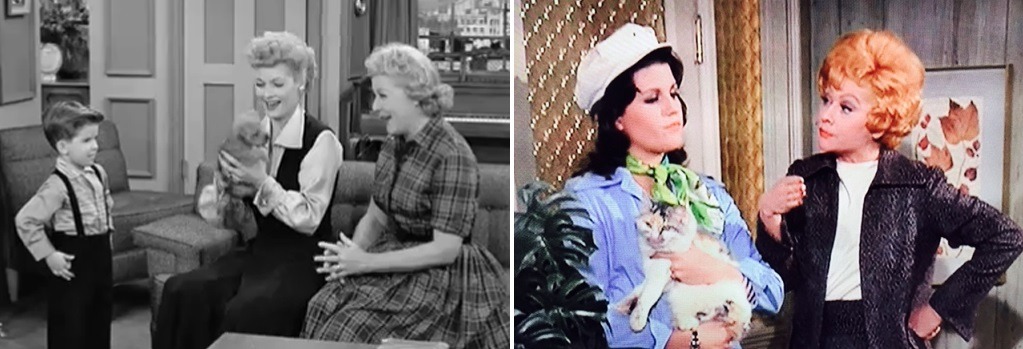
I LOVE LUCY episode “Little Ricky Gets a Dog” (1957), in which Lucy Ricardo’s son Little Ricky (Keith Thibodeaux) brings home a dog named Fred, who happens to share a name with his Godfather (William Frawley)….
HERE’S LUCY episode “Lucy Is N.G. as an R.N.” (1974), in which Lucy Carter’s daughter Kim (Lucie Arnaz) brings home a cat named Harry, who happens to share a name with her Uncle (Gale Gordon).
-
“Little Ricky Gets a Dog”

(S6;E14 ~ January 21, 1957) Directed by James V. Kern. Written by Madelyn Martin, Bob Carroll, Jr., Bob Schiller, and Bob Weiskopf. Filmed November 8, 1956 at Ren-Mar Studios. It was the 167th episode filmed. Rating: 45.1/61
Synopsis ~ Every boy wants a dog. Even if he already has a frog, two turtles, two parakeets, two goldfish, and a lizard (who fell – or jumped – out the window). When Lucy and Ricky reluctantly agree to let their son have a dog, they face the wrath of Fred and the threat of eviction.
The episode opens with Lucy in the kitchen feeding Little Ricky’s pets when Ethel drops by.
LUCY: “I wonder if this is the way Osa Johnson started?”

Lucy is referring to a mostly forgotten female explorer who made several feature-length wildlife documentaries and books with her husband, Martin E. Johnson. She also hosted television’s first wildlife show,NBC’s “Big Game Hunt” (1952), ten years before “Wild Kingdom.”

Lucy catalogs Little Ricky’s pets for Ethel as she is feeding them. Their names apparently are mostly show-biz inside references.
- The birds are Alice and Phil, named after Alice Faye and her husband Phil Harris. Harris would later turn up on “The Lucy Show” and “Here’s Lucy.”
- The turtles are Tommy and Jimmy, named after Tommy Dorsey and his brother, Jimmy Dorsey, bandleaders.
- The names for the fish – Mildred and Charles – are not as easy to identify; Mildred may refer to Carole Cook’s birth name, which Lucille Ball suggested she change to that of her great friend Carole Lombard.
- The frog is named Hopalong, a reference to the very popular television and film character of the time, Hopalong Cassidy, played by William Boyd.
Trying to get Charles out of the fish bowl to change the water, Lucy and Ethel try all sorts of tricks, including using Ethel’s hairnet as a strainer.
ETHEL: “Gregory Peck had less trouble with Moby Dick.”

Ethel is talking about Peck’s role as Captain Ahab in the 1956 film adaptation of Herman Melville’s classic novel, Moby Dick. The film opened in July 1956 and featured the Arnaz’s sometimes house guest Orson Welles, who played himself on an episode of “I Love Lucy” that was filmed just two weeks before the film premiered.

Little Ricky’s ‘BFF’ Billy Palmer gives him a puppy to take home. Billy Palmer will remain an off-screen character.

Lucy immediately calls Billy’s mother (another unseen character) who is named Lillian.

But abandons her intention to say ‘thanks, but no thanks’ when she sees her son with the puppy. Lillian was the name originally given to the character of Carolyn Appleby.

Ricky tries to tell his son he can’t keep the dog – but he, too, weakens. Fred (Mertz) is quick to point out a ‘no pets’ clause in the Ricardo lease.

This, despite the fact that he himself had a dog named Butch in “The Diet” (S1;E3, above) and that in “The Business Manager” (S4;E1) Mrs. Trumbull asks Lucy to buy a can of ‘All Pet’ (which Ricky mistakenly thinks is a stock called Canadian Allied Petroleum) for her cat. Like the others, Fred gives in when he hears Little Ricky say that he’s named the dog Fred.
LITTLE RICKY: “I always name my pets after people I like.”

Fred the dog was played by a Cairn Terrier named was Danny. He was trained by Bob Blair and was owned by Frank Inn.
Danny also played Fremont, Mr. Wilson’s dog on “Dennis the Menace” (1959-63). In films, he was Snuffy in Pal Joey (1957), Muffy in Anatomy of Murder (1959), and Pepe in the final Three Stooges short Sappy Bullfighters (1959). Blair and his son later formed The Blair Bunch, training dogs for pet food commercials while Inn discovered a famous pooch named Benji.
Fred the dog would make the move to Connecticut with the Ricardos, but the last time we see the parakeets and the goldfish is in “Lucy Hates to Leave” (S6;E16), just two episodes later.

When Lucy sings “Rockabye Baby” to Fred to lull him to sleep, Fred howls at her less-than-adequate vocals:
LUCY: “Alright, I’m no Dinah Shore. But you’re no Lassie either.”
Although Lucy would never team with Lassie, Dinah Shore guest-starred as herself on a 1971 episode of “Here’s Lucy.” Ball would also be a guest star on several editions of Dinah Shore’s talk shows.

Lassie, a border collie, was the star of her own series on CBS from 1954 to 1971 after completing a series of films. Although a female on screen, Lassie was actually played by a male collie named Pal (and Pal’s male offspring). Lassie is mentioned by Ricky in “Lucy Writes A Play” (S1;E17) and again in “Hollywood Anniversary” (S4;E23).

Outside the apartment building, Lucy had memorable encounters with such dogs as Richard Widmark’s St. Bernard, Cap, in “The Tour” (S4;E30),

…and Rocky the Bloodhound aboard the S.S. Constitution in “Second Honeymoon” (S5;E14), among others.
Lucille Ball was a great animal lover who owned many dogs during her life.

Her first was a little Fox Terrier named Whoopee that she got when she was just a teenager.

During her marriage to Desi Arnaz, the couple owned many dogs. There are numerous photos of her roaming around the Desilu Ranch with her two beloved Cocker Spaniels, one of which was named Pinto.

A grouchy new tenant played named Mr. Stewart (John Emery) seems to be the only one standing in the way of Fred (the dog’s) happiness.
John Emery (1905-64) was in 22 Broadway shows between 1934 and 1960, including playing Benvolio to Basil Rathbone’s Romeo, Leates to John Gielgud’s Hamlet, Caesar in Antony and Cleopatra starring Tallulah Bankhead, and the John Barrymore-like Tony Cavendish in a 1951 revival of The Royal Family, where on opening night he stumbled coming down a stair, tore ligaments in his ankle, and still played the last two acts! Watch the episode closely and his theatrical voice and gestures belie his stage background. He had not been seen on “I Love Lucy” since season 1, when he played a Tramp on “The Quiz Show” (S1;E5). He was also seen as a doctor in Forever, Darling which premiered just prior to the filming of this episode. From 1961, Emery was romantically involved with actress Joan Bennett, who cared for him during his final illness.

The plot of this episode strongly parallels “No Children Allowed” (S2;E22, above), where Mrs. Trumbull finds Little Ricky’s incessant crying as annoying as Mr. Stewart finds Fred the dog’s yelping. In the same way Pepito the clown provided the off-screen baby cry for that episode, noted voice artist June Foray provided the dog bark for this one.

June Foray (born June Lucille Forer in 1917) is best known as the voice of such animated characters as Rocky the Flying Squirrel, Natasha Fatale, Cindy Lou Who, Witch Hazel in the Bugs Bunny cartoons, Granny in the Tweety Bird cartoons, and many, many others.

When the dog is hiding under a huge sombrero, Lucy lies and says she’s been taking hat dancing lessons from Arthur Murray. She demonstrates a few quick steps. Lucy is referring to the dance studio, not its founder. Arthur Murray (1895 – 1991) was an American ballroom dancer and businessman.
Murray taught dance and franchised his dancing schools starting in 1925. He even had a television program from 1950 to 1960 called “The Arthur Murray Party.” The song “Cuban Pete,” which Ricky sang in “The Diet” (S1;E4), includes the line "And Cuban Pete don’t teach you in a hurry, like Arthur Murray.”

In the show’s sentimental send-off, just as Fred (Mertz) made an exception for Little Ricky in season 2, he also ends up making an exception for his canine namesake and sends Mr. Stewart on his way – returning his $200 check. Fred faints and the episode fades out!
A CLOSER LOOK

Lucy keeps Mildred and Charles in an Anchor Hocking one gallon glass fishbowl.
The Hocking Glass Company was founded in 1905, named after the Hocking River in Ohio. In 1937 they merged with AnchorCap and became one of the biggest producers of depression glassware.

The Ricardos have a Telechron bedside clock, (hexagonal The Dorm model) which gets its own close-up, filmed after the studio audience departed. Telechron was one of the most popular manufacturers of electric clocks between 1925 and 1956. The company opened in 1912 and went out of business in 1992. You’ll notice that the electric cord is not visible in the above shot. That’s because Telechron had always been self-conscious about their clocks’ cords. At clock shows, demonstrators would remove the cords so they’d look nicer. Catalog photos would never, ever show the cords after the novelty of electric power had passed (about 1930).

The center photo shows the Mertz Hotel Room in Monte Carlo during their trip to Europe. The same framed cameos turn up in both the Ricardo and Mertz apartments after they get home! Did they take home a few extra souvenirs?

In this episode, when Ricky is awakened by Fred’s (Foray’s) bark, we see that he has read Lobagola, a pseudo-biography published by Knopf in 1933.
Bata Kindai Amgoza ibn LoBagola was an early 20th-century American entertainer who posed as a native of Africa, his real name being Joseph Howard Lee from Baltimore, Maryland.

Perhaps Ricky was reading this book for research on his African show at the club?
Fast Forward!

“Lucy’s Contact Lenses” (TLS S3;E10) ~ November 23, 1964

“Lucy and the Bogie Affair” (HL S2;E13) ~ December 15, 1969
-
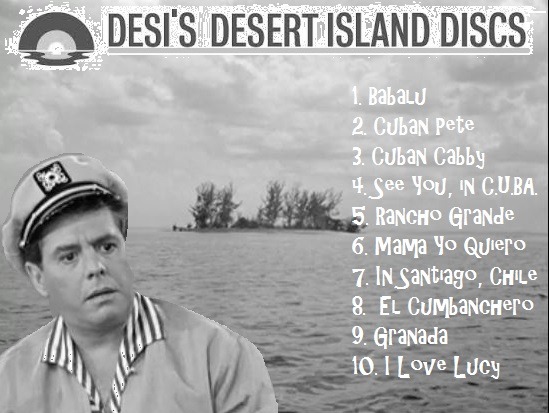
Desi’s Desert Island Discs (1956)
-
“Desert Island”

(S6;E8 ~ November 26, 1956) Directed by James V. Kern. Written by Madelyn Martin, Bob Carroll, Jr., Bob Schiller and Bob Weiskopf. Filmed October 4, 1956 at Ren-Mar Studios.
Rating: 46.7/63

Synopsis ~ To prevent the boys from judging a beauty contest, Lucy and Ethel come up with a plan that leaves the Ricardos and the Mertzes marooned on a tropical island.

The date this episode first aired (November 26, 1956) the main cast of “I Love Lucy” was in the city of New Orleans, Louisiana, to attend the Crippled Children’s Hospital’s Annual Ball at the Roosevelt Hotel. Before the ball, they were made honorary citizens for the day in the City Council Chambers, received the keys to the city, and had lunch aboard the Dock Board’s yacht. That evening they appeared at the Lyons Center before a crowd of 5,000 for an informal half-hour performance.

This is the second of several episodes that took the show to Florida and Cuba. During the summer of 1956, Lucy and Desi went on a publicity tour that included Miami, no doubt to firm up locations and sponsorship for their upcoming episodes. Although season 6 was originally announced as including a trip to New Orleans, the trip became Miami Beach and Havana after the publicity tour.
TITLE TROUBLE! The title of this episode is slightly incorrect. The island is not a DESERT island, but a DESERTED tropical island.
Due to the logistics of filming, this episode was not filmed in front of a live audience.

In 1939, Lucille Ball starred in a film titled Five Came Back in which a group of people were also stranded in the tropics. [Note: In this black and white film Lucille Ball was a brunette. The window card above was colorized giving Lucille Ball her now-trademark red hair, indicating that it was likely tinted nearly ten years after the release date, when Lucy adopted her legendary color.]

The day this episode first aired, a TV show that is still on the air today made its debut on NBC: “The Price is Right” hosted by Bill Cullen.

That day also marked the sad passing of bandleader Tommy Dorsey (above right), who co-starred with Lucille Ball in Du Barry Was A Lady (1943).

After fleeing Cuba in 1934, a 17 year-old Desi Arnaz called Miami home. This trip to Miami Beach has the gang staying at the luxurious Eden Roc Miami Beach Hotel, quite a step up from the poverty of Desi’s youth. Located at 4525 Collins Avenue, the real-life resort is still in operation today.

It first opened in 1956, making it virtually brand new when the Ricardos and the Mertzes stayed there. It was also featured in 1988’s Married to the Mob and 1995’s Just Cause.

The Eden Roc today and an insert photo from the show prove that not much has changed!

The Ricardos are in room 919. There is an 8 by 10 framed photograph of Little Ricky in the room, an odd thing to bring along on vacation, especially since Little Ricky is with them, not staying at home!

Ricky announces that he’s going to be in a film about the history of the state of Florida. The Sunshine State’s history begins in 1513 with its founding by Spanish explorer Ponce de León. Ricky says he will appear in the ‘modern’ scenes playing with his band in the hotel nightclub.
Fred is so excited to judge the beauty contest that he asks Ricky for a spritz of his eau de cologne.

ETHEL: “He hasn’t used eau de cologne since Lillian Russell came to town.”
Lillian Russell (1860-1922) was one of the most famous actresses and singers of the late 19th and early 20th centuries, known for her beauty and style, as well as for her voice and stage presence. Coincidentally, in 1947 William Frawley (Fred Mertz) was featured in My Wild Irish Rose, a film about Russell’s lover, Chauncey Olcott (Dennis Morgan) where Russell was played by Andrea King. In the late 1960s, Lucille Ball was announced to play Lillian Russell to Jackie Gleason’s Diamond Jim Brady in a film project that never materialized.

This episode utilizes extensive second unit footage in Miami Beach using doubles for the cast.
The rest of the scenes were re-created on a California sound stage using a water tank and rear projection for sea and sky.
Bathing beauty Jil Jarmyn (1926-87) was a sexy brunette who made more news with her private life than her public one. She filed assault charges against Susan Hayward alleging the star assaulted her in the bedroom of her former fiance. Under pressure from Hayward’s studio, Jarmyn reluctantly dropped the charges.

The other beauty was Joi Lansing (1928-72), a platinum blond who began posing at age 13 and attended MGM’s talent school at age 17. Her parents were devout Mormons who divorced when she was young. She was considered for the role that eventually went to Marilyn Monroe in All About Eve (1950). Most TV fans remember her as the wife of Lester Flatt on “The Beverly Hillbillies” from 1965 to 1968. She married Clark Kent (aka Superman) in a 1958 episode of “The Adventures of Superman” and might have become a regular had the series not ended when George Reeves died. Keith Thibodeaux (aka Little Ricky) recalled,
“I remember watching the chemistry between Joi Lansing and Desi, and Lucy’s reaction. Even at my age, I knew this couldn’t be good.”


FRED: “This Cruis Along is a dandy little boat, Rick!”
As in the previous episode, “Deep Sea Fishing” (S6;E7), the boats used were supplied by Cruis Along. In addition to the logo being clearly visible on the boat, Fred’s line gives the company verbal advertising. At some point, the company became a subsidiary of the Century Boat Company, which is still in business today.
In the story, Ricky and Fred are scheduled to judge a beauty contest, but Lucy has a scheme to prevent their attendance by only fueling up their boat with only half a tank of gas.

She plans to have a secret a fuel supply stowed away in a thermos. But when Ricky discovers the thermos of gasoline, he leaves it on the dock – leaving the Ricardos and the Mertzes adrift.
Sitcom Logic Alert! Lucy’s plan to have a spare thermos full of gasoline nearly poisons her own son! Luckily Fred smells something funny when pouring the ‘lemonade’ for Little Ricky!

Oops! The island in the second unit footage has a lot less vegetation than the one in the studio shots. Having an entire film crew operating ‘on the other side of the island’ without being seen or heard is unlikely!

They run aground on a deserted island (full of what Ricky calls “cock-a-nuts”) which turns out to be the location for a new documentary film about the history of Florida starring Claude Akins as a “giant native” and – of course – the bathing beauties from the newly re-scheduled beauty contest. Akins and the starlets all play ‘themselves.’

Claude Akins (1926-94) was the son of a police officer and appeared in nearly 180 films and TV shows in his 40 year career. He is perhaps best remembered as Sheriff Lobo in the 1970s television series “B.J. and the Bear.” He also appeared as a policeman in a 1967 episode of “The Lucy Show.”
In his autobiography, Keith Thibodeaux (Little Ricky) remembers that Akins had really bad breath!

Sitcom Logic Alert! When the bathing beauties show up on the ‘deserted’ island, Joi Lansing say that they needed extra girls for the picture. It is hard to imagine a scene set in 1513 when Ponce de Leon landed in Florida featuring either Lansing or Jarmyn.
Oops! When Fred swoops up Little Ricky to protect him from the ‘Giant Native’, Little Ricky’s captains hat falls off. He plays the rest of the scene without it.

Lucille Ball and Desi Arnaz threw a luau party on the island set after the episode was filmed.
FAST FORWARD~ Familiar Faces!

Claude Akins as Lieutenant Finch
in “Lucy Meets the Law” (TLS S5;E19).

Loi Lansing as Miss Long-Neck in “Lucy Wants a Career” (LDCH 1959).

On “The Danny Kaye Show” (1962), Lucille Ball and Danny Kaye encounter a Giant Native maître d’ at a Tahitian-themed restaurant who shrinks them down to pygmy size!

For most of its time on TV, “Gilligan’s Island” (1964-67) was on CBS just like “The Lucy Show.” Here are a few of the castaways that also appeared with Lucy.

Mrs. Thurston “Lovey” Howell III
Natalie Schafer as Phoebe Emerson in “The Charm School” (S3;E15)

The Skipper
Alan Hale Jr. as Moose Manley in “Lucy and Wally Cox” (HL S2;E21) in 1970.

Alan Hale Jr. as Captain Burke in “Lucy Puts Out a Fire at the Bank” (LS S2;E9) in 1963.

Director of “Here’s Lucy” Jack Donohue wasn’t on “Gilligan’s Island” but his costume certainly suggested it when he did a cameo in “Where Is My Wandering Mother Tonight?” (HL S6;E23) in 1974.

Thurston Howell III, The Millionaire
Jim Backus appeared with Lucille Ball in the films Easy Living (1949) and Critic’s Choice (1963).

Ginger, The Movie Star
Tina Louise co-starred with Lucille Ball in the TV special “Salute To Stan Laurel” in 1965.

The Professor
John Gabriel, who only played The Professor in the 1963 pilot and was replaced by Russell Johnson for the series, played Jack Thomas, “Mary Jane’s Boyfriend” (HL S6;E20), in 1974.

“Mr. and Mrs.” aka “The Lucille Ball Comedy Hour” (1964) was based on a play by Sherwood Schwartz, “Gilligan’s Island” creator and head writer.
“Lucy” and “Gilligan” also shared many character actors: Vito Scotti, Janos Prohaska, Hans Conreid, John McGiver, Strother Martin, Herb Vigran, and Sandra Gould.
 Bathing Beauties, Beauty Contest, Boating, Claude Akins, Cruis Along, Desert Island, Deserted Island, Desi Arnaz, Eden Roc, Eden Roc Hotel, Ethel, Florida, Fred, Fred Mertz, Giant Native, I love lucy, Jil Jarmyn, Joi Lansing, Keith Thibodeaux, Little Ricky, Lucille Ball, Lucy, Lucy Ricardo, Miami Beach, Richard Keith, Ricky, Ricky Ricardo, Vivian Vance, William Frawley
-
Subscribe
Subscribed
Already have a WordPress.com account? Log in now.
 Papermoon Loves Lucy