-
Lucy Takes a Job at the Bank
S2;E21
~ February 24, 1964

Synopsis
When
Jerry wants to buy a second-hand tuba, cash-poor Lucy talks Mr.
Mooney into giving her a job at the bank. All she has to do is hand
out toasters to people opening new accounts, but she has no success.
Lucy talks Audrey Simmons into withdrawing her money and then
re-depositing it again to stimulate business; but Audrey’s gossip
spreads a rumor that the bank is failing and starts a run on the
financial institution!Regular
Cast
Lucille
Ball (Lucy Carmichael), Vivian Vance (Vivian Bagley), Gale Gordon
(Theodore J. Mooney), Jimmy Garrett (Jerry Carmichael)
Candy
Moore (Chris Carmichael) and Ralph Hart (Sherman Bagley) do not
appear in this episode.Guest
Cast
Kathleen
Freeman
(Kathleen) was
‘born in a trunk’ to a family of vaudevillians. She made her
stage debut at age two in her parents’ act. Equally at home on
screen and stage, Freeman was appearing on Broadway in The
Full Monty in
2001 when she died of lung cancer. This is the second of her five
appearances in various character roles on “The Lucy Show.”
Freeman appeared in the previous episode “Lucy and Viv Open A
Restaurant” (S2;E20) as Olga the cook.Kathleen’s
husband’s name is Charley.
Mary
Jane Croft (Audrey
Simmons) played Betty Ramsey during season six of “I Love Lucy.”
She also played Cynthia Harcourt in “Lucy
is Envious” (ILL S3;E23)
and
Evelyn Bigsby in “Return
Home from Europe” (ILL S5;E26).
She played Audrey Simmons for eight episodes. When Lucy moves to
California, she will play Mary Jane Lewis (the actor’s married
name) until the series finale. Her husband Elliott Lewis was a
producer of “The Lucy Show” from 1962 to 1964. She also played a
character named Mary Jane Lewis on “Here’s Lucy” from 1969 to
1974. Her final appearance with Lucille Ball was in “Lucy Calls The President” (1977).
Carole
Cook (Thelma
Green) makes her penultimate appearance playing Thelma Green, although she
will play a variety of other characters in a dozen other episodes.
Lucille Ball took Cook as a protégé during the Desilu Playhouse
years. Although she was born as Mildred Cook, Ball suggested she take
the name Carole, in honor of Lucy’s great friend, Carole Lombard.
Cook also went on to appear in five episodes of “Here’s Lucy.”James
Gonzales
(Bank Teller) was
a popular Hollywood extra who first acted with Lucille Ball in the
1953 film The
Long, Long Trailer.
He was previously seen on the series as Stan Williams in “Lucy
Digs Up a Date” (S1;E2).
He was seen in more than 20 episodes of “The Lucy Show” and 3
episodes of “Here’s Lucy.” In this episode, he has a line when
ordering dinner.William
Meader
(Bank Teller) had
appeared as an airport extra in “The
Ricardos Go to Japan,”a
1959 episode of “The Lucy-Desi Comedy Hour.” He made many
appearances on “The Lucy Show,” most times as a clerk in Mr.
Mooney’s bank.
Bobby
Gilbert
(Bank Customer)
was born Robert Wolf in
1898. A
vaudeville actor, he was one of the first performers to play the
South Pacific on USO tours during WWII.
He was an extra in such hit films as Some
Like It Hot
(1959), How
To Succeed in Business
(1967), Thoroughly
Modern Millie (1967)
and Bednobs
and Broomsticks
(1971). This is the first of his two appearances on “The Lucy
Show.”Judith
Woodbury (Bank
Customer) makes the second of her eight (mostly) uncredited
appearances on “The Lucy Show.” She also appeared in one episode
of “Here’s Lucy.”Tony Dante (Bank Customer, uncredited) made more than 20 uncredited appearances on Desilu’s “The Untouchables.” This is one of his two episodes of “The Lucy Show.” He also did one episode of “Here’s Lucy” in 1970.
Victor Romito (Bank Customer, uncredited) was seen as the Bartender in “Lucy Meets John Wayne” (S5;E10). He also appeared in four episodes of “Here’s Lucy.” Romito was an extra in the 1960 Lucille Ball / Bob Hope film Critic’s Choice and in Mame (1974).
The
Bank Security Guard (“George”) is played by an uncredited actor.
More than a dozen other uncredited background performers play the
bank’s customers (including a bridal party, dentist and patient, and
woman with a shopping cart) as well as the bank staff.
Although
Jerry has saved half from his allowance, a second hand tuba will cost
$60. This is the equivalent of more than $500 today.
The
Danfield Bank has assets of over 8 million dollars and was founded in
1899, 65 years longer than any other bank in town.
Viv
has had her money in the Murray Hill Bank in New York City for the
last 20 years.
When
everyone thinks there’s a run on the bank, Viv shouts: “It’s
1933 all over again!” United
States money supply decreased substantially between October 29, 1929
(Black
Tuesday, the stock market crash that began the great depression) and
March
1933, when
there were massive bank
runs across
the United States.Although
Lucy’s job at the bank is part-time and ends with this episode, Lucy
Carmichael will eventually join the staff of Mr. Mooney’s bank as his
secretary. In “Here’s Lucy” Lucy Carter is also an employee of
Gale Gordon’s character, Harrison J. Carter.
A
clip of Lucy going up (and down) through the trap door was included
in the season three opening credit sequence.Callbacks!


Lucille
Ball frequently used a ‘pop-up’ toaster for comic effect in many
episodes of “I Love Lucy.”Blooper
Alerts!

Groundhog Day! The
edition of The Danfield Tribune that Lucy consults for her job search
has the same headline (“Hospital Fund Reaches Goal”) as the one
seen in “No More Double Dates” (S1;E21).
Spelling Bee! Mary
Jane Croft is incorrectly credited as “Mary Jean Croft” in the
closing credits. Carole Cook’s name is also mis-spelled as “Carol
Cook.”
“Lucy Takes a Job at the Bank” rates 3 Paper Hearts out of 5

-
Lucy and Viv Open a Restaurant
S2;E20 ~ February 17, 1964

Synopsis
Lucy
talks Viv buying a run-down cafe. Unable to attract even a single
customer, they transform it into a gypsy tea room and then a
Colonial themed restaurant – all to no avail. When Mr. Mooney
learns a highway will be built nearby, he offers to become a
partner. Unfortunately, blasting for the highway ruins both the
café and any chance for success.Regular
Cast
Lucille
Ball (Lucy Carmichael), Vivian Vance (Vivian Bagley), Gale Gordon
(Theodore J. Mooney)Candy
Moore (Chris Carmichael), Ralph Hart (Sherman Bagley) and Jimmy
Garrett (Jerry Carmichael) do not appear in this episode. Jerry,
however, is mentioned.Guest
CastKathleen Freeman (Olga, the Cook, below left) was ‘born in a trunk’ to a family of vaudevillians. She made her stage debut at age two in her parents’ act. Equally at home on screen and stage, Freeman was appearing on Broadway in The Full Monty in 2001 when she died of lung cancer. This is the second of her five appearances in various character roles on “The Lucy Show.”
This episode was first aired on Freeman’s 45th birthday!
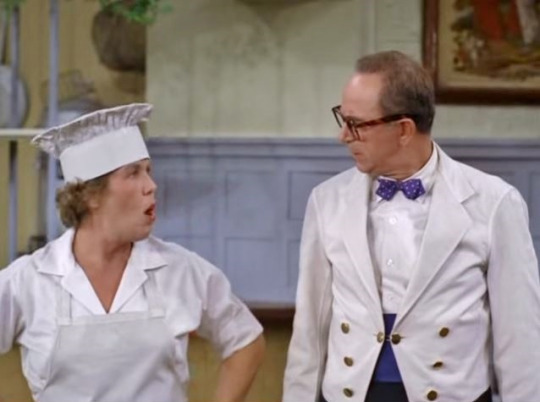
Jack
Albertson
(Herbert, the Waiter, above right) played the airport dispatcher arranging the
helicopter when Lucy misses the ship in “Bon Voyage” (ILL
S5;E13). He went on to
win a 1969 Oscar for The
Subject Was Roses.
He would also play Grandpa Joe in the 1971 movie Willy
Wonka & the Chocolate Factory,
but
is perhaps best known as ‘the man’ on the TV series “Chico and
the Man,” which won him a 1974 Emmy.
Alan
Hewitt
(Mr. Dutton, Society Columnist for the Danfield Tribune) was a
veteran of sixteen Broadway shows, including the original production
of Death
of a Salesman
(1949) and Call
Me Madam
starring Ethel Merman (1950). From 1964 to 1966 he played Detective
Brennan on “My Favorite Martian.” This is his only appearance
opposite Lucille Ball.Benny
Rubin
(Mr. Smith, Linen Supplier, below center) played
the snarky Hollywood Bus Driver in “The
Tour” (ILL S4;E30).
His first “Lucy Show” appearance was in “Lucy and the Runaway
Butterfly” (S1;E29). The recognizable character actor is probably
best remembered for his association with Jack Benny.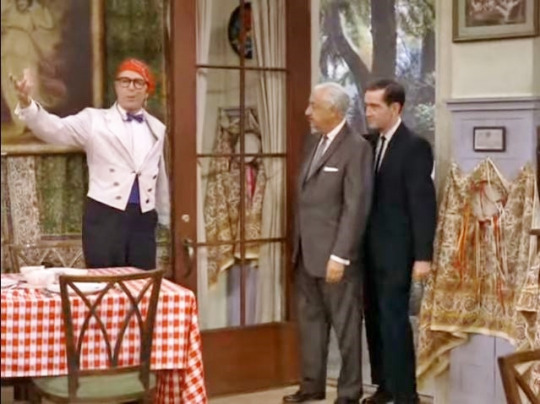
Jay
Ose
(Mr. Jones, Linen Supplier, above right) made a career combining gambling and up
close magic involving cards. He was a favorite at Hollywood’s Magic
Castle Club. In this episode, he demonstrates his skills by pulling
the table clothes off the tables without disrupting the place
settings. Ose has no dialogue; Rubin does all the talking for the
pair.Rubin
and Ose are not referred to by their last names in the episode. At
one point, however, Rubin does call Ose “Charley.”
Sid
Gould (Mailman)
made
46 appearances on “The Lucy Show,” all as background characters.
He also played a Mailman in “Lucy and the Military Academy”
(S2;E10). He did more than 40 episodes of “Here’s Lucy.” Gould
(born Sydney Greenfader) was Lucille Ball’s cousin by marriage to
Gary Morton. Gould was married to Vanda Barra, who also appeared on
“The Lucy Show” starting in 1967, as well as on “Here’s
Lucy.”James
Gonzales
(Mr. Dutton’s Dinner Guest) was
a popular Hollywood extra who first acted with Lucille Ball in the
1953 film The
Long, Long Trailer.
He was previously seen on the series as Stan Williams in “Lucy
Digs Up a Date” (S1;E2).
He was seen in more than 20 episodes of “The Lucy Show” and 3
episodes of “Here’s Lucy.” In this episode, he has a line of dialogue when
ordering dinner.William
Meader
(Mr. Dutton’s Dinner Guest) had
appeared as an airport extra in “The
Ricardos Go to Japan,” a
1959 episode of “The Lucy-Desi Comedy Hour.” He made many
appearances on “The Lucy Show,” most times as a clerk in Mr.
Mooney’s bank. In this episode, he has a line of dialogue when ordering dinner.Three
uncredited women play Mr. Dutton’s other dinner guests.
This episode was filmed on December 19, 1963, the last before the holiday hiatus. The final draft of the script was dated December 12, 1963. It was the 50th episode of the series to be filmed. Although filmed in color, CBS originally aired it in black and white.

The night this episode originally aired (Monday, February 17, 1964) opposite “The Lucy Show” on ABC, “Wagon Train” featured Eliva Allman (left) Marjorie Bennett (center), and Amzie Strickland (right), all of whom had been seen on “I Love Lucy” and “The Lucy Show.”
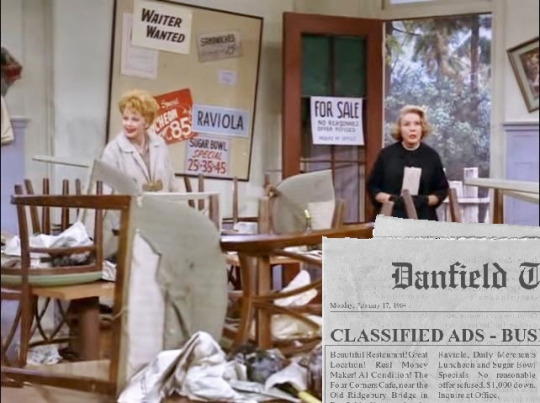
Lucy
responds to an ad in the Danfield Tribune.“For
Sale: Beautiful Restaurant! Great Location! Real Money-Maker! A-1
Condition!”Viv
puts down $1,000 of her ‘nest egg’ to buy the restaurant.VIV:
“If
I want to spend a thousand dollars for a meal, I’ll rent a couple of
togas and fly in Cary Grant for a Roman banquet.”
Viv may be referring to the 1961 romantic comedy Come September, starring Cary
Grant and Gina Lollobridgida and set in Italy. The handsome actor was first mentioned on the series in “No More Double Dates”
(S1;E21). He was mentioned in four episodes of “I Love
Lucy,” all during the gang’s stay in Hollywood.
Lucy and Viv’s newly refurbished Four Corners Cafe brings in no customers in five days of being “Under New Management”!
Chef Olga’s Advice: “Push the lobster. In one more day he has to go bye-bye.”
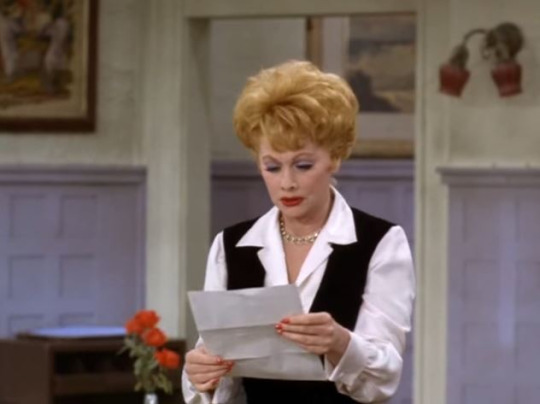
Lucy
and Viv apply for a GI Loan due to their service in the WAVES. Viv
says ‘serving their country’ consisted of typing eight hours a day in
the Navy purchasing department. Lucy and Viv’s experience in the
WAVES was established in “Lucy Becomes an Astronaut” (S1;E6).
Unfortunately, they discover they are one week past the ten year
window of eligibility. The special delivery letter from the
Veteran’s Administration is signed John Foley. In real life, John
Foley was the name of the series’ editor.LUCY: “How about making it a Spanish restaurant?
VIV: “Great! How about calling it El Fiasco.”They settle on a Gypsy Tea Room serving Hungarian fare.
The Gypsy Tea Room – In “No More Double Dates” (S1;E21) Lucy wanted to go to a restaurant called Café Tambourine.
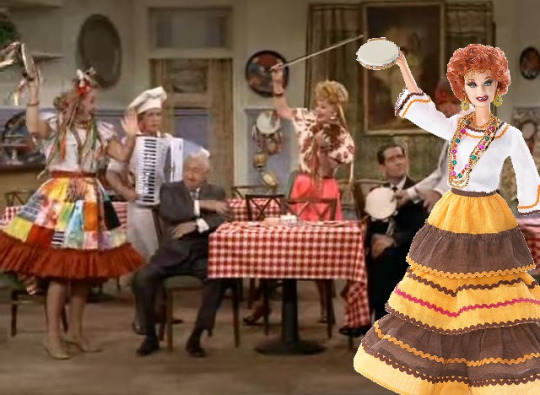
Chef Olga’s Advice: “Push
the Hungarian Goulash.”Lucy
Ricardo played Camille, the snaggle-toothed Queen of the Gypsies in
“The Pleasant Peasant” during the episode “The Operetta” (ILL
S2’E5). This time, Lucy plays the violin while Viv has the
tambourine. Lucy Carmichael first played the violin in “Lucy the
Music Lover” (S1;E8). Lucille Ball learned to play violin for that
episode, but only managed to muster a squeaky rendition of “Twinkle
Twinkle Little Star.” In this episode, Lucille Ball is not
actually playing.
When the Gypsy Tea Room doesn’t work out, they change to an Early American motif, complete with the George and Martha as greeters.
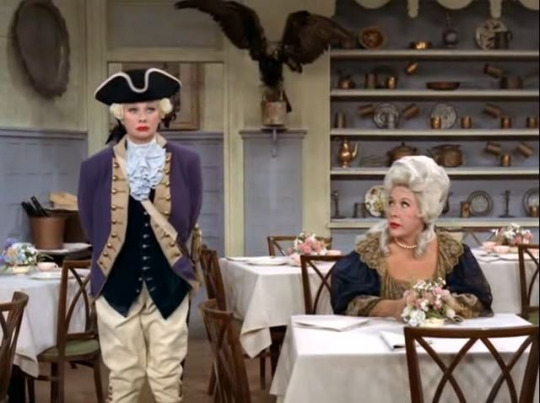
The
Colonial Inn
– This was also the name of a Colonial-themed establishment mentioned
in “No More Double Dates” (S1;E21).Chef Olga’s Advice: “Push the Yankee Pot Roast.”

Before
quitting, Olga suggests that Viv (dressed as Martha Washington) close the
restaurant and open a candy store. The
Martha Washington Candy
stores were a national chain started in the 1890s, selling ice cream
and chocolates, and furnished in an early American motif. By their
peak in the twenties, there were several hundred stores across the
country, but the Depression and the death of their founder hit them
hard and most of the stores had closed by the mid-thirties, although
a few lingered into the mid-forties.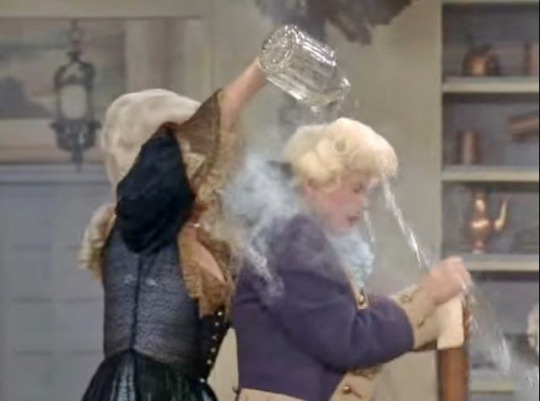
The
writer of the society column for the Danfield Tribune comes to the
Colonial Inn because the bridge to Ridgebury is out. In “Lucy
Becomes a Reporter” (S1;E17) Lucy fills in for The Danfield
Tribune’s society column editor Betty Gillis.
Mr.
Mooney mentions that the new highway to New Rochelle will bypass
Brewster and tunnel through Stone Mountain providing the restaurant
lots of potential customers. Or so he thinks!
Genealogists say that Lucille Ball is a distant cousin of George Washington!

Lucille Ball in front of the show curtain for publicity stills. (photos by Getty Images)
Callbacks!

This
story resembles “The Girls Go Into Business” (ILL S3;E2), where
Lucy and Ethel buy Hanson’s Dress Shop, which becomes a potentially
much bigger real estate deal when a developer wants to turn the
property into a skyscraper. In “The Diner” (ILL S3;E27) the Ricardos and the Mertzes
partnered to open a restaurant: A Little Bit of Cuba / A Big Hunk of
America.
The bank of wooden ice box doors glimpsed in the kitchen area are the same units used on “I Love Lucy” in “The Diner”, in Tony’s during “The Black Wig”, and in the kitchen of the unnamed Italian restaurant in “Equal Rights”!
Fast Forward!

George Washington (Don Wilson) dropped by for a word with Mr. and Mrs. Paul Revere (Lucy and Jack Benny) on “The Jack Benny Program” in October 1964, eight months after “Lucy and Viv Open A Restaurant”.

The construction of a new highway through town is what galvanizes Lucy Carmichael and all of Bancroft into action in “Main Street U.S.A.” and “Lucy Puts Main Street On the Map” during season five.

Mr. Mooney briefly appeared as ‘the Father of His Country’ (in painting form) when “Lucy Gets Mooney Fired” during season six.
Blooper
Alerts!Memory Lapse! Viv
says they started to live together six years ago. Just ten shows
earlier, in “The Loophole in the Lease” (S2;E12), Lucy said
they had lived together for 5 years.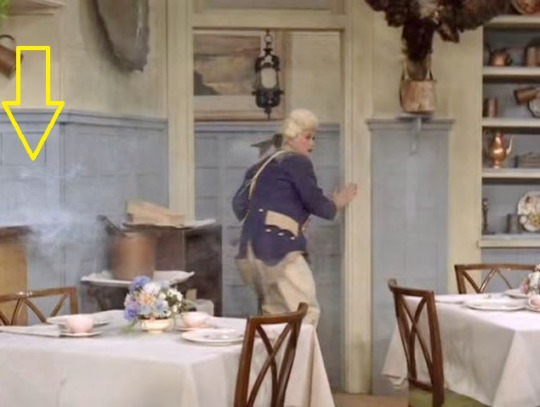
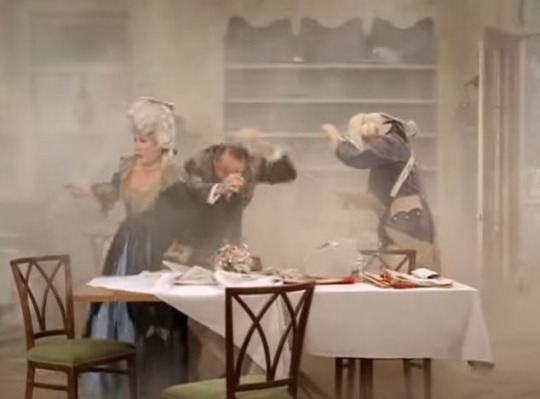
Where There’s Smoke… When
Lucy backs into the candle setting her wig on fire, the smoke is
clearly emanating from the wall panel behind her, even after she
moves away. Also, the ‘smoke’ behaves very much like dry ice,
clinging to the counter top.
“Lucy and Viv Open a Restaurant” Rates 4 Paper Hearts out of 5
-
Ethel Merman and the Boy Scout Show
S2;E19 ~ February 10, 1964

Synopsis
When
Ethel Merman headlines the Annual Boy Scout Show, Lucy and Viv are
relegated to being costumers. Feeling sorry for them, Merman agrees
to share the spotlight.Regular
Cast
Lucille
Ball (Lucy Carmichael), Vivian Vance (Vivian Bagley), Gale Gordon
(Theodore J. Mooney), Ralph Hart (Sherman Bagley) and Jimmy Garrett
(Jerry Carmichael)Candy
Moore (Chris Carmichael) does not appear in this episode.Guest
Cast
Ethel
Merman was
born in Queens, New York, in 1908. Known
primarily for her powerful belt voice and roles in musical
theatre,
she has been called ‘the undisputed First Lady of the musical comedy
stage.’ Among her many stage credits are: Anything
Goes (1934),
DuBarry
Was a Lady (1939),
Annie
Get Your Gun (1946),
Call
Me Madam (1950),
and Gypsy
(1959).
“There’s No Business Like Show Business” from Annie
Get Your Gun
became her signature song. It was also the title of a 1954 movie
musical starring Merman. Hollywood was not always friendly to Merman,
who was replaced for the film versions of Annie
Get Your Gun
(1950) by Betty Hutton, Gypsy
(1962) by Rosalind Russell, and Dubarry
Was A Lady (1943)
by Lucille Ball! Dubarry
Was A Lady
also included the song “Friendship,” which was featured in “Lucy
and Ethel Buy the Same Dress” (ILL S3;E3). In 1934 Ball and Merman
co-starred with Eddie Cantor in the film Kid
Millions.
Merman recreated her stage performances on TV in “Panama Hattie”
(1954) and “Annie Get Your Gun” (1967). Merman died in 1984 from
a long illness after a brain tumor.
LUCY: “You’d think she was the biggest star on Broadway.”
VIV: “She is.”
This
was the second of two episodes to feature Ethel Merman. Originally,
they were intended to be one episode, filmed on December 5, 1963, but
the material seemed rushed and the stars were enjoying the work so it
was decided to expand into a second episode. The first draft of this script was dated November 20, 1963 with pink and blue pages (updates and changes) from December 1963.
The previous episode (which originally had this episode’s title) was re-titled
“Lucy Teaches Ethel Merman To Sing” and the final scene of it was
rewritten to lead into this one. However, due to Merman’s schedule,
it wasn’t filmed until a month later. By that time, Lucy had started
wearing a new wig, Viv was tanned from a Christmas vacation,
and Merman had changed her hair color. In between the two episodes,
Desilu produced “Lucy Plays Florence Nightingale” (S2;E14), “Lucy
Goes To Art Class” (S2;E15) and “Chris Goes Steady” (S2;E16).These two Ethel Merman episodes were re-run on CBS on May 24 and June 1, 1964.

Lucy
was a big fan of Ethel Merman and offered her a guest spot after her
Desilu pilot “Maggie Brown” was not picked up for series.
Lucille Ball and Gary Morton attended the filming of the pilot and
Merman also was in the audience for an episode of “The Lucy Show.”
On the DVD extras, Jimmy Garrett recalls that Lucille Ball caught
him watching filming from the wings and whispered “Watch
very carefully. You’ll never see anyone better.”
Vivian
Vance understudied Ethel Merman as Reno Sweeney in the 1934 Broadway
musicals Anything
Goes
and Red, Hot and
Blue (1936),
both by Cole Porter.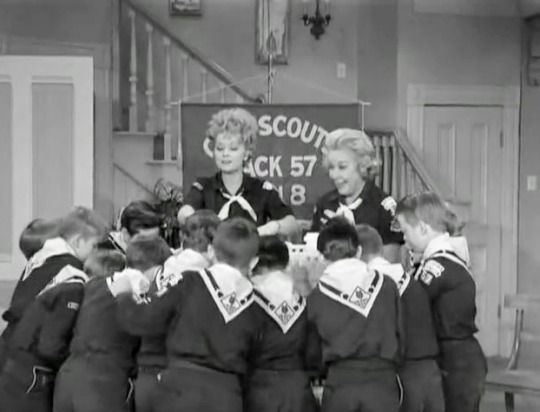
Merman
is living with Lucy and Viv while she’s in Danfield. Lucy
and Viv were established as den mothers of their sons’ scout troupe
in “Lucy
Visits the White House” (S1;E25).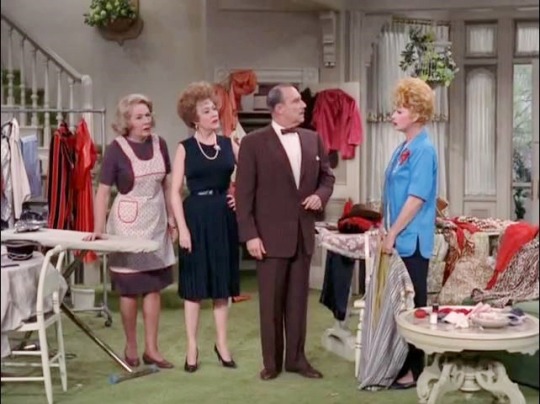
Mr.
Mooney’s daughter Rosemary, who lives in Trenton, New Jersey, is
about to give birth to his first grandchild.
This is the fourth Mooney child to be mentioned on the series:
Arnold, Bob, Ted Jr. and Rosemary. Like her mother, Irma, Rosemary
is never actually seen. Lucille Ball briefly lived in Trenton, New
Jersey, as an infant.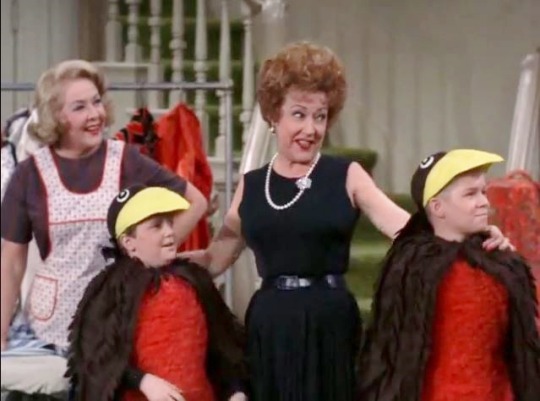
In
the living room, Merman sings a few bars of “Red, Red Robin” with
Jerry and Sherman dancing around her in bird costumes. “When
the Red, Red Robin (Comes Bob, Bob, Bobbin’ Along)”
was a 1926 popular
song written
by
Harry
Woods.
It
was a big hit for Al Joleson, Bing Crosby, and Doris Day.When
Viv demands Lucy finish her costume right away, Lucy calls her a
“wicked stepsister” – a reference to the fairy tale “Cinderella.” The line gets a large round of applause from the studio audience.
Lucy
says the old manual sewing machine belongs in the Betsy Ross museum.LUCY: “When I looked at the bobbin it was full of red, white, and blue thread.”
Coincidentally, as Lucy says this, she is wearing a blue shirt, with red and white tape measures around her neck.

Elizabeth ‘Betsy’ Griscom Ross
(1752–1836) is widely credited with making the first American
flag. Although there is no actual Betsy Ross museum, the Betsy Ross
House on Arch Street in Philadelphia is the location where she
supposedly sewed the first flag, although this fact (and her
residence there) is disputed by many historians. Betsy Ross was a character on “The Jack Benny Program” in 1964 (above) when Lucy played Mrs. Paul Revere!
Lucy tearfully tells Merman she’s always dreamed of having her ‘name up in lights’. She tediously spells out her full name: “L-U-C-I-L-L-E C-A-R-M-I-C-H-A-E-L”. Ethel replies “If you ever get to Broadway, you’ve got to get a shorter name!” Not coincidentally, Ethel Merman herself shortened her name for the marquee: she was born Ethel Agnes Zimmermann!
THE ANNUAL BOY SCOUT SHOW

- Sherman does an acrobatic dance routine as an opening act
In “Lucy the Music Lover” (S1;E8), Sherman did a quick ballet dance through the living room to impress Lucy’s date. Ralph Hart was also a musical theatre performer, seen in the film musicals Gypsy, The Music Man, and Bye Bye Birdie.
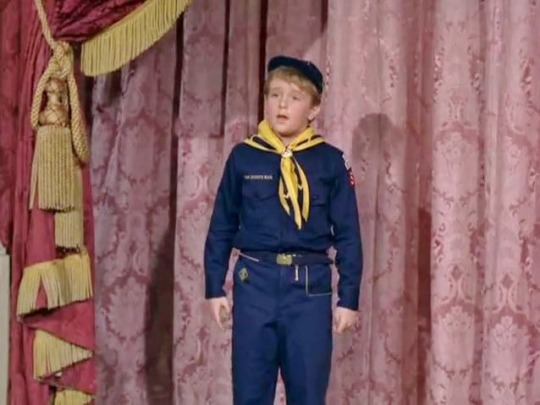
- Jerry
(in his scout uniform), tells a joke.
From
his first audition for the series, Lucille Ball thought that Jimmy Garrett’s dry
delivery of his lines was hysterical.The adult performers alternate in providing linking narration and paging the stage curtain to transition to the next act. Technically, the Boy Scout Show does not run in one continuous cut. The paging of the curtain allows for subtle edits in the film to piece together what were separate takes.

- Merman,
Lucy, Viv and Mr. Mooney sing “There’s No Business Like Show
Business”
The song is from Irving Berlin’s Annie Get Your Gun (1949).
It will also be sung again the the Boy Scout Show’s finale. Jerry
spoke the title in the previous episode “Lucy Teaches Ethel Merman
To Sing” (S2;E18).VAUDEVILLE
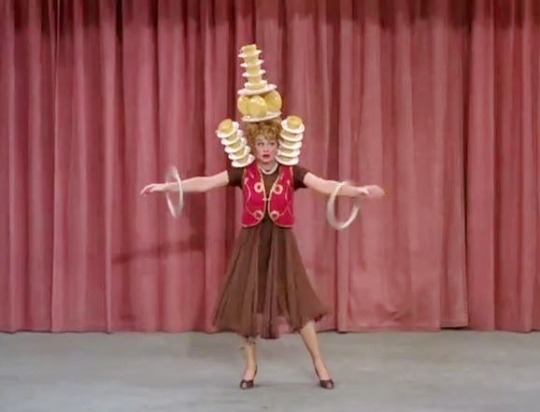
- Lucy
does a quick juggling act.
The
plates are obviously rigged for comic effect.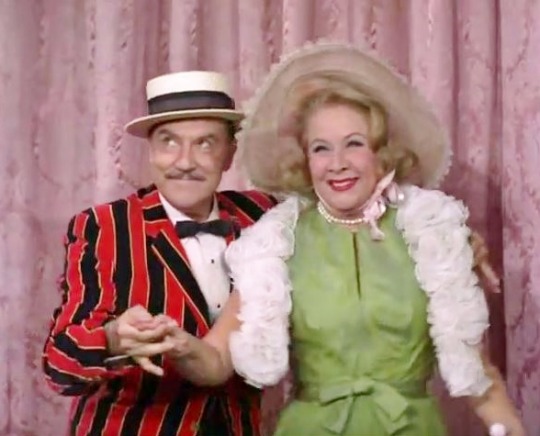
- Mr. Mooney and Viv sing “Tiptoe Through the Tulips”, which was originally to be sung by Mr. Mooney and his wife Irma, had she not had to go to Trenton for the birth of their grandchild.
“Tiptoe Through the Tulips (with Me)” was composed by Joe Burke with lyrics by Al Dubin for the 1929 film Gold Diggers of Broadway. In 1968, it was sung by Tiny Tim, whose version charted at #17, becoming his signature song. Due to its resurgence in popularity, the title was also mentioned on several episodes of “Here’s Lucy”.
THE FLICKERS (aka SILENT MOVIES)

- Lucy, Mr. Mooney, and Ethel Merman perform a silent movie sketch about a husband leaving his wife for another woman.
The sketch is pantomimed to honky-tonk piano accompaniment.
THE TALKIES

- Viv
as Shirley Temple sings “On the Good Ship Lollipop”. Vivian Vance, an accomplished singer, makes a concerted effort to satirize the mannerisms and vocal limitations of a child performer like Shirley Temple.
“On
the Good Ship Lollipop”
was composed by Richard
A. Whiting
with
lyrics by Sidney
Clare.
It was the
signature
song
of
child actress Shirley
Temple,
who first
sang it in the 1934 movie Bright
Eyes.
Shirley
Temple
was mentioned on “I Love Lucy” in 1955’s “The Tour” (ILL
S4;E30), by which time the former child star was married and known as
Shirley Temple Black.BROADWAY MUSICALS
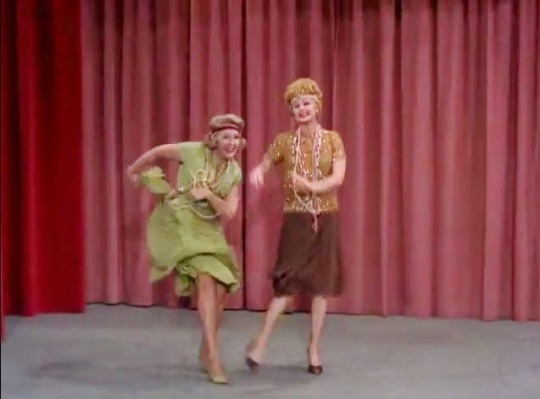
- A
tribute to 1920s stage musicals features Lucy, Viv, Ethel Merman and
Mr. Mooney
In
“Lucy Teaches Ethel Merman How To Sing” (S2;E18), Viv suggested
dancing the Charleston
for the Boy Scout Show, but the idea was shot down by producer
Sherman. The
sketch also features Gale Gordon doing a cartwheel, something he
would do in future ‘show-within-a-show’ episodes. After being jilted,
Lucy sings a few bars of “Am
I Blue?”
a
song written by Harry
Akst
and
Grant
Clarke
in
1929. It has since become a standard, covered by many musical
artists. The
sketch ends happily with Merman singing the final notes of her hit “I
Got Rhythm”, a song she originated in the 1930 Gershwin musical
Girl
Crazy
and also sang in the previous episode.RADIO

- Mr. Mooney is a radio host presenting a lady saxophone player (Lucy) from Altoona, Pennsylvania, playing
“Glow Worm” (badly)
“The
Glow-Worm”
is a song from Paul
Lincke’s
1902 operetta Lysistrata.
It was also used in the 1907 Broadway musical The
Girl Behind The Counter.
Lucille
Ball had briefly played the saxophone as a child. During the radio sequence Mr. Mooney says “Round
and round she goes! Where she stops, nobody knows!”
This was a quote from “Ted
Mack’s Amateur Hour”
a
radio
and
TV talent show that began in 1934. A wheel of fortune was spun to
determine the order
of the performers and while it was spinning, Mack intoned the
now-famous line. The show officially ended in 1970 but was revived
briefly in 1993. Before entering television, Gale Gordon was the highest paid radio performer in Hollywood. Lucille Ball was also a radio performer with her own series “My Favorite Husband.”TELEVISION
- A
tribute to “The Ed Sullivan Show” and its showcase of variety acts
To show the cyclic nature of entertainment, Lucy
repeats the same exact juggling act she did at the start of the show.
Ed
Sullivan hosted
an immensely popular variety show on CBS from 1948 to 1971. Up until
1955 it was called “Toast of the Town.” Ethel Merman
frequently appeared on “The Ed Sullivan Show,” often singing her
signature songs.FINALE
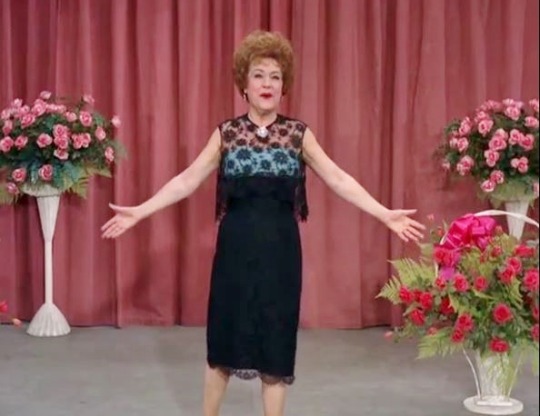
- Ethel
Merman sings “Everything’s Coming Up Roses”
“Everything’s
Coming Up Roses”
is a song introduced by Merman in the 1959 Broadway musical Gypsy
with music by Jule Styne and lyrics by Stephen Sondheim. Merman sang
the song throughout her career, even to a disco beat!
- Everyone joins in for a reprise of “There’s No Business Like Show Business”

After
the filming was complete, Merman recalled that she and Vance went to
Lucille Ball’s house for some girl talk and Lucille styled their hair
– to disastrous results. Ball also threw Merman a bridal shower (above) before her month-long marriage to Ernest Borgnine in 1964.Callbacks!

Lucy
Ricardo used a sewing machine for the first time in “Lucy Wants New
Furniture” (ILL S2;E28).
Cheesy vaudeville gags such Lucy’s rigged plate juggling were an integral part of the finale of “Ethel’s Home Town” (ILL S4;E15). Fred and Ethel Mertz were former vaudevillians.

In “Lucy Has Her Eyes Examined” (ILL S3;E11), Lucy Ricardo and the Mertzes burst into an a capella rendition of “There’s No Business Like Show Business” in an impromptu audition for Mr. Parker, a Broadway producer. The song would also be quoted (not sung) by Lucy Ricardo in “Baby Pictures” (ILL S3;E5).

“When the Red, Red Robin (Comes Bob, Bob, Bobbin’ Along)” was sung by Fred Mertz (William Frawley) in “Lucy and Ethel Buy the Same Dress” (ILL S3;E3) and later by Lucy Carter in “Guess Who Owes Lucy $23.50″ (HL S1;E11).

Lucy also played “Glow Worm” on “The Saxophone” (ILL S2;E2) and in “Lucy’s Club Dance” (ILL S3;E25). It was the only song she knew, until it was inexplicably “Sweet Sue” during season six!

LUCY: “Well, you see, Ethel. All my life I’ve wanted to be in show business!”
Lucy
sobs in front of Ethel Merman because all her life she wanted to be in the show, something Lucy Ricardo also did many times on “I Love Lucy.” The above line might easily have been spoken to Ethel Mertz or Ricky, instead of Merman.
When Merman agrees to give up one of her numbers for Lucy to be in the show, Viv asks Lucy if she would really let a big star like Merman do such a thing. Lucy lets out a high-pitched “Weeeelll” the same way that Lucy Ricardo often did.

In 1954, “The Ed Sullivan Show” (aka “Toast of the Town”) devoted an entire hour to Lucy and Desi. Sullivan’s name and his show were mentioned several times on “I Love Lucy.”

Lucy and Viv Charleston at the start of the ‘Broadway Musicals’ section of the Boy Scout Show. On “I Love Lucy” Lucy, Ricky, Fred and Ethel Charleston at the end of “Lucy Has Her Eyes Examined” (ILL S3;E11).

This is the second time a silent film skit has been part of “The Lucy Show.” The first was with Lucy as Charlie Chaplin during “Chris’s New Year’s Eve Party” (S1;E14).
Fast Forward!

Those red, red robins just keep bob, bob, bobbin’ again in “Kim Moves Out” (HL S4;E20) in 1974.

The Charleston never goes out of style, as demonstrated by Lucy and Kim Carter when “Ginger Rogers Comes to Tea” (HL S4;E11) on “Here’s Lucy” in 1971.
Blooper Alerts!

Flown the Coop! Although, Ethel Merman has Lucy make 24 robin costumes so that she can sing “When the Red, Red Robin” while the scouts dance around her, the song is not in the finished show!

Bulldog Cement? After
the 1920’s stage musical segment, Mr. Mooney’s false mustache is
falling off. It may have been due to spirit gum not adhering to Gale
Gordon’s own mustache or it may have been done for comic effect.
“Ethel Merman and the Boy Scout Show” rates 5 Paper Hearts out of 5
 1964, Am I Blue, Boy Scouts, CBS, Charleston, Cub Scouts, Ethel Merman, Ethel Merman and the Boy Scout Show, Everything’s Coming Up Roses, Gale Gordon, Glow Worm, Jimmy Garrett, juggling, Lucille Ball, On the Good Ship Lollipop, Radio, Ralph Hart, Roaring 20s, Saxophone, Shirley Temple, show business, silent movies, Ted Mack Amateur Hour, The Ed Sullivan Show, The Lucy Show, THere’s NO business Like Show Business, Tiptoe Through the Tulips, tv, Vaudeville, Vivian Vance
 -
Lucy Teaches Ethel Merman To Sing
S2;E18
~ February 3, 1964

Synopsis
When
Jerry and Sherman are producing their boy scout talent show, they ask
Lucy to get her ‘old friend’ Ethel Merman to headline. Merman is in
town under an assumed name so Lucy unwittingly recruits her to pass
herself off as the Broadway star, with just an hour of voice lessons
from Lucy.Regular
Cast
Lucille
Ball (Lucy Carmichael), Vivian Vance (Vivian Bagley), Gale Gordon
(Theodore J. Mooney), Ralph Hart (Sherman Bagley), Jimmy Garrett
(Jerry Carmichael)Candy
Moore (Chris Carmichael) does not appear in this episode.Guest
Cast
Ethel
Merman was
born Ethel Agnes Zimmerman in Queens, New York, in 1908. Known
primarily for her powerful belt voice and roles in musical
theatre,
she has been called ‘the undisputed First Lady of the musical comedy
stage.’ Among her many stage credits are: Anything
Goes (1934),
DuBarry
Was a Lady (1939),
Annie
Get Your Gun (1946),
Call
Me Madam (1950),
and Gypsy
(1959).
“There’s No Business Like Show Business” from Annie
Get Your Gun
became her signature song. It was also the title of a 1954 movie
musical starring Merman. Hollywood was not always friendly to Merman,
who was replaced for the film versions of Annie
Get Your Gun
(1950) by Betty Hutton, Gypsy
(1962) by Rosalind Russell, and DuBarry
Was A Lady (1943)
by Lucille Ball! DuBarry
Was A Lady
also included the song “Friendship” which was featured in “Lucy
and Ethel Buy the Same Dress” (ILL S3;E3). In 1934 Ball and Merman
co-starred with Eddie Cantor in the film Kid
Millions.
Merman recreated her stage performances on TV in “Panama Hattie”
(1954) and “Annie Get Your Gun” (1967). Merman died in 1984 from
a long illness after a brain tumor.
James
Gonzales
(Bank Teller) was
a popular Hollywood extra who first acted with Lucille Ball in the
1953 film The
Long, Long Trailer.
He was previously seen on the series as Stan Williams in “Lucy
Digs Up a Date” (S1;E2).
He was seen in more than 20 episodes of “The Lucy Show” and 3
episodes of “Here’s Lucy.”Four
other background actors play the bank staff and customers.
The original broadcast included commercials for Lux soap, Wisk laundry detergent, Pepsodent toothpaste, and Jell-O pudding.
This episode was re-run by CBS on May 25, 1964.

This
was the first of two episodes to feature Ethel Merman. Originally,
they were intended to be one episode, but the material seemed rushed
and the stars were enjoying the work so it was extended into a second
episode titled “Ethel Merman and the Boy Scout Show” (S2;E19).
The final scene of this episode was rewritten to lead into Part Two.
However, it wasn’t filmed until they shot the second episode a month
later. In that time, Desilu produced “Lucy Plays Florence Nightingale” (S2;E14), “Lucy Goes To Art Class” (S2;E15), and “Chris Goes Steady” (S2;E16).
Lucy
was a big fan of Ethel Merman and offered her this guest spot after
her Desilu pilot “Maggie Brown” (above) was not picked up for series.
Lucille Ball and Gary Morton attended the filming of the pilot and
Merman also was in the audience for an episode of “The Lucy Show.”
On the DVD extras, Jimmy Garrett recalls that Lucille Ball caught
him watching filming from the wings and whispered “Watch
very carefully. You’ll never see anyone better.”
Vivian
Vance understudied Ethel Merman as Reno Sweeney in the 1934 Broadway
musical Anything
Goes
by Cole Porter. Vance’s character of Ethel Mertz on “I Love Lucy” may have been named for Merman.
The
episode opens with Lucy doing the Twist, practicing for the this
year’s Boy Scout Show. Lucy says that last year she and Viv did a
soft shoe but it wasn’t well received. Lucy and Viv were established
as den mothers of their boys’ scout troupe in “Lucy Visits the
White House” (S1;E25). When the Twist is nixed by show producer
Sherman, Viv suggests the Charleston.Jerry
says (not sings) “there’s no business like show business,”
the title of Merman’s signature song from Annie Get Your Gun.
Sherman
mentions that Ethel Merman would be easier to get as a headliner than
Captain Kangaroo. “Captain
Kangaroo” was
a children’s television series that aired weekday mornings on CBS
from October 1955 to December 1984. The Captain (Bob Keeshan) would
tell stories, meet guests, and indulge in silly stunts with regular
characters, both humans and puppets. Captain Kangaroo was previously
mentioned on “Chris’s New Year’s Eve Party” (S1;E14).
Lucy
says she met Merman at a record signing at Rudy’s Record Store 17
years ago. The inscription on the album reads:“To my friend
Lucy. With kind appreciation, Ethel Merman.”Viv says the
record album costs $5.95. An un-named record store was seen in “Lucy
The Music Lover” (S1;E8).
The
episode mentions Merman’s hit shows Annie Get Your Gun, Call Me
Madam and Gypsy.
Merman
is staying at Danfield’s Elm Tree Inn under the assumed name of
“Agnes Schmidlap.” Agnes is Merman’s real middle name. Lucy, Viv, and the boys spent New Year’s Eve at the Elm Tree Inn while their home was being used for “Chris’s New Year’s Eve Party” (S1;E14). Roberta Sherwood stays there in “Viv Moves Out” (S2;E22) so it seems the ideal location for female singers visiting Danfield!
Hearing
that Lucy has fibbed to her son about knowing Ethel Merman, “Agnes
Schmidlap” says she once told her daughter that she was best
friends with Mary Martin. Mary Martin (1913-90) was also a
Broadway star of some magnitude. Merman and Martin appeared together
on a 1953 TV special celebrating Ford’s 50th Anniversary.
They re-teamed on Broadway in a concert in 1977.
During
Lucy’s music lesson with “Agnes” Lucy demonstrates how to sing
like Ethel Merman by pinching her nose and singing a few bars of “I
Got Rhythm.” Agnes starts singing along, too, shutting off the
record player and belting out the final notes until Lucy realizes her
true identity. “I
Got Rhythm”
was composed by George
Gershwin with
lyrics by Ira
Gershwin for the 1930 Broadway musical Girl
Crazy.
It was introduced by Ethel Merman in her Broadway debut and she
recorded the song several times throughout her career. The song is now part of the musical Crazy for You.
After
the filming of this episode, Merman recalls that she and Vance went to Lucille Ball’s
house for some girl talk and Lucille styled their hair – to
disastrous results. Ball also threw Merman a bridal shower before
her month-long marriage to Ernest Borgnine in 1964.Callbacks!

Lucy’s suggestion that she and Viv dance the Charleston recalls the ending of “Ricky Loses His Voice” (ILL S2;E9).

Lucy
credits the great Danfield vocal coach Dr. Gitterman (Hans Conreid)
of the Danfield Academy of Voice with teaching her how to sing
The vocal exercises Lucy Carmichael learned in “Lucy’s Barbershop Quartet” (S1;E19) are
repeated with Merman.
A month later, another powerhouse female singer rented Viv’s room, Roberta Sherwood (Roberta Shaeffer). Like Merman, Sherwood also was previously staying at the Elm Tree Inn and like Merman, Schaeffer was offered the episode after a failed pilot. Curiously, Lucy wears the same outfit in both episodes!
Fast Forward!

Carol Burnett imitates Ethel Merman singing “I Got Rhythm” in “Lucy and Carol Burnett: Part I” (S6;E14) while trying to entertain airline passengers.

Merman received the Pied Piper Award in 1982, with Lucille Ball at her side. Ginger Rogers and Hal David, too.

The three ladies were also together that year for an interview on “The Merv Griffin Show”.
Blooper
Alerts!
Anachronism Alert! Lucy
had a record album of Annie Get Your Gun which she claims
Ethel Merman autographed for her at a record store 17 years earlier,
which would be 1946, the year the musical premiered. However, 12-inch
long playing record albums weren’t introduced until 1953 and the
album seen in this episode isn’t the original green cover design but
a white cover that was introduced later. So the only album Merman
could have autographed in 1946 would have been a binder of 10-inch 78
RPM records.Door Drama! When
Jerry and Sherman run off to tell the other scouts about Ethel Merman
starring in their show, they slam the front door shut. A few seconds
later, the door has swung open. When Lucy shows “Agnes” (aka
Merman) out, the door does not stay shut and Lucy has to hold it
closed with her hand until the scene fades out.How Do You Work This Thing? Lucy
has trouble making the phonograph work. They had to stop filming to
get the instrument going properly. You can see Lucy having trouble
getting the record on the spindle before the cut.
Time Warp! The
bank wall clock reads 2 o’clock at the start of the scene. At the end
of the scene, nearly six minutes later, it still reads exactly 2
o’clock.Continuity Crisis! Due to prior commitments, Merman could not come back to film the second episode for four weeks. The last scene of the first part was rewritten and re-shot at that time but by then, Lucille had begun wearing a different wig, Vivian had taken a holiday and was tanned, and Merman had changed the color of her hair from dark brown to auburn.

“Lucy Teaches Ethel Merman To Sing” rates 5 Paper Hearts out of 5
-
Lucy Takes Up Golf
S2;E17 ~ January 27, 1964


Synopsis
Lucy
lies to her new boyfriend about her ability to play golf. After just
six lessons she has a handicap of 36 and is a terrible golfer.
After Gary’s partner gets ill, Lucy ends up
playing in a tournament with professionals Jimmy Demaret and F.G. Bo
Wininger.
Regular
Cast
Lucille
Ball (Lucy Carmichael), Vivian Vance (Vivian Bagley)Gale
Gordon (Theodore J. Mooney), Candy Moore (Chris Carmichael), Ralph
Hart (Sherman Bagley) and Jimmy Garrett (Jerry Carmichael) do not
appear in this episode.Guest
Cast
Jimmy Demaret was the Tiger Woods of his day. He won the Masters Tournament in 1940, 1947 and 1950. Today he is mostly only remembered by golf aficionados. In 1954 he appeared as himself on “I Love Lucy” in “The Golf Game” (ILL S3;E30). That same year he came in 3 under par at the 1954 Open Championship. He died on December 28, 1983 and was inducted into the Golf Hall of Fame.

Gary
Morton
(Gary Stewart) was a comedian who worked the famed ‘Borscht Belt’ in
the Catskills Mountains. He met Lucille Ball shortly after her
divorce from Desi Arnaz and they married in November 1961. At her
request, Morton gave up his nightclub career and became a producer of
“The Lucy Show.” Morton also served as a warm-up comic for the
show’s studio audience. In early episodes of the series, his loud
guffaw can often be heard on the laugh track. Frequent “Lucy Show”
extra Sid Gould was his cousin. He will make three more appearances
on the show as a variety of characters as well as three appearances
on “Here’s Lucy.” Morton passed away in 1999.
F.G. Bo
Wininger
was
an American professional
golfer
who
played on the PGA
Tour
in
the 1950s and 1960s.
This is his only screen credit. He died after a stroke in 1967 at
the age of 45.
Robert
J. Wilke
(Tom Carter) was a prolific character actor, primarily in Westerns.
He did over 300 film and television shows, often playing the ‘heavy’,
as in High
Noon
(1952).The
character’s surname is the same one adopted by Lucille Ball in
“Here’s Lucy.”
Roy
Rowan (TV
Announcer / Tournament Announcer) was
the off-camera announcer for every episode of “I Love Lucy” as
well as “The Lucy Show” and “Here’s Lucy.” He was also the
voice heard when TV or radio programs were featured on the plot of
all three shows. He was heard announcing the TV football game in
“Lucy
is a Referee” (S1;E3).
This is his first on-camera appearance on the series.
Louis
Nicoletti
(Gallery, center)
was a veteran extra “I Love Lucy. He played the Tournament
Chairman in “The Golf Game” (ILL S3;E30), one of his 15
appearances on the series. From 1966 to 1968 he served as the
assistant director of “The Lucy Show.”George Pierrone (Caddy) also played a caddy in 1954’s “The Golf Game” (ILL S3;E30).
Fifteen
men and women play the other members of the gallery.

In
real life, Gary Morton was an avid golfer. On the show, Lucy and Gary
are playing in the Fourth Annual Riverview Pro-Amateur Open Charity Tournament.
In real life, Riverside County is the location of Rancho
Mirage, a resort city in California where Lucy and Gary had a home
along the 17th fairway of the Thunderbird Country Club
Golf Course. Lucy and Desi Arnaz were founding members and charter
home owners. Morton, however, was not permitted to play there because
he was Jewish. Instead, he took out a membership at nearby Tamarisk
Golf Course.
Lucy
becomes Gary’s golf partner due to the illness of Duke Niles. In real life, Duke
Niles was the name of a music publisher friend of Gary Morton.
Viv
says that Lucy and Gary have been dating for three months. He is
the latest of Lucy’s boyfriends since the show’s start: Harry
Conners (Dick Martin), Henry Taylor (William Windom), and Bill King
(Keith Andes).
The
televised game Gary watches is in Las Vegas and features Arnold
Palmer and Jack Nicklaus. Palmer wins the game by sinking a 30 foot
putt.
The
premise of this episode is very similar to “Lucy Goes Duck Hunting”
(S2;E6) where Lucy lies about her skill at duck hunting to spend more
time with a new boyfriend.
Gary
rattles off the names of tournaments Demaret has competed in:
National Open, PGA, Pebble Beach, the Masters, and Augusta.
At
the end of the episode, Gary says “Lucy, I love you.”
Despite this, the character is never heard from again. Lucille Ball’s
plans for the series did not include Lucy Carmichael being in a
relationship.
In
1973, Lucille Ball endorsed a Milton Bradley game called Pivot Golf
with her name and photo on the box. The year before, she had done
the same with their game Pivot Pool. Ball was a games enthusiast
known for her addiction to backgammon.Callbacks!

Jimmy
Demaret also appeared as himself in a golf-themed episode of “I
Love Lucy” titled “The Golf Game” (ILL S3;E30) in 1954. Vivian
Vance, Louis Nicoletti, and George Pierrone were also part of that
episode.Blooper
Alerts!Time Warp! Gary
is watching the end of a Las Vegas golf game on television. Since the
scene takes place on a Saturday morning in New York, with the three
hour time difference and a two-hour average game, the timing is
unlikely. A live golf game telecast aired in New York would more
likely be finishing in the late afternoon.
“Lucy Takes Up Golf” rates 3 Paper Hearts out of 5
-
Chris Goes Steady
S2;E16 ~ January 20, 1964


Synopsis
When
Chris starts dating Mr. Mooney’s son, Lucy gets the mistaken idea
that they plan to elope and hides out in the boys’ tree house to
prevent it.Regular
Cast
Lucille
Ball (Lucy Carmichael), Vivian Vance (Vivian Bagley), Gale Gordon
(Theodore J. Mooney), Candy Moore (Chris Carmichael)Ralph
Hart (Sherman Bagley) and Jimmy Garrett (Jerry Carmichael) do not
appear in this episode.Guest
Cast
Michael
J. Pollard (Ted
Mooney Jr.)
was
born on May 30, 1939 in Passaic, New Jersey. He appeared on Broadway
in five shows, including Bye
Bye Birdie
and Enter
Laughing,
just before this appearance on “The Lucy Show.” At this time he
was married to Beth Howland (Vera on “Alice”) who he divorced in
1969. In 1967 he was nominated for an Oscar for the film Bonnie
and Clyde.
This is his only appearance opposite Lucille Ball. He died on November 20, 2019.Ted
Mooney is Mr. Mooney’s son.
Usual
series writers Madelyn Martin and Bob Carroll Jr. are joined by Fred
S. Fox and Irving (‘Iz’) Elinson for this episode. Fox wrote 15
episodes of “The Lucy Show” and 26 episodes of “Here’s Lucy.”
Elinson wrote a dozen episode of “The Lucy Show.”
This episode first aired on the 68th Birthday of comedian George Burns.1964 would see the death of his wife, Gracie Allan. Burns reinvented himself as a solo act and appeared on “The Lucy Show” as himself in 1966 and on “Here’s Lucy” in 1970. Burns will celebrate 31 more birthday before passing away in 1996 at age 100.

Opposite “Chris Goes Steady” on ABC, Kathleen Freeman was making the last of her five appearances on “Wagon Train”. Three weeks earlier she made the first of her five appearances on “The Lucy Show.”

That same night, Mr. Mooney’s predecessor Charles Lane (Mr. Barnsdahl) appeared as Mr. Frisby on “The Andy Griffith Show”, airing after “The Lucy Show.” Like Burns, Lane ended his life as a centenarian, living to the age of 102.

MY THREE SONS
This
is the third ‘son’ of Mr. Mooney introduced on the series.- Barry
Livingston played a young Arnold Mooney, Jerry’s classmate, in “Lucy
Gets Locked in the Vault” (S2;E4). The role will shortly be re-cast with Ted Eccles when Livingston is busy on “My Three Sons.” - Eddie Applegate played Bob
Mooney in “Lucy and the Bank Scandal” (S2;E7). Applegate was
reportedly too busy appearing on “The Patty Duke Show” to return
to the role of Chris’ boyfriend and it was re-cast (and re-named) for Pollard.
In an earlier episode, we hear that Mr. Mooney also has a daughter, who lives in Trenton NJ. Like her mother, the character is never seen on screen. Lucille Ball lived briefly in Trenton as an infant. On Mr. Mooney’s home office desk there is a framed photo a woman who may be Irma Mooney.

The title of this episode refers to the post-War practice of teenagers dating one partner exclusively – until they ‘break up’. Those not ‘going steady’ were ‘playing the field’. The boy generally gave his ‘steady’ a small token to wear as a sign of their commitment. Here, Chris is given Ted’s class ring to ‘make it official.’ Two weeks after this episode aired, “The Patty Duke Show” produced an episode titled “Going Steady” and later in 1964, the song “I’m Going Steady With A Dream” hit the charts. The Studebaker automobile’s user manual was titled “Going Steady With Studie”.

Chris
formerly dated Chuck Gibbons, who Lucy fondly remembers bathed in the
glow of the light from her refrigerator.Although
Jerry and Sherman are not in the episode, their baseball glove and
ball is visible on the side table and Lucy and Mr. Mooney occupy
their backyard tree house as a look-out post.
Vivian
can walk to the grocery store from their house. The malt shop is
mentioned several times in the episode. This may or may not be a
reference to the same location Chris and Cynthia worked in “Lucy is
a Soda Jerk” (S1;E23). For the umpteenth time, Chris mentions her
friend Cynthia, a character that was played in two episodes by Lucie
Arnaz, but merely mentioned in dozens more.
Viv
says that UNIVAC couldn’t have come up with a better match. UNIVAC
(UNIVersal Automatic Computer) was an early computer made by
Remington Rand that was originally used mainly for weather
forecasting, but would correctly predict that outcome of the 1956
Presidential election.
UNIVAC was first mentioned on “Lucy and Bob Hope” (ILL S6;E1).Ted: “I can’t get married till I get more customers on my paper route.”

Viv
sings a bit of “I Love You Truly.” The song was sung by
Elizabeth Patterson when Lucy Ricardo renewed her vows to Ricky in
“The Marriage License” (ILL S1;E26). “I
Love You Truly”
was
written by Carrie Jacobs-Bond and first published in 1901. It was
sung in the film It’s
A Wonderful Life (1946)
and was frequently heard on TV (often satirically). It was one of the
earliest songs composed by a woman to sell over one million copies.
A few moments later, Viv sings a few bars of another traditional wedding song, “Oh, Promise Me!”
an 1887 art song by Reginald de Koven and Clement Scott. She first sang it when Lucy’s sister got married in “Lucy’s Sister Pays a Visit” (TLS S1;E15) a year earlier. It was later heard on “Here’s Lucy” (1972) and “Happy Anniversary and Goodbye” (1974).
Mr.
Mooney bristles when Lucy suggests that Ted and Chris may get
married, dreading that they would be related. In “Here’s Lucy”, Lucy’s character is indeed related to Gale Gordon’s – she is his
brother-in-law. They are also related by marriage in “Life With Lucy.”Chris:
“We
both like the same ‘Hootenanny’
singers,
we both wear Beethoven sweatshirts, and and we both do our homework
listening to Dave Brubeck’s Jazz Combo.”
“Hootenanny”
was
a music series that aired on ABC from 1963 to 1964 during the height
of the folk music craze. It taped performances at college campuses
around the USA. Dave
Brubeck
is a jazz musician best known for his recording "Take Five.”
In “Lucy the Music Lover” (S1;E8) Jerry wore a Beethoven
sweatshirt.After
they use ‘reverse reverse psychology’ on Lucy and Mr. Mooney, Chris
and Ted get a smattering of exit applause from the studio
audience.
To
convince their parents that they are going to elope, Ted passes his
father’s study window carrying a long ladder. In fiction, a man
usually accessed his prospective bride’s bedroom window using a
ladder.
To further add verisimilitude to their
narrative, Chris borrows Viv’s suitcase and purposely leaves out a
travel brochure for Niagara Falls. Niagara Falls
is located on the border of New York State and Ontario, Canada, and
is known for its majestic waterfalls. It has long been a favorite
honeymoon destination, mentioned many times in films, TV shows and
songs. For more than 200 years it has touted itself as “The
Honeymoon Capital of the World.”This is one of a few episodes where Ralph, Viv’s ex-husband is mentioned. We never learn the first name of Lucy’s late husband.

To
spy on their kids, Lucy and Mr. Mooney take refuge in Sherman and
Jerry’s tree house, which Mr. Mooney describes as “early Huckleberry
Finn.” Huckleberry
Finn
is
a 12 or 13 old fictional character created by Mark
Twain
who
first appeared in the book The
Adventures of Tom Sawyer (1876) and
is the narrator of its sequel, Adventures
of Huckleberry Finn (1884).
Both Tom and Huck were known for roughing it living in the woods in
and around the Mississippi River.The boys have decorated their tree house with a yellow stop sign (above Mr. Mooney). The traditional red stop sign didn’t come along until 1954 because there were no red dyes that wouldn’t fade outdoors over time, so yellow was chosen when the signs were first standardized in 1922.

The
scene with Lucy and Mr. Mooney in the tree house will be reused in
the 1986
“Life
With Lucy” episode
“Lucy
and Curtis are Up a Tree” which went un-aired when the series was
abruptly canceled. It was also written by Madelyn Martin and Bob
Carroll Jr.
In that episode, it rained instead of snowed because the
characters of Lucy Barker and Curtis McGibbon lived in Pasadena,
California.
Since
the episode revolves around reverse psychology, Mr. Mooney invokes the
name of Sigmund Freud. Sigmund
Freud
(1856-1939) was an Austrian neurologist and the founder of
psychoanalysis, a clinical method for treating psychopathology
through dialogue between a patient and a psychoanalyst, often called ‘talk therapy.’
Trying
to stay awake in the tree house, Lucille Ball
uses her comic facial expressions much the same way she did fighting
drowsiness in many other episodes of her shows.Technical Note: This
is the first episode of “The Lucy Show” to use a ‘flip wipe’ between scene one and two
instead of the traditional fade transition. It is used again later
in the episode.Callbacks!

Reverse
psychology was a common plot device on “I Love Lucy.” Ricky
and the Mertzes use it to lift Lucy’s spirits in “The Inferiority
Complex” (ILL S2;E18). They later use it when “Little
Ricky Gets Stage Fright” (ILL S6;E4)
to
get him to play his drums. That same season, the girls use it on the
boys to make them think they would be better at “Building
a Bar-B-Q” (ILL S6;E24).
The rope ladder falling to the ground and stranding Lucy and Mr. Mooney in the treehouse is similar to when the ladder Lucy Ricardo planned to use to escape being locked on the roof falls to the ground in “Vacation From Marriage” (ILL S2;E6). Weather also gets the better of the stranded duo, albeit man-made weather via a garden hose.

In “Lucy Puts Up a TV Antenna” (TLS S1;E9) Lucy and Viv get stuck on the roof after their ladder breaks in half.

“Chris Goes Steady” rates 4 Paper Hearts out of 5
- Barry
-
Lucy Goes To Art Class
S2;E15 ~ January 13, 1964


Synopsis
Lucy
and Viv enroll in a beginners art class with their sights set on
a handsome newcomer. When Viv lands a date with him, Lucy sets out
to get even.Regular
Cast
Lucille
Ball (Lucy Carmichael), Vivian Vance (Vivian Bagley), Ralph Hart
(Sherman Bagley), Candy Moore (Chris Carmichael), Jimmy Garrett
(Jerry Carmichael)Gale
Gordon (Theodore J. Mooney) does not appear in this episode.Guest
Cast
Robert
Alda (John Brooks III) originated the role of Sky Masterson in
Broadway’s Guys and Dolls, winning the 1951 Tony Award. He is the
father of Alan Alda of “M*A*S*H” fame. Although this is his only
appearance on the “The Lucy Show,” he will do three episodes of
“Here’s Lucy.”
John
Carradine (Professor Guzman) originally studied sculpture and
went to Hollywood to be a scenic designer. Instead, he became one of
Hollywood’s most respected character actors. He did two films with
Lucille Ball, Winterset (1936) and Five Came Back
(1939). His long career encompassed everything from Westerns to
Horror, even playing Herman’s boss on two episodes of “The
Munsters.” He appeared frequently on Broadway and is the father of
actors Robert, David, and Keith. He died in 1988.
Robert Alda’s character was named after the show’s Art Director Rolland M. Brooks and John Carradine’s character was named after his colleague, Pato Guzman.

Howard
Caine (Harold)
was master
of 32 foreign and American dialects. He was featured on Broadway in
Wonderful Town, Inherit the Wind, Lunatics and Lovers, and
Tiger at the Gates.
He replaced Ray
Walston
as
Mr. Applegate in Damn
Yankees.
On screen he played Lewis Morris, the representative from New York,
in 1776.
He will make one more appearance on “The Lucy Show” in
“Lucy
Goes Into Politics” (S2;E25).Harold
is the proprietor of Harold’s Stationery and Art Store.The
other students in the art class are played by:- William
Meader
had
appeared as an airport extra in “The
Ricardos Go to Japan,”
a
1959 episode of “The Lucy-Desi Comedy Hour.” He made many more
appearances on “The Lucy Show,” most times as a clerk in Mr.
Mooney’s bank. -
Renita Reachi was a costumer for “The Lucy Show” from 1966 to 1968. She was also Vivian Vance’s camera and lighting stand-in for “I Love Lucy” and “The Lucy Show.” She was a costumer and/or made crowd appearances on “Here’s Lucy” and the Lucille Ball films Yours, Mine and Ours (1968) and Mame (1974).
- Hazel
Pierce was
Lucille Ball’s camera and lighting stand-in throughout “I Love
Lucy.” She also made frequent appearances on the show. Of her many
on-camera appearances on “The Lucy Show” only once was she given
a character name and credited, in “Lucy
Plays Cleopatra” (S1;E1).
She was also an uncredited extra in the film Forever
Darling (1956). - Bennett
Green was
Desi Arnaz’s camera and lighting stand-in throughout “I Love Lucy”
and
was
featured on screen in 21 episodes, often given a line or two. This
is one of his uncredited appearances on “The Lucy Show” but he
was given screen credit in seven future episodes. - Sid
Gould
was
first seen in “Lucy
is a Kangaroo for a Day” (S1;E7).
He made more than 45 appearances on “The Lucy Show,” all as background
characters. He also did 40 episodes of “Here’s Lucy.” Gould
(born Sydney Greenfader) was Lucille Ball’s cousin by marriage to
Gary Morton. Gould was married to Vanda Barra, who also appeared on
“The Lucy Show” starting in 1967, as well as on “Here’s
Lucy.”
Three
other background performers play the rest of the art students. All
students are uncredited.
MR. BROOKS: “I do believe that all of us have some sort of creativity bottled up inside of us.”
LUCY: “I think this class might be just the thing to pop my cork!”
The poster behind the art store counter is a print of the Edgar Degas painting
Dancers at the Barre – a masterwork begun in the early 1880s and continuously revised by the artist for the next 20 years. Degas most famous ballet-themed work, The Star, hung in the hallway of the Ricardo’s apartment on “I Love Lucy.”

Lucy
is shopping for an atlas to help Jerry with his homework. She says
that the only export from England she knew about was Richard Burton.
Technically, Richard
Burton (the actor) is
from Wales, not England. Burton will make a rare TV appearance on
“Here’s Lucy” in 1970.
Lucy
spills her purse at the art store. The contents include a partially
eaten sandwich from lunch, an apple, and a broken mousetrap.
This classic TV trope allows Mr. Brooks to ‘meet cute’ with
Lucy.
In the second kitchen scene, there is a pink bakery box on the counter. These same boxes will turn up later in the year in “Lucy’s Contact Lenses” (S3;E10) and “Lucy Gets Her Maid” (S3;E11).

Mr.
Brooks spent $16.32 (with tax) for his custom-framed Mona Lisa print.
Adjusted for inflation, that would be like $137 in today’s economy.
The
Mona Lisa is
a half-length portrait of Lisa
Gherardini
by
Italian
Renaissance
artist
Leonardo
da Vinci (1452-1519),
which has been described as the best known, most visited, most
written about, most sung about, most parodied work of art in the
world. The portrait is known for its enigmatic grin, which Lucy
attempts to mimic in this episode. The actual painting hangs in the
Louvre (above) in Paris, France. Unlike the reproduction seen in this episode, in real life it is a
mere 30” by 21”.
The African masks behind Viv on the Art Store wall will be stored in the Desilu Props Building and brought out to decorate The Hairy Ape nightclub (below) when “Viv Visits Lucy” (S5;E15) three years later!

Although similar, they are not the same masks that decorate the office of the Unique Employment Agency during the first few seasons of “Here’s Lucy.”

Since
Mr. Brooks is new in town, Viv mentions that she is in charge of the
Danfield Welcome Wagon. Welcome
Wagon
was a business founded in 1928 to greet newcomers to a neighborhood.
A representative (called ‘hostesses’ because they were generally
women) would
visit new homeowners with a gift basket containing samples, coupons,
and advertising from contributing businesses.
Today Welcome Wagon activities are primarily conducted online and
through the mail.
Once
again, Chris mentions her friend Cynthia. The character was played by
Lucie Arnaz, but has been mentioned far more than she has been seen.LUCY: “I wonder how late Flo’s Beauty Shop is open.”
VIV: “I dunno. Why?”
LUCY: “I just thought, perhaps, you’d have time to go and get your hair done.”
VIV: “I had my hair done this afternoon.”
LUCY: “Awww, I’m sorry, Viv. Yes, I see you did. Well, I guess even Flo has her off days.”In several previous episodes Flo was a
mentioned to be a manicurist. The name is probably a tribute to
Lucille Ball’s childhood friend Flo Pauline Lopus.
Lucy’s
‘poison pie’ consists of three jars of hot peppers, two cans of
anchovies, and one bottle of Tabasco sauce.Among other lies about Lucy, Viv tells Mr. Brooks she has cats and a
parrot.Callbacks!

Lucille Ball dabbled in painting during her rare free time at home.

The crazy contents of Lucy’s purse was also a visual gag in “Bonus Bucks” (ILL S3;E21).

The overstuffed purse was again a source of humor in “Lucy the Coin Collector” (S3;E13).

Harold, the art store owner, mentions Lucy and Viv’s previous enrollment in night classes. This is a callback to “Lucy and Viv Take Up Chemistry” (S1;E26). Hazel Pierce played a student in both episodes.

Lucy
Ricardo visited an art store when she was expecting Little Ricky in “Lucy
Becomes a Sculptress” (ILL S2;E15). Instead of painting, she decided on sculpture.Fast Forward!

In 1973, Lucy Carter also took an art class – this time making pottery in “Lucy and Uncle Harry’s Pot” (HL S5;E21).

Lucy Carter got involved in the art world again when she meets a gruff painter (Danny Thomas) who fears he won’t be discovered until he’s dead.

Lucille Ball will revive the ‘Mona Lucy’ sight gag in 1977 on “Bob Hope’s All-Star Comedy Tribute to Vaudeville”.

In 1966, Carol Channing revived Lucy’s gag of putting her face in a cut-out of Mona Lisa on CBS’s “An Evening with Carol Channing.” That same year, Desi Arnaz produced a pilot for a series starring Channing, but it was not picked up for production.
Blooper
Alerts!
Drawing a Blank! After sketching for just a few moments, Viv triumphantly says “There!” Lucy takes a glance at Viv’s pad and snidely remarks “That’s very good, Viv. Why don’t you draw what the rest of the class is drawing?” But when Viv gets up to get another pencil, her pad tips toward the camera and we can see it is completely blank!

Mona Upside-Down Pie! When
Lucy picks up the hot pie from the floor after it has fallen on the
paining, the Mona Lisa’s face is upside down. Lucille Ball wants it
right side up for the camera so she twists her arms around until it
is the proper orientation for the audience.Sitcom Logic Alerts! Even from across the room, it is a stretch to believe that Viv and John don’t notice Lucy’s face in the Mona Lisa when examining the frame! Later, when Viv paints a mustache on Mona Lucy, it just so happens that John has a palette of wet black paint and a brush lying on his coffee table. Handy!

“Lucy Goes To Art Class” rates 4 Paper Hearts out of 5
 Apple Pie, Art, art classes, Bennett Green, Candy Moore, Carol Channing, Degas, Flo Pauline Lopus, Hazel Pierce, Howard Caine, Jimmy Garrett, John Carradine, Leonardo Da Vinci, Lucie Arnaz, Lucille Ball, Lucy Goes To Art Class, Mona Lisa, Mona Lucy, Night School, Pato Guzman, Ralph Hart, Renita Reachi, Richard Burton, Robert Alda, Rolland M. Brooks, Sid Gould, The Lucy Show, Vivian Vance, Welcome Wagon, William Meader
 - William
-
Lucy Plays Florence Nightingale
S2;E14 ~ January 6, 1964


Synopsis
When
Chris needs a new dress for her first formal dance, Lucy has to get
the money from Mr. Mooney, who is in the hospital with a broken leg.
Lucy and Viv use their positions as candystripers to get into his
room, but after causing chaos they are chased around the hospital
adopting various disguises.Regular
Cast
Lucille
Ball (Lucy Carmichael), Vivian Vance (Vivian Bagley), Gale Gordon
(Theodore J. Mooney), Ralph Hart (Sherman Bagley), Candy Moore
(Chris Carmichael), Jimmy Garrett (Jerry Carmichael)Guest
Cast
Kathleen
Freeman (Mrs. Blake, above left) was ‘born in a trunk’ to a family of
vaudevillians. She made her stage debut at age two in her parents’
act. Equally at home on screen and stage, Freeman was appearing on
Broadway in The Full Monty in 2001 when she died of lung
cancer. This is the first of her five appearances in various
character roles on “The Lucy Show.”Paula Winslowe
(Mrs. Edwards, above right) played Mrs. Martha Conklin on “Our Miss Brooks”
opposite Gale Gordon. On “I Love Lucy” she was one of the
passengers on the S.S. Constitution in “Second Honeymoon” (ILL
S5;E14). This is her only appearance on “The Lucy Show.” She
was the voice of Bambi’s mother in the 1942 Disney film Bambi.
Bernie
Kopell (Interne) is a versatile and prolific character actor now
most remembered as Doctor Adam Bricker on “The Love Boat”
(1977-1987) as well as Siegfried on “Get Smart” (1966-1969).
This is his only appearance opposite Lucille Ball.
Karen
Norris
(Nurse, above right) previously
appeared as Babette Edwards in “Lucy and Viv Play Softball”
(S2;E3), Della Fox in “Lucy
and Viv Take Up Chemistry” (S1;E26),
and
Ella in “Lucy
and the Runaway Butterfly (S1;E29).
She will makes three more appearances on “The Lucy Show.” She
also did one episode of “Here’s Lucy” in 1968.
Sid
Gould
(Attendant) was
first seen in “Lucy
is a Kangaroo for a Day” (S1;E7).
He made 46 appearances on “The Lucy Show,” all as background
characters. He also did 40 episodes of “Here’s Lucy.” Gould
(born Sydney Greenfader) was Lucille Ball’s cousin by marriage to
Gary Morton. Gould was married to Vanda Barra, who also appeared on
“The Lucy Show” starting in 1967, as well as on “Here’s
Lucy.”Hazel
Pierce (Hospital
Helper) was Lucille Ball’s camera and lighting stand-in throughout
“I Love Lucy.” She also made frequent appearances on the show. Of
her many on-camera appearances on “The Lucy Show” only once was
she given a character name and credited, in “Lucy
Plays Cleopatra” (S1;E1).
She was also an uncredited extra in the film Forever
Darling (1956).
Several
other men and women play the hospital personnel and patients,
including the series’ first African American actor playing a hospital
orderly.
Florence
Nightingale (1820-1910)
came to be known as “The Lady with the Lamp.” She was a
pioneering nurse, writer, and noted medical statistician. She tended
wounded soldiers in the Crimean War and became an advocate for care
of the wounded soldier. Her name has become synonymous with nursing
worldwide.Usual
series writers Madelyn Martin and Bob Carroll Jr. were joined by Fred
S. Fox and Irving (‘Iz’) Elinson for this episode. Fox wrote 15
episodes of “The Lucy Show” and 26 episodes of “Here’s Lucy.”
Elinson wrote a dozen episode of “The Lucy Show.”
The
script was finalized on September 30, 1963. A
map of the hospital nurses station was included in the script to help
the cast navigate through the chase scene.Lucy
says Mr. Mooney used to live on a farm in Indiana.
This is the same backstory ascribed to Fred Mertz on “I Love
Lucy.”Lucy
switches with Audrey Simmons and Viv with Alice Canfield so they can
work now as Hospital Helpers and corner Mr. Mooney in the hospital.
Audrey Simmons is usually played by Mary Jane Croft. This is the
first mention of Alice Canfield. Lucy and Viv were canvassing for
Hospital Helpers in “Lucy and the Bank Scandal” (S2;E7).
Mr.
Mooney is in the hospital with a broken leg. Lucille Ball would
break her leg in a skiing accident while filming “Here’s Lucy.”
She continued the show in a wheelchair rather than cancel the
program. In the episode “Harrison Carter, Male Nurse” (HL S5;E3)
it was Gale Gordon who was nursing Lucy with a broken leg!Chris
mentions that she saw an apricot taffeta dress at Kleinstaff’s for
$39.50. In today’s economy, that would be equal to $330! Kleinstaff’s was
first mentioned in “Lucy’s Sister Pays a Visit” (S1;E15).When
Lucy puts the bite on Viv for a loan, Viv sarcastically says that
lately her “losses have been running rather heavy at Monte
Carlo.” Lucy Ricardo and Ethel Mertz visited there in “Lucy
Goes to Monte Carlo” (ILL S5;E25).
A
Western Union phone message from the bank wishing Mr. Mooney a speedy
recovery comes from George, Elaine, Philip, William, Alice, Eric,
Dick and Virginia. Lucy later makes up a story about Mr. Bentley the
teller.
Mr.
Mooney’s physician is Dr. Hutchinson. When Lucy disguises herself as
a doctor, she is mistaken for a surgeon named Dr. Davis. Just four
months after this episode aired, writer Madelyn Pugh Martin remarried
Dr. Richard Davis.
The
dialogue refers to the nurses as ‘Mrs.’ and the candystripers as
‘nurses’ – the opposite of what is usual today.CBS
repeated this episode on April 13, 1964.Callbacks!

Lucy
Ricardo disguised herself as a doctor and ran amok in a hospital when
Little Ricky had his tonsils out in “Nursery School” (ILL S5;E9).
“Lucy Plays Florence Nightingale” rates 3 Paper Hearts out of 5
-
Lucy Conducts the Symphony
S2;E13 ~ December 30, 1963


Synopsis
When
Viv’s nervous cousin can’t perform in his debut with the Manhattan
Symphony, Lucy takes his place – with disastrous results!Regular
Cast
Lucille
Ball (Lucy Carmichael), Vivian Vance (Vivian Bagley), Ralph Hart
(Sherman Bagley), Candy Moore (Chris Carmichael) and Jimmy Garrett
(Jerry Carmichael)Gale
Gordon (Theodore J. Mooney) does not appear in this episode.Guest
Cast
Wally
Cox (Wally / Harold Tuttle) was a beloved character actor best
known as “Mr. Peepers” (1952-55) and one of the original
“Hollywood Squares” (1965-73). This is his first and only
appearance on “The Lucy Show” but he will do four episodes of
“Here’s Lucy.”The
character was originally named Harold Tuttle, but during rehearsals
was changed to Wally. The closing credits still credit Wally
Cox
as
Harold Tuttle. He is
Viv’s cousin. His wife’s name is Edna and they have children.
Jack
Donohue
(Conductor) was
the director of this episode and 106 others. He also directed 35
episodes of “Here’s Lucy.” He was previously seen as Man in the
Bank in “Lucy and the Bank Scandal” (S2;E7).
Leon
Belasco
(Concert Master) was
born in Russia in 1902. He was in three films with Lucille Ball
before playing the art store clerk in “Lucy
Becomes a Sculptress” (ILL S2;E15).
He previously played the violin in “No More Double Dates”
(S2;E21) and will play a Maitre d’ when “Lucy Meets Danny Kaye”
(S3;E15).Roy
Rowan (Symphony Announcer) was
the off-camera announcer for every episode of Lucy’s radio series “My Favorite Husband,” “I Love Lucy” as
well as “The Lucy Show” and “Here’s Lucy.” He was also the
voice heard when TV or radio programs were featured on the plot of
all three shows. He was heard announcing the TV
football game in “Lucy is a Referee” (S1;E3).Appearing
(uncredited) as the Manhattan Symphony was the 46-piece Glendale
Symphony Orchestra of Glendale, California.

Lucy’s
opening lines refer to the fact that the carpenters have just left
and they have just finished re-decorating. This was originally
episode #39, filmed a week after “Lucy Decides to Redecorate”
(S2;E8), but then aired out of sequence.Miss
Pierson is Jerry’s arithmetic teacher.
When
Chris hides her rock and roll records from Wally, Lucy says it won’t
hurt her to go 24 hours without hearing “The Surfer’s Stomp.”
This song, a
1962 hit for The Mar-Kets, was
also mentioned in the beach-themed “Lucy is a Chaperone”
(S1;E27).Wally
Cox gets entrance applause from the studio audience. This is “The
Lucy Show’s” first recognizable ‘celebrity’ guest star. Viv’s cousin Wally
was formerly with the McKeysport Businessman’s Symphony.
In
the living room, Wally rehearses the percussion part from The
Nutcracker Suite by
Pyotr
Ilyich Tchaikovsky.
This is also the music performed by the symphony. Tchaikovsky’s
Sleeping
Beauty Ballet
was mentioned in “Lucy the Music Lover” (S1;E8).
Lucy
mentions Audrey and Harvey Simmons, who hypnotized a man during a
party. Although she does not appear in this episode, Audrey was played by Mary Jane Croft.
In “Lucy the Stockholder” (S3;E25) Lucy and Viv pretend to be under hypnosis for an age regression experiment.

In season five, Lucy and Mr. Mooney will have an encounter with Pat Collins “the hip hypnotist.”

This
is the only Lucy program ever to have its entire second half
performed completely in pantomime, with not a single word spoken!
A
short clip from this episode was incorporated into the season 3 opening credit sequence.Callbacks!

In
“The Kleptomaniac” (ILL S1;E27) Lucy Ricardo was hypnotized by a
psychiatrist (Joseph Kerns) and regresses to childhood.Blooper
Alerts!
Vocabulary Test! Viv
uses the word “credenza” when referring to a musical
performance. A credenza is an item of furniture. She means “cadenza.”
“Lucy Conducts the Symphony” rates 4 Paper Hearts out of 5
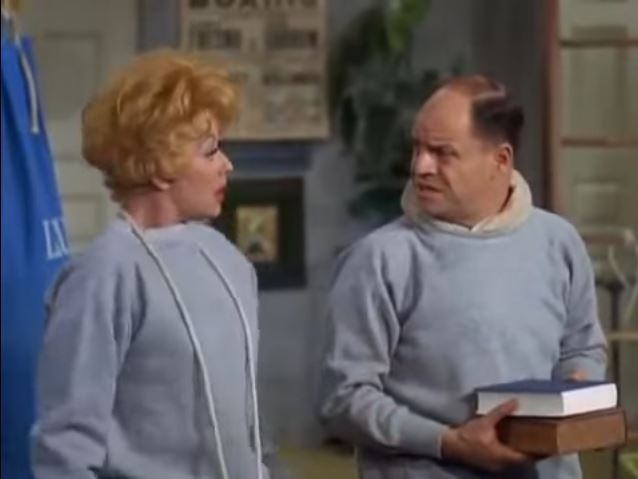
-
Subscribe
Subscribed
Already have a WordPress.com account? Log in now.
 Papermoon Loves Lucy