-
LUCY, THE CO-ED
S3;E6
~ October 19, 1970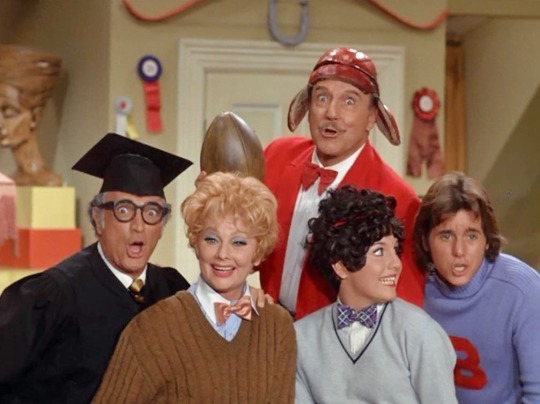

Directed
by Jack Baker ~ Written by Fred S. Fox and Seaman JacobsSynopsis
Harry’s
old flame Gloria (Marilyn Maxwell) is in town to help produce a
musical for their college alumni. They resurrect a show Harry wrote
in 1928 and cast Lucy, Kim, and Craig in supporting roles.Regular
Cast
Lucille
Ball (Lucy
Carter / ‘Ginger’), Gale
Gordon (Harrison
Otis Carter / ‘Crazy Hips’), Desi
Arnaz Jr. (Craig
Carter / ‘The Dead End Kid’), Lucie
Arnaz (Kim
Carter / ‘Honey Beasley’)Guest
Cast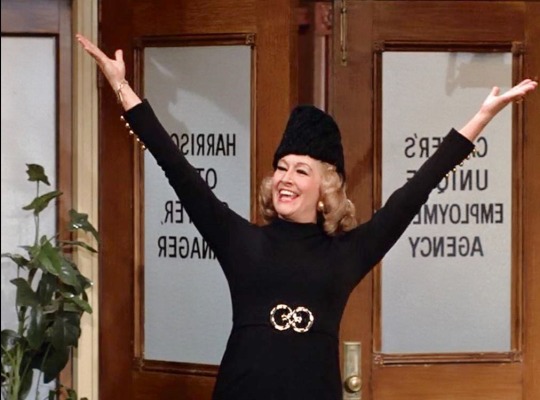
Marilyn
Maxwell
(Gloria Pendleton / ‘Nurse’) was a singer who started out her career
as an MGM contract player. She appeared in four films with Lucille
Ball between 1943 and 1963. It was rumored the Maxwell and Bob Hope
were romantically linked, despite both being married to others.
Maxwell died of a heart attack at the age of 50 in 1972.
Robert
Alda (‘Dean
Butler’) originated
the role of Sky Masterson in Broadway’s Guys
and Dolls,
winning the 1951 Tony Award. He is the father of Alan Alda of
“M*A*S*H” fame. He made one appearance on the “The Lucy Show,”
and this is the second of his three episodes of “Here’s Lucy”
and the only one where he plays a character instead of himself. Alda
died in 1986.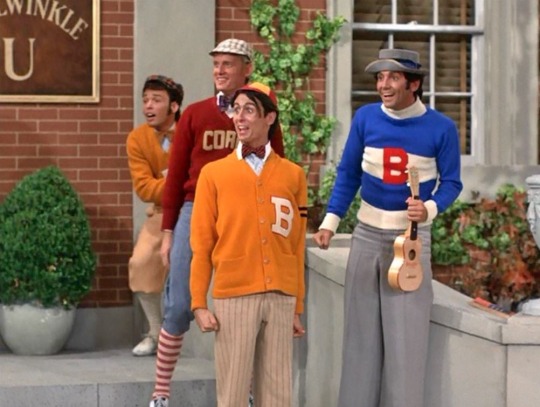
Cecil
Gold
(‘Cecil’, orange sweater, center) previously danced
in “Lucy and the Generation Gap” (S2;E12) also directed by Jack
Baker.
This is his final series appearance.Kevin
Edwards (‘Norman’,
blue sweater, right) was previously seen in “Lucy, the Conclusion
Jumper” (S1;E5) and was
an uncredited ballet dancer in Streisand’s Funny
Girl (1968).
This is his final series appearance.Jim
Bates
(‘Clarence’, red sweater left) appeared as an uncredited extra in
such films as
Singin’ in the Rain
(1950) and Easter
Parade
(1948). He previously appeared with Gale Gordon on a 1963 episode of
“Dennis the Menace.” Bates will appear in one more episode of
“Here’s Lucy” in 1972, his final screen appearance.Although
given character names in the final credits, none of the three boy
co-eds have their names spoken in the dialogue.The
Co-Ed Singers include:
Mickie Pollak (black hair) was assistant choreographer to Jack Baker on “Lucy and Liberace” (S2;E16). This is her only screen appearance.
Judy
Van Wormer
(blonde hair) would become the assistant choreographer on the Steven
Spielberg film 1941
(1979). She was also assistant choreographer for a 1970 episode of
“Jimmy Durante presents The Lemmon Sisters.” This is one of only
two screen appearances for Van Wormer.Lisa
Pharren
(red hair) gave up performing after only three appearances on screen
and became a Hollywood make-up artist eventually earning three Emmy
nominations for her work.Unlike the 3 male Co-Eds, the girls have no spoken dialogue, and therefore are not assigned character names in the final credits.
Other ‘Bullwinkle students’ are played by uncredited background performers.


On
the series DVD this episode is introduced by Jim Bates (Clarence) who
later became a choreographer on the show. Bates
shares the DVD intro with Anita Mann, assistant choreographer on this
and many other “Here’s Lucy” episodes.
The
evening this episode was first broadcast, Lucille Ball made her
fourth and final appearance on “The Carol Burnett Show.” Also
appearing was Mel Torme, who made several appearances on “The Lucy
Show” as Mel Tinker. Carol Burnett would star in one more episode
of “Here’s Lucy” in 1971.Harry
sarcastically says to Lucy, “Thank
you, Dear Abby.”
“Dear
Abby”
is
an advice
column founded
in 1956 by Pauline
Phillips under
the pen name “Abigail Van Buren” and carried on today by
her daughter, Jeanne
Phillips,
who now owns the legal rights to the pen name.Gloria
calls Harry ‘Windy’, his college nickname. Windy was also the nickname
given to Winfield Cheever by his nephew (Frankie Avalon) on “Lucy
and the Starmaker” (S6;E4). In “Lucy and Wally Cox” (S2;E21)
Harry’s old buddy Moose Manley says that Harry’s college nickname was
‘Blubber’.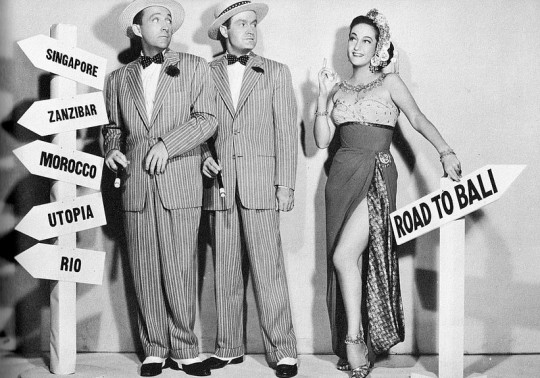
Lucy
reminds Harry that he got over his infatuation with Dorothy Lamour so
he’ll get over Gloria Pendleton. Dorothy
Lamour
(1914-96) was
an actress
and singer best remembered for appearing in the Road
to… movies
starring Bing Crosby and Bob
Hope.Harry
and Gloria are producing a musical show for the alumni of Bullwinkle
State University. It was written by Harry during his senior year
there in 1928. Previous episodes have stated that Harry both
performed and wrote shows while in college. The title of his musical
is…It’s
Always Do-Wacka-Do at Bullwinkle U!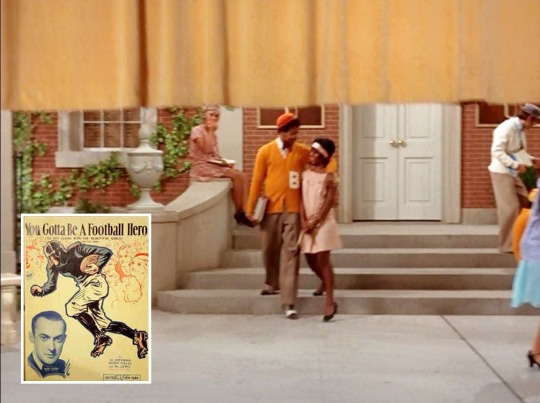
As
the curtain goes up on the front of steps of Bullwinkle U, the
orchestra plays “You
Gotta be a Football Hero (To Get Along with the Beautiful Girls)”
written
by Al Sherman, Buddy Fields and Al Lewis in 1933.
It is one of the most widely recorded and
performed football anthems of all time.
As
Ginger (Lucy) enters, the boys (Gold, Edwards, and Bates) sing “Ain’t
She Sweet”
written in 1927 by Milton Ager and Jack Yellin.
When
Crazy Hips (Harry) enters in his football uniform the girls (Van
Wormer, Pharren, and Pollak) sing
“Baby Face” written
in 1926 by Harry Akst and Benny Davis.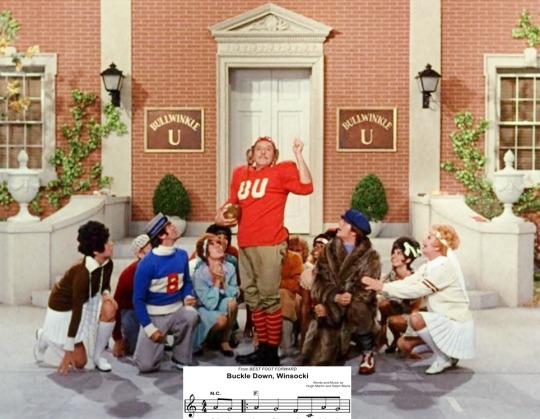
The
students all sing “Buckle
Down Bullwinkle”
to the tune of “Buckle Down Winsockie” a
song written for the film Best
Foot Forward (1943) which starred Lucille Ball. Perhaps not so coincidentally, Marilyn
Maxwell played the role originated by Lucille Ball in the 1954
television re-make of Best
Foot Forward,
which stayed closer to the 1941 Broadway show than the Lucille Ball
film, where Lucy essentially played herself.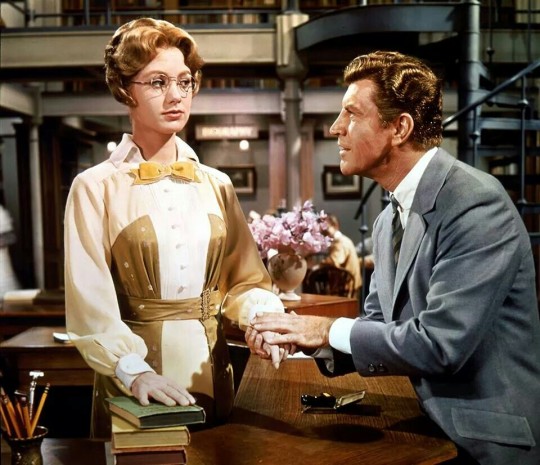
Crazy
Hips says that “Marion
the librarian keeps intercepting my passes.”
Marion
the librarian
was a character in the 1957 Broadway musical The
Music Man,
which was filmed in 1962 (above) with Shirley Jones as Marion. Both stage and screen versions starred Robert Preston in the title
role who would go on to play Beau in Mame
(1974) opposite Lucille Ball.
One
of the pennants decorating the dorm room says Princeton,
which is coincidentally where Lucille Ball made her legitimate stage
debut at McCarter Theatre in 1937 with the play Hey
Diddle Diddle.
It moved to Washington DC, but closed before Broadway due to the
illness of leading man Conway Tearle. Regular Lucy director Herbert
Kenwith also directed Lucy in Princeton in 1947’s Dream
Girl by
Elmer Rice.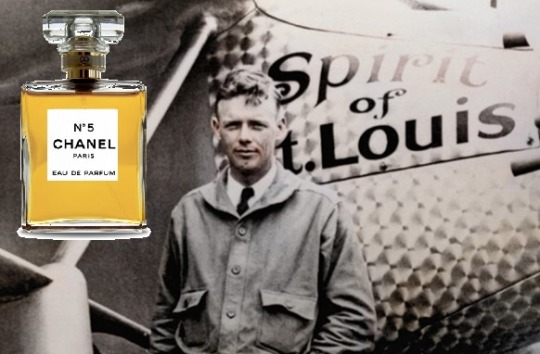
To
cover up for the girls hidden in the closet, Crazy Hips tells a ‘nosy’ Dean Butler that he uses perfume: Lucky Lindy No. 5. ‘Lucky Lindy’ was the
nickname of Charles
A. Lindbergh
(1902-74), an aviator who made the first
solo transatlantic
flight and
the first non-stop flight between North America and mainland Europe. The addition of ‘No. 5′ is a bow to Chanel No. 5, the
first perfume launched by designer Coco Chanel in 1921. It is still
sold today.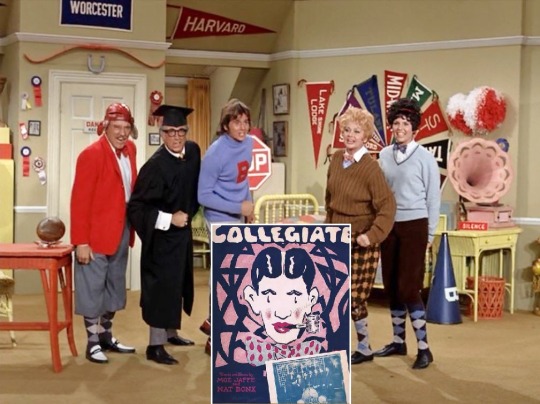
Ginger,
Honey, Dead End, Crazy Hips, and the Dean (Robert Alda) sing
“Collegiate”
written
in 1925 by Nat Bonx and Moe Jaffe.
Bullwinkle
University wins the big football game against North Keokuk. Although Keokuk is in
Iowa, North Keokuk is a town located in Oklahoma.
The
musical ends with “Varsity
Drag,” a
song written by Lew Brown and B.G. DeSylva for Good
News,
which was seen on Broadway in 1927 and on screen in 1947 when it was nominated for an Academy Award for Best Song.

“You
Gotta be a Football Hero (To Get Along with the Beautiful Girls)”
was sung by Craig in “Lucy and Carol Burnett” (S1;E17) to raise
money for the school gym. The red and white pom-poms on the dorm room wall were used by the cheerleaders in that episode. Red and white are the colors of Angeles High School, Kim and Craig’s alumnus.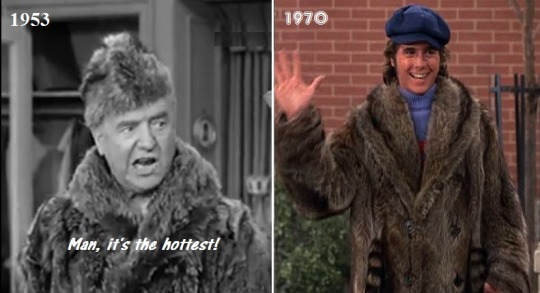
Craig
wears a raccoon coat, a typical fashion statement of the 1920s. One was also worn by Fred Mertz in “Lucy
Has Her Eyes Examined” (ILL SE;E11).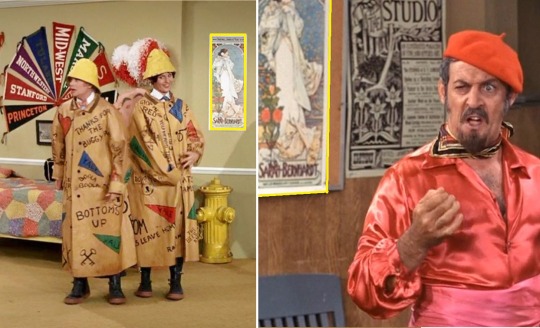
The
dorm room is decorated with an art deco poster of Sarah Bernhardt by
Alphonse Mucha (1897) that was previously seen on the wall of the
knife thrower The Great Pierre (Paul Winchell) in “Lucy, the Cement Worker”
(S2;E10).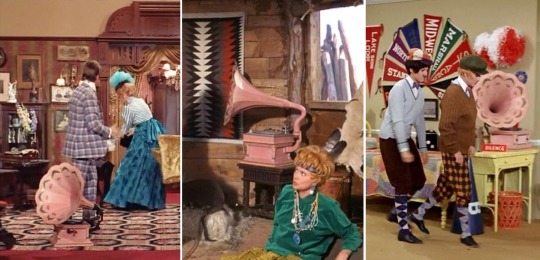
The
dorm room also features a pink phonograph that was seen in both “Lucy
and the Generation Gap” (S2;E12, left) and in the Navajo hogan in “Lucy
and the Indian Chief” (S2;E3, center).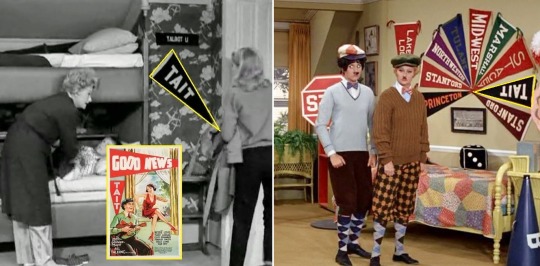
On
the wall of the dorm room is a pennant for Tait. The pennant was
also seen on the wall of Jerry and Sherman’s bedroom in “Lucy and Her Electric Mattress” (TLS S1;E12) in 1962. This
is a reference to the fictional Tait University in the musical Good
News,
which was seen on Broadway in 1927 and on screen in 1947.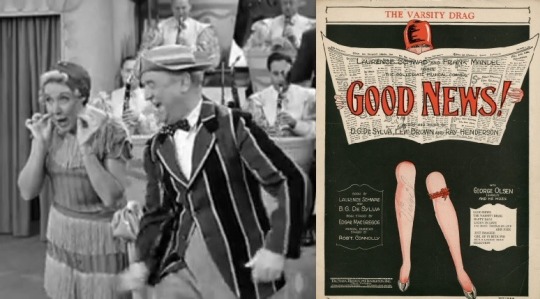
Good
News
also featured the song “Varsity Drag,” which Vivian Vance
performed in “Lucy
Has Her Eyes Examined” (ILL S3;E11).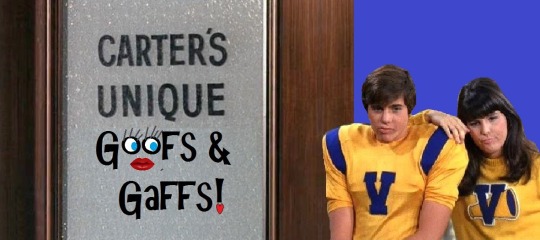

Who Are You? Oddly,
Robert Alda has a principal role of the Dean in the musical but has
no corresponding ‘real life’ character. Perhaps the character was cut from the opening scenes for time? It is possible that Alda was playing himself again.
“Lucy, the Co-Ed” rates 4 Paper Hearts out of 5
This
musical comedy episode is not quite as good as “Lucy and the
Generation Gap” but still a lot of fun for its high camp style.
Oddly, Gloria Maxwell is underused in the musical sequence and Robert
Alda is absent from the set-up scene.Ain’t She Sweet, Anita Mann, Baby Face, Buckle Down Winsockie, Cecil Gold, Chanel Number 5, Charles Lindbergh, Dear Abby, Desi Arnaz Jr., Dorothy Lamour, Fred S. Fox, Gale Gordon, Here’s Lucy, Jack Baker, Jim Bates, Judy Van Wormer, Kevin Edwards, Lisa Pharren, Lucie Arnaz, Lucille Ball, Lucy the Co-Ed, Marilyn Maxwell, Mickie Pollak, Princeton, Robert Alda, Seaman Jacobs, Tait, The Carol Burnett Show, The Music Man, You Gotta Be a Football Hero -
LUCY THE CRUSADER
S3;E5
~ October 12, 1970

Directed
by Herbert Kenwith ~ Written by Milt Josefsberg and Al SchwartzSynopsis
When
Lucy buys Craig a stereo for his birthday, it turns out to be a
lemon. Lucy goes on a crusade to have the manufacturer honor their
guarantee at the point of sale.Regular
CastLucille
Ball (Lucy
Carter), Gale
Gordon (Harrison
Otis Carter), Desi
Arnaz Jr. (Craig
Carter), Lucie
Arnaz (Kim
Carter)Guest
Cast
Charles
Nelson Reilly
(Elroy P. Clunk) started acting off-Broadway in the 1950s and made
his Broadway debut in 1960’s Bye Bye Birdie. He also created roles
in How To Succeed... and Hello, Dolly! On TV his first regular role
was as Claymore Gregg in “The Ghost and Mrs. Muir,” which ended
its two-season run in 1970. Reilly is perhaps best remembered as a
panelist on the game show “Match Game.” He did a week of shows
with Lucille Ball on the game show “Body Language” in 1984.
Charles Nelson Reilly died in 2007.
John
J. “Red” Fox (Mr.
Fox, Salesman) was best known for playing policemen, which is what he
did on five of his eight appearances on “The Lucy Show” as well
as three of his five episodes of “Here’s Lucy.”
This is one of two exceptions!Fox
is trying to sell Lucy and Harry the Jiffy Jolly Adding Machine.
Carole
Cook
(Mrs. Sheila Kasten) played
Thelma Green on “The Lucy Show” as well as many other characters.
She was a protege of Lucille Ball’s during the Desilu Playhouse
years. Although born as Mildred Cook, Ball suggested she take the
name Carole, in honor of Lucy’s great friend, Carole Lombard. Cook
appeared in five episodes of “Here’s Lucy.”The
character’s surname was also the name of Phil Silvers’ character in
“Lucy and the Efficiency Expert” (TLS S5;E13). Cook purchased a
faulty toaster made by the Prime Ultrasonics Company.
Kathleen
Hughes
(Mrs. Clara Portnoy) makes her only appearance with Lucille Ball, but
did three episodes of “The Ghost and Mrs. Muir” with Charles
Nelson Reilly as Mrs. Coburn.When
Lucy asks for complaints, Clara stands up. The
character is likely named after the principal character in the
controversial 1969 novel by Philip Roth, Portnoy’s
Complaint (inset).
The character purchased a malfunctioning garage door opener from the
Prime Ultrasonics Company.
Bob
Hastings
(Martin Phillips) was a character actor who turned to voice acting
toward the end of his career. He was featured in four of the
“Batman” television projects, mostly as Commissioner Gordon.Phillips
complains about a doll that is supposed to walk, talk, and wet. It
only does two of the three properly. (Guess which one doesn’t operate
as promised!)Leoda
Richards
(Woman at Lucy’s Complaints Meeting, uncredited) made
at least three background appearances on “I Love Lucy.” She was
in four episodes of “The Lucy Show” and was also in the Lucille
Ball film Yours,
Mine and Ours (1968).
This is the first of her two “Here’s Lucy” episodes. Her main
claim to fame is her appearance at the party given by Captain Von
Trapp in The
Sound of Music,
standing next to Christopher Plummer during the song “So Long,
Farewell.”Richards
is the grey-haired woman sitting behind Carole Cook.
Jerome
Cowan (Mr.
Gary, Chairman of the Board of Prime Ultrasonics Company) had
appeared with Lucille Ball in The
Fuller Brush Girl (1950)
and Critic’s Choice (1963). He was featured in such films as 1947’s Miracle
on 34th Street (with
William Frawley) and as Miles Archer in 1941’s The
Maltese Falcon.
He appeared in one episode of “The Lucy Show” in 1966. This is
his only “Here’s Lucy” appearance.The
character is credited as Mr. Gary, but his name is never spoken in
the dialogue.
Don
Briggs
(Mr. Huntington, Stockholder) starred
with Lucille Ball in the 1939 film Panama
Lady.
He played the recurring character of Eddie Collins for seven episodes
on season one of “The Lucy Show.” This is his only role on
“Here’s Lucy.” Briggs died in 1986 at the age of 75.Mr.
Huntington is the only stockholder to speak at the meeting.The Prime Ultrasonics Stockholders (all uncredited) are played by:
Leon
Alton
appeared
with Lucille Ball in The
Facts of Life (1960)
and Critic’s
Choice (1963).
He was in two episodes of “The Lucy Show.” This is the first of
his three episodes of “Here’s Lucy.”Jack
Berle
was
the older brother of Milton Berle. This is just one of his
eleven uncredited appearances on the series. He also did two
episodes of “The Lucy Show.”Paul
Bradley made
his six appearances on “The Lucy Show” in various roles. This is
the first of his two episodes of “Here’s Lucy.”George
DeNormand
appeared
in three films with Lucille Ball from 1937 to 1963. This is the just
one of his many appearances on “The Lucy Show” and “Here’s
Lucy.”Frieda
Rentie
makes the first of her two uncredited appearances on the series.
Rentie was in the original 1958 film of South
Pacific
and in 1972’s The
Poseidon Adventure.Walter
Smith
makes the second of his 13 mostly uncredited appearances on the
series. He also did one episode of “The Lucy Show.”Owen
Song was
an uncredited extra in the 1955 film Blood
Alley,
which was promoted by its star John Wayne on “I Love Lucy,”
including the film’s poster. He was a native Hawaiian. This
is his only series appearance.The
other people at Lucy’s complaints meeting, customers and employees at the complaints department, and the rest of the PU stockholders are played by uncredited background performers.
This episode was originally aired (probably unintentionally) on Columbus Day, a holiday known for retailers offering Columbus Day Sales.

The final draft of the script was dated January 15, 1970, although there were several changes to the final shooting script after this date.

The
episode is introduced on the series DVD by Carole
Cook,
who was a friend of both Lucille Ball and Charles Nelson Reilly. She
remembers that at the table read (rehearsal) Lucy barked “Good
joke! Wrong place!”
Lucy
(about Craig’s birthday present): It’s
something you’ve always wanted.
Craig:
Raquel
Welch?“Here’s
Lucy” usually mentions Raquel
Welch
when they want to reference a Hollywood sex symbol. Welch was first
mentioned in “Lucy Visits Jack Benny” (S1;E2) and
most recently in “Lucy and the Drum Contest (S3;E4). In April 1970 Welch hosted her own TV special “Raquel!”
When
Craig and Kim test out the stereo, they use the album “Pretty
Country” by
the Billy Vaughn Singers (1964). William Richard Vaughn (1919-91)
was a versatile singer and bandleader whose 1954 hit “Melody of
Love” hit #2 on the Billboard charts. The album cover is used but the title is never spoken and the sped-up audio is indecipherable.In the original script, the album Kim selects is “Stomp Your Feet Till Your Eyes Pop Out” by the new group Peter Paul & Spiro. Needless to say, this is a fictional recording that proved too silly for Lucille Ball and was cut. The group is a mash-up of Peter Paul & Mary and then vice-president Spiro Agnew. The musical trio broke up in 1970 to pursue solo careers, so doubtless these two names were on the writers’ minds.

In
order to get the shot of Elroy P. Clunk looking through the giant
magnifying glass,
the camera position had to be changed which required an insert shot
created out of sequence with the scene.
Scene 3 opens at the Unique Employment Agency. In the original script, a secretary named Mimi was signing Lucy’s petition, the 23rd secretary in the building to do so. The character was cut and the scene now begins with Lucy begging Harry to sign the petition. In the rewritten scene Lucy tells Harry she only has 19 signatures, not 23.

Lucy’s exploding electric typewriter was made in Japan, but not by Prime Ultrasonics Company.

During an informal neighborhood complaint forum in Lucy’s living room, Harry
rushes in to complain about his new TV which mixes up the channels.
He says “I just saw the flying nun self destruct in five seconds!”
“The Flying Nun” (1967-70) was a TV series that featured Sally
Field as a nun who’s pelican-like cornet allowed a stiff breeze to
lift her into the air. The show has been mentioned on several
previous “Here’s Lucy” episodes. On TV’s “Mission:
Impossible”
(1966-73) nearly all episodes featured instructions which played on
a mini tape recorder that self destructed five seconds after
finishing. The show was parodied in “Lucy’s Impossible Mission”
(S1;E6).
In the original script, Harry then goes on to mention that James Arness shot a woman on “Gunsmoke”. Lucy calmly offers that maybe she deserved it, to which Harry incredulously replies “Doris Day?!?” Arness played Matt Dillon on “Gunsmoke” which was “Here’s Lucy’s” lead-in on CBS. “Lucy” shared the 8 o’clock hour with “Mayberry R.F.D.” but at 9 o’clock, “The Doris Day Show” was on.

When
Mr. Phillips demonstrates that the doll
wets
through its ears, naturally Harry is right in the line of fire!
The
gag is repeated at the end of the episode. Although Harry thinks the
doll will squirt through her ears and hit Mr. Gary, it squirts
through the mouth hitting Harry square in the face. Anytime there is
water, Harry will end up wet!
Kim
and Craig rush into the complaints meeting to report that Steve March
just bought a new electric guitar made by the Prime Ultrasonics
Company that has short-circuited singing his hair. Steve
March is
the son
of Mel Torme and the adopted son of the Arnaz family’s friend, Hal
March. Steve March appear in “Lucy
and the Bogie Affair” (S2;E13) and
“Lucy and Sammy Davis Jr.” (S3;E3, above). He also wrote the song
“Country Magic” for “Lucy
and Ann-Margret” (S2;E20). In the original script, his surname was not mentioned and Craig observed that he now looks like “Yul Brynner with sideburns” which was a bit of a giveaway about the visual humor to come (see below), so the line was cut.
At
the Stockholders Meeting, Lucy, Harry and Elroy P. Clunk display an
array of Prime Ultrasonics’ malfunctioning products:- An instant
camera that pops its lens - A
flexible lamp that that doesn’t stay up - A
long-distance golf ball that drops and doesn’t bounce - A
hair dryer that eats the hair off the head (above) - A
miniature vacuum cleaner that exhales instead of inhales - And
finally Mr. Gary’s own hearing aid!


Lucy
Ricardo had trouble with returning defective merchandise she bought from the
Handy Dandy Company in “Sales Resistance” (ILL S2;E17).
A
record player that plays at super speed was a problem for Lucy
Ricardo when singing “Mamãe
Eu Quero”
in “Be A Pal” (ILL S1;E2).
Toasters
have long been a favorite prop of Lucille Ball’s. One of the most
repeated gags on “I Love Lucy” and “The Lucy Show” was
catching the toast mid-air after it popped up!FAST FORWARD!
During the worldwide Corona Virus pandemic of 2020, Broadway and Hollywood actors practicing quarantine and social distancing put together a tribute to this episode, led by John Tracey Eagan. It starred stay-at-home stars Klea Blackhurst (Lucy), Jennifer Simard (Kim), John Stamos (Craig), and Brad Oscar as Harry. Special appearances by Coco Peru, Richard Kind, Jonathan Freeman, Michael Kostroff, Stanley Bojarski, and Christine Pedi.


Where Do I Work? Although Elroy P. Clunk is the manager of a complaints department, it is never specified where he works. The original script describes the store as being like “Akron, Korvettes, or White Front”.

Age Check! The
last time Craig celebrated a birthday (on camera) was in March 1969.
He turned 16. Here, in October 1970, he is 18. At the time this
episode was first aired, Desi Arnaz Jr. was actually 17.
Maker’s Mark! Although
the faulty stereo is supposed to by made by the Prime Ultrasonics
Company (PU), the interior of the unit says Magnavox.
Fore! The
only product that doesn’t fit the profile of an electronics company
is the non-bouncing golf ball.
Where the Floor Ends! Yet another example of the camera pulling back a bit too far and exposing the concrete soundstage floor.

“Lucy the Crusader” rates 4 Paper Hearts out of 5
This
is a unique episode because Lucy has a mission and she is written as
level-headed, determined, and strong. There’s a lot of funny
performances by great character actors and a collection of
recognizable background players, too! My favorite line is almost a
throw-away and seems like it might even have been an ad-lib (although
Lucy rarely indulged in such things). Harry is on the phone about
the exploding typewriter and states importantly “This is Harrison
Carter of Carter’s Unique Employment Agency.” Lucy, almost
muttering, says “Big deal.” Sometimes it is the smallest things
that can get the biggest laughs.
 Al Schwartz, Billy Vaughn, Bob Hastings, Carole Cook, CBS, Charles Nelson Reilly, Desi Arnaz Jr., Donald Briggs, Frieda Rentie, Gale Gordon, George DeNormand, Herbert Kenwith, Here’s Lucy, Jack Berle, Jerome Cowan, John J. Fox, Kathleen Hughes, Leoda RIchards, Leon Alton, Lucie Arnaz, Lucille Ball, Magnavox, Milt Josefsberg, Mission Impossible, Owen Song, Raquel Welch, stereo, Steve March, The Flying Nun, Walter Smith
 - An instant
-
LUCY AND THE DRUM CONTEST
S3;E4
~ October 5, 1970

Directed
by Jerry Paris ~ Written by Martin RagawaySynopsis
When
Craig enters a amateur drum contest, Lucy convinces Buddy Rich to
give him lessons.Regular
CastLucille
Ball (Lucy
Carter), Gale
Gordon (Harrison
Otis Carter), Desi
Arnaz Jr. (Craig
Carter), Lucie
Arnaz (Kim
Carter)Guest
Cast
Buddy
Rich
(Himself) actually appeared with Lucille Ball as a member of the
Tommy Dorsey Orchestra in DuBarry
Was a Lady
(1943). Widely
considered one of the most influential drummers of all time and known
for his virtuoso technique, power, and speed, Rich was billed as ‘the
world’s greatest drummer’ during his career.
He died in 1987 at the age of 69.
Eugene
Molnar
(Willy the Band Boy) appeared
on four episodes of the series. These are his only screen credits.
Richard
Yniguez
(Jose Garcia, Drum Contest Competitor) made his screen debut with
this episode. As of 2014 he has accrued over 100 screen credits.Jose
has five brothers and four sisters.
Dick
Winslow
(Nightclub Emcee) appeared
in the films Thousands
Cheer (1940)
and Easy
To Wed (1943)
with Lucille Ball. This is second and last of his appearances on the
series. He also did two episodes of “The Lucy Show.”Walter
Smith
(Nightclub Patron, uncredited) makes the first of his 13 mostly
uncredited appearances on the series. He also did one episode of
“The Lucy Show.”The
other nightclub patrons and the musicians are played by uncredited
background performers.
This
is the second of only two episodes directed by Jerry
Paris
of “The Dick Van Dyke Show.” Paris also directed “Lucy Meets the
Burtons” (S3;E1), which was actually filmed after this one.
Lucille Ball and Paris had different styles, so although he had a
contract for six episodes, he was let go after only two.
This
is one of the last episodes that spotlights Desi
Arnaz Jr.
He will start missing several episodes to film Red
Sky at Morning (1970),
and by the end of the season will leave the series altogether.Buddy
Rich’s name was first mentioned on “Here’s Lucy” in “Lucy the
Helpful Mother” (S2;E15) when Kim shouts “Hey!
Buddy Rich!” to
get Craig’s attention over the din of his drumming.
The
episode actually features four different drummers, all but one of whom perform live on the set.
Richard
Yniguez (Jose) was obviously cast for his acting ability and he alone
mimes the drumming.
When
Craig says that Buddy Rich is his favorite musician, Harry says his
is Guy Lombardo, who Lucy tells the kids is the Lawrence Welk of
Harry’s generation. Guy
Lombardo
(1902-77, above right) was a musician and bandleader known for conducting the
Royal Canadians and playing “Auld Lang Syne” on New Year’s Eve.
Lawrence
Welk
(1903-92, above left) was also a musician and bandleader, as well as the host of
his own television show. He guest starred as himself on “Here’s
Lucy” during season two (inset).
To
get up close to Buddy Rich and capture the excitement of his drum
solo, “Here’s Lucy” uses a hand held camera for the first time.
It is a bit jarring to see the camera move so much on a “Lucy”
sitcom.
Willy
bring Rich his Zilca cymbols. This may be Rich’s way of not
mentioning the brand name Zilco,
which were cymbals made by the 400 year-old Zildjian company in
Canada between 1968 and 1970. The brand name of Rich’s drums,
Slingerland, however, is clearly visible. The Slingerland brand is
owned by Gibson and is strongly associated with Jazz drummers like
Rich and Gene Krupa. In “Here’s Lucy’s” early episodes, the name
brand of Craig’s drums was taped over! Now his drum set bears no
visible trademark or tape marks.Rich said he was awake all night praying to Ringo Starr that his cymbals were safe! Ringo Starr is the drummer for the Beatles. He was mentioned in two previous episodes of “Here’s Lucy.”

Rich
says he dreams about Raquel
Welch.
The sex symbol / movie star was previously mentioned on two episodes
of “Here’s Lucy.” Listening
to Craig play, he tells him to hit the cymbals harder. “You’re
not Tiny Tim tip-toeing through the tulips.”
Tiny
Tim
was a ukulele player who appeared on “Rowan and Martin’s Laugh-In”
and became famous for his rendition of the song “Tiptoe
Through The Tulips (With Me).” Coincidentally, both performers were mentioned in one line during “Lucy Competes with Carol Burnett” (S3;E24):Carol (about Lucy’s figure): “Compared to you, Tiny Tim looks like Raquel Welch.”

A reference to “Rowan and Martin’s Laugh-In” is almost a weekly occurrence on
“Here’s Lucy.” “Laugh-In’s” second half hour on ABC competed
directly with “Here’s Lucy,” so the writers probably figured they
could woo channel-hoppers over to CBS with regular mentions of the
show.Rich hints at the California divorce laws that say that a spouse is entitled to half of everything, which gets a laugh and some applause from the audience. Rich says “Have you ever tried playing with one cymbal?” Although playing himself, Rich is joking with Lucy because in reality he had only one wife, Marie Allison, whom he wed in 1953.


Lucy
Ricardo also had a son who was fond of drumming. Little Ricky was played by Keith Thibodeaux (aka Richard Keith, above). Like father, like son!
Sitcom
Logic Alert! Lucy’s purse just happens to be identical to the bag containing Buddy
Rich’s cymbals. Although Willy brought Rich the two symbols he left on
the stage, he only brings the smallest set. Did Rich remember his
medium and large size cymbals and forget only his small set?
Amnesia Alert! When
Lucy pulls the cymbals out of her bag she says she doesn’t know what
they are! Her son is a drummer whose drum set is next to her in the
living room, so it is hard to believe Lucy doesn’t have a clue what cymbals are!
“Lucy and the Drum Contest” rates 3 Paper Hearts out of 5
For
fans of drum icon Buddy Rich this episode is a must-see. Lucille
Ball lets the focus be on her son, and has very little funny stuff to
do here. What’s unique is that the episode has a sentimental ending – one that relies on a decision by Craig, not Lucy!1970, Buddy Rich, CBS, cymbals, Desi Arnaz Jr., Dick Winslow, Drum Contest, Drums, Eugene Molnar, Guy Lombardo, Here’s Lucy, Jerry Paris, Lawrence Welk, Lucie Arnaz, Lucille Ball, Martin Ragaway, Nightclub, Raquel Welch, Richard Yniguez, Ringo Starr, Tiny Tim, Tiptoe Through the Tulips, tv, Walter Smith, Zilco -
LUCY AND SAMMY DAVIS JR.
S3;E3
~ September 28, 1970

Directed
by Herbert Kenwith ~ Written by Sam Perrin and Ralph GoodmanSynopsis
When
Sammy Davis Jr. stumbles through the door of the Unique Employment
Agency and bumps his nose, Lucy and Harry are afraid of being sued.
Lucy goes to his film set to make sure he is alright and ends up
causing chaos.Regular
CastLucille
Ball (Lucy
Carter), Gale
Gordon (Harrison
Otis Carter), Desi
Arnaz Jr. (Craig
Carter), Lucie
Arnaz (Kim
Carter)Guest
Cast
Sammy
Davis Jr.
(Himself) was born in 1925 in Harlem, New York. Davis was
a singer, dancer, actor and comedian noted for his impressions of
actors, musicians and other celebrities.
Davis’s
film career began as a child in 1933. In 1960, he appeared in the Rat
Pack film Ocean’s
11.
After a starring role on Broadway in Mr
Wonderful (1956),
he returned to the stage in 1964’s Golden
Boy.
In
1966 he had his own TV variety show, titled “The Sammy Davis
Jr. Show.” He became a star in Las Vegas, earning him the
nickname “Mister Show Business.”
Although this is the only time he acted with Lucille Ball, he
subsequently appeared on many award shows and specials, some of them
celebrating Lucille Ball herself. He died of throat cancer in 1990.
Irwin
Charone
(Chester P. Franklin) made
five appearances on “The Lucy Show.” The expressive character
actor also did an equal number of “Here’s Lucy” episodes. He
died in January 2016 in Maplewood, New Jersey, at the age of 93.Mr.
Franklin is a next door neighbor of the Carters.
Steve
March
(Electric Guitar Player at Craig and Kim’s Party) is
the son of Mel Torme and the adopted son of the Arnaz family’s
friend, Hal March. Mel Torme appeared several times on “The Lucy
Show.” Hal March appeared on “I Love Lucy.” Steve
March appear in “Lucy and the Bogie Affair” (S2;E13) and wrote
the song “Country Magic” for “Lucy and Ann-Margret” (S2;E20).
Keith
Taylor (Fat
Boy at Craig and Kim’s Party) was a child actor whose career began in
1960 playing Harry Harrison on TV’s “Leave it to Beaver.” He
also played Tubby on eleven episodes of “McKeever & the
Colonel” (1962-63). His last screen credit was in 1987.The
character has no lines but takes all the sandwiches off Lucy’s tray.Jay
Dee Witney (Boy
at Craig and Kim’s Party, uncredited) was the son of director William
Witney, and as such appeared on such shows as “Hondo” (1967) and
“Bonanza” (1966). This is his only time working with Lucille
Ball.
Gary
Morton
(‘Night Club Manager’) was
a comedian who worked the famed ‘Borscht Belt’ in the Catskills
Mountains. He met Lucille Ball shortly after her divorce from Desi
Arnaz and they married in November 1961. At her request, Morton gave
up his nightclub career and became a producer of “The Lucy Show.”
Morton also served as a warm-up comic for the show’s studio
audience. He played the Emcee in “Lucy
and the Andrews Sisters” (S2;E6) and
will make one more on-camera appearances on “Here’s Lucy.”
Morton passed away in 1999.
Elliott
Reid
(Otto, Film Director) played
Edward Warren, a parody of Edward R. Murrow, in “The
Ricardos Are Interviewed” (ILL S5;E7) and
appeared in two episodes of “The Lucy Show.” This is the
second of his three appearances on “Here’s Lucy.”In
addition to being the director, Otto is also the producer, and
financial backer of the film. Reid plays the character with a German
accent.Joe Jackson (Script Boy) has only three other screen credits, according to IMDb.
Jack
Berle
(‘Audience Member,’ uncredited) was
the older brother of Milton Berle. This is just one of his
eleven uncredited appearances on the series. He also did two
episodes of “The Lucy Show.”Eugene
Jackson
(‘Audience Member,’ uncredited) gained
fame as Farina’s older brother, Pineapple, in six of Hal Roach’s “Our
Gang” serials (1924-25). He
appeared with Lucille Ball in the 1963 film Critic’s
Choice
as well as an episode of “The Lucy Show.” With Sammy Davis Jr.
he was an uncredited extra in the 1964 film Robin
and the Seven Hoods.
He will be seen in one more episode of “Here’s Lucy”
guest-starring Ginger Rogers.The
other teenagers at Kim and Craig’s party, Sammy Davis’ musicians, and
the Actors playing the Audience Members during the film shoot are all
played by uncredited background performers.

Although
writers Perrin and Goodman did the original draft of the script,
script supervisor Milt Josefsberg substantially revised it.
Buddy
Hackett had
a cameo in this episode but his part was cut from the final episode.
The
day after this episode first aired (Monday, September 28, 1970) actor
Edward
Everett Horton
died. Horton and Lucille Ball had appeared in three films together
before he played the amorous butcher Mr. Ritter on “Lucy Plays
Cupid” (ILL S1;E15) in 1952.
On
the series DVD, this episode is introduced by Altovise
Davis,
Sammy Davis’ widow. She speaks glowingly about Davis and Ball being
two geniuses. Altovise Davis died in 2009.
Lucy
says neighborhood grouch Mr. Franklin writes fan letters to Don
Rickles. Don
Rickles
(1926-2017) was an insult comic who appeared as a washed up boxer in
“Lucy the Fight Manager” (TLS S5;E20).
When
faced with a lawsuit, Craig tells Mr. Franklin to look up the case of
Jones v Dawson 1967. Lucy immediately assumes her son has been
ignoring his homework and watching reruns of “Perry Mason.”
Jones v Dawson is a fictional lawsuit. The surname Dawson
has been mentioned several times throughout the series. “Perry
Mason”
was a half-hour TV courtroom drama starring Raymond Burt that aired
on CBS from 1957 to 1966. Lucy Carmichael was fond of talking about
Perry Mason on “The Lucy Show.”
When
Sammy Davis Jr. first comes stumbling into the office, Lucy thinks he
is Harry
Belafonte,
who was considered one
of the most successful black pop stars in history for popularizing
the Caribbean musical
style. Davis and Belafonte appeared together on several TV musical
and variety shows. They were together on the cover of LIFE Magazine (above) in 1965 with actor Sidney Poitier. Lest anyone think that Lucy Carter thinks ‘all
colored people look alike,’ in the past she has also misidentified
white celebrities at first sight. It’s a character trait more
indicative of her scatterbrain personality than racism.
Lucy
offers Sammy the use of the office telephone as repayment for (she
sings) “What
Kind of Fool Am I?” The
song was written
by Leslie Bricusse and Anthony
Newley and
published in 1962. It was introduced by Anthony Newley in
the musical Stop
The World – I Want To Get Off.
In
1978 Davis starred in a Broadway revival of the musical and also did
a television special called “Sammy Stops the World.” The song
was briefly sung by author Anthony Newley in “Lucy in London”
(1966, above). In 1971 Davis recorded another Bricusse / Newley tune, “The
Candy Man” from the film Willy
Wonka and the Chocolate Factory.
It was a number one hit for the singer and is still associated with
him today although it was not one of his favorites.
Sammy
telephones his agent Sy
Marsh.
This was the name of Davis’ real-life agent at William Morris who
left the agency to be Davis’ business partner.
Sammy
says his producer loves to sue and that his favorite words are “Here
comes the judge! Here comes the judge!” This
is a catch-phrase
from “Rowan and Martin’s Laugh-In” first spoken by comic
Pigmeat Markham and later by Sammy Davis Jr. The NBC show’s second
half hour aired opposite “Here’s Lucy.”
The
catch-phrase was spoken by Lucy in “Lucy the Conclusion Jumper”
(S1;E5, above).
When
Sammy’s nose swells to twice its normal size, Lucy makes the
inevitable reference to Jimmy
Durante
(1893-1980). The vaudeville comedian and singer’s trademark was his
big nose. He and his nose were often referred to as ‘The
Schnozzola.” Although he never appeared on “I Love Lucy,” Lucy
dressed up in a Durante mask to fool nearsighted Carolyn Appleby in
“Lucy Meets Harpo Marx” (ILL S4;E28, above right). In “Hollywood at Last!”
(ILL S4;E16) Lucy and Ethel see a caricature of Durante on the wall
of the Brown Derby that takes up two frames – one for his nose! The real Jimmy Durante and his wife made a wordless walk-on appearance in “Lucy
Goes to a Hollywood Premiere” (TLS S4;E20, above left).
Setting
the scene of the most climactic scene of the film, the Otto the
Director tells Sammy that his character is opening with star billing
at the Sands
Hotel.
The Sands Hotel in Las Vegas was the setting for “Lucy Hunts
Uranium,” a 1958 episode of “The Lucy-Desi Comedy Hour.” The
Sands was briefly glimpsed in the Las Vegas strip montage sequence in
“Lucy and Wayne Newton” (S2;E22).In
his act, Sammy does vocal impressions of:
Jimmy
Stewart
– who shared the dais with Lucille Ball and Davis on many
television specials and award shows.
Jimmy
Cagney
– using Cagney’s most misquoted line, “You
dirty rat!”
Dean
Martin
– crooning a bit of “Everybody Loves Somebody Sometime” which
was a number one hit for Martin in 1964, although it was first
written in 1948. Martin had guest-starred as himself (and his stunt
double) on “Lucy Dates Dean Martin” (TLS S4;E21) and sang the
song in the episode. Davis mentions that Martin is playing at the
Riviera, which is coincidentally part of the plot of “Lucy and
Wayne Newton” (S2;E22) which includes a shot of his name on the
Riviera’s Las Vegas marquee.
Lucy
asks Sammy “What’s
Frank
Sinatra
really like?”
Although Sinatra never acted with Lucille Ball, the two were
off-screen friends. Along with Joey Bishop and Peter Lawford,
Sinatra and Davis were members of what was known as the Hollywood Rat
Pack. They all had extensive ties to the Las Vegas showroom circuit
and even did motion pictures together. A clip of Sinatra in the film
Guys
and Dolls
was incorporated into a 1955 episode of “I Love Lucy” where Lucy
performs at a showcase for the MGM executives. Due to copyright laws,
the clip was cut for syndication and is not included on the DVD.
Sammy
sings “And
When I Die”
a
song written by singer Laura Nyro. It was first recorded by
American folk group Peter, Paul and Mary in
1966. Nyro then recorded it on her 1967 debut album More
Than a New Discovery.
However, the song is probably best known for its third version by
rock group Blood, Sweat & Tears, which reached number 2 on
the US Billboard Hot 100 and
became a Gold record.

Lucy
Carter disrupts Sammy Davis’ flim shoot just the same way Lucy
Carmichael did to John Wayne in “Lucy and John Wayne” (TLS
S5;E10).
Sammy’s
huge nose recalls Lucy’s extended proboscis in “Hollywood at Last!”
(ILL S4;E16) although her’s was putty.
Line! Sammy
Davis Jr. stumbles over a few of his lines in the film shoot scene.
“Lucy and Sammy Davis Jr.” rates 3 Paper Hearts out of 5
This
is one of those episode where Lucy acts foolish and cries a lot.
Davis does his best and there is some funny stuff, but overall the
story is more sketch than plot.Altovise Davis, Buddy Hackett, Desi Arnaz Jr., Don Rickles, Edward Everett Horton, Elliot Reid, Eugene Jackson, Gale Gordon, Gary Morton, Harry Belafonte, Herbert Kenwith, Here’s Lucy, Irwin Charone, Jack Berle, Jay Dee Witney, Jimmy Durante, Joe Jackson, Keith Taylor, Lucie Arnaz, Lucille Ball, Perry Mason, Ralph Goodman, Rat Pack, Rowan and Martin’s Laugh-In, Sam Perrin, Sammy Davis Jr., Sands Hotel, Steve March, Sy Marsh, What Kind of Fool Am I -
LUCY, THE SKYDIVER
S3;E2
~ September 21, 1970
Directed
by Herbert Kenwith ~ Written by Larry Rhine and Lou DermanSynopsis
When
Kim and Craig take up dangerous hobbies, Lucy decides to use reverse
psychology and take up skydiving. But when Harry sees an opportunity
to get publicity for the Unique Employment Agency, Lucy has no choice
but to go through with her flight!Regular
CastLucille
Ball (Lucy
Carter), Gale
Gordon (Harrison
Otis Carter), Desi
Arnaz Jr. (Craig
Carter), Lucie
Arnaz (Kim
Carter)Guest
Cast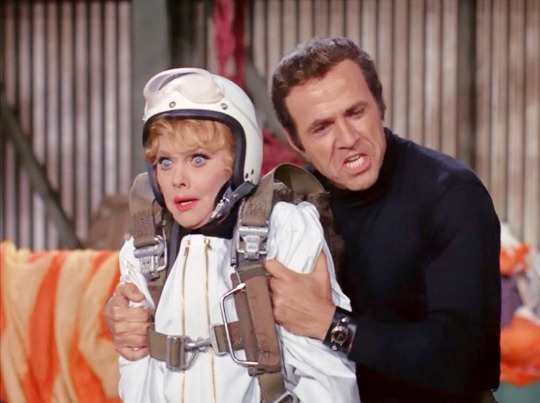
Rhodes
Reason
(Sam Tolliver) here
marks the third of his five episodes of “Here’s Lucy” having
previously appeared in “Lucy,
the Matchmaker” (S1;E12) and
“Lucy and the Gold Rush” (S1;E13). He
also appeared with Lucille Ball in the 1974 TV movie Happy
Anniversary and Goodbye.
Bill Baldwin (Steve Campbell, Reporter for the Valley Gazette) was a voice on the radio in the Lucille Ball film Critic’s Choice (1963).
The
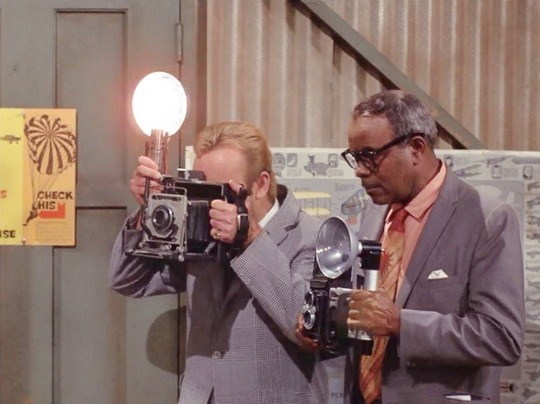
voices on the TV soap opera (Cynthia and Herbie) as well as the two
photographers are played by uncredited background performers.

The
date this episode first aired, ABC TV debuted “NFL
Monday Night Football,”
formidable competition for “Here’s Lucy.” The show is still on
the air today, although it moved to ESPN in 2006.
To
simulate Lucy actually skydiving, an apparatus was built outside the
sound stage. Lucille was strapped by her feet onto a high platform,
her lower body in a brace. The apparatus could move in any direction,
making it appear as though Lucy is moving through the air. A large
fan blows air at her while she moves about as if she is free falling.
The camera films her from beneath, keeping just her upper body in the
frame.
The
theme of this episode is ’do
your own thing.’
The phrase is used repeatedly in the dialogue. In
the 1960s, ‘do your own thing’ became a common expression used by and
about young people. It meant to do whatever you wanted, without
feeling guilty and free of the conformity of previous generations.
There was even a 1968 off-Broadway rock musical (based on Shakespeare’s
Twelfth
Night)
titled Your
Own Thing.
This school of thought led to what is now known as the “Me
Generation.”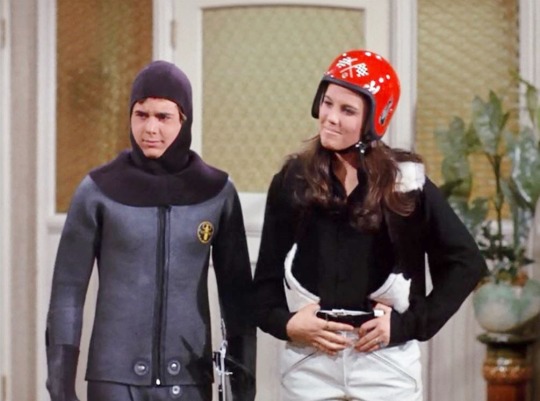
Doing
their own thing, Craig takes up spear fishing while Kim joins a
motorcycle club. When Lucy sees her daughter in a motorcycle helmet
she asks if she’s playing for the Rams,
Los Angeles’ hometown football team. Later, when she has the
parachute pack strapped to her back, Lucy says she feels like she’s
carrying the Green
Bay Packers,
yet another football reference in a sports-themed episode that aired (coincidentally) the same day as the premiere of Monday Night Football.
About
motorcycling, Lucy says she doesn’t want Kim to be another Steve
McQueen. Actor Steve
McQueen’s
favorite things were racing and motorcycles. He famously rode a
motorcycle in 1963’s The
Great Escape.
He was mentioned in this context by Lucy Carmichael in “Lucy Goes
to a Hollywood Premiere” (TLS S4;E20).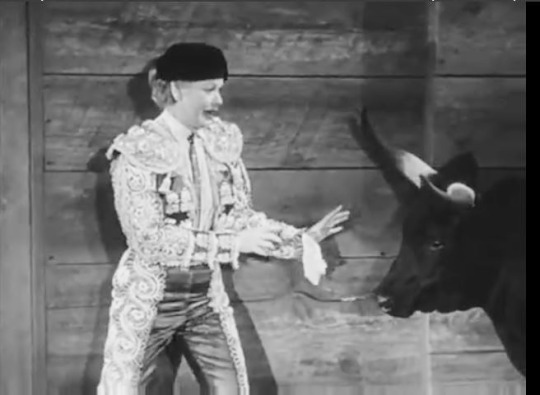
Before
arriving at the idea of skydiving, Lucy borrows a book about
wrestling alligators and even thinks about being a bull fighter. Lucy
Ricardo fought a bull in a Tijuana bullring in “Lucy Goes to
Mexico” a 1958 episode of “The Lucy-Desi Comedy Hour.”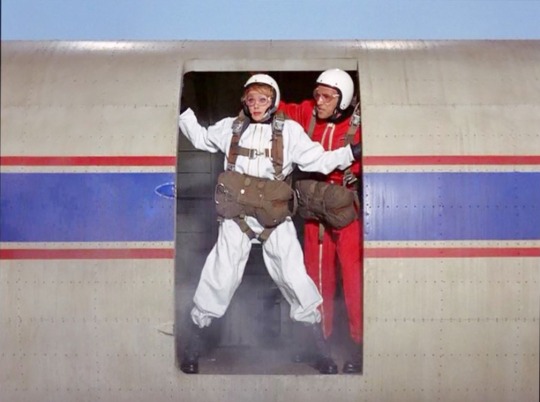
When
Harry jokes about committing suicide by jumping out of the window due
he says, “One
giant step for mankind, one small step for Harry.”
This is a paraphrase of the famous words spoken by astronaut Neil
Armstrong
when he first stepped foot on the surface of the moon on July 20,
1969.
When
Harry hears Lucy has changed her mind about skydiving he quips,
“Good.
You’d only confuse the swallows on their way to Capistrano.”
This
is a reference to San
Juan Mission in Capistrano,
southern California. It is there that the American cliff
swallow migrates every year from its winters in Argentina,
making the 6,000-mile trek in springtime. The expression “when
the swallows return to Capistrano” has
entered common usage. Capistrano was previously mentioned
in “Lucy
Gets the Bird” (TLS S3;E12)
and “Lucy’s Working Daughter” (S1;E10).Kim
is going motorcycling with Tommy Murphy, who Craig says must weigh
400 pounds, a funny visual image.
Lucy
comes home singing “Off We Go, Into the Wild Blue Yonder” aka
“The
U.S. Air Force Song”
written in 1938 by Robert MacArthur Crawford.
It was previously heard over the helicopter shot that ends “Lucy
Goes to the Air Force Academy: Part 2” (S2;E2).
To
encourage her to make the leap, Harry invokes the names of Joan
of Arc
and Florence
Nightingale
as inspiration. Harry later says that they may even put her
footprints in front of Grauman’s
Chinese Theatre.
Lucille Ball and Joan of Arc are two of the many powerful women
mentioned in the lyrics to the song “I Want it All” by David
Shire and Richard Matlby Jr. written for the 1983 Broadway musical
Baby.
In “Lucy Plays Florence Nightingale” (TLS S2;E14), Lucy
Carmichael becomes a candystriper just as Mr. Mooney enters the
hospital. Ironically, Lucille Ball is one of the few Hollywood stars
not to have ever had their footprints in the forecourt of Grauman’s
Chinese Theatre. She did, however, create a classic half hour of
television in which Lucy Ricardo and Ethel Mertz steal John Wayne’s
footprints from iconic movie palace in “Lucy Visits Grauman’s (ILL
S5;E1).
Lucy
compares herself soaring through the blue sky to Columbus sailing the
blue sea. Lucy Carter spoke a great deal about Christopher
Columbus
during her recitation portion of the Secretary Beautiful pageant in
“Lucy Competes with Carol Burnett” (S2;E24).A
worried Kim says that her mother’s rendezvous with destiny may well
be more like a rendezvous with Medicare! In 1970 Medicare
was barely five years old and was still frequently making newspaper
headlines. It was also used as the source of humor on the last two
seasons of “The Lucy Show.”Just
before making up her mind whether to jump, Lucy hears Harry’s
encouraging words in her head. This surreal technique was previously
used in “Lucy Competes With Carol Burnett” (S2;E24) when Carol
derides Lucy for not wanting to compete in the Secretary Beautiful
pageant.
When
Lucy’s parachute is revealed to have ‘Carter’s Unique Employment
Agency’ written on it, Harry remarks “Goodyear
Blimp eat your heart out.”
The
Goodyear Blimp
is a dirigible airship owned and operated by the Goodyear Tire and
Rubber Company which has the name of the company written across it
and is used mainly for advertising purposes. It was first flown in
1925 and still can be seen hovering over televised sports games and
highly attended events.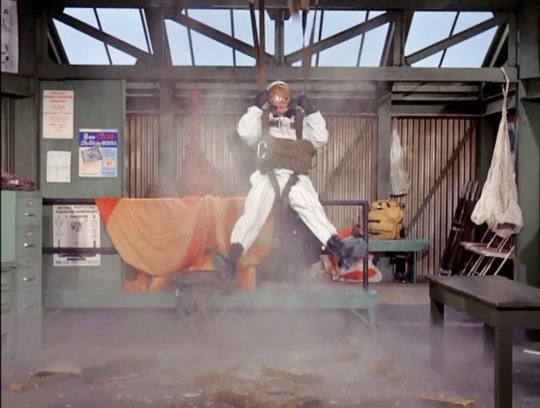
After
crashing through the ceiling, Lucy remarks “I
don’t know how the Flying Nun did it everyday.” “The
Flying Nun” was
a sitcom about a nun (Sally Field) whose habit and pelican-like
cornet helped her defy the laws of gravity. The show aired on ABC
from 1967 to 1970. The show was previously mentioned in “Lucy’s
Working Daughter” (S1;E10).

Lucille
Ball did a similar stunt of crashing through the ceiling after a
parachute jump in “Lucy and Bob Crane” (TLS S4;E22) when she
acted in a World War One movie with the “Hogan’s Heros” star.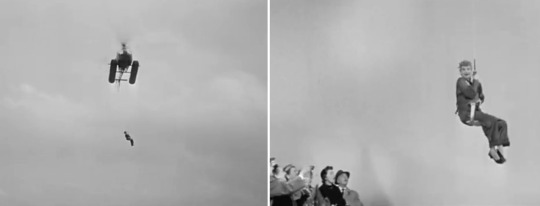
Lucille
Ball was previously dropped from the ceiling on a harness (without
the crash) when Lucy Ricardo missed the boat in “Bon Voyage” (ILL
S5;E13) and was lowered to the deck via helicopter. Like this
episode of “Here’s Lucy,” a double was filmed in long shots and
Lucy did the on-set scenes.
Reverse
Psychology was a common plot point on “Lucy” sitcoms. It
was first used in “The Inferiority Complex” (ILL S2;18, above) to coax
Lucy Ricardo out of a funk. They
later use it when “Little
Ricky Gets Stage Fright” (S6;E4) to
get him to play his drums. Later that same season, the girls
use it on the boys to make them think they would be better
at “Building
a Bar-B-Q” (S6;E24).

Props! Although
the reporter says he’s from The Valley Gazette, the morning paper
held by Craig has a masthead that reads The Daily Chronicle, the
show’s usual prop newspaper.
“Lucy, the Skydiver” rates 3 Paper Hearts out of 5
This
episode tries to maintain the generation gap themes of the series
without adding music or celebrities. Of course, its main draw is
Lucy’s stunt work at the end of the episode.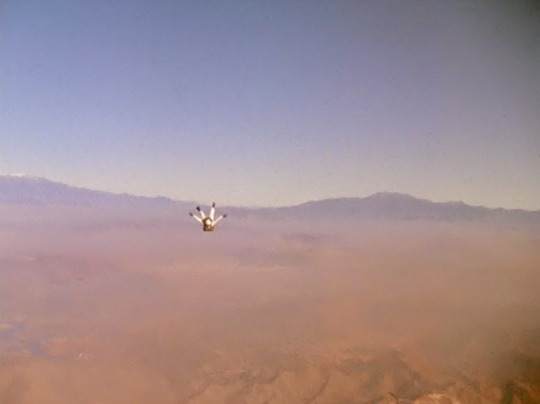 1970, Bill Baldwin, CBS, Christopher Columbus, Desi Arnaz Jr., Do Your Own Thing, Florence Nightingale, Gale Gordon, Goodyear Blimp, Grauman’s Chinese Theatre, Green Bay Packers, Herbert Kenwith, Here’s Lucy, Joan of Arc, LA Rams, Larry Rhine, Lou Derman, Lucie Arnaz, Lucille Ball, Medicare, Motorcycle, Neil Armstrong, NFL Monday Night Football, parachute, Rhodes Reason, skydiving, spear fishing, Steve McQueen, The Flying Nun, US Air Force Song
 -
LUCY MEETS THE BURTONS
S3;E1
~ September 14, 1970

Directed
by Jerry Paris ~ Written by Bob Carroll Jr. and Madelyn DavisSynopsis
When
film star Richard Burton sneaks out of his hotel disguised as
a plumber, Lucy unsuspectingly recruits him to fix the office sink.
When Elizabeth Taylor’s famous diamond ring falls out of the pocket
of his overalls, Lucy dares to try it on – and it gets stuck on her
finger! With just minutes until a big press party, Lucy comes up
with a plan.Regular
CastLucille
Ball (Lucy
Carter), Gale
Gordon (Harrison
Otis Carter)Desi
Arnaz Jr. (Craig
Carter) and Lucie
Arnaz (Kim
Carter) do not appear in this episode.Guest
Cast
Elizabeth
Taylor (Herself)
was
a British-American actress, businesswoman, and humanitarian. She
began her career as a child actress in the early 1940s, and was one
of the most popular stars of classical
Hollywood cinema
in
the 1950s. She continued her career successfully into the 1960s, and
remained a well known public figure for the rest of her life.
Throughout her life, Taylor’s personal affairs were subject to
constant media attention. She was married eight times to seven men,
marrying Richard Burton twice. She died in 2011.
Richard
Burton
(Himself) was born
Richard
Walter Jenkins Jr.
in Wales in 1924. He was noted for his mellifluous baritone voice
and established himself as a formidable Shakespearean
actor in
the 1950s. He gave a memorable
performance of Hamlet
in
1964 and was called the natural successor to Olivier by critic Kenneth
Tynan.
Burton
was nominated for an Academy
Award seven
times, but never won. In 1960 he appeared on Broadway as King Arthur
in Camelot
(at the same time as Lucille Ball was starring in Wildcat)
and won a Tony
Award for
Best Actor. In the 1960s, Burton was one of the top box office stars
and
one of the highest-paid actors in the world, receiving $1 million or
more per film. Burton remains closely associated in the public
consciousness with his second (and third) wife, actress Elizabeth
Taylor.
The couple’s turbulent relationship was rarely out of the news. He
died in 1984.
Cliff
Norton
(Sam The Plumber) makes
the first of three appearances on the series after having been seen
on two episodes of “The Lucy Show.”Sam
has his name boldly printed on his tool box, the front of his
overalls, and on the back. Just in case anyone mistakes him for
Richard Burton!
Brook
Williams
(Mr. Williams, Hotel Manager) was the younger son of the famous actor
and playwright Emlyn
Williams (Night
Must Fall)
and
the brother of the novelist Alan
Williams.
As a child, he was befriended by Richard
Burton and in
later years, became Burton’s personal assistant, adviser, and
collaborator.Richard
Burton requested that Williams be cast in the episode.
Vanda
Barra (Vanda)
was Lucille Ball’s cousin-in-law. This is
just one of her over two dozen appearances on “Here’s Lucy” as
well as appearing in Ball’s two 1975 TV movies “Lucy Gets Lucky”
(with Dean Martin) and “Three for Two” (with Jackie Gleason). She
was seen in half a dozen episodes of “The Lucy Show.”Jose
Portugal
(Fan, uncredited) makes his only series appearance. He was also an
uncredited extra in the Elizabeth Taylor film Rhapsody
(1954).The
Members of the Hollywood Press all play themselves and are named in
the final credits (in order of appearance):
Cecil
Smith
was married to Lucille Ball’s cousin Cleo, who was the show’s
producer. He wrote for the Los Angeles Times.
Joyce
Haber
was named in 1968 by the Los Angeles Times as a successor to gossip legend and “I Love Lucy” guest star Hedda
Hopper, who died in 1966.
James
Bacon began
as a writer for the Associated Press, then spent almost 20 years with
the Los Angeles Herald-Examiner.
Vernon
Scott
was a United
Press International (UPI) Hollywood correspondent and columnist for
52 years.
Other
Members of the Press who are credited, but are not identified nor speak dialogue:- Army
Archerd was
a columnist
for Daily Variety magazine since 1953 before retiring his “Just
for Variety” column in 2005. - Marilyn
Beck
was a well-known Hollywood
gossip columnist who studied journalism at USC. - Joan
Crosby
was the one-time president of the Hollywood Women’s Press Club. - Dick
Kleiner
was
a columnist
whose
question-and-answer column “Ask Dick Kleiner” about
Hollywood celebrities appeared in hundreds of newspapers across the
country. - Morton
Moss was
a sports and television columnist for the Los Angeles Examiner and
later the combined Herald Examiner newspapers. - Robert
Rose - Joyce Adams
Sig
Frohlich (Bellhop,
uncredited) makes the first of his six appearances on the series.Mickey
Martin
(Bellhop, uncredited) appeared
with Lucille Ball in the 1934 film Kid
Millions
starring
Eddie Cantor. He was also an uncredited extra in the 1947 Elizabeth
Taylor film Cynthia.
This is the second of his three episodes of “Here’s Lucy.”Other
fans, press, and hotel staff are played by uncredited extras.
Although
this episode kicked off the third season, it was filmed much later
and moved up as the season premiere.
For
this episode a special title
sequence
was created for the Burtons, including having their names announced
by series announcer Roy Rowan. This sequence replaced the one usually given to Lucie
Arnaz and Desi Arnaz Jr., who do not appear in this episode. For the
first and only time, Lucille Ball filmed an introduction to the
episode that also promoted the season’s many upcoming celebrity guest stars.
This
is the first episode to be directed by Jerry
Paris,
who was also an actor. He played Jerry Helper on “The Dick Van
Dyke Show” and also wrote 84 episodes, one of which won him an Emmy
in 1964. Paris was hired specifically for this episode. As a
condition of employment, he was given a six episode deal. Because Paris and Lucille Ball clashed in style, only one more episode ever came to
pass: “Lucy and the Drum Contest” (S3;E4), which was actually
filmed before this one. Paris also requested dialogue coach Bobby
Hoffman
be hired with the same deal. The coach ended up intimidated by
Burton and directing Ball instead, something Lucy did not tolerate
well. He, too, was let go.This
episode marks the return of original “I Love Lucy” and “The
Lucy Show” writers Bob
Carroll Jr. and Madelyn Davis.
They were given very short notice to write the script but finished
it in a little more than a week. This is the first time they’ve
written for Lucille Ball since 1964. They would pen 28 more episodes
of “Here’s Lucy” as well as the ill-fated series “Life with
Lucy” in 1986.
Although
not featured in the episode, Lucie Arnaz announced her engagement to
Phil Vandervoort during the show’s Monday table read. The two were married in 1971.A
thirty minute documentary film “Lucy Meets the Burtons: A Comedic
Gem” was included on DVD release of “Here’s Lucy” season 3. It
includes interviews with Lucie Arnaz, Carole Cook, and behind the
scenes footage.
This
show’s plot was built around the real-life publicity achieved when
Richard Burton bought his wife Elizabeth Taylor a 68 carat Cartier
diamond ring worth over a million dollars.
Property Master Ken Westcott created two replica rings for the medium
and long shots which were crafted from chandelier crystals. Although
he wanted to keep one after the shoot, Ball took one and Taylor took
the other.
Lucille Ball first met Elizabeth Taylor in an arranged ‘set visit’ during the shooting of 1953′s The Long, Long Trailer.
Lucille
Ball and Gary Morton met the Burtons at a Los Angeles party given by
the English ambassador. After a few drinks, Richard Burton said that
he wanted to work with Lucy. The next morning he regretted it and had
his agent call to retract the offer. When asked to keep his promise,
however, he and Taylor agreed.
Although
Burton had immense respect for Lucille Ball’s talent, the two had vastly
different working styles. Ball was unhappy that he continually
underplayed his lines. On more than one occasion she barked at him
“Speak
up, Richard! Speak up!”
Burton muttered “If
she says that one more time, it’s back to the hotel for both of us”
(meaning him and Taylor, not him and Lucy).When
Lucille Ball’s long-time hairstylist Irma Kusely heard that Elizabeth
Taylor was to be a guest, she bragged about knowing the star. Lucie
Arnaz thought she was fibbing until Taylor’s first visit to the set.
When Taylor spotted Kusely across the soundstage she shouted at the
top of her voice
“Irma!!!”
Taylor naturally brought her own hairstylist, Sidney Guilaroff, to
the shoot.
For
their four days of work on “Here’s Lucy,” the Burtons were each
paid $2,500 plus amenities:- private air transportation
- separate limousines
- separate trailers (each kitted-out with luxury
items from their rider list) - separate bungalows at the Beverly Hills
Hotel - separate security guards
At one point Burton admired a
sweater that Producer Gary Morton was wearing, so Morton told him
where to find it and told Burton to stop by and charge it to Lucille Ball
Productions. Burton bought one in every color – 16 sweaters!
Elizabeth
Taylor’s elaborate trailer came with a list of her preferred
champagne and chocolates. The trailer was originally built for
Barbra Streisand when she filmed On
A Clear Day You Can See Forever
(1970) at Paramount. For some reason, no one was allowed to mention
the name ‘Barbrain front of Elizabeth Taylor!
Streisand’
Casting
members of the Hollywood Press in bit roles assured that the episode
received amazing publicity, including the above cover of TV Guide. It ultimately
became CBS’s highest rated show on the air for the 1971-72 television
season. It was also the best remembered episode of the entire
series.Lucille
Ball’s protege and friend Carole Cook recalls tickets for the filming
were at a premium and the audience was filled with celebrities,
politicians and Hollywood big-wigs.
In the episode, the hotel manager tells
Richard Burton that the Burtons have replaced Lawrence Welk and
Liberace on the bus tour of the movie stars homes. Burton says that
almost makes up for losing the Oscar. The sympathetic studio audience
must agree because they burst into applause at the line. Welk and
Liberace
guest starred as themselves on season two episodes of “Here’s Lucy.” Burton
could be referring to any one of seven nominations he lost, but the
most recent would have been for Anne
of A Thousand Days
in 1969. A bus tour of the movie stars homes was featured in “The
Tour” (ILL S4;E30).
The
hotel manager tells Burton that the back door is mobbed by the
Elizabeth Taylor Fan Club – Glendale Chapter. Membership to the
club requires seeing National
Velvet 10 times! National Velvet (1945) was made when Taylor was just twelve years old.Lucy
makes the common error of thinking ‘Sam the Plumber’ (aka Burton) is
English. He stridently corrects her: “Certainly
not! I’m a Welshman!” To prove it, Burton
even speaks a little untranslated Welsh.When
Burton (as Sam) asks Lucy if she wants to hear some Shakespeare, he
does a soliloquy from Richard
II.
Lucy
pays Sam / Burton $23.50 for fixing the leak in the sink, taking
fifty cents off for the time he took to recite Shakespeare!
Harry
brags to Burton that he starred in his college theatre production of
Anthony
and Cleopatra
– as Cleopatra! In a previous episode, Harry admitted he went to
an all-boys school and also played Juliet in Romeo
and Juliet.
On “The Lucy Show” Lucy Carmichael played Cleopatra in a
community theatre production of Anthony and Cleopatra. Harry played
Caesar in a musical revue in “Lucy and the Generation Gap”
(S2;E12).When
Harry leaves the office to find Burton a cab, he dramatically
paraphrases Richard
III:
“A
cab! A cab! My kingdom for a cab!”
and exits with a flourish. When her returns he paraphrases Hamlet:
“Yet here, Laertes? Aboard, aboard,
your cab awaits!”
A
portion of the episode’s ending with Elizabeth Taylor saying “Good
night, Lucy”
in a voice reminiscent of Arte Johnson’s German soldier character on
“Rowan
& Martin’s Laugh-In” was
cut for broadcast but is included on the DVD extras.Traditionally,
after “Here’s Lucy” finished filming, Lucille Ball and Gary Morton
would go to Matteo’s for supper. But after this episode, a lavish
wrap party catered by Chasen’s was held in an adjoining studio.In
his later years, Richard Burton did not remember this episode kindly.
He characterized Lucille Ball as a manipulative, controlling bitch. Ouch!
Because
both Lucy Ricardo and Lucy Carmichael were both star-struck, Richard
Burton and Elizabeth Taylor’s names were both mentioned frequently on
previous “Lucy” sitcoms. In “A Date for Lucy” (S1;E19), Lucy
Carter and Mary Jane fantasize about dating Richard
Burton,
except that Elizabeth
Taylor wouldn’t
approve. Burton was also mentioned in another dating-themed
episode “Lucy
the Matchmaker” (S1;E12).
The
gag of Lucy placing her arm through a curtain was first used in “The
Handcuffs” (ILL S2;E4) when Ricky has to perform on a television
show while still handcuffed to Lucy. The gag was repeated on an
“Lucy the Music Lover” (TLS S1;E8) where Lucy Carmichael has to
bow a violin for a virtuoso violinist with a wounded hand. All
three episodes were written by Bob Carroll Jr. and Madelyn Davis.
When
trying on a ring Mr. Mooney has purchased for his wife’s birthday,
Lucy Carmichael can’t get it off her finger in “Lucy and the
Ring-a-Ding Ring” (TLS S5;E5).
When
Lucy is trying to act nonchalant in the office with Richard Burton
staring at her the moment is very similar to when Lucy Ricardo
discovered that William Holden was staring at her eat at the Brown
Derby in “Hollywood at Last!” (ILL S4;E16).
Plumbing
problems were also the cause for a celebrity cameo (or two) in “Lucy
and the Plumber” (TLS S3;E2). In that case, the stars in coveralls
were Jack Benny and Bob Hope.Burton
jokes that he got the ring out of a Cracker Jack barrel. On “I
Love Lucy” Ethel Mertz often joked that her wedding ring came out
of a box of Cracker Jack. This
was a favorite joke of writers Carroll and Davis.

Game Face! When Elizabeth Taylor makes her first entrance (nearly 20 minutes into the show), she can’t help but grin when she is greeted by applause, hoots, and whistles from the studio audience. It is worth remembering that Taylor was not used to stage work like Burton and had little experience with live audiences in a dramatic context.

Security Continuity! When
the closeup of the diamond is shown, one can tell that the background
is different from the medium shot. That is because the show’s
insurance wouldn’t cover the cost of showing the diamond at the
studio just in case it were lost or stolen, so a another shot had to
be done at a different, more secure location.
Facelift! For
season three, the Unique Employment Agency has been redecorated: new
wallpaper, new chairs, a new lamp, painted railings, there is even a
bathroom where a closet used to be! Lucy has finally upgraded to an
electric typewriter. Gone are the tribal masks and spears that
previously decorated the wall behind Lucy’s desk. The little shelf
in the vestibule with the model clipper ship is also gone. The office
finally looks more like an employment agency and less like an
antiques dealer.
“Lucy and the Burtons” rates 5 Paper Hearts out of 5
It’s
no mystery why this episode is so popular. It combines two of
Hollywood’s biggest stars, two of Lucy’s best gags, two of Lucy’s
finest writers, one red-hot sitcom director, and the biggest bling in
La La Land!Army Archerd, Barbra Streisand, Bob Carroll Jr., Bobby Hoffman, Brook Williams, Burtons, Cecil Smith, Cliff Norton, diamond ring, Dick Kleiner, Elizabeth Taylor, Gale Gordon, Here’s Lucy, James Bacon, Jerry Paris, Joan Crosby, Jose Portugal, Joyce Adams, Joyce Haber, Lucille Ball, Madelyn Davis, Marilyn Beck, Mickey Martin, Morton Moss, Richard Burton, Ring, Robert Rose, Sig Frohlich, Vanda Barra, Vernon Scott - Army
-
LUCY COMPETES WITH CAROL BURNETT
S2;E24
~ March 2, 1970

Directed
by Jay Sandrich ~ Written by Lou Derman and Larry RhineSynopsis
Lucy’s
old friend Carol Krausmeyer (Carol Burnett) has entered a secretary
beauty pageant. In a competitive mood, Lucy puts aside her
reservations and enters the contest too!Regular
CastLucille
Ball (Lucy
Carter), Gale
Gordon (Harrison
Otis Carter), Desi
Arnaz Jr. (Craig
Carter), Lucie
Arnaz (Kim
Carter)Guest
Cast
Carol
Burnett
(Carol Krausmeyer) got her first big break on “The Paul Winchell
Show” in 1955. A years later she was a regular on “The Garry
Moore Show.” In 1959 she made her Broadway debut in Once
Upon a Mattress,
which she also appeared in on television three times. From 1960 to
1965 she did a number of TV specials, and often appeared with Julie
Andrews. Her second Broadway musical was Fade
Out – Fade In which
ran for more than 270 performances. From 1967 to 1978 she hosted her
own highly successful variety show, “The Carol Burnett Show.”
Lucille Ball made several appearances on “The Carol Burnett Show.”
Burnett guest starred in four episodes of “The Lucy Show” and
three episodes of “Here’s Lucy,” only once playing herself.
After Lucille Ball’s passing, Burnett was hailed as the natural
heir to Lucy’s title of ‘The Queen of TV Comedy.’
Robert
Alda
(Himself) originated
the role of Sky Masterson in Broadway’s Guys
and Dolls,
winning the 1951 Tony Award. He is the father of Alan Alda of
“M*A*S*H” fame. He made one appearance on the “The Lucy Show,”
and this is the first of his three episodes of “Here’s Lucy.”
The next time he guest stars will be when “Lucy Goes Hawaiian” Part One and Part Two. Alda died in 1986.
Buddy
Lewis
(Cafeteria Customer) makes the first of his three appearances on
“Here’s Lucy.”
Vanda
Barra (Cafeteria
Cashier) was
married to Sid Gould so is Lucille Ball’s cousin-in-law. This is
just one of her over two dozen appearances on “Here’s Lucy” as
well as appearing in Ball’s two 1975 TV movies “Lucy Gets Lucky”
(with Dean Martin) and “Three for Two” (with Jackie Gleason). She
was seen in half a dozen episodes of “The Lucy Show.”Barra
has no lines, but a very funny bit of business with her cash
register.Harvey
Stone (Cafeteria
Chef) was
born just three weeks after Lucille Ball in 1911. He had appeared in
two plays at New Jersey’s Paper Mill Playhouse in 1968. This is the
second of his two appearances on the series, both directed by Jay
Sandrich. In 1974 Stone died of a heart attack while performing on a
cruise ship and was buried at sea.Stone
receives screen credit, but has no lines or business; he merely mills
about in the background of the cafeteria. Since there is a quite
noticeably edit in the scene, his contribution may have been cut for
time.Sid
Gould
(Contest Stage Hand) made
more than 45 appearances on “The Lucy Show,” and nearly as many
on “Here’s Lucy.” Gould (born Sydney Greenfader) was Lucille
Ball’s cousin by marriage to Gary Morton.
Francine
Pyne
(Miss ‘Al’s Bail Bonds’) makes the final of her nine screen
appearances with this episode.Pyne
is the only contestant that Robert Alda does not address by name.
Lavelle
Roby
(Lavelle Roby, Miss ‘Cohn’s Kosher Kitchen’) makes her only series
appearance in a career with nearly 50 screen credits.In
the talent portion of the contest, Roby (briefly) plays the upright
bass.In the first draft of the script (before casting) she was referred to as Wilma Jones.

Tonia
Izu
(Tonia Izu, ‘Miss Joe’s Body Shop’) makes her only screen appearance
with this episode.In
the contest, she gives the “What America Means to Me” recitation.
She is the only contestant to speak dialogue. In the first draft of the script (before casting) she was referred to as Ching Soo.Other
cafeteria employees and customers and the audience at the Miss
Secretary Beautiful Contest are played by uncredited background
performers.
Although unheard of today, the idea of corporate beauty contests was not unheard of in mid-20th century America. Mainly comprised of secretarial pools, female employees competed for trophies and community recognition at a variety of large companies.

When announcing their contest for Miss Sperry (electronics) in 1958, a representative enthused, “Who knows, she may win the Miss America title!”
The Miss Rheingold (beer) competition reported that 800 contestants had entered, “including a number of Negro models, three of whom lasted until the final eliminations.” In 1971, a year after this episode first aired, the Miss America Pageant had its first black contestant, but it would’t have a black winner until 1984 when Vanessa Williams was crowned.

This
is the final episode of season two and the last episode directed by
Jay Sandrich. The season ended with the show #6 in the Nielsen
Ratings with a 23.9 share, up slightly from season one. The First Draft of the Script was dated October 22, 1969. The Final Draft of the script was dated November 18, 1969.There are several alternate titles of this episode: “Lucy and Carol Burnett,” “Lucy and Carol Burnett: Part 2,” and “Secretary Beautiful.” Burnett appeared during season one in an episode which was also titled “Lucy and Carol Burnett.” Burnett will also appear during season three when the episode will again be titled “Lucy and Carol Burnett.” Clearly writing clever titles was not a high priority!

This episode was originally written with film star Don Ameche in mind to play the contest judge. Earlier in 1970, Ameche had appeared on “Julia” and “Petticoat Junction.” The script was revised when the role was recast with Ross Martin, who had just finished a long run on “The Wild, Wild West.”

But that was short-lived. Presumably Martin was not available or declined the role. He went on, however, to perform in two season three episodes of “Here’s Lucy.” The role eventually went to Robert Alda.

This
episode first aired on Desi Arnaz Sr.’s 53rd birthday. He was now re-married to Edith Mack Hirsch and making occasional appearances on talk and variety programs.
Later that night, a new episode of “The Carol Burnett
Show” aired on CBS which was written by Bob Schiller and Bob
Weiskopf, two of the writers of “I Love Lucy” and “The Lucy
Show.” The sketches included a salute to Universal Studios guest-starring Jane Connell, who would play Gooch in Lucy’s Mame in 1974.
Krausmeyer
is the same last name as the music teacher played by Hans Conried on
Lucille Ball’s radio show
“My
Favorite Husband.”The
scene in the cafeteria opens with the musical theme from “The Carol
Burnett Show” titled “I’m
So Glad We Had This Time Together” written
by Joe Hamilton, who was married to Burnett from 1963 to 1984.Carol
Krausmeyer says she used to work as a secretary for “zippy
old Zimmerman, the wolf of Wilshire Boulevard.” Harry
Zimmerman
was the musical director of “The Carol Burnett Show.”
When
Lucy compares beauty contests to horse shows, Carol sarcastically
says “Well
comb out my tail and call me Mr. Ed.” Probably the most famous horse on television, “Mr.
Ed” was a show about a talking palomino that aired from 1958 to
1966 on CBS. It was shot at the same studio as “Here’s Lucy.”
Kim
quickly mentions that Rodney Dawson asked her out. In “Lucy and
the Bogie Affair” (S2;E13) Kim
promises to go the prom and the spring formal with Freddy Dawson (who
she calls “the creature from the Black Lagoon”).
The surname Dawson
has been used in both “The Lucy Show” and “I Love Lucy,” when
young Peggy Dawson (Janet Waldo, above) had a teenage crush on Ricky in “The
Young Fans” (ILL S1;E20).
The
show takes a surreal turn when Lucy hears the condescending voice of
Carol (as well as her cackling laughter) in her head while at home
talking to her children about the pageant.
When
Harry sees Lucy balancing the telephone book on her head, he says
“Well,
Miss America.”
No episode about a beauty contest would be complete without a
mention of The
Miss America Pageant,
a beauty (now scholarship) pageant that was first held in 1921 and
continues today. Later, Robert Alda mentions Bert
Parks
(1914-92, inset photo), a singer and TV personality who hosted the
Miss American Pageant from 1955 to 1979. In 1970, Cheryl
Browne became the first African-American woman to compete for the
Miss America title.
Harry
brags the he directed all of his college musicals – “a
dozen of them, at least!” He
then
instructs Lucy on the finer points of walking like a beauty queen “as
if you’re wading through a sea of whipped cream.”
As Harry struts and poses, the soundtrack plays “A
Pretty Girl Is Like A Melody.”
The song was first heard on “I Love Lucy” when Lucy Ricardo,
dressed in an over-sized headpiece, clumsily played a showgirl in
“Lucy Gets Into Pictures” (ILL S4;E18). It
was written by Irving Berlin in 1919 and became the theme song of
Broadway’s long-running Ziegfeld
Follies.
However, the tune was not included in the 1946 MGM film Ziegfeld
Follies,
which starred Lucille Ball. Instead, it ended up in Paramount’s
Blue
Skies
starring
Fred Astaire, also in 1946. During season one, Lucy would do an impromptu
fashion show to the song in
“Lucy’s Working Daughter” (S1;E10).
When Carol catches Harry demonstrating the ‘beauty pageant walk’ she kids him by saying “Don’t look now, but your seams are crooked.” Harry takes a quick glance at the back of his trousers, snarls at Carol and leaves. Before the advent of pantyhose, nylon stockings would often have a seam that ran up the back of a leg. A woman wanting to look her best would always assure those seams were perfectly straight! Seamless stockings had been around since the 1920s, but were costly. During wartime, when nylon was in short supply, women would often draw the seams on the back of their bare legs.

Throughout the episode, Lucille Ball is obviously delighted and amused by Carol Burnett’s performance.

In order to find out what kind of women Robert Alda likes, Carol disguises herself as flower child reporter ‘Penny Pritchard’ from “Anti-Everything Magazine.” During her interview with Alda, she continually refers to the female contestants as ‘dolls’. This is probably intentional in order to remind us of Alda’s Tony-winning role as Sky Masterson in the hit Broadway musical Guys and Dolls (1951).

To spy on Carol and Alda, Lucy disguises herself as a
charwoman,
one who is the spitting image of the character Carol Burnett often
played on her television show and was eventually animated for the
show’s opening credit sequence. When Carol asks how Lucy thought up
such a goofy outfit, Lucy replies “from
some goofy dame on TV.” Carol
says
“Well, she must be some kind of nut!”
About
Lucy’s figure, Carol says “Compared
to you, Tiny Tim looks like Raquel Welch.” Tiny
Tim was
a thin, stringy-haired singer who found fame on “Rowan and Martin’s
Laugh-In” and is most famous for his song “Tiptoe Through the
Tulips.” By contrast, Raquel
Welch
was a voluptuous, sexy movie star. Welch was previously mentioned on
“Lucy and Johnny Carson” (S2;E11) and as Jack
Benny’s Palm Spring neighbor in the second
episode
of
the series.
Lucy snidely says Carol won a Yogi Berra look-alike contest. Yogi
Berra
(1925-2015) was
a professional baseball
catcher,
who later became a manager
and
coach.
Berra was NOT known for his movie star good looks.
In
the contest, Carol wears a sash that reads “Horton, Dorton, Gorton,
Norton [on the back] and Morton.” Morton
was Lucille Ball’s married name from her 1961 wedding to Gary Morton,
who is also a “Here’s Lucy” producer. Lucy’s sash simply says
“Carter Co.” probably because “Unique Employment Agency” was
too long for the sash and the gag of continuing the name on the
reverse was given to Carol. To add to the comedy, Lucy loses a heel
on her entrance – which she uses to stop Carol’s condescending laughter!
In
her “What America Means to Me” recitation in front of a large
map, Carol says “We
acquired Alaska because of her blubber and Hawaii because of Don Ho.”
Don
Ho
(1930-2007) was a Hawaiian singer and TV personality who is best
known for singing “Tiny Bubbles,” a song that Craig (Desi Arnaz
Jr.) will sing in Ho’s inimitable style when Lucy Carter cruises to
Hawaii in 1971.
In
her recitation about Christopher Columbus, Lucy says that he “sailed
to America on three ships: the Nina, the Pinta, and the Santa Anita.”
Of
course, she means to say Santa Maria, but Carol has just dashed her
index cards to the floor so she is flustered. Santa
Anita
is a racetrack in Southern California. It was first mentioned by Fred
(William Frawley) in “Ricky Minds the Baby” (ILL S3;E14) in 1954.LUCY CARTER: “Columbus got his funding from the trip from Queen Ferdinand. No, no, no. I think the queen was Isabella. I’m not sure about Ferdinand.”
Blathering on, Lucy says that if Columbus had not
discovered America we wouldn’t have CBS,
the Columbus Broadcasting System! Of course, she means the Columbia
Broadcasting
System, the network that aired all of Lucille Ball’s sitcoms before 1980. It
seems Lucy has turned into a regular Mrs. Malaprop!
In
the talent portion of the contest, Carol does the “Tarzan
Yell” that
Burnett made famous on her TV show. Burnett did the yell when she
first appeared on “The Lucy Show.” Lucy’s talent (of course) is
playing the saxophone,
something Lucille Ball learned during “I Love Lucy.” Usually,
when called upon to play the saxophone, Lucille Ball either plays
“Sweet Sue” or “Glow Worm,” but for the first time she
(tentatively) plays “Little
Brown Jug,”
a
song written in
1869 by Joseph Eastburn Winner.
It
earns a round of applause from the studio audience, who realize that
Ball is actually playing the instrument, not miming.
SPOILER
ALERT!
The contest ends in a tie. To find out between who – you’ll have to watch the episode! The first
prize is a new electric typewriter!

The Miss America Pageant was first mentioned by Lucy Ricardo while trying to think of a way of getting Ricky’s name in the papers during “The Publicity Agent” (ILL S1;E31) in 1952:
ETHEL MERTZ: “How about letting Ricky win a title like Miss America?”
LUCY RICARDO: “He doesn’t have the right measurements.”Instead, she pretends to be the Maharincess of Franistan!

The Miss America Pageant is mentioned again when Ethel tries to bolster Lucy’s sagging ego after hearing “Ricky’s Old Girlfriend” (ILL S3;E12) is in town.
ETHEL MERTZ: “Frankly, I can’t understand why you were never chosen Miss America.”

Ricky and Fred are scheduled to judge a beauty contest in “Desert Island” (ILL S6;E8) until Lucy schemes to keep them safely away – or so she thinks!
RICKY RICARDO: “What time is it, Fred?”
FRED MERTZ: “It’s half-past bathing beauty!”FAST FORWARD!

Carol Krausmeyer returns in a season 3 episode that has the pair putting on a movie-themed revue to help unemployed actors.

In “The Not-So-Popular Mechanics” (S5;E22), Harry drools over his vintage Rolls Royce.
LUCY CARTER: “I haven’t seen that expression on his face since he judged the Miss Borego Springs beauty contest.”

Where
the Floor Ends!
In the office scene, the camera pulls out too far and we can see
where the Unique Employment Agency carpet ends and becomes concrete
soundstage floor.Choppy Edit! In
the cafeteria scene, when Lucy says
“Happy baby!”
to the Customer the Chef is behind her. When the scene immediately
cuts to Carol, the Chef is behind Carol, several feet away from where
he was a second ago.
Oops!
When
Carol’s torn map is pushed offstage, a portion of it falls on the
floor and stays there while Alda enters. During the next few lines,
someone slowly drags it off stage.Sitcom Logic Alert! It
is odd that when Carol knocks Lucy’s index cards out of her hands,
Lucy doesn’t simply pick them up!
Halfsies? Since the contest is a tie, it is unclear how they will divide up the typewriter.

“Lucy Competes with Carol Burnett” rates 4 Paper Hearts out of 5
Any
episode with Carol Burnett is great fun to watch. Burnett had been
doing her own show for more than two years and her confidence and
comic timing are honed to perfection. Her evil eye to the cashier in
the cafeteria is so funny that the studio audience bursts into
applause thanks to Burnett’s extended take. Retrospectively, it is
interesting that the casting of the other three finalists is so
racially diverse. It is probably
intentional that the contest winner are the two minority contestants.
Later that year, the first African-American would compete in The
Miss America Pageant, so Lucy is ahead of the times!A Pretty Girl Is Like a Meloday, Beauty Pageant, Bert Parks, Buddy Lewis, Carol Burnett, Dawson, Desi Arnaz Jr., Francine Pyne, Gale Gordon, Harvey Stone, Here’s Lucy, I’m So Glad We Had This Time Together, Jay Sandrich, Krausmeyer, Larry Rhine, Lavelle Roby, Lou Derman, Lucie Arnaz, Lucille Ball, Miss America Pageant, Mr. Ed, Raquel Welch, Robert Alda, Secretary, Sid Gould, The Carol Burnett Show, Tiny Tim, Tonia Izu, Vanda Barra, Zimmerman -
LUCY TAKES OVER
S2;E23
~ February 23, 1970
Directed
by Jay Sandrich ~ Written by William Raynor and Myles WilderSynopsis
Lucy
finds her great grandmother’s diary with an IOU from one of Harry’s
relatives tucked inside. With interest, Lucy estimates Harry owes
her thousands and soon she’s taken over his business!Regular
CastLucille
Ball (Lucy
Carter), Gale
Gordon (Harrison
Otis Carter), Desi
Arnaz Jr. (Craig
Carter), Lucie
Arnaz (Kim
Carter)Guest
Cast
Lyle
Talbot (Harry’s
Lawyer) was a ‘B’ movie actor who made several films for Ed Wood,
including what is considered one of the worst films ever made Plan
9 from Outer Space (1959).
This is the first of his two appearances on the series. He was
previously seen on two episodes of “The Lucy Show.”Sid
Gould (Mover,
uncredited) made more than 45 appearances on “The Lucy Show,” and
nearly as many on “Here’s Lucy.” Gould (born Sydney
Greenfader) was Lucille Ball’s cousin by marriage to Gary Morton.James
J. Casino (Mover, uncredited) was a professional boxer who turned
into a screen actor and stunt man. He previously played one of the
singing and dancing teamsters in “Lucy
Helps Ken Berry” (TLS S6;E21) and will appear in one more
episode of “Here’s Lucy.”Orwin
C. Harvey (Mover, uncredited) was an actor and stuntman who
played one of the singing and dancing teamsters in “Lucy
Helps Ken Berry” (TLS S6;E21). This is one of his six
appearances on “Here’s Lucy.”Ron Nyman (Mover,
uncredited) was an English-born actor who played a passenger on the
S.S. Constitution when Lucy Ricardo sailed to Europe in “Bon
Voyage” (ILL S5;E13).Alberto Morin (Mover, uncredited) was born in Puerto Rico, and appeared in some of Hollywood’s most cherished films: Gone with the Wind (1939), Casablanca (1943), and Key Largo (1948).
He was Carlos, one of Ricky’s “Cuban Pals” (ILL S1;E28) and the Robert DuBois in “The French Revue” (ILL S3;E7). His many background appearances on “The Lucy Show” and “Here’s Lucy” were all uncredited.

This
is the only episode written by William
Raynor and
Myles Wilder. From 1953 to 1983, the writing team collaborated on nearly 200 scripts!
In
this episode we learn that Harry comes from Sinclairville, New York, and he is the fourth Harrison Otis Carter in his family.
Sinclairville
is a real-life town in Chautaqua County about 12 miles from Jamestown where Lucille
Ball was born. Harry claims his great grandparents had 17 children.
Fiction enters the narrative when Harry claims his great grandfather was one of the founders of Sinclairville, which was established in 1809 by Major Samuel Sinclear as “Sinclearville”. Even today, the tiny village’s population is barely 700.

Lucille
Ball’s real-life grandmother’s name Flora Belle Emmaline Hunt, is
used as Lucy Carter’s great-grandmother’s name in this episode. The
promissory note is made out to Lucy Carter’s great-grandfather
Frederick C. Hunt, which was the name of Lucille Ball’s grandfather.
After the death of her father, Lucille was raised by her grandfather
Hunt.
At
the start of the episode, Harry is having a phone conversation with
the office landlord, Mr. Praskins. Praskins
was the surname of Ann Tyrrell’s character Vi (above right) on the CBS comedy
“Private Secretary” (1953-57) starring Lucille Ball’s good friend
Ann Sothern.Critics often said that she was the “Ethel” to Ann Sothern’s “Lucy.”
There was an “I Love Lucy” / “Private Secretary”
cross-over on the first episode of “The Lucy-Desi Comedy Hour” in
1957, although only Sothern participated. Tyrrell later played Olive on Desilu’s “The Ann Sothern Show”, one episode of which featured Lucille Ball as Lucy Ricardo.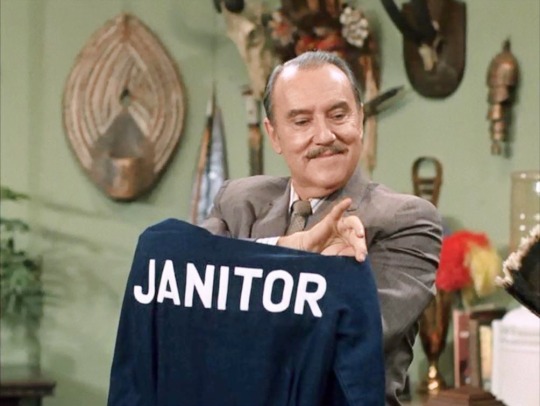
To save $9.40 a month on his rent, Harry appoints Lucy janitor, presenting her with coveralls, a feather duster, a mop, and a bucket!
LUCY (to Harry):
“You make Scrooge sound like Diamond Jim Brady.”Comparisons
of both Harrison O. Carter and Theodore J. Mooney to Diamond Jim
Brady were frequent. James
Buchanan Brady
(1856-1917)
was a real-life millionaire and philanthropist who was fond of jewels
(hence the nickname). Although often the comparison is to cheapskate
Jack Benny, here it is to Ebenezer Scrooge, the fictional miser at
the center of Charles Dickens’ famous novella
A Christmas Carol.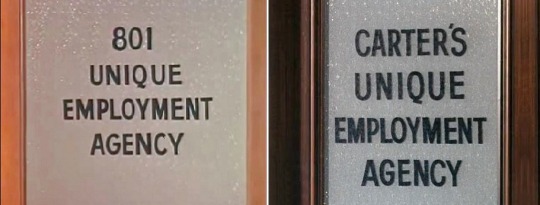
It
is revealed that Harry opened the Unique Employment Agency 29 years
ago. That would mean it was established in 1941. The name was based on an employment agency seen on “The Lucy Show” (left).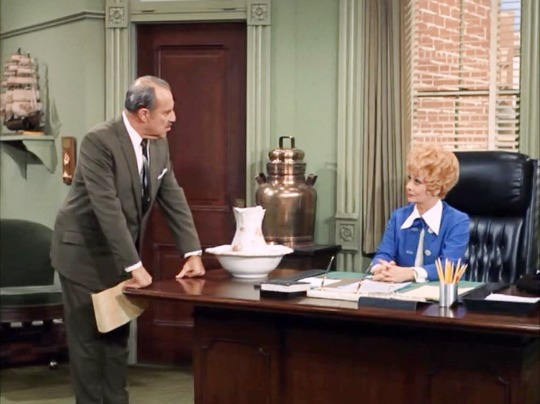
At
the start of scene two, Harry is dictating a letter to a Mr.
Rylander.
This name has been used by Gale Gordon many times on both “The
Lucy Show” and “Here’s Lucy.”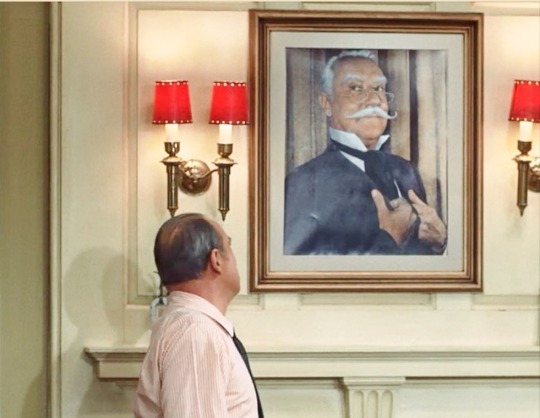
Lyle
Talbot gets entrance applause from the studio audience. The un-named attorney gets $50 an hour and (apparently) makes house calls.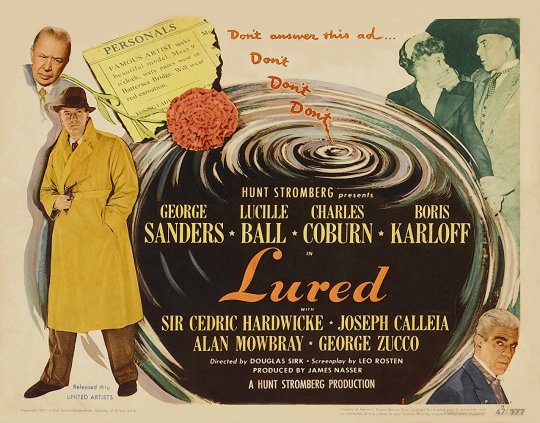
In
her new role as President of the Unique Employment Agency, Lucy hangs
up on a call from an important client named Charles Druten. Charles
van Druten
was a character played by Boris Karloff in the 1947 film Lured
starring Lucille Ball.
When
the movers try to take away the water cooler, Harry grabs the bottle
and – of course – ends up all wet! It wouldn’t be “Here’s Lucy”
if Harry stayed dry!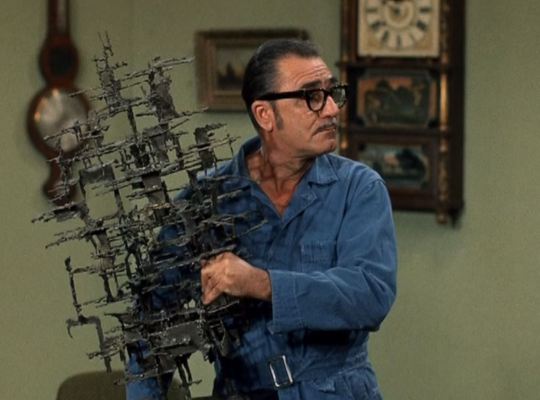
When the moving man (Alberto Morin) brings in Lucy’s new modern sculpture, the show gets close to a ‘dirty joke’.
MOVING MAN: “What do you want me to do with this?”
HARRY: (pause) “Oh, don’t tempt me!”Before giving his withering response, Gale Gordon pauses just long enough for the viewers to fill in the logical reply – had this not been primetime TV in 1970!
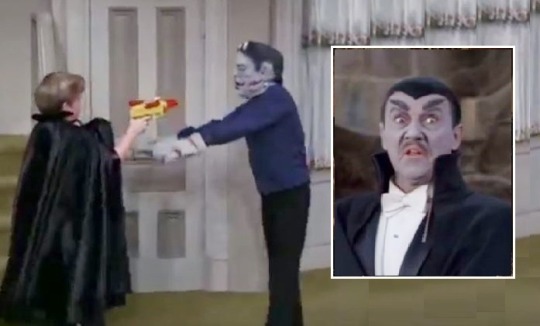
When
Kim says the cobweb-filled attic looks like something out of a Frankenstein
movie, Craig jumps out to scare her by pretending to be Bela Lugosi
as Dracula. As Mr. Mooney, Gale Gordon played Dracula in a
monster-themed episode of “The Lucy Show.” In the same episode
Lucy’s son Jerry dressed up Dracula and Viv’s son Sherman as
Frankenstein.
The abstract metal statue held by the mover (Alberto Morin) was previously seen in Van Johnson’s office during “Guess Who Owes Lucy $23.50?” (S1;E11).
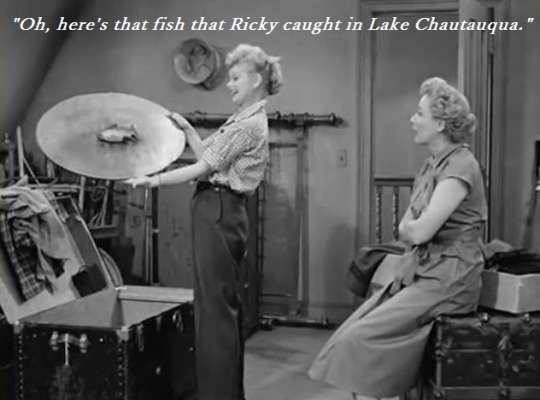
This is the first time viewers have visited Lucy’s attic.
The
attic of the apartment building at 623 East 68th Street was also only seen once; in “The Saxophone” (ILL S2;E2). Coincidentally, it too references Lucy’s hometown and county.

Similar framed
“Home Sweet Home” samplers were seen above Fred and Ethel’s bedin “Vacation from Marriage” (ILL S2;E6),
as well as on the wall of One Oak Cabin in “First Stop” (ILL S4;E14).
FAST FORWARD!

Lucy also named her bag lady character in Stone Pillow (1985) Florabelle after her grandmother. In an interview during filming she said about her grandmother
“She was a pioneer lady, and I just wanted this bag lady I played to be independent and have her own little survival kit, her own way of doing things without begging.”

Flora Belle Orcutt is also used as Lucy Carter’s great-grandmother’s name in “Lucy, the Sheriff” (S6;E18) in 1974.
Props!
When Harry goes to tear up the IOU, Lucy warns him that it will do no good because it’s a photostat [copy]. The document Harry is reading, however, is on yellowed parchment paper! The paper has a small black mark in the same place as the document Lucy pulled out of the diary in the attic in the previous scene. Is Lucy fibbing to Harry?
I’ve Got a Date! When
Harry opens the door of the closet, there is a wall calendar that
reads JAN. The year appears to be blacked out, but since the
first of the month falls on a Sunday, it is likely from 1967 or (less
likely) 1961. Confusing matters even more, there are students in cap and gown on the calendar, indicating it might be May or June!
Doppelgangers! The
framed painting of Harry’s great grandfather hanging over the
fireplace is actually a ‘doctored’ black and white photo of Gale Gordon
that hung over Mr. Mooney’s mantle on “The Lucy Show.” The same
photo, now, colorized, was used for a gag on “Lucy Protects Her
Job” (S2;E14).
Sitcom Logic Alert! Out of nowhere, Craig comes to the realization that the interest is compounded annually (although it doesn’t say that in the note itself) and that Harry owes Lucy $138,000. It takes Kim and Craig an entire episode to read further to see that the debt was already paid! Oh, well!
Sitcom Logic Alert II! The premise of redecorating the office with antiques from Lucy’s attic doesn’t make sense since the office is already decorated with antiques!

The Eyes Have It! Actor Lyle Talbot rarely makes eye contact with Gale Gordon in their scene together. Perhaps he was reading off cue cards?

Floor Plan! Harry’s
home and living room are differently configured than in previous
episodes. (photo by Brock Weir)
“Lucy Takes Over” rates 3 Paper Hearts out of 5
The
fun thing about this episode is watching Lucy take the upper hand.
Her display of self-confidence and superiority are a refreshing
change of pace and must have been what Lucille Ball the executive was
like.1970, Ann Tyrrell, attic, Bela Lugosi, CBS, Charels von Druten, Desi Arnaz Jr., Diamond Jim Brady, Flora Belle Hunt, Frederick C. Hunt, Gale Gordon, Here’s Lucy, Home Sweet Home, James J. Casino, Jay Sandrich, Lucie Arnaz, Lucille Ball, Lucy Takes Over, Lured, Lyle Talbot, Miles Wilder, Orwin C. Harvey, Private Secretary, Ronald Nyman, Scrooge, Sid Gould, Sinclairville NY, tv, William Raynor -
LUCY AND WAYNE NEWTON
S2;E22
~ February 16, 1970
Directed
by Danny Dayton ~ Written by Milt Josefsberg and Ray SingerSynopsis
The
Carters go to Las Vegas to see the shows, but Lucy loses all their
money in a gas station slot machine. On their way home they discover
a stray pony and return him to the owner, who turns out to be singer Wayne
Newton. The Carters take jobs as Newton’s ranch hands to make enough
money to return to Vegas.Regular
CastLucille
Ball (Lucy
Carter), Gale
Gordon (Harrison
Otis Carter), Desi
Arnaz Jr. (Craig
Carter), Lucie
Arnaz (Kim
Carter)Guest
Cast
Wayne
Newton (Himself)
previously played himself in “Lucy Sells Craig to Wayne Newton”
(S1;E9) and “Lucy
Discovers Wayne Newton” (TLS S4;E14).
He is one of the best-known entertainers in Las Vegas, known by the
nicknames the ‘Midnight Idol,’ ‘Mr. Las Vegas’ and ‘Mr.
Entertainment.’ His well-known songs include 1972’s “Daddy,
Don’t You Walk So Fast” (#4 on the Billboard chart), “Years”
(1980), and his signature song “Danke Schoen” (1963). This is his final episode of “Here’s
Lucy.”
Jerry
Newton (Himself, Guitarist, right) is the older brother of Wayne
Newton. He also appeared in
1968’s “Lucy Sells Craig to Wayne Newton” (S1;E9).Jerry’s
catch phrase is “Oh, gosh yes.” Although Wayne Newton
calls him by his first name, it is never mentioned that the two are
brothers.Tommy
Amato (Himself, Bass Player, left) was a bandleader and Wayne
Newton’s bass player. He also appeared in 1968’s “Lucy Sells
Craig to Wayne Newton” (S1;E9).Amato
is not identified by name in the dialogue.
Tiny
Tim (T.T.)
is an Angolan miniature horse from South America.
This is the second and last episode for director / actor Danny Dayton, who also was director of “Lucy Protects Her Job” (S2;E14).
The final draft of this script by Josefsberg and Singer was dated October 1, 1969.

Following the original broadcast of this episode, “The Doris Day Show” featured ‘Lucy’ supporting players Bobby Jellison, Mabel Albertson, and Hal Smith.
This
episode is filmed on location in the San Fernando Valley. Second
unit footage of the Las Vegas Strip featured doubles for the cast.
The in-car driving scenes were done using a studio process shot.
In
his introduction to the episode on DVD Wayne
Newton
recalls that this episode nearly caused a rift between him and Lucy
due to the demands of the production.
Musical Director Marl
Young
takes over the introduction and enthusiastically recalls writing the
jazz background music for the montage of the drive down the Las Vegas
strip. Young mistakenly calls “Gary Morton” and “Gale Gordon”“Gary Martin” and “Gale Garden.”
Sunset Strip Montage

Caesars
Palace
– opened in August 1966 and is still operating today. The marquee
headliner is Frank Sinatra with Little Richard with the Nitty Gritty
Dirt Band.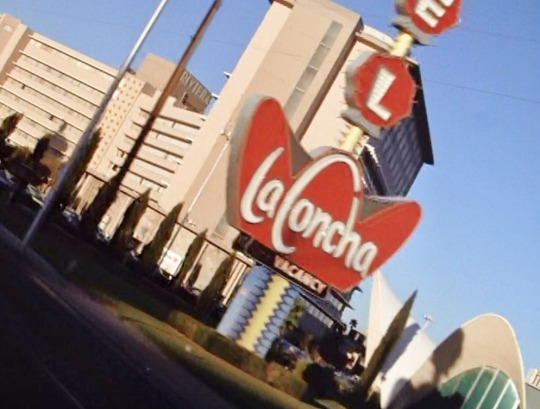
La
Concha
– was
a motel that opened in 1961
and
closed in 2004. The sign is restored and preserved in Las Vegas’s
Neon Museum. It was named after the resort community
of La
Concha, Spain.
It was neighbors with the Riviera,
which is in the background.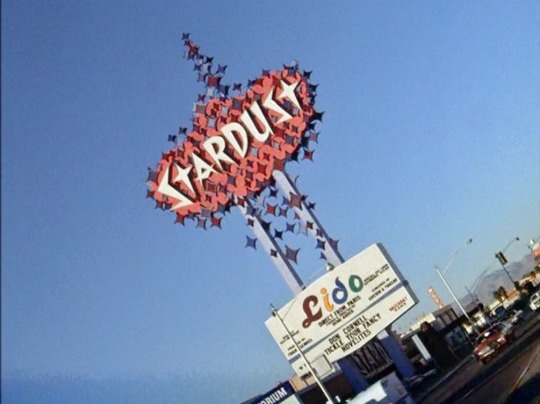
Stardust
–
was located at 3000 Las Vegas Boulevard South. It was first opened
in 1958 and demolished in 2007. The famed Stardust sign became one
of the symbols of Las
Vegas.
The
entertainment roster featured with the spectacular French production
show
Lido
de Paris.
International
–
opened
in 1969 and was known for many years as the
Las Vegas Hilton, then briefly as the LVH – Las
Vegas Hotel and Casino. It was renamed the Westgate Las Vegas in
2014.
Upon
opening, the International was the
largest hotel in the world.
The headliner at the time of the filming of the footage was Bill
Cosby with Lionel Hampton. Interestingly, the International boasts
the opening of a Children’s Youth Hotel!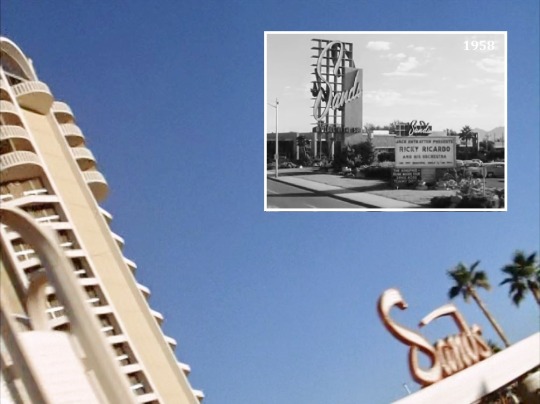
Sands
–
was
a historic hotel and casino on the Las
Vegas Strip
that
operated from 1952 to 1996. The Sands was the seventh resort to open
on the Strip. During its heyday, the Sands was the center of
entertainment and hosted many famous entertainers of the day, most
notably the Rat
Pack.
The Sands was featured in “Lucy Hunts Uranium” in 1958 (inset).
Flamingo
– opened the day after Christmas 1948 and is still operating today.
It is located at 3555 South Las Vegas Boulevard. The
hotel was the third resort to open on the Strip and remains the
oldest resort on the Strip still in operation today. The headliner at the
time was comedian Pat Paulsen.
Frontier
–
was
the second resort that opened on the Las Vegas Strip and operated
continuously from October 1942 until it closed on July 16, 2007 and
was demolished. It has the distinction of hosting Elvis
Presley’s
first Vegas appearance in 1956, and the final performance of Diana
Ross and The Supremes on
January 14, 1970. At the time of filming singer Abbe Lane and comic
Dick Shawn were headlining. Shawn guest starred in “Lucy and the
Pool Hustler” (TLS S6;E13) in 1968. At one time, Abbe Lane was
married to Xavier Cugat, Desi Arnaz’s mentor and Ricky Ricardo’s
competition.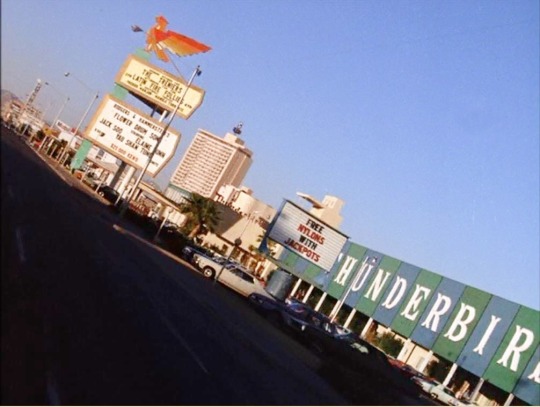
Thunderbird
–
was located at 2735 Las Vegas Boulevard South and operated from 1948
to 1992. It was the fourth resort to open on the strip and
had a Native
American
theme
that featured a Navajo-based
restaurant, the only bowling alley ever on the Strip, and a showroom.
The marquee here promotes a stage production of Rodgers and
Hammerstein’s 1958 Broadway musical Flower
Drum Song
starring Jack Soo, who had also been in the 1961 film adaptation.
Interestingly, the Thunderbird wooed gamblers with the promise of
‘Free Nylons with Jackpots’! From
1976 the property was known as the Silverbird and then, finally, El
Rancho.
Bonanza
– opened in
July 1967 on land formerly occupied by Three Coins Hotel and Casino.
It was later renamed the New
Bonanza Hotel and Casino. In 1973
it became part of Bally’s Las Vegas. It is not connected to the
Bonanza Gift Shop, a landmark store on the Strip and one of the
largest such establishments in the word.
Riviera – operated from April 1955 to May 2015. It was
the first high-rise and the ninth resort on the Las Vegas Strip. Liberace cut the opening ribbon, and became the first resident performer. The building was demolished in 2016.
The only sign that is missing from the montage is the iconic “Welcome To Fabulous Las Vegas Nevada” sign that is now visually associated with the gambling town.
Craig
notices that Dean
Martin
is playing at the Riviera. Desi Arnaz Jr. was in a band with
Martin’s son. Kim says “He’s one of my favorites!” Martin guest
starred as himself (and his doppelganger) on “The Lucy Show.”
His opening act at the Riviera is comedienne Totie Fields, who
will act on a 1972 episode of “Here’s Lucy.” In 1975, she was one
of the comics to roast Lucille Ball on “The Dean Martin Celebrity
Roast.”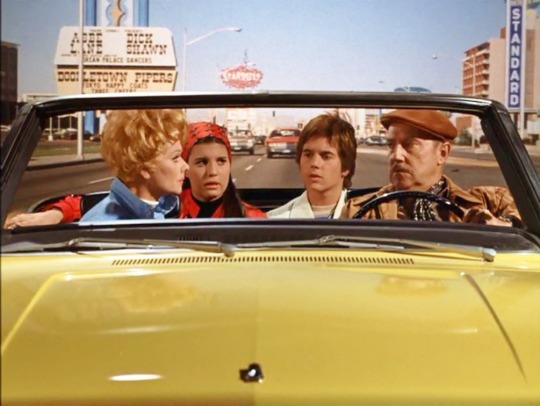
Harry’s 1970 yellow Plymouth Satellite convertible was previously seen in “Lucy and Viv Visit Tijuana” (S2;E19).

Also
during the driving scene, the background shows a marquee for P’zazz
’70, a lavish stage show at the Desert Inn Hotel and Casino,
in operation from 1950 to 2000. The show started out as P’zazz
’68 and was updated.
Their drive down the Strip also takes them past The Castaways casino, where Cotton Club Revue 70 is playing. The above snapshot was taken in September 1969, around the same time as filming. Castaways operated from 1963 to 1987, when it was imploded to make way for the Mirage. In 1967, the Castaways was sold to billionaire Howard Hughes for $3 million as part of his spree of buying Las Vegas properties.
Coincidentally, the reclusive millionaire is also mentioned in this episode.
CRAIG (to Harry): “If you didn’t come to Las Vegas to see shows, what did you come for?”
LUCY: “He came to kiss Howard Hughes’ ring.”
The foursome encounter a miniature horse on the side of the road but don’t know exactly what sort of horse it is. Lucy says she can’t imagine John Wayne sitting on it; Mickey Rooney, yes. John Wayne appeared on both “I Love Lucy” and “The Lucy Show” while Mickey Rooney starred with Ball in Thousands Cheer (1943) and as an acting teacher on a 1966 episode of “The Lucy Show.”

Wayne
Newton purchased the first five acres of what is now Casa
de Shenandoah
in 1966. It was raw land, with no well or electricity. The first
house was built between 1966 and 1968, along with four stalls for a
horse barn. He lived in that home with his parents and older brother.
He then acquired additional acres between 1969 and 1972.
Construction
of the Mansion began in 1973 and was completed in 1976.
Today, Casa de Shenandoah is one of the top tourist attractions in
Las Vegas.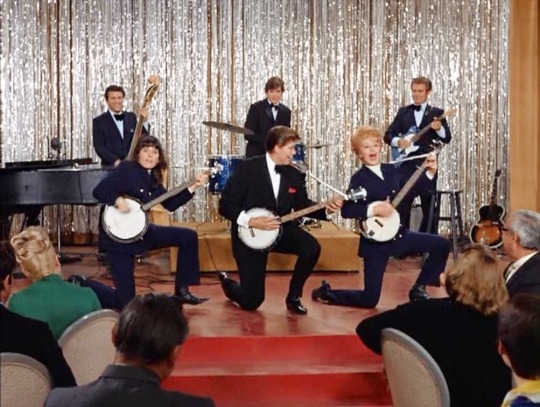
Although the episodes were by different writers,
Newton and the Carter family remember meeting each other in 1968 (above).
Newton remembers Harry because when they first met he asked for two
choruses “Hey
Big Spender” (which didn’t actually happen in the episode). The song is by Cy
Coleman
and
Dorothy
Fields
and was written for
the Broadway musical
Sweet
Charity in
1966 and was included in the 1969 film starring Shirley MacLaine.
Lucy’s
qualifications for working on a ranch are that she saw every Gene
Autry picture three times. Gene Autry (1907-98) was a Texas
born motion picture star dubbed “The Singing Cowboy.”Wayne
Newton shares that is half Cherokee. Craig says that means he is “one
of the original Americans.” Awareness of the plight of Native
Americans was heightened during the late 1960s. “Lucy and the
Indian Chief” (S2;E3) was shot on location on Navajo land using
Native American tribe members for extras.
At
the barbecue, Newton sings “Tumbling Tumbleweeds” accompanied by
Jerry on guitar and Tommy on bass. Kim and Craig sing back-up while
Lucy and Harry look on. “Tumbling Tumbleweeds” is a song
by Bob Nolan and sung by Gene Autry in a 1935 film of the same name.
In 1970 it was covered by Don Everly.When
Newton says that Kim and Craig have “good seats” (ie; ride horses
well), Lucy misunderstands and nonchalantly admits to having
“paddled” Kim and Craig! Yikes!
Lucille
Ball was an experience rider, having ridden horses in her films and
television shows, but here (at age 59) leaves the riding to her children. She
does, however, help Harry rope a calf for branding, but only manages
to brand Harry instead!
Lucille Ball wears tinted glasses for the exterior shoots, just as she did the previous year on location at the Air Force Academy at the start of season 2. These lenses allow viewers to still see Lucy’s expressive eyes, but also provide protection from the sun’s rays.
Lucie and Desi Jr. were sent to horse trainer Glenn Randall to learn how to ride the dancing horses used for the episode’s finale. Randall famously trained Trigger, Roy Rogers’ horse.

Lucie Arnaz later recalled, “We would drive two-hours in rush-hour traffic all the way up to this mountain where we get on with this horse dressage and learn from scratch how to ride so that we could do that show with Wayne Newton. I mean stuff like that just blows my mind.“
For
the finale, Wayne sings "I’ve
Got the World on A String”
by Harold Arlen and Ted Koehler written in 1932.
The song was made popular by Frank Sinatra. Wayne performs this song
while on his dancing horse. Kim and Craig are also on dancing horses
that perform while he sings.
What Happens in Vegas….

A quick subliminal callback happens in the very first moments of the episode, when Harry’s car drives past the Las Vegas Tropicana. Their sign is only briefly seen from behind [I’ve reversed the image on the left] while the focus is on the Caesar’s Palace marquee. Desi Arnaz borrowed the name from the original Tropicana nightclub in Havana for Ricky Ricardo’s club on “I Love Lucy.” Ironically, the Las Vegas casino hotel opened in 1957, just after Ricky changed the name to Club Babalu. It is still in business today.
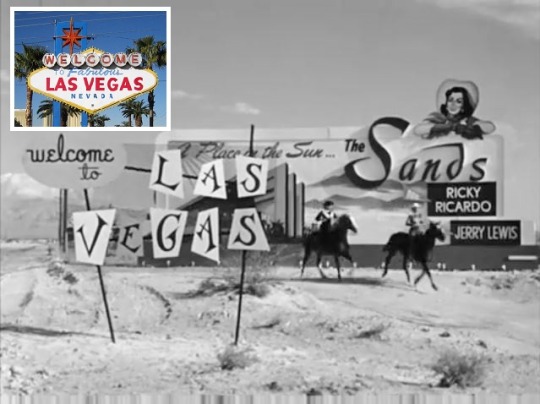
Lucy
Ricardo was in Las Vegas for “Lucy Hunts Uranium” (1958, above) hunting
for her fortune in the Nevada desert rather than the casinos. The
Sands, whose sign is seen in the opening montage of “Lucy and Wayne
Newton”, is where Ricky Ricardo performed and the gang stayed
during the episode. Location footage featuring the cast was shot in
the California desert while a second unit team and cast doubles were
filmed in Las Vegas. Lucille Ball and Desi Arnaz were invited to the
Sands’ fourth anniversary party in 1956.
Lucy and Ricky Ricardo were also in Vegas for “The Lucy-Desi Milton Berle Special” in November 1959 on NBC.

Lucy
Carmichael and Viv won a trip to Sin City in “Lucy Goes to Vegas”
(TLS S3;E17) where being broke doesn’t stop them from being high
rollers.
In 1975, Lucy Collins traveled to the Nevada gambling town to meet her celebrity crush, Dean Martin, in “Lucy Gets Lucky”, which also begins with a montage of the Strip, ending on the exterior of the MGM Grand, where the action is set.

“Lucy
Discovers Wayne Newton” (TLS S4;E14) also was set on Newton’s farm
and also featured a horse, although not shot on location.
The rear-projection shot of the cast driving down the Las Vegas Strip is visually similar to the now iconic image of the Ricardos and the Mertzes driving across the George Washington Bridge in “California, Here We Come!” (ILL S4;E14), which was the first process shot used on television.

Deja View! As with most rear projection process shots, the Harry’s car passes the same Las Vegas Strip landmarks several times as the scene goes on.

BYOB (Bring Your Own Bass)! Kim surprises everyone by asking Wayne Newton to sing. It is convincing enough that Newton’s brought along his guitar, to a picnic by the river, but it seems a stretch that Tommy has packed his upright bass!

Children & Animals! Working on location with live animals causes a few overlaps in dialogue and a few skillful ad libs by the cast.

Ouch! Talking of the unpredictability of animals, when Harry chases the calf around the pen, Gale Gordon smashes into the barn wall with his right shoulder. Like the trouper he is, Gordon continues the scene!

Stunt Roper? When the script has Harry lasso Lucy instead of the calf, the camera goes in for a medium shot of Lucy, with Harry off screen for when the lasso lands around her. It may be that after several attempts, Gale Gordon allowed a more skilled roper to throw the rope around Lucy and then walks into the shot. There is a definite scene change for when Lucy and Harry have (supposedly) subdued the calf in order to brand him. Gale Gordon (63) and Lucille Ball (58) are obviously winded from the scene, but are definitely doing most of their own stunts with the live (and lively) calf.
“Lucy and Wayne Newton” rates 3 Paper Hearts out of 5
 1970, Abbe Lane, Bill Cosby, Bonanza, Case de Shenandoah, Danny Dayton, Dean Martin, Desi Arnaz Jr., Flamingo, Frontier, Gale Gordon, Here’s Lucy, International, Jerry Newton, La Concha, Las Vegas, Lucie Arnaz, Lucille Ball, Marl Young, Milt Josefsberg, miniature pony, Pat Paulsen, Ray Singer, Riviera, Sands, Stardust, Thunderbird, Tommy Amato, Vegas Strip, Wayne Newton
 -
LUCY AND WALLY COX
S2;E21
~ February 9, 1970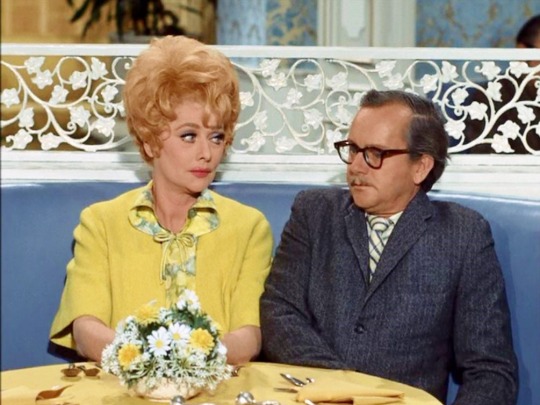
Directed
by Jay Sandrich ~ Written by Milt Josefsberg and Ray SingerSynopsis
Harry’s
old friend Moose has a shy son who Lucy helps bring out of his shell
– until a plan to help him bravely foil a robbery goes awry!Regular
CastLucille
Ball (Lucy
Carter), Gale
Gordon (Harrison
Otis Carter)Desi
Arnaz Jr. (Craig
Carter) and Lucie
Arnaz (Kim
Carter) do not appear in this episode, although they are billed in
the opening credits.Guest
Cast
Wally
Cox (Wally Manley) was a character actor best remembered for
being a panelist on TV’s “The Hollywood Squares” (1965-73) as
well as his hit series “Mr. Peepers” (1953-55). He played a
nervous musician on “Lucy Conducts the Symphony” (TLS S2;E13) and
a reformed safe cracker in “Lucy and the Ex-Con” (S1;E15). He
will make two more guest-star appearances on “Here’s Lucy.” Cox
died of a heart attack in 1973 at age 48.Cox was known for playing less-than-masculine characters, so the name ‘Manley’ is a bit of an inside joke. Despite
being billed in the title by his real name, Cox never played himself
on his many guest appearances with Lucille Ball. Cox’s character doesn’t enter the story until 10 minutes into the 24 minute program and receives a warm round of applause from the studio audience.LUCILLE BALL: “I adored Wally Cox. I worked with him every chance I got!”
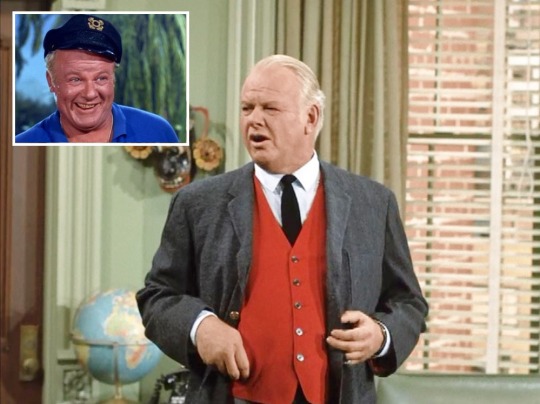
Alan
Hale Jr.
(Moose Manley, Wally’s Father) is best remembered as the Skipper on “Gilligan’s
Island” (1964-92). Hale previously appeared as a Fire Captain on
“Lucy Puts Out a Fire at the Bank” (TLS S2;E9) the year before he
started playing the Skipper. Hale made his film debut at
age 12. He died in 1990 at age 68.Moose
and Harry are old college buddies. He runs a detective agency with
branch offices in 30 big cities.
Chuck
Hicks (First
Stuntman, left) was
a stunt man and actor who was seen in “Lucy the Stunt Man” (TLS
S4;E5). Hicks was a long-time stunt double for Brian Dennehy. This is
his only time on “Here’s Lucy.” Boyd Red Morgan
(Bruce, Second Stuntman, right) is
an actor and stunt man who was last seen in “Lucy and John Wayne”
(TLS S5;E10), with whom he did eleven films. This is the first of his
four episodes of “Here’s Lucy.”In the 1970s, the first name Bruce was the generic name of a stereotypical gay man (complete with limp wrist and a lisp) in jokes about homosexual males. Here, Harry twice questions the name incredulously, having a hard time associating it with a masculine stunt man. The 1969 studio audience laughs, indicating they also make the connection.
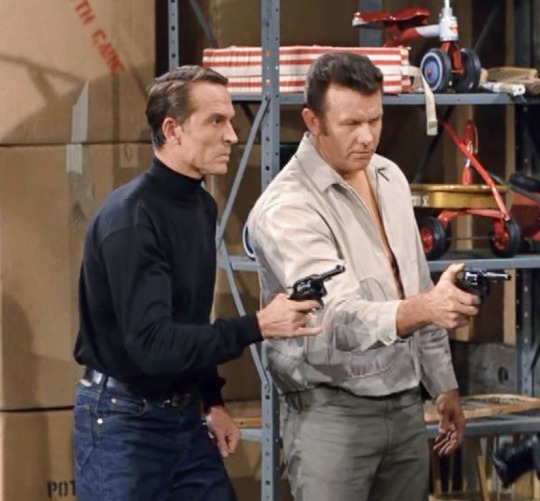
Gil
Perkins
(Baby Face Johnson, First Crook, right) was aboard the train when
Lucy and Ricky headed home from California in “The Great Train
Robbery” (ILL S5;E5). Prior to that he was seen in The
Big Street
(1942) and The
Fuller Brush Girl
(1950) with Lucille Ball. This is his only appearance on “Here’s
Lucy.” X.
Brands (Lefty Logan, Second Crook, left) was his real name! A
family tradition held over from when an ancestor added the letter ‘X’
to his name to differentiate himself from another man of the same
name in town. X Brands was known for playing American Indians, despite
not being one. This is his only appearance with Lucille Ball.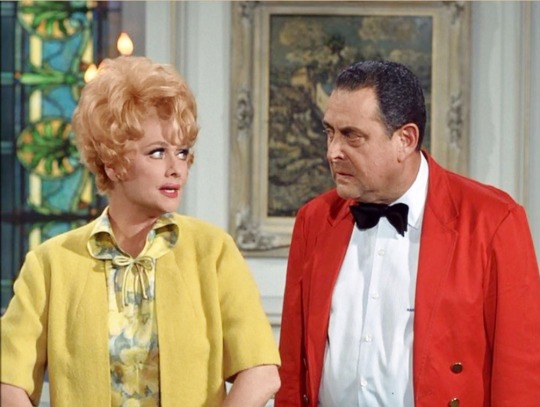
Harvey
Stone (Waiter) was born just three weeks after Lucille Ball in
1911. He had appeared in two plays at New Jersey’s Paper Mill
Playhouse in 1968. He will be featured in one more episode, also
directed by Jay Sandrich. In 1974 Stone died of a heart attack while
performing on a cruise ship and was buried at sea.The
waiter has no dialogue, but his face says it all!There
are a few diners in the background of the Cafe George, but their
faces cannot be seen.
This
is the first of three episodes to be directed by Jay
Sandrich.
The year after this episode, Sandrich won an
Emmy Award for his writing on “The Mary Tyler Moore Show.” He
won again for the same show in 1973 and earned two more Emmys for his
writing on “The Cosby Show” in 1985 and 1986. Sandrich first
joined the Desilu team in 1956 as Assistant Director of “I Love
Lucy” and “The Lucy-Desi Comedy Hour.” Sandrich remembers:“I
was so young and caught in the middle of America’s favorite couple
breaking up. Psychologically, I didn’t know how to handle it because
I was in the middle. They all were wonderful people but naturally
there was tension.”
In April 1968, Gale Gordon joined Wally Cox as one of “The Hollywood Squares.” Host Peter Marshall had played Lucy Carmichael’s brother-in-law on “The Lucy Show,” so Marshall and Gordon had that in common! Marshall would also star in “Happy Anniversary and Goodbye” in 1974. Also in the grid that week was Jack Cassidy, who had guest starred on “The Lucy Show” in 1965.
Although
Hale and Cox play father and son, they were only three years apart.
Moose Manley says that his son is 33 years old.
In reality, this episode was aired a week before Wally Cox celebrated
his 45th birthday.
Moose
says that in college, Harry was known as ‘Blubber’ because he was
overweight and adds that Harry still holds the college record for
swallowing 86 goldfish in ten minutes. Goldfish swallowing
was a fad of the 1920s and ‘30s college students probably during
initiation rituals or on dares. This unusual trend has been
previously mentioned on other “Lucy” shows. Harry later recalls that
they went on panty raids, another college stunt popular with
fraternity boys during the ‘20s and ’30s.
When
Harry thinks Moose is using blackmail to allow Lucy time off to help
his son with his girl problems, Moose replies “You bet your
bippy it is!” The word
“bippy” means “ass” and the euphemism was used as early as
1880, but was re-popularized by “Rowan and Martin’s Laugh-In,”
“Here’s Lucy’s” competition on ABC. In May 1969 a song titled “You Bet Your Sweet Bippy” was released. This is just one of many
“Laugh-In” references on “Here’s Lucy.”
Story Time with Hilda & Madge – When
Lucy hears that Wally is afraid of girls, she relates a story of a
high school friend named Hilda who had a girl-shy brother. Moose blackmails Harry by threatening to tell Lucy a salacious story about a girl in Harry’s past named Madge.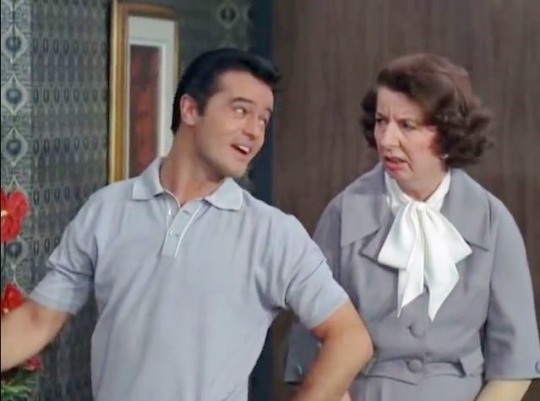
Moose
gets a phone call from his secretary, Miss Hurlow. Miss Hurlow
was also the name of Robert Goulet’s secretary who was played by Mary
Wickes in “Lucy and Robert Goulet” (TLS S6;E8, above).
After the two stunt men completely destroy Harry’s office, one of them says “We’ve got to get it out of our systems. We’re not allowed to be violent on TV anymore!” In 1969, the National Commission on the Causes and Prevention of Violence submitted a report that brought television violence under careful scrutiny. That same year, Senator John Pastore requested that the Surgeon General appoint a committee to conduct an inquiry into television violence and its effect on children. Clearly this topic was in the news, and as a result gets a laugh from the studio audience.

The warehouse seems to be stocked with
children’s toys and games (as well as lamps and boxes of nylon). The Ideal board game Seven Keys
can be seen on the table near the door. It was based on the TV game
show of the same name (which, in turn, was based on Chutes and
Ladders) that ran from 1961 to 1965 on ABC and was hosted by Jack
Narz.
There is also a Roadmaster V gold wagon by AMF. American Machine and Foundry (AMF) Roadmaster division was primarily known for bicycles, but also created many wheeled children’s toys. This is the fifth iteration of their gold pull toy wagon, manufactured in the 1960s.
As
usual, Lucy has no control of hoses and Harry ends the episode
soaking wet! To be fair, so does Lucy!
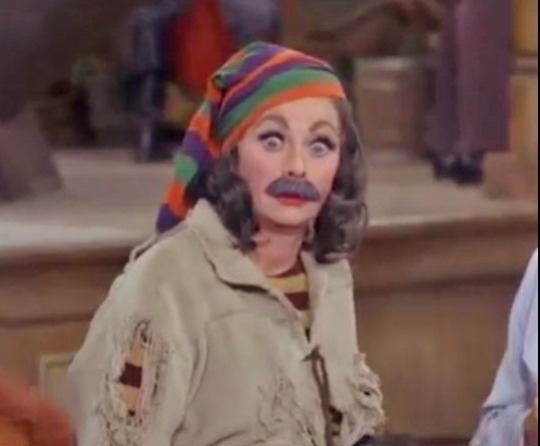
Episodes
featuring stunts recall when Lucy Carmichael took a job as a stunt
person named Iron Man Carmichael on “The Lucy Show.” In “Here’s
Lucy,” however, Lucille Ball leaves the stunt work to others!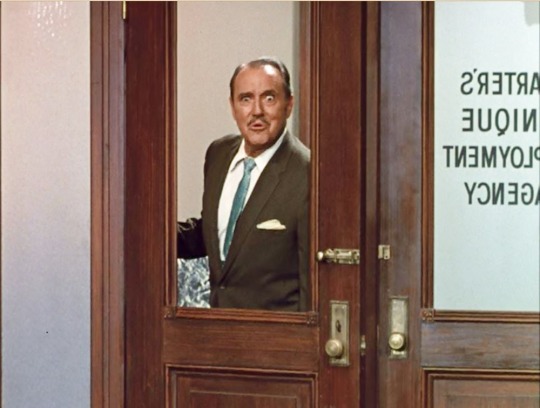
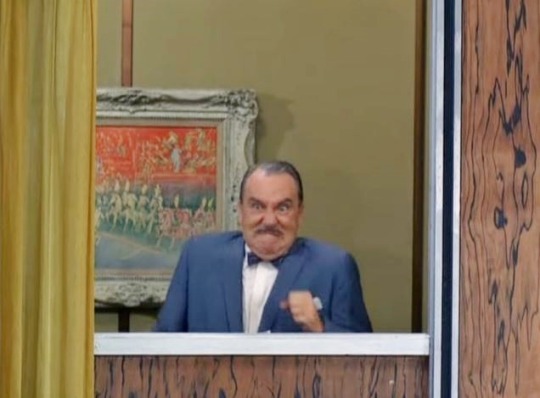
The gag of Harry’s glass door shattering was previously done to Mr. Mooney on “Lucy Gets Involved” (TLS S6;E17).

Oops! Picking
up the menus, Lucille Ball knocks over the
salt and pepper shakers. Nothing spills out (likely they were empty) and Lucy doesn’t bother to right them, knowing that the entire contents of the table will soon end up
on the floor anyway!
What Month Is It? Although the episode aired in February, the calendar in the storage room shows artwork of a line of graduating students in black cap and gown holding diplomas, usually indicative of May or June. The calendar year remains in soft focus throughout.
What’s
My Line?
Moose says he runs a detective agency, but is here supplying security
guards for a warehouse, quite a different business!Wanted Dead or…? Moose
recognizes Baby Face and Lefty as “the
most notorious killers in the country.” If that is so, why are they robbing toy warehouses? Also, they are armed with guns yet are easily overpowered by Wally and Lucy who only
have toys to defend themselves!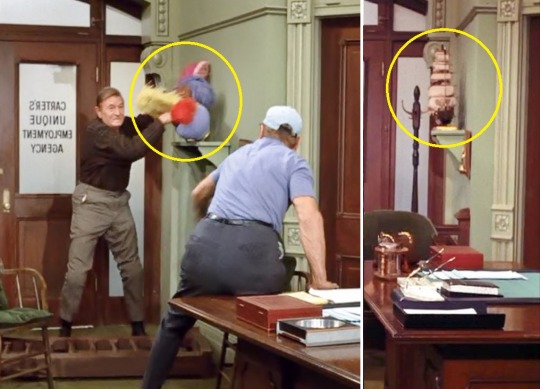
Redecorating!
The model ship that usually sits on the shelf next to the office
doors has been replaced by colorful vases and feathers. This is
because the stunt men are going to wreck the office and need
breakaway glass for their demonstration. The water cooler has also
been removed for this episode.
Where The Floor Ends! During the destructive demo, the camera pulls back a bit too far revealing where the edge of the wall-to-wall carpeting meets the cement of the soundstage floor.

Gimme a Break (but not yet)! The glass in the door shatters while Harry is opening the door to leave, instead of when he shuts it, slightly marring the timing of the gag.
“Lucy and Wally Cox” rates 3 Paper Hearts out of 5
This
is a moderately enjoyable episode, if only to see TV favorites Cox
and Hale play an unlikely father and son. It isn’t particularly
funny, however, and the outcome is predictable. There are also dated jokes about masculinity that haven’t aged very well.
-
Subscribe
Subscribed
Already have a WordPress.com account? Log in now.
 Papermoon Loves Lucy