-
LUCY FIGHTS THE SYSTEM
S6;E24 ~ March 18, 1974


Directed by Jack Donohue ~ Written by Robert O’Brien
Synopsis
A waitress feels she’s been fired for being too old, so Lucy and Kim plan to get her re-hired by turning the restaurant upside down with inept service by an incognito Kim.
Regular Cast
Lucille Ball (Lucy Carter), Gale Gordon (Harrison Otis Carter), Lucie Arnaz (Kim Carter)
Guest Cast

Mary Treen (Mary Winters) appeared with Lucille Ball in the 1950 film The Fuller Brush Girl. She is best remembered as Hilda (the maid) on “The Joey Bishop Show” (1962-65). She appeared as Cousin Tilly in It’s A Wonderful Life (1946) and as Pat Day in Kitty Foyle (1940). In 1972, she played Alice’s temporary replacement Kay on “The Brady Bunch.” Treen had done two films with Gale Gordon, as well as appearing with him on the sitcom “Pete & Gladys” in 1961. She died in 1989.
Winters is a career waitress who has been fired from her job at Harvey’s Welcome Inn. Her phone number is 555-9786. This role was written with Mary Wickes in mind. The surname “Winters” sounds similar to “Wickes” and also goes along with the theme of aging, winter being a metaphor for the last stages of one’s life. The original script (by Bob O’Brien) described the character: “Mary Winters is a woman who has seen many summers and the strain of years of hard work shows in her weary bearing.”

Jack Collins (Harvey Stevens) appeared on the final episode of “The Lucy Show” so it is fitting that he also appears here, on the final episode of “Here’s Lucy.” He played Russel Slater on “Dallas” from 1982 to 1987. This is his sixth appearance on the series.
Stevens is the owner of Harvey’s Welcome Inn. He has just turned 40 (but isn’t happy about it).

John J. ‘Red’ Fox (Charlie) was best known for playing policemen, which is what he did on five of his eight appearances on “The Lucy Show” as well as three of his five episodes of “Here’s Lucy.”
Charlie is the bartender at Havey’s Welcome Inn.

Ernest Sarracino (Tony) played the Judge in “Lucy and the Runaway Butterfly” (TLS S1;E29), also directed by Jack Donohue. His screen acting credits span from 1939 to 1994. He was featured in two episodes of “Here’s Lucy.”
Tony is the chef at Harvey’s Welcome Inn. In the original script the chef’s name was Antoine, but was probably changed to adapt to the casting of Sarracino.
The Diners

The ‘Soup / Salad’ Couple
-
Vanda Barra makes one of over two dozen appearances on “Here’s Lucy” as well as appearing in Ball’s two 1975 TV movies “Lucy Gets Lucky” and “Three for Two”. She was seen in half a dozen episodes of “The Lucy Show.” Barra was Lucille Ball’s cousin-in-law by marriage to Sid Gould.
-
Sid Gould made more than 45 appearances on “The Lucy Show” and nearly as many on “Here’s Lucy.” Gould (born Sydney Greenfader) was Lucille Ball’s cousin by marriage to Gary Morton.

The ‘Fur Coat’ Couple
-
Harry Holcombe played the Judge in the Lucille Ball film Yours, Mine and Ours in 1968. Holcombe played judges on 14 of his 100 screen credits.
-
Barbara Morrison played irate shoppers in both “Lucy’s Working Daughter” (S1;E10) and “Lucy Bags a Bargain” (TLS S4;E17). Morrison was an English-born actress who made three appearances on “Here’s Lucy.”

The ‘Franklin’ Foursome
-
Larry J. Blake (Mr. Franklin) first appeared as a Native American Medicine Man in “Lucy
the Rain Goddess” (TLS S4;E15). He was an ex-vaudevillian who made eight “Here’s Lucy” appearances.
-
The other three members of Mr. Franklin’s party are played by uncredited background performers.

The ‘No Reservations’ Foursome
-
Eddie Quillan (Mr.Jackson) appearedwith Lucille Ball in the film A Guide for the Married Man (1967) and in two episodes of “The Lucy Show” and “Here’s Lucy.”
-
Shirley Anthony (Mrs. Jackson, uncredited) made many appearances on “Here’s Lucy.” From 1994 to 1999 she played Sally on“The Rockford Files” TV movies.

-
Bob Whitney (uncredited) appeared with Lucille Ball in The Facts of Life (1960). He played one of the jurors (unnamed but credited) in “Lucy and Joan Rivers Do Jury Duty” (S6;E9). Whitney and his unidentified blonde dinner companion were also paired as patrons of Dirty Jack’s Paradise Cafe in the previous episode, “Where is My Wandering Mother Tonight?” (S6;E23).

The ‘Table #2’ Couple
-
Buddy Lewis (above right) was previously seen in “Lucy Competes with Carol Burnett” (S2;E24) and “Lucy and Chuck Connors Have a Surprise Slumber Party” (S6;E13). Lewis’ blonde dining companion is unidentified.

The ‘Booth by the Door’ Couple
-
Leoda Richards (uncredited) made at least three background appearances on “I Love Lucy.” She also did four episodes of “The Lucy Show.” In 1968, she was in the Lucille Ball film Yours, Mine and Ours and was also seen in Mame (1974). Richards’ dining companion is unidentified.

This is the final episode of the series, the 144th episode to be aired. Season six ended a disappointing 29th in the ratings and a 20 share, the lowest of the series. It was widely reported at the time that it was Ball’s decision not to continue. Lucie Arnaz chose to leave the series after being cast in the national tour of the musical Seesaw. Without her children, and with enough episodes for reruns, Ball met with CBS and they mutually chose to end the series. Ball
was the last performer from TV’s golden age who still had a weekly series at the beginning of 1974. Jackie Gleason, Red Skelton, Art Linkletter, Garry Moore, Jack Benny, George Burns, all were no longer on the network. Only “Gunsmoke” (1955-75) will survive for one more season. Between 1974 and 1978, still under contract, Ball would star in seven television specials for CBS.
This draft of the script is dated January 13, 1974 and shows some slight changes.

The script draft reveals that Lucille Ball’s long-time friend and co-star Mary Wickes was either the inspiration for the character or the original casting choice for Mary Winters. At least they found another Mary. Perhaps in honor of that idea, Mary Treen plays the role very much like Wickes might have.

After the series ended, “Here’s Lucy” was not immediately offered in syndication because the other two Lucy series were hits, and it was felt that this show might undermine the success of the other two. CBS retained the rights to run the show in daytime and reran the series weekday mornings from May 2 to November 4, 1977, in the same time-slot that they had previously rerun “The Lucy Show” and, before that, “I Love Lucy.” In the fall of 1981, “Here’s Lucy” was put into broadcast syndication but was not very successful and not shown much after 1985.

Ironically, for her last episode, Lucille Ball is up against her old pal Bob Hope in Call Me Bwana (1963), a film being shown on NBC that night.
It is somewhat ironic that the series’ final episode dealt with aging in the workplace, considering Lucille Ball had spent 23 years on series television. From the beginning, her characters never disclose their true age, which became a running gag. TV Guide called it the end of an era. Although, it is announced that Lucille Ball is quitting to pursue her movie career, feature film work never materialized.
Throughout this episode, Lucille Ball’s eyes occasionally wander to see the teleprompter or cue cards, something she started to rely upon more and more on as time went by.

When the episode opens at the Unique Employment Agency (for the final time), Harry is frantically looking for file folder the Costello account. As this is the final episode, it would have been fitting if Harry had been looking for the Rylander or Mosier account, two names Gale Gordon used many times regarding correspondence and reports. It is possible that Costello is a tribute to Lou Costello, with whom Gale Gordon did the 1959 film The 30 Foot Bride of Candy Rock. The film was released posthumously as Costello died March 1959.

Lucy shops during her lunch hour and eats at her desk. She owns a 1971 blue thermos known as half-pint vacuum bottle #2810 manufactured by King-Seeley Thermos Co. in 1971. Thermos was founded in Germany in 1904 and is still making thermos bottles (a generic term for any insulated bottle) today.
Mary Treen (Mary Winters) gets a round of exit applause from the studio audience after her first scene. So does Lucie Arnaz after her first scene.
Since the manager wants a young waitress with a degree in hospitality management, Kim uses the diploma of a former Unique Employment Agency applicant Sally Bartfield (who moved to Pittsburgh) to get the job. Ageist and sexist, Harvey insists on calling Kim “Pussycat”.

When Kim splits up – then re-arranges – the ‘No Reservations’ couples, she calls them “Bob and Carol and Ted and Alice.” This is a reference to the 1969 comedy Bob & Carol & Ted & Alice, which was filmed at Sunset Gower Studios, the former home of Desilu. In “Lucy Cuts Vincent’s Price” (S3;E9) Craig made a joke punning on the title of the film, which dealt with two couples who attempt a sexual liaison with each other.

When Kim clears table 2 by gathering everything in the table cloth and throwing the bundle over her shoulder, she sings a chorus of “Jingle Bells.” The song was part of the “I Love Lucy” Christmas tag and Christmas Show (1956). In “Lucy Goes to Sun Valley” (1958), Lucy says that Ricky proposed to her at Christmastime, so their ‘song’ is “Jingle Bells,” or – as Ricky pronounces it – “Yingle Bells.”

“I knew it would end like this.”
This is the final line of “Here’s Lucy,” ending Lucille Ball’s 23 consecutive years on network television. Until 1986, that is!
Interestingly, and perhaps less satisfying, it is not Lucille Ball who throws the pie at Harry, but actor Harry Holcomb!


All “Lucy” sitcoms have had their share of pie fights. At the end of “The Diner” (ILL S3;E27), there is a four-way pie fight between the Ricardos and the Mertzes.

Ten years earlier, Gale Gordon also ended season two of “The Lucy Show” with a pie in the face in “Lucy Enters a Baking Contest” (TLS S2;E28).

This is not the first time Kim has waited tables. In “Lucy Makes A Few Extra Dollars” (S4;E6), Kim is a server at a cafe making 40 cents an hour! In “Lucy Fights the System” she is earning $2.00 an hour (pre-tips). Larry J. Blake is in both episodes.

Although “Lucy Fights the System” was the last episode aired, it was not the last episode filmed. That would be “Meanwhile, Back at the Office” (S6;E16) aired on January 14, 1974. In it, Harry sells the business to Ken Richards (Don Porter) and the last shot (above) has the principals (for plot purposes, Lucie Arnaz is dressed as a little old lady) walking off into the proverbial ‘sunset’.

Over the Shoulder! When Lucie Arnaz flings the menu at Bob Whitney, it knocks over the salt shaker on his table.

Legal Eagle! The premise of this episode is slightly shoddy, since the Age Discrimination in Employment Act was passed in 1967, making Mary’s firing because of her age illegal.
Who Are You Again? Larry J. Blake introduces himself as “Mr. Franklin” but Jack Collins (Harvey) addresses him as “Mr. Frankel”. The script and end credits confirm the surname as “Franklin”.

“Lucy Fights the System” rates 3 Paper Hearts out of 5
In this final episode, Lucy cedes the stage to her daughter Lucie, handing over much of the episode to Kim for Lucie to shine – and she does. The episode also ends with a pie in the face, a symbol of the vaudevillian comedy roots that gave birth to much of Lucille Ball’s clowning. It is only right that Gale Gordon gets the last line! While not a hilarious (and sometimes flawed) episode, it is a fitting goodbye.
 1974, Barbara Morrison, Bob & Carol & Ted & Alice, Bob O’Brien, Bob Whitney, Buddy Lewis, Call Me Bwana, CBS, Eddie Quillan, Ernest Sarracino, Gale Gordon, Harry Holcombe, Here’s Lucy, Jack Collins, Jack Donohue, John J. Fox, Larry J. Blake, Leoda RIchards, Lucie Arnaz, Lucille Ball, Mary Treen, pie fight, Series Finale, Shirley Anthony, Sid Gould, tv, Vanda Barra
 -
-
William Frawley in “Ricky Asks for a Raise” (ILL S1;E35) 
Jim Bailey as Phyllis Diller on “Here’s Lucy” 
Lucille Ball and Wally Cox 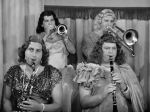
“Lucy’s Club Dance” (ILL S3;E25) 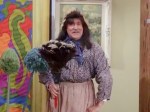
Gale Gordon 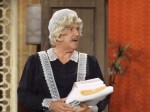
Gale Gordon 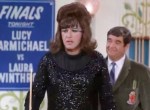
Dick Shawn in “Lucy and the Pool Hustler” (S6;E13) 
Gale Gordon 
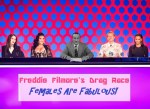
Gale Gordon Freddie Filmore’s Drag Race “Females Are Fabulous”
featuring the queens of “I Love Lucy” “The Lucy Show” and “Here’s Lucy”!

In 2020, gender-fluid actor Nick Tortorella turned up on “Rupaul’s Secret Celebrity Drag Race” as Lucille Ball!
-
WHERE IS MY WANDERING MOTHER TONIGHT?
AS6;E23
~ March 11, 1974

Directed
by Jack Donohue ~ Written by Madelyn Davis and Bob Carroll Jr.Synopsis
Lucy
is upset because her children have left the nest. Kim decides to
invite her mother to stay for the weekend, but when Lucy overhears
Kim’s phone conversation about her ‘mother-smothering’, Lucy goes
missing to give her daughter some space.Regular
Cast
Lucille
Ball (Lucy
Carter), Gale
Gordon (Harrison
Otis Carter), Lucie
Arnaz (Kim
Carter)Guest
Cast
Jack
Donohue (Dirty
Jack) was the director of the very first and the final episodes of
“Here’s Lucy” as well as 33 episodes in between. He also
directed the very first and the final episodes of “The Lucy Show”
with 105 episodes in between. He also directed Lucille Ball’s 1964
TV movie “Mr. and Mrs.” Donohue is making his third on-camera
appearance on “Here’s Lucy” after having been seen in two
episodes of “The Lucy Show.” He will also direct and appear in
“Lucy Gets Lucky” (1975) and “Happy Anniversary and Goodbye.”
His final collaboration with Ball was the TV special “Lucy Moves
to NBC” in 1980.Dirty
Jack is the proprietor of Dirty Jack’s Paradise Cafe.
Brian
Cutler
(Brian) was a stage actor who made his TV debut in 1965 with “The
Long, Hot Summer.” He is probably best remembered for playing Rick
on the short-lived superhero series “Isis” (1974-75).
Cindy
Barnes
(Cindy)In
“Lucy is N.G. as an R.N.” (S6;E17) Kim mentions asking Cindy to
take care of her cat.Shirley
Anthony (Dirty
Jack’s Patron, uncredited) makes the 12th of her 13 appearances
of “Here’s Lucy.” From 1994 to 1999 she played Sally
on “The Rockford Files” TV movies.Bob
Whitney (Dirty
Jack’s Patron, uncredited) appeared with Lucille Ball in The
Facts of Life (1960).
He played one of the jurors (unnamed but credited) in “Lucy and
Joan Rivers Do Jury Duty” (S6;E9).Marl
Young (Marl,
Dirty Jack’s Piano Player, uncredited) was also the “Here’s Lucy”
musical director and often appeared on camera when episodes included
music.The
other patrons of Dirty Jack’s Paradise Cafe are played by uncredited background
performers.

The
title of the episode is a paraphrase of the song “Where
is Your Wandering Mother Tonight?”
written in 1951 by Red Foley and made famous by The Andrews Sisters.
Patti Andrews guest starred on a 1969 episode of “Here’s Lucy”
where Kim and Lucy stood-in for Maxine and Laverne, although this
song was not included in their medley.
PR memos about the episode an a description of the publicity photos.

The
same evening this episode first aired, ABC broadcast the TV special
“Free
To Be…You and Me,”
which was created by and starred Marlo Thomas. Thomas is the daughter
of frequent Lucy guest star and Desilu employee Danny Thomas. The
show also starred the child of another frequent Lucy guest actor,
Alan Alda, son of Robert Alda.
Also
that evening, “Here’s Lucy’s” follow-up on CBS “The
New Dick Van Dyke Show,”
ended its run after three seasons on the air. Like Ball, Van Dyke
had re-invented his original sitcom to create a ‘new’ version. Both
ended within a week of one another leaving CBS without its two most
bankable stars.
In
her DVD introduction to the episode Lucie Arnaz remembers that the
episode was “funny and touching” and “very believable.” She
says she wouldn’t have minded a few more scripts like this one.
In
this episode, Lucie Arnaz sports a short (and very mature) hairstyle.
In the next and final episode of the series, Kim’s hair is covered by
a kerchief and then a large, curly wig. Lucie’s wardrobe is provided by ALROE, who likely also dressed Cindy in her yellow pantsuit.
Lucy
is upset because Kim lives five miles away and hasn’t called her in
ages. Harry reports that Kim is very busy working, going to school
two nights a week, and doing a play with her little theatre group.
Lucy guesses the title as “I DON’T Remember Mama”. This is a
reference to a 1944 play called I
Remember Mama
by John
Van Druten based
on Kathryn
Forbes’
novel Mama’s
Bank Account,
which was loosely based on her own childhood.
The play was made into a film in 1948 starring Irene Dunn and a
television series on CBS (simply titled “Mama”) starring Peggy
Wood that ran from 1949 to 1957, concurrently with “I Love Lucy.”
While “I Love Lucy” was filmed, “Mama” was on kinescope rendering it unavailable for syndication. An unsuccessful Broadway musical adaptation
in 1979 starred Liv Ullman and had music by Richard Rodgers.
Harry
tells Lucy to go have coffee with Mary Jane.
Mary Jane
(Mary Jane Croft) is not in the episode, having made her last
appearance on the series (appropriately enough) in “Mary Jane’s
Boyfriend” (S6;E20).
To
remind a sarcastic Lucy who she is, Kim states her weight – at
birth! Seven pounds, six ounces!
Kim, then Lucy, consult a yoga instruction booklet to guide them into the lotus position. Although it is difficult to say for sure, it was likely written by Kareen Zebroff, who wrote books about Yoga and hosted a Yoga instruction television show from 1971 to 1977.

In
her final bit of physical comedy on “Here’s Lucy,” Lucy gets
stuck in the lotus position while trying to do yoga. She was 62 years old at the time of filming.
After
Lucy’s great struggle getting out of the lotus position, Kim tells
Cindy they are going to the movies to see The
Great Struggle.
Although there was a 1931 film simply titled The
Struggle,
there was no film titled The
Great Struggle.
Lucy is not eager to see The
Great Struggle
because it has an ‘R’ rating.
“I’ve heard about ‘The Great Struggle.’ From what I hear the women
didn’t struggle enough.” Lucy
suggests they go see Robin
Hood.
Lucy
is referring to the 1973 animated version by Walt Disney.
Coincidentally, it features the voice talent of Phil Harris (above left), who
guest-starred on “Here’s Lucy” two episodes earlier.
Lucy
says Kim’s favorite food is pot roast and potato pancakes. After
dinner, Lucy suggests a game of backgammon,
one of Lucille Ball’s favorite pastimes. The series has always
depicted Lucy Carter as a fan of games, particularly in the recent
episode “Milton Berle is the Life of the Party” (S6;E19, above).
Trying
to keep busy, Lucy “fluffs” the bean bag chair and says “Love
this chair. Chair has a sense of humor.” This
sounds very much like Lucille Ball speaking, not Lucy Carter.
Kim
suggests her mother watch television. Lucy wants to watch a spooky
show called “The Beast Who Ate Boston.” With the sound channeled
through an earpiece, Lucille Ball reacts in silence to the horror
movie until she explodes with “Get
your claws off Bunker Hill!”
Dirty
Jack suggests that he and Lucy dance. He does a few hip gyrations
while the piano player (Marl Young) plays “As
Time Goes By,”
written by Herman
Hupfeld in
1931. The song became most famous in 1942 when part of it was sung by Dooley
Wilson in the movie Casablanca. It
became a number one hit for “Here’s Lucy” guest star Rudy
Vallée when
it was re-released to tie in with the film. It is also the theme of Warner Brothers Pictures, who had just released Lucille Ball’s
1974 musical film Mame.
Jack Donohue got his start in show business as a dancer in the
Ziegfeld
Follies of 1927.
The
costuming of Dirty Jack (Jack Donohue) resembles that of the Skipper
(Alan Hale Jr., inset) on “Gilligan’s
Island” (1965-67).
Alan Hale Jr. played Moose Manley in “Lucy and Wally Cox”
(S2;E21). Coincidentally, John Gabriel, the original Professor from
the unaired series pilot, was recently seen as “Mary Jane’s
Boyfriend” (S6;E20).
The
episode ends with Lucille Ball (Lucy Carter) slapping Jack O’Brien
(Dirty Jack), her director!


While
there is no sign of Harry, Kim’s cat, last seen in “Lucy is N.G. as
an R.N.” (S6;E17), the apartment is decorated with ceramic cats.
Unusual ceramic cats have been seen in “The Carters Meet Frankie
Avalon” (S6;E11) and “Lucy and the Ceramic Cat” (TLS S3;E16).
Apparently, when Kim moved out her mother gave her the playing card ice bucket from her home kitchen. It was last seen in “Lucy’s Replacement” (S4;E19, right).

Lucy’s
attempt to make her legs ‘obey’ her while getting into the yoga
position is reminiscent of when Lucy Ricardo’s leg got stuck on the
barre in “The Ballet” (ILL S1;E19), also written by Madelyn
(Pugh) Davis and Bob Carroll Jr. “A
bas! A bas!”
At
Dirty Jack’s Lucy has seven cups of coffee and the bill comes to
$8.00. Jack says it includes $5.00 entertainment tax. In “First
Stop” (ILL S4;E13) the Ricardos and the Mertzes were charged eighty
cents entertainment tax by Mr. Skinner of One Oak Cabins and
Cafe when they were served stale cheese sandwiches and treated to an
off-key rendition of “I’m Afraid to Come Home in the Dark.”

Location!
Location! Location! Kim
must have moved apartments since we lasted visited her Marina Del Rey
digs in “Kim Cuts You-Know-Whose Apron String” (S3;E24). The
view, formerly of sailboats at the Marina, is now of high rise
buildings and trees. The floor plan of the apartment, while similar,
has been altered. The nautically-themed Dirty Jack’s Cafe suggests Kim still lives near the Marina.
What Kind of Room? When Kim goes off to change and returns to find her mother knotted like a pretzel, she tells Cindy she was in “the dressing room” instead of “in the bedroom”. No doubt Lucie Arnaz was thinking about where she went to change clothes, not Kim! Unfortunately, she repeats the error twice. When Cindy asks why she didn’t answer the door promptly and then (to be consistent) to explain her mother’s knotty position!

“Where is My Wandering Mother Tonight?” rates 4 Paper Hearts out of 5
I have to agree with Lucie Arnaz. If the series had concentrated on the mother / daughter relationship in a realistic way, it might have been a totally different show. The moment Lucy overhears Kim talking about her on the telephone brings a lump to the throat. It is one every parent and child knows. The first scene, in the office, is typical “Here’s Lucy” – Harry bellowing and Lucy whimpering. Seeing director Donohue get slapped makes it all worthwhile!
1974, As Time Goes By, backgammon, bean bag chair, Bob Carroll Jr., Bob Whitney, Brian Cutler, CBS, Cindy Barnes, Free To Be…You and Me, Gale Gordon, Gilligan’s Island, Here’s Lucy, I Remember Mama, Jack Donohue, lotus position, Lucie Arnaz, Lucille Ball, Madelyn Davis, Mama, Marina Del Rey, Marl Young, Robin Hood, Shirley Anthony, The New Dick Van Dyke Show, tv, Where is Your Wandering Mother Tonight?, yoga -
LUCY CARTER MEETS LUCILLE BALL
S6;E22
~ March 4, 1974

Directed
by Jack Donohue ~ Written by Robert O’BrienSynopsis
Kim
enters a Lucille Ball look-alike contest to win a new car. When she
feels she’s been overlooked, Lucy gets involved, insisting on seeing
Miss Ball in person. When the two come face to face, Ball insists
Lucy enter the contest, too!Regular
CastLucille
Ball (Lucy
Carter / Lucille Ball), Gale
Gordon (Harrison
Otis Carter), Lucie
Arnaz (Kim
Carter)Guest
Cast
Gary
Morton
(Gary Morton) was
a comedian who worked the famed ‘Borscht Belt’ in the Catskills
Mountains. He met Lucille Ball shortly after her divorce from Desi
Arnaz and they married in November 1961. At her request, Morton gave
up his nightclub career and became a producer of “The Lucy Show.”
Morton also served as a warm-up comic for the show’s studio
audience. Morton passed away in 1999.
Doris
Singleton
(Doris, Lucille Ball’s Secretary) created
the role of Caroline Appleby on “I Love Lucy,” although she was
known as Lillian Appleby in the first of her ten appearances. She
made two appearances on “The Lucy Show.” This is the last of her
four appearances on “Here’s Lucy.” She was originally
intended to be a series regular but was written out after the first
episode.Singleton
is listed as “Doris” in the final credits, but her name is never
spoken aloud in the episode. Singleton has played a different
secretary in all four of her “Here’s Lucy” appearances.
Tom
Kelly
(Tom Morgon, Mais Oui Announcer) first
called play-by-play of college football and men’s basketball games
in 1961. He did so on radio from 1961 to 1988, then on TV from 1989
until 2003. He described the action of five USC national championship
football teams, five Heisman Trophy winners, and 92 first team
All-American footballers.
Kelly previously played himself in “The Big Game” (S6;E2) sharing
the screen with O.J. Simpson.
Carole
Cook
(Cynthia Duncan) played
Thelma Green on “The Lucy Show” as well as a host of other
characters. She was a protege of Lucille Ball’s during the Desilu
Playhouse years. Although born as Mildred Cook, Ball suggested she
take the name Carole, in honor of Lucy’s great friend, Carole
Lombard. Cook appeared in five episodes of “Here’s Lucy”
although she hasn’t been seen on the show since 1970’s “Lucy and Ma
Parker” (S3;E15).Cynthia’s
surname is used during the episode, but is not in the final credits.Roy
Rowan
(Voice of TV Late Movie Host) was
announcer for all of Lucille Ball’s television shows as well as
doing the voice of some TV and radio announcers. On several occasions
he appeared on camera as well.

The
day this episode first aired, People
Magazine’s
first issue hit the newsstands with Mia Farrow on the cover (left). After her passing in 1989, Lucille
Ball was featured on the cover of three issues of People.
As a young model, Lucille Ball appeared in several ads for perfume.

In real life,
Lucille Ball wore Florida Water, Chanel No. 5, and White Shoulders.

The episode opens with Lucy and Kim rushing home to catch a movie on television. This is the last time on the series we see the Carter living room. On the coffee table is Elite Magazine, a studio-manufactured publication seen on screen since “The Lucy Show”.

Scenes
between Lucy Carter and Lucille Ball were accomplished by split
screen and the use of body doubles. This was the best technology
available in 1974.
There
is lots of discussion about Lucille Ball’s hair color. While being
interviewed in the Mais Oui commercial, Ball declines to disclose the
last time she appeared in a film as a brunette. Like Lucille Ball, the character of Mame has a variety of hair colors during her life.
Some of the wigs are seen on Ball’s dressing table in the episode.
Although
Lucille Ball’s dressing room wall is lined with photographs of Mame
and the soundtrack plays the title tune by Jerry Herman, the name of
the movie is never
specifically mentioned.
The film was given its world premiere at the Radio City Music Hall in
New York City on March 7, 1974 three days after this episode first
aired, and released nationally three weeks later. Ball was thrilled
to be returning to the Music Hall after they declined to premiere her
1956 film Forever
Darling
starring Desi Arnaz and James Mason. The film opened at the Ziegfeld
instead.
Lucy’s
Mame
co-stars Robert Preston (Beau) and Bea Arthur (Vera) are also in a
few of the photographs on the dressing room wall. There is also a
photo of Lucille Ball’s mother, Dede.
Dede Ball was
said to be in the audience of every filming of a Lucille Ball TV
show. She made a cameo appearance in the studio audience of “The
Tonight Show” in “Lucy and Johnny Carson” (S2;E11).
On
the date of Mame’s
New York premiere, a pre-taped interview of Lucille Ball was aired on
“The Dick Cavett Show” as part of Ball’s promotion of the film.
Kim
says that a lot of her friends think she looks like Lucille Ball. Lucy scoffs “That’s
ridiculous. She’s old enough to be your mother!”
Lucy
Carter admits that she may look like Lucille Ball now, but when she
was younger she looked like Ingrid Bergman. Bergman was supposed to be “The Celebrity Next Door” (1957) on “The Lucy-Desi Comedy Hour,” but was forced to withdraw because of tax problems. After Bette Davis also passed on the role, it went to Tallulah Bankhead. Bergman’s name was mentioned on a 1967 episode of “The Lucy Show” where Lucy Carmichael and Mary Jane Lewis watch Gaslight, Bergman’s 1944 film with Charles Boyer, on television.
The
Lucille Ball Look-Alike Contest is sponsored by Mais Oui perfume.
There actually was a Mais Oui (French for “But Yes”) made by
Boujois that appeared in 1938, although the packaging and logo used
here bear no resemblance to the real product. The first prize is a
sports car complete with 8-track tape deck!
In
his DVD introduction to the episode (shared with Lucie Arnaz and
Carole Cook), “Here’s Lucy” Musical Director Marl Young says he
had a great time writing the four different iterations of the Mais
Oui jingle. Lucy Carter’s lyrics refer to “a
Joe Namath pass.” Namath was a guest star on “Here’s Lucy” in 1972.
Lucy’s
secretary Doris tells Lucy Carter that Miss Ball is very busy planning a charity event for
Share. Share
was a real life charity that Lucille Ball had worked with for many
years. They were mentioned on “I Love Lucy” during “The
Fashion Show” (ILL S4;E19) in 1955 when the non-profit was just two
years old. Share is dedicated
to raising funds for children with special needs.
In
real life, Lucille Ball’s secretary was named Wanda Clark so it is
curious that (to add veracity), the credits do not name her Wanda
instead of Doris. Clark had a cameo in “Lucy Protects Her Job”
(S2;E14) as – what else – a secretary!
The
bright red outfit Lucille Ball wears to present the three finalists
was the same one she wore while singing the song “It’s Today!” in
Mame.
It is now on display at the Lucille Ball Desi Arnaz Museum in
Jamestown, New York.
Inside Lucille Ball’s dressing room closet is the red spangled jacket Lucy Carmichael wore in “Lucy Dates Dean Martin” (TLS S4:E21) and the blue nightgown Ball wears in “The Bob Hope Christmas Special” (1973). The blue negligee also appears in “Three for Two” (1975) and the jacket in “The Danny Kaye Show” (1962) where Lucy spoofs Judy Garland.

Lucie
and Cook dared to try to make a no-nonsense Lucille Ball laugh during
the filming by doing silly, unscripted things. While Ball is
lip-synching her Mais Oui jingle, Cook cavorted behind her in a
colorful mu-mu. When Ball saw her out of the corner of her eye, she
stopped ‘singing’ and started to laugh, mouthing “son of a bitch”
with a smile on her face. Only her daughter and an old friend like
Cook could get away with such clowning on Lucille Ball’s set. Some of these antics are available on the Season 6 DVD extras.
Because
Lucille Ball wore a wig as Lucy Carter, she could not effectively
try-on the brunette wig without stopping the filming, something she was usually
reluctant to do. She turns her back and hides behind a screen to disguise the cuts.
Lucille Ball says Lucy Carter has “a
voice as un-musical as mine.”
This is a daring admission on national television considering Ball is
about to premiere a million dollar motion picture musical of a
beloved Broadway hit. Lucille Ball was widely criticized for her vocals when the film was reviewed.
Although viewers were watching “Lucille Ball” it is important to realize that the character they were watching was no more like the real Lucille Ball than any of her other guest stars who played themselves. This is a character representative of ‘Lucille Ball’ the film star filtered through the choices made by the performer and on the demands of the script.
And the winner is….

You’ll have to watch the episode to find out! But whoever wins can drive their new sports car listening to the Mame soundtrack on 8-Track tape! It was issued by Warner Brothers Records in 1974 and is now rare, but may be available through secondary dealers.

Fittingly,
Lucille Ball is given both a Starring and Guest Star credit on separate screens!MORE META MADNESS & DOPPELGANGER DRAMA!
This
is not the first time “Here’s Lucy” has taken a turn for the
meta.
In 1946, Lucille Ball (the actress) met Lucille Ball (the filly), courtesy of jockey Johnny Longden.

A guest appearance by Van Johnson in “Guess Who Owes Lucy $23.50?” (S1;E11) is used as an opportunity to promote their 1968 film Your Mine
and Ours, where Lucy plays the wife of Henry Fonda.VAN:
“I
loved working with that kooky redhead.”
LUCY CARTER: “Personally,
I thought she was much too young for Henry Fonda.”
When
Kim decorates her room with posters of classic film stars in “Lucy
and the Andrews Sisters” (S2;E6), Lucy Carter finds a poster
of Lucille Ball! She looks at it thoughtfully, is about to put
it on the wall, and then says “Meh” and puts it down.
When “Lucy Competes With Carol Burnett” (S2;E24), she dresses like a charwoman identical to the character created by Burnett. When Carol Krausmeyer (disguised as a hippie reporter) asks how Lucy Carter thought up such a goofy outfit, Lucy replies “from some goofy dame on TV.” Carol says “Well, she must be some kind of nut!”

In 1975′s “Lucy Gets Lucky” Lucy Collins admires a photo of Lucille Ball while walking through the Las Vegas MGM Grand Hotel’s Hall of Fame.


The black and white photo next to the door is from “The Lucy Show” 1962 episode “Lucy and Chris’s New Year’s Eve Party” (S1;E14) where Lucy Carmichael did a silent movie sketch as Charlie Chaplin.

Perfume was on Mrs. Trumbull’s mind when Lucy Ricardo sailed to Europe in 1954. The real-life My Sin by Lanvin was a favorite of Matilda’s – although saying the name out loud embarrassed her! When packing to return home from Europe, Lucy protests getting off the plane without a present for her mother (the cheese!) – and the bottle of perfume for Mrs. Trumbull.

Playing himself, Gary
Morton asks Lucille Ball for permission to play golf, his favorite
pastime. In his first on screen appearance with his new wife in
1964, “Lucy Takes Up Golf” (TLS S2;E17), he played Gary Stewart,
who was obsessed with the game, just like Morton was in reality.

When
Lucy Carter is wearing Lucille Ball’s brunette wig with her red
bangs, it is reminiscent of the look worn by the ‘Maharincess of
Franistan’ in “The Pulicity Agent” (ILL S1;E31) where Lucy Ricardo donned a dark wig as a disguise.ASSASSIN:
“You
have red and black hair of Franistan royalty. What is secret?”
LUCY RICARDO:
“I’ll
give you the secret. It’s
every two weeks a cup of henna to a gallon of water. I’m not a
Maharincess, I’m a Henna-rinse-ess.”
In
a 1967 episode of “The Lucy Show,” Lucy Carmichael entered a
truck driver named Chuck Willis (played by Robert Goulet) in a Robert
Goulet look-alike contest which also featured (you got it) Robert
Goulet playing himself – as well as a third look-alike.FAST FORWARD!

In 1981
“Mork & Mindy” was inspired by Lucy with “Mork Meets Robin Williams” (S3;E15) with Williams playing himself and Mork in the same episode.

In his 2006 book The Comic DNA of Lucille Ball: Interpreting the Icon, Michael Karol sums up the episode.


Son-of-a-! The same framed black and white photo of Desi Arnaz Jr. appears in Lucille Ball’s office, and on Lucy Carter’s desk at home! Do they also have sons that look alike? In a parallel universe, is Craig Carter entered in a Desi Arnaz look-alike contest?

Wardrobe
(Literally) Malfunction!
While looking through Lucille Ball’s wardrobe, Lucy Carter pulls out a
shear powder blue dress that Lucy Carter actually wore in the
previous episode, “Lucy and Phil Harris Strike Up the Band”
(S6;E20). Do Ball and Carter shop at the same boutiques?
Oops!
Promotion for this episode sent to the press said that the first
prize was a “complete stereo outfit” when in fact it was a new
sports car with an eight-track tape deck.
Reality Check! In the background of the “studio” set are signs that read LUCILLE BALL MUSICAL NUMBER and BALLROOM SET. These were obviously created to communicate to viewers that they are on the film set (again without naming the film) and would likely not be found on any real movie set. What purpose would they serve?

“Lucy Carter Meets Lucille Ball” rates 5 Paper Hearts out of 5
Usually, fantasy episodes are some of the worst in the “Lucyverse” but this is one of my favorites. After meeting virtually every star in Hollywood on three different series’, it’s only logical that Lucy should meet Lucy! A wonderful tribute to film and television star Lucille Ball that gets even more sentimental and sweet as time goes on.
 1974, Carole Cook, CBS, Dede Ball, Doris Singleton, Gale Gordon, Gary Morton, Here’s Lucy, Ingrid Bergman, Jack Donohue, look-alike contest, Lucie Arnaz, Lucille Ball, Lucy Carter, Lucy Carter Meets Lucille Ball, Mais Oui, Mame, People Magazine, Robert O’Brien, Roy Rowan, Share Inc., Tom Kelly, tv, wigs
 -
LUCY AND PHIL HARRIS STRIKE UP THE BAND
S6;E21
~ February 25, 1974
Directed
by Jack Donohue ~ Written by Robert O’BrienSynopsis
To
drum up business for the Unique Employment Agency, Lucy replies to an ad in
the newspaper to supply musicians for Phil Harris’ orchestra. The candidates
she brings Harris are all of different ethnicity,
creating a multi-cultural musical act.Regular
CastLucille
Ball (Lucy
Carter), Gale
Gordon (Harrison
Otis Carter)Lucie
Arnaz (Kim
Carter) does not appear in this episode, although the final credits
do state “Lucie Arnaz Wardrobe by Alroe”. The character is
mentioned by Lucy in the dialogue.Guest
Cast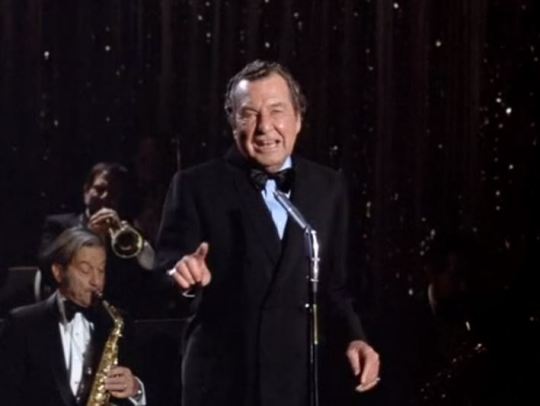
Phil
Harris
(Himself) previously played soused songwriter Phil Stanley in a 1968
episode of “The Lucy Show.” Harris was known as a bandleader who
became a comic radio star as a Jack Benny sidekick in the 1930s.
Although his fondness for booze was largely a creation of the Benny’s
writers, Harris played the part to the hilt. Harris was mentioned
in “Lucy
Gets Jack Benny’s Account” (TLS S6;E6) when
Benny made a reference to Harris’ persona as a lush. In “Lucy
and Joan” (TLS S4;E4) Joan
(Joan Blondell) says she’s been in pictures so long she saw Phil
Harris take his first drink! Harris
was married to movie star Alice Faye from 1941 until his death in
1995 at age 91.
Tommy
Farrell
(Fred, Phil Harris’ Arranger) was on Broadway in three plays between
1942 and 1947. He was seen on “The Lucy Show” twice. This
is the last of his six episodes of “Here’s Lucy.”In
the final credits Farrell is billed as “Freddie” although Harris
never calls him anything but “Fred.” The name is probably a
tribute to Lucille Ball’s brother and grandfather, both of whom were
named Fred.
Marl
Young
(Marl Young, Pianist) was
the “Here’s Lucy” musical director and often appeared on camera
when episodes included music.Young (as the character) says he’s been working as an accountant. His last gig was with the
Boston Philharmonic.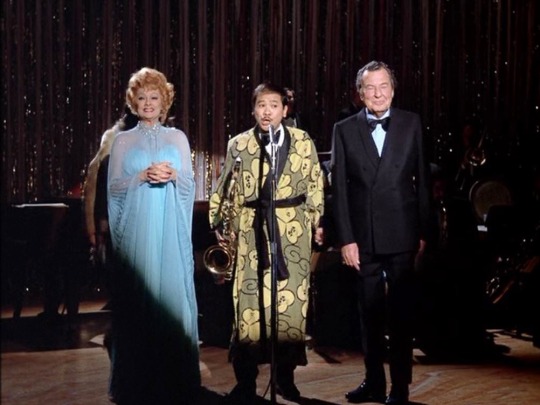
Michaelani
(Mr. Yamoto) makes the third of his four screen appearances here.Mr.
Yamoto plays the clarinet and says he speaks several languages.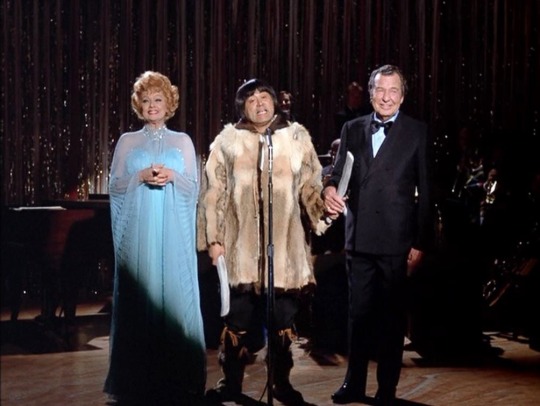
Anthony
Ortega
(Ooka Lanooka) was a professional saxophonist (although he does not play the instrument here) and is making his screen acting debut.Ooka
Lanooka plays the whale bones and is number one in his field. Back in
Alaska, he worked a couple of one-night stands, which Lucy calls “working steady” because
the nights in Alaska are six months long!
Henry
L. Miranda
(Pancho Rodriguez)Pancho
is a trumpet player formerly of Herb Albert and the Tijuana Brass.
Jack Kelso (Saxophonist
in Harris’ Band, uncredited) worked
as a studio musician between 1964 and 1984, in addition to recording
with Mercer Ellington and Mink
DeVille, touring worldwide and appearing in “The Concert for
Bangladesh” as part of Jim Horn and the Hollywood Horns.Ted
Nash (Saxophonist
/ Clarinetist in Harris’ Band, uncredited) was a saxophonist with Les
Brown and His Band of Renown. In addition to being a studio musician
for many films, he worked on the series “Peter Gunn” (1958-59).The
other members of Harris’ orchestra, including ‘Hawaiian’ guitarist Malikalua,
are played by uncredited musicians.

Two days after this episode first aired, February 27, 1974, The New York Times broke the news that Lucille Ball had decided not to continue with “Here’s Lucy” and that the show would finish production at the end of its current season. This came as no surprise to anyone, including viewers.

The
the book “Lucy A to Z: The Lucille Ball Encyclopedia” by Michael
Karol, it is noted that Anthony
Ortega
was a professional saxophonist who was cast by “Here’s Lucy”
Musical Director Marl Young. Ortega remembers nearly stepping on
Lucille Ball’s foot while crammed into the booth to pre-record the
music for this episode. Afterwards, Ball complimented him by kissing
him on the cheek and saying “You
did a good job. I hear that you are a very fine saxophone player.”
High praise, considering that all Ball’s TV characters were amateur
saxophonists. Ortega shared the booth with fellow sax
players Jack Kelso and Ted Nash who also appear in the episode.The
script was dated January 9, 1974, meaning there was very little time
between filming and broadcast – a mere seven weeks.
In
her DVD introduction to the episode, Lucie Arnaz reminds us of her
mother’s early advocacy for hiring minorities, including Lucie’s own
father, Desi Arnaz, whom CBS was skeptical about portraying Ricky
Ricardo. She also states that Marl Young was the first African
American Musical Director of a major television show. Lucie calls
this episode “Music for Everyone’s Ears.”
Lucy
says she was at the Wilshire Bowl the night Alice met Phil. This is a
reference to Phil Harris’ second wife, movie star Alice
Faye.
Faye herself was mentioned on “The Hollywood Unemployment Follies”
(S3;E22) when Lucy and Carol Burnett discover a rack of costumes worn
by Faye and Betty Grable. Harris
and his orchestra had a regular engagement at the Wilshire Bowl, a
restaurant in Hollywood located on Wilshire Boulevard which operated
from 1933 to 1943. The building was demolished in 1982. Harris
married actress / singer Alice Faye in 1941.
Lucy says if she’d gotten to the Wilshire Bowl five minutes sooner
she might be Mrs. Phil Harris!
“Phil
Harris, popular star of stage screen and television, is taking a
sentimental journey back into the music business. Between Las Vegas
engagements, Phil is organizing a big band to encourage the
increasing popularity of this kind of music. The former maestro has
been engaged by the Club Internationale to inaugurate a big band
policy for this popular night spot. He is looking for musicians with
big band know-how to augment his orchestra now in rehearsal.”Lucy’s morning paper of choice is the Globe-Record. “Here’s Lucy” propmaster Kenneth Westcott probably got this newspaper from from a small prop company called The Earl Hays Press, one of the oldest newspaper prop manufacturers in Hollywood.
As
the series draws to a close, it might be a good time to mention the
ubiquitous blue report covers used at the Unique Employment Agency.
The use of this color cover dates back to the Westland bank offices on “The
Lucy Show.” These are probably bound scripts recycled as props –
but always with the blue cover. Blue was a good color for Lucy!To
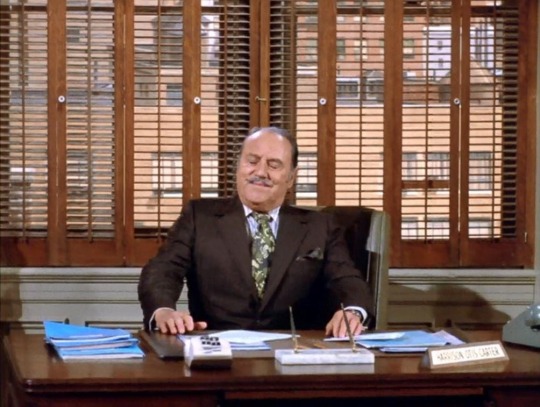
drum up business, Harry arranges a lunch meeting with the Northshore
Insurance Company. In many episodes like this one, Gale Gordon’s
character is in the set-up (generally the first scene) and then
disappears from the narrative.
When
Lucy arrives at the nightclub, Phil Harris is finishing a rehearsal
of “Is
It True What They Say About Dixie?“
a 1936 song written by Irving Caesar, Sammy Lerner and Gerald Marks.
Lucy
tells Harris that they have met before. She had Harris autograph her
program during his performances at the Frontier in Las Vegas the previous summer.
Lucy says she took the bus to Vegas. Frontier was
the second resort that opened on the Las Vegas Strip and operated
continuously from October 1942 until it closed on July 16, 2007 and
was demolished. The
Frontier’s sign was glimpsed in the opening montage of “Lucy and
Wayne Newton” (S2;E22).
When
Mr. Yamoto (who is of Japanese descent) continually bows instead of
speaks, Lucy reassures Harris that he’s very good. Harris replies
“Must
be. He ain’t hit a note and he’s already taking bows.”
When
Harris questions Lucy about the number of minorities she’s brought to
audition, he admits that he is Native American himself, but he
doesn’t let it get around because “they
might cut off my whiskey.”
He adds if it wasn’t for [Equal] Opportunity, he might be “stringing
beads at Wounded Knee.”
I reality, the idea that Harris was Native American is as
exaggerated as his penchant for spirits. Harris’ birth name was
Wonga, which is Cherokee for “speedy messenger” but the name is
in honor of a friend of his parents’ who worked in their circus; nothing to do with his heritage.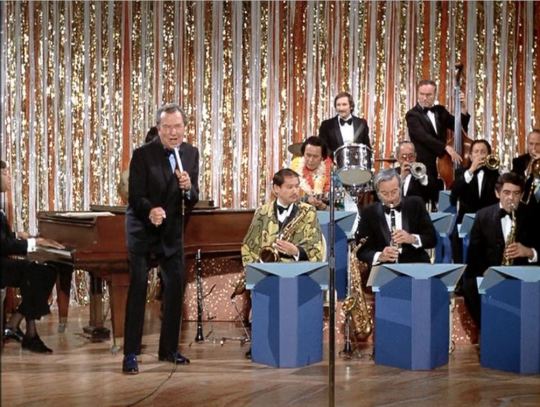
The
only candidate that doesn’t get to perform solo is named Malikalua.
He is a Hawaiian guitar player who Lucy claims works as a plumber during the day
but sometimes subs with the Les Brown Band at night. In the final
performance the guitarist on the bandstand wears a Hawaiian shirt and many colorful leis around his neck. This is Malikalua.Phil Harris: Look,
honey. Are you from the employment agency or the United Nations?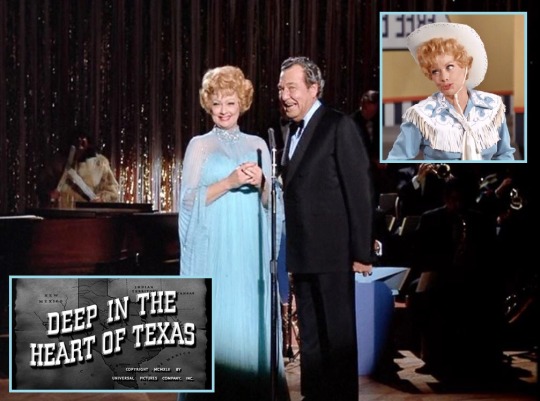
To
appease a women’s lib group picketing the nightclub, Lucy is quickly recruited
into Harris’ act. She provides the obligatory clapping for “Deep in the Heart
of Texas.” In “Lucy and the Used Car Dealer” (S2;E9) Lucy
Carter disguises herself as ‘Laredo
Lucy’ and sings a bit of “Deep
in the Heart of Texas,” a
1941 song by June Hershey and Don Swander.
Harris
sings his hit song “That’s
What I Like About the South”
by Andy Razlaf and is joined by Lucy and his recently hired
musicians.
Specially
written lyrics are sung by the diverse musicians and by Lucy. Her’s
seem particularly applicable to her character in Mame,
although it is not overtly stated:“Men
have names like BeauregardTip
their hat when they pass your yardThey
act so cool but they fall so hardThat’s
what I like about the South”
In
the about-to-be-released film, Southern gentleman Beauregard Jackson
Pickett Burnside (Robert Preston) “falls
so hard” for
Mame Dennis (Lucille Ball) that the two get married.During
Harris’ performance at the Club Internationale, the orchestra members stand up and take solos: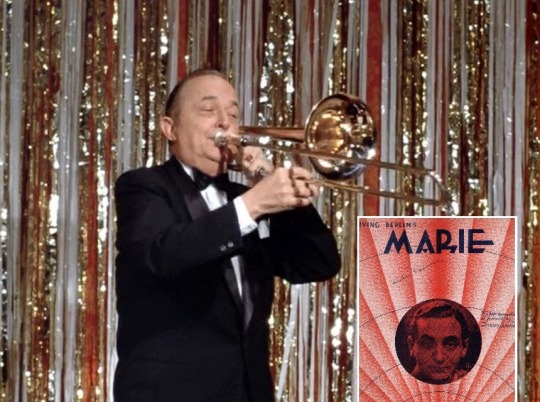
His
trombonist plays in the style of Tommy
Dorsey.
Dorsey appeared with Lucille Ball in the 1943 film DuBarry
Was a Lady.
The uncredited musician riffs on “Marie”
by Irving Berlin.
His
trumpeter plays in the style of Harry
James.
James appeared on “The Lucy-Desi Comedy Hour” with his wife,
Betty Grable, in 1958. The uncredited musician riffs on "Ciribiribin” written
by Alberto
Pestalozza in
1898.
His
clarinetist Ted Nash plays in the style of Benny
Goodman.
In “The Publicity Agent” (ILL S1;E31) Lucy reads that the Shah of
Persia has a standing order for all Benny Goodman’s records, which inspires her disguise as the Maharincess of Franistan. Nash
riffs on “Let’s
Dance”
by Fanny Mae Baldridge, Gregory Stone, and Joseph Bonime.
His
drummer plays in the manner of Gene
Krupa.
In a 1960 episode of “The Lucy-Desi Comedy Hour” Ernie Kovacs
called Desi Arnaz “the Cuban Krupa.”
The uncredited musician riffs on “Sing,
Sing, Sing” by
Louis Prima.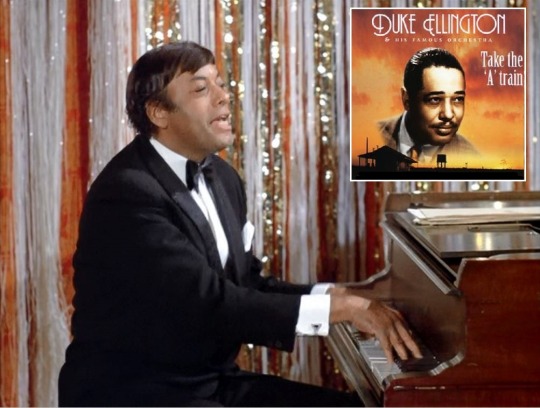
Pianist Marl Young plays in the style of Duke
Ellington,
riffing on"Take
the ‘A’ Train“
by Billy
Strayhorn. It
was
the signature
tune of
the Duke Ellington orchestra.
As the finale, the
entire Phil Harris orchestra plays in the style of Count
Basie
performing Basie’s signature tune “One
O’Clock Jump” while
Lucy does the jitterbug.

In
“Lucy and Sid Caesar” (TLS S6;E23), a starving Frankie the Forger
(Sid Caesar) orders pork chops, a squab stuffed with oyster dressing,
a turkey, lasagna, black-eyed peas, candied yams, corn pone, Virginia
hams, hot bread, turnip beans, fat back, and lima beans! He is
paraphrasing the lyrics to the song “That’s
What I Like About the South.” Interestingly,
the song was not performed by Phil Harris when he was a guest
star on
“The Lucy Show” just
a month earlier.
Bob
O’Brien also wrote “Lucy and Phil Harris” (TLS S6;E20), Harris’
first appearance with Lucille Ball on “The Lucy Show” in 1968.
It was O’Brien’s idea to highlight ethnic diversity in the “Here’s Lucy” script.
The
costumes Lucy provides for the new band members are reminiscent of “The Black Wig” (ILL S3;E26) where
Lucy Ricardo and Ethel Mertz disguise themselves in a random assortment of theatrical costumes to fool their husbands. Lucy replies that Ethel looks like “An
ad for a trip around the world.”
In “Little Ricky Gets a Dog” (ILL S6;E14) on January 21, 1957)
his parakeets are named Alice and Phil, named after Alice Faye and her husband Phil Harris.

You Break Me Up, Pastel! Harris’
punchline “they
might cut off my whiskey”
makes Lucille Ball laugh in a way that suggests it was an ad lib by
Harris. He mutters something under his breath to Ball along the
lines of “Cut
off his whiskey. You like that?” They try to return to the script, but Harris adds “You
like that, eh Pastel?”
before Lucy regains her composure and continues the scene.
“Lucy and Phil Harris Strike Up the Band” rates 4 Paper Hearts out of 5Lucy and Harris have a very relaxed rapport on screen. The ‘big band’ medley is one of the best musical segments of the series. And that’s what I liked about this episode!
Alice Faye, Anthony Ortega, Benny Goodman, Big Band, Ciribiribin, Deep in the Heart of Texas, Ethnic Diversity, Frontier Hotel, Gale Gordon, Harry James, Henry L. Miranda, Here’s Lucy, Is It True What They Say About Dixie?, Jack Donohue, Jackie Kelso, Las Vegas, Let’s Dance, Lucille Ball, Mame, Marie, Marl Young, Michaelani, Phil Harris, Robert O’Brien, Ted Nash, That’s What I Like About the South, Tommy Dorsey, Tommy Farrell, Wilshire Bowl, Women’s Lib -
MARY JANE’S BOYFRIEND
S6;E20
~ February 18, 1974

Directed
by Jack Donohue ~ Written by Fred S. Fox and Seaman JacobsSynopsis
Mary
Jane has a new boyfriend – who happens to fall for Lucy. Now it’s
up to Lucy to figure a way out of her love triangle.Regular
CastLucille
Ball (Lucy
Carter), Gale
Gordon (Harrison
Otis Carter)Lucie
Arnaz (Kim
Carter) does not appear in this episode, although the final credits
do state “Lucie Arnaz Wardrobe by Alroe”. The character is
mentioned by Lucy in the dialogue.Guest
Cast
Mary
Jane Croft (Mary
Jane, left) played Betty Ramsey during season six of “I Love Lucy.”
She also played Cynthia Harcourt in “Lucy
is Envious” (ILL S3;E23) and
Evelyn Bigsby in “Return
Home from Europe” (ILL S5;E26).
She played Audrey Simmons on “The Lucy Show” but when Lucy
Carmichael moved to California, she played Mary Jane Lewis, the
actor’s married name and the same one she uses on all 31 of her
episodes of “Here’s Lucy. Her final acting credit was playing
Midge Bowser on “Lucy Calls the President” (1977). She died in
1999 at the age of 83.This Mary Jane Croft’s last appearance on “Here’s Lucy.”

Cliff
Norton
(Walter Butley) played
Sam the Plumber in “Lucy
Meets the Burtons” (S3;E1) whose
coveralls were later worn by an incognito Richard Burton and turn up
when Lucy is packing up the office in “Lucy
and Harry’s Memoirs” (S5;E24).
Prior to that, he appeared in two episodes of “The Lucy Show.”
This is the third of his three appearances on the series.Butley
owns a meat market.
John
Gabriel (Jack
Thomas) was the original professor in the pilot of “Gilligan’s
Island,” but was replaced by Russell Johnson when the show was
picked up for a series. He is probably best known as Dr. Seneca
Beaulac (1975-89) on “Ryan’s Hope.” He also played Andy Rivers
in half a dozen episodes of “The Mary Tyler Moore Show.” This is
his only appearance with Lucille Ball.Roy
A. Rowan
(Voice of the Power of Positive Thinking Tape) was announcer for all
of Lucille Ball’s television shows as well as doing the voice of some
TV and radio announcers. On several occasions he appeared on camera
as well.
This
is the
only episode of this series to feature a story dependent on Mary Jane
Croft’s character of Mary Jane Lewis.
In
her DVD introduction to the episode, Lucie Arnaz recalls that Mary
Jane Croft was a very calming presence on the set, something that was
appreciated in the high-pressure world of TV production.
Mary
Jane’s dating life has been discussed before:- In “Lucy Goes on Her
Last Blind Date” (S5;E16), Mary Jane says that she is dating a man named
Marvin. - In “Lucy and the Group Encounter” (S5;E14) she is paired
off with an unidentified man who might well be the previously mentioned Marvin. - In “Goodbye,
Mrs. Hips” (S5;E23) Mary Jane tells Lucy and Vanda that she has a
new boyfriend who
has curly brown hair, blue eyes, and dimples. Mary Jane admits that he is a little bit
short.
It helps to realize that season six episodes were frequently aired out of filming order so the word “new” is misleading in the larger picture of Mary Jane’s love life.
Harry
recalls also being caught up in a triangle while in college. He
dated both Betty and Mercedes on alternate days and rested on Sunday.
This is the second biblical joke about “resting on the seventh
day,” the first less than four minutes earlier.
Harry
calls Walter “meathead” because when he walked in the door, Lucy
had just plopped a package of ground round on his head. “Meathead”
was also what Archie Bunker frequently called his son-in-law Mike
Stivic on “All in the Family,” a show that began airing on CBS in
1971.
After
suggesting a solution to her love triangle, Harry says “In
affairs of the heart, Dear Abbey always comes to me!”
Dear
Abby is
an advice column founded in 1956 by Pauline Phillips under the pen
name ‘Abigail Van Buren’ and carried on today by her daughter,
Jeanne Phillips. In 1965, CBS aired a radio version of Dear
Abby’s column while Lucy aired her own radio show, “Let’s Talk to Lucy.”
Lucy
is reading a copy of (fictional) Vanity
Magazine
in bed. This magazine was seen at the start of season five when Lucy
broke her leg and was confined to bed.

Mary
Jane says that she’s been going to charm school. Lucy Ricardo and
Ethel Mertz attended Phoebe Emerson’s Charm School (inset) to get their
husbands to pay attention to them at parties.
Line! When Walter brings both Lucy and Mary Jane flowers, Lucy steps on Mary Jane’s line with her “thank you.”

Oops!
When
Walter removes the package of ground round from his head, a
brown-colored item designed to help the prop stay on his head falls
to the floor. Lucille Ball watches it fall, but does not stop to
pick it up or draw attention to it. Instead of calling “cut” to pick it
up, the item stays on the floor in full view as the scene continues.
This sort of thing previously happened in “Lucy in the Jungle”
(S4;E13) when Lucy carried luggage on her head.
Props!
Lucy closes the window and draws the curtain after getting rid of
Walter, but the window shade at first gets caught on the outside of
the drapes. Lucy quickly adjusts the blind and continues.
“Mary Jane’s New Boyfriend” rates 3 Paper Hearts out of 5
The trope of a romantic triangle is explored in an uninspired episode. It is only entertaining because Mary Jane Croft is the star.
- In “Lucy Goes on Her
-
MILTON BERLE IS THE LIFE OF THE PARTY
S6;E19
~ February 11, 1974
Directed
by Jack Donohue ~ Written by Bob Carroll Jr. and Madelyn DavisSynopsis
Lucy’s
parties are a bore, so she calls a telethon to make a very low bid on
Milton Berle to attend her next soiree – and wins!Regular
CastLucille
Ball (Lucy
Carter), Gale
Gordon (Harrison
Otis Carter)Lucie
Arnaz (Kim
Carter) does not appear in this episode, although the final credits
do state “Lucie Arnaz Wardrobe by Alroe”Guest
Cast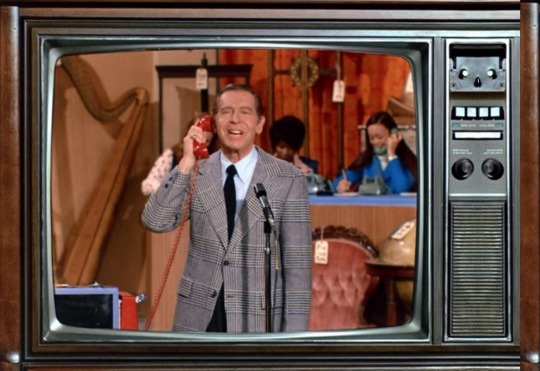
Milton
Berle (Himself)
previously played Cheerful Charlie in “Lucy and the Used Car
Dealer” (S2;E9), the
first time that Milton Berle has not played Milton Berle on a Lucille
Ball sitcom. He was born Milton Berlinger in New York City on July
12, 1908. He started performing at the age of five. Berle perfected
his comedy in vaudeville, early silent films, and then on radio,
before taking his act to the small screen, where he would be
proclaimed “Mr. Television” and later “Uncle Miltie.” He
hosted “Texaco Star Theater” on NBC from 1948 to 1956. The
variety show was re-titled “The Milton Berle Show” in 1954 when
Texaco dropped their sponsorship. The program was briefly revived in
1958, but lasted only one season. In 1959 he played himself
in “Milton
Berle Hides out at the Ricardos.” Berle
continued to perform live, in films, and on television specials for
the remainder of his career. Berle previously appeared on “The Lucy
Show” in “Lucy
Saves Milton Berle” (S4;E13) and
did a cameo in “Lucy
Meets John Wayne” (S5;E10).
Berle died of cancer in 2002.
Elliott
Reid (Elliott,
Telethon Emcee) played Edward Warren, a parody of Edward R. Murrow,
in “The
Ricardos Are Interviewed” (ILL S5;E7) and
appeared in two episodes of “The Lucy Show.” This is his third
appearance on “Here’s Lucy.”Reid
is only credited as “Emcee” but Milton Berle calls him Elliott.
James
Joyce (Man
at TV Station) passed away just three months after this episode was
first aired. He posthumously appeared in the film A
Woman Under the Influence
(1974). He was 53 years old.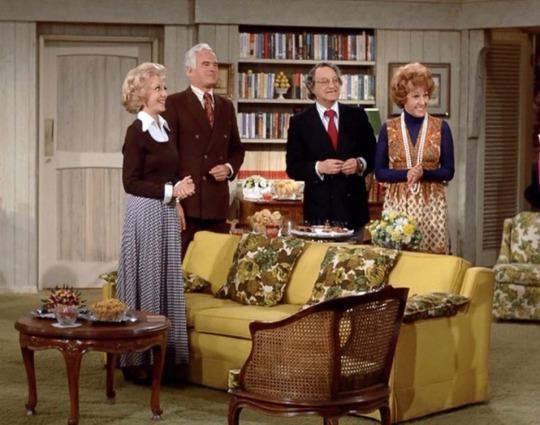
Mary
Jane Croft (Mary
Jane, left) played Betty Ramsey during season six of “I Love Lucy.” She
also played Cynthia Harcourt in “Lucy
is Envious” (ILL S3;E23) and
Evelyn Bigsby in “Return
Home from Europe” (ILL S5;E26).
She played Audrey Simmons on “The Lucy Show” but when Lucy
Carmichael moved to California, she played Mary Jane Lewis, the
actor’s married name and the same one she uses on all 31 of her
episodes of “Here’s Lucy. Her final acting credit was playing
Midge Bowser on “Lucy Calls the President” (1977). She died in
1999 at the age of 83.Vanda
Barra (Vanda, right)
makes one of over two dozen appearances on “Here’s Lucy” as
well as appearing in Ball’s two 1975 TV movies “Lucy Gets Lucky”
and “Three for Two”. She was seen in half a dozen episodes of
“The Lucy Show.” Barra was Lucille Ball’s cousin-in-law by
marriage to Sid Gould.Sid
Gould (Sam, above right center)
made more than 45 appearances on “The Lucy Show” and nearly as
many on “Here’s Lucy.” Gould (born Sydney Greenfader) was
Lucille Ball’s cousin by marriage to Gary Morton.Robert
Hitchcock (Marvin,
uncredited, above left center) was
seen in in one episode of “The
Lucy Show.” This
is his sixth and final appearance on “Here’s Lucy.”Marvin
has no lines and no ‘date’ for the party. Hitchcock appears
uncredited.
John
Clavin
(Bill McCormick) makes his very first screen appearance with this
episode of “Here’s Lucy.”
Shirley
Anthony
(Mrs. Thalken) makes
the tenth of her 13 appearances of “Here’s Lucy.”Bob
Whitney (Mr. Thalken, uncredited) appeared with Lucille Ball in The
Facts of Life (1960).
He
played one of the jurors (unnamed but credited) in “Lucy and Joan
Do Jury Duty” (S6;E9).Whitney has no lines.
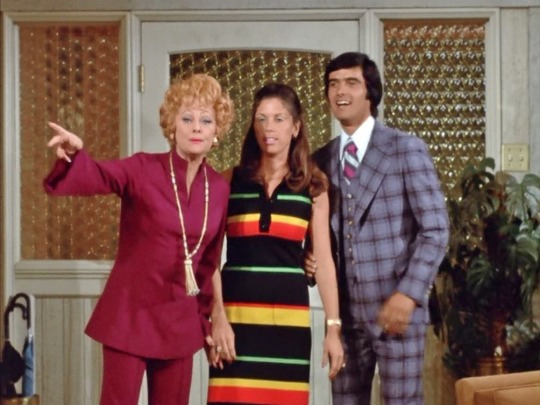
Joyce
McNeal (Mrs.
Helen Maurer) was a stunt performer and actor making her very first
screen appearance with this episode. She later worked extensively on
the “Star Trek” franchise, which began at Desilu.John
Calvin (Bob
Maurer, uncredited) grew up in New York City and started his film
career in 1971 at age 24.Helen
and Bob Mauer are the names of Lucille Ball’s in-laws. Helen is Gary
Morton’s siter. John Calvin has no lines.Jack
Berle
(Telethon Stage Manager, uncredited) was
the older brother of Milton Berle. This is one of his eleven
uncredited appearances on the series. He previously did two
episodes of “The Lucy Show.”Bob
Harks (Telethon Cameraman, uncredited) was seen in the
background of Mame
(1974). In 1970 he popped up on his first television show and was
seen in more than a dozen episodes of “Here’s Lucy.” He died at
age 83 in 2010.Those
working the phone bank at the telethon appear uncredited.
There
was no new episode of “Here’s Lucy” on Monday, February 4, 1974.Director
Jack
Donohue
replaces Coby Ruskin, who Lucille Ball fired during “Lucy, the
Sheriff” (S6;E19). Donohue was the first director of the series,
having staged 29 episodes from 1968 to 1971.
At
the start of the episode, Lucy, Mary Jane and Harry are playing
cards. Harry asks Lucy, “Don’t
you ever get tired of playing games?”
Lucy bluntly replies “No!”
In real life, Lucille Ball adored games.
She was well-known for her addiction to backgammon, Scrabble, and
charades, the latter two being incorporated into several scripts. She
even endorsed a couple of mass marketed games with her photo
appearing on the box.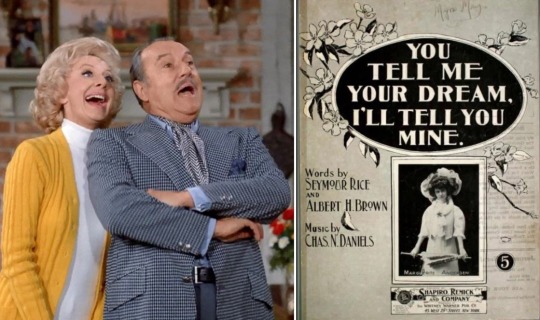
Harry
and Mary Jane suggest an alternative to party games: singing
barbershop quartet – launching into a chorus of “You
Tell Me Your Dream, I’ll Tell You Mine.”
The song was written in 1899 by Seymour Rice and Albert Brown.Everyone
seems to have an excuse NOT to attend Lucy’s party. Harry has to go
to Santa Barbara to see an ill client, Mary Jane has to go to Laguna
to see her sick aunt, Vanda and Sam are going to Arrowhead, the
Maurers are going to Palm Springs, and the Thalkens are going to San
Diego.
Instead
of playing another game, they watch a TV telethon auction raising
money for a Day Care Center Fund. When they tune in, the Emcee is
just thanking Mrs. Dorothy Culbertson, who phoned in the highest bid
to hear The Franklin Brothers’ latest song. The bidding is still open
on one of Lawrence Welk’s autographed batons. It ends up fetching
$780 from the Sun City Shuffleboard Club. Combining Sun City (a 55+
gated community) and shuffleboard, a game associated with senior
citizens, the writers are making a joke about Welk’s old fashioned
music and style. What’s even funnier is the idea of signing a baton –
essentially a thin dowel of wood!The
KBEX
TV
camera is seen for the third time on the series. KBEX are the
fictional call letters used for broadcast stations depicted in movies
and on TV. The telethon’s phone number is 555-7236, which utilizes
the 555 prefix generally assigned to on-screen phone numbers.
Milton
Berle offers his services as a guest at a party thrown by the highest
bidder. The first bid is phoned in by (an unseen) Don
Rickles,
an insult comedian who Berle calls “the Merchant of Venom,” a pun
on Shakespeare title The
Merchant of Venice.
Just
in case she wins, Lucy gives Berle directions to her home. Westlake
is a planned community of similar homes that straddles the Los
Angeles and Ventura county line.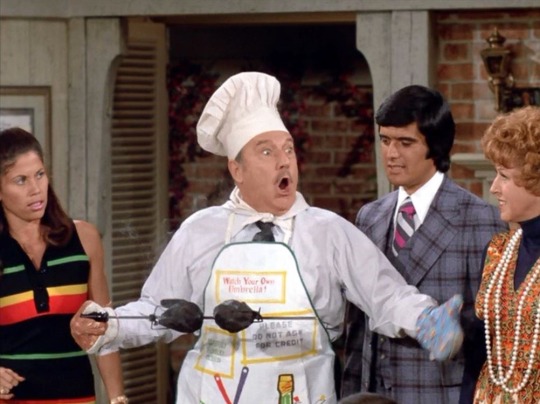
Harry
isn’t going to change his RSVP because Milton Berle will be the guest
of honor. He says he wouldn’t be influenced by Elizabeth Taylor,
Frank Sinatra, Clint Eastwood, or Princess Anne and her new husband.
Anne, the Princess Royal, and Queen Elizabeth’s daughter, married
Mark Phillips on November 14, 1973, which indicates that this episode
was filmed sometime after that date. The
couple divorced on April 23, 1992.
When
Harry rushes through the living room headed to the barbecue with two
chickens on a spit, Lucy calls him the Galloping
Gourmet.
That is the name of the persona of Graham
Kerr, an English chef
who is best known for his 1969–71 television cooking show “The
Galloping Gourmet.”
Milton
Berle tries in vain to tell a joke about a foursome at Hillcrest
County Club but is constantly interrupted by latecomers to Lucy’s
party. Hillcrest
Country Club is
a private social club located in the Cheviot
Hills neighborhood
of Los
Angeles.
For
years, many of the city’s top comedians, including Jack Benny, George
Burns, George Jessel, Groucho Marx, Danny Kaye, and later Milton
Berle and Don
Rickles,
got together for a regular Friday lunch at Hillcrest, where they
would socialize, try new material out on their friends, and talk
“shop.”
Harry
and Milton Berle mention his old TV sobriquet “Uncle Miltie” as
well as his well-known gag of appearing in drag, something he did on
“The Lucy-Desi Comedy Hour” in 1959.This
episode includes a lot of name dropping of Hollywood celebrities. Click on the names to read about their appearance and/or mention on a “Lucy” show (if any)!- Kirk
Douglas - Bert
Parks - Pinky
Lee - Soupy
Sales - Durwood
Kirby - Lawrence
Welk - Elizabeth
Taylor - Frank
Sinatra - Clint
Eastwood - Princess
Anne and her Husband (Mark Phillips) - Don
Rickles - Dean
Martin - Jack
Benny - Buddy
Hackett - The
Galloping Gourmet (aka Graham Kerr)

In
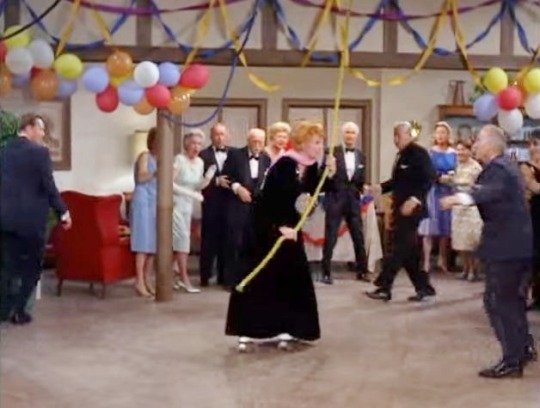
“Lucy and the Good Skate” (TLS S3;E1) a
country club doorman announces “Mr.
and Mrs. Robert Maurer.” at
a dinner dance where Lucy Carmichael is hiding roller skates under
her evening gown.
The
Emcee tells Milton Berle that someone bid five – which Berle thinks
is $500. This is what happened to Lucy Ricardo when she pledged money
to the charity of philanthropist Cynthia Harcourt (coincidentally
played by Mary Jane Croft) in “Lucy is Envious” (ILL S3;E23).
The
Maurer’s cancel their trip to Palm Springs because of a forecast of
rain, just as it does when Lucy Ricardo and Ethel Mertz travel there
during “In Palm Springs” (ILL S4;E26). Rainstorms are a rarity
for the California desert resort.

Wardrobe
Malfunction! Lucy fiddles with the collar of her jacket
during the first scene. Unbeknownst to her, it gets stuck with one
side up and the other down.
“Milton Berle is the Life of the Party” rates 3 Paper Hearts out of 5
Lots of inside references, Hollywood name-dropping, and “Lucy” alumni make this fun, though not stellar, viewing.
Bert Parks, Bob Carroll Jr., Clint Eastwood, Don Rickles, Durwood Kirby, Elliott Reid, Gale Gordon, Here’s Lucy, Hillcrest Country Club, Jack Berle, Jack Donohue, James Joyce, John Calvin, John Clavin, Joyce McNeal, KBEX, Lucille Ball, Madelyn Davis, Mary Jane Croft, Milton Berle, Pinky Lee, Princess Anne, Robert Hitchcock, Robert Maurer, Shirley Anthony, Sid Gould, telethon, The Galloping Gourmet, Vanda Barra, You Tell Me Your Dream I’ll Tell You Mine - Kirk
-
LUCY, THE SHERIFF
S6;E18
~ January 28, 1974

Directed
by Coby Ruskin and Lucille Ball ~ Written by Seaman Jacobs and Fred
S. FoxSynopsis
Lucy
finds out that her grandmother was the first woman sheriff of a
Montana town that is celebrating its centennial. She is asked to
play her grandmother at the celebrations, which include the
recreation of a bank robbery. Lucy is enjoying playing lawmaker until a couple of genuine robbers interrupt the celebration and take her hostage!Regular
CastLucille
Ball (Lucy
Carter), Gale
Gordon (Harrison
Otis Carter)Lucie
Arnaz (Kim
Carter) does not appear in this episode, although the final credits
do state “Lucie Arnaz Wardrobe by Alroe”Guest
Cast
Ross
Elliott (Chuck
Stewart) played
the director of Lucy Ricardo’s Vitameatavegamin
commercial in
1952. He played Ross, Ricky’s publicity agent in three other
episodes. From 1961 to 1964 he played another TV director on “The
Jack Benny Program.” He
made one appearance on “The Lucy Show” in 1965. This is his
final appearance with Lucille Ball.Stewart
is the Mayor of Cartridge Belt, Montana. The name Chuck Stewart was
adopted by the psychiatrist (Gerald Mohr) treating Lucy Ricardo in
“The Inferiority Complex” (ILL S2;E18).
Mary
Wickes (Clara
Simpson) was
one of Lucille Ball’s closest friends and at one time, a neighbor.
She made a memorable appearances on “I Love Lucy” as ballet
mistress Madame Lamond in “The
Ballet” (ILL S1;E19). In
her initial “Lucy Show” appearances her characters name was
Frances, but she then made four more as a variety of characters for a
total of 8 episodes. This is one of her 9 appearances on “Here’s
Lucy.” Their final collaboration on screen was “Lucy Calls the
President” in 1977.
Cliff
Osmond (Jake, left)
was born in Jersey City, NJ, in 1937. His career spanned from 1962
to 1996. This is his only time acting with Lucille Ball.John
Craig (Rusty, right)
appeared on Broadway with Ethel Merman in Happy
Hunting
(1956) and understudied the lead in
L’il Abner
as well as touring with the show. He was spotted by Hollywood agents
when the show played Las Vegas. This is his only time acting with
Lucille Ball.
Cliff Osmond (no relation to the singing family) provides the DVD introduction to this episode.

Florence
Halop
(Little Old Lady) played one of the women on the party line in
“Redecorating” (ILL S2;E18). She is probably best remembered
for her final role, as the dead-pan Bailiff on “Night Court”
(1985) replacing Selma Diamond after her passing.
Boyd
‘Red’ Morgan (Charlie)
was
an actor and stunt man who was seen in “Lucy
and John Wayne” (TLS S5;E10),
with whom he did eleven films. This is the fourth and final episode
of “Here’s Lucy.”
Orwin
C. Harvey (Sheriff
Bart Thomas) was
an actor and stuntman who played one of the singing and dancing
teamsters in “Lucy
Helps Ken Berry” (TLS S6;E21).
This is one of his nine appearances on “Here’s Lucy.”
Vince
Deadrick Sr.
(Bandit #1)
was a stunt double for Steve McQueen and (later) Lee Majors. He is
one of only four actors to appear in both the original “Star
Trek” (1966), a Desilu production, and “Star Trek:
Enterprise” (2001).
Gerald
Brutsche
(Bandit #2) was a stunt man and actor who was stunt double for Granny
(Irene Ryan, inset) on “The Beverly Hillbillies” as well as a appearing
in minor roles on the CBS series.The
woman Lucy calls Bertha and Brutsche uses as a shield is uncredited.
Walter
Smith
(Townsperson, uncredited, center) made
14 mostly uncredited appearances on the series. He also did one
episode of “The
Lucy Show.”Freida
Rentie (Townsperson,
uncredited, behind Smith) is the younger sister of Marla Gibbs. Rentie makes
the third and last of her uncredited appearances on the series.
Rentie was in the 1958 film South
Pacific and
1972’s The
Poseidon Adventure.Al
Stewart
(Townsperson, uncredited) appeared as an umpire in the Lucille Ball
film Critic’s
Choice
(1963). This is his final screen appearance.The
other townspeople of Cartridge Belt, Montana, are played by
uncredited background performers.

This
is Coby Ruskin’s last episode. Lucille takes over as Director during
the rehearsal process and fires Ruskin. This
is the only time that Lucille Ball is officially credited as
Director, though, unofficially, she ‘directed’ many episodes. Ball
also directed a 1980 pilot of a sitcom called “Bungle Abbey” that
was not picked up for series.
Lucille
Ball was proud of her family and heritage. Her genealogy can be
traced back to the earliest settlers in the colonies. Her
grandmother’s name, Flora
Belle Orcutt, is
used as Lucy Carter’s great-grandmother’s name in this episode.
She
will use the name Flora Belle again in the TV movie “Stone
Pillow” (1985).
The
town of Cartridge
Belt, Montana (founded
1874) is named after the Western holster belts that included straps
to hold ammunition to reload the pistols. Montana Cartridge Belts
became known as a style of holster.
As
an infant, Lucille Ball lived in Butte, Montana, where her father
died. For a while, her nickname was “Montana.” At the start of
her professional career, Lucille Ball often gave her birthplace as
Butte, feeling that it sounded more interesting to casting people
than Jamestown.
Flora
Belle Orcutt (the fictional one) is supposedly the first
lady sheriff in
the West. In real life, the distinction of first woman sheriff has
been disputed. Some say it was Texan Emma
Banister (1918), but others claim it was Mary Roach (1922-27) because
Emma had inherited the position from her husband. Still others
believe the title belongs to Kansan Mabel Chase (1926).
Mrs.
James
Latty of Burlington, Iowa, was known as the first “Unofficial Woman
Sheriff" as far back as 1870. “Unofficial” probably
means an un-elected vigilante.
Harry
tells a story about the one who got away – a 22-pound (in earlier
tellings 18-pound) trout nicknamed ‘Old Spasher’ on the Rogue River
near Sagramore Falls in October 1968. “Here’s Lucy” had just
begun its first season in October 1968, airing episodes 3, 4, and 5 –
none of which mentioned Harry’s fish tale.
Town philanthropist Clara Simpson prematurely bursts into a chorus of “I Love Life,” written by Mana-Zucca and Irwin Cassel in 1923. It was recorded by such notable singers as Lawrence Tibbett and John Charles Thomas.

Clara Simpson makes a citizen’s arrest of Harry for “wading after 2pm in Simpson’s Pond,” a violation of ordinance 32a, on the books since 1894.

If
the day calendar on the wall of the sheriff’s office is for the year
1973, the episode takes place on Saturday, June 2, which may also
have been the filming date. There is a second calendar (month style)
on the wall behind the file cabinet. On that calendar the 2nd falls on a Friday.
When they wolf-whistle at Lucy, she calls jailbirds Jake and Rusty “little Richie Burton and Omar
Sharif”. Lucy Carter met actor Richard Burton when she got Elizabeth Taylor’s expensive diamond ring stuck on her finger in “Lucy and the Burtons” (S3;E1). In “Tennessee Ernie’s Fun Farm” (S1;E23) Lucy asks the overalls-wearing Ernie if he is a farmer. Ernie replies “Well, I ain’t that Omar Shareef on his way home from a square dance!” Actor Omar Sharif was nominated for a 1963 Oscar for Lawrence of Arabia and had won a Golden Globe in 1966 for Doctor Zhivago.
Harry
says if Lucy were Sheriff at her grandmother’s time, Billy the kid
would have wound up being President. Henry
McCarty (1859-81), popularly
known as Billy
the Kid,
was an Old
West gunfighter
known
to have killed eight men.
Two days after Lucille Ball’s 63rd birthday, President Richard M. Nixon resigned in scandal. While not
a murderer, Nixon was considered to be a criminal for covering up the
Watergate scandal.
The
bank in Cartridge Belt is called Benson’s Bank. The name ‘Benson’ was
previously used for the weepy mother played by Norma Varden when “The
Ricardos Switch Apartments” (ILL S2;E26). The number above the
bank doors is 1874, which corresponds with the fact that the town is
celebrating its centennial.
With
Lucy as a hostage, the bank robbers plan to go to Canada. Lucy says
she can’t go because she’s not dressed for Canada. This is the only
reference to the country in the series.
In
addition to the cash, dimwitted Rusty (John Craig) also steals a bag
of pennies from the bank, which Sheriff Lucy uses to knock him out
just before she is rescued. When asked how she did it, Lucy holds up
the bag and says
“pennies from heaven.”
Coincidentally, the 1981 film Pennies
from Heaven
was Craig’s final film credit.
With
two long-standing members of the Desilu family in the same cast, Mary
Wickes and Ross Elliott, a different configuration is worked out in
the final credits, with Wickes’ name centered and stacked.

Lucy
Carter / Lucille Ball’s family history was also at the heart of “Lucy
Takes Over” (S2;E23). Grandmother Flora Belle is also mentioned in
this episode.
Harry
wears the same fishing vest, plaid shirt, and hip waders he wears in
“Harry Catches Golf Fever” (S6;E12).

One Bank Town! When
Charlie yells that “Dirty
Julius is robbing the bank” Lucy
asks “What
bank”?
Does Cartridge Belt have more than one? The townsperson playing
Dirty Julius is never specified.
“Lucy, the Sheriff” rates 4 Paper Hearts out of 5
This is a very clever premise, incorporating the colorful old west backdrop without doing the familiar “making a movie” plot. It is also is a great way to incorporate tributes to Lucille Ball herself. The best part is the wonderful supporting cast.
Al Stewart, Bank Robbery, Billy the Kid, Boyd Red Morgan, Canada, Cliff Osmond, Coby Ruskin, Flora Bell Orcutt, Florence Halop, Fred S. Fox, Frieda Rentie, Gale Gordon, Gerald Brutsche, Gunfight, Here’s Lucy, I Love Life, John Craig, Lucille Ball, Mary Wickes, Montana, Old West, Omar Sharif, Orwin C. Harvey, Pennies from Heaven, Richard Burton, Ross Elliott, Seaman Jacobs, Sheriff, Vince Deadrick Sr., Walter Smith -
LUCY IS N.G. AS AN R.N.
S6;E17 ~ January 21, 1974
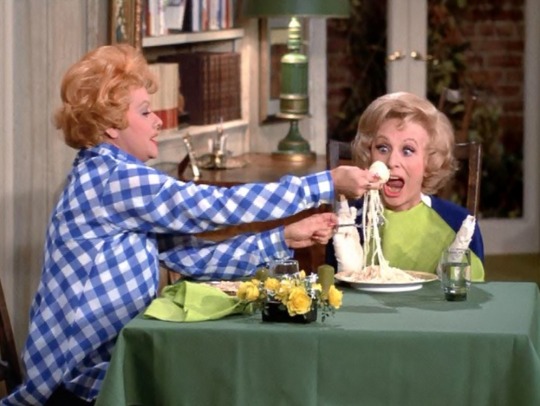

Directed
by Coby Ruskin ~ Written by Bob Carroll Jr. and Madelyn DavisSynopsis
Kim
gets a cold, Harry hurts his knee, and Mary Jane breaks her fingers.
Even the cat is having kittens! Naturally, it falls to Lucy to nurse
them all back to health.Regular
CastLucille
Ball (Lucy
Carter), Gale
Gordon (Harrison
Otis Carter), Lucie
Arnaz (Kim
Carter)Guest
Cast
Mary
Jane Croft (Mary
Jane) played Betty Ramsey during season six of “I Love Lucy.” She
also played Cynthia Harcourt in “Lucy
is Envious” (ILL S3;E23) and
Evelyn Bigsby in “Return
Home from Europe” (ILL S5;E26).
She played Audrey Simmons on “The Lucy Show” but when Lucy
Carmichael moved to California, she played Mary Jane Lewis, the
actor’s married name and the same one she uses on all 31 of her
episodes of “Here’s Lucy. Her final acting credit was playing
Midge Bowser on “Lucy Calls the President” (1977). She died in
1999 at the age of 83.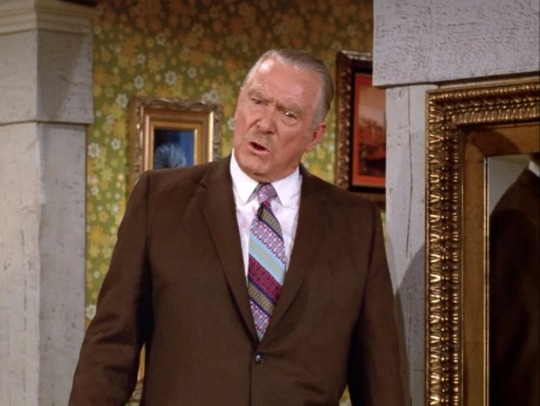
Roy
Roberts (Dr.
Honeycutt) was born Roy Barnes Jones in Tampa, Florida in 1906. His
early career was on the Broadway stage. In Hollywood, the veteran
character actor accrued over 900 screen performances in his 40 year
career, most of which were authority figures. He and Lucille Ball
appeared together in Miss
Grant Takes Richmond (1949).
On “The Lucy Show” he first appeared as a Navy Admiral in “Lucy
and the Submarine” (TLS S5;E2) before
creating the role of Mr. Cheever, the president of Mr. Mooney’s
bank, a recurring character he played through the end of the series.
On “Here’s Lucy” he played the Superintendent of the Air
Force Academy in
season two’s two-part
opener. He
also played a Doctor in “Lucy and the Astronauts” (S4;E5).
Al
Checco (Dr.
Crawford) was originally the comedy partner of Don
Knotts entertaining
US troops stationed overseas. This is the second of his two
appearances on the series,
having first appeared in “The Big Game” (S6;E2).Dr.
Crawford, a veterinarian, is substituting for Dr. Moss.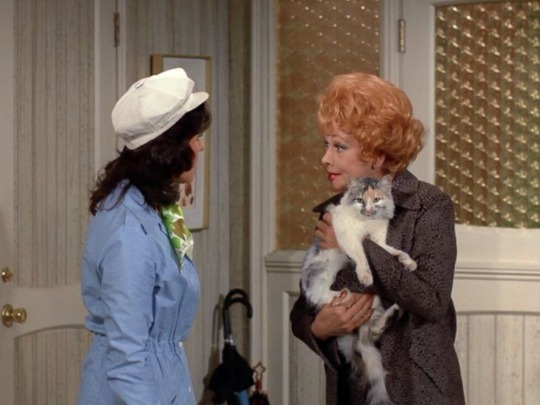
Harry, Kim’s
Cat
(uncredited) isthe mother of 20 kittens and is pregnant for the fifth time. She was briefly named Harriet, but refused to respond to
anything but Harry. Harry is a kitten from the litter of a cat owned
by Lucy’s friend Vanda.
The
title features abbreviations that might be confusing: N.G. stands for
“No Good” and “R.N.” means “Registered Nurse.”

The
same evening this episode originally aired, Roy Roberts also appeared
on “Gunsmoke,” “Here’s Lucy’s” lead-in on CBS. Roberts played
Mr. Bodkin in 19 episodes of the long-running Western. Like his character of Mr. Cheever on “The Lucy Show,” Mr. Bodkin was a banker. These two back-to-back episodes are Roberts’ last television appearances before his death a
year later. In that year, he also starred in two feature films:
Chinatown
(1974) and The
Strongest Man in the World (1975).
In
his DVD introduction to the episode, Al Checco says that the “Here’s
Lucy” company worked like
“a well-greased automobile engine.”
Truthfully, Checco was the only ‘outsider’ in this episode full of
“Lucy” regulars, having only done one previous episode.
As
the episode opens, Harry is catching up with his reading with the
September 1969 issue of The
Ring.
The boxing magazine published its first issue in 1922. On “I Love
Lucy,” both Ricky and Fred were big prize fighting fans, with the
last scene of the very first aired episode set ringside.
Harry
says he spends dinner-time watching Walter Cronkite deliver the news.
Walter
Cronkite
(1916-2009) was anchorman of “The CBS Evening News” for nearly 20
years. He was recently mentioned in “Lucy Plays Cops and Robbers”
(S6;E14) when Harry gets a new television set.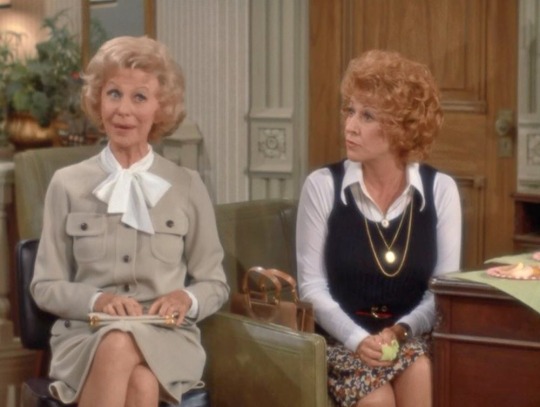
Lucy
and Mary Jane are headed to San Francisco for a convention of The
Girl Fridays Association, where Lucy intends to run for vice
president. The Girl Fridays were last mentioned in “Lucy Gives
Eddie Albert the Old Song and Dance” (S6;E6, above). The local members of the Girl Fridays are Lucy, Mary Jane, and Vanda.
Kim
has acquired a cat to keep her company at her Marina Del Rey
apartment. This is the first full-grown cat on the series, although a
kitten appeared in “Lucy the Fixer” (S1;E14, above). The previous
episode to be aired, “Meanwhile, Back at the Office” (S6;E16),
featured an even cat – a full grown lion!
When
she hears about Kim’s cat having another litter, Lucy asks the cat if
she’s heard of the Anti-Litter Campaign. Pun aside, the
Anti-Littering Campaign, also known as the Keep America Beautiful
Campaign, started in 1953 and was co-founded by original “I Love
Lucy” sponsor Philip-Morris. The Campaign was mentioned in “Lucy
Meets the Law” (TLS S5;E19). Lucy alumni Iron Eyes Cody, who appeared
as the Medicine Man in “Lucy and the Indian Chief” (S2;E3), was
seen as the Native American with the single tear running down his
cheek in TV and print ads for the Campaign.
When
Lucy can’t cat-sit, Kim wonders if Cindy can take the cat for the
weekend. Cindy (Cynthia) was Lucie Arnaz’s character name on several
episodes of “The Lucy Show.”
Lucy
asks Mary Jane why she’s reading a ‘spicy’ book like “Starved
Love.” She’s heard it makes Jacqueline
Susann
look like Dr. Seuss. Susann’s novel (and the subsequent film) Valley
of the Dolls,
was parodied as Valley
of the Puppets in
“Lucy and Eva Gabor” (S1;E7).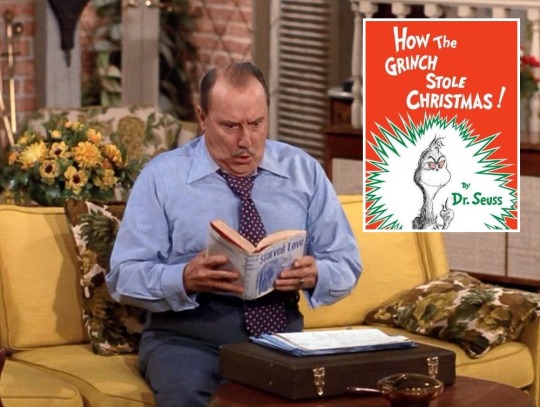
When she catches Harry reading
it, Lucy says
“It sure beats ‘How the Grinch Stole Christmas’, doesn’t it?”Sitcom Logic Alert! Harry
is staying in Craig’s old room and Kim is back in her old room. Just
where Harry and Mary Jane are sleeping is not specified. Perhaps
Mary Jane is bunking in with Lucy? In addition to mentioning the
absent Craig (formerly played by Desi Arnaz Jr.), the episode also
mentions Lucy’s friend Vanda (Vanda Barra), who hasn’t been seen in
several episodes.

Lucy
Carter’s daughter, Kim, has named her cat after her Uncle Harry, just
the same way Lucy Ricardo’s son, Ricky, named his dog after his
‘Uncle’ Fred.Little
Ricky:
“I always name my pets after people I like!”
Running
up and down stairs to help a sick friend was also done by Lucy
Carmichael when Viv was bed-ridden (and feeling litigious) in “Vivian
Sues Lucy” (TLS S1;E10).
“Lucy is N.G. as an R.N.” rates 4 Paper Hearts out of 5
Al Checco’s observation that the “Here’s Lucy” troupe was like a well-oiled machine is spot-on. This episode feels like another series: no bellowing from Gale, no whimpering from Lucy – the characters treat each other in a realistic manner rarely seen on the series – one that probably mirrors real life. Add to that clever writing and you’ve go one of the best episodes of the series. The only drawback is the abrupt ending, which needed a bigger comic finish. Oh, and the title is terrible, too!
1974, Al Checco, Anti-Litter Campaign, Bob Carroll Jr., Cat, CBS, Coby Ruskin, Dr. Suess, Gale Gordon, Gunsmoke, Here’s Lucy, How The Grinch Stole Christmas, Jacqueline Susann, Keep America Beautiful, Lucie Arnaz, Lucille Ball, Madelyn Davis, Mary Jane Croft, Roy Roberts, The Ring Magazine, tv, Walter Cronkite -
MEANWHILE, BACK AT THE OFFICE
S6;E16
~ January 14, 1974
Directed
by Coby Ruskin ~ Written by Fred S. Fox and Seaman JacobsSynopsis
Harry
sells the business, but immediately has regrets. When the new boss
(Don Porter) gets everyone arrested for running a bookie operation,
Lucy and Kim scheme to get the agency back for Harry.Regular
CastLucille
Ball (Lucy
Carter), Gale
Gordon (Harrison
Otis Carter), Lucie
Arnaz (Kim
Carter / “Mrs. Pierpont Skyler of the Pasadena Skylers”)Guest
Cast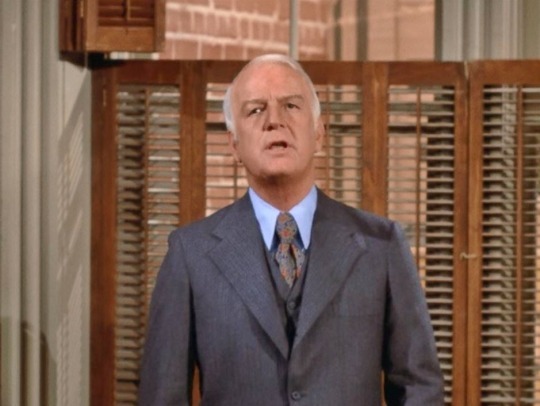
Don
Porter (Ken
Richards) previously played Mr. Devery on “The Ann Sothern Show”
(1958-61), a Desilu production. In 1958 Lucille Ball guest-starred as
Sothern’s friend Lucy Ricardo who tries to play matchmaker between
Devery and Sothern’s character Katy. He had also appeared on Sothern’s
previous show, “Private Secretary” (1953-57). In 1974, Porter
appeared with Ball in Mame,
playing snooty Mr. Upson, father of her nephew Patrick’s intended, Gloria.
Later that same year, Porter appeared with Lucille Ball again in the
teleplay “Happy Anniversary and Goodbye.”
George
Chandler (Winston Shelby) made five films with Lucille Ball between 1938 and
1946. His final TV appearances was in 1979 having accrued more the
450 screen credits. He is probably best remembered as Uncle Petrie
Martin on “Lassie” (1954-56).Shelby
says that his business is selling household appliances through the
mail, but he is actually acting as a bookie.
Billy
Sands
(Billy, left) played Lucy’s
milkman in both “Lucy’s
Lucky Day” (S4;E15)
and “Lucy’s Punctured Romance” (S4;E22). Sands began his
professional acting career in 1946 when he appeared on Broadway with
Spencer Tracy in Robert Sherwood’s Rugged
Path, but
he eventually became a television character actor who appeared
regularly as Dino Papparelli on “The Phil Silvers Show” and as
‘Tinker’ Bell on “McHale’s Navy.”John
Wheeler
(Hank, right) was yet another actor Lucille Ball worked with on the movie
Mame.
Other musicals include the TV version of Wonderful
Town
in 1958 (his screen debut) and Sweet
Charity
(1969). In both cases he was in the New York stage productions and
came to Hollywood to work on the screen versions.
Dave
Morick
(Plainclothes Police Detective) played police officers on various
television shows. He was frequently seen as a background player on
“Hogan’s Heroes” (1966-71).
Neil
(Mrs.
Skyler’s Kitty Cat, uncredited) was brought up on milk.Bentley
the chauffeur (the lion’s handler), and two uniformed policemen
appear uncredited and have no dialogue.
The title is a paraphrase of the catch-phrase “Meanwhile, back at the ranch.”
The expression originated as a stock subtitle in silent movies and at first the reference to the ranch was literal. Later, as the phrase became a cliché, it was used more and more loosely and with a growing sense of mockery or levity.

Lucy
says a depressed Harry looks like a recruiting poster for Forest
Lawn. Forest
Lawn Memorial Park
(aka Cemetery) is located in the Hollywood Hills neighborhood
of Los Angeles. Due to the many celebrities buried there and the
tourists that visit their graves, it has gained a reputation as a
“theme-park necropolis.” When Lucille Ball died on April
26, 1989 she was buried at Forest Lawn, but three years later was
moved to the family plot at Lake View Cemetery in Jamestown, New York. George Chandler (Mr. Shelby) is entombed at Forest
Lawn’s Glendale location, the first of their six properties.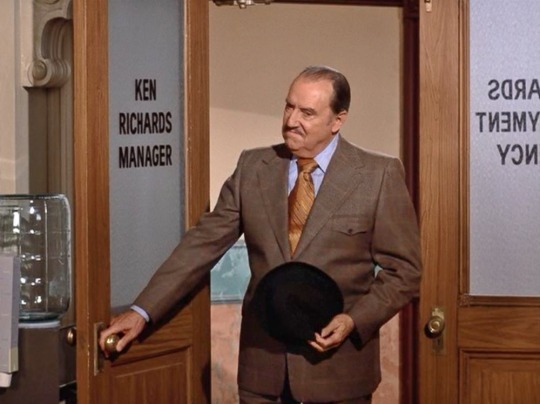
When
Harry shows up at the newly-purchased office, the frosted
glass doors now read “Richards Employment Agency” and “Ken
Richards Manager.” However, the iconic wall sign saying “Unusual Jobs for Unusual
People” subtitled “Carter’s Unique Employment Agency” still
remains.
Porter
warns Lucy that he doesn’t appreciate humor. He says “If
I had wanted a funny secretary, I would have hired Phyllis Diller.”
Master impressionist Jim Bailey played comedienne Phyllis Diller in
“Lucy and Jim Bailey” (S5;E9).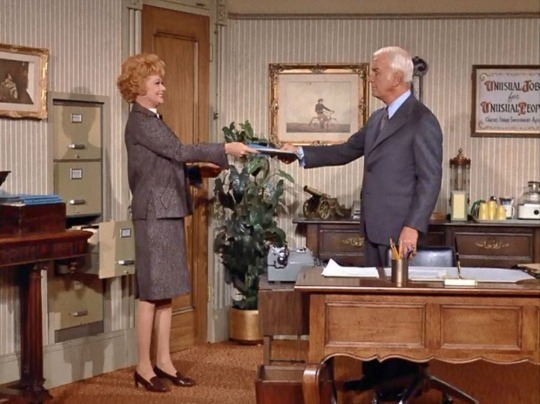
Porter
is frustrated by Lucy’s filing system (a joke that hasn’t been mined
very often recently) and tells her to find him the Bradshaw file.
The name Bradshaw was
often one used by Gale Gordon in his dictation as both Mr. Mooney and
Harrison Carter. In
“A Home is Not an Office” (S5;E4) Harry
is looking for the Bradshaw file and Lucy has filed it under ‘G’
because Mr. Bradshaw reminds her of Cary
Grant.
In this episode, Lucy has filed it under ‘H’ because when she first
met Mr. Bradshaw he told her about his weekend in San Francisco, and
Lucy associates the city with the song “I Left My Heart
in San Francisco.”
Sitting
at a tiny typing table instead of his stately desk, Harry says he
feels like “Napoleon at Waterloo.” Napoleon
Bonaparte (1769-1821)
was a French statesman and military leader who rose to
prominence during the French Revolution. He was Emperor of
the French until his defeat at the Battle of Waterloo in 1815.
Harry played the ‘spirit’ of Napoleon (and Lucy is wife Josephine) at
a séance held by Helen Hayes in “Lucy and the Little Old Lady”
(S4;E17, above).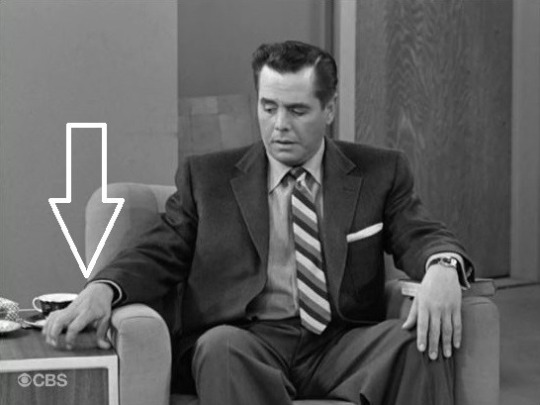
During
a meeting of “the office force”, Mr. Richards tells Harry that
the way he drums his fingers while talking on the telephone is
exceedingly irritating. This was the same bad habit Ricky Ricardo
was accused of by Lucy during “In Palm Springs” (ILL S4;E26, above).
Richards also asks Lucy if there’s any way for her to “dim” her
hair!
Hank
explains how the book-making racket works. When callers state the
model number of the ‘appliances’ they want to order, they are
actually gambling on horse races.- First
number = amount of bet - Second
number = race number - Third
number = horse number - Numbers
1, 2, 3 = win, place, show

They
field telephone calls from Mssrs. Clark, Frasier, McGee, Santiago and
Thomas, to name a few. These names could be completely random on the
part of the writers, or they could have had some significance.When
Billy asks if anyone speaks Spanish, Lucy says that she does. She may
be just saying so to earn the $100 bonus for the most ‘orders’
because Lucy Carter has never demonstrated proficiency with any
language in the past. She says goodbye by saying “Que sera sera!”
This is French and most connected with the Doris Day tune “Que
Sera Sera” (1956).
This is the last episode shot for “Here’s Lucy,” but it was decided not to use it as the series finale. The last shot, of Lucy, Harry and Kim, toddling off into the ‘sunset’ certainly feels like a Hollywood ending.


Harry
also sold the Unique Employment Agency at the end of season five
for $25,000. This is the same price Harry got from Mr. Richards.
Kim
disguises herself as a stereotypical little old lady named Mrs.
Skyler, of the South Pasadena Skylers. In “Lucy and the Ex-Con”
(S1;E15), Wally Cox disguises himself as a little old lady named Mrs.
Perkins, of the Pasadena Perkins’. The connection between elderly
women and the California city doubtless is derived from the hit
song “The
Little Old Lady from Pasadena” (1964)
sung by Jan and Dean.
This
is the second time that a live lion has been seen on “Here’s Lucy.”
The first was in “Lucy in the Jungle” (S4;E13).
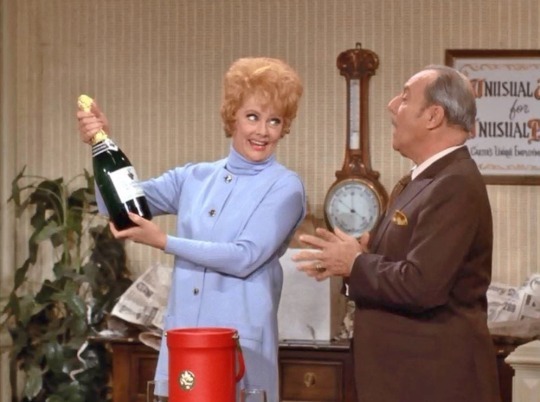
Souvenirs! When
Harry sold the business to Mr. Richards, he neglected to take his
precious barometer, something he told Lucy to carefully pack when he
first sold the business in “Lucy and Harry’s Memoirs” (S5;E24).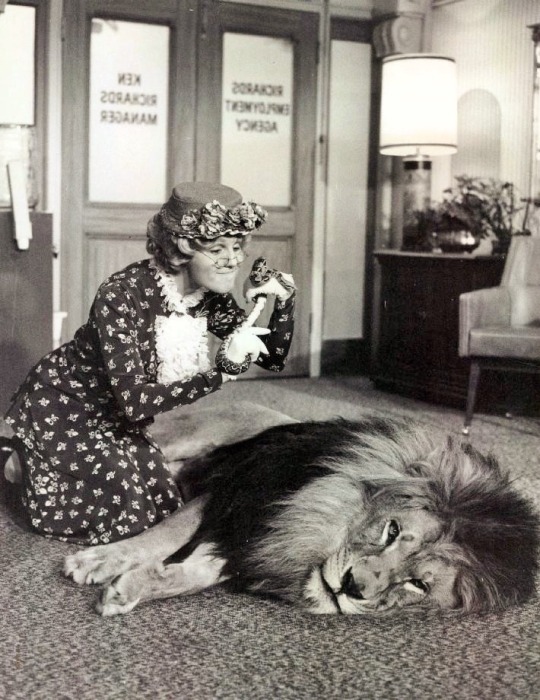
Kitty Litter! When
Bentley the chauffeur (actually the lion’s trainer) is about wrestle
with ‘Neil’, Lucie Arnaz says “Show
them how cuddly and kitty
he is”
which doesn’t make grammatical sense. No doubt that the presence of
a live lion on set had everyone a bit distracted. [The snake held by Lucie Arnaz in the above promo shot belonged to her! It does not appear in the episode.]
“Meanwhile, Back at the Office” rates 4 Paper Hearts out of 5
This episode probably should have been the series finale – it feels like a finale. Lucie Arnaz does a wonderful comic turn as the stereotypical little old lady – something her mother would have done 20 years earlier.

- First
-
Subscribe
Subscribed
Already have a WordPress.com account? Log in now.
 Papermoon Loves Lucy