-
GYPSY IN MY SOUL
January
10, 1976 on CBS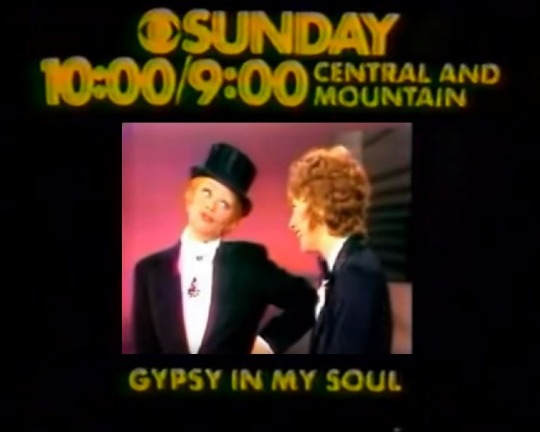
Directed
and Choreographed by Tony CharmoliProduced
by William O. Harbach, Fred Ebb, Cy ColemanWritten
by Fred EbbMusic
by Cy ColemanShirley MacLaine
was born Shirley MacLean Beaty in Richmond, Virginia, in 1934. Her
younger brother is the actor Warren Beatty. Shirley was stand-by for
Carol Haney in Broadway’s The
Pajama Game
when she was spotted by a Hollywood producer who signed her to a
contract at Paramount. Her first film was Alfred Hitchcock’s The
Trouble With Harry (1950).
In 1960, she finally got to do a screen musical with Can-Can,
ironically, she was supposed to do the Broadway stage version before
being wooed away by Hollywood. Equally at home in drama, comedy, or
musical, MacLaine was nominated for five Oscars before winning in
1983 for Terms
of Endearment.
She won an Emmy Award in 1976 for this special.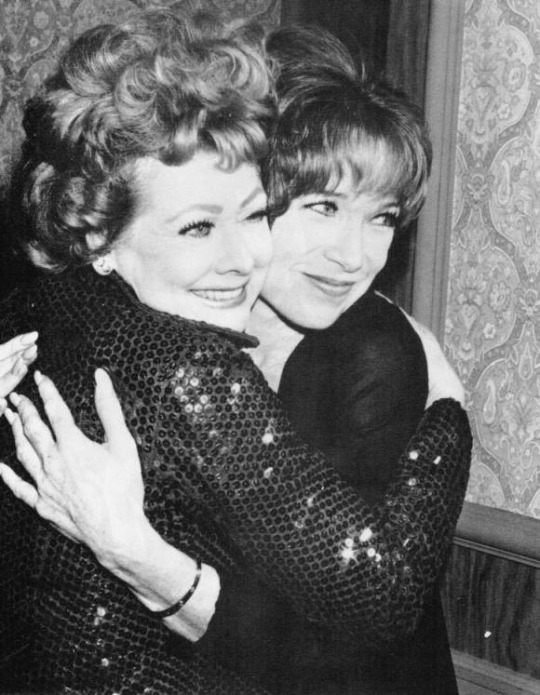
Lucille
Ball
was born on August 6, 1911 in Jamestown, New York. She began her
screen career in 1933 and was known in Hollywood as ‘Queen of the
B’s’ due to her many appearances in ‘B’ movies. With Richard
Denning, she starred in a radio program titled “My Favorite
Husband” which eventually led to the creation of “I Love Lucy,”
a television situation comedy in which she co-starred with her
real-life husband, Latin bandleader Desi Arnaz. The program was
phenomenally successful, allowing the couple to purchase what was
once RKO Studios, re-naming it Desilu. When the show ended in 1960
(in an hour-long format known as “The Lucy-Desi Comedy Hour”) so
did Lucy and Desi’s marriage. In 1962, hoping to keep Desilu
financially solvent, Lucy returned to the sitcom format with “The
Lucy Show,” which lasted six seasons. She followed that with a
similar sitcom “Here’s Lucy” co-starring with her real-life
children, Lucie and Desi Jr., as well as Gale Gordon, who had joined
the cast of “The Lucy Show” during season two. Before her death
in 1989, Lucy made one more attempt at a sitcom with “Life With
Lucy,” also with Gordon, which was not a success and was canceled
after just 13 episodes.The
Gypsies:Trudy
Carson made her Broadway debut as a gypsy in 1964 with (ironically) a show
titled I Had a Ball. Five more shows followed, including the
original Follies ,
and Irene in 1973. She was also a Rockette. On TV she was one of the June
Taylor Dancers and danced on film in All
That Jazz (1979). She was married to comic Soupy Sales.Denise
Pence
also danced in the original Follies
(1972) as well as working with Bob Fosse in Pippin.
Pence was married to fellow gypsy Steven
Boockvor
and the two served as Michael Bennett’s models for the characters of
Christine and Al in the long-running musical A
Chorus Line,
a tribute to gypsy dancers. She danced on film in Jesus
Christ Superstar
(1973) also with Boockvor. She left dancing for daytime drama and was
Emmy nominated for “The
Guiding Light.” He was
nominated for Broadway’s 1978 Tony Award as Featured Actor in the
musical Working.
In addition, he was also seen in or choreographed 15 other Broadway
musicals, including A
Chorus Line and
Follies.Jonathan
Wynne was
also in the film version of Superstar,
as well as in Finian’s
Ranbow
on screen. On Broadway, he was in the ensemble of the 1975 revival
of
Hello, Dolly starring
Pearl Bailey.Gary
Flannery
was one of Shirley’s gypsies on Broadway in 1976 as well as her
return engagement in 1984. He was also a replacement in the Broadway
show Dancin’.
He was a principal dancer in the film All
That Jazz.Jane
Summerhays started
dancing on Broadway in the original
A Chorus Line and
was nominated for a Tony Award for her role as Lady Jacqueline in
1986’s Me
and My Girl.
She was able to move into comedy acting and has been seen in a
variety of roles on Broadway, including plays by Alan Ayckbourn and
Ken Ludwig.Wyetta
Turner
was also on screen in Superstar,
but was seen on Broadway in the original company of Hello,
Dolly
and the revival of The
Pajama Game.Adam
Grammis first
danced on Broadway in 1971 in Wild
and Wonderful,
which closed on opening night. He was a replacement in the original
A
Chorus Line and
also was one of Shirley’s gypsies in her 1976 Broadway outing. He
died in 1985, an early victim of the AIDS pandemic.The
child dancer and three senior citizen dancers are uncredited.
GYPSY Backstory
Cy
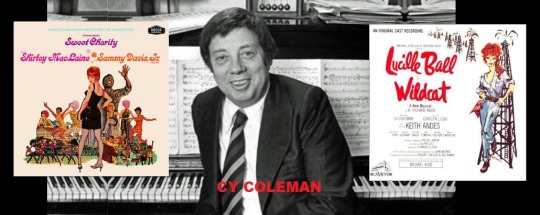
Coleman wrote the lyrics for Lucille Ball’s Broadway musical,
Wildcat
(1960).
He also wrote the music for Sweet
Charity,
which was filmed starring Shirley MacLaine in the title role.
MacLaine’s theme song is “If They Could See Me Now” from Sweet
Charity
while Lucy’s theme song (outside of the “I Love Lucy Theme”) is
Coleman’s “Hey, Look Me Over” from Wildcat.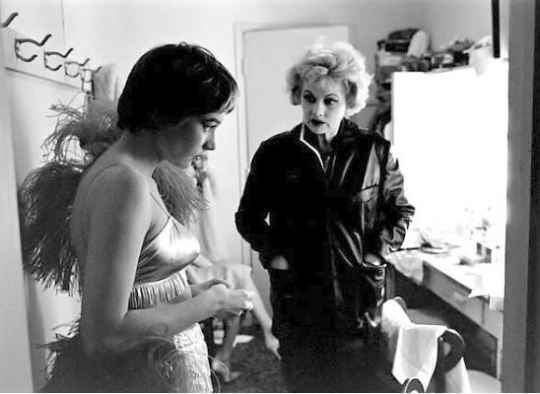
On
November 1, 1959, Lucille Ball and Shirley did a Las Vegas benefit
for the victims of Japan’s Typhoon Vera. The show, however, was not
televised. Lucy’s frequent co-star Bob Hope was also part of the
benefit. There were nearly 3,200 victims of the Typhoon.
On
April 19, 1976, Shirley MacLaine appeared at the Palace Theatre on
Broadway in a similar show written by Fred Abb and Cy Coleman and
directed by Tony Charmoli. This incarnation was simply titled
Shirley
MacLaine or
Shirley
MacLaine and Shirley’s Gypsies,
who were Candy Brown, Gary Flannery, Adam Grammis, Joann Lehman, and
Larry Vickers. An original cast album from the show was titled
Shirley
MacLaine Live at the Palace.
The song “The Gypsy in My Soul” was included on all three. This
was her first time back on the Broadway stage since The
Pajama Game
more than twenty years earlier. The show was also a big hit in
London. Needless to say, Lucille Ball was not involved with any of
these other versions of the show.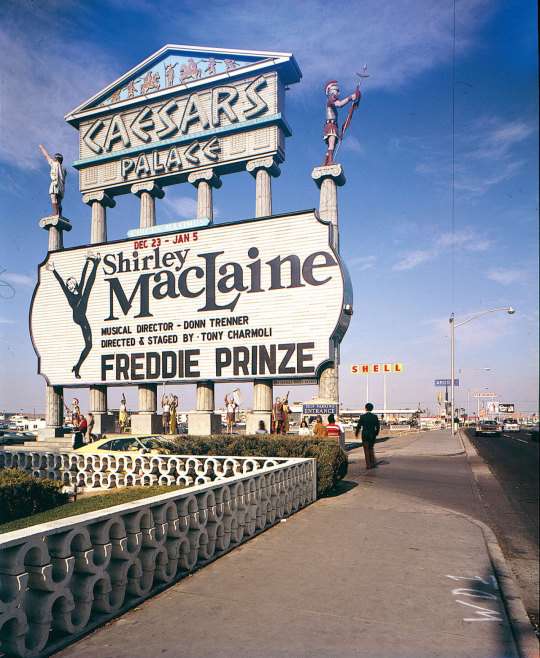
The
day before the show opened in New York City, the New York Times
published this feature article and interview, conducted while the
show was in Las Vegas and filmed for broadcast.LAS
VEGAS – On a sign outside
Caesar’s Palace in Las Vegas a larger‐than‐life Shirley MacLaine
is shown tossing off a preternaturally high kick. Words don’t matter
in this town. Signs do. There is a neon hieroglyph for almost
everything, and this sign means Shirley MacLaine is back on stage and
kicking up her heels. Her show, “A Gypsy In My Soul,” which
sports Miss MacLaine and a back‐up troupe of five dancers (aka
Shirley’s Gypsies) opened to raves at London’s Palladium. The British
critics hailed her as a performer on a par with Judy Garland, Danny
Kaye and Ethel Merman to more raves in 12 cities throughout Europe
and Latin America, and is now en route to New York City, where it
opens tomorrow night at the Palace Theater.On
a recent afternoon, Miss MacLaine sat cross‐legged at the living
room coffee table or her borrowed Las Vegas house, eating breakfast
and talking about the origins of her show. “After
working in the McGovern campaign,” she recalled. “I took a trip
across America by car. I’d seen a lot of other countries, but that
was the first time I’d really seen America. What I saw was a lot of
disillusionment, mistrust and despair. I got back to Los Angeles,
looked at myself in the mirror and saw the same thing. I’d gained 30
pounds, lot my hair go, and looked awful.” Her post‐election
depression deepened. Then, she said, “I decided to do something
about it. The first thing did was to go China. The second thing was
to put together show.In
2015, an online source talked to MacLaine about working with Lucille
Ball:“Talk
about a woman with balls! She loved her legs and she said, ‘I want
to come on your show and I want to do something in a leotard!’ I
thought, ‘That’s good,’ because I like my legs too. I thought
it was so wonderfully honest of her to put it in her contract like
that. She was a stickler for being liked. Once you made an
arrangement with her it didn’t shift. Always told you the truth.”

The
show was taped over two days. The first day with an audience for
Shirley’s solos and numbers with the gypsies, and without an audience
for Lucy’s portions of the show. Ball loved live audiences when
doing comedy, but after breaking her leg she was scared to death to
dance live in front of an audience.In
his book I
Loved Lucy,
author Lee Tannen remembers attending the taping of “Gypsy in My
Soul”.
The
program’s main sponsor was Bell Telephone.
Filmed rehearsal
sequences the begin the special were done by The Maysles Brothers,
who also created the documentary Gray
Gardens
in 1975.
Lucille Ball had finished doing “Here’s Lucy” in 1974. This special was aired between two of her own specials: “Three For Two” (December 3, 1975) and “What Now Catherine Curtis?” (March 30, 1976).
Some
sources list the air date of the special as January 20, 1976, and one
or two list it as January 21st.
The
word ‘gypsy’ in the title refers to Broadway dancers who generally
went from one show to the next, much like the Romany gypsies of
central Europe, who were traditionally transient people. The most
famous use of the word ‘gypsy’ in show business was by stripper Rose
Lee Hovic (above), who took the stage name Gypsy Rose Lee. Her autobiography
was turned into the stage and screen musical Gypsy.
Recently, negative connotations of the word ‘gypsy’ have caused it to
become more selectively used in the entertainment industry.
GYPSY IN MY SOUL

The
show opens on location in an actual rehearsal room where Shirley,
Lucy, and ‘the gypsies’ are rehearsing. During a five minute break,
Shirley introduces the show talking directly to the camera. After a brief title sequence, the action
returns to the rehearsal room where Lucy drags Shirley onto the floor
by her hair (literally).
As Shirley makes her entrance into the song,
the rehearsal morphs into the actual show, on a soundstage with
orchestra, lighting, and costumes. With the singers and dancers, she
performs the title song “Gypsy
in My Soul.”Next
Shirley performs
“It’s Not Where You Start (It’s Where You Finish)”
from the Cy Coleman Broadway musical Seesaw
(1973) with lyrics by Dorothy Fields. During the number, each of the
gypsies take their turn in the spotlight (literally).Shirley
and gypsies Steve and Adam dance “The Rudolf Friml Hustle,” a
mash-up of the popular dance the Hustle and the 1937 song “The
Donkey Serenade”
from the 1912 operetta The
Firefly,
filmed in 1937. They get a standing ovation from the studio
audience.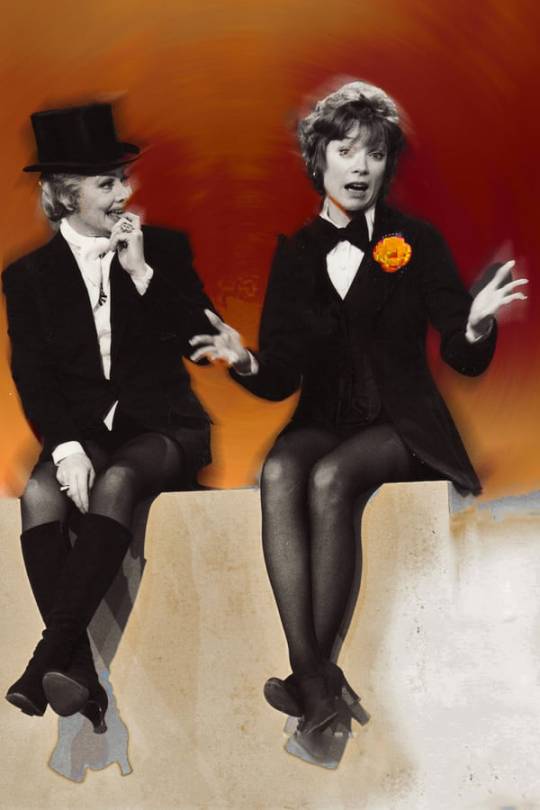
After
a commercial break, Shirley and the gypsies sing “Lulu’s Back in
Town” (appropriately adapted to “Lucy’s
Back in Town”)
which heralds the entrance of Lucille Ball. The song was originally
written by Harry Warren and Al Dubin in 1935. In a planned comedy
bit, Lucy acts surprised to see Shirley in line with the gypsies.Lucy
tells the now familiar story of how she survived as a chorine by
visiting coffee shops, waiting until a patron left, then slipping
into their seat to use their tip to order coffee. If they left a
half-eaten doughnut it was a bonus.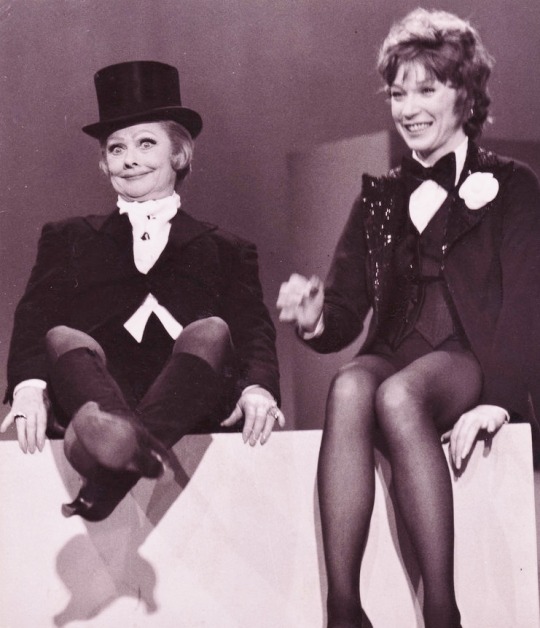
Shirley:
“How
many chorus jobs were you fired from?”
Lucy:
“Every
one of them!”Lucy
and Shirley sing Cy Coleman’s “Bouncing
Back for More,” a
song with lyrics by Carolyn Leigh written for Lucy to sing in 1960’s
Wildcat,
but never used. It was later inserted into the 1976 musical
Hellzapoppin
but
show closed out of town in Baltimore.Shirley
and the gypsies do a fast-paced dance to “Bring
Back Those Good Old Days”
but Lucy says that Shirley is a star, and shouldn’t be working so
hard. Lucy demonstrates the same routine doing the minimum: a few
shoulder shrugs and hip gyrations. Shirley begs her to put a bit
more into it. With Shirley leading, the two do a slightly more
physical routine, ending with high kicks, which the audience
naturally greets with applause.The
second half hour of the show starts with MacLaine and the gypsies
performing “Every
Little Movement (Has a Meaning All Its Own)”
written by Otto Harbach and Ken Hoschna for the 1910 operetta Madame
Sherry.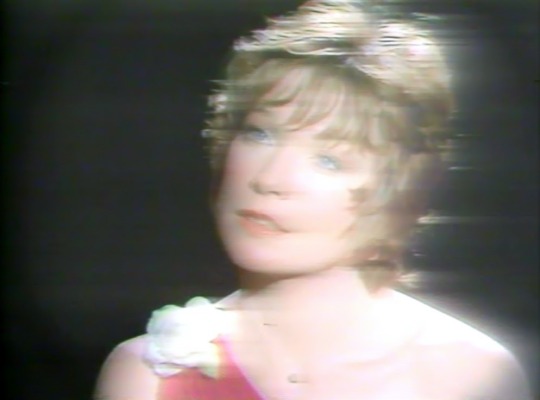
Alone
in a spotlight, Shirley dedicates the torch song “She’s
a Star” to
all those who didn’t make it in show business. This is a translation of the 1973 song
“La
Chanteuse a Vingt Ans” Serge
Lama.
The English version was arranged by Cy Coleman.
As
a testament to the history of the gypsy dancer, Shirley brings on a
little girl doing a tap routine while also hitting a hotel bell with
her foot!
On the other end of the spectrum, next onstage is a trio
of senior citizens who each take their turn doing a specialty dance.
Shirley then reveals that everyone in the studio audience is a
dancer. Their admission ticket was their AFTRA (American Federation
of Radio and Television Artists) card! Shirley choreographs the
entire audience from their seats, row by row, and then finally doing
all three steps together to the music of “Shall We Dance” from
The
King and I.
Shirley
brings the entire audience on stage, and thanks them for all they’ve
sacrificed to make performers like her look good. She then drags
(literally) Lucy on stage and they all end with high kicks to “It’s
Not Where You Start (It’s Where You Finish.”
On
This Date in Lucy History
~ January 10th
“California,
Here We Come!” (ILL S4;E13) ~ January 10, 1954
“Lucy
and Art Linkletter”
(TLS S4;E16) ~ January 10, 1966
“Lucy
and the Chinese Curse”
(HL S4;E18) ~ January 10, 1972 -
HOLLYWOOD WITHOUT MAKE-UP
1963
Produced
by Ken MurrayMusic
by George StollWritten
by Royal Foster
Ken
Murray
(Himself, Host) is billed as “the man who makes movies of the
people who make movies.” He was born
Kenneth Abner Doncourt in 1903
to vaudevillian parents. Murray
got his start in show business on the stage in 1920s as a stand-up
comedian.
He performed his comedy act on the vaudeville
circuit.
He found success as a stage performer after appearing in Earl
Carroll’s
Vanities
on
Broadway
in
1935. In
the 1940s, Murray became famous for his Blackouts,
a racy, stage variety show at the El
Capitan Theatre in
Hollywood. The Blackouts played to standing-room-only
audiences
for 3,844 performances, ending in 1949. Later that year, the show
moved to Broadway
and
closed after six weeks. He made his film debut in the 1929 romantic
drama Half
Marriage,
followed by a role in Leathernecking
in
1930. He was also the host of “The
Ken Murray Show,”
a weekly music and comedy show on CBS
Television that
ran from 1950 to 1953.
The
show was the first to win a Freedom Foundation Award. Over the course
of his career, Murray filmed Hollywood celebrities using his 16mm
home movie camera. He began filming the footage to send back home to
his grandparents in lieu of writing letters. His grandmother saved
the footage, which Murray later used in compilation films like
Hollywood
Without Make-Up.
He died in 1988 at age 85.
Features
footage of: Eddie Albert, June Allyson, George K. Arthur, Mary Astor,
Lew Ayres, Max Baer, Lucille
Ball,
Richard Barthelmess, Rex Bell, Edgar Bergen, Sally Blane, Humphrey
Bogart, John Boles, Pat Boone, Eddie Borden, Hobart Bosworth, Clara
Bow, William Boyd, Fanny Brice, Paul Brooks, Joe E. Brown, Johnny
Mack Brown, Virginia Bruce, Polly
Burson,
Rory
Calhoun,
Leo Carrillo, Charles Chaplin, Lew Cody, William Collier Jr., Russ
Columbo, Gary Cooper, Jackie Cooper, Jeanne Crain, Robert Cummings,
Linda Darnell, Marion Davies, Joan Davis, Olivia de Havilland,
Dolores del Rio, Cecil B. DeMille, Jack Dempsey, Walt Disney, Kirk
Douglas, Marie Dressler, Irene Dunne, Josephine Dunn, Stuart Erwin,
Ruth Etting, Douglas Fairbanks, Douglas Fairbanks Jr., Charles
Farrell, Todd Fisher, Errol Flynn, Joan Fontaine, Glenn Ford, Clark
Gable, Greta Garbo, Reginald Gardiner, Cary Grant, Alan Hale, Oliver
Hardy, William Randolph Hearst, Jean Hersholt, William Holden, Bob
Hope,
Hedda Hopper, Walter Huston, Sam Jaffe, Van Johnson, Buck Jones, Hope
Lange, Charles Laughton, Stan Laurel, Gertrude Lawrence, Mervyn
LeRoy, Charles Lindbergh, Carole Lombard, William Lundigan, Fred
MacMurray, Jayne Mansfield, George
Marshall,
Herbert Marshall, Chico Marx, Groucho Marx, Harpo Marx, Joel McCrea,
Victor McLaglen, Adolphe Menjou, Mayo Methot, Marilyn Monroe, Frank
Morgan, Wayne Morris, Jean Parker, Louella Parsons, Mary Pickford,
Dick Powell, Tyrone Power, George Raft, Gregory Ratoff, Donna Reed,
Debbie Reynolds, Buddy Rogers, Charles Ruggles, Albert Schweitzer,
George Seaton, Norma Shearer, George Stevens, Lewis Stone, Margaret
Sullavan, Robert Taylor, William T. Tilden, George Tobias, Spencer
Tracy, Lupe Velez, Jimmy Walker, John Wayne, Johnny Weissmuller, Mae
West, Claire Windsor, Robert Woolsey, Jane Wyman, and others.
The
show is also available on DVD from Sprocket Flicks It has been aired on TV on Turner Classic Movies.
In
1963, when this documentary was released, Lucille Ball was starting
her second season of “The Lucy Show” on CBS TV.
In
June 1950, one year before “I Love Lucy” premiered, Lucille Ball
and Desi Arnaz were guests on “The Ken Murray Show” on CBS TV.
Tap dancer Bunny Briggs and ‘Little Rascal’ Darla Hood were also
guests.
In 1966, Lucy and Murray were both guests on “Bob Hope’s
Leading Ladies.” Murray played a television executive named Harvey
Sarnoff. Lucy played herself. Sort of.
Lucy
returned to Sun Valley to film an episode of “The Lucy-Desi Comedy
Hour,” using the same locations scene in this documentary.

Twenty
minutes into the documentary, the location turns to Sun Valley,
Idaho, where Hollywood stars went for winter sports. June Allyson,
Errol Flynn, Martha O’Driscoll, Johnny Weissmuller, Wayne Morris,
and Reggie Gardiner have a snowball fight while making a snowman.
Lounging at the Lodge are Rory Calhoun (center) and Lucille Ball.
Sun Valley was one of the Arnaz’s favorite vacation spots, accessible by train from Hollywood. Desilu would film “Lucy Goes
To Sun Valley” (1958) there. Lucy’s good friend Ann Sothern also
loved Sun Valley, and is buried nearby.
Murray
says that this is not the only home movies of Lucille Ball that he
has. First is a quick clip of Lucy at Chatsworth Ranch with one of her cherished dogs. Lucy
and Desi had three dogs at the time.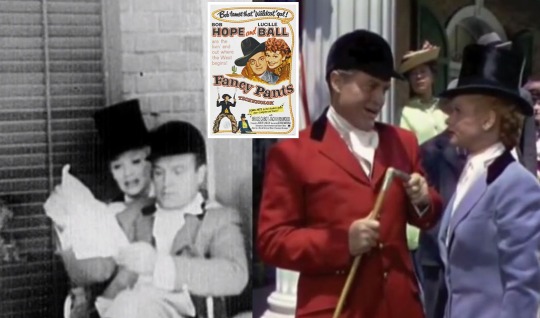
This leads to footage of
Lucille Ball filming Fancy
Pants
in 1950 with director George Marshall and co-star Bob Hope. Murray
also mentions that Lucy has done quite a few pictures with Hope,
including Critic’s
Choice,
which was released in 1963, the same year as this documentary. In
1969, when Lucy wanted to film episodes of “Here’s Lucy” on
location, including on the Colorado River, she hired Marshall,
remembering his expertise with location filming in rough terrain.
Ball
also poses with Marshall and her Fancy
Pants
stunt double, Polly
Burson,
although Murray does not specifically mention her name.
Ball is shown
doing a stunt where she falls onto a break-away table, not once…
not
twice…
but three times!
Murray:
“Someone
once said that Lucille Ball stands alone as the greatest comedienne
of our time. That goes for sitting down, too!”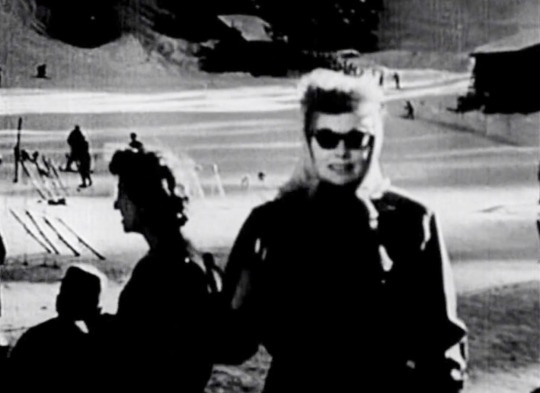
Lucy Without Make-Up: Literally!

A movie star, Lucille Ball was rarely scene without full make-up, but when a scene demanded she take a blast of water to the face, she removed her false eyelashes, as she did here in “Never Do Business With Friends” (ILL S2;E31) in 1953.
-
DANNY THOMAS’ THE WONDERFUL WORLD OF BURLESQUE
December
8, 1965 on NBC
Directed
by Alan HandleyWritten
by Hugh Wedlock Jr., Allan ManingsFlying
by Peter FoyComedy
Consultant Herbie Faye
Danny
Thomas
(Himself, Host / Dr. Vivian Throckmorton) and
Lucille Ball’s careers are forever linked. “Make Room for Daddy”
was filmed at Desilu Studios and when it moved to CBS the characters
did a cross-over episode of “The
Lucy-Desi Comedy Hour,“ exchanging
homes with the Ricardos. In return, Lucy and Desi played Lucy and
Ricky on an episode of “Make Room for Daddy.” When Thomas starred
in a sequel titled “Make
Room for Granddaddy”
Ball guest-starred and did the same when he starred in the
short-lived series “The
Practice.”
Thomas
appeared as himself in a 1965 episode of “The
Lucy Show”
and as an eccentric artist on “Here’s
Lucy”
in 1973.
Lucille
Ball
(Herself / Gertie / Tondelayo) was
born on August 6, 1911 in Jamestown, New York. She began her screen
career in 1933 and was known in Hollywood as ‘Queen of the B’s’
due to her many appearances in ‘B’ movies. With Richard Denning,
she starred in a radio program titled “My Favorite Husband” which
eventually led to the creation of “I Love Lucy,” a television
situation comedy in which she co-starred with her real-life husband,
Latin bandleader Desi Arnaz. The program was phenomenally successful,
allowing the couple to purchase what was once RKO Studios, re-naming
it Desilu. When the show ended in 1960 (in an hour-long format known
as “The Lucy-Desi Comedy Hour”) so did Lucy and Desi’s
marriage. In 1962, hoping to keep Desilu financially solvent, Lucy
returned to the sitcom format with “The Lucy Show,” which lasted
six seasons. She followed that with a similar sitcom “Here’s
Lucy” co-starring with her real-life children, Lucie and Desi Jr.,
as well as Gale Gordon, who had joined the cast of “The Lucy Show”
during season two. Before her death in 1989, Lucy made one more
attempt at a sitcom with “Life With Lucy,” also with Gordon,
which was not a success and was canceled after just 13 episodes.
Jerry
Lewis
(Himself / Morty Cockinlocker / Phil Thropingham) was
a comedian, actor, and singer born in Newark, New Jersey in 1926. He
was known for his slapstick humor and was originally paired up with
Dean Martin, forming the famed comedy team of Martin and Lewis. His
long-standing commitment to hosting the annual Muscular Dystrophy
telethon in 2010, after 44 years, earning him a nomination for the
Nobel Peace Prize in 1977. He was also presented the French Legion of
Honor in 1984. Lewis died in 2014.
Shirley
Jones
(Herself / Trixie) starred
as wholesome characters in a number of well-known musical
films,
such as Oklahoma!
(1955),
Carousel
(1956),
and The
Music Man
(1962).
She won the Academy
Award for Best Supporting Actress
for
playing a vengeful prostitute in Elmer
Gantry
(1960).
She played the lead role of Shirley Partridge, the widowed mother of
five children, in the television series The
Partridge Family
(1970–74),
which co-starred her real-life stepson, David
Cassidy,
son of Jack
Cassidy,
a guest star on “The Lucy Show” in 1965.Jimmy
Durante (Handsome
New Englishman) was
a multi-talented performer who was distinguished by his bulbous nose.
In “Lucy
Meets Harpo Marx” (ILL S4;E28)
Lucy
Ricardo dons a novelty store mask and trench coat to impersonate
Durante for a nearsighted Carolyn Appleby.
Durante did a cameo as himself in “Lucy Goes To A Hollywood
Premiere” (TLS S4;E20). Two years later, Lucy
Carmichael and guest star Carol Burnett imitate Jimmy Durante as they
sing his 1944 song “Start
Out Each Day with a Song.” He first appeared with Lucille Ball in
1935’s Carnival.
He died in 1980.Sheldon
Leonard (Cigar
Vendor) was
born Leonard Sheldon Bershad in New York City in 1907. In 1953 he
played fast-talking salesman Harry Martin, who sells Lucy Ricardo the
Handy Dandy vacuum cleaner in “Sales
Resistance” (ILL S2;E17).
Leonard was an integral part of the Desilu family off-screen as well,
directing “Make Room for Daddy” including an episode that
featured Lucy and Ricky Ricardo in 1959. He was one of the creators
of “The Andy Griffith Show,” also filmed at Desilu. He played
himself in a 1967 episode of “The Lucy Show.” Leonard may be best
remembered as the Nick, the bartender in the classic film It’s
a Wonderful Life
(1945).
He died in 1997.In
the final bows, Danny Thomas refers to Leonard’s character as “the
Candy Butcher.”
Frank
DeVol and
his OrchestraThe
Headwaiter, the Drunk, a Waiter, and the Card Girl, are all played by
uncredited performers.

This
was the second edition of “The Wonderful World of Burlesque.”
The first program aired in March 1965 and starred Jack Benny, Mickey
Rooney, and Frank Sinatra. A third edition aired in December 1966
starring Carol Channing and Dean Martin. The fourth and final
edition was aired in September 1967 featuring Phil Silvers and
Nanette Fabray.
The
program was nominated for one 1966 Primetime Emmy Award for costumes
by Bob Mackie and Ray Aghayan.
Lucille
Ball played burlesque performer Bubbles in the 1940 film Dance,
Girl, Dance.
"Lucy
Saves Milton Berle”
(TLS S4;E12) premiered on CBS two days prior to
this special.
Lucy’s
“Butterfly Ballet” is included (in color) on “The Lucy Show”
season 4 video set as a DVD extra.In the final credits, the program is listed as “The Danny Thomas Show.” Like many of the Danny Thomas and Bob Hope specials on NBC, the main sponsor is Timex.

Danny
Thomas comes through the curtain to thank the audience for coming to
the second “Wonderful World of Burlesque.” He apologizes for
omitting references to many burlesque greats in the first broadcast.
He tells a story in the manner of Bert Williams, a black
vaudevillian.Thomas
introduces Jerry
Lewis,
who sashays onto the stage waving a silk handkerchief like a
burlesque dancer. Thomas tells him that they’re not doing ‘that’ sort
of burlesque!Jerry
Lewis:
“Oh! I thought this was ‘Hullabaloo!’”“Hullabaloo”
(1965-66) was
a pop rock variety show on NBC. As with ABC’s “Shindig”,
which began four months earlier, it combined the musical trends of the
day: The British Invasion, Detroit’s Motown sound, and the emerging
folk rock trend.
As
the orchestra strikes up a few bars of “76 Trombones” from The
Music Man, Shirley
Jones joins Thomas and Lewis on stage. To the strains of “Hey Look Me
Over” from Wildcat, Lucille
Ball enters
and joins the group. All four are dressed in elegant formal wear.
The ladies’ gowns were designed by Bob Mackie.
Lucy:
“Whenever
I do a show like this, I’m always a little nervous. Especially when
I’m working with a great singer.”
Danny:
“Thank
you, Lucy.”
Lucy:
“I
meant Shirley! Of course, it’s not easy being onstage with such a
great actor.”
Danny:
“Thank
you, Lucy.”
Lucy:
“I
meant Jerry! And it’s always a thrill working with an old-fashioned
type comic who isn’t afraid to stoop to pratfalls and baggy
pants.”
Danny:
“Thank
you, Lucy.”
Lucy:
“I
meant me!”[This
is a terrific example of an ideal burlesque / vaudeville joke. It
contains three parts, repetition, and a surprise ending!]
Danny
Thomas and Jerry Lewis perform a comedy routine as two broke guys
going on a double date with two dolls (Lucy and Shirley) that they
can ill-afford to entertain. The women order everything on the menu
– including champagne!
Blooper
Warning!
When the waiter arrives with the check just as the foursome down a
sip of champagne, Jerry Lewis does a spit-take that results in him
spitting out his false buck teeth! Lewis says to someone off camera
“Give me my teeth” and the dentures are tossed to him and he pops them back in his mouth. All the other performers dissolve in
laughter.
During
the scene change, Danny has a comic exchange with a vendor in the
theatre aisle (Sheldon Leonard) who is selling Dutch Masters Cigars.
This is actually an integrated commercial with Thomas singing the Dutch Masters jingle at its conclusion.
Shirley
Jones introduces a burlesque parody of the Broadway hit White
Cargo,
the story of two proper Englishmen and a tempestuous woman of the
islands. White Cargo by Leon Gordon played two engagements, one
downtown in 1923 and one uptown in 1926. It is best remembered as
the first Broadway show to depict a white man married to a black
woman.
It was made into a motion picture in 1942 starring Watler
Pidgeon, Richard Carlson, and Hedy Lamaar as Tondelayo, the native
woman. The Englishmen in the sketch are Danny Thomas as Dr.
Throckmorton and Jerry Lewis as Phil Thropingham.Throckmorton:
“Welcome
to the island of Pango.”
Thropingham:
“Pango?
I thought it was Pango Pango.”
Throckmorton:
“It’s
not half the island it used to be!”
Wearing
a leopard print shift and a black wig, Lucille Ball struts in an
announces “I am Tondelayo.” She seduces Throckmorton into
surrendering his pocket watch. Jerry Lewis works in a mention for
the evening’s sponsor, Timex.Thropingham
[to Throckmorton]: “Have
you forgotten the vow you made to bring back the rare Goona Goona
butterfly?”
Tondelayo:
“It’s
just Goona butterfly now.”
Thropingham:
“Goona?”
Tondelayo:
“Yeah.
It’s not half the butterfly it used to be.”
With
Throckmorton out hunting the rare Goona, Tondelayo turns her
attention to Thropingham. Twenty four hours later (as a card girl
informs us), Throckmorton returns, and Tondelayo is still embracing
Thropingham, his clothing now in tatters.Throckmorton:
“Well, Thropingham. I see the island and Tondelayo have gotten to
you, too.”
Tondelayo:
“No
call him Thropingham. Call him Throp. He not half the man he used
to be.”Competition
for the affections of Tondelayo drives everyone to thoughts of murder!Throckmorton
[aside]: “Little
does he realize, but he’s had it.”
Thropingham
[aside]:
“Little does HE realize, but HE’S had it.”
Tondelayo
[aside]: “Little
do they realize, but Tondelayo’s gonna knock ’em both off!”
When
Tondelayo pours the poison tea, Lucille Ball earns a round of
applause from the studio audience due to the fact that the spout of
the prop teapot has a bifurcated spout and pours simultaneously into
two different cups!
As
the two take their last breath, a ship’s horn signals a new arrival
(played by Jimmy Durante).Blooper
Alert! Both
Danny Thomas and Jerry Lewis are supposed to be ‘dead’ but crack up
laughing at the sound of Durante’s voice. Even Durante starts to
break character as the sketch ends.
For
the final act, Lucille Ball performs “The Butterfly Ballet”
suspended on a wire above the stage and the auditorium. For this act,
Peter Foy, of the famous Foy Family (who did flying on Broadway for
Peter Pan and other shows) were brought in to supply rigging and
supervise. Film of the act later became part of their archives. The
ballet lasts two and a half minutes and is underscored by the Frank DeVol orchestra.For
the final bows Danny Thomas brings out Jerry Lewis (who has toilet
paper stuck to his show), Shirley Jones, and Lucille Ball to say (and
sing) goodnight.
LUCY TAKES FLIGHT!
This is not the first time Lucille Ball had been hoisted in the air on wires, nor would it be the last. Generally, it was for accomplishing death-defying stunts, but sometimes Lucy got to fly!

“Little
Ricky’s School Pageant” (ILL S6;E10) as The Witch in ‘The Enchanted
Forest’
In the Dinah Shore TV special “Like
Hep” (April 13, 1969), Lucy appeared as Mary Poppins in a sketch titled ‘The
Fairy Godmother’s Revenge’.
The second time she is airborn, Lucy collides mid-air with the Flying Nun!

“Kiddie
Parties Inc.” (TLS S2;E2)
This
Date in Lucy History ~ December 8
“Lucy
Is Enceinte”
(ILL S2;E10) – December 8, 1952
“Lucy
and the Generation Gap”
(HL S4;E12) – December 8, 1969 -
SALUTE TO STAN LAUREL
November 23, 1965 on CBS
Directed by Seymour Berns
Produced by Henry Jaffe, Seymour Berns
Written by Hugh Wedlock Jr., Charles Isaacs, Alan Manings with Carl Reiner and Aaron Ruben
Cast (in order of appearance)
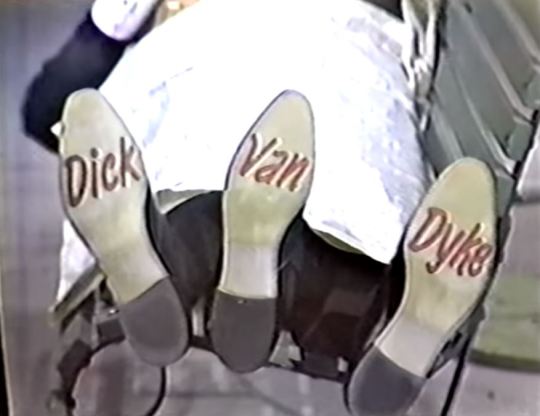
Dick Van Dyke (Host, Himself) was born Richard Wayne Van Dyke in West Plains, Missouri, in 1925. Although he’d had small roles beforehand, Van Dyke was launched to stardom in the 1960 Broadway musical Bye Bye Birdie,for which he won a Tony Award. He reprised his role in the 1963 film. He has starred in a number of other films throughout the years including Mary Poppins (1964) and Chitty Chitty Bang Bang (1968). From 1961 to 1966 he played TV writer Rob Petrie in “The Dick Van Dyke Show.” He also starred in “The New Dick Van Dyke Show” (1971-74), “Van Dyke & Company” (1976), on which Lucille Ball guest-starred. Van Dyke was often compared physically to Stan Laurel.
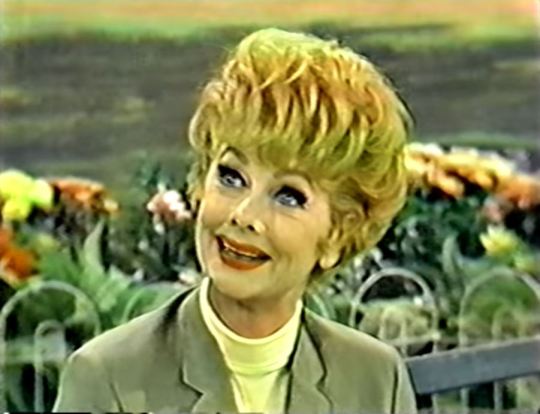
Lucille Ball (Woman in the Park) was born on August 6, 1911 in Jamestown, New York. She began her screen career in 1933 and was known in Hollywood as ‘Queen of the B’s’ due to her many appearances in ‘B’ movies. With Richard Denning, she starred in a radio program titled “My Favorite Husband” whicheventually led to the creation of “I Love Lucy,” a television situation comedy in which she co-starred with her real-life husband, Latin bandleader Desi Arnaz. The program was phenomenally successful, allowing the couple to purchase what was once RKO Studios, re-naming it Desilu. When the show ended in 1960 (in an hour-long format known as “The Lucy-Desi Comedy Hour”) so did Lucy and Desi’s marriage. In 1962, hoping to keep Desilu financially solvent, Lucy returned to the sitcom format with “The Lucy Show,” which lasted
six seasons. She followed that with a similar sitcom “Here’s Lucy” co-starring with her real-life children, Lucie and Desi Jr., as well as Gale Gordon, who had joined the cast of “The Lucy Show” during season two. Before her death in 1989, Lucy made one more attempt at a sitcom with “Life With Lucy,” also with Gordon, which was not a success and was canceled after just 13 episodes.Ball has no spoken dialogue in her sketch.
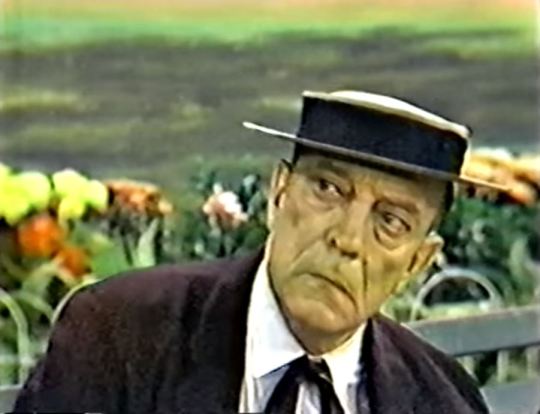
Buster Keaton (Painter in the Park) was born in 1895 to parents who were vaudevillians. His legendary film career began in 1917. He became a star known for his slapstick comedy, pork pie hat, slapshoes, and deadpan expression. In 1960 he was given an honorary Oscar. Lucille Ball worked with Keaton on the 1946 film Easy To Wed. He died in February 1966, just two months after this special aired.
Keaton has no spoken dialogue in his sketch.
Harvey Korman (Policeman in the Park) is best known as part of “The Carol Burnett Show” (1967-77). He made five appearance on “The Lucy Show” as various characters. In 1977 he had his own show on ABC which lasted just one season. At the time of this episode he was a regular on “The Danny Kaye Show” (1963-67) which aired Friday nights on CBS. He died in May 2008.
Korman has no spoken dialogue in his sketch.
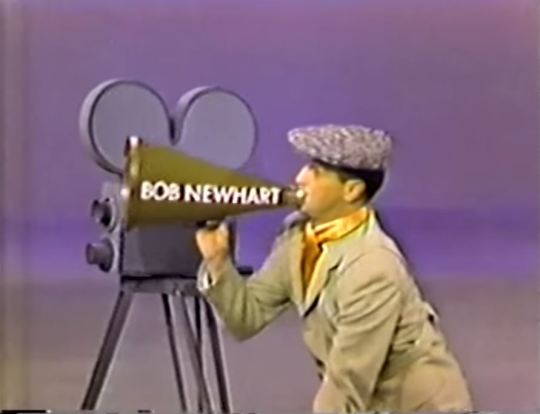
Bob Newhart (Himself / Uncle Freddy) is a stand-up comic with a deadpan delivery who headed two eponymous television sitcoms: “The Bob Newhart Show” (1972-78) and “Newhart” (1982-90).
Audrey Meadows (Pearl) is best remembered as Alice Kramden on “The Honeymooners” (1955-56), a role that won her an Emmy in 1955, against Vivian Vance as Ethel Mertz on “I Love Lucy.” She also played Lucy’s sister on an episode of “Life With Lucy” (1986). Meadows died in 1996 at age 73.
Meadows has no spoken dialogue in her sketch “The Perils of Pearl.”
Cesar Romero (Rod, Leading Man) was born in 1907 in New York City to Cuban parents. Despite earning more than 200 screen credits, Romero is perhaps best remembered for playing the Joker on TV’s “Batman” (1966-68) and in a Batman film in 1966. He played Ricky Ricardo’s buddy Carlos when “Lucy Takes a Cruise to Havana” (LDCH 1957), the very first hour-long episode of “I Love Lucy” set in Cuba in 1940, as well as Lucy Carmichael’s date in “A Date for Lucy” (TLS S1;E19). He died on New Year’s Day 1994 at age 86.
Tina Louise (Wilma, Leading Lady) is best known as ‘the movie star’ Ginger Grant on “Gilligan’s Island” (1964-67). This is only appearance with Lucille Ball.
Louise has no spoken dialogue in her sketch.
Leonid Kinskey (Silent Movie Director) was born in Russia in 1903. He played a variety of Russian and middle-European characters. One of the few to share film credits with Stan Laurel, they were both seen in Hollywood Party in 1936. He died in 1998 at age 95.
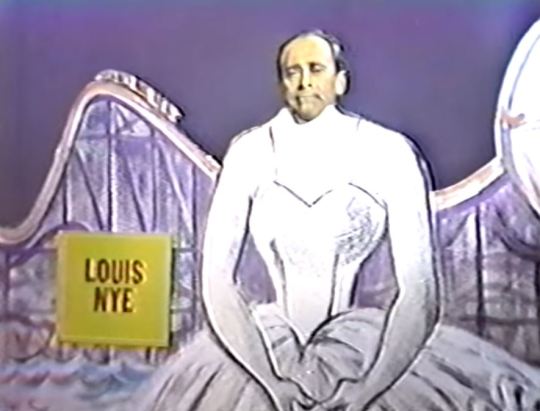
Louis Nye (Mood Music Musician) was a character actor skilled in accents and voices. He appeared with Lucille Ball in the films The Facts of Life (1960) and A Guide for the Married Man (1967). He died in 2005 at age 92.
Fred Gwynne (Herman Munster) was the star of two iconic television series: “Car 54 Where Are You” (1961-63) and “The Munsters” (1964-66), the role he reprises here. This is his only time working on the same show as Lucille Ball (although the two TV icons share no scenes together). He died in 1993 at age 66.
Gwynne has no dialogue in the sketch.
Danny Kaye (Himself) was born David Kaminsky in 1911 and left school at the age of 13 to work in the Borscht Belt of Jewish resorts in the Catskill Mountains. It was there he learned the basics of show biz. In 1939, he made his Broadway debut in Straw Hat Revue, but it was the stage production of the musical Lady
in the Dark in 1940 that brought him acclaim and notice from agents. Also in 1940, he married Sylvia Fine, who went on to manage his career. She helped create the routines and gags, and wrote most of the songs that he performed. Danny could sing and dance like many others, but his specialty was reciting tongue-twisting songs and monologues. In 1964 he appeared on “The
Lucy Show” as himself and Lucy appeared on his special in return. He died in 1987.
Phil Silvers (Himself) was born Philip Silversmith in 1911 (the same year as Lucille Ball). He started entertaining at age 11. He made his Broadway debut in 1939. In 1952 he won a Tony Award in the Broadway musical Top Banana in which he played a TV star modeled on Milton Berle. His feature film debut came in 1940. Silvers became a household name in 1955 when he starred as Sergeant Ernest G. Bilko. In 1963, Ball and Silvers performed the classic ‘Slowly I Turn’ sketch for “CBS Opening Night.” In December 1966 Silver guest-starred in “Lucy and the Efficiency Expert” (TLS S5;E13). A year later Ball and Silvers both had bit parts in the film A Guide for the Married Man (1967). He died at the age of 74.
Bern Hoffman (Pop / Street Bully / Cop) was a burly character actor seen with Lucille Ball on the first season of “The Lucy Show” and in the film The Facts of Life (1960). He was seen on Broadway in the original casts of the musicals Guys and Dolls (1950) as Joey Biltmore and Li’L Abner (1956) as Earthquake McGoon, a role he recreated in the 1959 film version.
None of Hoffman’s characters speak.
Mary Foran (Mom / Tango Dancer) was a heavyset character actor usually cast for her size. She appeared as one of the women at the health club in “Lucy and the Countess Lose Weight” (TLS S3;E21) earlier in 1965.
Foran does not have any dialogue.
Gregory Peck (Himself) was one of the most popular film stars from the 1940s to the 1960s. Peck received five Academy Award nominations winning for his performance as Atticus Finch in the 1962 drama film To Kill a Mockingbird. Although Peck and Lucille Ball never appeared together professionally, his name was mentioned several times on “Lucy” sitcoms. He also never worked with Stan Laurel. Peck died in 2003 at age 87.
Archival Footage
Stan Laurel (Archive Footage) was born as Arthur Stanley Jefferson in England in 1890. Laurel began his career in music hall, where he developed a number of his standard comic devices: the bowler hat, the deep comic gravity, and the nonsensical understatement. He began his film career in 1917 and made his final appearance in 1951. From 1928 onward, he appeared exclusively with Oliver Hardy (1892-57). Known simply as Laurel and Hardy, the pair became one of the most recognizable comic duos in history. Stan Laurel passed away in February 1965, eight months prior to this tribute show. He was 74 years old.

Oliver Hardy (archive footage) was born Norvell Hardy in Georgia USA in 1892. He appeared with his comedy partner Stan Laurel in 107 short films, feature films, and cameo roles. He was credited with his first film, Outwitting Dad, in 1914. In some of his early works, he was billed as “Babe Hardy”. He died in 1957 at age 65.
Dorothy Coburn (Nurse in “The Finishing Touch” Archive Footage) was ideally cast as a perennial foil for Stan Laurel and Oliver Hardy in films like The Second 100 Years (1927) where Stan inadvertently covers her bottom with white paint; Putting Pants on Philip (1927) in which she is being chased by an over-amorous, kilt-wearing Stan Laurel around town; and as a dentist’s nurse in Leave ‘Em Laughing (1928). She died in 1978 at age 72.
Edgar Kennedy (Cop in “The Finishing Touch” Archive Footage) was seen with Laurel and Hardy in more than a dozen films. He was also seen in three RKO films with Lucille Ball in the early 1930s. He died in 1948 and his final film was released posthumously.
Betty Grable (Pat Lambert in Footlight Serenade Archive Footage) was a starlet who did three films with Lucille Ball from 1933 to 1936. In 1958 she appeared with her husband bandleader Harry James as themselves on an episode of “The Lucy-Desi Comedy Hour.” Footlight Serenade (1942) was also supposed to feature Lucille Ball, but she refused to be loaned out to Fox to play a secondary role.
Stan Salute Trivia
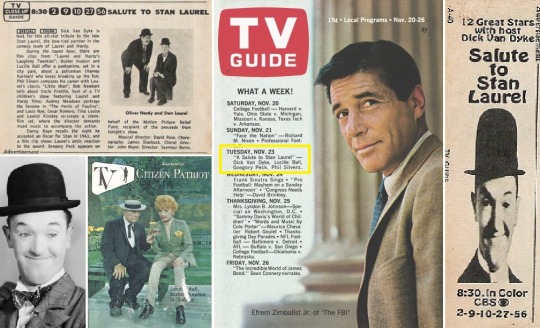
The tribute was not well-received by critics, who opined that the program felt less like a celebration of Laurel’s career than a promo for the new fall shows; the same critics were, however, in general agreement that Van Dyke’s devotion was palpable and heartfelt. Consequently Laurel and Hardy biographers tend to regard it as well-intentioned, but ultimately inconsequential. Wrapping up the
season in April 1966, TV Chronicle’s Neil Compton would dismiss the special’“Not much of a tribute to the late comedian (who appeared briefly in a number of film clips brutally hacked out of their original context), and did not enhance the reputations of participants such as Dick Van Dyke, Lucille Ball, or Phil Silvers.”

DickVan Dyke (who was also one of the producers) reportedly complained that his vision for the Salute had itself been hacked to pieces by network corporate types. Van Dyke had delivered the eulogy and Stan Laurel’s funeral. An appearance by Fred Gwynne in full Herman Munster regalia clearly had more to do with CBS (home of “The Munsters”) than with Laurel. A lengthy biography of Phil Silvers in the show’s second half also has little to do with Laurel. On the whole, the special is a tribute to both Laurel AND Hardy, who passed away eight years earlier.

The Salute aired opposite new episodes of “McHale’s Navy” and
“F-Troop” on ABC and “Dr. Kildare” on NBC. It was preceded
on CBS by “Rawhide” (starring Clint Eastwood) and followed by
“Petticoat Junction.”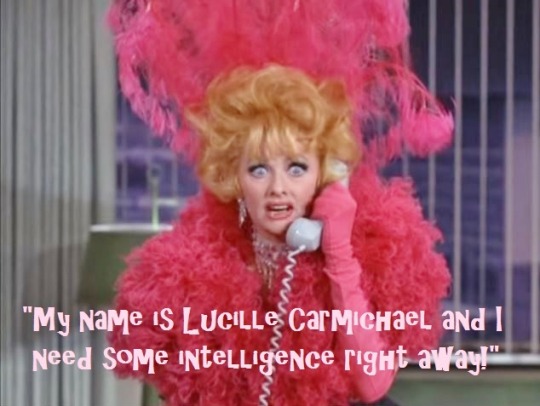
The day before (Monday, November 22), “Lucy and the Undercover Agent” (TLS S4;E10) was aired for the first time. In the episode, Mrs. Carmichael goes undercover as Carol Channing to break into a government installation!
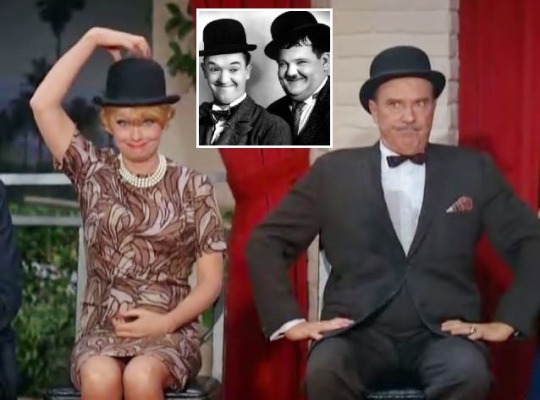
One year after this special aired, Lucy Carmichael and Mr. Mooney were put under hypnosis by Miss Pat, “the hip hypnotist” (a nightclub entertainer). Their hypnotic suggestion was to imitate Laurel and Hardy. Lucy, naturally, was Stan Laurel.
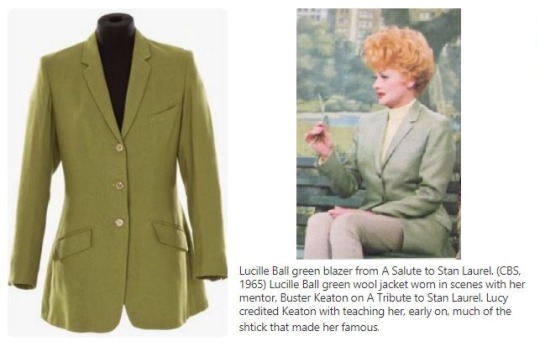
The underscoring of the Salute makes liberal use of “Dance of the
Cuckoos” which was Laurel and Hardy’s theme music. It was written by Marvin Hartley as the ‘hour chime’ for a radio station. It was first heard during a Laurel and Hardy film in 1930.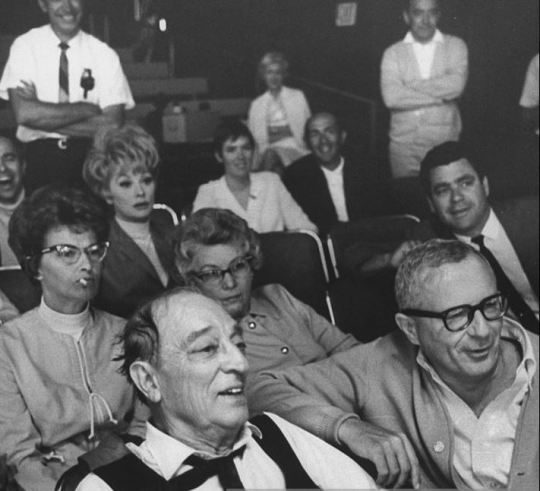
This was the last comedy performance of Buster Keaton, who had been diagnosed as terminally ill and would die a few months later. Lucy and Keaton were there own mutual admiration society, Lucy considering him her mentor and Keaton championing Ball’s talents, even before her TV fame. In the above photo, Keaton and Ball watch the dailies from their sketch on the Salute.
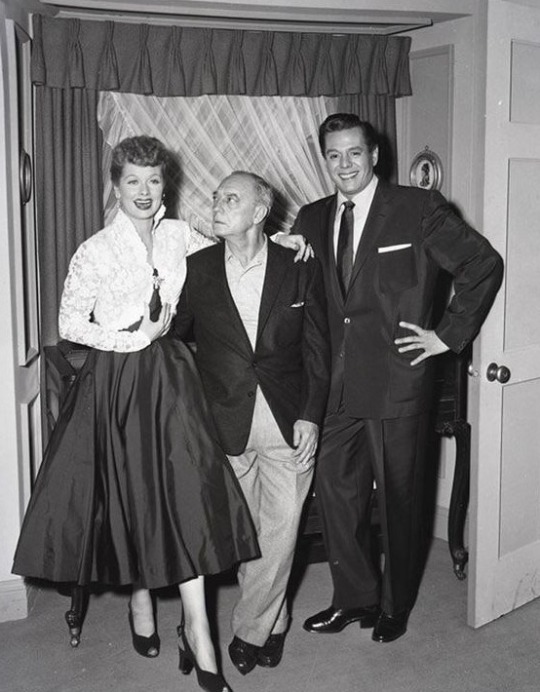
Although Buster Keaton never guest-starred on a “Lucy” sitcom, he did visit the set of “I Love Lucy” to see his now successful protege.

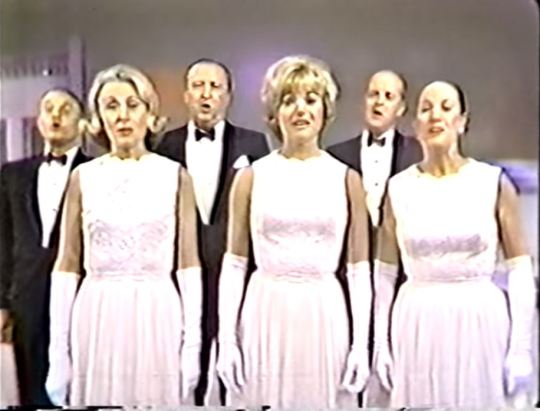
The Salute begins with a production number called “Stanley” featuring singer / dancers dressed as Laurel and Hardy inter-cut with film footage of the pair and the opening credits.
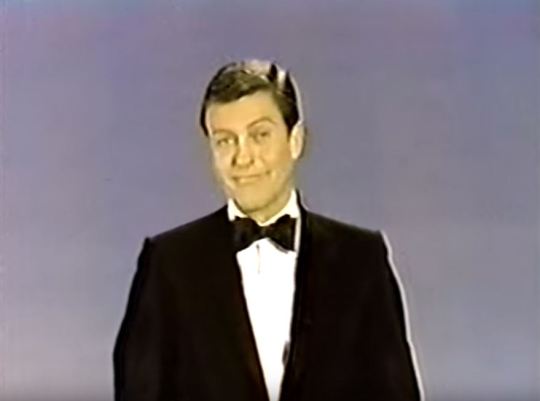
After the first commercial Dick Van Dyke introduces the show. He says that he never got to meet Oliver Hardy, but did know Stan Laurel. Film excerpts from “Wrong Again” (1929), which was re-released by MGM as “Laurel and Hardy’s Laughing 20s”, a compilation of Laurel and Hardy shorts.

Lucille Ball and Buster Keaton perform a silent sketch set on a park bench. Harvey Korman plays a cop. The sketch is without words, but includes background music, exaggerated sound effects, and the ubiquitous laugh track.

After a brief clip from the Laurel and Hardy short “Putting Pants on Philip” (1927), Dick Van Dykegives a lecture on comedy rooted in observing physical pain in others. He notes how comedy has changed, all the while having a series of funny accidents. This “comedy lecture” was specially written by Carl Reiner and Aaron Ruben.
Blooper Alert! When Van Dyke gets a waste paper basket stuck on his foot, he kicks it offstage. It apparently collides with someone off-camera, which makes Van Dyke laugh and apologize. Just before this happened, the boom microphone dips down into the frame.
The ‘lecture’ ends with Van Dyke tripping over a footstool on his way out, something he did in the opening credits of his show.
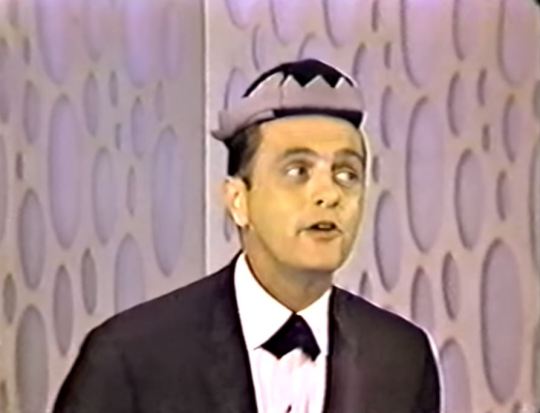
Bob Newhart talks about his research on Laurel and Hardy. He does his impression of a stereotypical kiddie show host named Uncle Freddy. Such TV kiddie shows were often the outlet for showing Laurel and Hardy shorts.

After a clip from “Call of the Cuckoo” (1927), an audience at an old
time cinema sings about seeing ‘The Perils of Pearl’, the type of
serial melodrama that typically played alongside a comedy feature by Laurel and Hardy.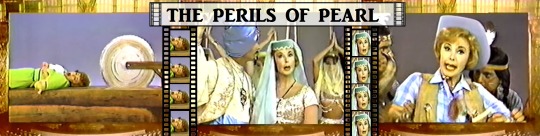
Audrey Meadows plays Pearl, in a variety of her ‘perils’: As a women about to be bisected by a mill saw, a harem dancer pursued by an over-amorous Calif, a cowgirl burned at the stake by Indians, and a woman sitting atop a giant time bomb.
Movie-Goers: “Will they blow up little Pearl? Is her life at stake? To be continued [the look into the camera]… after station break!”
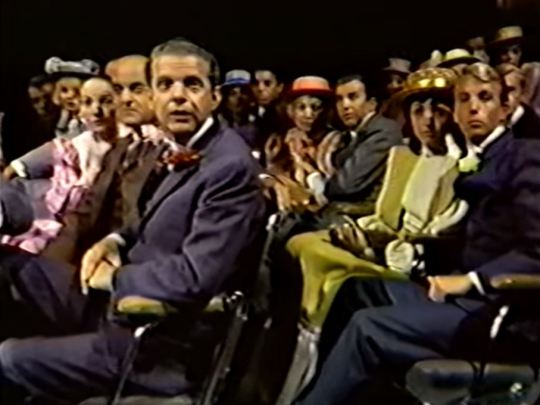
After the commercial break, the movie-goers are still looking at the
camera. They look back at the movie screen where Pearl is still atop the bomb.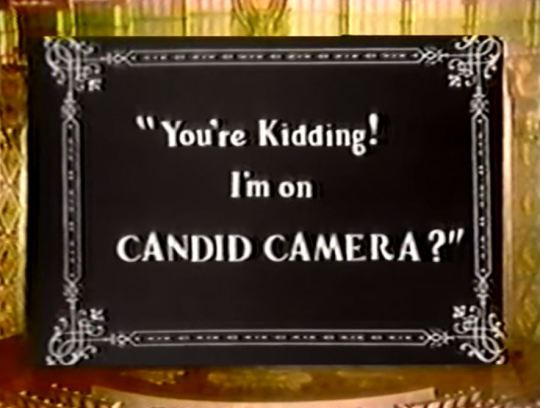
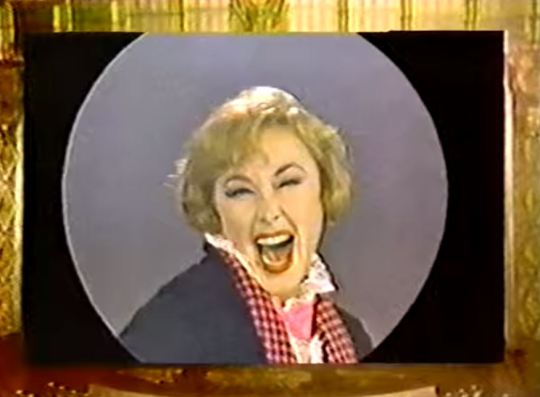
Pearl laughs and her hat falls off. The matinee audience is suddenly onstage in a full out dance number!
Dick Van Dyke introduces a comedy sketch about the filming of a
silent movie.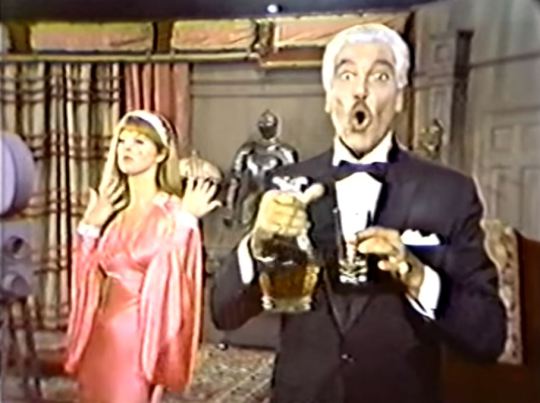
It stars Cesar Romero as The Leading Man, Tina Louise
as The Leading Lady, Leonid Kinsky as The Director, and Louis Nye as The Mood Music Musician (aka violinist).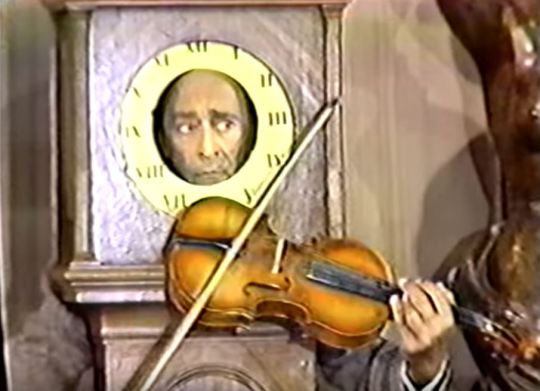
The comedy comes from Nye trying to stay out of the pantomimed action while providing the mood music to help the actors emote. After destroying several violins, Nye himself falls out the window.
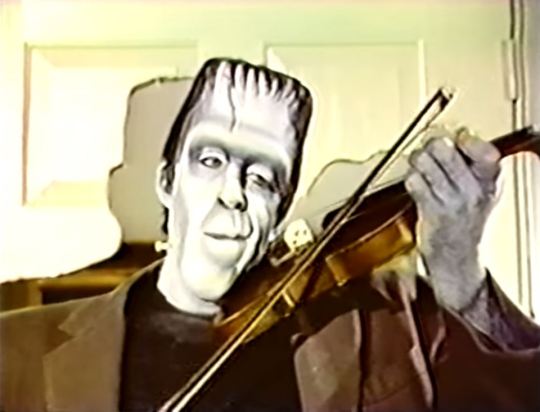
Crashing through the door comes his replacement, Herman Munster (Fred Gwynne) playing the fiddle! This is the first time a 1865 TV audience has seen Gwynne in color, although his green complexion would be on display in a 1966 Munsters movie.
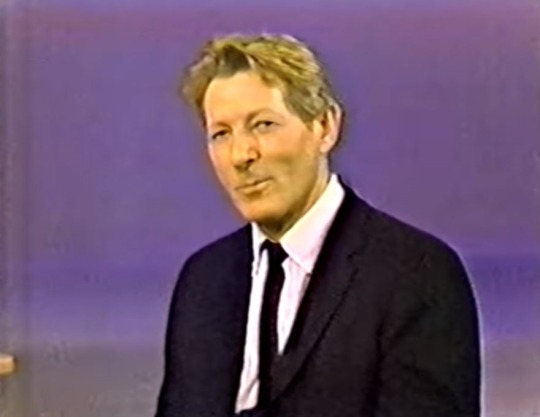
Danny Kaye is sitting beside Stan Laurel’s honorary Oscar, which Kaye accepted for Laurel in 1961. A clip of “The Finishing Touch”
(1928) shows Laurel installing a window.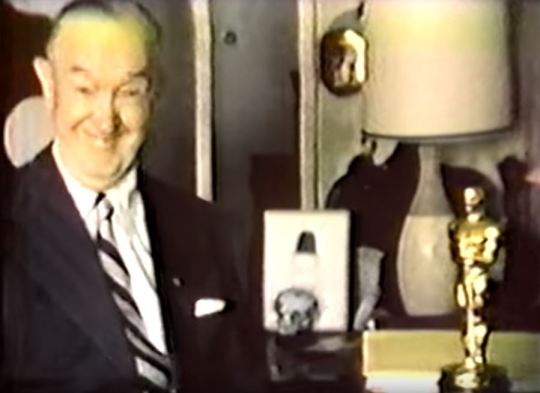
Color (but silent) footage shows Laurel polishing his Oscar from his home in 1961.

Sitting among a stack of film reels, Dick Van Dyke introduces another clip from “The Finishing Touch” (1928) in which Laurel and Hardy are renovating a house.
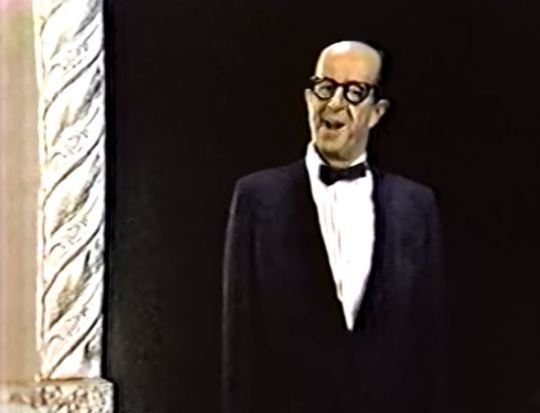
Phil Silvers compares Laurel’s youth as “a little man” to his own life story. A sketch shows a bespectacled Silvers in a baby bonnet and crib with his mother and father beside him. His teen years (in a page boy wig) feature his cracking voice singing “Shine On Harvest Moon.”
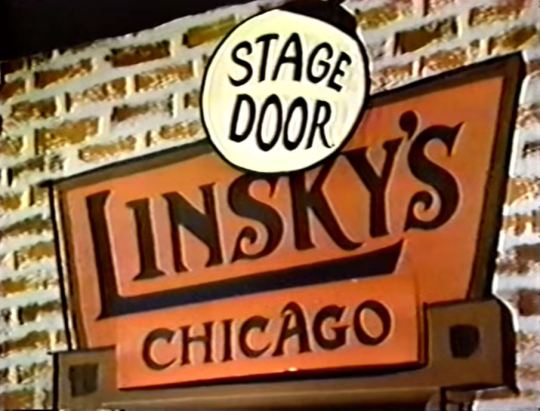
The mini-biography tracks Silvers’ career from street performer to vaudeville.
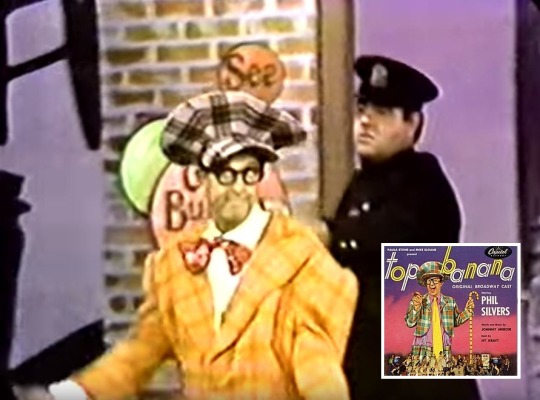
In Burlesque, he plays Linksy’s theatre (a pun on the real-life Minsky’s Burlesque) wearing the same huge plaid cap that he wore onstage and screen in the musical Top Banana ten years earlier.

Actual footage from his big break in movies shows Silvers and Betty Grable in Footlight Serenade (1942). Silvers finally brings his story back to Stan Laurel, but not without a few quick clips of him in “Sergeant Bilko”!
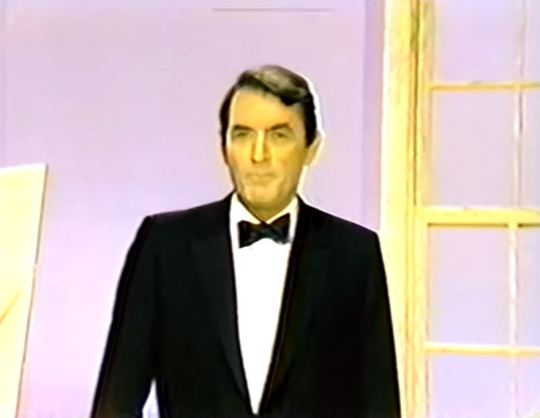
Gregory Peck closes the program by thanking everyone and giving a last pitch for the new MGM film compilation of Laurel and Hardy’s shorts.
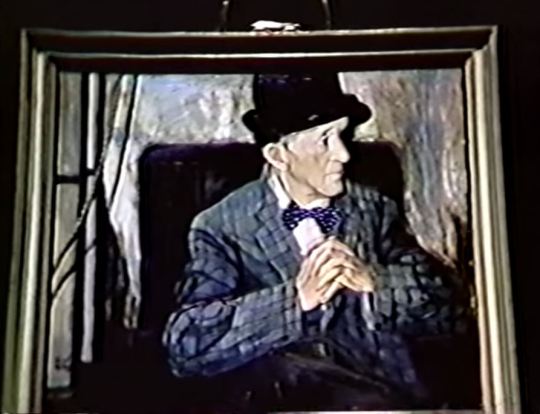
The singers and dancers who opened the show return for a final chorus of “Stanley.” The number ends on a shot of a painting of Stan Laurel. This same painting inspired the creation of the show.
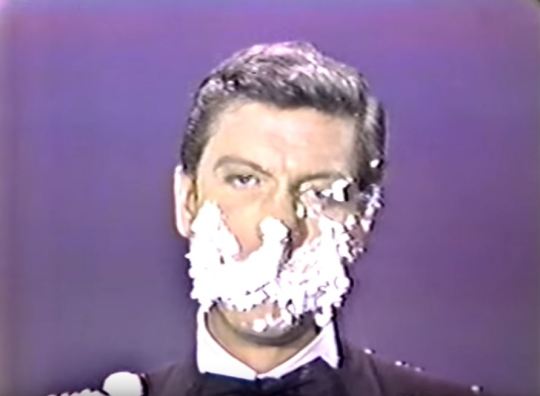
Dick Van Dyke returns for yet another pitch for the MGM film compilation “Laurel and Hardy’s Laughing 20s”. Van Dyke gets a face full of cake at the very end, inter-cut with Oliver Hardy slipping on a banana peel while carrying a huge cake excerpted from 1928’s “From Soup To Nuts.”
This Date in Lucy History – November 23

“Redecorating the Mertzes’ Apartment” (ILL S3;E8) – November 23, 1953

“Lucy’s Contact Lenses” (TLS S3;E10) – November 23, 1964

“Lucy and Jack Benny’s Biography” (HL S3;E11) – November 23, 1970
A Salute To Stan Laurel, Audrey Meadows, Bern Hoffman, Betty Grable, Bob Newhart, Buster Keaton, Carl Reiner, CBS, Cesar Romero, comedy, Danny Kaye, Dick Van Dyke, Dorothy Coburn, Edgar Kennedy, Gregory Peck, Hal Roach, Harvey Korman, Laurel and Hardy, Leonid Kinskey, Louis Nye, Lucille Ball, Mary Foran, Oliver Hardy, Phil Silvers, Seymour Berns, silent movies, slapstick, Stan Laurel, Tina Louise, tv -
LUCY & THE GARDEN STATE
Lucille Ball’s various encounters with New Jersey!
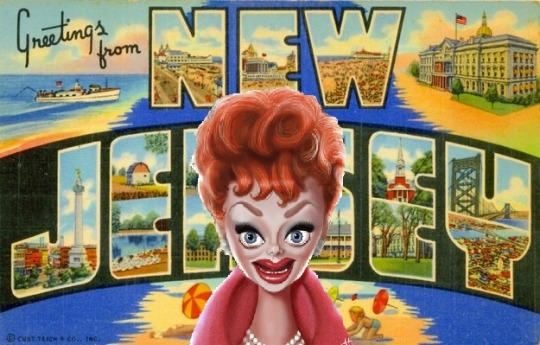
Save the “Lucille Ball” Pond!
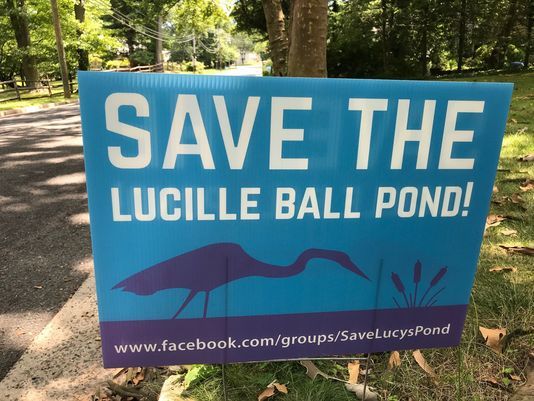
The
famed “Lucille Ball house and pond”, located on the corner of
Clive Street and Mason Drive in Edison, New Jersey, has been recently
purchased by developers. Word has spread that the plans call to
demolish the existing home and fill in the existing pond. There has been an outpouring of support from the community to
help save the pond for ecological and aesthetic reasons.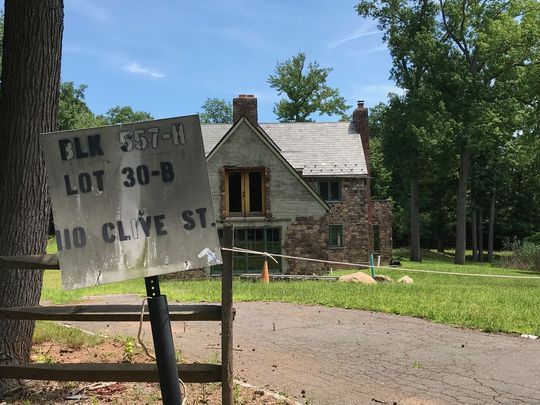
Despite the nickname, neither Lucille Ball or anyone in her
family ever owned the home, but the Metuchen-Edison Historical
Society indicates the famed actress did visit the area at least once
in late 1960 or early 1961, after divorcing Desi Arnaz and before
marrying Gary Morton, at a time when she was about to appear in Wildcat on Broadway.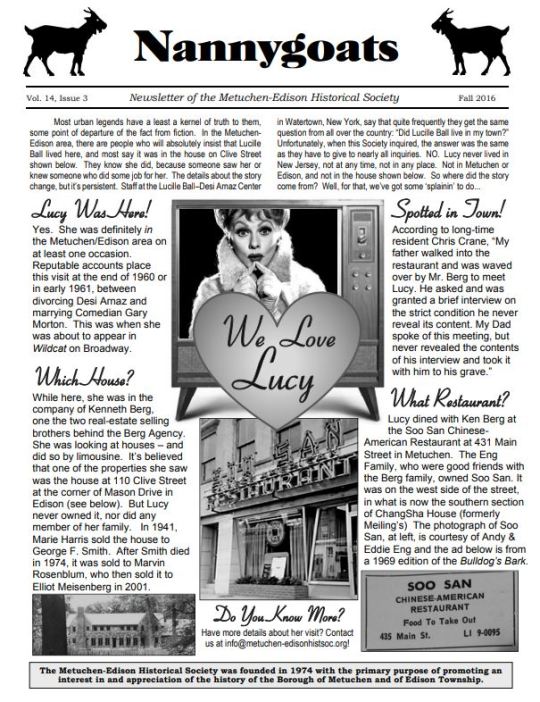
According
to the source, Ball met with Kenneth Berg, one of two brother
realtors from the Berg Agency, which may have led to speculation that
she was looking at homes — one of the homes she may have looked at
was the house at 110 Clive Street. Berg and Ball dined at a Main
Street, Metuchen Chinese restaurant. Ball and Berg were ‘dating’ and spending a weekend at his home and decided to get some
Chinese food for dinner. He said Ball took a ride with him to the
restaurant and sat at a table to wait for their order. While waiting,
Berg’s friend, the owner of the local newspaper, came in and
conducted an "off the record” interview with Ball.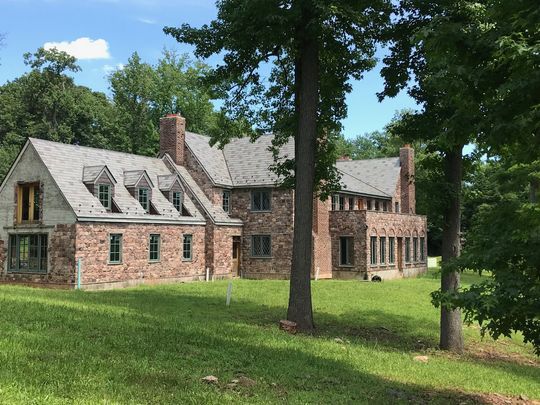
Of
the many homes in the area, the Clive Street one was thought to look
the most like a movie star’s home, and the legend stuck!

Lucy
second husband, Gary Morton’s family, lived nearby in the Colonia
section of Woodbridge, New Jersey in the 1960s. People often thought that Lucille Ball
lived there, too, and the Mortons got calls and visits looking for Lucy.
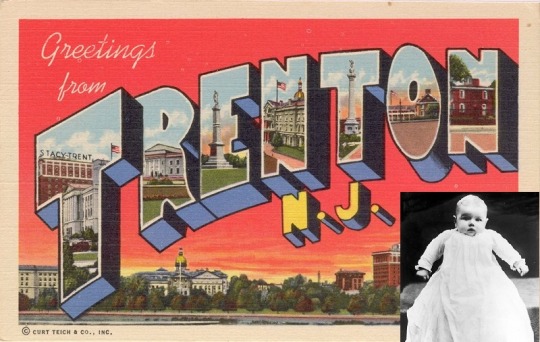
Coincidentally,
as an infant, Lucille Ball’s father was a lineman, and briefly lived
with newborn Lucy in Trenton, New Jersey, the state capital, although
no official address was ever established for her short stay in the Garden
State.

Professionally,
Lucille Ball appeared in 1937 at Princeton, New Jersey’s McCarter
Theatre in a play called Hey Diddle Diddle. The play was
Broadway-bound, but was sidetracked when the leading man became ill. She returned a decade later in Dream Girl by Elmer Rice.

In
1983, Lucy went to the Paper Mill Playhouse in Millburn, New Jersey to
see her daughter Lucie (and her husband, Lawrence
Luckinbill) in “The Guardsman.” Due to her great fame, Ball was
ushered in the side door just as the lights went down.
NEW JERSEY ON “LUCY”
On
“I Love Lucy” there were quite a few references to New Jersey by the
Ricardos, who lived on the East Side of Manhattan, until they
relocated to Westport, Connecticut in 1956.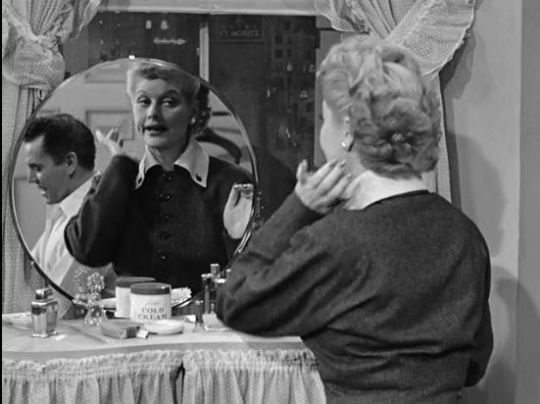
Thinking out loud in “The Adagio” (ILL S1;E12), Ricky presciently ponders moving to the country. He first suggests Long Island or Westchester, but then also considers New Jersey.

In 1951’s “Drafted”
(ILL S1;E11) Ricky is asked to entertain at Fort Dix in Burlington
County, New Jersey. Naturally, Lucy and Ethel think they’ve been drafted!
After
finding out that their marriage license has been revoked in a 1952
episode titled “The Marriage License” (ILL S1;E26), Lucy goes on
a twelve hour walk to East Orange, New Jersey, to think things out.“How
I ever got through the Holland Tunnel, I don’t know.”
East
Orange and the Holland Tunnel will be mentioned again three years
later in “Lucy
Learns to Drive” (ILL S4;E11).
Reportedly, she tried to make a u-turn in the Holland Tunnel
resulting in traffic being tied up to East Orange, New Jersey.
When
Lucy and Ethel pretend to be women from Mars at the top of the Empire
State Building, newspaper reports warn“Hordes
of invaders also seen in New Jersey and Connecticut.”Any
similarity to Orson Welles’ 1939 “War of the Worlds” radio invasion of
Grover’s Mill, New Jersey (an unincorporated community within West Windsor in Mercer County) is definitely intentional! Welles was a friend (and frequent houseguest) of the Arnaz’s and would appear as himself in season six of the series.
One
of Ricky’s Tropicana shows was set in Atlantic City, New Jersey, during the Gay
‘90s. The episode ends with the lyrics:“On the Boardwalk in Atlantic City I found what I waited for. In
romantic, enchanting Atlantic City, down by the old New Jersey
shore!”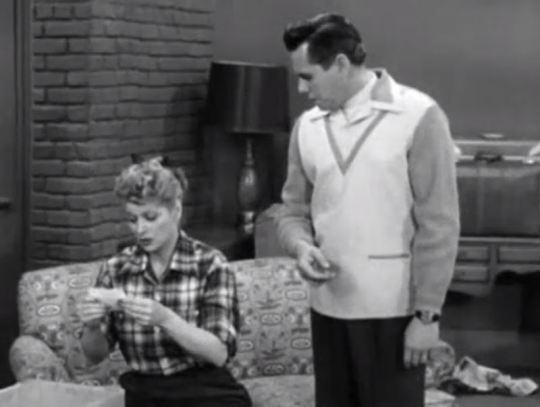
When
an argument erupts between the Ricardos and the Mertzes, Lucy and
Ricky pack their things to move, but they run across a sentimental
photograph.
“It’s a picture of us and Fred and Ethel taken in Atlantic City
last summer. We
sure had a lot of fun there, didn’t we?”Since
the series was traditionally on hiatus during the summer months, no
such trip was ever seen on the show.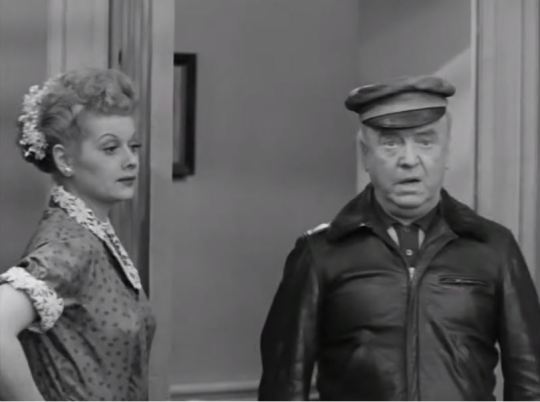
Another
mention of Atlantic City was cut for time from the ending of “Cuban
Pals” (ILL S1;E28). To ditch Ricky’s sexy dancer Renita, Fred pretends to be a
taxi driver that will bring her to the Tropicana “by way of
Philadelphia.” The original script, however, ended with Ethel
reading a telegram
from Fred that he took Renita to Atlantic City, and they’re
living it up!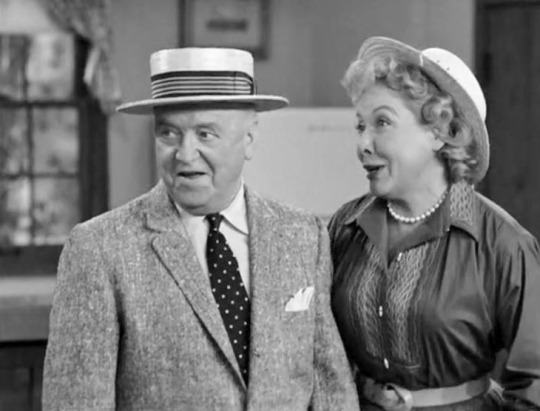
In “Lucy’s Summer Vacation”, a 1959 episode of “The Lucy-Desi Comedy Hour”, the Ricardos summer in Vermont, while the Mertzes head to Atlantic City.

“Come on, Ethel. You take the East side and I’ll take the West side, and I’ll be in Jersey afore ya!“
~ The last line of “Million Dollar Idea” (ILL S3;E13)
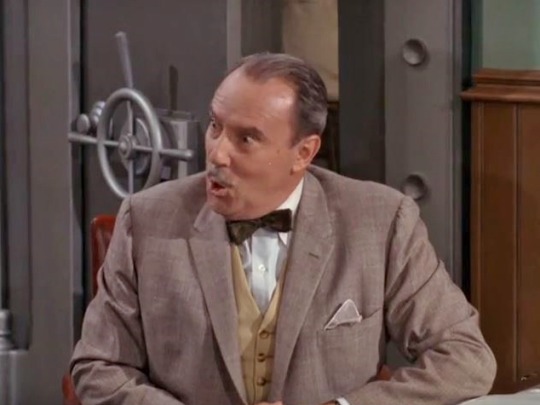
On an episode of “The Lucy Show” (whose first seasons took place in fictional Danfield, New York), Mr. Mooney reports that his daughter Rosemary has had a baby and he has to go see her – in Trenton, New Jersey. Exactly where Lucy lived as an infant!
Atlantic City, CBS, Colonia, Desi Arnaz, Dream Girl, East Orange, Edison, Gale Gordon, Gary Morton, I love lucy, Laurence Luckinbill, Lucie Arnaz, Lucille Ball, McCarter Theatre, Metuchen, New Jersey, Paper Mill Playhouse, The Guardsman, The Lucille Ball House, The Lucille Ball Pond, The Lucy Show, Trenton, tv, Vivian Vance, William Frawley -
LUCY ON THE DAIS – Part Two
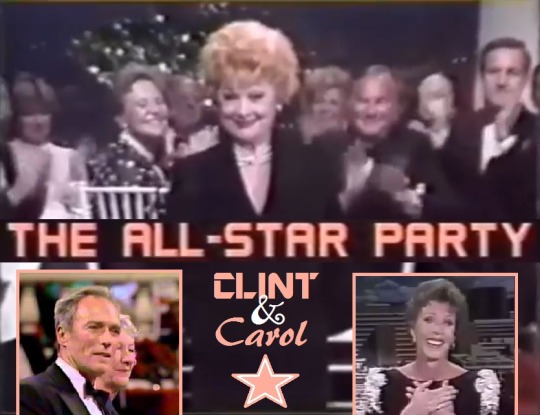
“All-Star
Party for Carol Burnett”December
12, 1982 on CBSDirected
by Dick McDonoghProduced
and Written by Paul KeyesMusic
by Nelson Riddle
THE PARTY-GOERS

Carol
Burnett
(Honoree) got
her first big break on “The Paul Winchell Show” in 1955. A years
later she was a regular on “The Garry Moore Show.” In 1959 she
made her Broadway debut in Once
Upon a Mattress,
which she also appeared in on television three times. From 1960 to
1965 she did a number of TV specials, and often appeared with Julie
Andrews. Her second Broadway musical was Fade
Out – Fade In which
ran for more than 270 performances. From 1967 to 1978 she hosted her
own highly successful variety show, “The Carol Burnett Show.”
Lucille Ball made several appearances on “The Carol Burnett Show.”
Burnett guest starred in four episodes of “The Lucy Show” and
three episodes of “Here’s Lucy,” subsequently playing a
character named Carol Krausmeyer. After Lucille Ball’s passing,
Burnett was hailed as the natural heir to Lucy’s title of ‘The
Queen of TV Comedy.’
Lucille
Ball
was
born on August 6, 1911 in Jamestown, New York. She began her screen
career in 1933 and was known in Hollywood as ‘Queen of the B’s’
due to her many appearances in ‘B’ movies. With Richard Denning,
she starred in a radio program titled “My Favorite Husband” which
eventually led to the creation of “I Love Lucy,” a television
situation comedy in which she co-starred with her real-life husband,
Latin bandleader Desi Arnaz. The program was phenomenally successful,
allowing the couple to purchase what was once RKO Studios, re-naming
it Desilu. When the show ended in 1960 (in an hour-long format known
as “The Lucy-Desi Comedy Hour”) so did Lucy and Desi’s
marriage. In 1962, hoping to keep Desilu financially solvent, Lucy
returned to the sitcom format with “The Lucy Show,” which lasted
six seasons. She followed that with a similar sitcom “Here’s
Lucy” co-starring with her real-life children, Lucie and Desi Jr.,
as well as Gale Gordon, who had joined the cast of “The Lucy Show”
during season two. Before her death in 1989, Lucy made one more
attempt at a sitcom with “Life With Lucy,” also with Gordon,
which was not a success and was canceled after just 13 episodes.Monty
Hall
– Chairman of Variety Clubs InternationalCarol
Burnett’s Family
(center table)- Joe
Hamilton – Carol’s Husband - Erin
Hamilton – Carol and Joe’s daughter (age 14) - Jody
Hamilton – Carol and Joe’s daughter (age 15) - Carrie
Hamilton – Carol and Joe’s daughter (age 19)
Credited
Entertainers & Speakers
(with
credits shared with Carol Burnett)- Tim
Conway
– “The Carol Burnett Show” (1967-78) - *Sammy
Davis Jr.
– “The Carol Burnett Show” (1975 & 1976), “Sammy & Co.”
(1976) - Bette
Davis - Glenda
Jackson
– HealtH
(1980) - *Steve
Lawrence – “The
Garry Moore Show” (1959-63), “The
Carol Burnett Show” (1967-78) - Vicki
Lawrence –
“The Carol Burnett Show” (1967-78) - *Jim
Nabors –
“The
Carol Burnett Show” (1967-76), “Gomer Pyle: USMC” (1967 &
1969), “The Jim Nabors Hour” (1969 & 1970), “The Jim Nabors
Show” (1978) - Jack
Paar
– “The Jack Paar Tonight Show” (1957-58) - Burt
Reynolds
– “The Carol Burnett Show” (1972), “Evening Shade” (1993) - Nelson
Riddle
and his orchestra - Tom
Selleck –
“Magnum P.I.” (1984 & 1988) - Beverly
Sills
– “Sills & Burnett at the Met” (1976) - James
Stewart
– “The Joey Bishop Show” (1969), “A Special Evening with Carol
Burnett” (1978)
Uncredited Attendees (with credits shared with Carol Burnett)
- Steve
Allen - Loni
Anderson - Fred
Astaire - Ned
Beatty - Sammy
Cahn - *Ellen
Corby - Altovise
Davis – Wife of Sammy Davis Jr. - Dom
DeLuis - Angie
Dickinson - Mike
Douglas - Morgan
Fairchild - Zsa
Zsa Gabor - Harold
Gould - Florence
Henderson - Ted
Lange - Michele
Lee - *Dick
Martin - *Jayne
Meadows - Rita
Moreno - Lynn
Redgrave - Jean
Stapleton - Loretta
Switt - *Danny
Thomas - Daniel
J. Travanti - Abe
Vigoda - Betty
White
*
Appeared with Lucille Ball on one of her television series’

Two
years later, “All-Star
Party for Lucille Ball” also
featured Monty Hall, Sammy Davis Jr., Burt Reynolds, James Stewart,
and Vicki Lawrence.
Variety,
the Children’s Charity
is an organization founded in Pittsburgh, Pennsylvania in 1927, when
a group of eleven men involved in show business set up a social club
which they named the Variety Club. On Christmas Eve 1928, a baby was
left on the steps of the Sheridan Square Film Theatre. When efforts
to trace the mother failed, the Variety Club named the child
Catherine Variety Sheridan, after the club and the theatre on whose
steps she was found, and undertook to fund the child’s living
expenses and education. Later the club decided to raise funds for
other disadvantaged children. The discovery of the baby inspired the
film Variety
Girl (1947).
In 1986, Ball served as Hostess for the “All-Star Party for Clint
Eastwood.”
THE ALL-STAR PARTY
Previous
“All-Star Party” honoree 1981 Burt Reynolds introduces the show.After the first commercial break, Lucille Ball is introduced.
She kisses Carol and walks to the stairs to speak. While she does,
Carol bows to her as ‘the Queen of Comedy.’Lucy
says they are there to honor three women:- Carol Burnett, the singer
- Carol Burnett, the legitimate actress, and
- Carol Burnett, the comedienne
Lucy:
“Good
for you, kid. You’ve done it all, and you’ve done it well.”Carol Burnett would often remark how Lucy affectionately called her ‘kid’. Lucy
reads a letter from the White House signed by Ronald Reagan. Reagan
would be the guest of honor in 1983. He would also send notes of
congratulations and regrets in 1984 (for Lucille Ball) and 1986 (for
Clint Eastwood). The latter two notes were read by Cary Grant.Lucy
introduces Sammy Davis Jr. Sammy wanted to sing, but defers to Steve
Lawrence, who sings Cole Porter’s “You’re The Top” with special
lyrics for the occasion by Sammy Cahn.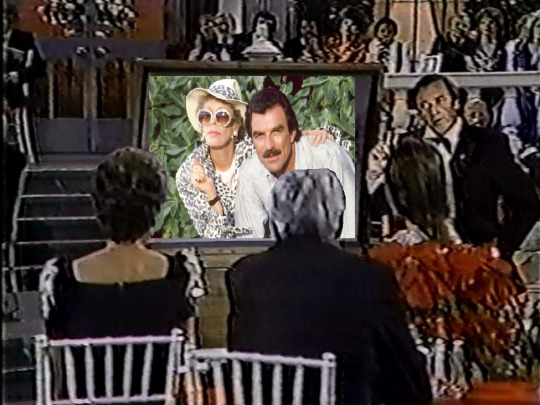
Jim
Nabors wheels on a large projection TV and Tom Selleck (in a Hawaiian
shirt, naturally) appears on it to pay tribute to Burnett. His
seductive tone causes Carol to cuddle up to the TV set.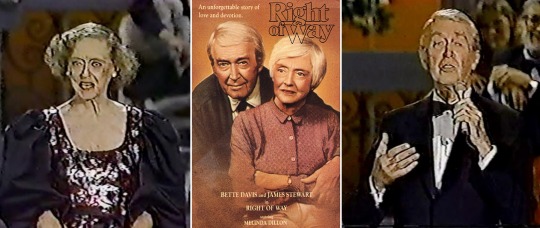
Nabors
brings on Bette Davis if, for no other reason, to introduce Jimmy
Stewart. Davis and Stewart had just done a picture together, the TV
film Right of Way, released in 1983. It was Stewart’s penultimate
screen acting role. Surprisingly, Davis says that Stewart will sing!Jimmy
Stewart, not known as a singer, croons Cole Porter’s “Easy to
Love,” the evening’s second song from the 1934 stage musical
Anything
Goes.
The song was also included in the 1936 film Born
To Dance
starring Stewart and Eleanor Powell (whose voice was dubbed).
Stewart manages to get through the first chorus (although sadly out
of key). For the second chorus he asks that the lights be dimmed so
it is just him singing to Burnett. It is a truly intimate and lovely
moment considering that the only time the two ever saw each other was
on award, talk, or tribute shows. Burnett and Stewart never appeared
together in a dramatic context.
After
a break, Tim Conway does an elaborate comedy bit with a bank of
telephones designed for viewers to call in to pay tribute to Carol.
Despite the large number of phones (and corresponding lights) – no
one calls. Conway reads Carol a telegram from Garry Moore.
Jack
Paar talks about their early days on “The Tonight Show” and
recalls Burnett singing “I Was A Fool For John Foster Dulles” by
Kenny Welsh in August 1958. Paar introduces Vicki Lawrence to
re-create the song.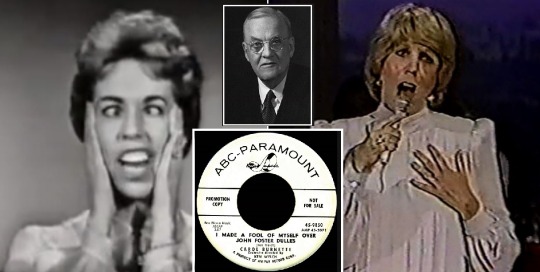
John Foster Dulles served as United States Secretary of State under President Dwight D. Eisenhower from 1953 to 1959. He was a significant figure in the early Cold War era, advocating an aggressive stance against communism throughout the world.
Glenda
Jackson steps out to unveil a photograph of the UCLA Medical Center
where a wing will be renamed the Carol Burnett Wing for Handicapped
Children.Carol
expresses her thanks to everyone. She tells how she and her
grandmother used to go to the movies to see many of the folks in the
room: Jimmy Stewart, Lucille Ball, Fred Astaire, and Bette Davis.Carol
is coaxed into singing her theme song “I’m So Glad We Had This Time
Together.” Another voice joins in from behind her – it is her
old friend opera singer Beverly Sills. The song continues, with
special lyrics for the occasion (likely written by Sammy Cahn).
This
Date in Lucy History –
December 12
“Ricky’s
European Booking” (ILL S5;E10) – December 12, 1955
“Lucy
and the Efficiency Expert”
(TLS S5;E13) – December 12, 19661982, All-Star Party for Carol Burnett, Bette Davis, Beverly Sills, Burt Reynolds, Carol Burnett, Carrie Hamilton, CBS, Fred Astaire, Glenda Jackson, Jack Paar, Jayne Meadows, Jim Nabors, Jimmy Stewart, Joe Hamilton, Lucille Ball, Monty Hall, Nelson Riddle, Ronald Reagan, Sammy Cahn, Sammy Davis Jr., Steve Allen, Steve Lawrence, Tim Conway, Tom Selleck, tv, Variety Clubs, Vicki Lawrence - Joe
-
LUCY ON THE DAIS – Part One

“The
All-Star Party for Clint Eastwood”November
30, 1986 on CBSDirected
by Dick McDonoghWritten
& Produced by Paul KeyesMusic
by Nelson Riddle
THE PARTY-GOERS

Clinton
Eastwood Jr.
(Honoree) is an actor, filmmaker, musician, and political figure.
After achieving success in the Western TV series “Rawhide,” he
rose to international fame with his role as the Man with No Name
in
Sergio Leone’s Dollars
trilogy
of
spaghetti Westerns
during
the 1960s, and as antihero
cop
Harry Callahan
in
five Dirty
Harry
films
throughout the 1970s and ‘80s. He has two Oscars for Directing and
Producing Unforgiven
(1992) and another two for Million
Dollar Baby (1994).
He received a special Oscar in 1994. At
the age of 74, he was the oldest recipient of the Academy Award for
Best Director to date. Eastwood
won
election as the nonpartisan mayor of Carmel-by-the-Sea,
California in
April 1986.
A Mitt Romney supporter, he
delivered a prime time address at the 2012
Republican National Convention
to an empty chair representing Barack
Obama.
Eastwood has had personal relationships with a number of women, with
partner Sandra Locke famously filing a palimony suit in 1989. He was
married twice and also had a relationship with co-star Frances
Fisher.
Lucille
Ball
(Hostess) was
born on August 6, 1911 in Jamestown, New York. She began her screen
career in 1933 and was known in Hollywood as ‘Queen of the B’s’
due to her many appearances in ‘B’ movies. With Richard Denning,
she starred in a radio program titled “My Favorite Husband” which
eventually led to the creation of “I Love Lucy,” a television
situation comedy in which she co-starred with her real-life husband,
Latin bandleader Desi Arnaz. The program was phenomenally successful,
allowing the couple to purchase what was once RKO Studios, re-naming
it Desilu. When the show ended in 1960 (in an hour-long format known
as “The Lucy-Desi Comedy Hour”) so did Lucy and Desi’s
marriage. In 1962, hoping to keep Desilu financially solvent, Lucy
returned to the sitcom format with “The Lucy Show,” which lasted
six seasons. She followed that with a similar sitcom “Here’s
Lucy” co-starring with her real-life children, Lucie and Desi Jr.,
as well as Gale Gordon, who had joined the cast of “The Lucy Show”
during season two. Before her death in 1989, Lucy made one more
attempt at a sitcom with “Life With Lucy,” also with Gordon,
which was not a success and was canceled after just 13 episodes.Monty
Hall
– Chairman of Variety Clubs InternationalClint
Eastwood’s Family (center table)- Sondra
Locke – partner of Clint Eastwood. The
Outlaw Josey Wales (1976),
The Gauntlet (1977),
Every
Which Way But Loose (1978),
Bronco Billy
(1980), Any
Which Way You Can (1980),
Sudden Impact (1983) - Ruth
Wood – Eastwood’s mother - John
Beldon Wood – Eastwood’s step-father - Jeanne
Bernhardt – Eastwood’s younger sister - Alison
Eastwood –
Eastwood’s daughter (age 14) by Maggie Johnson - Kyle
Eastwood
– Eastwood’s son (age 18) by Maggie Johnson
Credited
Entertainers & Speakers (with
credits shared with Clint Eastwood, introduced by Monty Hall)- *Sammy
Davis Jr. - Roberta
Flack
– Play
Misty For Me
(1971), Sudden
Impact
(1983) - Cary
Grant - Merv
Griffin
– “Talent Scouts” (1963), “The Merv Griffin Show” (1967-74) - Jill
Hollier - +*Bob
Hope - Marsha
Mason
– Heartbreak
Ridge
(1986) - *Don
Rickles –
Kelly’s
Heroes
(1970) - Nick
Perrino and
the Variety Club Orchestra - Don
Siegel –
Director of Coogan’s
Bluff (1968),
Two Mules for Sister Sarah (1970),
The Beguiled (1971),
Play
Misty for Me (1971),
Dirty
Harry (1971),
Escape from Alcatraz
(1979) - James
Stewart
Uncredited
Attendees (with credits shared with Clint Eastwood)- +Bea
Arthur - Tom
Bosley - Charles
Bronson – “Rawhide” (1965) - Joan
Collins - Tyne
Daly – The
Enforcer
(1976) - Altovise
Davis – wife of Sammy Davis Jr. - Phyllis
Diller - *Barbara
Eden – “Rawhide” (1963 & 1964) - Zsa
Zsa Gabor - *Eydie
Gorme - *June
Haver – wife of Fred MacMurray - Florence
Henderson - Hal
Holbrook - Brian
Keith – “Rawhide” (1959) - *Harvey
Korman - *Bernie
Kopell - *Steve
Lawrence - Michele
Lee - *Fred
MacMurray - *Dick
Martin - *Gary
Morton – husband of Lucille Ball - George
Peppard - Lynn
Redgrave - *Charles
‘Buddy’ Rodgers - *Cesar
Romero - Mort
Sahl - Joan
Van Ark - Dick
Van Patten - Jonathan
Winters
*
Appeared with Lucille Ball on one of her television series’+ Appeared with Lucille Ball in films
THE ALL-STAR PARTY

Monty
Hall says that this is the 11th annual Variety Club All-Star Party.
The previous year President Ronald Reagan was honored. Two years
earlier, Hall hosted the 1984 event honoring Lucille Ball. In 1982
Ball participated in the All-Star Party for Carol Burnett.
“All-Star
Party for Lucille Ball” (1984)
also featured Monty Hall, Sammy Davis Jr., James Stewart, Joan
Collins, Bea Arthur, Joan Van Ark, and Zsa Zsa Gabor.
The
show was taped on September 28, 1986 on an NBC stage at the network’s
Burbank headquarters and broadcast by CBS on November 30.
Proceeds from the evening were
used to expand the existing drug and alcohol center operated by
Community Hospital of Monterey Peninsula, near Carmel.
The
broadcast aired opposite “The Wonderful World of Disney” on ABC
and sitcoms on NBC. It earned a 21 rating, winning its time period
and the night. The highest rated of the “All-Star Parties” was
for Frank Sinatra in 1983.
Hardly
anyone in the large audience knew Clint Eastwood personally, as Sondra Locke recalled in her autobiography:“James
Stewart, whom we’d never met, gave a speech; Joan Collins, whom we’d
never met, sat very near us. Yet everyone acted like good friends.”Marsha
Mason
is the first to speak about Clint, talking about their recently
finished yet-to-be-released film Heartbreak
Ridge.She
introduces Roberta
Flack,
who performs “The
First Time Ever I Saw Your Face” by Ewan MacColl from the film Play
Misty for Me
(1971). Flack
thanks Eastwood for liking the song and introduces Bob Hope.Bob
Hope: “I
won’t say he’s a tough mayor, but he’s got a SWAT team to deal with
overtime parking. His motto is ‘Walk softly and carry a big percent
of the gross.’ Now that he’s mayor they give the death penalty for
jay-walking in Carmel.”Hope
compliments Cary Grant for looking good for his age. Eerily, the day
before the party aired, Grant died. CBS
paid tribute to Grant with the following statement after the closing
credits:
Hope
mentions Eastwood’s only musical, Paint
Your Wagon
(1969). Hope sings his signature tune “Thanks for the Memory”
with special lyrics for the occasion.
Cary
Grant
reads
a letter from President Ronald Reagan. Reagan was honored with an
All-Star Party the previous year, 1985. Grant also read a
congratulatory telegram from President Reagan in 1984, when Lucille
Ball was honored.Merv
Griffin
introduces newcomer Jill
Hollier
who sings “How
Much I Care” from
Pale Rider (1985)
with melody by Clint Eastwood and newly written lyrics for the
occasion by Sammy Cahn.Film
Director Don
Siegel
talks about being assigned to direct his first Eastwood picture.
Don
Rickles
takes the stage to ‘roast’ Eastwood and the other party attendees.Sammy
Davis Jr. says
that his relationship with Eastwood goes back to “Rawhide.” He
sings “Misty”
by Erroll
Garner and Johnny
Burke from the film Play
Misty for Me
(1971). Davis has written an introduction to the song to be spoken
by Clint Eastwood as Dave Garland, his disc jockey character from the
film.Jimmy
Stewart calls Clint “a credit to the motion picture industry”
as both actor and director.Jimmy
Stewart: “He
is an actor who took the art of acting back to basics. He is the
common denominator of the common man. You
portray a man of the world… you stick up for yourself and all the
rest of us.”
Monty
Hall
talks about the charitable endeavors of the Variety Clubs
International. Lucille Ball takes the stage.
Ball:
“Clint, you’re
such a big star because you’re such a big hunk.”Ball
notes that Clint has filled the room with many of his past production
and behind-the-scenes co-workers.
LUCY & CLINT

In
1972’s “Lucy and the Group Encounter” (HL S5;E14) Lucy Carter
says that if she were stranded on a desert island she would want
Clint
Eastwood
to be there.
A
year later, when Jackie Coogan played “Lucy’s Tenant” (HL S6;E7),
Lucy wonders why guys like Clint
Eastwood
don’t rent rooms!
In
1974, in “Milton Berle is the Life of the Party” (HL S6;E19),
Harry says he wouldn’t come to one of Lucy’s parties even if Clint
Eastwood
were a guest! Nor would he be swayed by Elizabeth
Taylor, Frank Sinatra, or Princess Anne – but he changes his tune
when it turns out to be Uncle Miltie.
In
1960, Clint
Eastwood was
one of Lucille Ball’s first choices to play her romantic lead in the
Broadway musical Wildcat.
When he (and a few other A-list marquee names) were not available,
she settled on Keith Andes (above).
After
Lucille Ball’s passing in 1989, Clint
Eastwood sent
a note of condolences to Gary Morton. The note is recreated in the
2004 book Lucy &
Desi: The Real Life Scrapbook of America’s Favorite Couple.
Genealogists
say that Lucille Ball and Clint
Eastwood
are actually related! They are ninth cousins, once removed.
Six
months after playing Lucille Ball in the TV film “Lucy & Desi:
Before the Laughter” Frances Fisher started filming the Clint
Eastwood film Unforgiven
(1992). The two had a personal relationship
that produced a daughter in 1993. They are no longer together.
This
Date in Lucy History – November 30
“Too
Many Crooks”
(ILL
S3;E9) – November 30, 1952
“Lucy
Gets Her Maid”
(TLS S3;E11) – November 30, 1964
“Lucy
and Rudy Vallee”
(HL S3;E12) – November 30, 1970
Part Two – “The All-Star Party for Carol Burnett”!
Barbara Eden, Bernie Kopell, Bob Hope, Brian Keith, Cary Grant, Charles Bronson, Clint Eastwood, Don Rickles, Don Siegel, eydie gorme, Fred MacMurray, Gary Morton, Harvey Korman, Jill Hollier, Jimmy Stewart, Joan Collins, Lucille Ball, Marsha Mason, Merv Griffin, Monty Hall, Rawhide, Robert Flack, Sammy Davis Jr., Sondra Locke, Steve Lawrence, The All-Start Party, Tyne Daly, Unforgiven, Variety Clubs, Zsa Zsa Gabor - Sondra
-
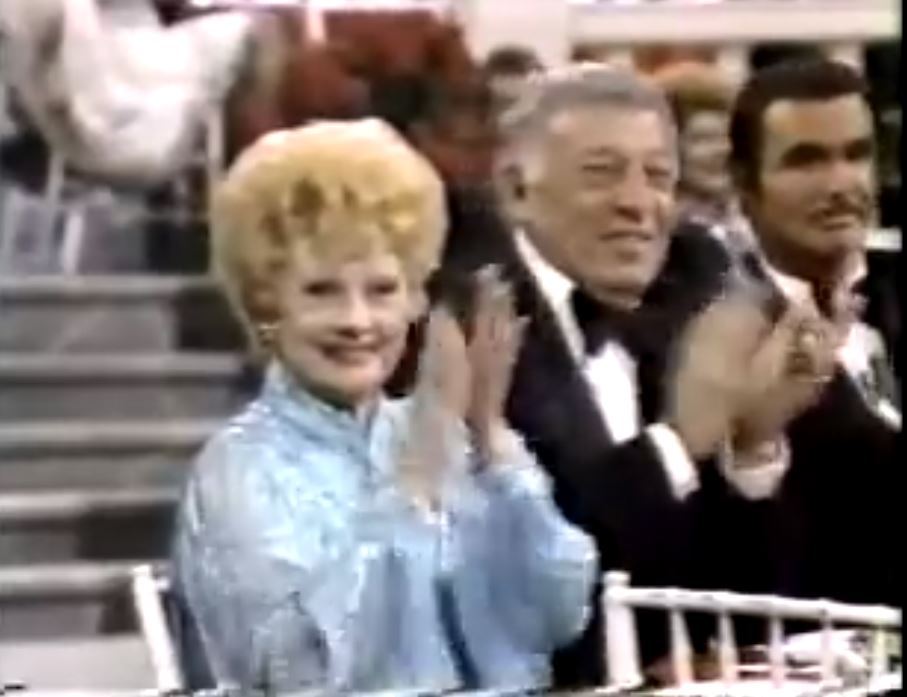
Although the late Burt Reynolds and Lucille Ball never performed together, he attended AN ALL-STAR PARTY FOR LUCILLE BALL in 1984, sitting at the head table with Lucy, Gary Morton, and Frank Sinatra. Burt did not speak, but attended as a previous Variety Club Honoree.
-
K.O. KITTY
“The Westinghouse Desilu Playhouse” ~ November 17, 1958
Produced
by Bert Granet, Quinn MartinDirected
by Jerry ThorpeDances
and Fights staged by Jack BakerWritten
by Bob Carroll, Madelyn Davis, Quinn Martin (story)Synopsis:
Los
Angeles dance
teacher Kitty (Lucille Ball) is delighted when she learns
that she has inherited a boxer from her late Uncle Charlie. But the
boxer turns out not to be a canine, but a prize fighter named Harold
Tibbetts (Aldo Ray), a muscle-bound country boy.Cast
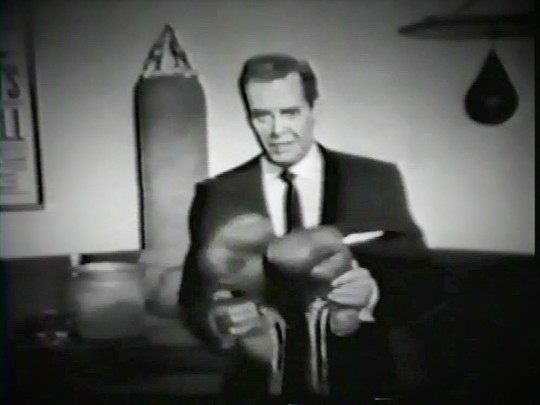
Desi
Arnaz
(Himself, Host) was
born in Cuba in 1917 and immigrated to America as a youngster. He was
a musician who married Lucille Ball in 1940 after meeting her on the
set of 1939’s Too
Many Girls,
which he had done on stage in New York. In order to keep him ‘off
the road’ Ball convinced producers to cast him as her husband in a
new television project based on her radio show “My Favorite
Husband.” The network was convinced. In 1951, Arnaz and Ball began
playing Lucy and Ricky Ricardo, roles they would be identified with
for the rest of their lives. The couple had two children together,
Lucie and Desi Jr. In 1960, Ball and Arnaz divorced. Desi became a
producer, responsible for such hits as “The Mothers-in-Law”
(1967-69). He re-married in 1963. Desi Aranz died in 1986, just a few
years before Ball.Lucille
Ball (Kitty
Winslow) was
born on August 6, 1911 in Jamestown, New York. She began her screen
career in 1933 and was known in Hollywood as ‘Queen of the B’s’
due to her many appearances in ‘B’ movies. With Richard Denning,
she starred in a radio program titled “My Favorite Husband” which
eventually led to the creation of “I Love Lucy,” a television
situation comedy in which she co-starred with her real-life husband,
Latin bandleader Desi Arnaz. The program was phenomenally successful,
allowing the couple to purchase what was once RKO Studios, re-naming
it Desilu. When the show ended in 1960 (in an hour-long format known
as “The Lucy-Desi Comedy Hour”) so did Lucy and Desi’s
marriage. In 1962, hoping to keep Desilu financially solvent, Lucy
returned to the sitcom format with “The Lucy Show,” which lasted
six seasons. She followed that with a similar sitcom “Here’s
Lucy” co-starring with her real-life children, Lucie and Desi Jr.,
as well as Gale Gordon, who had joined the cast of “The Lucy Show”
during season two. Before her death in April 1989, Lucy made one more
attempt at a sitcom with “Life With Lucy,” also with Gordon,
which was not a success and was canceled after just 13 episodes.Most
sources list Kitty’s surname as ‘Williams.’ Her last name is clearly
spoken twice in the teleplay as ‘Winslow.’Aldo
Ray
(Harold Tibbetts, below center) was born as Aldo DeRe and nicknamed ‘the Rugged
Romeo’. In 1964 he worked again with Lucille Ball in Bob Hope’s “Have
Girls, Will Travel” (1964). His career waned in the 1970s. He
died in 1991.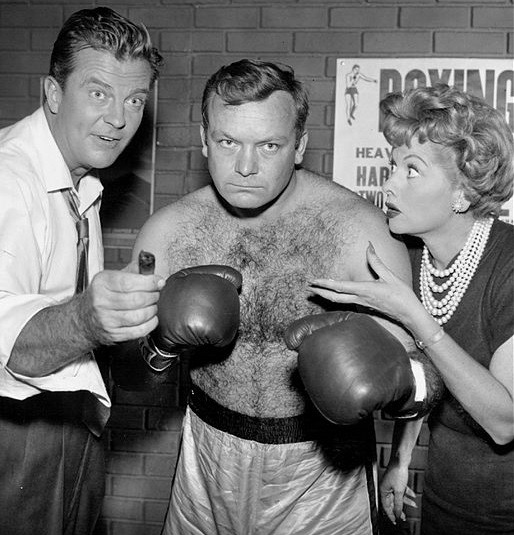
William
Lundigan (David
Pierce, above left) was a genial ‘B’ movie and TV actor. His career began in
1937. His last television role was in 1971. He was a good friend of
William Frawley (Fred Mertz) and served as pallbearer at his funeral. Lundigan
died in 1975.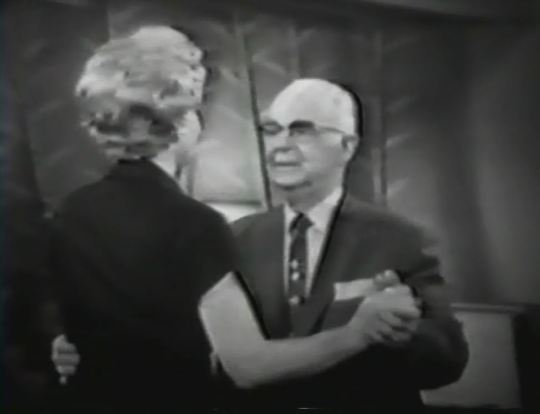
Harry
Cheshire (Mr.
Brubaker) did three films with Lucille Ball between 1947 and 1950. He
played Sam Johnson, a Texan who sells Lucy and Ricky “Oil Wells”
(ILL S3;E18) in 1954. His
best-known role was as Judge Ben Wiley in the TV series
“Buffalo Bill, Jr.” (1955). He died in 1968 at the age of 76.Jesse
White (Barney
Snyder, below right) is
probably best remembered for playing the lonely Maytag repairman on
TV commercials airing from 1967 to 1988. A busy character actor,
White subsequently starred opposite Lucille Ball on a 1972 episode of
“Here’s Lucy.” He died in 1997.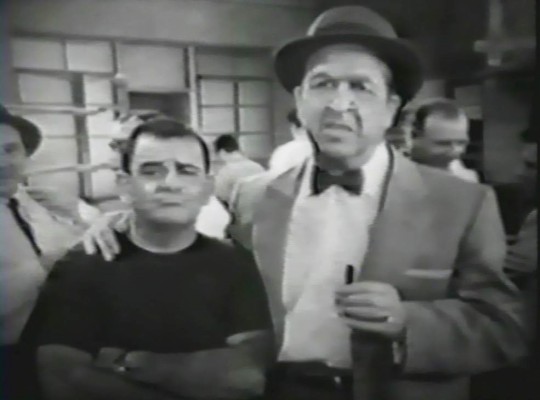
Sid
Melton
(Louie, above left) also appeared
on the “Westinghouse Desilu Playhouse” as a bellboy in “Lucy
Goes to Alaska”
(February
1959) and as a construction worker in “Milton Berle Hides Out at
the Ricardos” (September 1959). He played one of the jockeys in
“Lucy
Wins a Racehorse”
(February
1958). He later played Charley Halper on “Make Room For Daddy” (filmed at Desilu) and Alf Monroe on "Green Acres” (aired on CBS).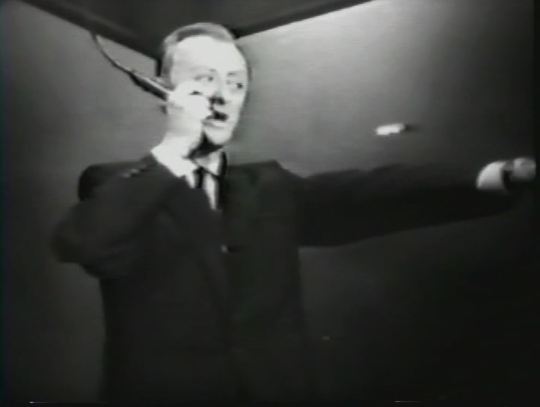
Frankie
Van
(Himself, Referee) was a stand-in and background performer whose
more than 50 credits are nearly all as referees in films and
television shows about boxing. Fittingly, his last screen credit was
as a referee in Rocky
(1976).In
this script, Van is called by his real name.Freddie
Beshore
(Tommy Thompson, uncredited) picked up boxing while serving in the
United States Navy during World War II. During his career he was the
Heavyweight Champion of the Pacific Coast. During the late 1940s and
early 1950s he was a top heavyweight title contender.Norman
Leavitt
(Policeman, uncredited) appeared
with Lucille Ball in the 1950 film A
Woman of Distinction as
well as The
Long, Long Trailer (1953).
The character actor also appeared on three episodes of “The
Lucy-Desi Comedy Hour” and
two episodes of “The Lucy Show.”
About
“The Westinghouse Desilu Playhouse”
After
the end of the half-hour “I Love Lucy” episodes, Desi Arnaz
convinced CBS to purchase an anthology series titled “Desilu
Playhouse” which would feature different hour-long dramas every
week along with monthly stories of the Ricardos and the Mertzes,
something begun a year before.
Thirteen hour-long “I Love Lucy”
adventures were eventually made and sold to syndication as “The
Lucy-Desi Comedy Hour,” ten of which were produced under the
Westinghouse sponsorship. The appliance company paid a then-record 12
million dollars to sponsor the show.
Desi Arnaz hosted the show and
introduced the stories. Desi, Lucy, Vivian Vance, and William
Frawley, were often involved in the lengthy studio-filmed
commercials, with Betty Furness spokesperson for the Westinghouse
products. Although it wasn’t around long, the show gave birth to
pilots for “The Untouchables” and “The Twilight Zone.”
In
the summer of 1958, in anticipation of their partnership, the cast of
“I Love Lucy” played themselves in an industrial film (known as “Lucy Buys
Westinghouse”) that toured the Desilu Studios, promoted “Lucy
Goes to Mexico”, and highlighted Westinghouse appliances. The film
was never in theatrical release or broadcast, but only shown Westinghouse dealers and
corporate clients.
The
Desilu Playhouse was also an actual little theatre on the Desilu
backlot which hosted classes for actors and put on workshop shows for
agents and industry insiders. When Lucille Ball joined RKO in the
1930s, the program was headed by Ginger Rogers’ mother, Lela. Lucy
wanted to continue the tradition. It was depicted in both “The
Desilu Revue” (December 25, 1959) and “Hedda Hopper’s Hollywood”
(January 10, 1960).
About
“K.O. Kitty”
In
the title, “K.O” is boxing term short for “Knock Out,” when a
fighter has hit his opponent so hard that he hits the mat and cannot
get up again.
This
is the first time that Lucille Ball acted on television not playing
Lucy Ricardo. Lucille
Ball was supposed to do several more non-Lucy Ricardo roles on the
series, but this was the only one that ever materialized.
The series ended in 1960, along with the Arnaz marriage. “The
Desilu Playhouse” went
into syndication, minus the Lucy-Desi Comedy Hours. In 1962, Desilu
sold those 13 shows back to CBS for $750,000.
Quinn
Martin (Producer / Story) was married to “Lucy” writer Madelyn
Pugh Davis from 1955 to 1960. His production company was later
responsible for such hits as “The Streets of San Francisco”
(1972-77), “The Fugitive” (1963-67), and “Barnaby Jones”
(1973-78) earning him four Emmy nominations. He also produced nine
other episodes of “The Westinghouse Desilu Playhouse.”
Like
“I Love Lucy” and “The Lucy-Desi Comedy Hour,” the episode
uses a laugh track. Unlike most of those shows, there was no studio
audience. “K.O. Kitty” followed “Lucy Goes to Mexico” (October) and was followed by “Lucy Makes Room for Danny” (December), a cross-over episode with “Make Room for Daddy.”
Earlier
in 1958, boxing made the cover of Life Magazine when Sugar Ray
Leonard beat Carmen Basilio.
Boxing had been a major attraction on television, the highlight being the “Playhouse 90” presentation of “Requiem for a Heavyweight” in 1956 on CBS. It was directed by Rod Serling (”The Twilight Zone”) and starred Jack Palance.

A
country boy out of his element, Harold Tibbetts (Aldo Ray) is
reminiscent of when Tennessee Ernie Ford visited the Ricardos on “I
Love Lucy.” Like Cousin Ernie, Harold has an enormous appetite and
can’t return home because he has no money. He also tends to speak
with homespun wit.
Harold
also resembles another visitor to the Ricardo apartment, Mario (Jay Novello), the
“Visitor From Italy” (ILL S6;E5). Like Harold, Mario had no cash
to and had to go to work – in his case making pizza.
But
“K.O. Kitty” most closely resembles a 1967 episode of “The Lucy
Show” titled “Lucy, the Fight Manager” (TLS S5;E20) starring
Don Rickles as a washed-up boxer named Eddie who Lucy Carmichael
decides to train at home. Lucy dubs herself ‘Killer Carmichael’ and
even jumps rope in tandem with Eddie, a stunt she learned to do for
“K.O. Kitty.” Despite being by different writers, both scripts
contain characters named Louie.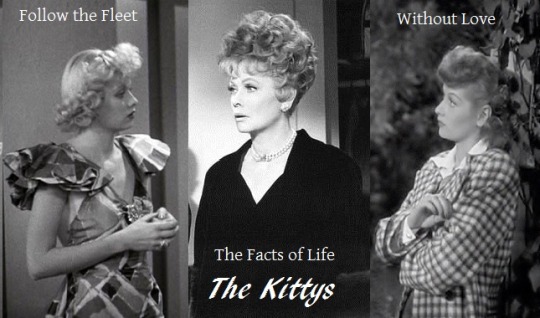
Lucille Ball also played characters named Kitty
in the films Follow
the Fleet (1936),
Without
Love
(1945), and The
Facts of Life
(1960). A name featuring two-syllables ending with ‘y’ made reminded
the listener of ‘Lucy’.
Eight
months later “The Westinghouse Desilu Playhouse” did another
story about prizefighting titled “The Killer Instinct” starring
Rory Calhoun and Janice Rule. It was based
on the career of ex-boxer Joe Barnum.
The Episode
Desi
Arnaz introduces the program, noting that it is a special episode
because it stars “his favorite redhead” Lucille Ball.
The
story opens with Kitty at work, teaching dance. She is trying to get
Mr. Brubaker (Harry Cheshire) to do the Cha-Cha.Kitty:
“Your
feet are doing the cha-cha-cha but your hips are back in the rumba
class.”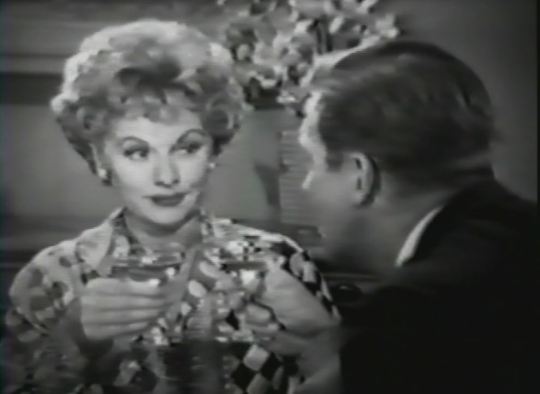
During
the dance lesson, we learn that Kitty is engaged to an up-and-coming
lawyer named David (William Lundigan) who won’t marry her until he gets a partnership in his
law firm, Abbott Parker and Jones. She tells Mr. Brubaker that he is
dancing with an ‘heiress’ due to her Uncle Charlie dying and leaving
her a diamond stick-pin, a gold pocket watch, and a dog – a boxer,
to be precise.
David
(William Lundigan) tells Kitty he is going away on a business trip to
San Francisco for a week. During their romantic dinner, there is a
knock on the door and the boxer arrives – Harold Tibbetts,
professional prize fighter. Tibbetts admits he’s not really from
Ogalala, Nebraska, but from Crockett – just “a hoot and holler”
away.Harold:
“I’m
so hungry, my stomach’s a-growlin’ like hound dog’s just smelled a
weasel in a hen house.”Overcome
with a sense of loyalty to her Uncle Charlie, Kitty agrees to manage
Harold. She arranges for Harold to fight the impressive Tommy
Thompson, a powerhouse that no one wants to go up against. Kitty cannot
afford the gym fees so trains him at her apartment.The name Tommy Thompson was also the name of a producer who worked extensively with Lucille Ball starting in 1964. In 1958 he was on the Desilu lot working as assistant director on “The Danny Thomas Show”
Kitty
sends Harold off to the store to buy training supplies while she
stays behind at the gym to observe and pick up some pointers on
boxing. First, she indulges in a little shadow boxing. Next she
tries to use a punching bag, but it punches back – right in her
face. Remembering how to jump rope from her childhood, she jumps into
a boxer’s reps keeping time with a schoolyard rhyme. These are all
prime opportunities for Lucille Ball to indulge in some of her
well-hone physical comedy skills.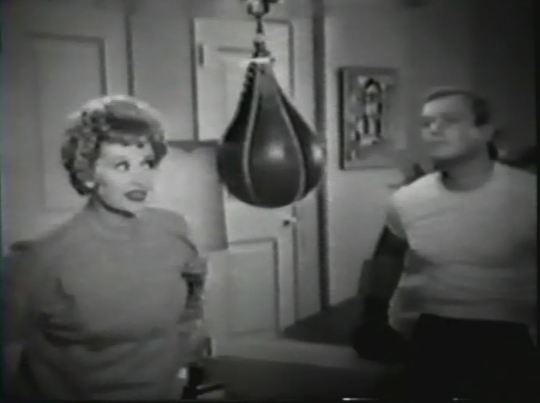
Back
at the apartment, there is a montage of scenes of Kitty training
Harold. He knocks the punching bag out the window, shatters a mirror
while shadow boxing, and crashes to the floor while jumping rope.
Kitty decides that the best training for klutzy Harold would be
dancing lessons.
They
begin lessons by dancing to “I
Can’t Give You Anything But Love, Baby”
by
Jimmy
McHugh
and Dorothy
Fields.
The song was introduced on Broadway in Blackbirds
of 1928.
The dance lesson scene is nearly identical to when Lucy Ricardo
taught awkward Arthur Morton (Richard Crenna) to dance in “The
Young Fans” (ILL S1;E20) in 1952.David returns unexpectedly from
San Francisco to find Kitty and Harold in a carefree clinch. Kitty attempts to explain what is going on but it devolves into an argument and
David storms out.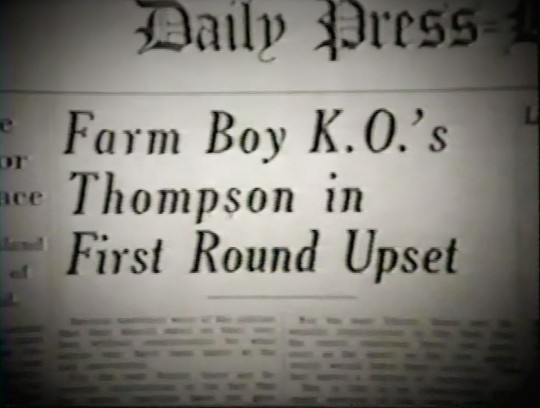
Using
Kitty’s dance steps and her singing “I Can’t Give You Anything But
Love” from ringside as inspiration, Harold surprisingly wins his bout against Tommy Thompson.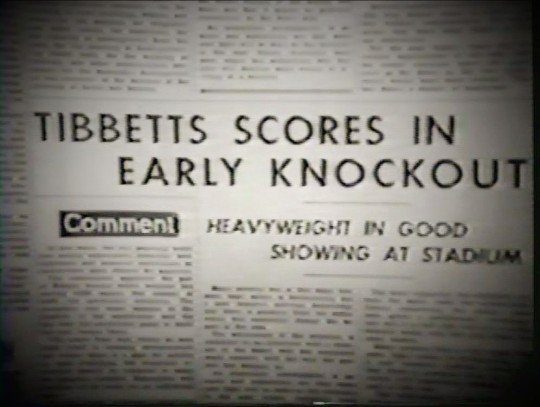
He
then wins a second fight.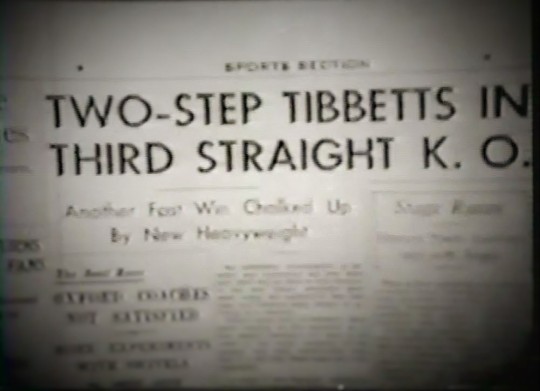
And
a third!
With a fourth K.O. under his belt thanks to Kitty, he eyes the title!
Barney Snyder (Jesse White) and
David conspire to get Kitty out of the fight game – for both their
sake. Snyder and Louie (Sid Melton) show up at Kitty’s apartment,
guns drawn, to convince Lucy that they are crooks, and that the fight
is fixed.Meanwhile,
back at the gym, ‘Two Step Tibbetts’ (as he’s now called) is waiting
for Kitty to arrive knowing he can’t win the fight without her
singing ringside while he spars. David arrives to tell Harold the bad
news that Kitty will be detained. He learns from Harold that earlier
that day they decided that this would be his last fight. David offers
to sing instead of Kitty, but Harold can’t remember the name of the
song – except that the word ‘love’ was in the title.
Still at gunpoint, Kitty watches the match from home on TV. When Barney and Louis become engrossed in the fight, Kitty hides in the closet. This
is very reminiscent of “Ricky and Fred are TV Fans” (ILL S2;E30)
where Lucy and Ethel manage to evade the police when they can’t take
their eyes off a televised boxing match.Meanwhile, back at the ring,
Harold is taking a beating while David rattles off the title of every
‘love’ song he can think of, including a few bars of “I Love You
Truly,” a traditional wedding song.Barney
and Louis confess to Kitty that they made up their story about being mobsters.
Their guns are actually cigarette lighters! They spill the beans to
Kitty about their plans. In order to get to the stadium as fast as
possible, Kitty pretends she’s going to have a baby and gets a police
escort. Kitty and David rush to the ringside in time to sing the
song, which everyone in the stadium joins in. At the final moment,
Harold lands a knock out punch and wins the fight. David and Kitty
make-up with a kiss as the program ends.
Ringside
With Lucy
Lucy
Ricardo and Ethel Mertz ended up at the fights in the last scene of
1951’s “The
Girls Want to Go to a Nightclub” (ILL S1;E1),
the very first “I Love Lucy” episode ever aired.
Everyone
but Lucy and Ethel seem to be watching the fights on television in
“Ricky
and Fred are TV Fans” (ILL S2;E30).
This
Date in Lucy History
~ November 17
"Lucy
and the Used Car Dealer”
(HL S2;E9) ~ November 17, 19691958, Aldo Ray, Bert Granet, Bob Carroll, Boxing, CBS, Desi Arnaz, Desilu, Don Rickles, Frankie Van, Freddie Beshore, Harry Cheshire, I love lucy, Jack Baker, Jerry Thorpe, Jesse White, K.O. Kitty, Life Magazine, Lucille Ball, Madelyn Davis, Norman Leavitt, Quinn Martin, Sid Melton, The Killer Instinct, The Lucy Show, The Lucy-Desi Comedy Hour, The Westinghouse Desilu Playhouse, tv, Westinghouse, William Lundigan -
THE DESILU REVUE
“The Westinghouse Desilu Playhouse” ~ December 25, 1959

Produced
by Bert Granet & Lucille BallDirected
by Claudio GuzmanWritten
by Bob Schiller & Bob WeiskopfOriginal
Music by Walter Kent & Walton FarrarSynopsis: The Desilu Playhouse is hosting a Christmas Party and the action flashes back to the group’s first opening night, at which Lucy was a nervous wreck as their producer. In between songs and dance numbers, Lucy, Vivian, Bill, and Desi indulge in some classic “I Love Lucy” antics when Desi bans Lucy from backstage. Naturally, she finds a way in!
Starring…
Lucille
Ball
was
born on August 6, 1911 in Jamestown, New York. She began her screen
career in 1933 and was known in Hollywood as ‘Queen of the B’s’
due to her many appearances in ‘B’ movies. With Richard Denning,
she starred in a radio program titled “My Favorite Husband” which
eventually led to the creation of “I Love Lucy,” a television
situation comedy in which she co-starred with her real-life husband,
Latin bandleader Desi Arnaz. The program was phenomenally successful,
allowing the couple to purchase what was once RKO Studios, re-naming
it Desilu. When the show ended in 1960 (in an hour-long format known
as “The Lucy-Desi Comedy Hour”) so did Lucy and Desi’s
marriage. In 1962, hoping to keep Desilu financially solvent, Lucy
returned to the sitcom format with “The Lucy Show,” which lasted
six seasons. She followed that with a similar sitcom “Here’s
Lucy” co-starring with her real-life children, Lucie and Desi Jr.,
as well as Gale Gordon, who had joined the cast of “The Lucy Show”
during season two. Before her death in April 1989, Lucy made one more
attempt at a sitcom with “Life With Lucy,” also with Gordon,
which was not a success and was canceled after just 13 episodes. She died on April 26, 1989 at the age of 77.
Desi
Arnaz
was
born in Cuba in 1917 and immigrated to America as a youngster. He was
a musician who married Lucille Ball in 1940 after meeting her on the
set of 1939’s Too
Many Girls,
which he had done on stage in New York. In order to keep him ‘off
the road’ Ball convinced producers to cast him as her husband in a
new television project based on her radio show “My Favorite
Husband.” The network was convinced. In 1951, Arnaz and Ball began
playing Lucy and Ricky Ricardo, roles they would be identified with
for the rest of their lives. The couple had two children together,
Lucie and Desi Jr. In 1960, Ball and Arnaz divorced. Desi became a
producer, responsible for such hits as “The Mothers-in-Law”
(1967-69). He re-married in 1963. Desi Aranz died in 1986, just a few
years before Ball.Desi
also narrates the program.Special
Guest Star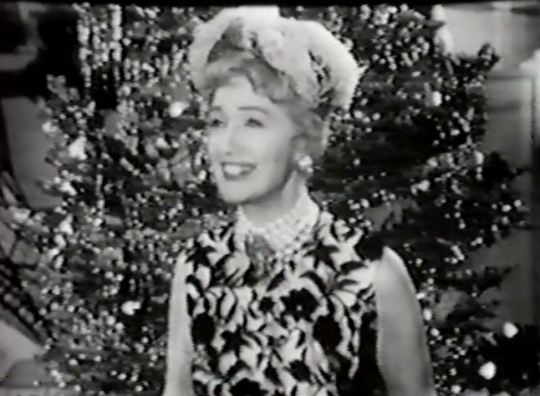
Hedda
Hopper
was
born Elda Furry in Hollidaysburg, Pennsylvania. She was one of
Hollywood’s most powerful and influential columnists. She appeared
on “I
Love Lucy”
and
“The
Lucy-Desi Comedy Hour.”
Among
her hundreds of films as an actress, she did two with Lucille Ball:
Bunker
Bean
(1936)
and That’s
Right – You’re Wrong
(1939).
Hopper was best known for her flamboyant hats. In films and television, Hopper has been
portrayed by such actors as Fiona Shaw (RKO
281),
Jane Alexander (Malice
in Wonderland),
Katherine
Helmond (Liz:
The Elizabeth Taylor Story),
Helen Mirren (Trumbo),
Tilda Swinton (Hail,
Caesar!), Judy Davis (“Feud”), and Holly Kaplan (”Hollywood”).With…
William
Frawley
was already a Hollywood veteran when he was hired by Desi Arnaz to
play Fred Mertz on “I Love Lucy.” After the series concluded he
joined the cast of “My Three Sons” playing Bub Casey. His final
appearance before his death in March 1966 was as a stable groom on an
episode of “The Lucy Show,” also featuring Ann Sothern.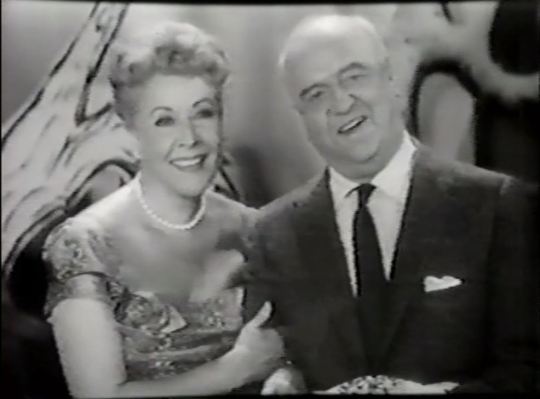
Vivian
Vance was
born Vivian Roberta Jones in Cherryvale, Kansas in 1909, although her
family quickly moved to Albuquerque, New Mexico where she was raised.
She had extensive theatre experience, co-starring on Broadway with
Ethel Merman in “Anything Goes.” She was acting in a play in
Southern California when she was spotted by Desi Arnaz and hired to
play Ethel Mertz, Lucy Ricardo’s neighbor and best friend. The
pairing is credited with much of the success of “I Love Lucy.”
Vance was convinced to join the cast of “The Lucy Show” in 1962,
but stayed with the series only through season three, making
occasional guest appearances afterwards. She made a total of six
appearance on “Here’s Lucy.” She also joined Lucy for a TV
special “Lucy Calls the President” in 1977. Vance died two years
later.Guests…
John
Bromfield
(Audience Member) was best known for playing the title role in the
Desilu / CBS series “U.S. Marshal.” He
retired from acting in 1960 to become a commercial fisherman.
In 1959, he was married to Larri Thomas, who appeared in “Lucy
Wants a Career” (1959) on “The Westinghouse Desilu Playhouse.”
He died in 2005 at age 83.Spring
Byington (below) received
an Academy Award nomination for her role as Penelope Sycamore in You
Can’t Take It with You
(1938).
She appeared in twenty Broadway plays between 1924 and 1935. She
made her film debut as Marmee March in 1933’s Little
Women.
Her
career included a seven-year run on radio and television as the star
of “December
Bride,” a Desilu / CBS production. The show followed “I Love Lucy” on the CBS Monday night line-up from Fall 1954 to Spring 1959. Desi Arnaz played himself on a 1956 episode of the series. She was a former MGM
contract
player who appeared in films from the 1930s to the 1960s.
She played the “Batman” character J. Pauline Spaghetti in 1966.
Byington made an appearance on the Desilu series “The Greatest
Show on Earth” in 1964. Her final roles were as Major Nelson’s
mother on “I Dream of Jeannie” in 1967 and as the Mother General
on “The Flying Nun” in 1968. She died in 1971 at age 84.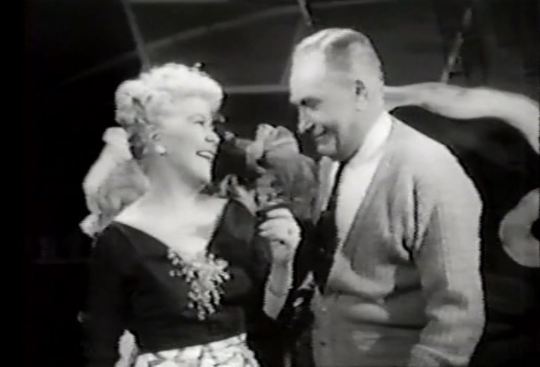
William Demarest (above) was best remembered as Uncle Charlie on “My Three Sons,” a role created after the death of William Frawley. This is one of two times Demarest and Frawley appeared together on screen. The other was in The Farmer’s Daughter (1940). He was nominated for an Academy Award in the biography, The Jolson Story (1946). Demarest did three films with Lucille Ball, including Sorrowful Jones (1949). He died in 1983 at age 91.
Lita
Baron (Audience
Member, below) was born
Isabelita Castro and played Ricky Ricardo’s former dance partner
Renita Perez in “Cuban Pals” (ILL S1;E28). She also appeared in
the films Club
Havana (1945)
and
Don
Ricardo Returns (1946).
Despite this, Baron was actually born in Spain, not Cuba. From 1948
to 1970 she was married to actor Rory Calhoun and had appeared on his
CBS / Desilu series “The Texan.”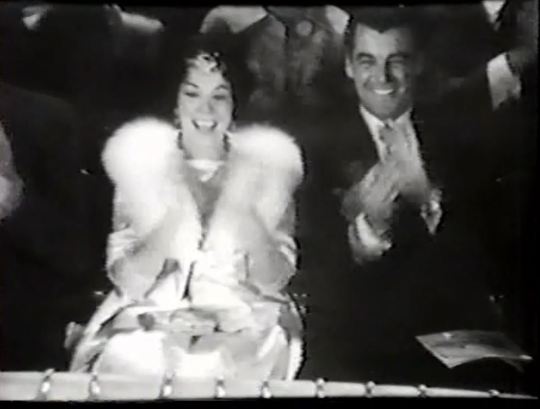
Rory
Calhoun
(Audience Member, above) starred in many Westerns in the 1950s and ‘60s and
was famous for his black cowboy hat. As a young man he spent some
time in prison. Born
Francis Timothy McCown,
his screen name was given to him by David O. Selznick. In 1959 he
was appearing in the CBS / Desilu show “The Texan” (1958-60).Bonita
Granville
(Audience Member) was nominated for an Oscar in 1937 for These
Three.
She was also known as Nancy Drew from the serials of the 1930s. In
1959, Granville became producer of the TV series “Lassie” and this is probably
the reason she is in the audience here.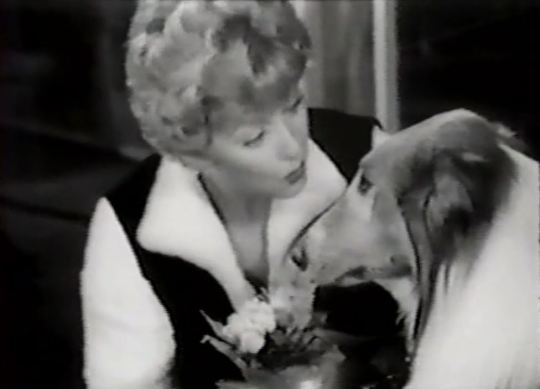
Lassie
is
one of the most famous canine stars in Hollywood history. From 1954
to 1974, Lassie had her own series. The collie also starred in
numerous films. She was mentioned on “I Love Lucy.”George
Murphy
(Audience Member) started singing and dancing on Broadway at age 25.
There he is credited with introducing Bob Hope to his wife Dolores.
In Hollywood, he became Screen Actors Guild (SAG) President and was
eventually elected US Senator. He was given a special Oscar in 1950.
Murphy was in four films with Lucille Ball between 1934 and 1941. He
starred with Desi Arnaz in The
Navy Comes Through (1942)
and Bataan
(1943).
In 1959, Murphy and Desi switched roles when Desi took a role in his
own anthology series “The Westinghouse-Desilu Playhouse” and
Murphy acted as guest host. Murphy
interviewed Lucy and Desi for “MGM Parade” in February 1956. He
died in 1992 at age 89.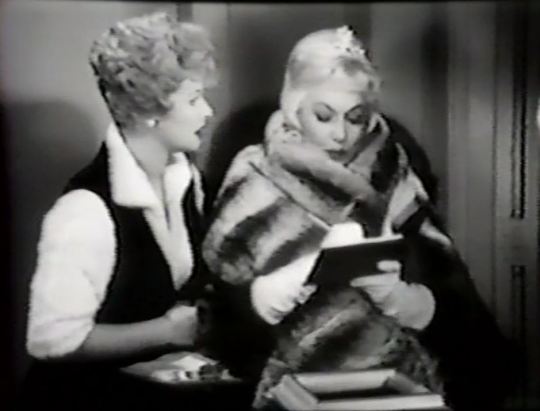
Ann
Sothern
appeared in the first “Lucy-Desi Comedy Hour” “Lucy
Takes a Cruise to Havana”
(1957)
as Susie MacNamara, the same character she played on her show
“Private Secretary” from 1953 to 1957. In return Lucille Ball
played Lucy Ricardo on her show in 1959. Sothern appeared with Ball
in five films between 1933 and 1943. On “The Lucy Show” Sothern
made three appearances as Rosie, the Countess Framboise. She was
nominated for an Oscar for her final screen appearance in The
Whales of August in
1987. She is buried near her home in Sun Valley, Idaho, a place also
dear to Lucy and Desi.
Danny
Thomas
was
born Amos Muzyad Yakhoob Kairouz in 1912. His screen career began in
1947 but he was most famous for appearing on television in the
long-running show “Make Room for Daddy” (1953-64), which was
shot at Desilu Studios. When the series moved from ABC to CBS in
1957, Thomas and the cast starred in a rare TV cross-over with “The
Lucy-Desi Comedy Hour” titled “Lucy
Makes Room for Danny”
(December 1958). In
return, Lucy and Desi turned up on Thomas’s show. Fifteen years
later, Lucy and Danny did yet another cross-over when Lucy Carter of
“Here’s Lucy” appeared on “Make Room for Granddaddy.” In
addition, Thomas also played an aging artist on a 1973 episode of
“Here’s Lucy.” He died in 1999.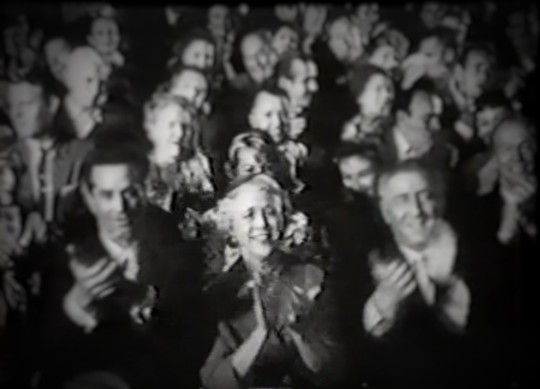
Bess
Flowers
(Audience Member, uncredited) was
dubbed ‘Queen of the Extras’ in Hollywood and is credited with
more than 700 film and TV appearances from 1923 to 1964. She was seen
in the audience of Over
the Teacups
in
“Ethel’s
Birthday” (ILL S4;E8)
and
The
Most Happy Fella during
“Lucy’s
Night in Town” (ILL S6;E22).
Flowers also made five uncredited appearances on “The Lucy Show.”
Not surprisingly, she was a founding member of SEG, the Screen Extras
Guild (now part of SAG) in 1945. She appeared in more films with Lucille Ball than any other performer.Cast of the Desilu Workshop…
Robert Osborne
was
the host on Turner Classic Movies from its inception in 1994, in
large part due to his knowledge of film. It was Lucille Ball who
suggested that Osborne combine his interest in classic film and
training in journalism, and write instead of act. Osborne took this
advice and produced “Academy Awards Illustrated” a book
which then begat his years at The Hollywood Reporter. He also became
the official historian of the Academy of Motion Picture Arts and
Sciences. He also acted in “Chain of Command” for the
“Westinghouse Desilu Playhouse,” also in 1959, and also with Hugh
O’Brien. Osborne died in 2017 at age 84.Billed
as “Bob Osborne” in the opening number.
Roger
Perry
also appeared in “Ballad of a Bad Man” for “Westinghouse Desilu
Playhouse” in 1959 written by Desi Arnaz. He later starred in
Desilu’s “Mannix” and “Star Trek.” He died in July 2018 at
age 85.
Howard
Storm
married fellow Playhouse cast member Marilyn Lovell in 1959. He
started directing in 1975. In 1959 he appeared in the CBS series
“Hennessy” and the following year made an appearance on the
Desilu series “The Untouchables.”Billed
as “Howie Storm” in the opening number.
Jerry
Antes graduated
from Hollywood Professional School in 1944.
In “Hedda Hopper’s Hollywood” Lucille Ball calls him by name in
their brief promotion of the Desilu Playhouse. Prior to this, Antes
was a dancer who made three appearances on “The Alan Young Show”
(1950).Majel
Barrett
was
later cast as Nurse Chapel on Desilu’s new space adventure series,
“Star Trek.” During this time she had a relationship with the
show’s creator Gene Roddenberry, marrying him in 1969, the same
year the series was canceled. She was part of most all iterations of
“Star Trek” until her death in 2008. In 1962 she played a
secretary in “Lucy is Kangaroo for a Day” (TLS S1;E7).Billed
as “Majel Barret” in the opening number.
Mark
Tobin appeared
on the TV series “Lock-Up” in 1959. He made two appearances on
the original “Star Trek,” one as a Klignon. He also played a
Klignon on “Star Trek: Voyager” in 1999.Robert
Barron
made the ‘B’ movie Tank
Commandos
in 1959. He only has one other credit of record, a 1964 appearance
in the film The
Ballad of a Gunfighter.
He died in 2002 at age 78. This may be due to the misspelling of his surname.Billed
as “Rob Barran” in the opening number.
Fran
MartinBilled
as “Frances Martin” in the opening number.Gary
Menteer
started his career as a dancer, but later transitioned to being a
writer, director, and casting agent, earning two Emmy nods for “Punky
Brewster” (1984-88). He died in 2016 at age 76.
Janice
Carroll
started playing background characters and uncredited roles in 1951.
In 1959 she appeared in the Desilu series “U.S. Marshal.” Her
final screen appearance was in 1987. She died in 1993 at age 61.
Carole
Cook
made
four appearances playing Thelma Green on “The Lucy Show,” although she also played Mrs. Valance in three episodes and a
variety of other characters in eleven others. Although she was born
as Mildred Cook, Ball suggested she take the name Carole, in honor of
Lucy’s great friend, Carole Lombard. Cook also went on to appear in
five episodes of “Here’s Lucy.”
Georgine
Darcy
was most famous as Miss Torso in the Hitchcock thriller Rear
Window
(1954), her screen debut. In 1958 she made a single appearance on
“Make Room for Daddy” filmed by Desilu. Her final appearance was
on Desilu’s “Mannix” in 1971. As part of the Desilu Playhouse,
she was also seen in “Hedda Hopper’s Hollywood.” She died in
2004 at age 73.
Dick
Kallman was
next cast as a bellboy in the final “Lucy-Desi Comedy Hour” “Lucy
Meets the Mustache” (1960). Kallman replaced Tommy Steele on
Broadway in the musical Half
a Sixpence. The
actor was killed during a robbery in 1980.
Bob
Travis had only one previous screen credit, appearing on “The Jack Paar Tonight Show” in September 1958.Billed
as “Bob Trevis” in the opening number.Marilyn
Lovell
was a singer who appeared in Hollywood and New York. Her first
husband was Desilu Playhouse member Howie Storm. Her second husband
was Carol Burnett’s musical director Peter Matz. In 1959 she made an
appearance on CBS’s “Tightrope.” She died in 2012 at age 80.Billed
as “Marilynn Lovell” in the opening number.
John O’Neill was primarily a singer, who sang the title tune of the Western series “Wagon Train” (1958-59). He appeared in Young Jesse James (1960), and is rumored to have been one of the whistlers for the theme of The Good, The Bad, And the Ugly (1966).
Billed as “Johnny O’Neill” in the opening number.
About
“The Westinghouse Desilu Playhouse”
After
the end of the half-hour “I Love Lucy” episodes, Desi Arnaz
convinced CBS to purchase an anthology series titled “Desilu
Playhouse” which would feature different hour-long dramas every
week along with monthly stories of the Ricardos and the Mertzes.
Thirteen hour-long “I Love Lucy”
adventures were eventually made and sold to syndication as “The
Lucy-Desi Comedy Hour,” ten of which were produced under Westinghouse sponsorship. The appliance company paid a then-record 12
million dollars to sponsor the show, which resulted in the
cancellation of their prestigious “Studio One” anthology show.
Desi Arnaz hosted the show and introduced the stories from in front
of a show curtain (ostensibly at the Desilu Playhouse).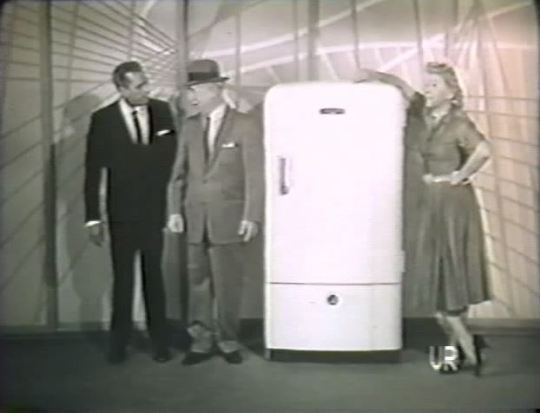
Desi, Lucy,
Vivian Vance, and William Frawley, were often involved in the lengthy
studio-filmed Westinghouse commercials and promotions, with Betty Furness spokesperson for the
Westinghouse products.
Although it wasn’t around long, the series gave birth
to pilots for “The Untouchables” and “The Twilight Zone.” In
fact, many entries proved to be pilots for series, not all of which
were produced.
In
the summer of 1958, in anticipation of the partnership, the cast of
“I Love Lucy” played themselves in aun industrial film that toured the Desilu
Studios, promoted “Lucy Goes to Mexico” and highlighted
Westinghouse appliances. The film was never broadcast, but only made
to show Westinghouse dealers and corporate clients. Years later it was colorized for video.
The
Desilu Playhouse was an actual little theatre on the Desilu backlot
which hosted classes for actors and put shows for agents and industry
insiders.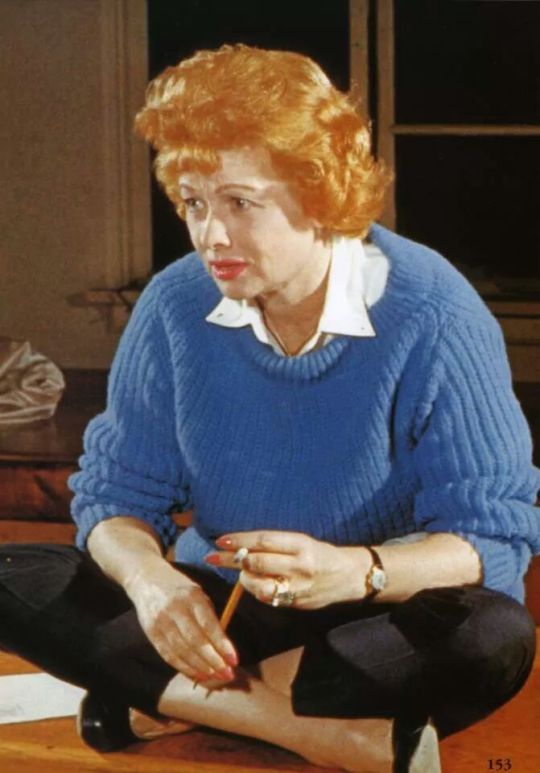
When Lucille Ball joined RKO in the 1930s, the program was
headed by Ginger Rogers’ mother, Lela. Lucille wanted to continue the
tradition.
About
“The Desilu Revue”
In
late 1959, sixteen of the workshop actors joined the “I Love Lucy” cast in creating a
holiday special. The show aired on Christmas Day 1959 and featured
gossip columnist Hedda Hopper as well as many other stars then working on the Desilu lot.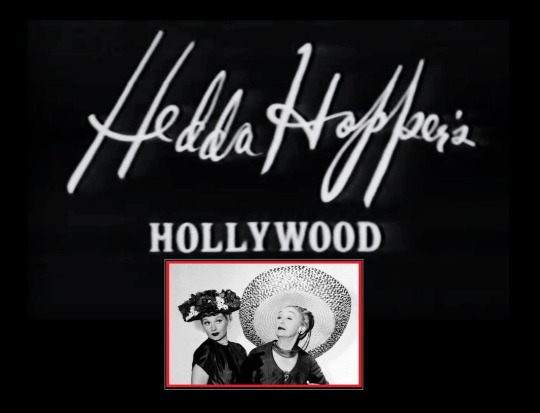
Hopper also took the opportunity to shoot
footage for her own TV special, “Hedda Hopper’s Hollywood”, with
Lucy cross-promoting her special.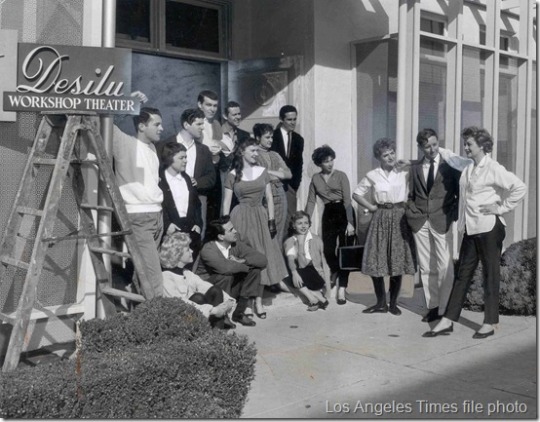
This
is essentially a musical variety show starring the members of the
Desilu workshop, actors Desilu was grooming to appear in series’ or
launch their careers in films. Among the most famous to participate
were Robert Osborne (future host of Turner Classic Movies) and Carole
Cook, who went on to play character roles on Lucy’s sitcoms and on
Broadway. Majel Barrett would become known as “the mother of Star
Trek” (a Desilu series) and wife to Gene Rodenberry, the show’s creator.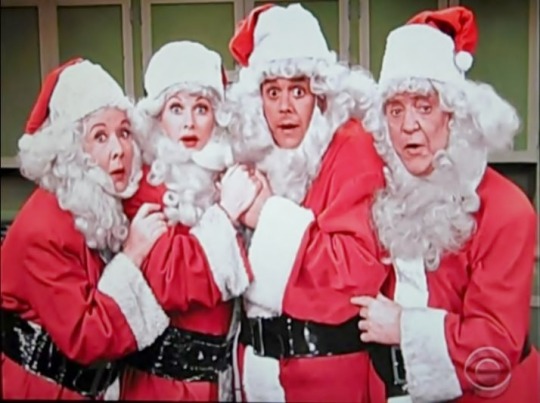
This
program was aired only once. It is one of just a handful of holiday
programs produced by Lucille Ball. A Christmas ‘tag’ was added to
episodes of “I Love Lucy” until it was fleshed out into a
full-length flashback show during season six. “The Lucy Show”
produced two Christmas themed episodes, and one for New Year’s Eve.
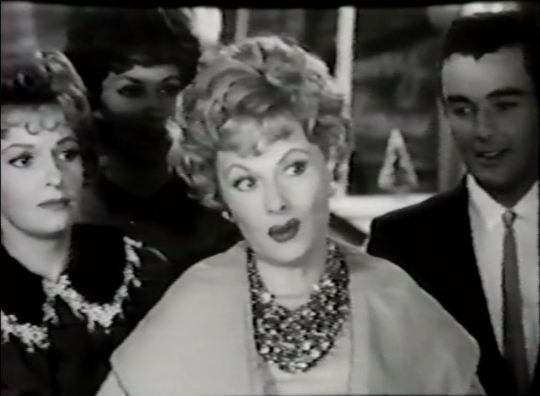
The
show opens with Lucille Ball driving a golf cart through the studio
streets laden down with a stack of Christmas presents and a decorated
Christmas tree. Desi Arnaz narrates. Inside the Desilu Playhouse, the
cast are decorating the theatre and singing “Jingle Bells.” Hedda
Hopper
arrives and compliments the tree:Hedda Hopper:
“It
would make a stunning hat!”Hopper
is going to do a column on the ‘kids’ of the workshop. As Lucy
dashes off to check on the catering from the commissary, Desi tells
Hedda how nervous Lucy was during the opening night of their first
workshop production. Flashback to opening night – and Lucy is
backstage busily checking in with all of the ‘kids’ in the workshop.Lucy
has prevailed upon nearly everyone at Desilu to pitch in. William
Demarest and
Spring Byington
are working on costumes. Lassie
delivers opening night flowers to Lucy. Vivian
Vance
is doing make-up. William
Frawley
is the stage doorman.Lucy
reprimands Janice
Carroll
for peeking through a hole in the curtain to see her mother – it is
bad luck. Lucy asks Desi to conduct the orchestra instead of their
usual conductor. Ann
Sothern
(wearing a tiara and fur stole) takes tickets – in between signing her autograph for fans.Danny
Thomas
is outside operating the huge searchlight. He tells Lucy that he
started in show business as an usher in the movies with a tiny
flashlight – and look at him now!Desi
enters the auditorium with his baton to start the show, but cannot
find the entrance to the orchestra pit. After a few words with audience member George Murphy, he jumps the railing.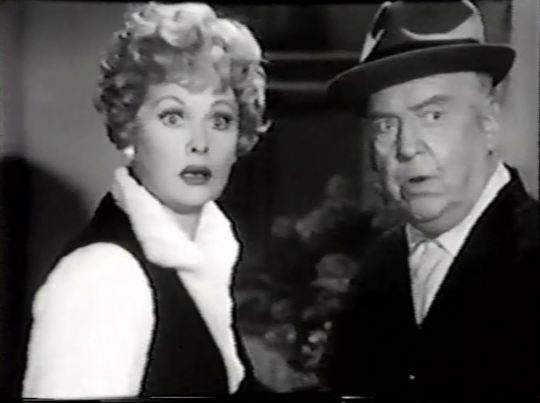
Lucy
barrels through the stage door to deliver her last minute notes to
the cast but is stopped by Bill Frawley, remembering Desi’s orders to
keep Lucy away from the cast. His behavior surprises Lucy.Lucy:
“Bill
Frawley how can you be so mean?”
Frawley:
“Don’t
think of me as Bill Frawley. Think of me as Fred Mertz.” [evil
laugh]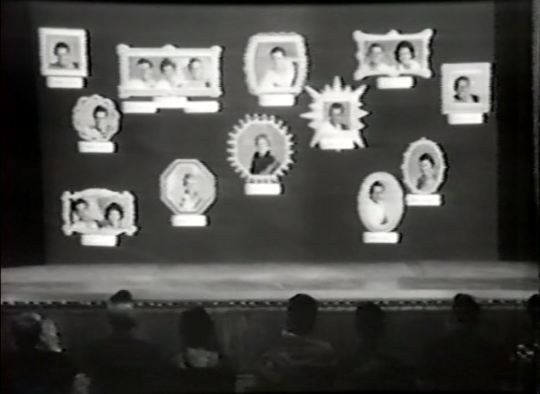
The
16 workshop members sing the opening number “We Wanna Be By You” written for the show by Walter Kent and Walton Farrar.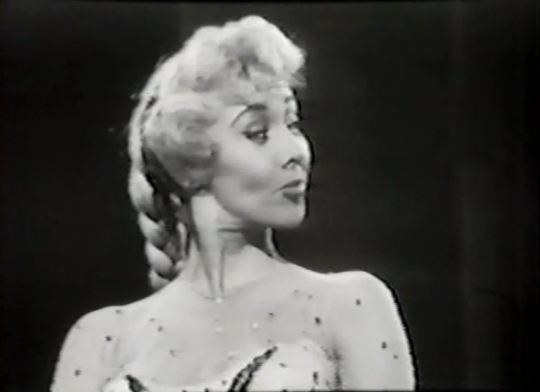
Next
up is a jazz dance routine featuring Georgine
Darcy, Jerry Antes, and
Gary
Menteer.Vivian
discovers Lucy trying to sneak backstage through a dressing room
window. Lucy threatens to tell the audience Vivian’s real age if she
doesn’t let her in! Bill Frawley discovers Lucy giving notes to the cast.
His scowl scares Lucy into leaving the same way she came in!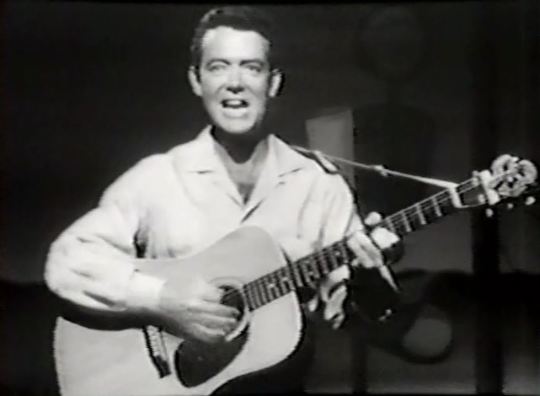
Johnny
O’Neill sings
“Fast Freight” by Terry Gilkyson while accompanying himself on
the guitar. The song was a 1958 hit for The Kingston Trio.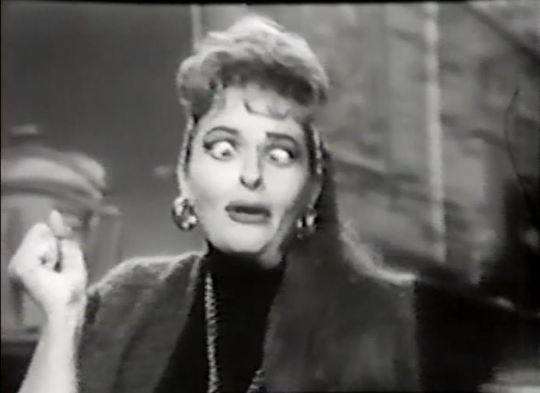
Dick
Kallman
(sporting a goatee) and Carole
Cook
do a beatnik number called “Hip To The Blues” by Baker, Young,
Raskin, and Burger.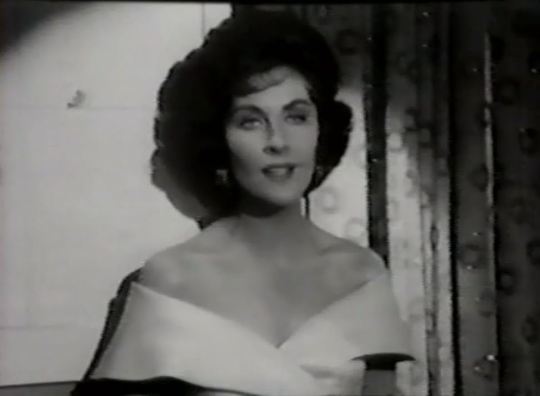
Marilyn
Lovell
sings the torch song “I Still Remember.”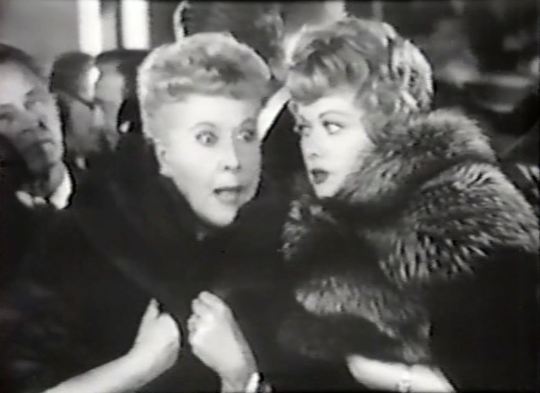
During
the intermission, Lucy and Vivian bury themselves in fur coats up to
their eyeballs to listen to the producers’ chatter about the first
act. The only thing they overhear is that Ann Sothern has lost her
gloves!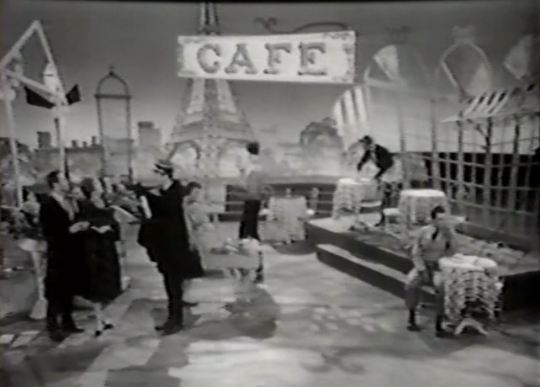
Act
Two opens on a busy Parisian street with an American sailor on leave.
The sailor sings “I’m in Love With Paris.” An Army officer sitting at
a café table sings “Alone In Gay Paris.”In
the dressing room, Bob
Osborne
reads a note from Lucy written on the mirror in lipstick. It
references using a hand mike in “the bandstand number.” Curiously, no such song is in the show. Perhaps it was cut or (more
likely) never existed.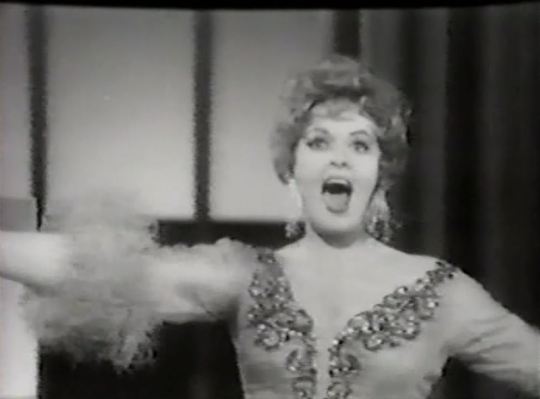
Carole
Cook sings a comedy song called “Whistler’s Mother” by Mike
Stewart and Shelley Mowell. In it, Cook is seen as a tableau vivant
of the famous painting come to life. She steps out of the frame and transforms into a vamp.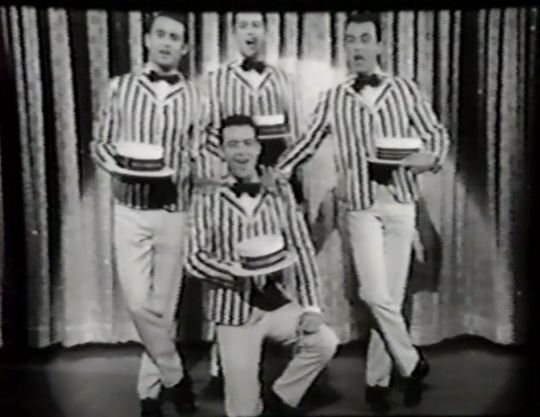
A
barbershop-style song “Summertime is Summertime” by Walter Kent
and Kim Gannon is sung by four of the men in candy striped suits and
straw boaters. It opens up into a gay nineties dance number. It
finishes with a cake walk to “Hey Do Ya Love Me Honey” led by
Roger
Perry
singing and playing the piano.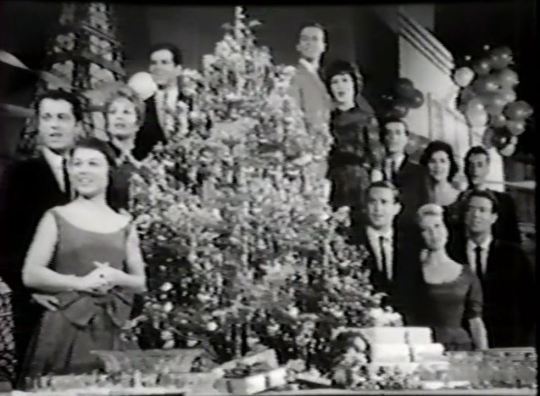
The
program returns to the present and the Desilu Playhouse Christmas Party with Desi telling Hedda Hopper what happened on opening night. The
workshop members sing “Let’s Pretend It’s Christmas Eve” while
Lucy, Desi, Bill, Vivian, and Hedda look on adoringly.Overcome with
emotion, Vivian Vance impulsively gives Bill Frawley an affectionate kiss on
the cheek and whispers “Merry Christmas” to him. Surprisingly, he returns the
favor. Considering the well-known friction between the two, this is either very convincing acting or the pair had mended fences
knowing their decade working together was finally drawing to an end. Vance had just nixed an “I Love Lucy” sequel about the Mertzes, despite the fact
that Frawley was open to the idea.
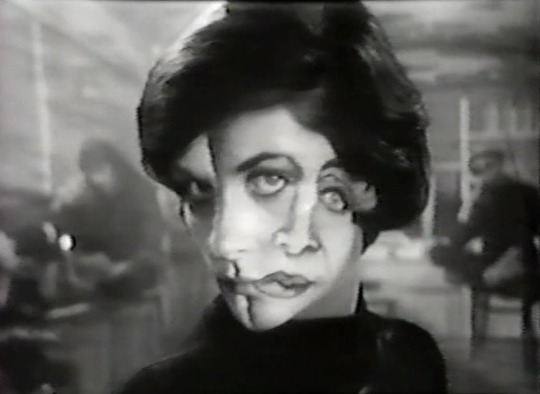
Not a camera trick! Make-up by Fred Phillips!
1959, Bert Granet, Bob Schiller, Bob Weiskopf, Carole Cook, christmas, Claudio Guzman, Desi Arnaz, Desilu, Hedda Hopper, Hedda Hopper’s Hollywood, John Bromfield, Lita Baron, Lucille Ball, Majel Barrett, Revue, RKO, Robert Osborne, Rory Calhoun, Spring Byington, The Desilu Playhouse, The Desilu Revue, The Lucy-Desi Comedy Hour, Vivian Vance, Walter Kent, Walton Farrar, Westinghouse, Westinghouse Desilu Playhouse, William Demarest, willliam frawley
-
Subscribe
Subscribed
Already have a WordPress.com account? Log in now.
 Papermoon Loves Lucy