Part 1 ~ The TV Shows of the Lucyverse
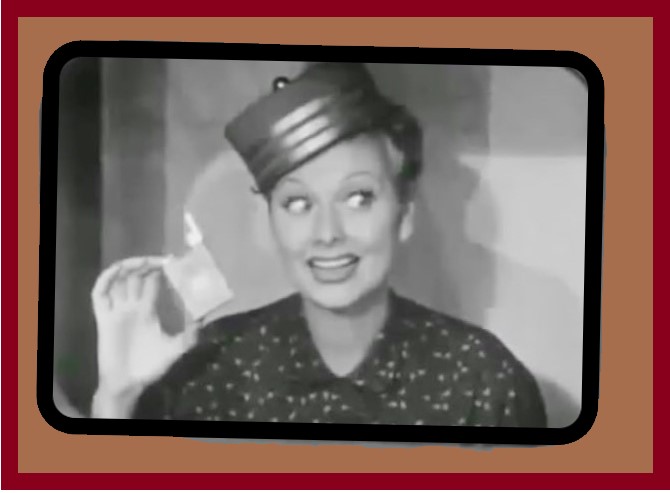
Although it may seem redundant, the worlds created by Lucille Ball on radio and television frequently created and mentioned other TV shows! Here are a few.

“Television” (1949)
Liz and George’s visit to their next door neighbors, the Stones, turns into a disaster when George tries to repair the Stones’ new television set by himself.
“Television throws ‘My Favorite Husband’ for a loss, and the whole neighborhood into night courts.” ~ Mason City Globe-Gazette radio listing

“Too Many Television Sets” (1949)
Liz (Lucilll Ball) can’t get George (Richard Denning) interested in buying a television set, until they spend an evening at the Atterburys, who have one. With his interest piqued, George arranges one be sent over on trial. Little does he know Liz has done the same thing – as have the Atterbury’s!
LIZ: “I never know who won the fights or what Kukla and Fran are doing to Ollie.”
“Kukla, Fran, and Ollie” was a children’s television show created by Burr Tillstrom that aired from 1947 to 1957. Kukla and Ollie were puppets and actress Fran Allison interacted with them. The show won a 1949 Peabody Award and went on to win two Emmys.
IRIS: “I did my knitting last night with Ed Wynn; I had breakfast with Tex and Jinx; and this afternoon I took a bath with Hopalong Cassidy!”

“The Ed Wynn Show” was a variety show broadcast from September 22, 1949 to July 4, 1950 on the CBS Television Network. Comedian and former vaudevillian Ed Wynn was the star of the program. Lucille Ball and Desi Arnaz made their television debut as a couple on the show on Christmas Eve 1949, just a few weeks after this episode of “My Favorite Husband”.
“Tex and Jinx” were Eugenia “Jinx” Falkenberg and her husband John “Tex” McCary. The couple were popular radio hosts who began on television in January 1947.
“Hopalong Cassidy” made the leap from books and movies to the small screen on June 24, 1949, kicking off the legacy of the Western on television. These were not new, but simply cut-down versions of the feature films that were in cinemas from 1935 to 1948.
Joe (Jay Novello) warns the Coopers not to sit behind Iris because they only have a ten inch screen. He advises that they visit the Schraders who watch “Pantomime Quiz” and serve sandwiches. “Pantomime Quiz” (later titled “Stump the Stars”), was a television game show hosted by Mike Stokey. Running from 1947 to 1959, it has the distinction of being one of the few television series to air on all four TV networks during the Golden Age of Television. Lucille Ball is reported to have been on the series in December 1947, which would make it her television debut.

“Liz Appears on Television” (1950)
Liz and Iris (Bea Benadaret) make an appearance on a television show celebrating Friendship Week. Their friendship is tested when they discover they’ve bought the same dress for the occasion. The name of the show is “Love Your Neighbor” the host of which is played by Frank Nelson. The episode mentions two of the same television programs as “Too Many Television Sets” a year earlier.
GEORGE: “I can see it now: ‘Kukla, Fran and Lizzie!”
LIZ: “Try Hopalong Cassidy. He looks good next to a horse!”

“Lucy Does a TV Commercial” (1952)
RICKY:“You’ve never even been on a television show!”
LUCY: “Maybe not, but I’ve watched them a lot.”
Lucy gets hired to do a TV commercial on Ricky’s new show, not realizing the health tonic she has to consume is full of alcohol!
LUCY: “When Ricky comes home tonight you’re going to turn on that television set, and you know who’s going to be on it?”
FRED: “Well, I can only hope it’s Faye Emerson.”
Faye Emerson (called the “first lady of television”) was a very glamorous stage and screen actress turned TV hostess who had her own variety show “Fay Emerson’s Wonderful Town” on CBS.

The TV show Ricky hosts is titled “Your Saturday Night Variety”. You can see Lucille Ball waiting in the wings, with the living room set behind her! The TV camera has had its identifying information redacted and replaced by TVC (TV Camera)!

“Lucy Gets Ricky on the Radio” (1952)
When their TV breaks down, the gang tunes in to a radio quiz show. Surprisingly, Ricky correctly guesses the answers to all of the questions, so the next day Lucy signs them up to be on the show. Placing the radio atop the malfunctioning TV set, the gang stares intently at the radio, just as they would television. Before the TV breaks down, the foursome are watching a movie, despite poor reception.
LUCY: “That little girl is Margaret O’Brien, isn’t it?”
RICKY: “Look again – it’s Shirley Temple.”
FRED: “Look again – it’s Mary Pickford!”

“New Neighbors” (1952)
“That’s pretty corny dialogue, even for television. Well, it’s a living!” ~ Mr. O’Brien
New neighbors the O’Briens have just moved into 323 East 68th Street. When Lucy gets stuck hiding in their closet, she overhears the couple practicing their lines for a TV show and jumps to conclusion that they are foreign spies! Hayden Rorke and K.T. Stevens play the acting couple.
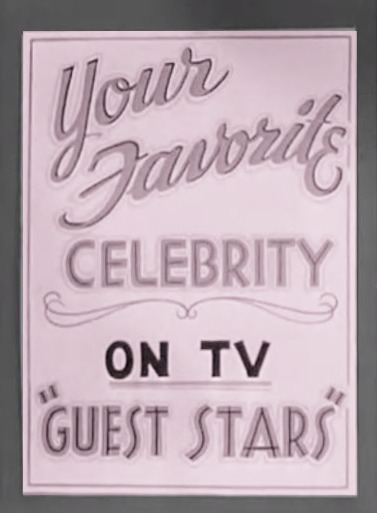
“The Handcuffs” (1952)
To keep Ricky home, Lucy handcuffs them together – but then doesn’t have the key. Ricky needs to host a TV show that evening – “Your Favorite Celebrity Guest Stars on TV”. Lucy has no choice but to be part of the act – even if it is only her left arm!

Ricky (and Lucy’s arm) perform “In Santiago, Chile (’Tain’t Chilly at All). Ricky is interviewed and introduced by Veola Vonn, real-life wife of Frank Nelson.
“Readers keepers, losers go look at television!” ~ The Black Eye (1953)

“Ricky and Fred Are TV Fans” (1953)
Lucy and Ethel feel the boys are ignoring them to watch the fights on television. They go to elaborate lengths to stop their obsession. The championship boxing match that Ricky and Fred are watching pits The Kid against Murphy. A heavyweight boxer named Irish Bob Murphy famously fought Jake LaMotta in June 1952. Kid Gavilán was a welterweight boxer from (unsurprisingly) Cuba, who was world champion in 1952. Naturally Ricky bets on The Kid, while Irishman Fred is in Murphy’s corner.
“Lucy and Ethel Buy the Same Dress” (1953)
“We have a whole half hour on television!” ~ Lucy Ricardo
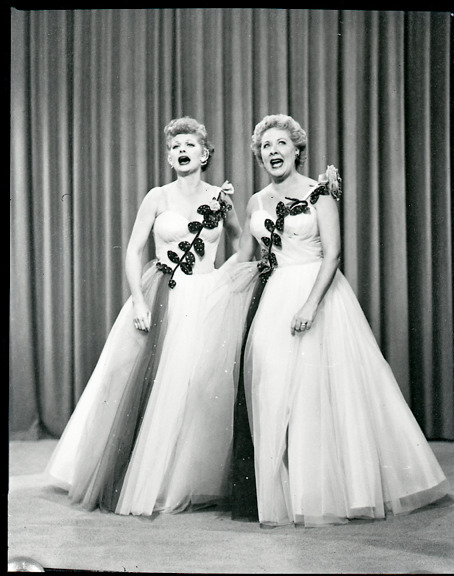
Lucy and Ethel are excited to appear on TV with their club, until they buy the same dress, which tests their “Friendship”.

Before Lucy and Ethel do their “Friendship” song, Ricky’s sings “Vaya con Dios.”

“Baby Pictures” (1953)
Trying to impress the Ricardos about his TV station’s offering of motion pictures Charlie Appleby says:
“We’ve got the newest moving pictures in town. I bought a block of films yesterday, and I want to tell you that they’re going to make television stars out of some of the actors. Now, just remember their names: Conway Tearle and Mabel Normand.” ~ Charlie Appleby
Both were silent film stars and died in the 1930s!

“Million Dollar Idea” (1954)
Lucy bottles her own salad dressing, then she and Ethel go on TV to sell it. When the episode was colorized in 2019, the image in the television monitor (above) was deliberately left black and white!

They appear on “The Dickie Davis Show,” a four-hour daily TV program produced at the station run by Caroline Appleby’s husband, Charlie. Frank Nelson plays Dickie Davis.

“The Charm School” (1954)
The episode opens with a party where the men are in one room and the women in the other. At the party, the men talk about how soon color might be introduced on television.
“Well, there are two schools of thought on that matter. Some people think it’s just around the corner. Others think it’s gonna be a year or two.” ~ Bill Hall
In reality, it was just six months away – but not on CBS and not on “I Love Lucy.” Ricky says he read an article by Harry Ackerman, a TV producer who supported the filming of “I Love Lucy” in front of a live studio audience.

“Home Movies” (1954)
“If I want to see old movies, I’ll watch television.” ~ Fred Mertz
When his feelings get hurt that no one is interested in his home movies, Ricky refuses to include Lucy, Fred and Ethel in his new TV pilot film. Lucy, however, has a plan to get into the action anyway!

“Ricky’s Hawaiian Vacation” (1954)
Lucy plans to win a trip to Hawaii on a television quiz show so that she can go with Ricky on a work trip.

The TV show is called “Be A Good Neighbor” and it is hosted by Freddy Fillmore, who has finally made the leap from radio to television. In reality, many radio shows made the transition to television during the early 1950s.

“The Black Wig” (1954)
When Ethel tries on Lucy’s wig. Fred recognizes her immediately, and isn’t impressed.
ETHEL: “This is that new Italian haircut.”
FRED: “Well, on you it looks like Life with Luigi.”
“Life With Luigi” was a radio comedy that transferred to television. It premiered on CBS one season after “I Love Lucy,” but was not a success, lasting only a year before briefly returning to radio. One of the ‘Italian’ characters was played by Alan Reed, who later voiced Fred Flintstone. Two years earlier, both “Luigi” and “Lucy” were part of “Stars in the Eye”, a 1952 CBS special that celebrated the opening of Television City Studios.

“Tennessee Ernie Hangs On” (1954)
The gang and Ernie sing on television to make money to send him back to Bent Fork. “Millikan’s Chicken-Mash Hour” was a fictional country music TV program, but there were real-life examples of the genre as well. The first ever was called “Village Barn,” broadcast from 1948 to 1950 from a New York City nightclub. Others included “Hayloft Hoedown,” “ABC Barn Dance,” “Saturday Night Jamboree,” “Windy City Jamboree,” “The Old American Barn Dance,” and “Midwestern Hayride” – all on rival networks. The most famous entry into the genre, “Hee Haw,” did air on CBS, but didn’t come along until 1969.

“Mr. and Mrs. TV Show” (1954)
“This is going to be one of the biggest television programs to hit town in years!” ~ Mr. Cromwell, Ad Executive
Ricky has a chance to do an ‘at-home’ TV breakfast show, and naturally Lucy wants to be in it. Things go well until Lucy discovers Ricky only let her do the show because the sponsor insisted. Then revenge is what is served for breakfast! The live show is named “Breakfast with Ricky and Lucy.”

“Breakfast with Ricky and Lucy” was inspired by “Breakfast with Dorothy and Dick.” This daily radio chat show aired from 1945 through 1963, and starred Dorothy Kilgallen, journalist and reporter, and her husband Richard Kollmar, a Broadway actor and producer. There was another popular husband and wife radio breakfast show called “Hi Jinx” that starred model and actress Jinx Falkenburg and publicist Tex McCrary, which made the leap to television in 1948.
“Ricky Minds the Baby” (1954)
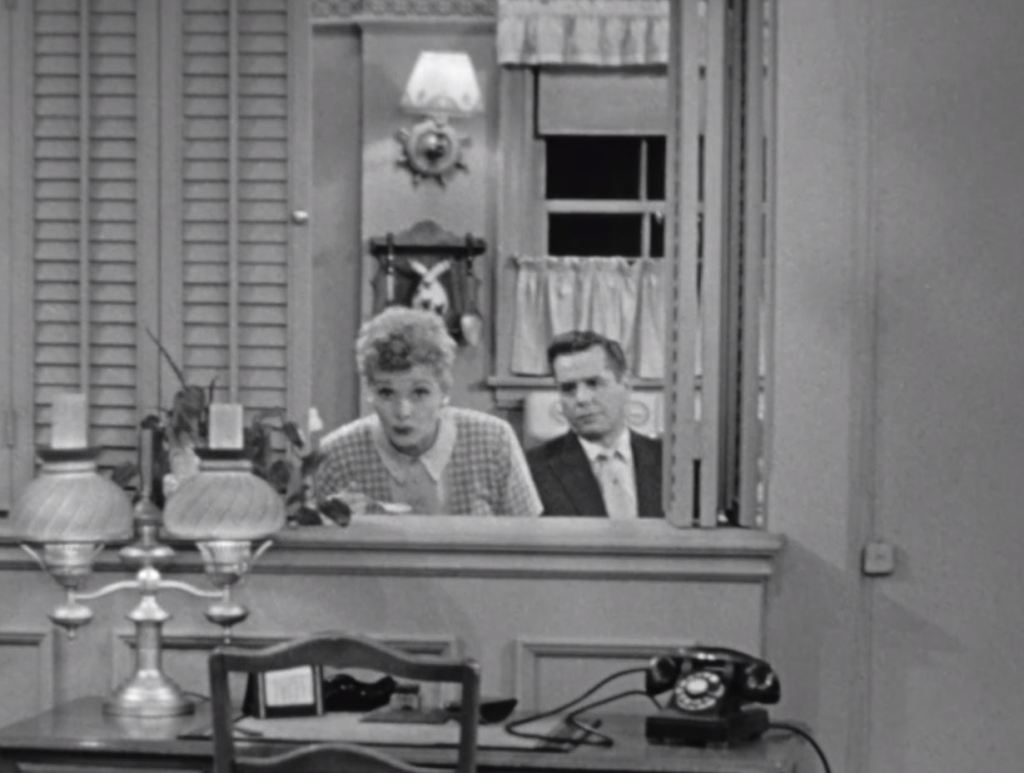
As the episode opens, Lucy is watching television through the kitchen shutters while eating dinner. America’s obsession with television – greatly aided by the popularity of “I Love Lucy” – was growing by leaps and bounds. Although we hear the program’s background music (provided by the Desi Arnaz Orchestra) we don’t see the television, or learn the name of the show Lucy is so obsessed with.
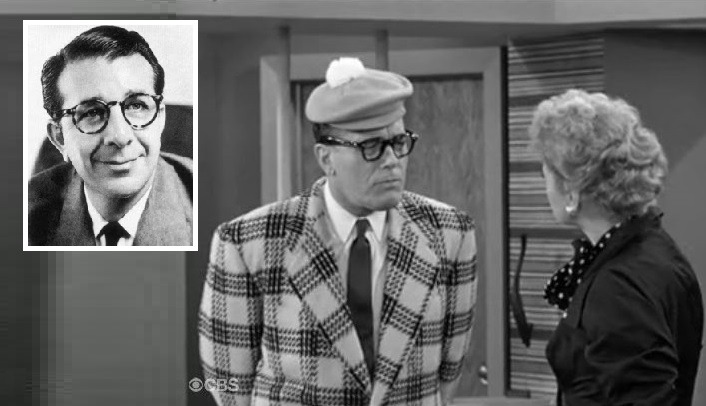
“Don Juan is Shelved” (1955)
When Ricky’s picture is canceled, Lucy hires an actor to play Dore Schary – who turns out to be the real Dore Schary!
“I don’t usually work this cheap, but things are tough, what with television and all.” ~ Dore Schary
But only on television. The real film producer Dore Schary was scheduled to play himself, but pulled out at the last minute. The reason of record was illness, but many feared it was pressure from the studio, feeling that television was replacing film-going by the American public. He was replaced by Vivian Vance’s husband, Phil Ober.

“Bullfight Dance” (1955)
When Lucy is asked to write an article for Photoplay about what it’s like being married to Ricky, she uses it to blackmail him to get to perform in a TV benefit for the Heart Fund, a cause that was near and dear to Lucy and Desi. The benefit television show is called “Coast-to-Coast”, hosted by Ricky and featuring Lucy in the bullfight number of the episode’s title.

The sequence is introduced with an establishing shot of the newly-opened CBS Television City building at 7800 Beverly Boulevard in Los Angeles, California. Although “I Love Lucy” was one of CBS’s strongest shows, Desilu was already happily ensconced at Ren Mar Studios.
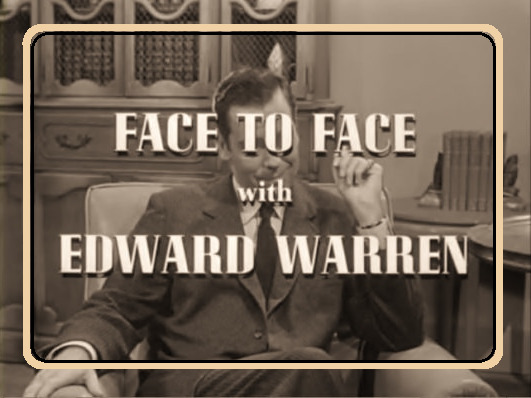
“Face to Face” (1955)
Lucy and Ricky appear on a TV interview show from their apartment. But his new agent says the apartment is a dump, and urges them to move into ritzier quarters. The agent tells Ricky that he thinks he’s got him “planted on the Sullivan show next month”. “The Ed Sullivan Show” (aka “Toast of the Town”) was a Sunday night staple on CBS. In addition to hosting performers on the stage of their New York theatre, celebrities would also be in the audience, and get introduced by Sullivan to get camera time. This is what is meant by “planted” on the Sullivan show.

Ed Warren (Elliott Reid) is a parody of Edward R. Murrow (right), who hosted the interview show “Person to Person” from 1953 to 1959. Just like Murrow, Warren signs off by bidding the audience “Good night, and good luck!”

“Lucy Meets Charles Boyer” (1956)
Lucy thinks every man she sees is film star Charles Boyer. When she spots the real Boyer, Ricky convinces him to pretend to be a second rate actor who just happens to look like the star. Boyer mentions “Four Star Playhouse” (1952-56), an anthology series sponsored by Singer and Bristol Myers. The premise of the CBS series was that Boyer, Ida Lupino, David Niven, and Dick Powell would take turns starring in episodes.

“Lucy and Superman” (1957)
Lucy brags that she can get Superman for Little Ricky’s birthday party. When he isn’t available, Lucy dresses up as the man of steel instead.

As the episode opens, Ricky and Little Ricky are watching “Adventures of Superman” on TV. Superman fans have said that this excerpt was not from the original series, but created for “I Love Lucy” using a double. The wires holding Superman up are clearly visible in the shot and it was commonly known that George Reeves disliked using wires because of an incident early in the show’s creation.

“Lucy Gets Chummy with the Neighbors” (1957)
When a misunderstanding about the between Betty (Mary Jane Croft) and Lucy spreads to the boys, Ralph (Frank Nelson) rescinds his offer for Ricky to appear on one of his advertising agency’s TV shows, saying “We’ll get Cugat!” For Ricky, this is the ultimate insult. In the early days of television, advertising agencies could dictate whether a show would be aired or not. Such was the case with “I Love Lucy” in 1951. Biou Advertising represented Philip Morris, the show’s sponsor during the first several years.

“Lucy Goes To Sun Valley” (1958)
When Ricky, Little Ricky and Fred have to stay home to work on a television show, Lucy reluctantly takes Ethel to Sun Valley.

“Lucy Goes To Alaska” (1959)
The Ricardos and Merztes go to Alaska where Ricky and Fred have bought some land and Ricky is doing a TV show. When Red Skelton’s partner fails to appear, Lucy is recruited to perform with him.

“Lucy Wants a Career” (1959)
“I can’t believe it! Lucy on television!”
Looking for fulfillment outside the home, Lucy takes a job as a Girl Friday for Paul Douglas on the morning TV show “Early Bird.”

The first morning news program on television was “Three To Get Ready,” a local show hosted by comedian Ernie Kovacs that aired in Philadelphia from 1950 to 1952. Although it was mostly entertainment-oriented, the program did feature news and weather segments. Its success prompted NBC to look at producing something similar on a national basis and in January 1952 the “Today Show” premiered. CBS (Lucy’s network) entered the field in 1954, but was never able to compete in the ratings.

“Lucy Meets the Mustache” (1960)
Near the end of the episode, Ernie Kovacs tells Ricky to “take a good look” at Crandall (aka Lucy in disguise).
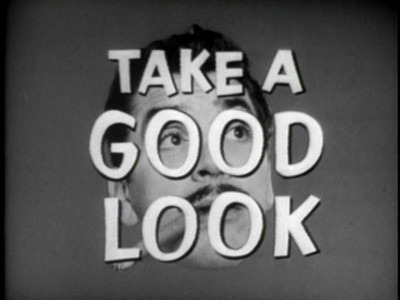
“Take a Good Look” was the name of a TV quiz show Kovacs moderated at the time. It involved a panel guessing answers based on short skits.
Stay Tuned for Part 2! Same Time, Same Channel!
 Papermoon Loves Lucy
Leave a comment