Lucy On Stage ~ Act 4
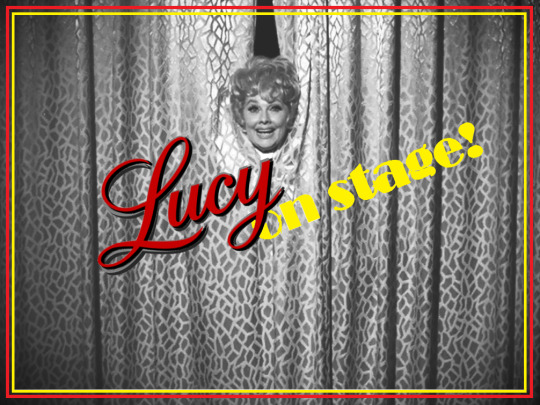
Lucille Ball’s dream was to be on Broadway. She achieved that goal in 1960, but along the way she found herself on various other stages. Here’s a look at Lucille Ball, stage actress.

In school, Lucille’s mother Dede encouraged her daughter to be active in the drama club. Lucille performed and directed with the group, staging a production of Charley’s Aunt by Brandon Thomas, which opened on Broadway in 1893. In the above photo, Lucille Ball is seated in the front row, second from the left. Her teacher was named Lillian Appleby. Lucille later honored her by naming a character on “I Love Lucy” after her.

The Celoron, New York, grammar school Lucille attended (above) has long since been razed. But a formative moment in Lucille Ball’s life occurred on this site when her stepfather, Ed Peterson, brought her to see a performance by the renowned monologist Julius Tannen in the school auditorium. As Lucy remembered, “I don’t think a stage career ever occurred to me until that night.” Lucille left school before graduating, going to New York City to attend drama school. The experiment was short-lived and Lucille returned home.
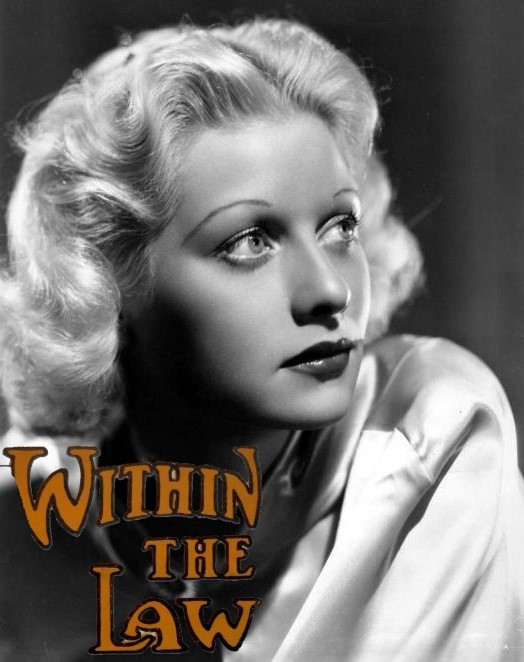
In 1929, 18 year-old Lucille Ball was cast in a production of Within the Law by Bayard Veillier – her first stage performance outside of school. Lucille played the supporting role of Agatha at Jamestown’s Shea Theatre. In 1991, the theater was renamed The Lucille Ball Little Theatre in a ceremony with Ball’s family in attendance.
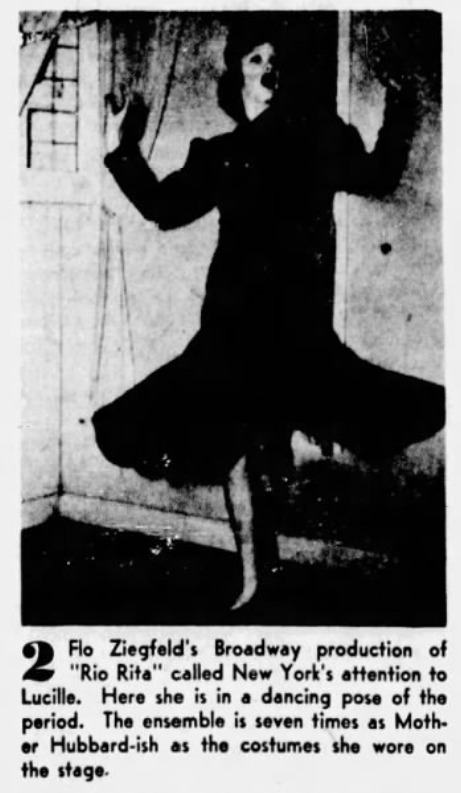
Back in Manhattan, Lucille was cast (but quickly fired) from the chorus of two road shows of Broadway productions. Rio Rita was a New York hit produced by Flo Ziegfeld.

In a 1963 epsiode of “The Lucy Show” Lucy Carmichael says that Thelma Green (Carole Cook) once appeared in the third road company of Rio Rita. The writers used Ball’s real-life history but attributed it to Thelma.
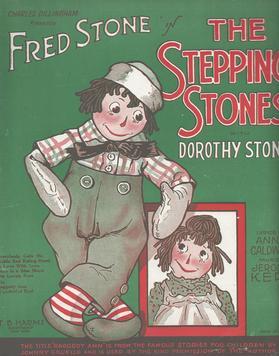
She was also in the road company of The Stepping Stones, a musical fantasy about Raggedy Ann and Andy starring Fred and Dorothy Stone. Again, Lucille was quickly let go.
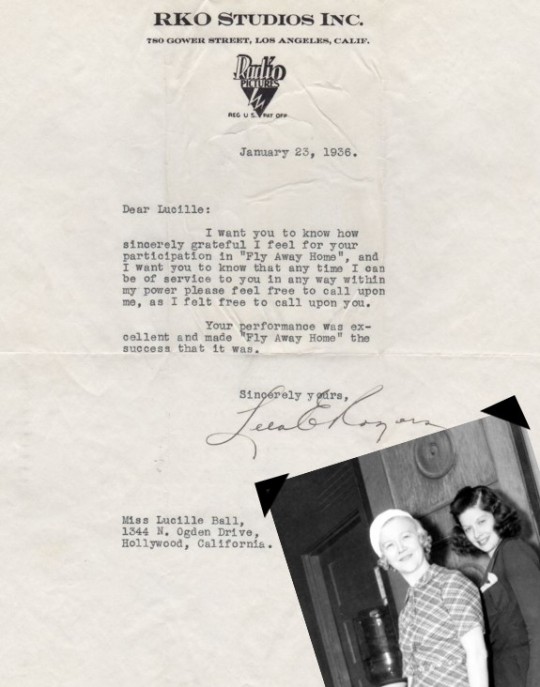
In Hollywood, Lucille Ball was coached by Lela Rogers, Ginger’s mother, on the RKO lot. At the RKO Little Theatre (later the Desilu Workshop Playhouse) Lucille appeared in several plays. In 1936 she was in Fly Away Home, a play that had appeared on Broadway the year before starring Montgomery Clift and Sheldon Leonard. Agents, Managers, and members of the public could attend for twenty five cents.

Also in 1936, she appeared in Breakfast With Vanora by Fred Ballard, which received good notices in the press. Lucille played the leading role and Barbara Pepper was in the ensemble. Above, Lela instructs John Shelton how to hold a gun while Lucy looks on.

In 1937, Lucille took a break from Hollywood to make (what she hoped) would be her Broadway debut in Hey Diddle Diddle, a play by Bartlett Cormack starring Conway Tearle. The play premiered at McCarter Theatre in Princeton, New Jersey, with a destination of the Vanderbilt Theatre on Broadway. In its second out-of-town stop in Washington DC, Tearle become gravely ill. That, combined with the fact that producers felt the script needed revisions, caused the production to be halted. Lucille returned to Hollywood. In 1953, Tearle’s name was mentioned on “I Love Lucy.” He had died in 1938.
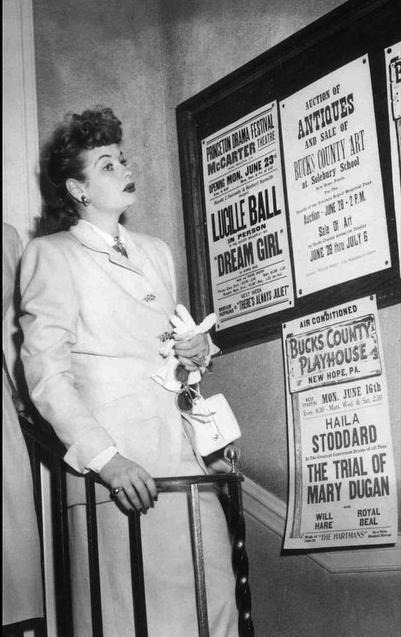
In mid-1947, now married and a successful film star, Lucille Ball again began to think about her stage aspirations and left Hollywood for the boards. She toured in a revival of Dream Girl, a fantasy play by Elmer Rice that had played Broadway in 1945.

The play’s fantasy sequences seemed tailor-made for Ball’s style and comic wit. In a way, Georgina was a prelude to the “Lucy” character on TV, who is dreaming her way out of her suburban life – and sometimes succeeding.
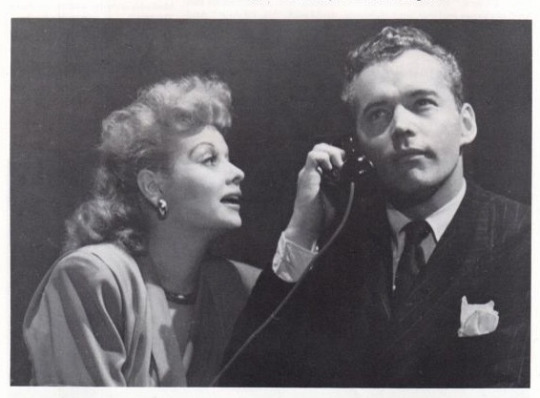
The play co-starred Scott McKay as the imaginative writer. McKay played the role of Wilbur in the 1958 pilot for TV’s “Mr. Ed” but was replaced on the series by Alan Young.
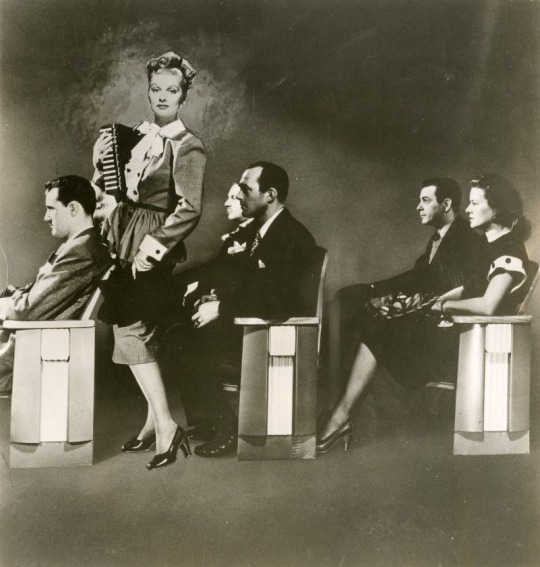
“I have seen other productions of this play, but the only actress whose performance really delighted me was Lucille Ball. She lacked… tender wistfulness, but her vivid personality and expert timing kept the play bright and alive.” ~ Edgar Rice, Playwright

The tour was produced by Herbert Kenwirth who later directed 14 episodes of “Here’s Lucy.” It featured Barbara Morrison, Alan Hewitt, and Hayden Rorke, who would all later appear on Lucy sitcoms.

In January 1948, Lucille got the opportunity to recreate the role in Los Angeles, but fell ill with a virus shortly after it opened and the show closed prematurely. It wasn’t long before Lucille was back in front of a live audience, but this time on radio, as the star of the sitcom “My Favorite Husband,” which led to her meteoric success on “I Love Lucy.”

After the series came to an end in early 1960, Lucille again revived hopes of acting on Broadway. Wildcat, a new musical about by Richard Nash with songs by Cy Coleman was looking for a star. Nash had envisioned the main character of as a woman in her late 20s, and was forced to rewrite the role when 49 yearl-old Lucille Ball expressed interest not only in playing it but financing the project as well. Lucille personally chose her co-stars Keith Andes as her love interest and Pauls Stewart as her sister. Future sitcom star Valerie Harper was in the chorus (above right).
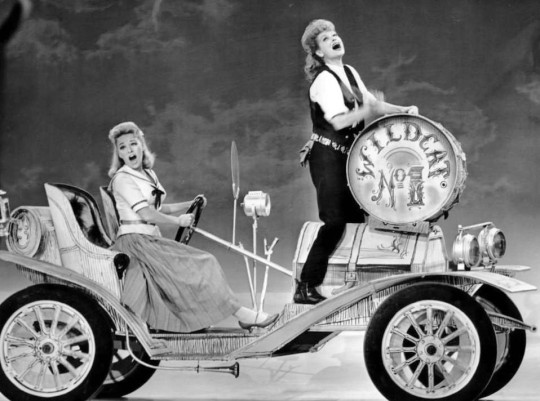
Lucille played Wildcat ‘Wildy’ Jackson, who dreams of striking oil in 1912 Centavo City, California. The score included what would become her signature tune: “Hey, Look Me Over”.
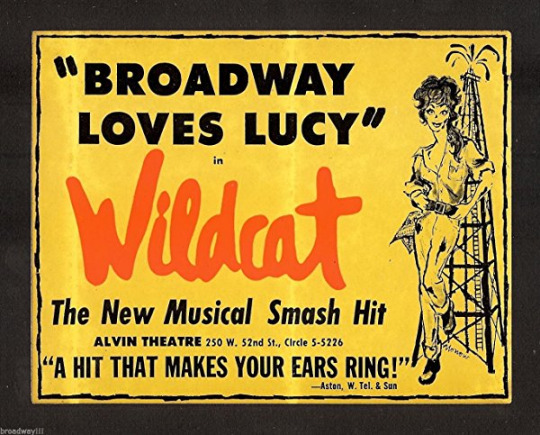
The Philadelphia tryout opened on October 29, 1960 to a glowing review from Variety, but local critics were less enthusiastic. The scheduled Broadway opening had to be postponed when trucks hauling the sets and costumes to New York were stranded on the New Jersey Turnpike by a major blizzard. After two previews, the show opened on December 16 at the Alvin Theatre (now the Neil Simon).
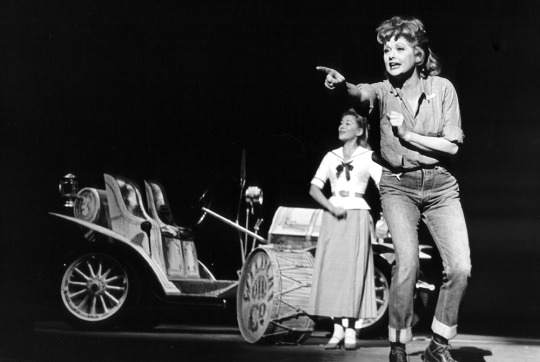
Ball quickly realized audiences had come expecting to see her Lucy Ricardo persona and began ad-libbing to bring her characterization closer to that of the zany housewife she had portrayed on television. But the rigors of singing and dancing in a Broadway musical eight times a week caught up with Ball. She got illl and demands for refunds ran high, the producers planned to close the show for a week to allow her to recover. The closure came sooner than planned when Ball, suffering from a virus and chronic fatigue, departed for Florida. She returned two weeks later, but collapsed on stage. It was decided the show would close for nine weeks at the end of May and reopen once its star had fully recovered but when the musicians’ union insisted on members of the orchestra being paid during the shutdowns. Not even Lucille’s deep pockets could afford the cost, and the show closed permanently on June 3, 1961.

Lucille returned to Hollywood, her dream realized, even if it was short-lived. Thereafter, she would incorporate her love for theatre into her television and film performances, starring in many ‘mini-musicals’ on “The Lucy Show” and “Here’s Lucy” and – in 1974 – tackling the full-scale Broadway musical Mame on film.
 Papermoon Loves Lucy
Leave a comment