January 27, 1950
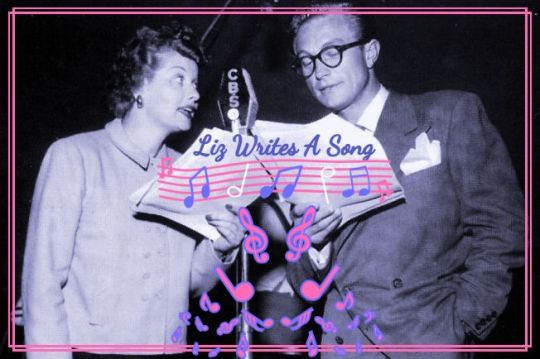
“Liz Writes a Song” is episode #73 of the radio series MY FAVORITE HUSBAND broadcast on January 27, 1950 over the Armed Forces Radio and Television Service.
Synopsis ~ Liz is convinced that she is a musical talent, but when a music professor tells her she’ll never be a singer, she decides to take up songwriting.

Portions of this script were later used as inspiration for “The Benefit” (ILL S1;E13) filmed on November 30, 1951 and first aired on January 7, 1952. The premise of the foursome gathering around the piano for a night of singing and discovering Lucy cannot hold a tune is identical to this radio script.
This was the 22st episode of the second season of MY FAVORITE HUSBAND, the second of the new year and of the new decade (1950). There were 43 new episodes, with the season ending on June 25, 1950.

“My Favorite Husband” was based on the novels Mr. and Mrs. Cugat, the Record of a Happy Marriage (1940) and Outside Eden (1945) by Isabel Scott Rorick, which had previously been adapted into the film Are Husbands Necessary? (1942). “My Favorite Husband” was first broadcast as a one-time special on July 5, 1948. Lucille Ball and Lee Bowman played the characters of Liz and George Cugat, and a positive response to this broadcast convinced CBS to launch “My Favorite Husband” as a series. Bowman was not available Richard Denning was cast as George. On January 7, 1949, confusion with bandleader Xavier Cugat prompted a name change to Cooper. On this same episode Jell-O became its sponsor. A total of 124 episodes of the program aired from July 23, 1948 through March 31, 1951. After about ten episodes had been written, writers Fox and Davenport departed and three new writers took over – Bob Carroll, Jr., Madelyn Pugh, and head writer/producer Jess Oppenheimer. In March 1949 Gale Gordon took over the existing role of George’s boss, Rudolph Atterbury, and Bea Benaderet was added as his wife, Iris. CBS brought “My Favorite Husband” to television in 1953, starring Joan Caulfield and Barry Nelson as Liz and George Cooper. The television version ran two-and-a-half seasons, from September 1953 through December 1955, running concurrently with “I Love Lucy.” It was produced live at CBS Television City for most of its run, until switching to film for a truncated third season filmed (ironically) at Desilu and recasting Liz Cooper with Vanessa Brown.
MAIN CAST

Lucille Ball (Liz Cooper) was born on August 6, 1911 in Jamestown, New York. She began her screen career in 1933 and was known in Hollywood as ‘Queen of the B’s’ due to her many appearances in ‘B’ movies. With Richard Denning, she starred in a radio program titled “My Favorite Husband” which eventually led to the creation of “I Love Lucy,” a television situation comedy in which she co-starred with her real-life husband, Latin bandleader Desi Arnaz. The program was phenomenally successful, allowing the couple to purchase what was once RKO Studios, re-naming it Desilu. When the show ended in 1960 (in an hour-long format known as “The Lucy-Desi Comedy Hour”) so did Lucy and Desi’s marriage. In 1962, hoping to keep Desilu financially solvent, Lucy returned to the sitcom format with “The Lucy Show,” which lasted six seasons. She followed that with a similar sitcom “Here’s Lucy” co-starring with her real-life children, Lucie and Desi Jr., as well as Gale Gordon, who had joined the cast of “The Lucy Show” during season two. Before her death in 1989, Lucy made one more attempt at a sitcom with “Life With Lucy,” also with Gordon.
Richard Denning (George Cooper) was born Louis Albert Heindrich Denninger Jr., in Poughkeepsie, New York. When he was 18 months old, his family moved to Los Angeles. Plans called for him to take over his father’s garment manufacturing business, but he developed an interest in acting. Denning enlisted in the US Navy during World War II. He is best known for his roles in various science fiction and horror films of the 1950s. Although he teamed with Lucille Ball on radio in “My Favorite Husband,” the two never acted together on screen. While “I Love Lucy” was on the air, he was seen on another CBS TV series, “Mr. & Mrs. North.” From 1968 to 1980 he played the Governor on “Hawaii 5-0″, his final role. He died in 1998 at age 84.
Gale Gordon (Rudolph Atterbury) had worked with Lucille Ball on “The Wonder Show” on radio in 1938. One of the front-runners to play Fred Mertz on “I Love Lucy,” he eventually played Alvin Littlefield, owner of the Tropicana, during two episodes in 1952. After playing a Judge in an episode of “The Lucy-Desi Comedy Hour” in 1958, he would re-team with Lucy for all of her subsequent series’: as Theodore J. Mooney in ”The Lucy Show”; as Harrison Otis Carter in “Here’s Lucy”; and as Curtis McGibbon on “Life with Lucy.” Gordon died in 1995 at the age of 89.
Bea Benadaret (Iris Atterbury) was considered the front-runner to be cast as Ethel Mertz but when “I Love Lucy” was ready to start production she was already playing a similar role on TV’s “The George Burns and Gracie Allen Show” so Vivian Vance was cast instead. On “I Love Lucy” she was cast as Lucy Ricardo’s spinster neighbor, Miss Lewis, in “Lucy Plays Cupid” (ILL S1;E15) in early 1952. Later, she was a success in her own show, “Petticoat Junction” as Shady Rest Hotel proprietress Kate Bradley. She starred in the series until her death in 1968.
Ruth Perrott (Katie, the Maid) was also later seen on “I Love Lucy.” She first played Mrs. Pomerantz, a member of the surprise investigating committee for the Society Matrons League in “Pioneer Women” (ILL S1;E25), as one of the member of the Wednesday Afternoon Fine Arts League in “Lucy and Ethel Buy the Same Dress” (ILL S3;E3), and also played a nurse when “Lucy Goes to the Hospital” (ILL S2;E16). She died in 1996 at the age of 96.
Bob LeMond (Announcer) also served as the announcer for the pilot episode of “I Love Lucy”. When the long-lost pilot was finally discovered in 1990, a few moments of the opening narration were damaged and lost, so LeMond – fifty years later – recreated the narration for the CBS special and subsequent DVD release.
GUEST CAST

Hans Conried (Professor Krausemeyer / Mr. Wood, the Cooper’s neighbor) first co-starred with Lucille Ball in The Big Street (1942). He then appeared on “I Love Lucy” as used furniture man Dan Jenkins in “Redecorating” (ILL S2;E8) and later that same season as Percy Livermore in “Lucy Hires an English Tutor” (ILL S2;E13) – both in 1952. The following year he began an association with Disney by voicing Captain Hook in Peter Pan. On “The Lucy Show” he played Professor Gitterman in “Lucy’s Barbershop Quartet” (TLS S1;E19) and in “Lucy Plays Cleopatra” (TLS S2;E1). He was probably best known as Uncle Tonoose on “Make Room for Daddy” starring Danny Thomas, which was filmed on the Desilu lot. He joined Thomas on a season 6 episode of “Here’s Lucy” in 1973. He died in 1982 at age 64.
Conried uses a German accent for the role of the Professor. He previously played Krausemeyer in “Piano and Violin Lessons” (aka “Professor Krausmeyer’s Talent Scouts”), episode #26, broadcast on January 14, 1949. Professor Krausmeyer is likely the inspiration for Professor Gitterman on “The Lucy Show.” It is unusual for Conried to play back to back characters in one episode, but he regularly plays Mr. Wood and listeners would know his voice.

Hal March (Radio Host) first appeared on the “I Love Lucy” in “Lucy Fakes Illness” (ILL S1;E16) using his own name to play an actor posing as the doctor who diagnoses Lucy with ‘golbloots.’ March got his first big break when he was cast as Harry Morton on “The George Burns and Gracie Allen Show” in 1950. He eventually lost the part to Fred Clark who producers felt was better paired with Bea Benaderet, who played Blanche, and here plays Iris Atterbury. He stayed with the show in other roles, the last airing just two weeks before his appearance as Eddie Grant in “Lucy is Matchmaker” (ILL S2;E27). In 1966 he was seen on “The Lucy Show.”

Norma Zimmer (Radio Singer) was one of the citizens of Kildoonan in
“Lucy Goes to Scotland” (ILL S5;E17). She also appeared as a chorus girl in Singin’ in the Rain (1952). She would become famous as Lawrence Welk’s Champagne Lady and 20 years later introduced the episode “Lucy Meets Lawrence Welk” (HL S2;E18) on the “Here’s Lucy” series 2 DVD.
EPISODE
ANNOUNCER: “As we look in on the Coopers, it’s evening and Liz and George are entertaining George’s boss, Mr. Atterbury, and his wife. Dinner’s over and the group is in the living room having coffee.”

“Bibbidi-Bobbidi-Boo” (also called “The Magic Song”) was written by Al Hoffman, Mack David, and Jerry Livingston for the 1950 film Cinderella. Coincidentally, it was first performed by actress Verna Felton, who would go on to play the Ricardo’s maid, Mrs. Hudson, and star in the Desilu sitcom “December Bride” as Hilda. The song was nominated for the Academy Award for Best Original Song in 1951 but lost out to “Mona Lisa” from Captain Carey, U.S.A.
Mr. Atterbury doesn’t understand the song’s nonsense lyrics. Liz explains:
LIZ: “It’s ‘Mairzys Doates’ sung sideways.”

“Mairzy Doats” is a novelty song written in 1943 by Milton Drake, Al Hoffman, and Jerry Livingston, two of the same writers that would create “Bibbidi-Bobbidy-Boo.” The song made the pop charts several times, with a version by the Merry Macs reaching No. 1 in March 1944. The song was also a number-one sheet music seller, with sales of over 450,000. Bing Crosby also had a hit with the silly song.
George flips the radio off the radio and Mr. Atterbury complains that they don’t write songs like they used to. Iris sarcastically reminds him of his youth by asking him to sing ‘Vo-do-do-de-o.”

Iris is probably referring to “Vo-do-do-de-o Blues” a novelty song written by Jack Yellen and Milton Ager in 1927, although the term “Vo-do-do-de-o” was common slang in the 1920s and was found in a number of songs of the time.
Mr. Atterbury says that there was nothing like “When Francis Dances With Me” and “The Sheik of Araby” – even singing a few bars.

“When Francis Dances With Me” was written by Sol Violinsky and Ben Ryan in 1921 and covered by The Andrews Sisters in 1958. “The Sheik of Araby” was written in 1921 by Harry B. Smith and Francis Wheeler, with music by Ted Snyder. It was composed in response to the popularity of the Rudolph Valentino feature film The Sheik. On “I Love Lucy,” Lucy’s mother was a fan of Valentino and even sang a few bars of this song in “The Hedda Hopper Story” (ILL S4;E21) in 1955.
Liz notices Mr. Atterbury’s good singing voice. George chimes in with a few choruses of “Yes Sir, That’s My Baby.”

“Yes Sir, That’s My Baby” was written by Walter Donaldson and Gus Kahn in 1925. The title inspired a 1949 film of the same name starring Donald O’Connor and Gloria DeHaven, who will be reunited by Lucille Ball for “Lucy Moves To NBC” in 1980.
The foursome settle on spending a night singing around the piano, starting with a chorus of “When You Wore A Tulip”.

“When You Wore A Tulip And I Wore A Big Red Rose” was written in 1914 by Percy Wenrich and Jack Mahoney and popularized by Dolly Connolly (1888-1965). It was part of the 1942 film For Me And My Gal sung by Gene Kelly and Judy Garland.
It becomes apparent that somebody is out of tune.
MR. ATTERBURY: “One of our songbirds has gravel in his beak!”
No one will confess to being the clunker, so they sound one note at a team till it is revealed that it is Liz who has a tin ear! Iris suggests they sing “Button Up Your Overcoat,” but their quartet has become a trio. Liz must “button up her lip.”

“Button Up Your Overcoat” was written by Ray Henderson, B.G. DeSylva and Lew Brown in 1928, and was first performed by Ruth Etting, who appeared with Lucille Ball in Roman Scandals (1933). However, the most famous rendition of this song was by Helen Kane, the inspiration for the voice of Betty Boop.
Jack Haley and Zelma O’Neal sang it on Broadway in the musical, Follow Thru (1929). They reprised the song in the film version in 1930. It has since been heard in nine films and multiple television shows.
Next day, George says good morning to Liz, who went to bed early while George and the Atterbury’s sang the night away.
LIZ: “Well, if it isn’t Al Jolson. What time did Bing and Dinah go home?”

Singer, comedian, and actor Al Jolson would die 9 months after this broadcast. He co-wrote and introduced the song “California, Here I Come” which was famously sung on “I Love Lucy” in an episode of the same name. Bing Crosby (1903-77) was one of the most successful multi-media stars of his time. He was mentioned by Ricky Ricardo on “I Love Lucy” in “Ricky’s Contract” (ILL S4;E10) in 1954. Dinah Shore (1916-94) was the top-charting female vocalist of the 1940s. Shore guest starred as herself on a 1971 episode of “Here’s Lucy” (HL S4;E7) and Ball made numerous appearances on her talk and variety shows.
Liz tells George that Professor Krausemeyer is coming over to give her voice lessons.
LIZ: “Don’t be surprised if I’m singing on radio before long.”
GEORGE: “Liz, television hasn’t hurt it that much!”

In early 1950, television was still considered an upstart medium, inferior to radio. the idea that television might woo listeners away from the radio was being voiced, but most were still skeptical. As is evidence from the above TV program grid for January 27, 1950, CBS and ABC had no new programs up against “My Favorite Husband” on radio at 8:30pm. Many early television shows, including “I Love Lucy” were aired on both radio and television well into the late 1950s.
GEORGE (leaving for work): “See ya at Carnegie Hall!”

Carnegie Hall is an iconic concert venue in Midtown Manhattan in New York City. It is at 881 Seventh Avenue, occupying the east side of Seventh Avenue between West 56th and 57th Streets. It was built by philanthropist Andrew Carnegie in 1891 and it is still considered the epitome of a vocalists career to sing there.
George bets that Liz will never sing on the radio – even going so far as to promise to roll an egg down main street with his nose if she does!

Katie the Maid opens the door to Professor Krausemeyer (Hans Conried). His theory of singing is that if you can talk, you can sing. The Professor is astounded just how tone deaf Liz really is, but he forges ahead. He tells Liz to just sing something for him. She choses “Stardust” – one of her favorites. Needless to say, she is terribly out of tune. He stops her.
PROFESSOR: “You love that song?
LIZ: “Yes.”
PROFESSOR: “I’d hate to hear you sing something you hate.”

“Star Dust” was composed in 1927 by Hoagy Carmichael with lyrics added by Mitchell Parish in 1929. The song became an American standard and is one of the most recorded songs of the 20th century with over 1,500 recordings. In “The Saxophone”
(ILL S2;E2) in 1952, Ethel requests Lucy play “Star Dust” but it keeps coming out as “The Glow-Worm.”
Professor Krausemeyer finally declares that there are two kinds of singers: those who sing, and those who listen. Liz is in the latter category!
In Part Two, Liz is crying to Katie that she will never be a nightingale. Katie says her sister writes songs and lets others sing them. She wrote the ‘hit’ songs: “Think of Your Friends as Bananas and Count Me as One of the Bunch” and “I Call My Little Boy Tripod Since He’s Grown Another Foot.” Katie tells Liz there’s a weekly song-writing contest at the local radio station and Liz intends on entering it.
LIZ: “Carrie Jacobs Cooper writes again!”

Carrie Jacobs-Bond (1862-1946) was a songwriter who composed some 175 pieces of popular music from the 1890s through the early 1940s. She is perhaps best remembered for writing the parlor song “I Love You Truly”, becoming the first woman to sell one million copies of a song.
The song was sung by Elizabeth Patterson when Lucy Ricardo renewed her vows to Ricky in “The Marriage License” (ILL S1;E26) and briefly by Viv Bagley in Chris Goes Steady (TLS S2;E16) in 1964.
After several hours of song-writing, Liz is going crazy repeating rhymes to write lyrics for her songs. Her neighbor, Mr. Wood (Hans Conried again) comes to the door and strikes a deal that they will be co-authors of songs for the contest. Liz plunks out the tune she has been working on. It is identical to “My Country ‘Tis Of Thee”! Mr. Wood tells her that this also happened to him. He was once accused of stealing a tune from Tchaikovsky.
but he didn’t. He actually stole from Freddy Martin who stole it from Tchaikovsky!

Freddy Martin (1906-83) was a bandleader and saxophonist who appeared as himself on a 1971 episode of “Here’s Lucy”. His theme song, “Tonight We Love,” was adapted from the first movement of Tchaikovsky’s First Piano Concerto. It sold over one million copies by 1946, and was awarded a gold record.

Mr. Wood says they should should seek inspiration on songs from the past. Liz reckons that their song should have a girl’s name in it.
“Look at “Margie”, “Dinah”, “Laura”, “Sweet Sue”.
-
“Margie” (aka “My Little Margie”) by Benny Davis, a vaudeville performer and songwriter. The song was introduced by the Original Dixieland Jazz Band in 1920.
- “Dinah” was written in 1925 by Harry Akst, Sam M. Lewis and Joe Young. One singer, Fannye Rose Shore, became so identified with the song that a DJ called her “Dinah Shore”, which then stuck as her stage name for the next 50 years.
- “Laura” was composed by David Raksin for the 1944 movie Laura, which starred Gene Tierney and Dana Andrews.
-
“Sweet Sue (Just You)” is a jazz standard of 1928, composed by Victor Young with lyrics by Will J. Harris. On “I Love Lucy,” it was one of the few songs Lucy Ricardo could play on the saxophone, next to the previously mentioned “Glow Worm.”
Mr. Wood says there should be a city in it, too:
“Like Chicago”, “Chattanooga Choo-Choo”, “Meet Me In Old St. Louis.”
-
”Chicago“ was written by Fred Fisher and published in 1922. The song has been recorded by many artists, but the best-known version is by Frank Sinatra. It was heard on screen in The Story of Vernon and Irene Castle (1930), Roxie Hart (1945), and Oh, You Beautiful Doll (1949).
-
”Chattanooga Choo Choo“ is a 1941 song written by Mack Gordon and composed by Harry Warren. It was originally recorded by Glenn Miller and His Orchestra and featured in the 1941 movie Sun Valley Serenade. It was the first song to receive a gold record in 1942.
- "Meet Me in St. Louis” is a song from 1904 with words by Andrew B. Sterling; and music by Kerry Mills. The song was the centerpiece of the 1944 Judy Garland movie, Meet Me in St. Louis.
Liz says it should also be a western, citing:
“Ghost Riders in the Sky” and “Mule Train.”
- “(Ghost) Riders in the Sky” is a cowboy-styled country / western song written in 1948 by Stan Jones. A number of versions were crossover hits on the pop charts in 1949, the most successful being by Vaughn Monroe.
- “Mule Train” was written by Johnny Lange, Hy Heath, Ramblin’ Tommy Scott and Fred Glickman. It is a cowboy song originally recorded by Ellis “Buz” Butler Jr. in 1947. The song was featured in the 1950 film Singing Guns (sung by Vaughn Monroe) and nominated for the Academy Award for Best Original Song in 1950, but lost to “Mona Lisa”.
LIZ: “All we need is a girl who is going to a city who falls in love with a ghost writer who beats her with a whip. Let’s get started!”
The day of the contest, Liz is nervously pacing by the telephone waiting to hear the results. Mr. Wood went down to the radio station to see what he could find out. Mr. Wood phones and tells Liz the good news that they won! They will both have to sing it on the radio that night, although Liz insists she will just stand nearby and look pretty while he does the singing.
Arriving at the radio station with the Atterburys and George in tow, she finds out that Mr. Wood has developed laryngitis. The radio host (Hal March) introduces Liz and Mr. Wood, and tells him that she will have to sing for Mr. Wood, who has lost his voice. Their song sounds suspiciously like “Home on the Range,” if Liz can only sing loud enough to be heard, that is.
The host volunteers sings with her to boost her volume.
LIZ & HOST (singing): “Oh, I’ve got a girl
Her first name is Pearl
She comes from Pittsburgh, PA.
She looks like a witch,
But her old man is rich,
and her last name is yippy ki-yay!”
Liz wins the prize and George realizes he will have to roll an egg down main street with his nose!

In the bedtime tag, Liz wakes up George, who is snoring. She puts a pillow over his face to stop his snoring, but then fears he has stopped breathing – until he gives another great, big snore.
 Papermoon Loves Lucy
Leave a comment