December 30, 1950

“Liz Has the Flimjabs” (aka “A Severe Case of Flimjabs”) is episode #112 of the radio series MY FAVORITE HUSBAND broadcast on December 30, 1950.
This was the 14th episode of the third season of MY FAVORITE HUSBAND. There were 31 new episodes, with the season ending on March 31, 1951.
Synopsis ~ Liz wants a mink coat from George, so she pretends to be sick in order to get his sympathy – and the coat! George is on to her tactics, and decides to give her the scare of her life – literally!

Note: This program served as the basis for the “I Love Lucy” episode “Lucy Fakes Illness” (ILL S1;E16) filmed on December 18, 1951 and first aired on January 28, 1952. The role of the Doctor was taken by Hal March, who was actually playing an actor friend of Ricky’s named Hal March pretending to be a doctor. On television, Lucy also adopts a psychological illness in addition to her physical ailments. There was no mention of Christmas or New Years on the television show.

“My Favorite Husband” was based on the novels Mr. and Mrs. Cugat, the Record of a Happy Marriage (1940) and Outside Eden (1945) by Isabel Scott Rorick, which had previously been adapted into the film Are Husbands Necessary? (1942). “My Favorite Husband” was first broadcast as a one-time special on July 5, 1948. Lucille Ball and Lee Bowman played the characters of Liz and George Cugat, and a positive response to this broadcast convinced CBS to launch “My Favorite Husband” as a series. Bowman was not available Richard Denning was cast as George. On January 7, 1949, confusion with bandleader Xavier Cugat prompted a name change to Cooper. On this same episode Jell-O became its sponsor. A total of 124 episodes of the program aired from July 23, 1948 through March 31, 1951. After about ten episodes had been written, writers Fox and Davenport departed and three new writers took over – Bob Carroll, Jr., Madelyn Pugh, and head writer/producer Jess Oppenheimer. In March 1949 Gale Gordon took over the existing role of George’s boss, Rudolph Atterbury, and Bea Benaderet was added as his wife, Iris. CBS brought “My Favorite Husband” to television in 1953, starring Joan Caulfield and Barry Nelson as Liz and George Cooper. The television version ran two-and-a-half seasons, from September 1953 through December 1955, running concurrently with “I Love Lucy.” It was produced live at CBS Television City for most of its run, until switching to film for a truncated third season filmed (ironically) at Desilu and recasting Liz Cooper with Vanessa Brown.
MAIN CAST

Lucille Ball (Liz Cooper) was born on August 6, 1911 in Jamestown, New York. She began her screen career in 1933 and was known in Hollywood as ‘Queen of the B’s’ due to her many appearances in ‘B’ movies. With Richard Denning, she starred in a radio program titled “My Favorite Husband” which eventually led to the creation of “I Love Lucy,” a television situation comedy in which she co-starred with her real-life husband, Latin bandleader Desi Arnaz. The program was phenomenally successful, allowing the couple to purchase what was once RKO Studios, re-naming it Desilu. When the show ended in 1960 (in an hour-long format known as “The Lucy-Desi Comedy Hour”) so did Lucy and Desi’s marriage. In 1962, hoping to keep Desilu financially solvent, Lucy returned to the sitcom format with “The Lucy Show,” which lasted six seasons. She followed that with a similar sitcom “Here’s Lucy” co-starring with her real-life children, Lucie and Desi Jr., as well as Gale Gordon, who had joined the cast of “The Lucy Show” during season two. Before her death in 1989, Lucy made one more attempt at a sitcom with “Life With Lucy,” also with Gordon.
Richard Denning (George Cooper) was born Louis Albert Heindrich Denninger Jr., in Poughkeepsie, New York. When he was 18 months old, his family moved to Los Angeles. Plans called for him to take over his father’s garment manufacturing business, but he developed an interest in acting. Denning enlisted in the US Navy during World War II. He is best known for his roles in various science fiction and horror films of the 1950s. Although he teamed with Lucille Ball on radio in “My Favorite Husband,” the two never acted together on screen. While “I Love Lucy” was on the air, he was seen on another CBS TV series, “Mr. & Mrs. North.” From 1968 to 1980 he played the Governor on “Hawaii 5-0″, his final role. He died in 1998 at age 84.
Bea Benadaret (Iris Atterbury) was considered the front-runner to be cast as Ethel Mertz but when “I Love Lucy” was ready to start production she was already playing a similar role on TV’s “The George Burns and Gracie Allen Show” so Vivian Vance was cast instead. On “I Love Lucy” she was cast as Lucy Ricardo’s spinster neighbor, Miss Lewis, in “Lucy Plays Cupid” (ILL S1;E15) in early 1952. Later, she was a success in her own show, “Petticoat Junction” as Shady Rest Hotel proprietress Kate Bradley. She starred in the series until her death in 1968.
Ruth Perrott (Katie, the Maid) was also later seen on “I Love Lucy.” She first played Mrs. Pomerantz, a member of the surprise investigating committee for the Society Matrons League in “Pioneer Women” (ILL S1;E25), as one of the member of the Wednesday Afternoon Fine Arts League in “Lucy and Ethel Buy the Same Dress” (ILL S3;E3), and also played a nurse when “Lucy Goes to the Hospital” (ILL S2;E16). She died in 1996 at the age of 96.
Bob LeMond (Announcer) also served as the announcer for the pilot episode of “I Love Lucy”. When the long-lost pilot was finally discovered in 1990, a few moments of the opening narration were damaged and lost, so LeMond – fifty years later – recreated the narration for the CBS special and subsequent DVD release.
Gale Gordon (Rudolph Atterbury) does not appear in this episode.
GUEST CAST

Frank Nelson (Dr. Stevenson) was born on May 6, 1911 (three months before Lucille Ball) in Colorado Springs, Colorado. He started working as a radio announcer at the age of 15. He later appeared on such popular radio shows as “The Great Gildersleeve,” “Burns and Allen,” and “Fibber McGee & Molly”. Aside from Lucille Ball, Nelson is perhaps most associated with Jack Benny and was a fifteen-year regular on his radio and television programs. His trademark was playing clerks and other working stiffs, suddenly turning to Benny with a drawn out “Yeeeeeeeeees?” Nelson appeared in 11 episodes of “I Love Lucy”, including three as quiz master Freddy Fillmore, and two as Ralph Ramsey, plus appearance on “The Lucy-Desi Comedy Hour” – making him the only actor to play two different recurring roles on “I Love Lucy.” Nelson returned to the role of the frazzled Train Conductor for an episode of “The Lucy Show” in 1963. This marks his final appearance on a Lucille Ball sitcom.
The doctor’s surname may be a reference to noted costume designer Edward Stevenson, who designed gowns for Lucille Ball in more than a dozen RKO films and would eventually become costume designer of “I Love Lucy” after the departure of Elois Jenssen in 1955.
EPISODE
ANNOUNCER: “And now, let’s look in on the Coopers. It’s evening, and Liz and George are sitting in the living room admiring their Christmas tree.“
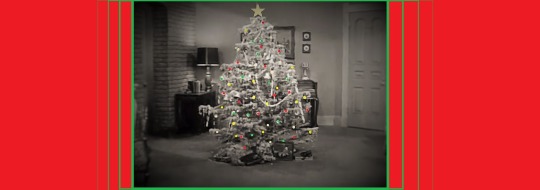
George wonders if it is time to take the Christmas tree down but Liz doesn’t want to. They agree to put away their presents instead and start to talk about the gifts they didn’t give or get.
Liz nearly bought George a set of matching golf clubs. George says he nearly bought her a mink jacket. He says he saw it in the window at Millers, but realized he couldn’t afford it. Liz sadly reminds him that she has never had a fur coat and wonders if they could afford it if they all their Christmas gifts to the store. George says it still wouldn’t be enough, but Liz wants to wear something special to the Atterbury’s New Year’s Eve party.
Next morning, in the kitchen, Katie the Maid asks Liz why she is so sad. Liz tells her about her mink jacket dreams. Liz solicits Katie’s opinion on how she can’t best get George to get her a mink jacket in time for the party. Liz decides to play sick since George always gets her what she wants when she’s ill.
After dinner, Liz and George contemplate what to do. Liz suggests going to the movies to see Harvey starring Jimmy Stewart, which is playing at the Strand.

Harvey is a comedy about a man whose best friend is a six-foot tall imaginary rabbit. It premiered just ten days earlier before this broadcast and starred James Stewart. The film won an Oscar for Josephine Hull. The screenplay was based on the 1944 Broadway play of the same name by Mary Chase which won the 1945 Pulitzer Prize for Drama.
Before Liz can tell George the second feature, she starts to writhe in pain! Amid moans and groans, Liz details the pain for George. She says she used to have these attacks as a child. When she says the only thing that sometimes helps is little gifts to make her happy, George gets suspicious. He quickly leaves the room to make a phone call, which Liz thinks is to buy her a mink jacket, but he has actually called the doctor!
End of Part One
Bob LeMond presents a live Jell-O commercial, giving a basic recipe for preparation of all delicious six flavors!
ANNOUNCER: “As we look in on the Coopers once again, Liz is pretending to be sick and George, who is worried about her, has called the doctor.”
The doorbell rings and George admits Dr. Stevenson (Frank Nelson). Before seeing Liz, George tips him off that Liz may have a rare disease and that the only cure is a mink coat! George asks him to give her a good scare and the Doctor agrees to play along.

Entering the bedroom, Liz immediately tells the Doctor she feels much better. But after a quick exam, the Doctor diagnoses Liz with a rare tropical disease from the West Indies called the ‘Flimjabs’. The only cure is to operate and remove her ‘torkle’ but warns her that she will never be able to ‘yammle’ again. The Doctor explains that ‘yammling’ is an involuntary peristalsis of the transverse clavis.
GEORGE: “Doctor, do you have to remove the whole torkle?”
DOCTOR: “Maybe we’ll be lucky and can save half of it. After all, half a torkle is better than none.”
LIZ: “Well, I should say so! I’d hate to think of never yammeling again!”
The Doctor says that they must now wait 24 hours and see if she turns green.
DOCTOR: “If you turn green, three hours later (snaps his fingers) gone.”
LIZ: (snaps) “Gone?”
DOCTOR: (snaps) “Gone.”

For the television script, the ‘Flimjabs’ was renamed the ‘Gobloots’ – a rare tropical disease that carried into America on the hind legs of the ‘boo-shoo bird.’ It can necessitate a person having to undergo a ‘zorchectomy’ – total or partial removal of the ‘zorch’. Even if doctors are able to save half a person’s ‘zorch,’ the patient will never be able to ‘trummle’ again. ‘Trummling’ is a mysterious involuntary internal process. Finally, if you turn green while suffering from the ‘gobloots’ you will be dead in 30 minutes!
Iris Atterbury drops by to see Liz on her way to the Bridge Club meeting. Liz tells her that she has been diagnosed with the Flimjabs.
IRIS: “Oh, how exciting! This will make Betty Ricky’s gallstones look sick! She’ll be absolutely green.”
LIZ: “She’s not the only one. That’s one of the danger signs. I may turn green.”
IRIS: “With a green face and red hair, you’ll be out of this world.”
LIZ: “Yes, that’s what I’m afraid of.”
Iris is overcome with emotion at the thought of losing Liz. She doesn’t want to leave, but the ice cream for the Bridge Club meeting is in the car and it’s melting!
That night, Doctor Stevenson returns to check on Liz. Answering the door, George confesses that he’s put a green light bulb in Liz’s bedroom light. As soon as George turns on the lights, Liz shrieks seeing her green hands! Her face and hair have turned green, too! Liz thinks the men have Flimjabs too, because they are also green, but then the truth sets in.

LIZ: “Oh, no! This is the end! I’m looking at the world through green colored eyeballs!”
Liz dramatically declares that she’s dying. George accuses her of being over-dramatic.
LIZ: “I’m sorry, George. But I don’t die every day and it’s new to me.”
Before her imminent demise, Liz confesses to all the car accidents she’s had and hidden by having the car fixed without telling him.
LIZ: “In fact, the only thing left of the original car you bought is the ashtray in the back seat!”

Then Liz bravely confesses to pretending to be sick to get him to buy her a mink coat. George also needs to make a confession: it was all a trick. There is no such thing as ‘Flimjabs’ and the light is from a green light bulb!
The phone rings and it is Iris, tearfully calling from the Bridge Club meeting. The girls have just had a memorial ceremony for Liz by turning her chair to the wall and smashing her teacup in the fireplace. Before Liz can tell Iris that it was a joke, she learns that they all chipped in and bought her a goodbye present: a mink coat! Liz hangs up in tears. George is confused.
GEORGE: “Isn’t that what you wanted?”
LIZ: “Yeah, but I have to die to get it!”
END OF EPISODE

In the live Jell-O commercial, Lucille Ball and Bob LeMond play a couple of nomads lost in the desert. Lucy uses her ‘Isabella Clump’ voice as ‘Smith’. Bob is looking for his camp, near a big dune.
LUCY / ‘SMITH’: “A dune? What’s a dune?”
BOB: “What’s a dune????”
LUCY / ‘SMITH’: “I dunno. What’s a-dune with you?”
Smith sees a mirage – a big bowl of Jell-O! After describing the six delicious flavors, Bob suggests they go home.
BOB: “Go home? We’re lost in the desert!”
LUCY / ‘SMITH’: “Why don’t we each take one of those cars.”
BOB: “What cars?”
LUCY / ‘SMITH’: “The ones over there. That’s a two-car mirage!”


The same date this episode was broadcast, columnist Sid Shalit in the New York Daily News reported that a television situation comedy was being prepared starring Lucille Ball and Desi Arnaz in the mold of “My Favorite Husband”. Clearly, the radio series was winding down. This was the final episode of 1950 with only 16 episodes left.

Meanwhile, in addition to radio and television, Ball was on the nation’s movie screens in two 1950 films: The Fuller Brush Girl and Fancy Pants.
 Papermoon Loves Lucy
Leave a comment