September 26, 1952

Friday, September 26, 1952 was a particularly busy news day for Lucille Ball. “I Love Lucy” had just kicked off season two with the iconic “Job Switching” episode and followed up with the memorable “The Saxophone”. That day, several press releases and Lucille Ball references hit the nation’s newspapers all at once! Let’s take a look…

UP (United Press later known as United Press International or UPI) released the above story by Aline Mosby. After one highly successful season of “I Love Lucy” on television, movie studios were eager to woo Ball back to the silver screen. At this time, television’s increasing popularity threatened movie attendance, competing for consumers’ entertainment dollar. Ball states that she doesn’t know if she’ll ever work in a “theatre movie” again. Of course, that proved not to be true. Although she was much more selective in her film roles after 1951, Ball did six films after “I Love Lucy,” with varying degrees of success: The Long, Long Trailer (1953), Forever Darling (1956), The Facts of Life (1960), Critic’s Choice (1962), Yours Mine and Ours (1968), and Mame (1974).

Aline Mosby (1922-98) mostly wrote for UPI. She was the first American woman correspondent assigned by a major news service to the Moscow Kremlin and later Beijing. While in Russia, she famously met and interviewed Lee Harvey Oswald in 1959, four years before he assassinated John F. Kennedy. Mosby was also the first journalist to report on the Marilyn Monroe nude calendar in March 1952, just six months before this article. In 1962 she appeared as a contestant on “To Tell The Truth”.
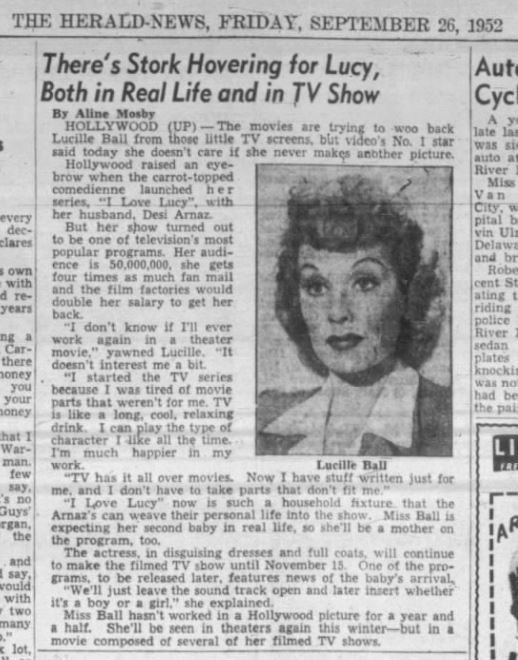
While newspapers generally reprinted a UP article verbatim, they were free to edit for space. Here the end of the article (omitted in some papers) talks about Lucille Ball’s pregnancy and how it will affect her television show. Her claim that they will leave the gender a mystery by keeping the soundtrack open proved not to be the case. When Lucille Ball discovered that she would have a boy, it was determined that the Ricardo baby would also be a boy, although the news was kept from the public and the press until the baby’s birth on January 18, 1953.

The last lines of the article talk about a film comprised of several “I Love Lucy” episodes. Shortly after the end of the first season of I Love Lucy, Lucille and Desi decided to cash in on their show’s popularity by compiling several episodes of the first season of the series into a movie. A test screening in Bakersfield, California, went very well but MGM demanded the film be shelved because they felt it would diminish interest in the upcoming film, The Long, Long Trailer. The I Love Lucy movie was ultimately forgotten until it was discovered and released on DVD in 2000.


In addition to editing for space, newspapers were free to create their own headlines and to add photographs to go along with the UP article.

In lieu of using the UP article, some newspapers used the quotes of Mosby’s story to create their own news item.

The same date this UP article appeared, RKO Boston took out an ad announcing a “Fuller Brush” double feature! The Fuller Brush Girl (1950) was already two years old when this article appeared. It was a sequel to The Fuller Brush Man (1948) starring Red Skelton, who does a cameo in the sequel. RKO Boston is clearly trying to cash in on the popularity of “I Love Lucy” and trying to woo people away from the small screen and into their cinema. They could not have known about the Mosby article’s appearance on the same day.

The Fuller Brush Girl, however, was not Lucille Ball’s most recent film as of September 1952. That would be 1951′s The Magic Carpet, a film that Ball did begrudgingly for Columbia. Her poor experience with The Magic Carpet was one of her greatest incentives to make the leap to television. On September 26, 1952, a Fort Worth, Texas, second run cinema and a St. Louis, Missouri, drive-in were presenting the film, which performed poorly at the box office during its initial release.

Also on September 26, 1952, Lucille Ball was mentioned in a NEA (National Enterprise Association) article by Erskine Johnson about actor Jack Carson’s plans to do a filmed sitcom in the style of “I Love Lucy.” Canadian-born Carson was then on television as one of four rotating hosts of "All Star Playhouse”. Carson’s reasoning for eschewing a studio audience? “You can’t do a show in front of 500 people intended for four people in a living room.” History begs to differ. Carson’s sitcom never came to pass. He had done three films with Lucille Ball in 1937 and 1938.

On the same date, in Erskine’s own syndicated column, he mentions that Desilu is creating merchandise to capitalize on “I Love Lucy’s” popularity. Like Hedda Hopper, Erskine Johnson was an actor turned Hollywood gossip columnist. He appeared with Lucille Ball in the 1938 film That’s Right – You’re Wrong.

All three of the items mentioned were indeed marketed, although Erskine mistakenly calls Desi’s drum bongos instead of conga drums and only the pattern for the smoking jacket was produced.

Also on September 26, 1952 (in Chicago only) in Larry Wolters’ ‘Television News and Views’ column, Lucille Ball is mentioned. WGN-TV’s plans to create a Monday night sports block will be programmed against “I Love Lucy,” the number one show in the United States. For three decades Lucille Ball’s sitcoms would hold down Monday nights on television.

Not to be outdone, Earl Wilson’s syndicated ‘It Happened Last Night’ column briefly mentioned Lucy! Apparently, Lucille denied being related to actress Suzan Ball, despite Suzan saying the contrary! Records show that they are indeed related. Their common ancestor was a great grandfather, Clinton Ball, making them second cousins.

Finally, and most incredibly, on September 26, 1952, it was announced that the Tea Association of the USA had bestowed The Golden Teapot awards to six individuals, including Lucy and Desi, representing television.

The Awards were bestowed for the recipients personal use of tea and the use of tea in film and television scenes. It is unknown which of these applies to Lucy and Desi!

While the nation was reading about Lucy in their Friday newspapers, “I Love Lucy” was busy working – filming “Lucy Changes Her Mind” – which wouldn’t air until March 30, 1953.
 Papermoon Loves Lucy
Leave a comment