June 21, 1948

The Cavalcade of America ran on NBC Radio from 1935 to 1953. It featured events from American history, usually dramatizing the positive aspects of the nation’s past. Additionally, the show attempted to end criticism of its sponsor, the Du Pont Company due to negative publicity from profiting by producing gunpowder during World War I.

Throughout the years, actors and actresses from Broadway and Hollywood were featured. The show was broadcast live from the Longacre Theatre in NYC and repeated later in the day.

In 1952, the series was transferred to NBC television and lasted until 1957, nearly identical to the run of “I Love Lucy” on CBS. For six months the radio and television versions also overlapped. The TV version featured “Lucy” actors Robert Foulk, Dayton Lummis, Byron Foulger, Maurice Marsac, Ross Elliott, Roy Roberts, Hayden Rorke, Pierre Watkin, Will Wright, Nestor Paiva, Joi Lansing, Dorothea Wolbert, Don Rickles, Burt Mustin, Lurene Tuttle, Gladys Hurlbut, Paul Picerni, Richard Reeves, James Flavin, Larry J. Blake, Peter Graves, Rhodes Reason, Irving Bacon, Milton Frome, Eleanor Audley, Joe Mell, Mary Ellen Kay, Mario Siletti, John Banner, Harry Bartell, Robert Carson, William Fawcett, Mabel Paige, June Whitley Taylor, Iron Eyes Cody, Strother Martin, Norma Varden, Madge Blake, Ellen Corby, Dick Elliott, Vivi Janiss, Ida Moore, Elizabeth Patterson, Frank J. Scannell, Herb Vigran, and William Schallert.
Synopsis: “Skylark Song” by Virginia Radcliff is the story of Grace Moore, charting her climb from a small southern church choir to star of the Metropolitan Opera House in New York City.

Grace Moore (December 5, 1898 – January 26, 1947) was an operatic soprano and actress in musical theatre and film. Born in Slabtown, Tennessee, she was nicknamed the “Tennessee Nightingale.” Her films helped to popularize opera by bringing it to a larger audience. She was nominated for the Academy Award for for her performance in One Night of Love. In 1947, Moore died in a plane crash at the age of 48. She published her autobiography in 1944 titled You’re Only Human Once.

In 1953, a film about her life was released titled So This Is Love starring Kathryn Grayson and Lucy’s friend Merv Griffin. The movie featured “Lucy” players Herb Vigran, Victorio Bonanova, Moroni Olsen, Mario Siletti, Ray Kellogg, Olin Howland, Tristram Coffin, Jack Chefe, and Barbara Pepper as Fat Girl with Sailor in Nightclub!

Lucille Ball (Grace Moore) may be the last person on earth one would consider to play one of the most famous opera singers of all time – but this was radio – and recordings of Grace Moore and studio singers were used to supplement the program. Ball affects a slight southern accent during the broadcast. Operatic trills and other miscellaneous singing by the character was provided by Marjorie Brett and Marjorie Hamilton.

Lucille Ball signed the contract for “Skylark Song” on June 11, 1948 and was paid $3,500 for her work.

The story starts when Moore is 17, convincing her father to allow her to attend music school. She goes to New York City where her father tells her to “only take parts in Shakespeare”. She tells him she will report to theatrical impresario David Belasco to ask him if she can play Juliet.

GRACE: “Hark! What light through yonder window breaks…”
Belasco stops her. Moore is reciting Romeo’s speech because that is the role she played in school. Lucille Ball purposely does a very stilted rendition, with a large country twang.
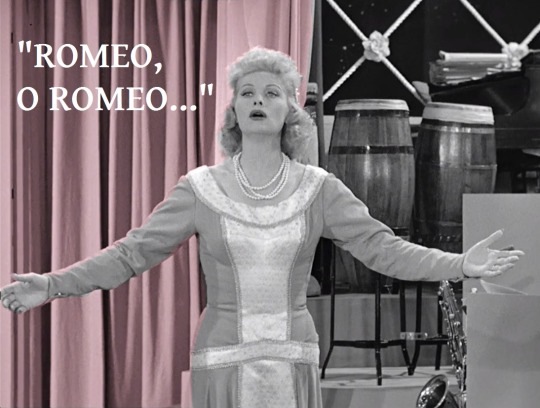
Lucy Ricardo also did Romeo and Juliet in school, later hoping to repeat her triumph with Orson Welles.

Belasco sends her to see composer and producer George Gershwin, who unfortunately hasn’t got a job for her.

In 1920, Moore finally lands a job in the chorus of a Broadway show called “Hitchy-Koo.” The show was produced by Raymond Hitchcock (hence the unusual name) with music by Jerome Kern (”Showboat”).
GRACE: “Well, Daddy, what do you think of your skylark, now?”

Grace lands an audition at the Metropolitan Opera but is told that her Broadway work has damaged her classically-trained voice and sent away.

GRACE: “I’m either a skylark or a mud hen. There’s nothing in between.”
A fortune teller named Carmen tells her that she should go to Europe and make her name. In a montage sequence, Moore trains in Europe. Now at the peak of her vocal range, Grace finally gets a job at the Metropolitan Opera as Mimi in La Boheme.

Her proud father and mother attend Grace’s triumphant opening night.

Announcer Ted Pearson sums up Grace’s remarkable journey, as well as her tragic death in a plane crash in Denmark.

Pearson reminds us that next week on The Cavalcade of America Basil Rathbone will play Thomas Jefferson in “The Common Glory”…

…and that Lucille Ball will soon be seen in the Paramount Picture Sorrowful Jones, despite the fact that the film will not premiere until a year later, June 1949. Filming began on April 7, 1948.
 Papermoon Loves Lucy
Leave a comment