November 23, 1965 on CBS

Directed by Seymour Berns
Produced by Henry Jaffe, Seymour Berns
Written by Hugh Wedlock Jr., Charles Isaacs, Alan Manings with Carl Reiner and Aaron Ruben
Cast (in order of appearance)
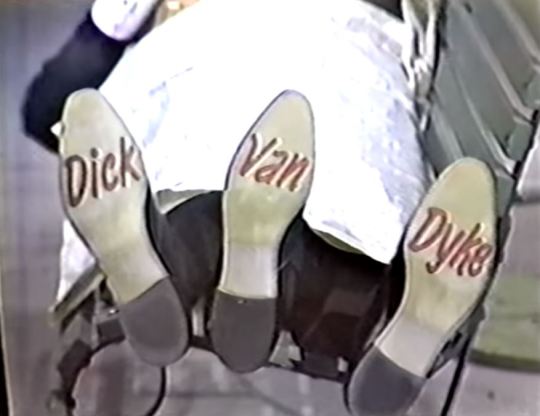
Dick Van Dyke (Host, Himself) was born Richard Wayne Van Dyke in West Plains, Missouri, in 1925. Although he’d had small roles beforehand, Van Dyke was launched to stardom in the 1960 Broadway musical Bye Bye Birdie,for which he won a Tony Award. He reprised his role in the 1963 film. He has starred in a number of other films throughout the years including Mary Poppins (1964) and Chitty Chitty Bang Bang (1968). From 1961 to 1966 he played TV writer Rob Petrie in “The Dick Van Dyke Show.” He also starred in “The New Dick Van Dyke Show” (1971-74), “Van Dyke & Company” (1976), on which Lucille Ball guest-starred. Van Dyke was often compared physically to Stan Laurel.
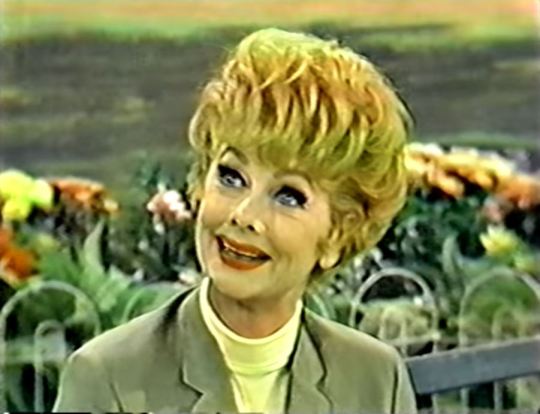
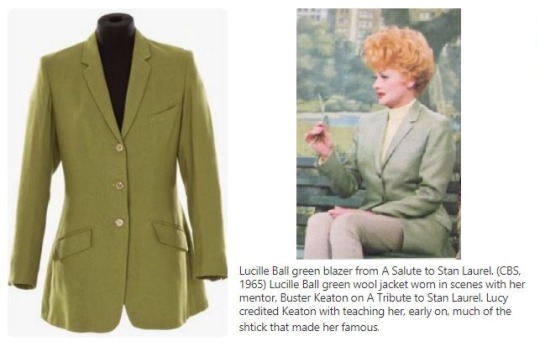
Lucille Ball (Woman in the Park) was born on August 6, 1911 in Jamestown, New York. She began her screen career in 1933 and was known in Hollywood as ‘Queen of the B’s’ due to her many appearances in ‘B’ movies. With Richard Denning, she starred in a radio program titled “My Favorite Husband” whicheventually led to the creation of “I Love Lucy,” a television situation comedy in which she co-starred with her real-life husband, Latin bandleader Desi Arnaz. The program was phenomenally successful, allowing the couple to purchase what was once RKO Studios, re-naming it Desilu. When the show ended in 1960 (in an hour-long format known as “The Lucy-Desi Comedy Hour”) so did Lucy and Desi’s marriage. In 1962, hoping to keep Desilu financially solvent, Lucy returned to the sitcom format with “The Lucy Show,” which lasted
six seasons. She followed that with a similar sitcom “Here’s Lucy” co-starring with her real-life children, Lucie and Desi Jr., as well as Gale Gordon, who had joined the cast of “The Lucy Show” during season two. Before her death in 1989, Lucy made one more attempt at a sitcom with “Life With Lucy,” also with Gordon, which was not a success and was canceled after just 13 episodes.
Ball has no spoken dialogue in her sketch.
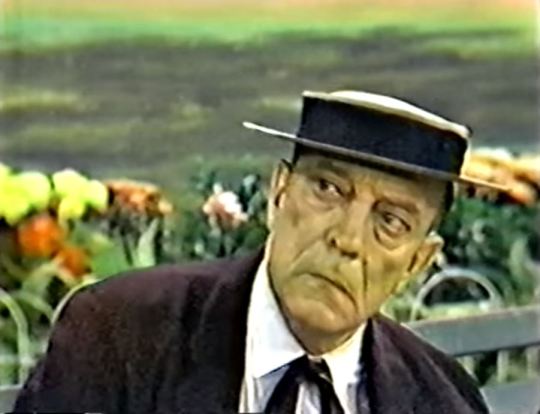
Buster Keaton (Painter in the Park) was born in 1895 to parents who were vaudevillians. His legendary film career began in 1917. He became a star known for his slapstick comedy, pork pie hat, slapshoes, and deadpan expression. In 1960 he was given an honorary Oscar. Lucille Ball worked with Keaton on the 1946 film Easy To Wed. He died in February 1966, just two months after this special aired.
Keaton has no spoken dialogue in his sketch.
Harvey Korman (Policeman in the Park) is best known as part of “The Carol Burnett Show” (1967-77). He made five appearance on “The Lucy Show” as various characters. In 1977 he had his own show on ABC which lasted just one season. At the time of this episode he was a regular on “The Danny Kaye Show” (1963-67) which aired Friday nights on CBS. He died in May 2008.
Korman has no spoken dialogue in his sketch.
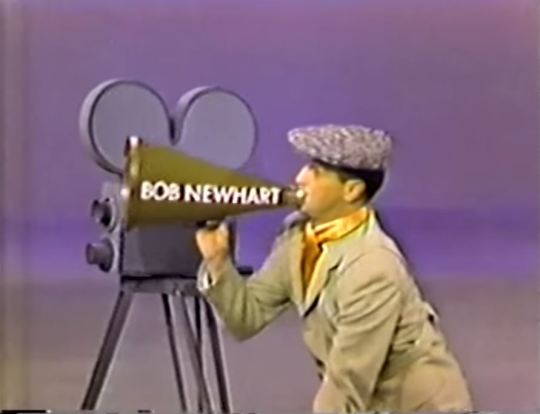
Bob Newhart (Himself / Uncle Freddy) is a stand-up comic with a deadpan delivery who headed two eponymous television sitcoms: “The Bob Newhart Show” (1972-78) and “Newhart” (1982-90).
Audrey Meadows (Pearl) is best remembered as Alice Kramden on “The Honeymooners” (1955-56), a role that won her an Emmy in 1955, against Vivian Vance as Ethel Mertz on “I Love Lucy.” She also played Lucy’s sister on an episode of “Life With Lucy” (1986). Meadows died in 1996 at age 73.
Meadows has no spoken dialogue in her sketch “The Perils of Pearl.”
Cesar Romero (Rod, Leading Man) was born in 1907 in New York City to Cuban parents. Despite earning more than 200 screen credits, Romero is perhaps best remembered for playing the Joker on TV’s “Batman” (1966-68) and in a Batman film in 1966. He played Ricky Ricardo’s buddy Carlos when “Lucy Takes a Cruise to Havana” (LDCH 1957), the very first hour-long episode of “I Love Lucy” set in Cuba in 1940, as well as Lucy Carmichael’s date in “A Date for Lucy” (TLS S1;E19). He died on New Year’s Day 1994 at age 86.
Tina Louise (Wilma, Leading Lady) is best known as ‘the movie star’ Ginger Grant on “Gilligan’s Island” (1964-67). This is only appearance with Lucille Ball.
Louise has no spoken dialogue in her sketch.
Leonid Kinskey (Silent Movie Director) was born in Russia in 1903. He played a variety of Russian and middle-European characters. One of the few to share film credits with Stan Laurel, they were both seen in Hollywood Party in 1936. He died in 1998 at age 95.
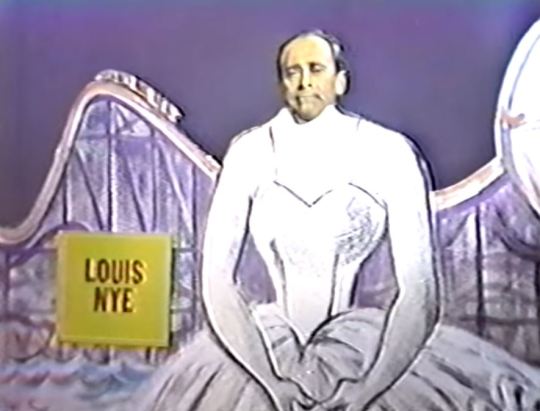
Louis Nye (Mood Music Musician) was a character actor skilled in accents and voices. He appeared with Lucille Ball in the films The Facts of Life (1960) and A Guide for the Married Man (1967). He died in 2005 at age 92.
Fred Gwynne (Herman Munster) was the star of two iconic television series: “Car 54 Where Are You” (1961-63) and “The Munsters” (1964-66), the role he reprises here. This is his only time working on the same show as Lucille Ball (although the two TV icons share no scenes together). He died in 1993 at age 66.
Gwynne has no dialogue in the sketch.
Danny Kaye (Himself) was born David Kaminsky in 1911 and left school at the age of 13 to work in the Borscht Belt of Jewish resorts in the Catskill Mountains. It was there he learned the basics of show biz. In 1939, he made his Broadway debut in Straw Hat Revue, but it was the stage production of the musical Lady
in the Dark in 1940 that brought him acclaim and notice from agents. Also in 1940, he married Sylvia Fine, who went on to manage his career. She helped create the routines and gags, and wrote most of the songs that he performed. Danny could sing and dance like many others, but his specialty was reciting tongue-twisting songs and monologues. In 1964 he appeared on “The
Lucy Show” as himself and Lucy appeared on his special in return. He died in 1987.
Phil Silvers (Himself) was born Philip Silversmith in 1911 (the same year as Lucille Ball). He started entertaining at age 11. He made his Broadway debut in 1939. In 1952 he won a Tony Award in the Broadway musical Top Banana in which he played a TV star modeled on Milton Berle. His feature film debut came in 1940. Silvers became a household name in 1955 when he starred as Sergeant Ernest G. Bilko. In 1963, Ball and Silvers performed the classic ‘Slowly I Turn’ sketch for “CBS Opening Night.” In December 1966 Silver guest-starred in “Lucy and the Efficiency Expert” (TLS S5;E13). A year later Ball and Silvers both had bit parts in the film A Guide for the Married Man (1967). He died at the age of 74.
Bern Hoffman (Pop / Street Bully / Cop) was a burly character actor seen with Lucille Ball on the first season of “The Lucy Show” and in the film The Facts of Life (1960). He was seen on Broadway in the original casts of the musicals Guys and Dolls (1950) as Joey Biltmore and Li’L Abner (1956) as Earthquake McGoon, a role he recreated in the 1959 film version.
None of Hoffman’s characters speak.
Mary Foran (Mom / Tango Dancer) was a heavyset character actor usually cast for her size. She appeared as one of the women at the health club in “Lucy and the Countess Lose Weight” (TLS S3;E21) earlier in 1965.
Foran does not have any dialogue.
Gregory Peck (Himself) was one of the most popular film stars from the 1940s to the 1960s. Peck received five Academy Award nominations winning for his performance as Atticus Finch in the 1962 drama film To Kill a Mockingbird. Although Peck and Lucille Ball never appeared together professionally, his name was mentioned several times on “Lucy” sitcoms. He also never worked with Stan Laurel. Peck died in 2003 at age 87.
Archival Footage
Stan Laurel (Archive Footage) was born as Arthur Stanley Jefferson in England in 1890. Laurel began his career in music hall, where he developed a number of his standard comic devices: the bowler hat, the deep comic gravity, and the nonsensical understatement. He began his film career in 1917 and made his final appearance in 1951. From 1928 onward, he appeared exclusively with Oliver Hardy (1892-57). Known simply as Laurel and Hardy, the pair became one of the most recognizable comic duos in history. Stan Laurel passed away in February 1965, eight months prior to this tribute show. He was 74 years old.

Oliver Hardy (archive footage) was born Norvell Hardy in Georgia USA in 1892. He appeared with his comedy partner Stan Laurel in 107 short films, feature films, and cameo roles. He was credited with his first film, Outwitting Dad, in 1914. In some of his early works, he was billed as “Babe Hardy”. He died in 1957 at age 65.
Dorothy Coburn (Nurse in “The Finishing Touch” Archive Footage) was ideally cast as a perennial foil for Stan Laurel and Oliver Hardy in films like The Second 100 Years (1927) where Stan inadvertently covers her bottom with white paint; Putting Pants on Philip (1927) in which she is being chased by an over-amorous, kilt-wearing Stan Laurel around town; and as a dentist’s nurse in Leave ‘Em Laughing (1928). She died in 1978 at age 72.
Edgar Kennedy (Cop in “The Finishing Touch” Archive Footage) was seen with Laurel and Hardy in more than a dozen films. He was also seen in three RKO films with Lucille Ball in the early 1930s. He died in 1948 and his final film was released posthumously.
Betty Grable (Pat Lambert in Footlight Serenade Archive Footage) was a starlet who did three films with Lucille Ball from 1933 to 1936. In 1958 she appeared with her husband bandleader Harry James as themselves on an episode of “The Lucy-Desi Comedy Hour.” Footlight Serenade (1942) was also supposed to feature Lucille Ball, but she refused to be loaned out to Fox to play a secondary role.
Stan Salute Trivia
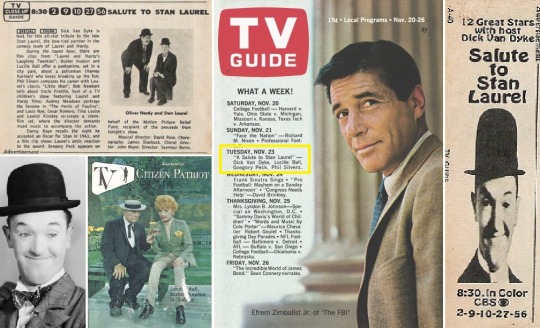
The tribute was not well-received by critics, who opined that the program felt less like a celebration of Laurel’s career than a promo for the new fall shows; the same critics were, however, in general agreement that Van Dyke’s devotion was palpable and heartfelt. Consequently Laurel and Hardy biographers tend to regard it as well-intentioned, but ultimately inconsequential. Wrapping up the
season in April 1966, TV Chronicle’s Neil Compton would dismiss the special’
“Not much of a tribute to the late comedian (who appeared briefly in a number of film clips brutally hacked out of their original context), and did not enhance the reputations of participants such as Dick Van Dyke, Lucille Ball, or Phil Silvers.”

DickVan Dyke (who was also one of the producers) reportedly complained that his vision for the Salute had itself been hacked to pieces by network corporate types. Van Dyke had delivered the eulogy and Stan Laurel’s funeral. An appearance by Fred Gwynne in full Herman Munster regalia clearly had more to do with CBS (home of “The Munsters”) than with Laurel. A lengthy biography of Phil Silvers in the show’s second half also has little to do with Laurel. On the whole, the special is a tribute to both Laurel AND Hardy, who passed away eight years earlier.

The Salute aired opposite new episodes of “McHale’s Navy” and
“F-Troop” on ABC and “Dr. Kildare” on NBC. It was preceded
on CBS by “Rawhide” (starring Clint Eastwood) and followed by
“Petticoat Junction.”
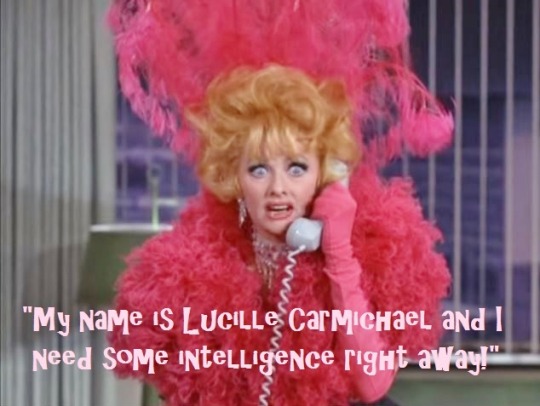
The day before (Monday, November 22), “Lucy and the Undercover Agent” (TLS S4;E10) was aired for the first time. In the episode, Mrs. Carmichael goes undercover as Carol Channing to break into a government installation!
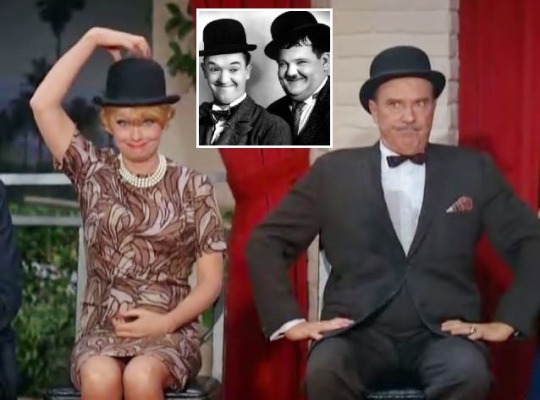
One year after this special aired, Lucy Carmichael and Mr. Mooney were put under hypnosis by Miss Pat, “the hip hypnotist” (a nightclub entertainer). Their hypnotic suggestion was to imitate Laurel and Hardy. Lucy, naturally, was Stan Laurel.
The underscoring of the Salute makes liberal use of “Dance of the
Cuckoos” which was Laurel and Hardy’s theme music. It was written by Marvin Hartley as the ‘hour chime’ for a radio station. It was first heard during a Laurel and Hardy film in 1930.
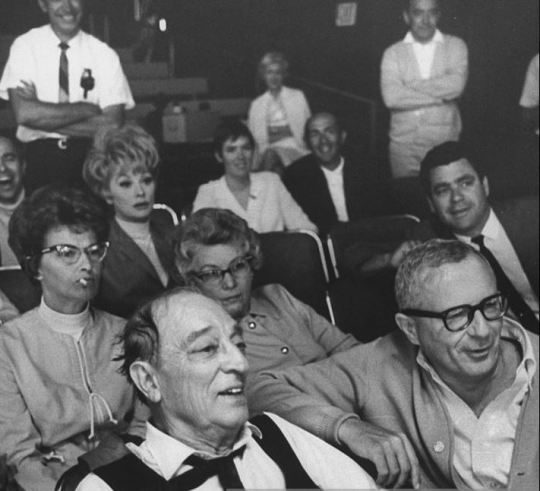
This was the last comedy performance of Buster Keaton, who had been diagnosed as terminally ill and would die a few months later. Lucy and Keaton were there own mutual admiration society, Lucy considering him her mentor and Keaton championing Ball’s talents, even before her TV fame. In the above photo, Keaton and Ball watch the dailies from their sketch on the Salute.
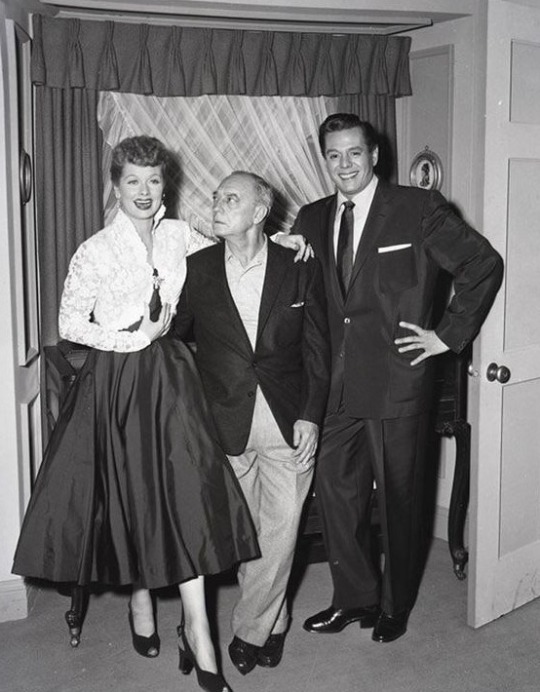
Although Buster Keaton never guest-starred on a “Lucy” sitcom, he did visit the set of “I Love Lucy” to see his now successful protege.

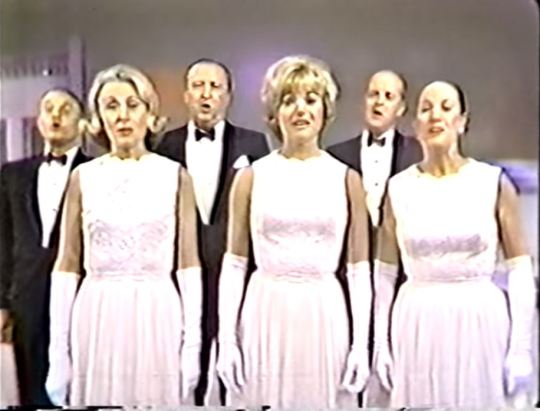
The Salute begins with a production number called “Stanley” featuring singer / dancers dressed as Laurel and Hardy inter-cut with film footage of the pair and the opening credits.
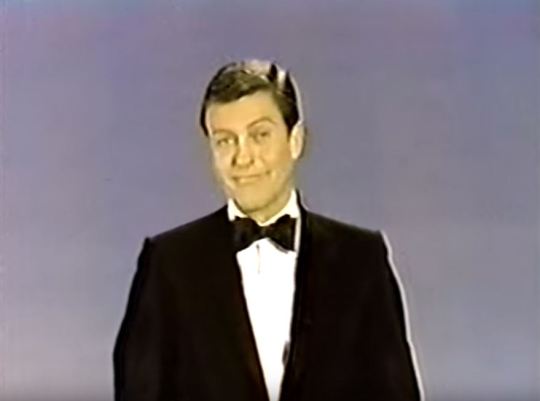
After the first commercial Dick Van Dyke introduces the show. He says that he never got to meet Oliver Hardy, but did know Stan Laurel. Film excerpts from “Wrong Again” (1929), which was re-released by MGM as “Laurel and Hardy’s Laughing 20s”, a compilation of Laurel and Hardy shorts.

Lucille Ball and Buster Keaton perform a silent sketch set on a park bench. Harvey Korman plays a cop. The sketch is without words, but includes background music, exaggerated sound effects, and the ubiquitous laugh track.

After a brief clip from the Laurel and Hardy short “Putting Pants on Philip” (1927), Dick Van Dykegives a lecture on comedy rooted in observing physical pain in others. He notes how comedy has changed, all the while having a series of funny accidents. This “comedy lecture” was specially written by Carl Reiner and Aaron Ruben.
Blooper Alert! When Van Dyke gets a waste paper basket stuck on his foot, he kicks it offstage. It apparently collides with someone off-camera, which makes Van Dyke laugh and apologize. Just before this happened, the boom microphone dips down into the frame.
The ‘lecture’ ends with Van Dyke tripping over a footstool on his way out, something he did in the opening credits of his show.
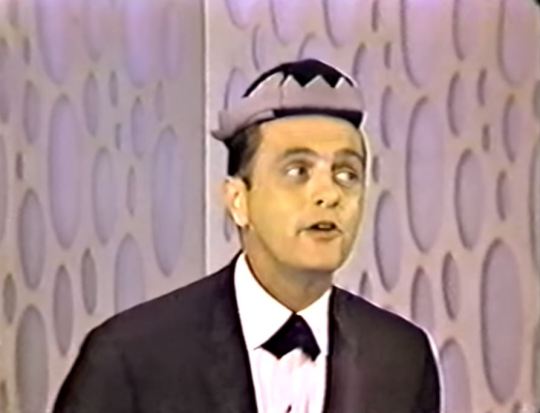
Bob Newhart talks about his research on Laurel and Hardy. He does his impression of a stereotypical kiddie show host named Uncle Freddy. Such TV kiddie shows were often the outlet for showing Laurel and Hardy shorts.

After a clip from “Call of the Cuckoo” (1927), an audience at an old
time cinema sings about seeing ‘The Perils of Pearl’, the type of
serial melodrama that typically played alongside a comedy feature by Laurel and Hardy.
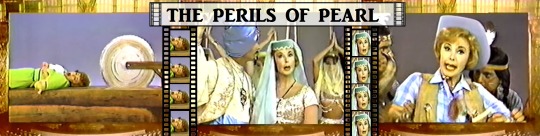
Audrey Meadows plays Pearl, in a variety of her ‘perils’: As a women about to be bisected by a mill saw, a harem dancer pursued by an over-amorous Calif, a cowgirl burned at the stake by Indians, and a woman sitting atop a giant time bomb.
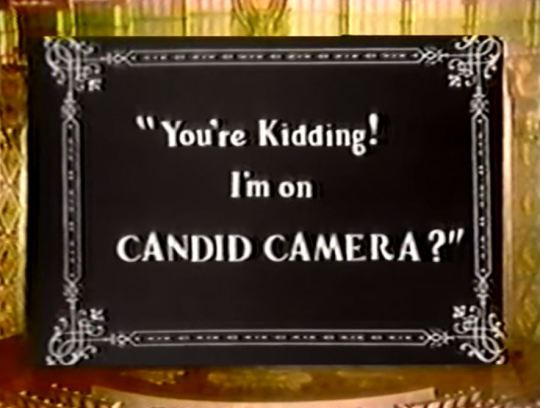
Movie-Goers: “Will they blow up little Pearl? Is her life at stake? To be continued [the look into the camera]… after station break!”
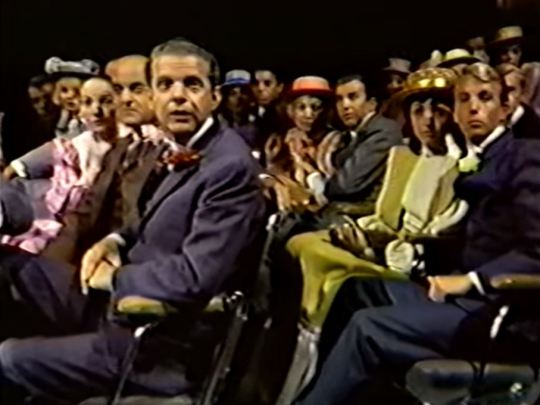
After the commercial break, the movie-goers are still looking at the
camera. They look back at the movie screen where Pearl is still atop the bomb.
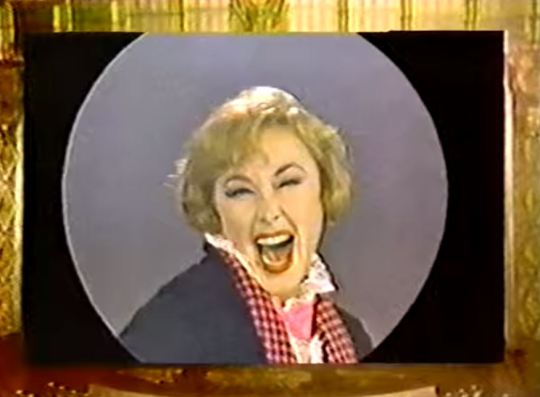
Pearl laughs and her hat falls off. The matinee audience is suddenly onstage in a full out dance number!
Dick Van Dyke introduces a comedy sketch about the filming of a
silent movie.
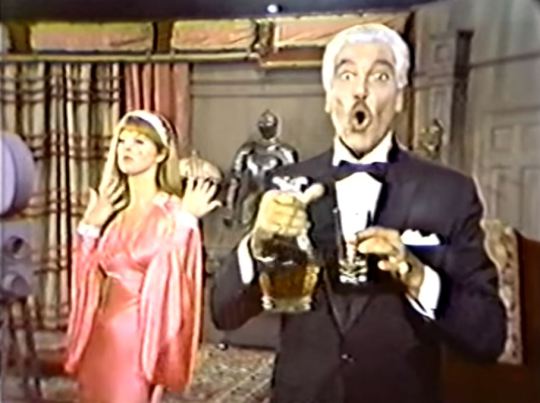
It stars Cesar Romero as The Leading Man, Tina Louise
as The Leading Lady, Leonid Kinsky as The Director, and Louis Nye as The Mood Music Musician (aka violinist).
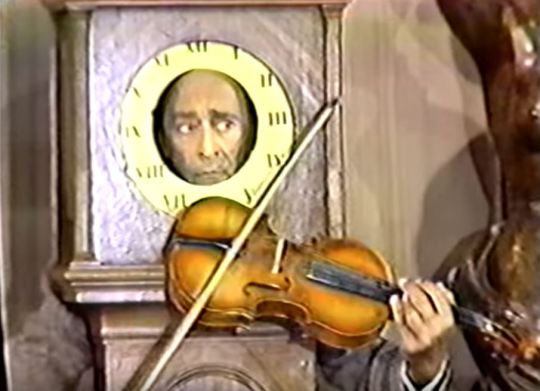
The comedy comes from Nye trying to stay out of the pantomimed action while providing the mood music to help the actors emote. After destroying several violins, Nye himself falls out the window.
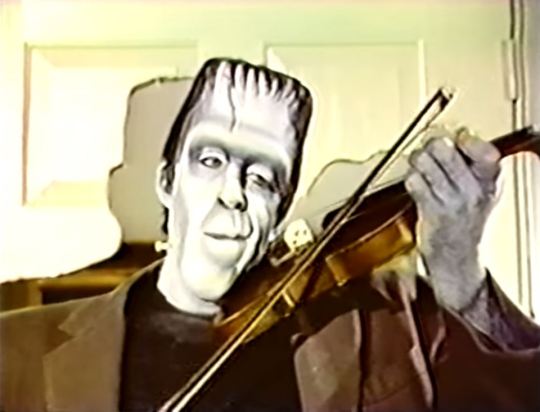
Crashing through the door comes his replacement, Herman Munster (Fred Gwynne) playing the fiddle! This is the first time a 1865 TV audience has seen Gwynne in color, although his green complexion would be on display in a 1966 Munsters movie.
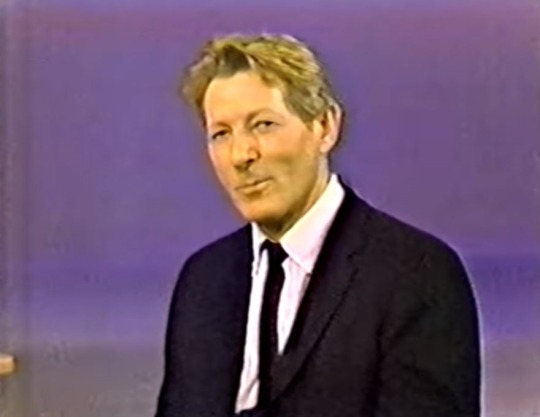
Danny Kaye is sitting beside Stan Laurel’s honorary Oscar, which Kaye accepted for Laurel in 1961. A clip of “The Finishing Touch”
(1928) shows Laurel installing a window.
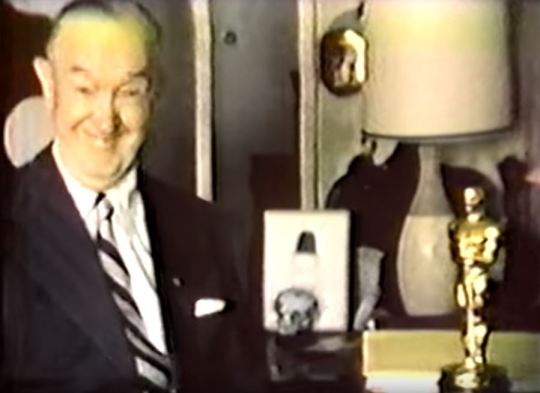
Color (but silent) footage shows Laurel polishing his Oscar from his home in 1961.

Sitting among a stack of film reels, Dick Van Dyke introduces another clip from “The Finishing Touch” (1928) in which Laurel and Hardy are renovating a house.
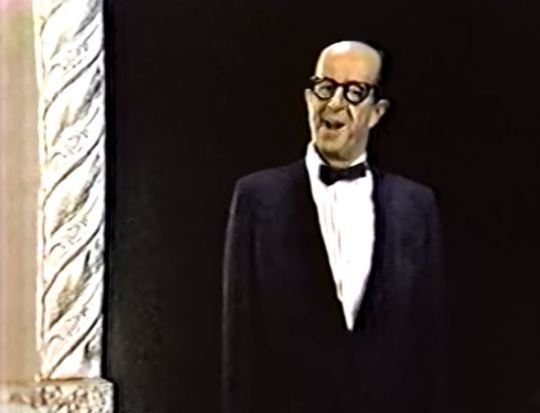
Phil Silvers compares Laurel’s youth as “a little man” to his own life story. A sketch shows a bespectacled Silvers in a baby bonnet and crib with his mother and father beside him. His teen years (in a page boy wig) feature his cracking voice singing “Shine On Harvest Moon.”
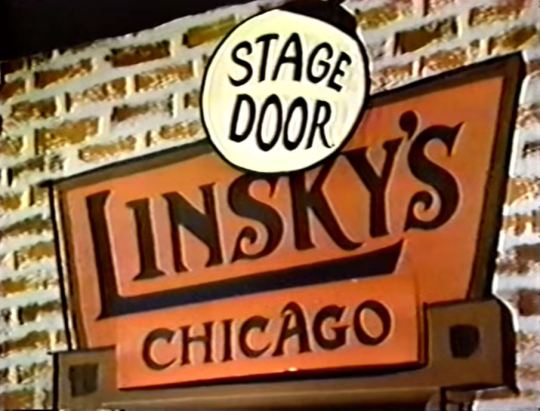
The mini-biography tracks Silvers’ career from street performer to vaudeville.
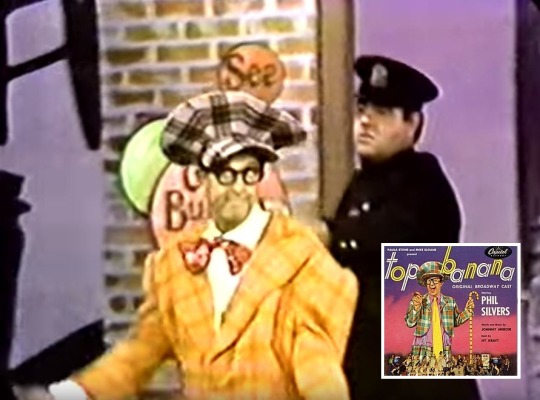
In Burlesque, he plays Linksy’s theatre (a pun on the real-life Minsky’s Burlesque) wearing the same huge plaid cap that he wore onstage and screen in the musical Top Banana ten years earlier.

Actual footage from his big break in movies shows Silvers and Betty Grable in Footlight Serenade (1942). Silvers finally brings his story back to Stan Laurel, but not without a few quick clips of him in “Sergeant Bilko”!
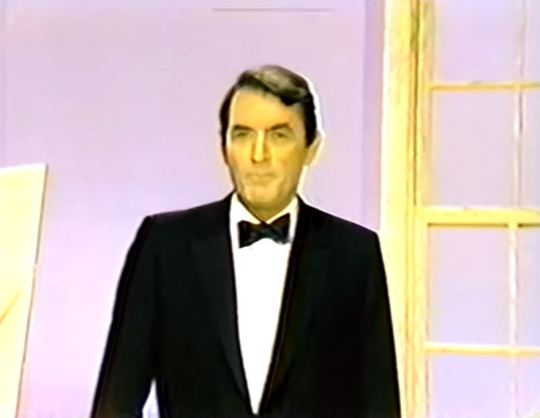
Gregory Peck closes the program by thanking everyone and giving a last pitch for the new MGM film compilation of Laurel and Hardy’s shorts.
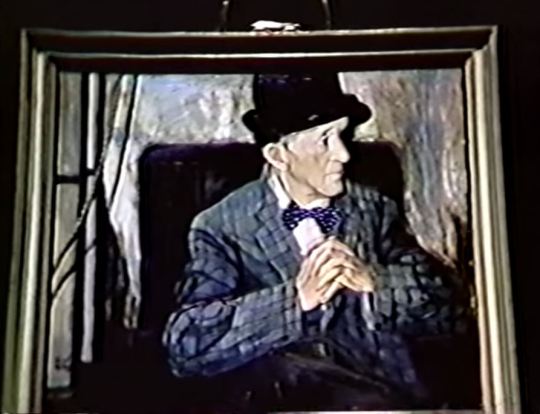
The singers and dancers who opened the show return for a final chorus of “Stanley.” The number ends on a shot of a painting of Stan Laurel. This same painting inspired the creation of the show.
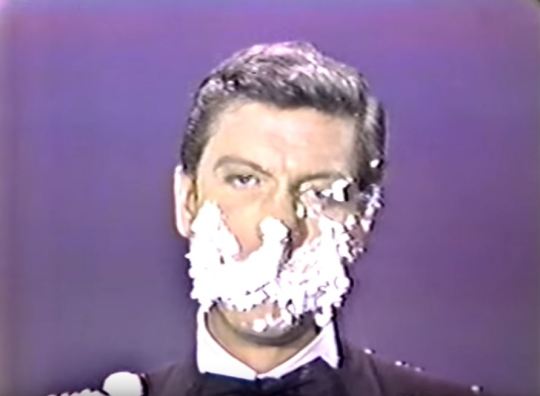
Dick Van Dyke returns for yet another pitch for the MGM film compilation “Laurel and Hardy’s Laughing 20s”. Van Dyke gets a face full of cake at the very end, inter-cut with Oliver Hardy slipping on a banana peel while carrying a huge cake excerpted from 1928’s “From Soup To Nuts.”
This Date in Lucy History – November 23

“Redecorating the Mertzes’ Apartment” (ILL S3;E8) – November 23, 1953

“Lucy’s Contact Lenses” (TLS S3;E10) – November 23, 1964

“Lucy and Jack Benny’s Biography” (HL S3;E11) – November 23, 1970

 Papermoon Loves Lucy
Leave a comment