S5;E4
~ October 2, 1972


Directed
by Coby Ruskin ~ Written by Fred S. Fox and Seaman Jacobs
Synopsis
Harry
finds he can’t run the office efficiently with Lucy at home with a broken leg, so
he brings the office to Lucy’s home causing Lucy to resort to some
elaborate schemes to get him to leave.
Regular
Cast
Lucille
Ball (Lucy
Carter), Gale
Gordon (Harrison
Otis Carter), Lucie
Arnaz (Kim
Carter)
Guest
Cast
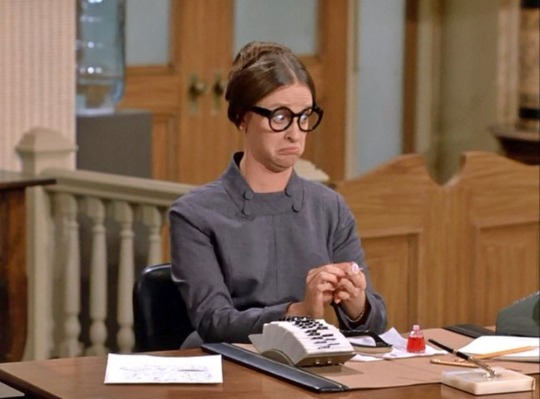
Susan
Tolsky
(Miss Quigley) is probably best remembered for playing Biddie
Coom on the TV series “Here Comes the Brides” (1968-70). Tolsky
played Kim’s friend and neighbor Sue Ann in “Kim Finally Cuts
You-Know-Whose Apron String” (S4;E24), a possible spin-off that was
not picked-up for production. This is her last appearance on “Here’s
Lucy.”
Miss
Quigley is said to be the fourth substitute secretary Harry has had
since Lucy broke her leg.

Mary
Jane Croft (Mary
Jane, above left) played Betty Ramsey during season six of “I Love Lucy. ”
She also played Cynthia Harcourt in “Lucy
is Envious” (ILL S3;E23) and
Evelyn Bigsby in “Return
Home from Europe” (ILL S5;E26).
She played Audrey Simmons on “The Lucy Show” but when Lucy
Carmichael moved to California, she played Mary Jane Lewis, the
actor’s married name and the same one she uses on all 31 of her
episodes of “Here’s Lucy. Her final acting credit was playing
Midge Bowser on “Lucy Calls the President” (1977). She died in
1999 at the age of 83.
Vanda
Barra (Vanda, above center)
makes one of over two dozen appearances on “Here’s Lucy” as
well as appearing in Ball’s two 1975 TV movies “Lucy Gets Lucky”
(with Dean Martin) and “Three for Two” (with Jackie Gleason). She
was seen in half a dozen episodes of “The Lucy Show.” Barra was
Lucille Ball’s cousin-in-law by marriage to Sid Gould.
Gloria
Wood
(Doris, in black) was one of the off-stage back-up singers in “Lucy and Rudy
Vallee” (S3;E12) and will do one more episode of the series, also
singing.
Peggy
Clark
(June, in violet)
began singing as the Clark Kiddies lead singer. She was later part of The Sentimentalists. She was a very busy studio singer for decades in Los Angeles, heard on TV, film, records and commercials.
Gwenn
Johnson
(Mercedes, in floral print) is making her only screen appearance here.
Doris,
June, and Mercedes (along with Mary Jane and Vanda) are members of Lucy’s Canary Club, an a cappella
singing group. They are not individually identified by name except
in the final credits. They have no dialogue other than their group
singing.

Robert
Carson (Officer
Hurlow, Police Officer) was a busy Canadian-born character actor who appeared on six
episodes of “The Lucy Show.” This is the fifth and final
appearance on “Here’s Lucy.”
The
surname Hurlow was used as the name of the driving instructor (Jack
Gilford) in “Lucy
Helps Craig Get a Driver’s License” (S1;E24) and
the nurse (Mary Wickes) in “Lucy and Harry’s Tonsils” (S4;E6).

Sid
Gould (Sam / Jerry) made more than 45 appearances on “The Lucy Show”
and nearly as many on “Here’s Lucy.” Gould (born Sydney
Greenfader) was Lucille Ball’s cousin by marriage to Gary Morton. He is married to Vanda Barra (Vanda).
For
the role, Gould wears dark glasses and a false mustache, perhaps so that he looks noticeably different to Harry, who might recognize him from the office coffee shop. Kim tells her mother that “Sam from the coffee shop is ready” but the name Jerry is listed in the final credits and never spoken
aloud during the scene.

Phil
Vandervort
(Tommy) appeared in two episodes of “The Lucy Show”
where he met Lucie Arnaz. The two were married from 1971 to 1977. This is third and final episode of the series.
For
the role, Vandervort wears a false beard and wire-framed eyeglasses.
Harry says he looks like he crawled out of the woodwork.
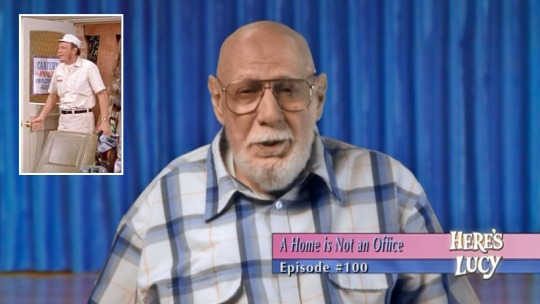
Emile
Autuori (Mr.
Munson, Painter) makes his fifth and final appearance on “Here’s
Lucy.” He passed away in early 2017. He was the uncle of
writer / director P.J. Castalleneta.
In
his introduction to the episode on the series DVD, Autuori says that
his sister, Theresa Autuori Price, was Gary Morton’s secretary at the
time. Munson was also the surname of Grace and Harry, characters who appear on “I Love Lucy.”
Orwin
C. Harvey
(Painter, uncredited) was an actor and stuntman who played one of the
singing and dancing teamsters in “Lucy
Helps Ken Berry” (TLS S6;E21).
This is one of his six appearances on “Here’s Lucy.”
Bob
Harks (Mover, uncredited) was born on September 20, 1927.
Harks appeared in his first film in 1968 and was seen in the
background of Mame
(1974). In 1970 he popped up on his first television show and was
seen in more than a dozen episodes of “Here’s Lucy.” He died at
age 83 in 2010.
Hank
Robinson
(Mover, uncredited) was a busy background player in Hollywood seen on
such shows as “Kojak,” “The Rockford Files,” and “Gunsmoke.”
This is his last appearance on “Here’s Lucy.”
The
other movers and painters are played by uncredited background
performers.
This is the series’ 100th episode! It is the first of only a few episodes not to have a personal name in the title.
This
episode is the fourth installment in the longest story arc (Lucy’s
broken leg) of the series. This storyline was dictated by the fact
that Lucille Ball actually broke her leg skiing, necessitating
scripts for the first half of season five be tailored to her being in
a cast.

The
evening this episode first aired, Susan Tolsky (Miss Quigley) also
appeared on CBS’s “The
New Bill Cosby Show.”
Tolsky was a regular on the variety show, which lasted just one
season. That evening the show also featured insult comic Don
Rickles, who had played a washed-up boxer on a 1967 episode of “The
Lucy Show.”

The evening this episode first aired, Lucie Arnaz guest-starred on “Rowan and Martin’s Laugh-In” which aired on NBC the hour prior to “Here’s Lucy.” Desi Arnaz Jr. had also appeared on the madcap variety show in 1970. “Laugh-In” was frequently referenced on “Here’s Lucy” during its first two seasons. Initially, “Laugh-In’s” second half hour on NBC overlapped “Here’s Lucy” on CBS.

Harry
is looking for the file for the Charles Bradshaw account. Lucy filed
it under ‘G’ because Mr. Bradshaw reminds her of Cary
Grant.
Grant was frequently mentioned on all of Lucille Ball’s sitcoms. The
name Bradshaw was often one used by Gale Gordon in his dictation
directives as both Mr. Mooney and Harrison Carter.

Lucy
is the head of the Canary Club, a group of a cappella women singers
consisting of Mary Jane, Vanda, Doris, June, and Mercedes. They give
her the “Humpty Dumpty Award” for skiing which cost the members
(including Lucy) $2.50 each. The figurine has red hair and a cast on her right leg, just like Lucy.

To
welcome Lucy home, the Canary Club sings “Hello, Lucy” to the
tune of “Hello,
Dolly.”
The song is by Jerry Herman who also wrote the music for Mame,
which Lucy was about to start filming when she broke her leg. In its
original form the song is from a Broadway musical of the same name
based on Thornton Wilder’s play The
Matchmaker.
In “Lucy and the Undercover Agent” (TLS S4;E10, above) it was sung as
“Hello, Solly” when Lucy Carmichael dressed up as Carol Channing
(Broadway’s original Dolly) to get into an Army base. First, she had
to distract “Sol” (aka “Solly”) the base guard.

Lucy tells her daughter she’s never had a song written for her before. For Lucille Ball, that is just not true. The theme song to “I Love Lucy” by Eliott Daniel was written for her (as Lucy Ricardo). The statement is also not true for Lucie Arnaz. Her father and composer Eddie Maxwell wrote “There’s a Brand New Baby in Our House” for the birth of Lucie in 1951. It was re-released to coincide with the birth of Little Ricky / Desi Jr. in 1953. So although the Carter gals may not have had songs written for them, the Arnaz girls have!

According
to the back of their coveralls, the moving men are from Dart Movers.

Lucy
is surprised she is no longer Harry’s candidate for “Miss Boo-Boo
of Nineteen
Seventy Two-Two.”
In order that episodes not seem ‘dated’, the year was rarely spoken
in the dialogue of “Lucy” shows, especially considering their
popularity in syndication.
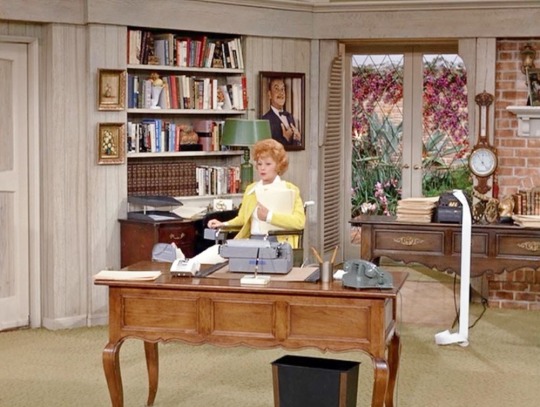
The
framed photograph of Gale Gordon seen in many previous episodes of
“Here’s Lucy” and “The Lucy Show” has been hung in Lucy’s
living room, although it is not usually part of the office set.

Lucy
says that having Harry doing business in her home is like having a
rest cure at Devil’s Island. Devil’s
Island
(aka Bagne de Cayenne) was a penal colony in French Guiana. It was previously mentioned in “Lucy’s Bonus Bounces” (S4;E16) and on “I Love Lucy” in “Paris at Last” (ILL S5;E18).

When
Kim suggests giving the office furniture to the Salvation Army, Lucy
says “Harry
has spies there. That’s where he gets his clothing.”
Lucille Ball was a supporter of The Salvation Army.

The charitable organization was
indirectly satirized on “I Love Lucy” as The Friends of the
Friendless and in “Lucy Moves To NBC” with Lucy playing Sister Hitchcock, a character on “The Music Mart”.

To
drive Harry away, the Canary Club sing “Camptown Races.”
“Camptown
Races”
is a minstrel
song by Stephen
Foster (1826–64)
published in 1850.

Upon seeing the room turned into a place of business, Kim sings “Be it ever so humble…” then drops the song and flatly states “there’s no place like an office.” The 19th century song “Home Sweet Home” was composed by Englishman Sir Henry Bishop with lyrics by
American actor John Howard Payne.
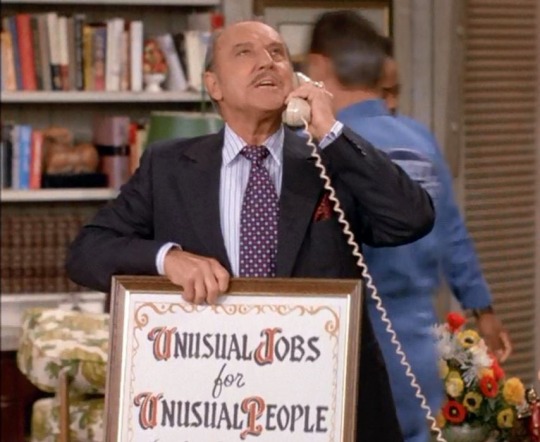
Harry
starts to dictate a letter to Mr.
Frank S. Leach, Fayetteville, Arkansas.
This is the name of an old World War II Army buddy of writer Seaman
Jacobs. The two kept correspondence over the years and Jacobs wanted
to surprise his friend with his name being spoken on television.
When CBS legal department checked they found there were two people
named Frank S. Leach
in Fayetteville, Arkansas, and suggested the name be changed to Frank
S. Larson. Jacobs wrote to his friend to sign a release, which
allowed the name to be used. On filming day, however, Gale Gordon
had trouble pronouncing the name Leach, so Jacobs informed him of the
reason it was so important to him that he get it right. Gordon got
the name right, but then mispronounced Fayetteville as Fayettesville.
The extra ’s’ was later removed in post-production.

Harry
says he didn’t think the painters were interns from “Medical
Center,”
a CBS hospital drama that aired from 1969 to 1976 on Wednesday nights.

At
the end of the episode, Harry gets wet – this time soaked in yellow
paint.

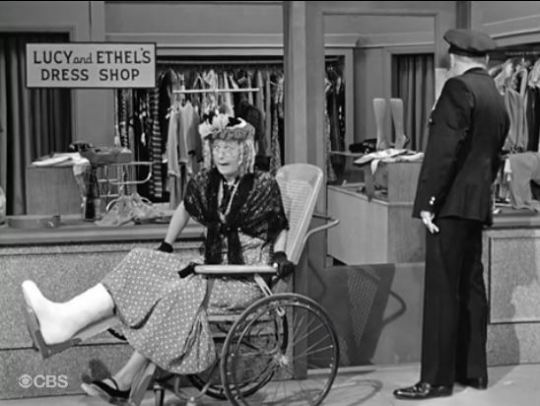
Lucy
Ricardo also had a broken leg and used a wheelchair in 1953’s “The
Girls Go Into Business” (ILL S3;E2). Both episodes also feature police officers.
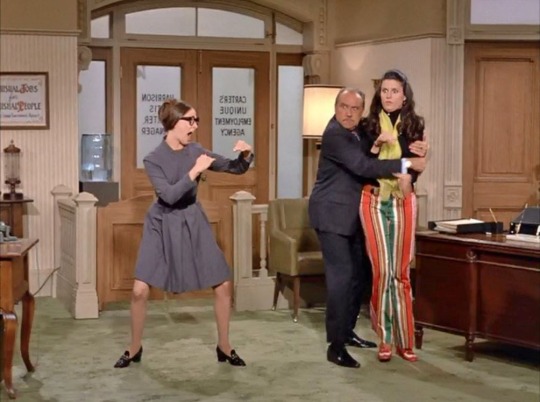

Miss
Quigley (Susan Tolsky) tells Harry that at secretarial school she
learned typing, shorthand, and Karate (to defend herself). Susan
Tolsky previously played Sue Ann on “Kim Cuts You-Know-Whose Apron
String” (S4;E24), an episode that was centered around Kim and Sue
Ann learning self-defense from a book.

Character
Clarity! Standing in the living room/office, Harry tells Kim to “go home.”
Kim calls it “her mother’s house.” It can be assumed this means
Kim is still living in the Marina Del Rey apartment that she moved
into in “Kim Finally Cuts You-Know-Whose Apron String” (S4;E24),
although is not specifically stated. It also could mean that Kim is
staying at the college dorm, as was hinted in “Harrison Carter,
Male Nurse” (S5;E3).

“Miss Quigley, in this letter you just typed up for me…” – The camera catches a quick glimpse of the ‘letter’ and it is obviously bold handwriting, not typing. It is likely a portion of the script in order to remind Gale Gordon of his lines. Reports from the set by writer Seaman Jacobs confirm that Gordon did not always perform the script word for word.

Bad…Worse…________! Of the three previous substitute secretaries he has had, Harry says that Miss Quigley is the “worse-est.” When Quigley differs, she says “I don’t think there’s such word as “worstest”. It is unclear whether the original script said “worse-est” or “worstest” (both are grammatically incorrect), but traditionally, for consistency sake, if an actor makes an error of this sort, their scene partner should repeat the word spoken, not the scripted word.

Brand X – Lucy’s manual typewriter has the brand name redacted with blue tape. This is the same typewriter she will use a year later in “The Big Game” (S6;E2).
“A Home is Not an Office” rates 3 Paper Hearts out of 5
This is a sprawling episode, with lots of characters and activity. Although restricted to a wheelchair, Lucille Ball still manages some funny physical comedy with a feisty file cabinet. Ball appears to be happy to be back in her element and enjoying the company of her co-stars. There are also some sweetly sentimental moments between Harry and Lucy.
 Papermoon Loves Lucy
Leave a comment