S1;E4 ~ October 14, 1968
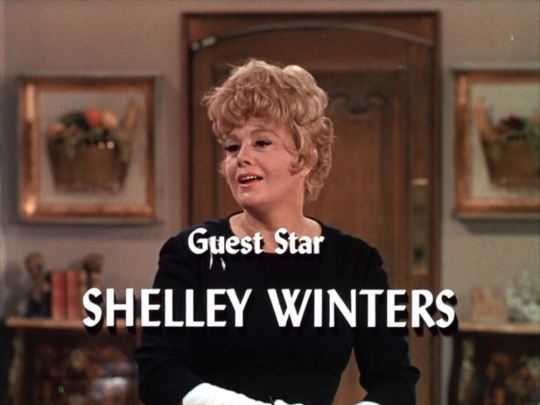

Directed by Jack Donohue ~ Written by Milt Josefsberg and Ray Singer
Synopsis
Shelley Winters needs to slim down before filming her new picture, so Lucy is employed as her private secretary and diet coach.
Regular Cast
Lucille Ball (Lucy Carter), Gale Gordon (Harrison Otis Carter)
Lucie Arnaz (Kim Carter) and Desi Arnaz Jr. (Craig Carter) do not appear in this episode.
Guest Cast
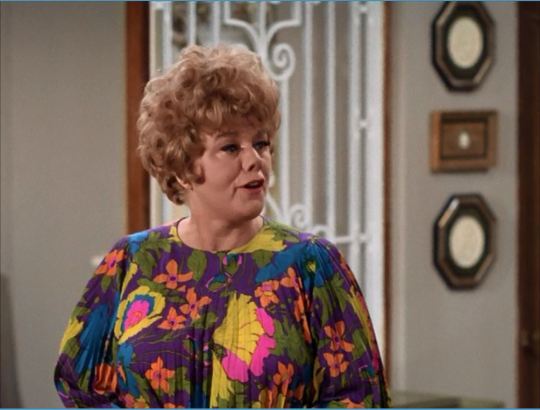
Shelley Winters (Shelley Summers) was born Shirley Schrift in 1920 (some sources list 1922) in Illinois. Her screen acting career began in 1943 under the name Shelley Winter (no ‘s’). It culminated in two Oscars for Best Supporting Actress in the films The Diary of Anne Frank in 1960 and A Patch of Blue in 1966.
She also won a 1964 Emmy. One of her final roles was as Nana Mary on TV’s “Roseanne.” Winters was married four times and known for her brash sexuality. She had an uncredited role in the 1946 Lucille Ball film Two Smart People. She died in 2006.
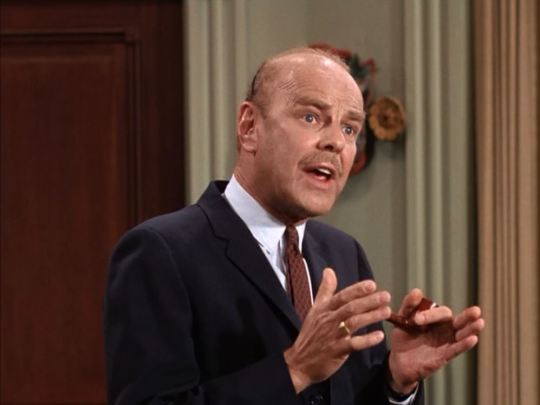
Bartlett Robinson (C.B.Wellborn) had played Mr. Wilkins in “Lucy Gets Trapped” (TLS S6;E2). This is his only appearance on “Here’s Lucy.” He died in 1986.
The title refers to her as “Miss Shelley Winters” just as she was billed in the 1955 film The Big Knife when she was between husbands having divorced Vittorio Gassman in 1954 and not married Anthony Franciosa until 1957. During “Here’s Lucy” she was also single, having divorced Franciosa in 1960 and not remarrying until the day before her death in 2006. The original title of the episode was “Lucy and Chubby.”

This was the first time Shelley Winters guest starred on a sitcom. She is the first guest-star on “Here’s Lucy” to have won a competitive acting Oscar at the time of her appearance (The Diary of Ann Frank in 1959). She was followed by:
- Elizabeth Taylor – who earned an Oscar in 1960 and appeared on the show in 1970
- Ginger Rogers – who earned an Oscar in 1940 and appeared on the show in 1971
- Helen Hayes – who earned Oscars in 1931 and 1970 and appeared on the show in 1972. Hayes has the distinction of being the only multiple Oscar winner on the series as well as the only actor playing a distinctly different character than herself without her name in the title. [Winters plays Shelley Summers, and essentially is different from Winters in name only!]
William Holden holds this same distinction on “I Love Lucy” and Ed Begley Sr. on “The Lucy Show.”

As the episode opens, Lucy is listening to Harry on the dicta-phone and decides to try out the newfangled recording machine for herself, first quoting a bit of Lincoln’s Gettysburg Address, then singing “The Man I Love,” a torch song by George and Ira Gershwin. The song was written for, but deleted from, the 1924 Broadway musical Lady Be Good.
Overhearing Lucy sing into the dicta-phone, Harry quips “Thank you, Tiny Tim!” Tiny Tim (born Herbert Buckingham Khaury in 1932) was a singer and ukulele player known for his cover of “Tiptoe Through the Tulips.” He was a regular cast member on “Rowan and Martin’s Laugh-In” which aired opposite “Here’s Lucy” on NBC.
Harryreminds Lucy that “This is a business office, not Tin Pan Alley!” Tin Pan Alley is the name given an area of New York City where music publishers and songwriters who dominated the popular music of the late 19th century and early 20th century had their businesses. The origins of the name Tin Pan Alley are unclear but one account claims that it was a derogatory reference to the sound of many pianos playing (comparing them to the banging of tin pans).

Once Lucy leaves the office to get Harry’s lunch, Harry also uses the dicta-phone to record himself. He sings “Shortnin’ Bread” by James Whitcomb Riley in 1900. The song was famously sung by Vivian Vance as Ethel Mertz in “Ethel’s Home Town” (ILL S4;E15) in 1955.
Satisfied with the sound of his voice on the playback, he remarks “Wayne Newton eat your heart out!” Wayne Newton (born 1942) is a singer and entertainer who played a version of himself on “Lucy Discovers Wayne Newton” (TLS S4;E14). He will make two appearances as himself on “Here’s Lucy.”

Lucy is looking forward to meeting movie producer C.B. Wellborn (no doubt named after Cecil B. DeMille), because she says hopes to break into show business, something Lucy Carter has in common with the otherLucy characters. “After all, lots of people are discovered in drug stores and elevators…” This is a reference to the legendary but apocryphal story that actress Lana Turner was discovered at Schwab’s Drugstore in Hollywood. In “Lucy Gets Into Pictures” (ILL S4;E18) Lucy went down to Schwab’s to be discovered but all she discovered was a stomach ache from too many ice cream sodas. Dorothy Lamour was an elevator operator in Chicago when she was discovered.
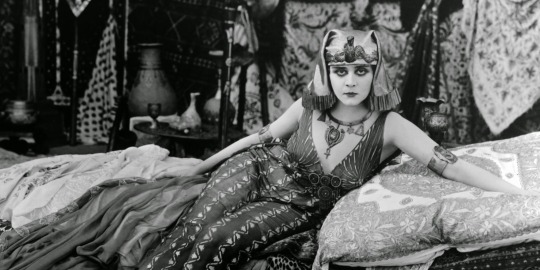
When Lucy theatrically plays up to Mr. Wellborn, Harry says to her “That will be all, Theda Bara.” Theodosia Burr Goodman (aka Theda Bara, 1885–1955) was a silent film and stage actress. She was the first to play Cleopatra on film in 1917 (now lost). Lucy played Cleopatra on the very first color filmed “The Lucy Show” in 1963, in which Lucy was also compared to Theda Bara.

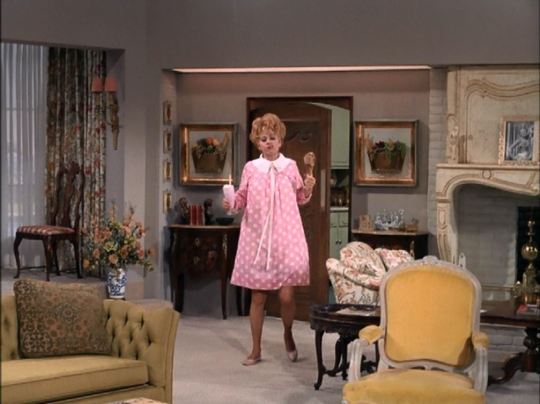
On the mantle of Summers’ apartment is a photo of Shelley Winters from the 1950 film Frenchie. She glances guiltily at the photo when she is about to overeat.
Summers brags about having two Oscars, just like Shelley Winters. Wild in the Street starring Shelley Winters had opened in late May 1968. In December 1968 Winters opened in the film Buona Sera, Mrs. Campbell starring Gina Lollobrigida.

Shelly Winters’ dresses were padded to make her appear bigger then she really was. This is done so that in the final scene she appears thinner in her new black dress.
Shelley hides food all over her apartment:
- A box of candy in the chandelier
- A banana in a framed fruit basket
- A bowl of spaghetti from the TV (which is actually a mini-fridge)
- A whole pizza pie on the turntable of the stereo
The scene is underscored with Theremin music, which is an electronic instrument mainly used during dream sequences and in sci-fi and horror movies. It was first used to underscore Lucy Ricardo’s dream of Ricky’s infidelity in “Lucy and the Dummy” (ILL S5;E3). It was also used in “Lucy Gets Mooney Fired” (TLS S6;E9) when Lucy Carmichael and Mr. Mooney are ‘gaslighting’ Mr. Cheever into rehiring him!
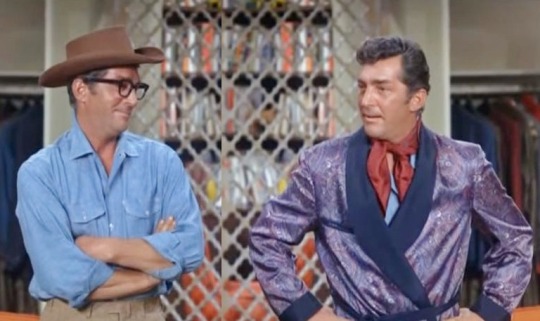
When Lucy catches her with the pizza, she claims it is a Dean Martin record and sings “When the moon hits your eye like a big pizza pie, that’s amore!” “That’s Amore” was written by Harry Martin and Jack Brooks and recorded by Dean Martin in 1953. “Amore” means “love” in Italian. Dean Martin guest starred on “The Lucy Show” in 1966 playing himself and his stunt double, Eddie Feldman.

Lucy discovers a rope of sausages hidden in the sofa cushion that Shelley claims are her love beads! Love beads were a necklaces worn by hippies in the 1960s as a symbol of peace and goodwill.

Shelley humorously remarks “Honey, they invented CinemaScope to get my hips in the screen!“ CinemaScope is an anamorphic lens used from 1953 to 1967 for shooting widescreen movies. Its creation in 1953 by 20thCentury Fox, marked the beginning of the modern anamorphic format in both principal photography and movie projection. The anamorphic lens allowed the process to create an image almost twice as wide as the previously common format. Winters’ first CinemaScope film was I Died A Thousand Times in 1955.
When Lucy bumps into Shelley and says she didn’t see her, Shelley replies “Baby,on a clear day you can see me from Catalina!” The Island of Catalina off the California coast has been used as a punchline in “Lucy and Tennessee Ernie Ford” (TLS S5;E21) when the bell captain smugly says of a swanky hotel penthouse “On a clear day you can see Catalina.” This same claim was made about the Cugamonga high rise apartment in “Lucy Helps the Countess” (TLS S4;E8). In reality, it is highly unlikely (even on a rare smog-free day) to be able to see Catalina from Los Angeles, which is nearly sixty miles away.

The episode allows Winters to stretch her comic abilities. The script assigns her all the physical comedy that would normally be done by Lucy. Like Ball, Winters is game for anything and pulls it off.
Other Hollywood stars have had their surnames slightly altered for their appearances, such as Joan Blondell (Joan Brennan) and Mel Torme (Mel Tinker).
Callbacks

Preparing to make a home cooked meal for a hot date behind roommate Viv’s back, Lucy hides food all over the house in “Lucy Builds a Rumpus Room” (TLS S1;E11) just like Lucy Ricardo did when she faked a hunger strike in “Lucy Gets a Paris Gown” (ILL S5;E20).

Lucy Carmichael dieted and exercised at a fat farm in “Lucy and the Countess Lose Weight” (TLS S3;E21) in 1965. They wear pink sweat suits just like Shelley Winters!

Lucy Ricardo tried to lose weight to get into Ricky’s act (and a tight costume) in “The Diet” (ILL S1;E3) in 1951. I wonder if Lucy Ricardo’s workout clothes are also pink?
“Lucy and Miss Shelley Winters” rates 4 Paper Hearts out of 5
Oddly, Shelley Winters is basically playing herself, so it is unclear why she had to be re-named Shelley Summers. Many “Lucy” guest stars have used their own names and played very different versions of themselves on screen (Wayne Newton and Joan Crawford, for example). This episode may be considered politically incorrect in today’s society, which seeks to celebrate the fuller figured woman and not measure acceptance by body size.
 Papermoon Loves Lucy
Leave a comment