S5;E18
~ January 30,
1967

Synopsis
Trying
to think of a way to help bring the town of Bancroft’s story to the rest of
America, Lucy and the town fathers stage a gun battle to get national
news coverage.
Regular
Cast
Lucille
Ball (Lucy
Carmichael),
Gale Gordon
(Theodore J. Mooney)
Mary
Jane Croft (Mary
Jane Lewis) and Roy
Roberts
(Mr. Cheever) do not appear in this episode.
Guest
Cast
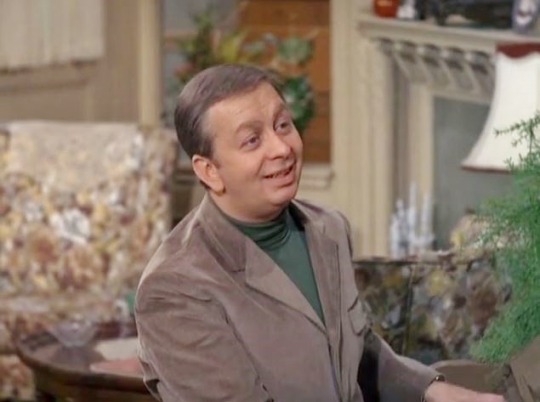
Mel
Tormé
(Mel Tinker) returns to play Lucy’s neighbor Mel having previously
played the role in “Lucy in the Music World” (S4;E3) and “Main
Street U.S.A.” (S5;E17). Tormé
was
a musician nicknamed ‘the velvet fog’. He was best known as a
singer of jazz standards. He was also a jazz composer and arranger,
drummer, an actor in radio, film, and television, and the author of
five books. He composed the music for “The Christmas Song”
(“Chestnuts Roasting on an Open Fire”) and co-wrote the lyrics
with Bob Wells. He died in 1999 at the age of 73.

John
William Sublett (John
Bubbles) was known
as the “Father of Rhythm Tap,” and was the original Sportin’
Life on Broadway in Porgy
and Bess
(1935). Since he did not read music, George Gershwin had to teach him
the songs note by note. Sublett was his birth name but his stage name
was Bubbles, which he uses as his character name here. He appeared in
the previous episode “Main Street U.S.A.” (S5;17). He had a stroke and had to
retire from show business. He died in 1986.
Although
not the first black face on a Lucille Ball sitcom, Sublett has the
distinction of being the first to be be billed as a guest star and to
be an integral part in the storyline.

Paul
Winchell
(Doc Putnam) previously
played himself in “Lucy and Paul Winchell” (S5;E4). He was
born Paul Wilchinsky in 1922. Coming into the public eye in 1948, he
became one of the most famous ventriloquists since Edgar Bergen. He
hosted the enormously popular children’s television show
“Winchell-Mahoney Time” (1964-68) in which he shared the
spotlight with Jerry Mahoney, one of his most popular characters.
Winchell is fondly remembered as the voice of Winnie the Pooh’s pal
Tigger and (later) Papa Smurf. He played Doc Putnam in “Main Street
U.S.A.” (S5;17), as well as doing two episodes of “Here’s
Lucy.” Surprisingly, Winchell was also an inventor who is credited
with the artificial heart, among other innovations. He died in 2005.
Paul Winchell
was most famous as a ventriloquist, but he does not do
ventriloquism in this episode. He cherished the opportunity to act without his dummies. Winchell learned to play violin for this episode.

Hal
Smith
(Mr. Weber) is
probably best remembered as Otis Campbell, the town drunk, on “The
Andy Griffith Show,” even though in real life he never drank
alcohol. He appeared with Lucille Ball in the 1963 film Critic’s
Choice.
This is the third of his three appearance on “The Lucy Show.” He reprises the role of Mr.
Weber last seen in “Main
Street U.S.A.” (S5;E17) and
did one episode of “Here’s Lucy” in 1972.
In
the previous episode Mr. Weber could not get his tuba from around his
waist. In this episode he is still wearing it!

Burt
Mustin
(Old Uncle Joe) was born in 1884. He didn’t do his first film until
age 67, although his stage and radio career started earlier. He was
generally cast as the stereotypical little old man. He is probably
best remembered as Mr. Quigley on “All in the Family” and Mr.
Lanson on “Phyllis.” He played Old Uncle Joe in the previous episode and did a 1973 episode of “Here’s Lucy.” Mustin also
played Uncle Jeff in Lucy’s Mame
(1974). He died at age 92.

Carole
Cook (Aunt
Carrie) played Thelma Green on the series when it was set in
Danfield. She
was a protege of Lucille Ball’s during the Desilu Playhouse years.
Although born as Mildred Cook, Ball suggested she take the name
Carole, in honor of Lucy’s great friend, Carole Lombard. Cook also
went on to appear in five episodes of “Here’s Lucy.”
Aunt
Carrie is a relative of Mel Tinker. The character did not appear in the previous episode.

Dan
Rowan
(Dan McGowan) was
the comedy partner of Dick Martin, who played Lucy’s boyfriend
Harry on season 1 of “The Lucy Show.” He is best known as the
co-host of “Rowan and Martin’s Laugh-In” which aired from 1968
to 1973 and earned him a 1972 Emmy Award. In 1966 he had appeared
with Lucille Ball on “The Dean Martin Show.” This is the second
of his two appearances on “The Lucy Show.” He died in 1987 at age
65.
Dan
McGowan is a TV reporter with the National News Service.

Roy
Barcroft
(Police Chief Tinker) had more than 375 screen credits from 1931 to
1970. He played the Marshall in the screen adaptation of Oklahoma!
(1955). This is his only appearance with Lucille Ball.
The
character is the father of Mel Tinker.

Bennett
Green (Cameraman
with National News Service, uncredited) was
Desi Arnaz’s stand-in during “I Love Lucy.” He does frequent
background work on “The Lucy Show.”

Some
of the Bancroft Townspeople (uncredited) are played by:
- Walter
Bacon was last seen in “Lucy Wins a Racehorse,” a 1958
episode of “The Lucy-Desi Comedy Hour.” Bacon played ‘townsmen’
on many TV westerns. - Nick
Borgani appeared with Lucille Ball in the 1937 film Stage
Door. He will also be seen in two episodes of “Here’s Lucy.” - Victor
Romito was
last seen as the Bartender in “Lucy Meets John Wayne” (S5;E10).
He
also appeared in four episodes of “Here’s Lucy.” Romito was
an extra in the 1960 Lucille Ball / Bob Hope film Critic’s
Choice. - Glen
Walters was
a Canadian actress who’s career spanned from 1926 to 1973. This is
her only appearance with Lucille Ball. - Judith
Woodbury
makes the seventh of her eight (mostly) uncredited appearances on
“The Lucy Show.” She also appeared in one episode of “Here’s
Lucy.”
The
actor with the gray beard and overalls who is referred to as ‘Farmer
Brown’ in the previous episode “Main Street U.S.A.” (S5;17)
returns in this episode.
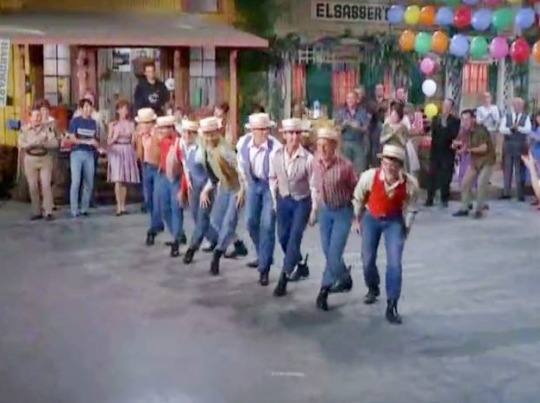
Other citizens of Bancroft are played by
uncredited background artists, most of whom were likely in the
previous episode as well.
This episode was filmed in mid-December 1966, shortly after the completion of
“Main Street U.S.A.” (S5;E17). Although
stand-alone in their plots, this episode is a continuation of the
previous one, which also takes
place in the small town of Bancroft.
This is the only episode of
season five that is still under copyright protection and not in
public domain.

Coincidentally, this episode first aired on Dick Martin’s 45th birthday. He previously played Lucy Carmichael’s boyfriend Harry on the series. His comedy partner Dan Rowan plays a reporter in this episode.

The dance sequences were choreographed by Jack Baker.

Bancroft
is supposedly located in California, but feels more like a
mid-western or northeastern town. Although this is a fictional
location, there is a Bancroft outside of San Francisco. At the time
of filming, however, it was known as Hookston,
is an unincorporated community in Contra Costa County.

Mel
Tormé
wrote
the original song “Main
Street U.S.A.”
especially for these two episodes. It was first sung at the end of
the previous episode and is reprised at the start of this one. Here we learn that it was Lucy Carmichael who wrote the songs lyrics to Mel Tinker’s music. Torme also wrote and sings the ballad “In
Our Home Town,”
a tribute to small town life. In 1944 he had a hit with another ‘town’ song titled “Stranger in Town” and in 1959 released an
album titled Back
in Town.

As
‘Carrot Top Carmichael’ Lucy says she plans to be the “most
vicious, cold blooded killer since Ma Barker.”
Kate
Barker
(1873–1935, inset photo)
was the mother of several criminals who ran the Barker gang. She
traveled with her sons during their criminal careers. FBI director J.
Edgar Hoover described her as “the
most vicious, dangerous and resourceful criminal brain of the last
decade.” Barker was last mentioned in “Lucy and the Great Bank Robbery” (S3;E5). Ma
Barker was parodied as Ma Parker in a 1970 episode of “Here’s
Lucy” (above) starring Carole Cook (who plays Aunt Carrie here).

Behind
the TV camera atop the station wagon is a shop called Grandma
Thompson’s Bakery. This is likely a tribute to director Maury
Thompson and producer Tommy Thompson, who were not related.

Marl Young is credited with the dance music for John Bubbles.
Callbacks!
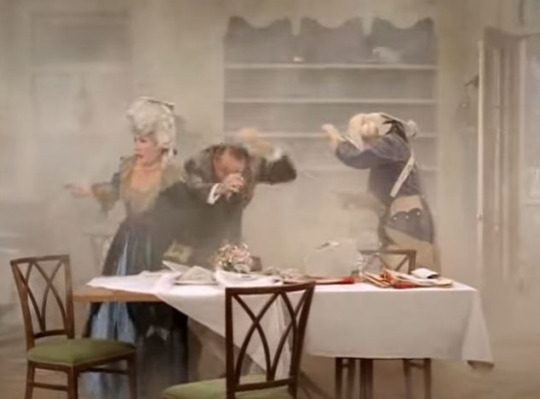
Back
in Danfield, construction of a new freeway was the cause of the
destruction of their roadside cafe when “Lucy and Viv Open a
Restaurant” (S2;E20).
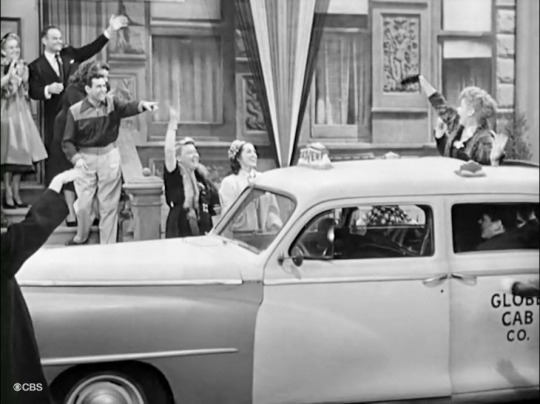
The
residents of East 68th Street planned a big block party when Ricky Ricardo came home from
Hollywood in “The Homecoming” (ILL S5;E6).
Blooper
Alerts!

Sound Slip! Mel plays “Our Home Town” on an old upright piano, but on the soundtrack it is not a piano, but a harpsichord.

Popular Print! The painting above Lucy’s left shoulder in the Tinker parlor was previously seen in Lucy’s Danfield living room and later in Viv’s bedroom.
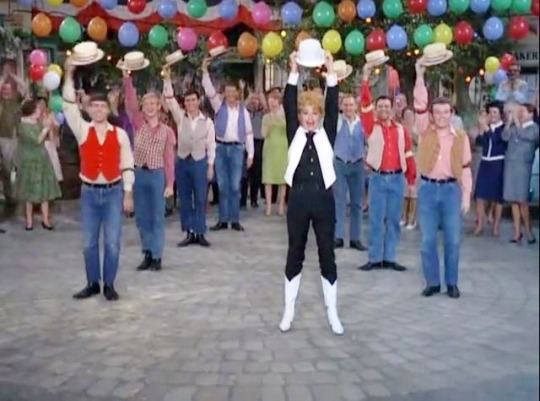
Smile For The Camera(s)! When
Lucy and Mel break into song for the TV news, they perform with
their backs to the camera, which is still atop the station wagon
behind them.
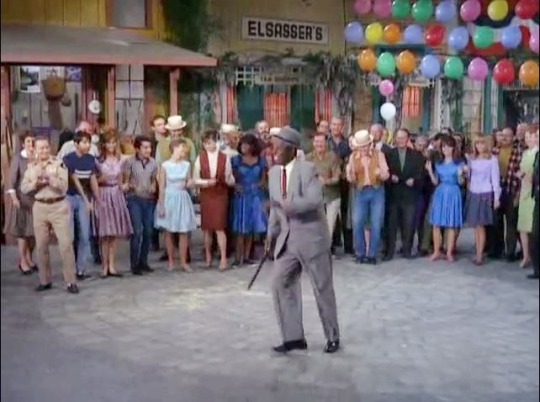
Bloody Bad Idea! Even though the gun battle is staged to woo reporter McGowan to Bancroft
to publicize a good cause, a pile of bullet-ridden corpses and a
whopping lie seem a dubious way to bring attention to the joys of
small town life. Ironically, right after the corpses get up, Mel
sings “it’s peaceful and quiet, there’s never a riot, in my home
town.”

Soft Goods at the Hardware Store! A sign in the window of the Hardware Store advertises an unusual item – Matador Scarfs! Why would a small-town hardware store stock matador scarfs?

Ready! Aim! Kerplunk! When
‘Carrot Top Carmichael’ surrenders, she throws her guns aside and
knocks a bright yellow tea kettle off the hardware store porch. When the tin kettle hits the deck, the lid pops off and rolls across the set!

Roll Call! Bancroft’s Mayor (played by Barry Kelley in the previous episode)
does not show up for the big block party / gun battle. Surely this would be an occasion suitable for the Mayor’s participation. Perhaps he disapproved of the entire escapade? More likely Desilu needed to keep their budget in mind in this expensive episode.
FAST FORWARD!

Years later, Paul Winchell’s daughter April wrote about her father’s relationship with Lucille Ball, her mother Nina, and this episode:
Not everyone loved Lucy. My mother, for example, couldn’t stand her. And Lucy returned the favor. In fact, they had a showdown on the set of ‘The Lucy Show’ that remains the most artful display of bitchery I ever witnessed.
It all started when I was about six years old. I remember my dad getting off the phone and yelling for my mother. He had just been given a recurring role as Lucy’s Grandfather [*], and he was as excited as I had ever seen him.
It was a demanding part. He had to dance quite a bit, and even learn to play the violin. And since he was only about 45 at the time, he had to do it all wearing heavy old age make-up and a full wig. He spent hours under the hot lights, sometimes getting lightheaded in his three-piece tweed suit. All things considered, it was probably one of the hardest jobs my father ever had. And he loved every minute of it. My dad, Paul Winchell, was a ventriloquist, and by this time, he was already a very successful man.
Naturally, a puppet-free gig like this was important to him, and he took it very seriously. He rehearsed difficult dance routines in our garage at night, and worked long days on the set without complaint. And along the way, he and Lucy developed a lasting friendship based on mutual respect, a common work ethic and a shared affection for recreational drugs. Yes, my father loved his drugs. My mother, determined to save their marriage, began watching him vigilantly, and attempted to rid him of every acquaintance he used with. Unfortunately, she couldn’t broom Lucy from their lives. And so the three of them tried to find an uneasy peace, which was impossible.
It all came to a head during rehearsals for an episode called, "Lucy Puts Main Street on the Map”. This was a big two-parter, with lots of guest stars. On this particular day, my father was rehearsing a parade scene. This was a big, complicated musical number with close to a hundred people on the soundstage. There were majorettes, townspeople, a marching band, and of course, Gale Gordon, Vivian Vance [*] and Lucy herself, wearing white go-go boots and a white patent leather vest. My mother and I sat in the bleachers that would later hold the studio audience, watching my father work. And he was working very, very hard. Over and over again, he would run out into the middle of the street, do a jig, play a violin solo and disappear back into the crowd. My father had polio as a kid, and one of his legs was shorter than the other.
All the standing and dancing was taking a toll, so when Lucy stopped the action to look through the camera, he politely asked her if he could take a break. She was very understanding, and told him to sit with us for a while. She asked if he was thirsty, and when he said yes, a glass of orange juice instantly appeared. Dad made his way over to the bleachers, and we watched the scene for while. After drinking about half of the juice, he handed the glass to my mother, who took a sip. Suddenly, Lucy stopped the rehearsal.
“Wait a minute, wait a minute, cut, cut, cut,” she shouted.
The playback music of the marching band stopped abruptly, and everyone fell silent. Lucy turned and looked at my mother.
“What are you drinking?” she yelled.
“Who, me?"
"Yes, you. What are you drinking?"
"Orange juice."
"Did I buy that orange juice for you?"
"I gave it to her, Lucy,” my father said sheepishly.
“That’s not the point, Paul. I bought that juice for you. If I knew she was going to drink it, I’d have made her pay for it."
This was bad. This was very bad. My mother was not afraid of anyone, and I really expected this to get ugly in a hurry. She rose to her feet, and I braced myself. All the blood drained from my father’s face. Time stood still. Then she did something surprising. My mother turned to me, and held out her hand. I took it, and we began to leave. I looked over my shoulder and saw the entire cast watching us, stock-still. My mother pushed through the heavy stage door into the sunlight, and we were on our way.
By the time we got back to the studio, everyone had gone to lunch. My mother understood where my father was, and headed straight for Lucy’s trailer. She led me up the steps to the door, and without knocking, went in. Lucy and my father were sitting on the couch, eating lunch. When he saw my mother, he froze in terror, certain that the angel of death was passing over his career.
"Lucy,” my mother said, “I have something to say to you."
Lucy eyed my mother cautiously. "Yes, Nina?"
"I want you to know how sorry I am about what happened this morning."
My father’s shoulders sagged with relief.
Lucy was stunned. "Well, I … that’s okay, Nina. Don’t worry about it."
"No,” my mother continued, “I feel badly to have taken advantage of you when you’ve been so kind to us."
"Forget it,” she said.
“I will. But only after you’ve accepted this gift.”
My mother held out a gaily-wrapped box from Saks. Lucy genuinely did not know what to say. She looked at the box, then at my father, then at my mother, then me, then the box again. She took the box and carefully opened it. Inside was a pullover sweater made of glittering gold yarn. Metallic knits were all the rage those days, and it was obvious that mom had spent a good deal of money on it. Lucy held it up against herself, delighted. It set off her red hair and blue eyes beautifully. She looked up at my mother, who was smiling beatifically.
“Thank you, Nina."
"You’re welcome, Lucy."
My father was beaming. The next day, Lucy showed up on the set wearing the gold sweater. A few hours later, my mother arrived, wearing the exact same sweater in silver. I learned an important lesson that day. You can catch more flies with honey than you can with vinegar. And once you catch them, pull their little fucking wings off.
[*] These small facts are slightly incorrect. The character is not Lucy’s Grandfather and Vivian Vance was not in the show or on set. Chalk it up to the memory of a six year old!

“Lucy Puts Main Street on the Map” rates 2 Paper Hearts out of 5
 Papermoon Loves Lucy
Leave a comment