S2;E19 ~ February 10, 1964

Synopsis
When
Ethel Merman headlines the Annual Boy Scout Show, Lucy and Viv are
relegated to being costumers. Feeling sorry for them, Merman agrees
to share the spotlight.
Regular
Cast
Lucille
Ball (Lucy Carmichael), Vivian Vance (Vivian Bagley), Gale Gordon
(Theodore J. Mooney), Ralph Hart (Sherman Bagley) and Jimmy Garrett
(Jerry Carmichael)
Candy
Moore (Chris Carmichael) does not appear in this episode.
Guest
Cast

Ethel
Merman was
born in Queens, New York, in 1908. Known
primarily for her powerful belt voice and roles in musical
theatre,
she has been called ‘the undisputed First Lady of the musical comedy
stage.’ Among her many stage credits are: Anything
Goes (1934),
DuBarry
Was a Lady (1939),
Annie
Get Your Gun (1946),
Call
Me Madam (1950),
and Gypsy
(1959).
“There’s No Business Like Show Business” from Annie
Get Your Gun
became her signature song. It was also the title of a 1954 movie
musical starring Merman. Hollywood was not always friendly to Merman,
who was replaced for the film versions of Annie
Get Your Gun
(1950) by Betty Hutton, Gypsy
(1962) by Rosalind Russell, and Dubarry
Was A Lady (1943)
by Lucille Ball! Dubarry
Was A Lady
also included the song “Friendship,” which was featured in “Lucy
and Ethel Buy the Same Dress” (ILL S3;E3). In 1934 Ball and Merman
co-starred with Eddie Cantor in the film Kid
Millions.
Merman recreated her stage performances on TV in “Panama Hattie”
(1954) and “Annie Get Your Gun” (1967). Merman died in 1984 from
a long illness after a brain tumor.
LUCY: “You’d think she was the biggest star on Broadway.”
VIV: “She is.”

This
was the second of two episodes to feature Ethel Merman. Originally,
they were intended to be one episode, filmed on December 5, 1963, but
the material seemed rushed and the stars were enjoying the work so it
was decided to expand into a second episode. The first draft of this script was dated November 20, 1963 with pink and blue pages (updates and changes) from December 1963.

The previous episode (which originally had this episode’s title) was re-titled
“Lucy Teaches Ethel Merman To Sing” and the final scene of it was
rewritten to lead into this one. However, due to Merman’s schedule,
it wasn’t filmed until a month later. By that time, Lucy had started
wearing a new wig, Viv was tanned from a Christmas vacation,
and Merman had changed her hair color. In between the two episodes,
Desilu produced “Lucy Plays Florence Nightingale” (S2;E14), “Lucy
Goes To Art Class” (S2;E15) and “Chris Goes Steady” (S2;E16).
These two Ethel Merman episodes were re-run on CBS on May 24 and June 1, 1964.

Lucy
was a big fan of Ethel Merman and offered her a guest spot after her
Desilu pilot “Maggie Brown” was not picked up for series.
Lucille Ball and Gary Morton attended the filming of the pilot and
Merman also was in the audience for an episode of “The Lucy Show.”
On the DVD extras, Jimmy Garrett recalls that Lucille Ball caught
him watching filming from the wings and whispered “Watch
very carefully. You’ll never see anyone better.”

Vivian
Vance understudied Ethel Merman as Reno Sweeney in the 1934 Broadway
musicals Anything
Goes
and Red, Hot and
Blue (1936),
both by Cole Porter.
Merman
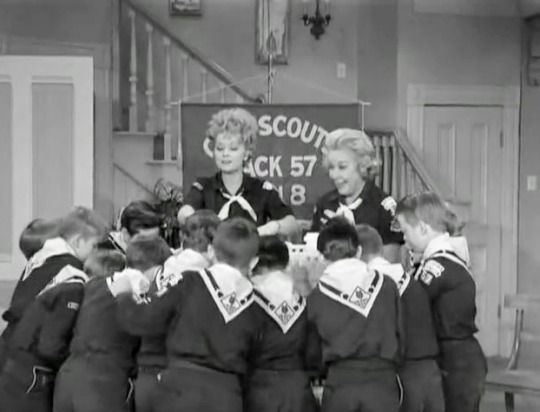
is living with Lucy and Viv while she’s in Danfield. Lucy
and Viv were established as den mothers of their sons’ scout troupe
in “Lucy
Visits the White House” (S1;E25).
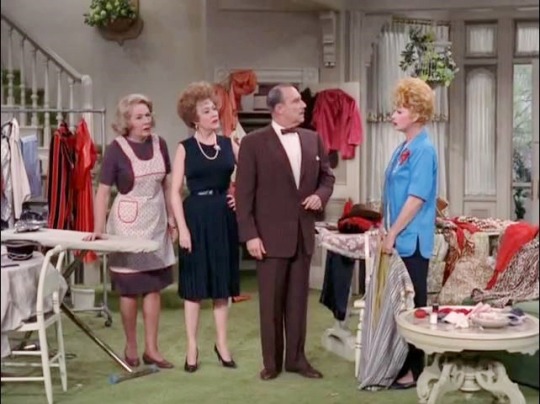
Mr.
Mooney’s daughter Rosemary, who lives in Trenton, New Jersey, is
about to give birth to his first grandchild.
This is the fourth Mooney child to be mentioned on the series:
Arnold, Bob, Ted Jr. and Rosemary. Like her mother, Irma, Rosemary
is never actually seen. Lucille Ball briefly lived in Trenton, New
Jersey, as an infant.
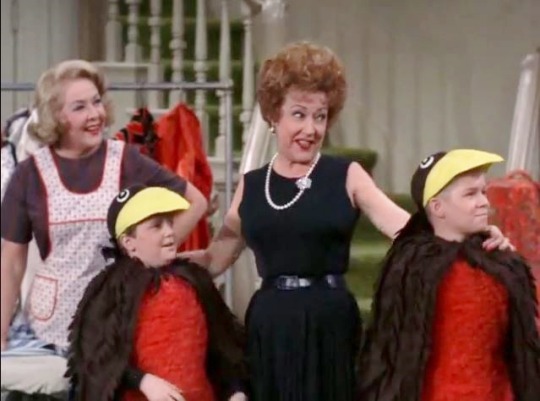
In
the living room, Merman sings a few bars of “Red, Red Robin” with
Jerry and Sherman dancing around her in bird costumes. “When
the Red, Red Robin (Comes Bob, Bob, Bobbin’ Along)”
was a 1926 popular
song written
by
Harry
Woods.
It
was a big hit for Al Joleson, Bing Crosby, and Doris Day.
When
Viv demands Lucy finish her costume right away, Lucy calls her a
“wicked stepsister” – a reference to the fairy tale “Cinderella.” The line gets a large round of applause from the studio audience.

Lucy
says the old manual sewing machine belongs in the Betsy Ross museum.
LUCY: “When I looked at the bobbin it was full of red, white, and blue thread.”
Coincidentally, as Lucy says this, she is wearing a blue shirt, with red and white tape measures around her neck.

Elizabeth ‘Betsy’ Griscom Ross
(1752–1836) is widely credited with making the first American
flag. Although there is no actual Betsy Ross museum, the Betsy Ross
House on Arch Street in Philadelphia is the location where she
supposedly sewed the first flag, although this fact (and her
residence there) is disputed by many historians. Betsy Ross was a character on “The Jack Benny Program” in 1964 (above) when Lucy played Mrs. Paul Revere!

Lucy tearfully tells Merman she’s always dreamed of having her ‘name up in lights’. She tediously spells out her full name: “L-U-C-I-L-L-E C-A-R-M-I-C-H-A-E-L”. Ethel replies “If you ever get to Broadway, you’ve got to get a shorter name!” Not coincidentally, Ethel Merman herself shortened her name for the marquee: she was born Ethel Agnes Zimmermann!
THE ANNUAL BOY SCOUT SHOW

- Sherman does an acrobatic dance routine as an opening act
In “Lucy the Music Lover” (S1;E8), Sherman did a quick ballet dance through the living room to impress Lucy’s date. Ralph Hart was also a musical theatre performer, seen in the film musicals Gypsy, The Music Man, and Bye Bye Birdie.
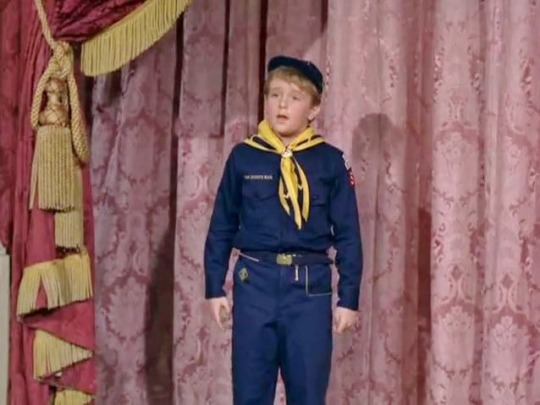
- Jerry
(in his scout uniform), tells a joke.
From
his first audition for the series, Lucille Ball thought that Jimmy Garrett’s dry
delivery of his lines was hysterical.
The adult performers alternate in providing linking narration and paging the stage curtain to transition to the next act. Technically, the Boy Scout Show does not run in one continuous cut. The paging of the curtain allows for subtle edits in the film to piece together what were separate takes.

- Merman,
Lucy, Viv and Mr. Mooney sing “There’s No Business Like Show
Business”
The song is from Irving Berlin’s Annie Get Your Gun (1949).
It will also be sung again the the Boy Scout Show’s finale. Jerry
spoke the title in the previous episode “Lucy Teaches Ethel Merman
To Sing” (S2;E18).
VAUDEVILLE
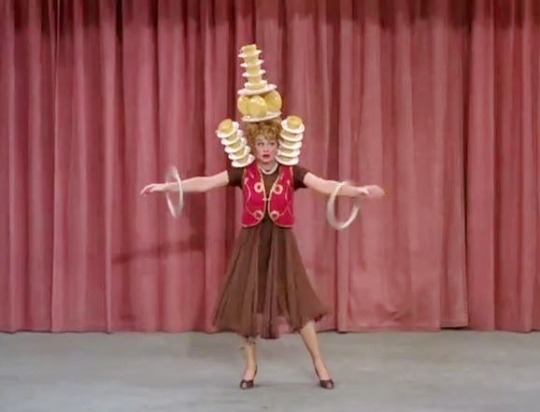
- Lucy
does a quick juggling act.
The
plates are obviously rigged for comic effect.
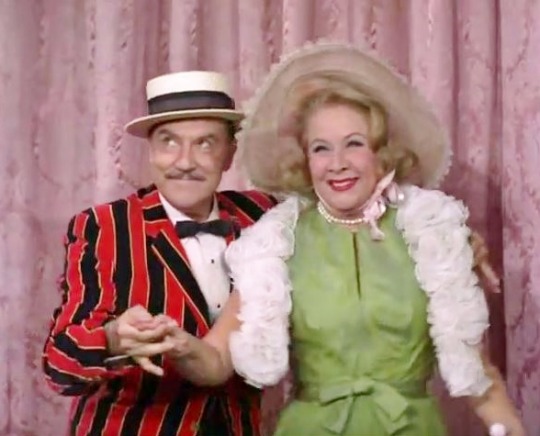
- Mr. Mooney and Viv sing “Tiptoe Through the Tulips”, which was originally to be sung by Mr. Mooney and his wife Irma, had she not had to go to Trenton for the birth of their grandchild.
“Tiptoe Through the Tulips (with Me)” was composed by Joe Burke with lyrics by Al Dubin for the 1929 film Gold Diggers of Broadway. In 1968, it was sung by Tiny Tim, whose version charted at #17, becoming his signature song. Due to its resurgence in popularity, the title was also mentioned on several episodes of “Here’s Lucy”.
THE FLICKERS (aka SILENT MOVIES)

- Lucy, Mr. Mooney, and Ethel Merman perform a silent movie sketch about a husband leaving his wife for another woman.
The sketch is pantomimed to honky-tonk piano accompaniment.
THE TALKIES

- Viv
as Shirley Temple sings “On the Good Ship Lollipop”. Vivian Vance, an accomplished singer, makes a concerted effort to satirize the mannerisms and vocal limitations of a child performer like Shirley Temple.
“On
the Good Ship Lollipop”
was composed by Richard
A. Whiting
with
lyrics by Sidney
Clare.
It was the
signature
song
of
child actress Shirley
Temple,
who first
sang it in the 1934 movie Bright
Eyes.
Shirley
Temple
was mentioned on “I Love Lucy” in 1955’s “The Tour” (ILL
S4;E30), by which time the former child star was married and known as
Shirley Temple Black.
BROADWAY MUSICALS
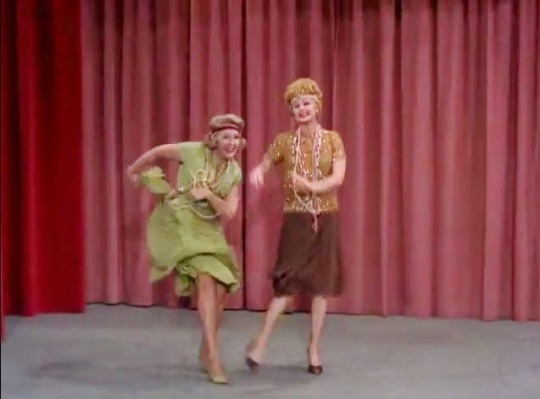
- A
tribute to 1920s stage musicals features Lucy, Viv, Ethel Merman and
Mr. Mooney
In
“Lucy Teaches Ethel Merman How To Sing” (S2;E18), Viv suggested
dancing the Charleston
for the Boy Scout Show, but the idea was shot down by producer
Sherman. The
sketch also features Gale Gordon doing a cartwheel, something he
would do in future ‘show-within-a-show’ episodes. After being jilted,
Lucy sings a few bars of “Am
I Blue?”
a
song written by Harry
Akst
and
Grant
Clarke
in
1929. It has since become a standard, covered by many musical
artists. The
sketch ends happily with Merman singing the final notes of her hit “I
Got Rhythm”, a song she originated in the 1930 Gershwin musical
Girl
Crazy
and also sang in the previous episode.
RADIO

- Mr. Mooney is a radio host presenting a lady saxophone player (Lucy) from Altoona, Pennsylvania, playing
“Glow Worm” (badly)
“The
Glow-Worm”
is a song from Paul
Lincke’s
1902 operetta Lysistrata.
It was also used in the 1907 Broadway musical The
Girl Behind The Counter.
Lucille
Ball had briefly played the saxophone as a child. During the radio sequence Mr. Mooney says “Round
and round she goes! Where she stops, nobody knows!”
This was a quote from “Ted
Mack’s Amateur Hour”
a
radio
and
TV talent show that began in 1934. A wheel of fortune was spun to
determine the order
of the performers and while it was spinning, Mack intoned the
now-famous line. The show officially ended in 1970 but was revived
briefly in 1993. Before entering television, Gale Gordon was the highest paid radio performer in Hollywood. Lucille Ball was also a radio performer with her own series “My Favorite Husband.”
TELEVISION
- A
tribute to “The Ed Sullivan Show” and its showcase of variety acts
To show the cyclic nature of entertainment, Lucy
repeats the same exact juggling act she did at the start of the show.
Ed
Sullivan hosted
an immensely popular variety show on CBS from 1948 to 1971. Up until
1955 it was called “Toast of the Town.” Ethel Merman
frequently appeared on “The Ed Sullivan Show,” often singing her
signature songs.
FINALE
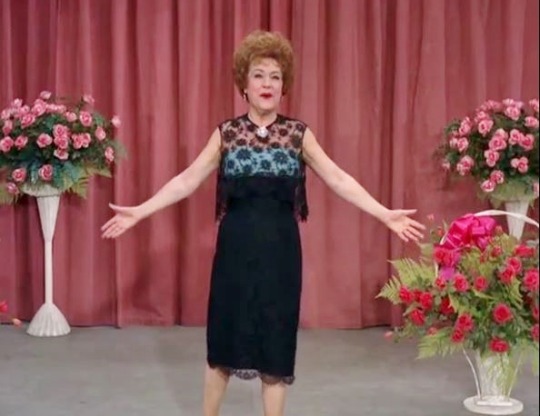
- Ethel
Merman sings “Everything’s Coming Up Roses”
“Everything’s
Coming Up Roses”
is a song introduced by Merman in the 1959 Broadway musical Gypsy
with music by Jule Styne and lyrics by Stephen Sondheim. Merman sang
the song throughout her career, even to a disco beat!

- Everyone joins in for a reprise of “There’s No Business Like Show Business”

After
the filming was complete, Merman recalled that she and Vance went to
Lucille Ball’s house for some girl talk and Lucille styled their hair
– to disastrous results. Ball also threw Merman a bridal shower (above) before her month-long marriage to Ernest Borgnine in 1964.
Callbacks!

Lucy
Ricardo used a sewing machine for the first time in “Lucy Wants New
Furniture” (ILL S2;E28).

Cheesy vaudeville gags such Lucy’s rigged plate juggling were an integral part of the finale of “Ethel’s Home Town” (ILL S4;E15). Fred and Ethel Mertz were former vaudevillians.

In “Lucy Has Her Eyes Examined” (ILL S3;E11), Lucy Ricardo and the Mertzes burst into an a capella rendition of “There’s No Business Like Show Business” in an impromptu audition for Mr. Parker, a Broadway producer. The song would also be quoted (not sung) by Lucy Ricardo in “Baby Pictures” (ILL S3;E5).

“When the Red, Red Robin (Comes Bob, Bob, Bobbin’ Along)” was sung by Fred Mertz (William Frawley) in “Lucy and Ethel Buy the Same Dress” (ILL S3;E3) and later by Lucy Carter in “Guess Who Owes Lucy $23.50″ (HL S1;E11).

Lucy also played “Glow Worm” on “The Saxophone” (ILL S2;E2) and in “Lucy’s Club Dance” (ILL S3;E25). It was the only song she knew, until it was inexplicably “Sweet Sue” during season six!

LUCY: “Well, you see, Ethel. All my life I’ve wanted to be in show business!”
Lucy
sobs in front of Ethel Merman because all her life she wanted to be in the show, something Lucy Ricardo also did many times on “I Love Lucy.” The above line might easily have been spoken to Ethel Mertz or Ricky, instead of Merman.

When Merman agrees to give up one of her numbers for Lucy to be in the show, Viv asks Lucy if she would really let a big star like Merman do such a thing. Lucy lets out a high-pitched “Weeeelll” the same way that Lucy Ricardo often did.

In 1954, “The Ed Sullivan Show” (aka “Toast of the Town”) devoted an entire hour to Lucy and Desi. Sullivan’s name and his show were mentioned several times on “I Love Lucy.”

Lucy and Viv Charleston at the start of the ‘Broadway Musicals’ section of the Boy Scout Show. On “I Love Lucy” Lucy, Ricky, Fred and Ethel Charleston at the end of “Lucy Has Her Eyes Examined” (ILL S3;E11).

This is the second time a silent film skit has been part of “The Lucy Show.” The first was with Lucy as Charlie Chaplin during “Chris’s New Year’s Eve Party” (S1;E14).
Fast Forward!

Those red, red robins just keep bob, bob, bobbin’ again in “Kim Moves Out” (HL S4;E20) in 1974.

The Charleston never goes out of style, as demonstrated by Lucy and Kim Carter when “Ginger Rogers Comes to Tea” (HL S4;E11) on “Here’s Lucy” in 1971.
Blooper Alerts!

Flown the Coop! Although, Ethel Merman has Lucy make 24 robin costumes so that she can sing “When the Red, Red Robin” while the scouts dance around her, the song is not in the finished show!

Bulldog Cement? After
the 1920’s stage musical segment, Mr. Mooney’s false mustache is
falling off. It may have been due to spirit gum not adhering to Gale
Gordon’s own mustache or it may have been done for comic effect.

“Ethel Merman and the Boy Scout Show” rates 5 Paper Hearts out of 5

 Papermoon Loves Lucy
Leave a comment