S1;E17 ~ January 21, 1963

Synopsis
After
just three days as the fill-in society reporter for the Danfield
newspaper, Lucy’s job is hanging by a thread. The only thing that
will save it is an interview with a press-shy financier visiting
town. Once she learns he had been Viv’s high school sweetheart, Lucy
heads down to his hotel for a scoop, passing herself off as Vivian.
Regular
Cast
Lucille
Ball (Lucy Carmichael), Vivian Vance (Vivian Bagley)
Jimmy
Garrett (Jerry Carmichael), Ralph Hart (Sherman Bagley), Candy Moore
(Chris Carmichael), and
Dick Martin (Harry Connors) do
not appear in this episode
Guest
Cast
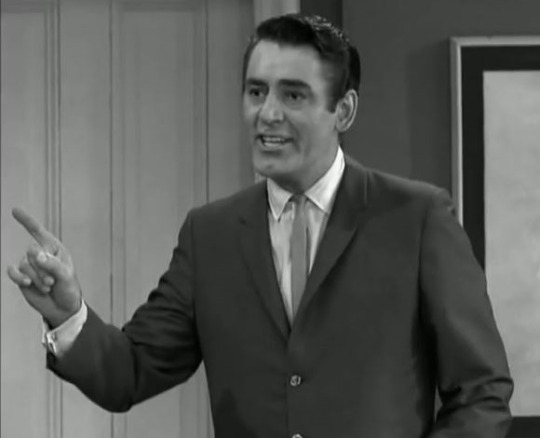
John
Vivyan
(Argyle Nelson) makes his only appearance on “The Lucy Show.” He
played the title character of the CBS series “Mr. Lucky”
(1958-60). He died in 1983.
The character is named after Desilu’s Vice President for Studio
Operations W. Argyle Nelson.
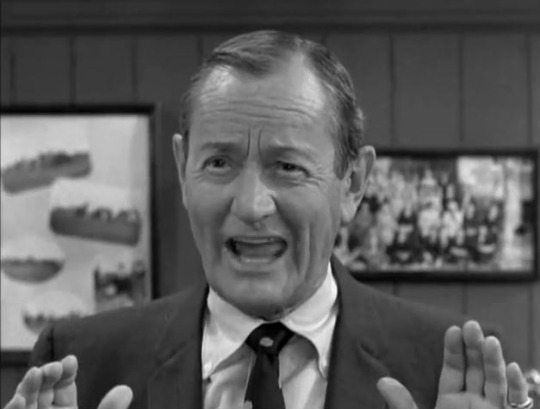
Roscoe
Karns
(Mr. Foley, the Editor) appeared with Lucille Ball in the 1939 film That’s
Right – You’re Wrong.
This appearance on “The Lucy Show” is his penultimate screen
credit. He died in 1970.
Foley is the name for creating sound effects in the film business.

Bobs
Watson
(Calvin, the Copy Boy) started in the business as a child actor who could cry on
cue, earning him the nickname ‘The Crybaby of Hollywood.’ At the age
of eight he appeared with Lucille Ball in the film Go
Chase Yourself (1938).
He was probably most famous for playing Pee Wee in
Boys Town
(1938) and Men
of Boys Town
(1941). He does not cry like a baby in this episode, but Lucy does! He died in 1999 at the age of 68.

Emlen
Davies
(Mr. Nelson’s Secretary) makes her only series appearance in this episode. Her
final screen appearances was as a background player in a 1967 episode
of “The Mothers-in-Law,” a series produced by Desi Arnaz.
This episode’s copyright date is December 6, 1962.

On the date this episode first aired, silent film actor Al ‘Fuzzy’ St. John, one of the original Keystone Cops, died at age 68. He had briefly appeared with Lucille Ball in the 1943 film Valley of the Sun. Coincidentally, his second wife’s last name was Ball (no relation).

After this episode of “The Lucy Show,” “The Danny Thomas Show” featured ‘Lucy’ character actors Hans Conried (Dr. Gitterman), Sid Melton (“The Lucy Desi Comedy Hour”), and Phil Ober (Vivian Vance’s ex-husband).
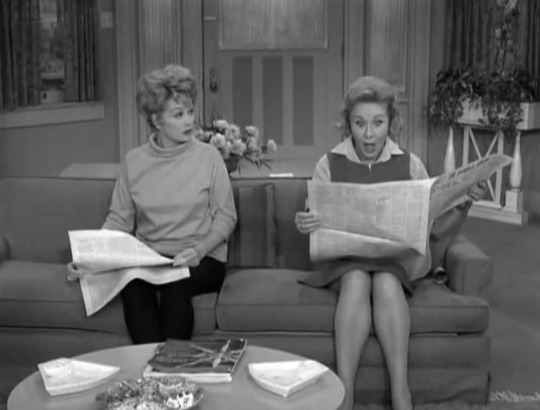
Viv sets up the premise of the episode by reading from
Betty Gillis’ Society Column in The Danfield Tribune:
“Argyle
Nelson, mystery man financier, has checked-in to the Danfield Hotel.
Could it be another of his hush-hush million dollar business deals?”
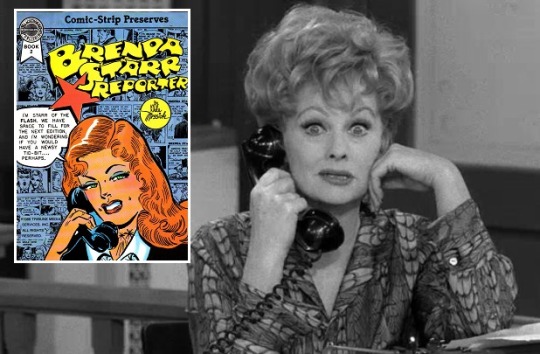
Mr.
Foley, the Tribune’s editor, refers to Lucy as Brenda Starr. Brenda
Starr
is the lead character in a comic strip about an adventurous female
reporter. It debuted in 1940. Like Lucy, she had red hair.

Lucy
says that she was called ‘Clare Boothe Lucy’ in high school. This is a
pun on Clare
Boothe Luce
(1903-87), who was a writer and journalist in her own right, in
addition to being married to Henry Luce, a powerful publishing
magnate in the magazine industry. Luce was the author of the 1938 play Kiss The Boys Goodbye, which starred Vivian Vance in its Chicago production. On Broadway, the role was played by Vance’s friend (and Ethel Merman understudy) Benay Venuta. It also featured Vance’s third husband, Phil Ober. In the 1941 film version (above) the role was taken by Barbara Jo Allen, but the film featured Elizabeth Patterson (Mrs. Trumbull). The storyline of the play / film was inspired by the search for Scarlett O’Hara. Lucille Ball was one of the many actors who was considered for the role.

Viv
calls Lucy ‘Louella’ a reference to gossip columnist Louella
Parsons (right).
Lucy later invokes the name of Parsons’ chief rival, Hedda
Hopper (left),
another
chronicler of
Hollywood during the mid-twentieth century. Both
women were frequently mentioned on “I Love Lucy,” although only
Hopper appeared on the show, playing herself in two episodes.

Lucy
hangs up the phone with Betty Gillis saying “That’s
thirty!”
“-30-” has
been traditionally used by journalists in North America to indicate
the end of a transmitted or written story.
There are many theories about its
origin. In 1959 there was a film about the newspaper business titled
-30- (inset photo).
In the UK, the movie was titled Deadline
Midnight
because the number 30 is predominantly an American press usage.
LINGO JINGO! Trying to fit in to the world of ink-stained men, Lucy answers the phone by saying “Shoot!” instead of “Hello” and identifies herself as “Scoop” Carmichael. She calls Mr. Foley
“Chief” and tells him that Viv is her “leg man” with a “hot
item.” Lucy shouts “stop the presses” to report that Vivian Bagley has been invited to play bridge at Audrey
Simmons’. Mr. Foley points out that it is not a “scoop” because
there are no other papers in town.

Lucy
and Viv were featured on the front page of The Danfield Tribune in
“Lucy Becomes an Astronaut” (S1;E6).
Mr.
Foley sends Lucy to Oak Street and Long Ridge Road. Lucy thinks it
is to cover a big story, but it is to pick up lunch from
the drug store. The drug store was first mentioned in the series
opener. This episode also
gives us a look at a suite at the Danfield Hotel.
We
learn a lot about Viv in this episode. Her maiden name is Tuttle.
Argyle “Socks” Nelson was her first kiss.
Lucy gets a phone call from Audrey Simmons complaining that Lucy has spelled her name with just one ‘m’ when writing about her dinner party. Audrey Simmons is usually played by Mary Jane Croft, although she does not appear in this episode.
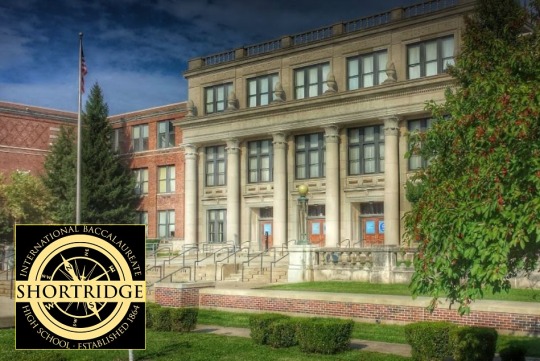
Viv
went to Shortridge
High School, which was the real life Indianapolis high school of
writer Madelyn
Pugh Davis.
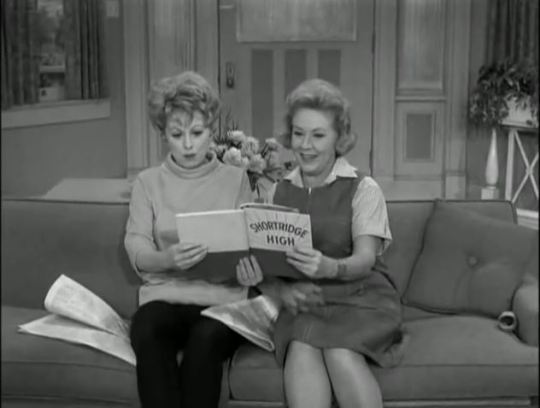
The yearbook that Lucy and Viv look at was a real 1938 yearbook Davis
brought in from home.
Viv mentions that her high school principal was Mr. Hadley, which
was also the name of Davis’s high school principal. Lucy says the
school was named after educator George P. Shortridge, but in fact
his name was really Abraham C. Shortridge. The school colors were
blue and white and they were known as the Blue Devils. Argyle and
Viv were cheerleaders together.

According
to Nelson, Viv was known in high school was as ‘Truckie’ because of her dance moves while doing “The Big Apple.” The
dance dates back to the African American ritual dances of the
mid-1800s. The name comes from its revival in the 1930s at The Big
Apple Club in Columbia, South Carolina. In 1937 it became a national
dance craze. ‘Truckin’ is a shuffle step variation popularized after the vaudeville
era.
The right hand is held up with the index finger extended and wagging.
Lucy
and Argyle demonstrate it during the episode. The name of the move
comes from the song “Truckin’ My Blues Away” by Blind Boy Fuller
and later led to the expression “Keep on Truckin’!”
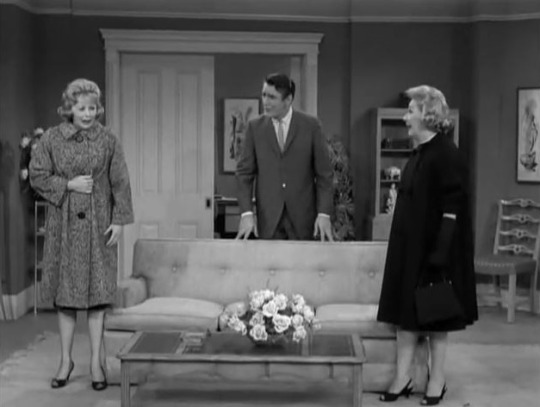
Viv
says that Nelson has turned into an eccentric, or as Lucy
calls him ‘a weirdo,’ who won’t talk to the press. It sounds very
much like they’re describing reclusive billionaire Howard Hughes
(1905-76) who was also described in such terms and avoided the
press.
Callbacks!

Lucy
Carmichael disguises herself as Vivian Bagley to get the story. Lucy
Ricardo and Ethel Mertz disguised themselves as male newspaper
reporters to crash Ricky’s daddy shower when “Ricky Has Labor
Pains” (ILL S2;E14).
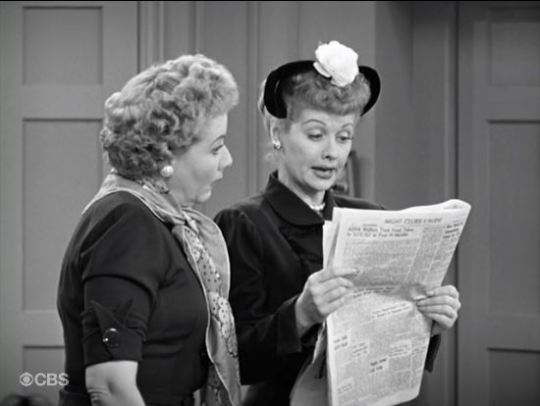
Lucy
Carmichael consulting the newspaper want ads for a part-time job was also
something done by Lucy Ricardo in “The Amateur Hour” (ILL
S1;E14), “Job Switching” (ILL S2;E1), and “Lucy is Envious”
(ILL S3;E23, above).
Blooper
Alerts!
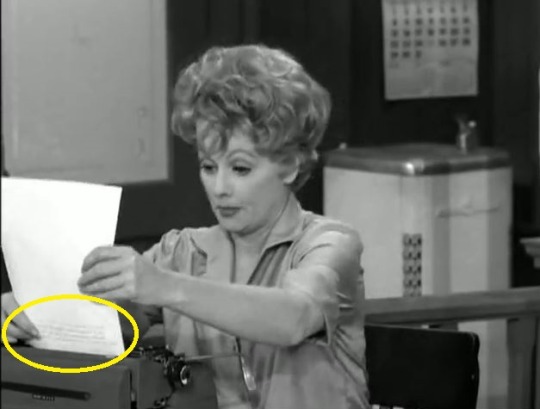
Recycling! When
Lucy puts her first piece of paper in the typewriter, it already has
typing on it!

Calendar Clues! Judging
by the arrangement of dates and the fact that the ‘25′ is a
different color, the wall calendar must be for December 1963.
The episode was probably filmed in December 1962 using a new 1963
calendar flipped ahead to December.

“Lucy Becomes a Reporter” rates 4 Paper Hearts out of 5
 Papermoon Loves Lucy
Leave a comment